Official · About this artwork
Institutional record for Norham Castle Sunrise. Institutional record for Norham Castle Sunrise.
Wikimedia Commons record providing title variants, medium, dimensions and Tate collection membership.
- Language
- English
Artwork record / 274 of 331
Artist: Joseph Mallord William Turner
A gallery guide's reading of Turner's late sunrise on the River Tweed, in which Norham Castle dissolves in mist and the painted light itself becomes the subject.
Read the story ↓ About the artist ↓ Research and record ↓ Literature and sources ↓ Listen to the article ↓Your browser could not copy automatically. Select the research text below, then copy it.
Open the complete research text
The highest-resolution file we hold, available without payment or an account.3,840 × 3,013 pixels.
Download highest-resolution imageFaint brown strokes at right that read as a second animal or group of cattle half absorbed by mist and reflected light, showing how Turner reduces living form to a few telling touches.
The ochre, olive and russet ground of the near left bank rising toward the mist, providing the warm tonal counterweight that frames the cool blue castle and the pale river.
The dark mirrored smear of the castle and its mound in the calm water, bleeding downward in vertical strokes that show how deliberately Turner left the surface unresolved.
Your gallery guide
A gallery guide's reading of Turner's late sunrise on the River Tweed, in which Norham Castle dissolves in mist and the painted light itself becomes the subject.
Editorial review by Artifact Archive automated publishing
Explore the researchThe story About 3 minutes to read
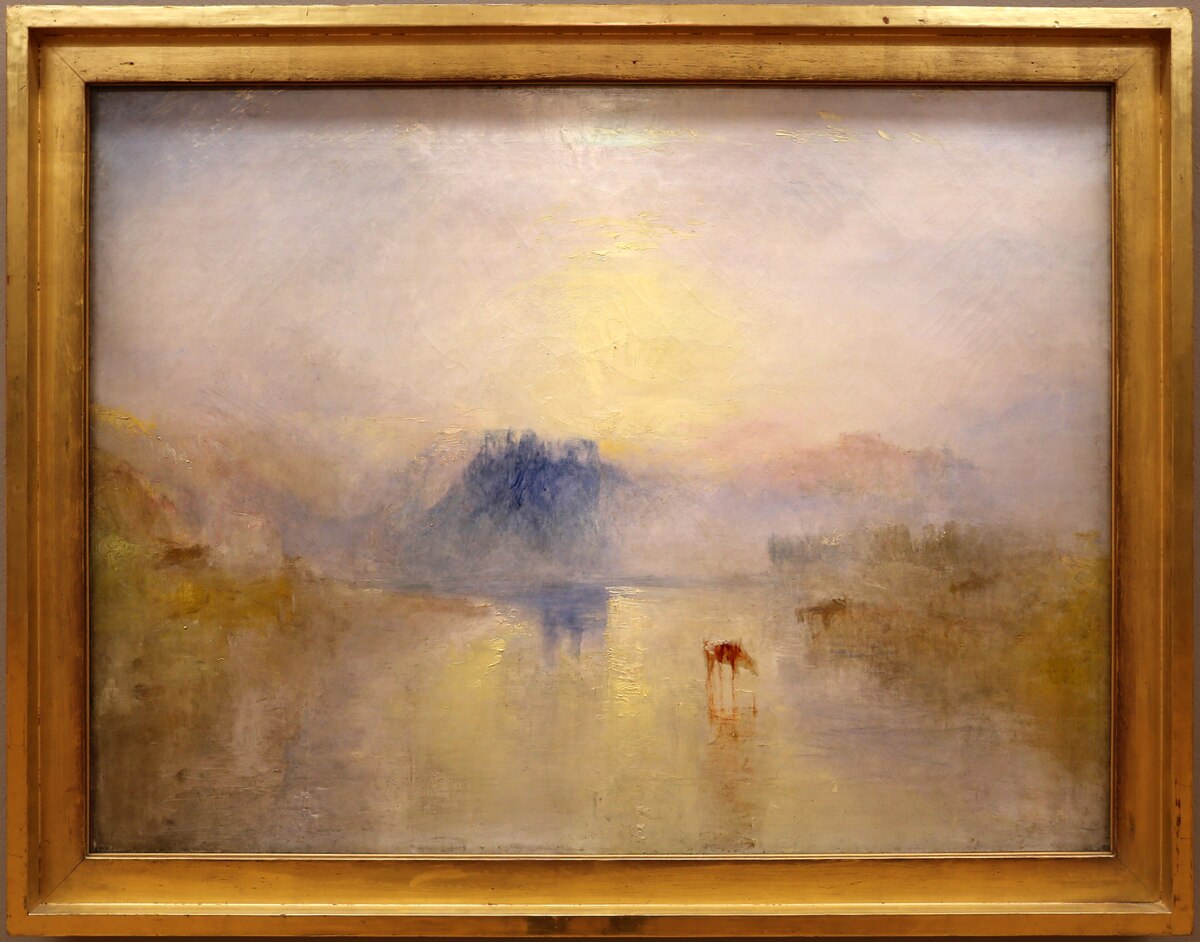
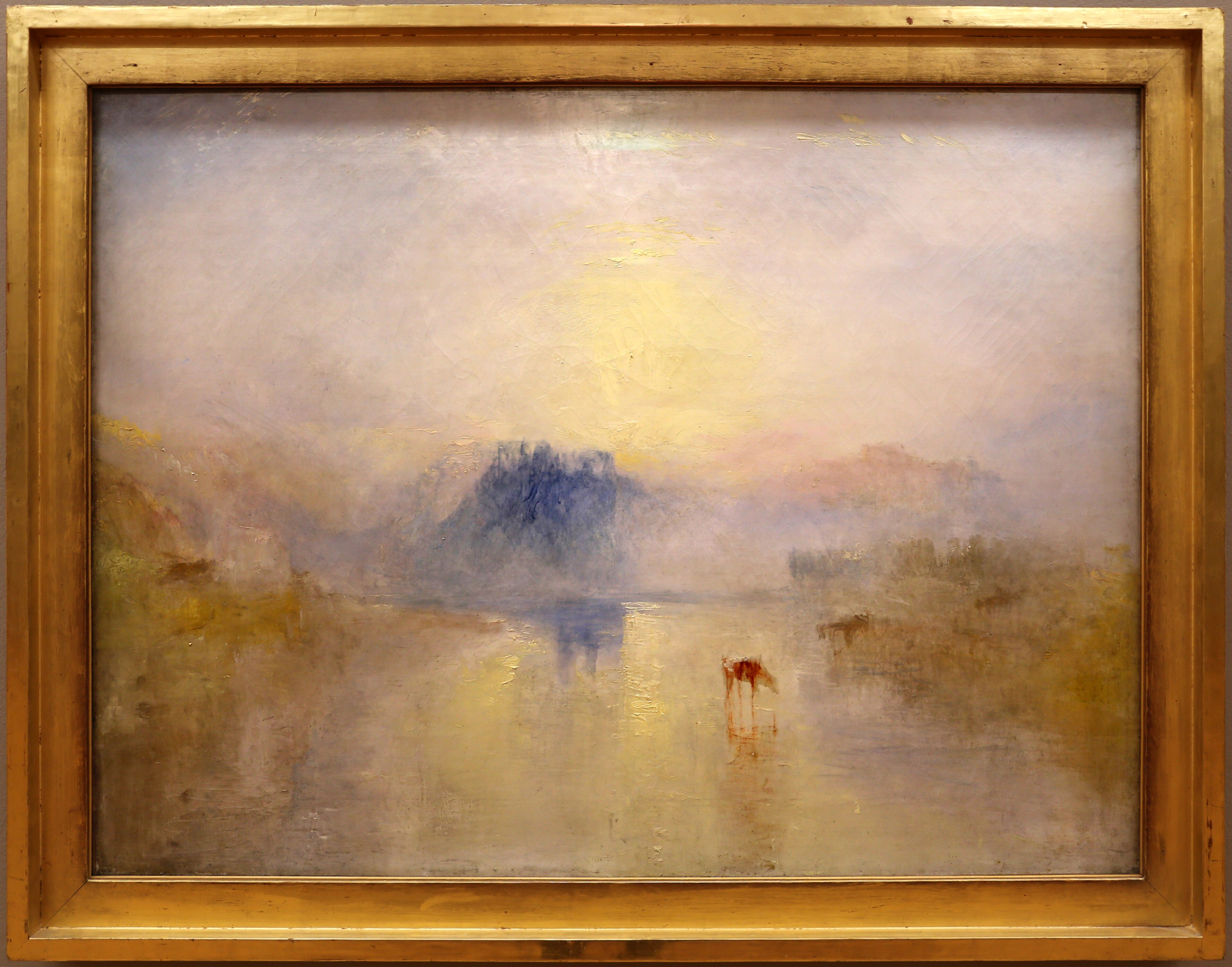
This is Norham Castle, Sunrise by Joseph Mallord William Turner, painted around 1845. Norham Castle stands on the River Tweed, and Turner returned to the site across his career. The painting is in the collection of Tate.
At first the castle is easy to miss. It sits above its rise as a blue-grey shape, dissolved into the mist rather than drawn against it. Nothing here has a hard edge. Sky, water and land shift into one another, and the horizon almost disappears. Low at the right, a single reddish-brown cow stands in the shallows. It is the only firm accent of saturated colour in the scene.
The sun appears as a pale yellow disc, and its halo spreads outward in yellow, rose and lilac, brushed over the sky in loose veils. Tate's reading of this canvas is that the painted light is its true subject. The castle may give the picture its name, but the sunrise carries its weight.
Turner knew this stretch of the Tweed well. He painted Norham Castle more than once, including a view on the river around 1822 to 1823 and another sunrise around 1830. By the 1840s his handling of paint had grown freer, and this canvas shows light and atmosphere taking priority over crisp detail.
That looseness changes how the picture asks to be seen. The castle is still there, but it is nearly absorbed into the haze, held in place by a few cool tones against the warmth around it. The one solid note is the cow, small, low and warm against all that softness. It gives the eye a footing, and it measures how far the mist has gone.
What this painting represents, finally, is the moment more than the monument. A castle that once dominated its bank is now a fading shape inside the morning, and the light spreading across the Tweed becomes the real event. So the smallest thing in the picture, a cow in the shallows, is also the clearest. Turner lets it hold the scene together while everything grander drifts away into colour.
Editorial review by Artifact Archive automated publishing.
Historical claims are linked to the records below. Close looking and interpretation are identified in the passage notes.
J. M. W. Turner. Image source · Public domain
About the artist
1775 to 1851
J. M. W. Turner was an English painter and draftsman (c.1775–1851). Their work is associated with Romanticism; English painting. Their recorded places of work include Vienna; Belgium; Prague; Dieppe; Lyon; Paris; Rouen; Berlin; Dresden; Heidelberg; Constance; Bologna; Florence; Naples; Rome; Turin; Venice; Amsterdam; Delft; Dordrecht; Haarlem; Leiden; Rotterdam; The Hague; Utrecht; Lucerne; Rheinfelden; Zurich; Bristol; Chester; Edinburgh; London; Malmesbury; Twickenham.
The research & record
Find catalogue details, historical context, technical research and the literature behind this artwork.
Your browser could not copy automatically. Select the research text below, then copy it.
Open the complete research textThe artwork record
Catalogue information and detailed research, with references that link to the bibliography.
Updated .
The object's catalogue title is Norham Castle, Sunrise, attributed to Joseph Mallord William Turner and dated to circa 1845. The qualifying "circa" belongs to the catalogue record itself, so the date should be understood as an approximate scholarly attribution rather than a documented completion date; the later institutional and reference records that carry the title are distinct in time from the picture's own making and do not date it more precisely. In genre terms the institution classifies the work simply as a landscape painting, a designation that frames everything else recorded about its subject, support and scale.(Tate, n.d.)(commons.wikimedia.org, n.d., Summary, Genre)
The institutional record supplies the physical catalogue data for the picture. It is oil on canvas, measuring 90.8 cm in height and 121.9 cm in width, and it is held in the collection of Tate. These are the material and custodial facts that anchor the work: a large oil painting on a fabric support, now held within a public national collection, rather than a watercolour or a drawing. The record also preserves at least one title variant in circulation alongside the plain catalogue title.(Tate, n.d.)(commons.wikimedia.org, n.d., Summary, Genre)
The scene itself is described as Norham Castle at sunrise, with the castle appearing as a blue-grey silhouette dissolved in mist above its rise. The single reddish-brown cow standing in the shallows at the right is recorded as the only firm accent of saturated colour in the composition. Both details are matters of what the canvas shows and how its forms and tones are arranged, and they are consistent with the landscape genre classification assigned to the work.(commons.wikimedia.org, n.d., Summary, Genre)
Interpretation
Tate's reading of the canvas is that the painted light is its true subject: the pale yellow disc of the sun and its expanding halo of yellow, rose and lilac are brushed in loose veils over the sky, and the castle, though it gives the picture its name, is not what carries the picture's weight. This is an attributed institutional interpretation, not a documented fact about Turner's intention, and it should be reported as such. It nonetheless aligns with the visual evidence of the dissolved silhouette and the dominant tonal field, so the interpretation and the observable composition can be read together without treating the reading as proof of the artist's aim.(Tate, n.d.)(commons.wikimedia.org, n.d., Summary, Genre)
Taken together, the catalogue data, the recorded subject and the attributed interpretation place the work within a broader history of landscape painting in which light and atmosphere are treated as subjects in their own right rather than as backdrop to a monument. The distinction between the object's approximate date, the later institutional and reference records that catalogued it, and the separate earlier views of the same site is what allows the picture to be studied as an object with a documented custody and a documented form, while its meaning as a sunrise remains a matter of interpretation advanced by the holding institution.(Tate, n.d., You might like)(commons.wikimedia.org, n.d., Summary, Genre)
The artwork is Norham Castle, Sunrise by Joseph Mallord William Turner, dated circa 1845.(Tate, n.d.)(commons.wikimedia.org, n.d.)
The work is a landscape painting.(commons.wikimedia.org, n.d.)
Visual observation
The depicted subject of this canvas is Norham Castle at sunrise. The castle appears not as a sharply defined structure but as a blue-grey silhouette dissolved in mist above its rise, so that the building's mass reads through atmosphere rather than against it. The only firm accent of saturated colour in the scene is a single reddish-brown cow standing in the shallows at the right. That the work is a landscape painting is recorded alongside these observations, and the institutional record supports them as structured descriptive data rather than as interpretive claims.(commons.wikimedia.org, n.d., Structured data, depicts; Structured data)
The depicted subject is Norham Castle at sunrise, the castle appearing as a blue-grey silhouette dissolved in mist above its rise.(commons.wikimedia.org, n.d.)
A single reddish-brown cow stands in the shallows at the right, providing the only firm accent of saturated colour in the scene.(commons.wikimedia.org, n.d.)
The canvas under discussion is Norham Castle, Sunrise by Joseph Mallord William Turner, dated circa 1845 and held in the collection of Tate. The institutional record describes it as a landscape painting in oil on canvas, measuring 90.8 cm in height and 121.9 cm in width, and the same record supplies the title and collection membership that the Tate object page confirms. The subject is a real place: Norham Castle stands on the River Tweed, a site Turner returned to repeatedly, so this late sunrise view belongs to a longer engagement with one stretch of border river rather than to a single isolated commission. What survives in the record is the identification of artist, title, approximate date, medium, dimensions and collection; nothing in the supplied evidence documents who ordered the picture, how it entered the collection, or the circumstances in which it was made.(Tate, n.d., You might like)
Turner's repeated treatment of the site gives the 1845 canvas a place within his own working history. He depicted Norham Castle in other works including Norham Castle, on the River Tweed of about 1822 to 1823 and Norham Castle at Sunrise of about 1830, so the river and its castle were familiar material across more than two decades. Those comparanda are dated approximately in the supplied record, and nothing here establishes whether the later canvas was painted on the spot, from memory, from earlier studies or in the studio, or whether it was finished, exhibited or sold in Turner's lifetime. The documented fact is the persistence of the motif; the relationship between the three versions, and any development it might imply, remains a matter for argument rather than record.(Tate, n.d., You might like)
Interpretation
The strongest evidence in this dossier concerns identification and appearance rather than commissioning. Tate and the institutional record agree on artist, title, approximate date, medium and collection, and secure identification of the picture as Turner's Norham Castle, Sunrise, circa 1845, does not settle why it was made, for whom, or with what purpose. It is tempting to read the loose handling of paint as a deliberate statement about light and atmosphere in the 1840s, and the comparison with the earlier Norham views would allow such a reading, but no document supplied here records Turner's intent or the expectations of a patron. The responsible conclusion is narrower: the picture is securely identified, dated approximately, and connected by subject to a site the artist painted more than once, while its commissioning history and the motives behind its formal choices remain undocumented in the available evidence.(Tate, n.d., You might like)
Norham Castle stands on the River Tweed, and Turner depicted the site in other works including Norham Castle, on the River Tweed (c.1822-3) and Norham Castle at Sunrise (c.1830).(Tate, n.d.)
The material record for this canvas is unusually compact. The institutional record describes the work as oil on canvas, establishing the support as a woven textile ground and the paint medium as an oil-based one rather than tempera, watercolour or another binder. The same record gives the dimensions as 90.8 cm in height and 121.9 cm in width, a horizontal format roughly in the proportion of a landscape view. Those two facts, medium and measurement, are the only materials and technique data the file documents directly; everything else about how the picture was made has to be read from what the surface shows. The distinction matters for the account that follows, because assertions about pigments, grounds, layer structure or brush type are not supported here and should not be inferred as if they were.(commons.wikimedia.org, n.d., Summary, Medium; Summary, Dimensions)
Interpretation
Reading the medium against the motif clarifies why the documented facts are consequential rather than incidental. An oil-on-canvas painting at this scale permits the painter to rework broad areas of sky and water while still allowing a small, opaque accent to be placed late and left crisp. The cow functions visually as that accent: it is the one point in the composition where a saturated reddish-brown reads as a discrete object rather than a dissolved tone. The castle, by contrast, is described as a blue-grey silhouette absorbed into mist, which means the painting asks the viewer to distinguish between two kinds of paint handling within a single image. The evidence supports the existence of that contrast in the finished picture; it does not specify the brushwork, palette or sequence of application that created it, and no such claims are made here.(commons.wikimedia.org, n.d., Summary, Medium; Structured data, depicts; Structured data)
The painting is oil on canvas.(commons.wikimedia.org, n.d.)
The painting measures 90.8 cm in height and 121.9 cm in width.(commons.wikimedia.org, n.d.)
Interpretation
Tate's reading of the canvas is that its true subject is painted light. In that account the pale yellow disc of the sun and its expanding halo of yellow, rose and lilac are brushed in loose veils over the sky, and this painted light, rather than the castle, carries the weight of the picture. It is worth separating the parts of that claim. The description of the sun, the halo and the loose veils belongs to the observed handling of the canvas; the judgement that this light is the true subject is an attributed reading by the institution, not a statement about what Turner privately intended. The evidence supports the reading as an interpretation of the picture's priorities, and it does not document the artist's motive.(Tate, n.d.)
Taken together, the observation that the castle dissolves into mist and the attributed reading that light is the subject point in the same direction without being the same kind of statement. One is a description of what is visible on the canvas; the other is a scholarly and institutional interpretation of where the picture's emphasis lies. The object also matters beyond its own frame because it belongs to a site Turner painted repeatedly, from the river view of about 1822 to 1823 to the sunrise of about 1830 and on to this canvas of about 1845. Within that larger history of landscape painting, the interest of this work is not that it corrects or abandons the earlier Norham views, but that a familiar named site is treated so that atmosphere and coloured light take precedence over the crisp delineation of the place.(Tate, n.d., You might like)
The pale yellow disc of the sun and its expanding halo of yellow, rose and lilac are brushed in loose veils over the sky, and this painted light is the true subject of the canvas.(Tate, n.d.)
Norham Castle, Sunrise is in the collection of Tate, which holds the canvas and is the source for the basic facts of its identification and physical form. The institutional record describes the work as a landscape painting by Joseph Mallord William Turner, dated to about 1845, executed in oil on canvas and measuring 90.8 cm in height by 121.9 cm in width. Those dimensions and the medium matter for any account of the picture's appearance, because they establish the scale at which the loose handling and the veils of colour were made and are now seen. The record also supplies title variants alongside the title by which the work is commonly known, situating the canvas within a public collection rather than a private holding.(commons.wikimedia.org, n.d., Summary, Collection)
What the painting depicts is given by the same institutional account: Norham Castle at sunrise, with the castle appearing as a blue-grey silhouette dissolved in mist above its rise. Alongside this the record identifies a single reddish-brown cow standing in the shallows at the right, described as the only firm accent of saturated colour in the scene. The relationship between these two described elements is the crux of how the canvas reads: the named subject is rendered as an indistinct shape, while the smallest and least monumental motif is the one firm note of colour. The evidence supports both observations without resolving the picture into a single narrative, and it does not record pigments, preparatory studies or treatment history for the canvas.(commons.wikimedia.org, n.d., Summary, Collection)
The painting is in the collection of Tate.(commons.wikimedia.org, n.d.)
Interpretation
The recorded calculated working insurance estimate places the work in a range of US$80 million to US$200 million, with a recorded generation date of 2026-10-16. The methodology stated for that figure is explicit: it was a working insurance range calculated for manual review from the confirmed artwork context and the two supplied sources, not from a transaction. Its stated inputs were Turner's standing as a major historical artist of British Romanticism, the late date of circa 1845, the oil-on-canvas medium, the large scale of approximately 90.8 by 121.9 cm, the imagery of Norham Castle at sunrise, and the work's long-standing presence in a major national collection. The same evidence unit states plainly that the work is held in a public museum collection, that no public sale, auction or appraisal price is supplied, and that the range was therefore estimated conservatively rather than derived from a transaction. The range is described as broad and intentionally conservative precisely because institutional collection status limits ordinary market comparability and because the supplied sources contain no financial data.(Tate, n.d.)(commons.wikimedia.org, n.d.)
The qualifications attached to that figure are as consequential as the figure itself. It is designated a model-generated working range for manual review only, and is expressly not an official insurance value, appraisal, auction result or sale price. It was calculated from the supplied artwork context and source excerpts without comparable sales data, private insurance records, condition assessment, provenance review or formal valuation. The same unit warns that actual insurance values may differ materially and should be determined by a qualified appraiser or insurer. Read together with the object data, this means the range documents an internal estimation exercise rather than a market fact about Turner's canvas; the only monetary number in the record is one whose own stated provenance is a working calculation for review.(Tate, n.d.)(commons.wikimedia.org, n.d.)
One further connection between the valuation unit and the object sources is worth making explicit rather than leaving implicit. The valuation methodology names as its inputs the very attributes the two object records establish: the artist's identity and historical position, the circa 1845 date, the oil-on-canvas medium, the roughly 90.8 by 121.9 cm dimensions, the sunrise imagery and Tate collection membership. In other words, the working range does not rest on any trait established outside these records; it extrapolates from documented object characteristics toward a figure that no surviving evidence in this archive confirms. That asymmetry is the honest state of the record: the object's physical description is corroborated across two independent sources, while its monetary valuation has a single, self-qualifying, model-generated source that explicitly disclaims transaction data and formal appraisal.(Tate, n.d.)(commons.wikimedia.org, n.d.)
These value claims also matter for the larger history the work belongs to. Norham Castle, Sunrise is valued, in the working estimate's stated reasoning, because it is a late Turner in a national collection: the artist's position within British Romanticism, the lateness of the circa 1845 date and the institutional setting are treated as the conditions that make the range so high and simultaneously so difficult to fix by ordinary market comparison. The imagery the estimate cites, the castle at sunrise, is the same imagery the object records describe, so the valuation and the descriptive accounts share their anchor in the painting rather than in any documented transaction. For the history of art and material culture, that is the useful point: the work's monetary standing is a function of its museum context and its place in Turner's late career, while its evidentiary record here documents no sale, appraisal or insurance file at all.(Tate, n.d.)(commons.wikimedia.org, n.d.)
Working estimate
Calculated working insurance estimate, not a sale price: Estimated value: US$80M to US$200M Recorded date: Working calculation, generated 2026-10-16. Methodology: This working insurance range was calculated for manual review from the confirmed artwork context and the two supplied sources. The Tate source identifies the work as Norham Castle, Sunrise by Joseph Mallord William Turner, dated circa 1845, accession N01981, oil on canvas, 90.8 cm by 121.9 cm, and part of the Tate collection. The Commons record independently confirms the same title, artist, approximate date, medium, dimensions, and Tate collection membership. Because the work is held in a public museum collection and no public sale, auction, or appraisal price is supplied, the range was estimated conservatively rather than derived from a transaction. The calculation considers Turner as a major historical artist of British Romanticism, the late date of circa 1845, the oil-on-canvas medium, the large scale of approximately 90.8 by 121.9 cm, the work's notable imagery of Norham Castle at sunrise, and its long-standing presence in a major national collection. The range is broad and intentionally conservative because institutional collection status limits ordinary market comparability and the supplied sources contain no financial data. Qualification: This is a model-generated working range for manual review only. It is not an official insurance value, appraisal, auction result, or sale price. It was calculated from the supplied artwork context and source excerpts, without comparable sales data, private insurance records, condition assessment, provenance review, or formal valuation. Actual insurance values may differ materially and should be determined by a qualified appraiser or insurer.(Tate, n.d.)(commons.wikimedia.org, n.d.)
Further reading
Paid links. As an Amazon Associate I earn from qualifying purchases.

Ministère de la culture, Editions de la Réunion des musées nationaux
A J.M.W. Turner title whose recorded subjects include 'Landscape in art' and an exhibition context. Norham Castle, Sunrise is a landscape subject, and an exhibition-related Turner catalogue with a landscape subject heading offers a plausible art-historical frame for comparison. The record does not name the specific work, so this is a contextual rather than object-specific choice.
ISBN 2711802388
Bibliography
References are arranged by author or organisation, with links to the original publications. Where no publication date is recorded, n.d. means no date.
Source notes updated .
No recorded sources match these filters. Reset the filters to see the full bibliography.
Official · About this artwork
Institutional record for Norham Castle Sunrise. Institutional record for Norham Castle Sunrise.
Wikimedia Commons record providing title variants, medium, dimensions and Tate collection membership.
Book
J.M.W. Turner: Galeries nationales du Grand Palais, Paris, 14 octobre 1983-16 janvier 1984 : à l'occasion du cinquantième anniversaire du British Council. Ministère de la culture, Editions de la Réunion des musées nationaux.
A J.M.W. Turner title whose recorded subjects include 'Landscape in art' and an exhibition context. Norham Castle, Sunrise is a landscape subject, and an exhibition-related Turner catalogue with a landscape subject heading offers a plausible art-historical frame for comparison. The record does not name the specific work, so this is a contextual rather than object-specific choice.
Museum · About this artwork
Norham Castle, Sunrise. Norham Castle, Sunrise.
Official Tate object page for this exact painting, confirming title, artist, date and collection.
Art to live with
A piece of the archive, made yours. Explore Norham Castle, Sunrise in a size and finish that fits your space.
Choose your edition Combine this painting with your favourites
10 × 8 in / 25.4 × 20.3 cm · Standard

10 × 8 in / 25.4 × 20.3 cm · Standard

10 × 8 in / 25.4 × 20.3 cm · Standard

10 × 8 in / 25.4 × 20.3 cm · Standard
A gallery paper print with a smooth art-paper surface. Choose a size that suits the painting.
Choose size and finish
10 × 8 in / 25.4 × 20.3 cm · Black frame

10 × 8 in / 25.4 × 20.3 cm · Black frame

10 × 8 in / 25.4 × 20.3 cm · Black frame

10 × 8 in / 25.4 × 20.3 cm · Black frame

10 × 8 in / 25.4 × 20.3 cm · Black frame
A ready-to-hang wooden frame with a clear Perspex cover and a semi-gloss printed insert, made in the UK.
Choose size and finish


11oz · 2 image repeats
11oz · Standard


11oz · 2 image repeats


11oz · 2 image repeats


11oz · 2 image repeats


11oz · 2 image repeats


11oz · 2 image repeats
An 11oz white ceramic mug with AAA+ ORCA coating and a C-shaped handle. Dishwasher and microwave safe, printed and dispatched in the UK.
Choose size and finish
15 × 16.5 in / 38 × 42 cm · Black

15 × 16.5 in / 38 × 42 cm · Black

15 × 16.5 in / 38 × 42 cm · Black

15 × 16.5 in / 38 × 42 cm · Black

15 × 16.5 in / 38 × 42 cm · Black

15 × 16.5 in / 38 × 42 cm · Black
A cotton tote with reinforced handles and artwork on the front, printed and dispatched in the UK.
Choose size and finish
8.7 × 8.7 in / 22 × 22 cm · Standard

8.7 × 8.7 in / 22 × 22 cm · Standard

8.7 × 8.7 in / 22 × 22 cm · Standard
A rectangular PU leather mouse mat with a non-slip base, printed locally for your delivery country.
Choose size and finish
A5 · Glossy cover · Lined pages

A5 · Glossy cover · Lined pages

A5 · Glossy cover · Lined pages

A5 · Glossy cover · Lined pages

A5 · Glossy cover · Lined pages

A5 · Glossy cover · Lined pages
An A5 notebook with 150 lined pages, a glossy laminated front cover carrying your artwork, black wire-o binding and a white back cover.
Choose size and finish