Identity and catalogue
Link- Title
- Susanna and the Elders
- Artist or attribution
- Rembrandt van Rijn
- Object date
- 1647
- Dimensions
- 76.6 cm × 92.8 cm
- Current collection or location
- Gemäldegalerie der Staatlichen Museen zu Berlin, Berlin, Germany
- Movement or period
- Dutch Golden Age, Baroque
- Country or culture
- Dutch Republic
- Depicted subject
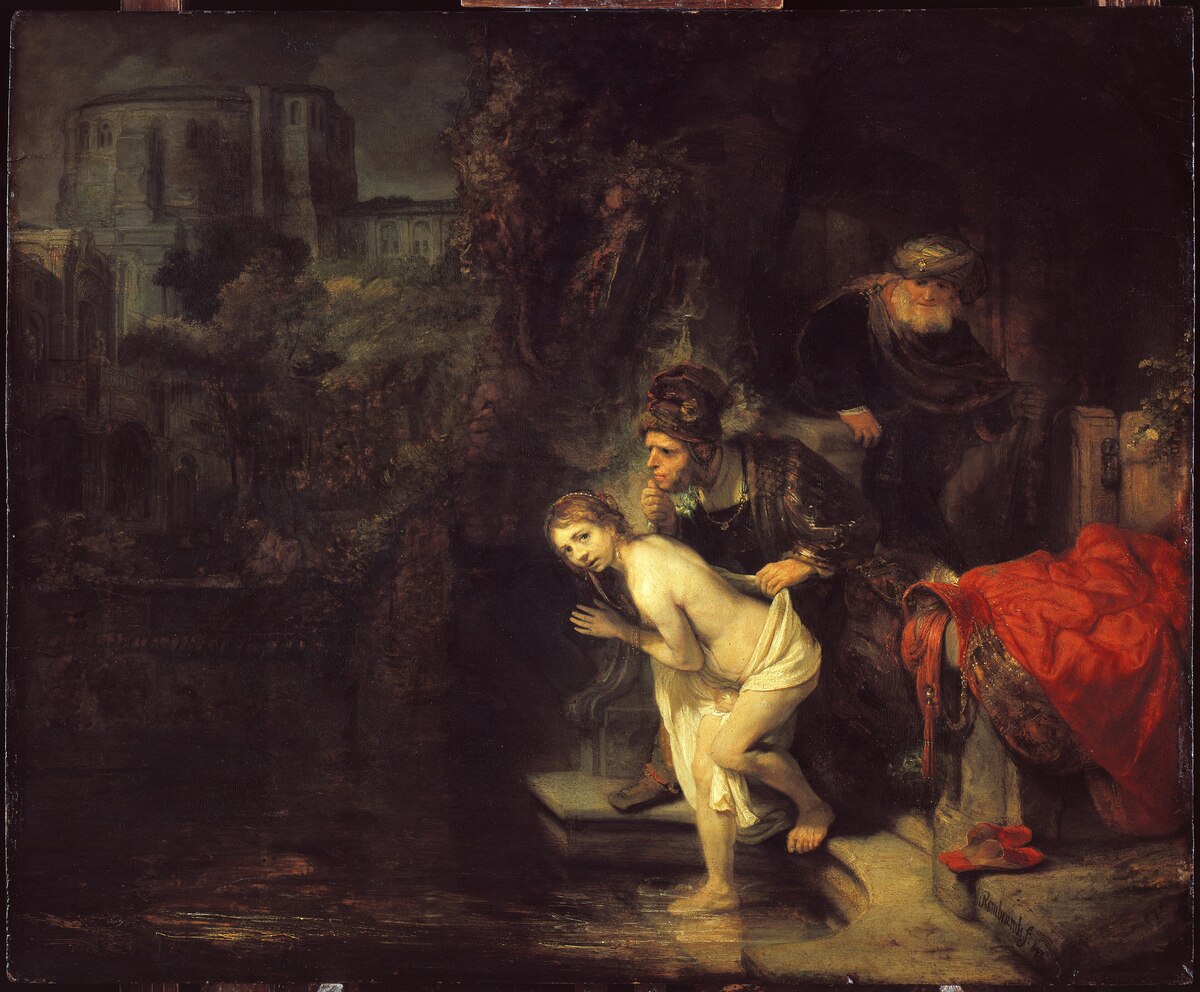
- Susanna, a young woman, is caught by two elder men while bathing in a garden. The narrative comes from the biblical Book of Daniel. Rembrandt shows the moment of intrusion: one elder crouches behind Susanna and pulls at her drapery, while the second watches from a stone balustrade. The work was made in 1647, distinct from the scriptural event it depicts.
- Title variants
- Susanna im Bade; Suzanne et les vieillards; Susanna e i vecchioni
- Accession number
- 828E
- Support
- mahogany panel
Catalogue identity and subject
The painting is catalogued as Susanna and the Elders and attributed to Rembrandt van Rijn, with a date of 1647. The subject is drawn from the Book of Daniel: two elder men accost Susanna while she bathes, and their false accusation sets the narrative in motion. The work's title circulates in several languages, among them Susanna im Bade (German), Suzanne et les vieillards (French) and Susanna e i vecchioni (Italian), a sign of how widely the image was recognised across European collections. It is described as religious art and classified as history painting, and the figures depicted are identified as Susanna and the Elders. The scriptural narrative it depicts is far older than the painting; the object date of 1647 is distinct from the biblical events the image represents.(Wikimedia Commons: Susanna and the Elders, n.d., Summary)
The painting bears the artist's signature and date at bottom right, inscribed as Rembrandt. f. [1]647. The date carried in the catalogue entry for the work is 1647, matching the year recorded in the inscription. Recorded provenance also places the picture in Rembrandt's hands in 1647, when Adriaen Banck purchased it from him in Amsterdam for approximately 500 guilders, a transaction that further anchors the work to that year. The bracketed numeral in the inscription, in which only the second and later digits survive intact in the recorded transcription, is how the source reports the date as read from the object.(Wikimedia Commons: Susanna and the Elders, n.d., Summary; Object history)
The section treats the object's identity and its supporting catalogue record, including how the work has been named, attributed, dated and traced through collections. Attributions and dates for paintings of this period can be qualified, and later catalogue dates, sale dates and exhibition dates are separate from the date of the object itself. The narrative content, the title and the attribution all circulate together in the same record, so the object's identity is inseparable from its subject.(Wikimedia Commons: Susanna and the Elders, n.d., Summary)
The work's title is given in multiple languages, including Susanna im Bade (German), Suzanne et les vieillards (French), and Susanna e i vecchioni (Italian), reflecting its wide recognition across European collections.(Wikimedia Commons: Susanna and the Elders, n.d.)
The Scriptural Subject and Its Pictorial Translation
Interpretation
The depicted subject is Susanna and the Elders, a narrative drawn from the biblical Book of Daniel in which two elder men accost Susanna while she bathes. The painting is identified as religious art and as an instance of history painting, and the figures within it are named as Susanna and the Elders, an identification that governs how the object has been catalogued and discussed. The scriptural episode is far older than the picture, so the narrative subject and the making of the work occupy two distinct historical moments; the painting depicts a moment of intrusion, in which one elder crouches behind Susanna and pulls at her drapery while a second watches from a stone balustrade. Read together, these descriptions establish both the textual source and the compositional shape given to it, with the crouching elder positioned low and close behind Susanna so that his body presses into her space, and the standing elder placed farther back and raised on the balustrade, watching from above. The arrangement makes the threat come from two directions at once, leaving Susanna without a clear path out of the garden and positioning both figures so as to block her escape. The picture is thus legible as a history painting of a specific scriptural crisis rather than as a generic bathing scene.(Wikimedia Commons: Susanna and the Elders, n.d., Summary; Title)
Title, Medium, and Inscription
The work is known under multiple titles in several languages, including Susanna im Bade in German, Suzanne et les vieillards in French, and Susanna e i vecchioni in Italian, a pattern of naming that reflects its wide recognition across European collections and its circulation through several linguistic art worlds. Its documented physical form is oil on mahogany panel, measuring 76.6 cm in height and 92.8 cm in width, and it belongs to the collection of the Gemäldegalerie, Staatliche Museen zu Berlin, under accession number 828E. The painting bears the artist's signature and date at the bottom right as Rembrandt. f. [1]647, which is the primary technical and documentary basis for dating the work to 1647 and for connecting it to Rembrandt van Rijn. The support material, the dimensions and the inscription together anchor the object as a mid-seventeenth-century Dutch panel painting rather than as a later copy or an undocumented attribution.(Wikimedia Commons: Susanna and the Elders, n.d., Title; Summary)
The depicted subject is Susanna and the Elders, a narrative from the biblical Book of Daniel in which two elder men accost Susanna while she bathes.(Wikimedia Commons: Susanna and the Elders, n.d.)
Materials and technique
LinkSupport, medium and recorded dimensions
The materials record for this painting is short and precise: it is oil on mahogany panel, measuring 76.6 cm in height and 92.8 cm in width. Two points follow from that description. First, the paint medium is oil, so the image was built up in a drying oil medium rather than, for instance, tempera or a water based medium. Second, the support is a wood panel of mahogany rather than canvas, copper or another panel wood, and the recorded dimensions are those of that panel as it now measures. The evidence supplied establishes the medium, the support species, and the dimensions, but it does not describe the panel's thickness, its joinery or cradle, any transfers or thicknessing, the ground or priming layers, the pigments or paint layer structure, the brushes or other tools, or any conservation treatment. Those aspects of the making and present physical state therefore remain undocumented in the available units and should not be inferred from the visual impression of the image.(Wikimedia Commons: Susanna and the Elders, n.d., Summary)
The medium and support statement belongs to the same object record that carries the artist's signature and date at bottom right, Rembrandt. f. [1]647. Because the inscription is documented in that record alongside the medium description, the signature and date can be treated as evidence about the same panel whose materials are described, rather than as a separate tradition about a different work. The records also identify the picture by the biblical subject of Susanna and the Elders, a narrative from the Book of Daniel in which two elder men accost Susanna while she bathes, and classify it as religious art and as history painting. This classification matters for the materials account because it places the panel within the ambitious figure painting tradition in which Rembrandt worked in oil, but the classification itself is a subject and genre designation and does not add technical detail about how the panel was prepared or painted.(Wikimedia Commons: Susanna and the Elders, n.d., Summary; Inscriptions)
Condition and conservation
LinkThe inscription and the physical support
The condition and conservation record for this painting begins, in the supplied documentation, with what the surface itself carries: the artist's signature and date at bottom right, Rembrandt. f. [1]647. That inscription is the anchor for the object's dating and authorship, and it is also a physical feature of the painted surface rather than an external label, so any later examination of condition has to account for its legibility and survival. The same body of evidence records the work as oil on mahogany panel, 76.6 cm high and 92.8 cm wide. The support is therefore a rigid wood panel rather than canvas, a material fact with conservation consequences, because panel paintings respond differently from canvas to changes in relative humidity and to handling. The evidence supplied here does not describe those responses for this particular object, and no panel joins, warping, splits, flaking, cradling, transfer or other structural intervention is recorded in the units available, so the condition history of the support remains undocumented in this account rather than assumed.(Wikimedia Commons: Susanna and the Elders, n.d., Inscriptions; Summary)
Why condition documentation matters for this object
Interpretation
The painting's place in a larger history of European collecting is relevant to why its condition and documentation matter. The source describes the work as religious art within the genre of history painting, depicting Susanna and the Elders, a narrative from the biblical Book of Daniel in which two elder men accost Susanna while she bathes. The supply of multilingual titles, Susanna im Bade in German, Suzanne et les vieillards in French and Susanna e i vecchioni in Italian, reflects its wide recognition across European collections, and that recognition is consistent with the ownership chain and with the exhibition record, which includes New Haven, Berlin, Amsterdam and London. For an object moving through that many collections and languages, the preservation record is not a side issue: it is the material substrate of the artwork's continuing availability to scholarship and display. The evidence presented here establishes the object's identity, medium, dimensions, inscription, provenance and exhibition history, and it establishes that no dated condition or treatment account is among the supplied units; the responsible research position is to keep those two facts in view together.(Wikimedia Commons: Susanna and the Elders, n.d., Inscriptions; Summary; Exhibition history; Object history)
Provenance and ownership
LinkFrom the Studio to the Market
The earliest recorded transaction places the painting still in the artist's hands: in 1647 it was purchased by Adriaen Banck in Amsterdam from Rembrandt van Rijn for approximately 500 guilders. This date corresponds to the year carried in the inscription on the work, which reads Rembrandt. f. [1]647 at bottom right, so the sale from the studio belongs to the same year as the painting's completion rather than to a later dispersal. The recorded price of about 500 guilders is the only value attached to the work while Rembrandt himself was the seller, and it establishes Banck as the first documented owner after the artist. The surface subject of the panel, Susanna accosted by two elders while she bathes, drawn from the biblical Book of Daniel, places the work in the genre of religious history painting, and that standing is relevant to the prices the picture later commanded in the market.(Wikimedia Commons: Susanna and the Elders, n.d., Object history; Summary)
Banck held the painting for over a decade. On 31 August 1660 it was purchased from him by Adriaen Maen, whose place of residence is given as Dordrecht or Schiedam, for 560 guilders. The transaction raises the recorded value from roughly 500 to 560 guilders within thirteen years of the original purchase. A further documented movement follows more than three quarters of a century later: by 16 April 1738 the painting belonged to Baron Schönborn in Pommersfelden, and on that same date it was sold at the Schönborn collection sale held at Gysbert Hol in Amsterdam, as lot 67, for 100 guilders. The interval between 1660 and 1738 is not filled by any recorded owner in the supplied evidence, and the drop from 560 guilders to 100 guilders at the Schönborn sale is a fact of the auction record rather than something the documentation explains.(Wikimedia Commons: Susanna and the Elders, n.d., Object history)
By 1766 the painting was in the collection of the French painter Jacques Aved, whose life dates are given as 1702 to 1766, so the work entered his possession before or during his final year. Aved's ownership places the panel in a French painter's collection in the third quarter of the eighteenth century and marks the point at which the documented chain moves from Amsterdam sales into French and then English hands. The evidence supplies the terminal year of Aved's life and the fact of his ownership by 1766, without recording the transaction through which he obtained the picture.(Wikimedia Commons: Susanna and the Elders, n.d., Object history)
English Collections and the Reynolds Circle
Two owners are documented in London within a span of months. By 1 May 1769 the painting was owned by Edmund Burke (1729 to 1797), and by 12 June 1769 it was in the collection of Sir Joshua Reynolds (1723 to 1792) in London. The evidence establishes the sequence of these holdings but does not record the transfer between Burke and Reynolds, so the movement of the picture from one to the other within roughly six weeks is a documented change of custody without a documented instrument of sale or gift. Reynolds's ownership is significant for the later history of the object: his collection became the source of the next recorded disposal, and the painting's presence in the collection of a leading English painter of the period has been treated as part of its English reception, a connection made explicit by its inclusion in the 1983 exhibition Rembrandt in eighteenth century England at the Yale Center for British Art in New Haven, held from 19 October to 30 December 1983 as catalogue number 5.(Wikimedia Commons: Susanna and the Elders, n.d., Object history; Exhibition history)
Reynolds died in 1792, and in that year the painting was inherited by Mary II Palmer (1750 to 1820) from him. The Reynolds collection was then sold: on 14 March 1795 the painting was purchased by Wilson at the sale of Sir Joshua Reynolds's collection at Christie's, London, as lot 82, for 156 guineas, on behalf of Mary II Palmer. The purchase price at Reynolds's posthumous sale, 156 guineas, stands against the 560 guilders paid in 1660 and the 100 guilders realized in 1738, and the sale at Christie's marks the transition of the object from a painter's private collection into the London auction market. The record set here establishes both the sale lot and the fact that the buyer acted for Mary II Palmer, so her interest in the painting survived the inheritance and the auction that followed it.(Wikimedia Commons: Susanna and the Elders, n.d., Object history)
Only eight days after the Christie's sale, the painting changed hands again. On 22 March 1795 it was purchased by Charles Offley for 120 guineas, a figure lower than the 156 guineas paid on 14 March for the same picture in the same month. The following year, in 1796, it was acquired by Joseph Berwick of London and Attingham Park in Shropshire. This sequence of three movements within roughly a year, from the Reynolds sale through Offley to Berwick, is documented in the evidence as a series of acquisitions without recorded intermediaries; the account preserves both the prices and the short intervals between transactions rather than constructing a continuous narrative of ownership beyond what the sales and acquisitions establish.(Wikimedia Commons: Susanna and the Elders, n.d., Object history)
The Lechmere Generation and the Berlin Acquisition
The next stages of the chain are recorded as inheritances whose dates the evidence leaves open. At an unknown date the painting was inherited by Mary Berwick (died 1820) and Anthony Lechmere, 1st Baronet (1766 to 1849), and at a further unknown date it was inherited by Sir Edmund Hungerford Lechmere, 2nd Baronet (1792 to 1856). The evidence gives the individuals and their life dates but not the years of either inheritance, so these passages in the object's history are documented in ownership but unrecorded in chronology. The descent within the Lechmere family continues into the next generation: by 1883 the painting belonged to Sir Edmund Lechmere, 3rd Baronet (1826 to 1894) at The Rhydd in Worcestershire. The family holdings thus span at least the period from the Berwick inheritance, at an unspecified date after 1796, to the 3rd Baronet's ownership by 1883, with the intermediate transfers specified as inheritances rather than sales.(Wikimedia Commons: Susanna and the Elders, n.d., Object history)
In 1883 the painting left the Lechmere family through the art trade: it was acquired by Charles Sedelmeyer, an art dealer in Paris, and then by the Gemäldegalerie in Berlin. The Paris dealer's acquisition is the last recorded private transaction before the work entered a public museum collection, and the Gemäldegalerie consequently holds the object today, where it carries accession number 828E. The move to Berlin in 1883 stands at the end of the documented chain that begins with the 1647 purchase from Rembrandt, and it marks the conversion of a picture handled in Amsterdam, Paris and London sales into a museum holding.(Wikimedia Commons: Susanna and the Elders, n.d., Object history)
The Shape of the Documented Chain
Interpretation
Read as a whole, the documented chain runs from the artist's sale to Adriaen Banck in 1647 through Maen in 1660, the Schönborn collection by 1738, Aved by 1766, Burke and Reynolds in 1769, Mary II Palmer by inheritance in 1792, the Reynolds sale and Offley in 1795, Berwick in 1796, the Lechmere inheritances of unspecified date, the 3rd Baronet by 1883, and finally Sedelmeyer and the Gemäldegalerie in 1883. The account distinguishes what the evidence records as dated transactions from what it records only as holdings at a given moment or as inheritances without dates; the intervals between 1660 and 1738, and the years of the Berwick and Lechmere inheritances, remain unrecorded rather than proven to be periods of continuous possession by a single owner. The pattern of prices across the documented sales, approximately 500 guilders in 1647, 560 guilders in 1660, 100 guilders in 1738, 156 guineas and then 120 guineas in 1795, is part of the object's documented market history, and it can be reported as such without being explained by evidence the supplied units do not contain.(Wikimedia Commons: Susanna and the Elders, n.d., Object history)
Provenance timeline
- 1647
The painting was purchased from Rembrandt van Rijn in Amsterdam by Adriaen Banck for approximately 500 guilders.(Wikimedia Commons: Susanna and the Elders, n.d., Object history)
- 31 August 1660
Adriaen Maen of Dordrecht or Schiedam purchased the painting from Adriaen Banck for 560 guilders.(Wikimedia Commons: Susanna and the Elders, n.d., Object history)
- By 16 April 1738
The painting belonged to Baron Schönborn in Pommersfelden.(Wikimedia Commons: Susanna and the Elders, n.d., Object history)
- 16 April 1738
It was sold at the Schönborn collection sale at Gysbert Hol in Amsterdam, lot 67, for 100 guilders.(Wikimedia Commons: Susanna and the Elders, n.d., Object history)
- By 1766
The painting was in the collection of Jacques Aved.(Wikimedia Commons: Susanna and the Elders, n.d., Object history)
- By 1 May 1769
The painting was owned by Edmund Burke.(Wikimedia Commons: Susanna and the Elders, n.d., Object history)
- By 12 June 1769
The painting was in the collection of Sir Joshua Reynolds in London.(Wikimedia Commons: Susanna and the Elders, n.d., Object history)
- 1792
The painting was inherited by Mary II Palmer from Joshua Reynolds.(Wikimedia Commons: Susanna and the Elders, n.d., Object history)
- 14 March 1795
At the sale of Sir Joshua Reynolds' collection at Christie's, London, lot 82, the painting was purchased by Wilson for 156 guineas on behalf of Mary II Palmer.(Wikimedia Commons: Susanna and the Elders, n.d., Object history)
- 22 March 1795
The painting was purchased by Charles Offley for 120 guineas.(Wikimedia Commons: Susanna and the Elders, n.d., Object history)
- 1796
The painting was acquired by Joseph Berwick of London and Attingham Park, Shropshire.(Wikimedia Commons: Susanna and the Elders, n.d., Object history)
- By 1883
The painting belonged to Sir Edmund Lechmere, 3rd Baronet, at The Rhydd, Worcestershire.(Wikimedia Commons: Susanna and the Elders, n.d., Object history)
- 1883
The painting was acquired by the Paris art dealer Charles Sedelmeyer and then by the Gemäldegalerie, Berlin.(Wikimedia Commons: Susanna and the Elders, n.d., Object history)
- 19 October to 30 December 1983
The painting was included in the exhibition Rembrandt in eighteenth century England at the Yale Center for British Art, New Haven, catalogue number 5.(Wikimedia Commons: Susanna and the Elders, n.d., Exhibition history)
- 12 September to 10 November 1991
The painting was included in the exhibition Rembrandt, The master and his workshop at the Altes Museum, Berlin, catalogue number 37.(Wikimedia Commons: Susanna and the Elders, n.d., Exhibition history)
- 4 December 1991 to 1 March 1992
The same exhibition was shown at the Rijksmuseum, Amsterdam, catalogue number 37.(Wikimedia Commons: Susanna and the Elders, n.d., Exhibition history)
- 26 March to 24 May 1992
The same exhibition was shown at the National Gallery, London, catalogue number 37.(Wikimedia Commons: Susanna and the Elders, n.d., Exhibition history)
- 4 August to 5 November 2006
The painting was included in the exhibition Rembrandt - Genie auf der Suche at the Gemäldegalerie, Berlin, catalogue number 55.(Wikimedia Commons: Susanna and the Elders, n.d., Exhibition history)
- Unknown date
The painting was inherited by Mary Berwick and Anthony Lechmere, 1st Baronet.(Wikimedia Commons: Susanna and the Elders, n.d., Object history)
- Unknown date
The painting was inherited by Sir Edmund Hungerford Lechmere, 2nd Baronet.(Wikimedia Commons: Susanna and the Elders, n.d., Object history)
Exhibition History
Susanna and the Elders by Rembrandt van Rijn carries a documented exhibition history that traces the painting's movement through late twentieth and early twenty-first century museum contexts, chiefly in Britain and Germany. The earliest of the three recorded appearances is its inclusion in the exhibition Rembrandt in eighteenth century England, held at the Yale Center for British Art in New Haven from 19 October to 30 December 1983, where it appeared as catalogue number 5. That exhibition title frames the painting through its English reception rather than through Rembrandt's Dutch context alone, which is consistent with the object's documented ownership by English collectors. In 1766 the painting was in the collection of Jacques Aved; by 1 May 1769 it was owned by Edmund Burke, and by 12 June 1769 it had entered the collection of Sir Joshua Reynolds in London. Its later English descent, through the Lechmere family, ended only in 1883 when the dealer Charles Sedelmeyer and then the Gemäldegalerie, Berlin, acquired it. The 1983 New Haven exhibition thus presented the painting in the country where it had spent well over a century of its life, and under a title that acknowledged that history explicitly.(Wikimedia Commons: Susanna and the Elders, n.d., Exhibition history; Object history)
The most widely travelled of the recorded exhibitions is Rembrandt, The master and his workshop, catalogue number 37, which opened at the Altes Museum, Berlin, from 12 September to 10 November 1991, then moved to the Rijksmuseum, Amsterdam, from 4 December 1991 to 1 March 1992, and closed at the National Gallery, London, from 26 March to 24 May 1992. This was a three-venue tour that reversed the painting's earlier geographical trajectory, returning it temporarily from its Berlin home to Amsterdam and on to London. The exhibition title, with its emphasis on the master and his workshop, is significant for a painting that bears the artist's signature and date at bottom right as Rembrandt. f. [1]647, since the signature claims autograph status while the exhibition frame invited comparison with workshop production. The tour also coincided with the painting's established place in the Gemäldegalerie, Berlin, following its acquisition there in 1883.(Wikimedia Commons: Susanna and the Elders, n.d., Exhibition history; Inscriptions; Object history)
A single-venue exhibition followed in 2006, when the painting appeared in Rembrandt - Genie auf der Suche at the Gemäldegalerie, Berlin, from 4 August to 5 November 2006, catalogue number 55. Unlike the 1991 to 1992 tour, this exhibition was held in the institution that owns the work, so it functioned as a display of the painting within its permanent home rather than a loan to another country. The German title, with its characterization of Rembrandt as a genius in search, sits alongside the multiple-language titles by which the work is known, including Susanna im Bade, Suzanne et les vieillards, and Susanna e i vecchioni. The existence of these parallel titles reflects the painting's wide recognition across European collections, and the 2006 Berlin exhibition can be read as one moment in that continuous German-language reception, anchored by the painting's long-term presence in Berlin since 1883.(Wikimedia Commons: Susanna and the Elders, n.d., Exhibition history; Title; Object history)
Set against the exhibition record, the painting's earlier documented history shows a very different pattern of movement and valuation. In 1647 it was purchased by Adriaen Banck in Amsterdam from Rembrandt van Rijn for approximately 500 guilders. On 31 August 1660 it was purchased by Adriaen Maen of Dordrecht or Schiedam from Adriaen Banck for 560 guilders. By 16 April 1738 it belonged to Baron Schönborn in Pommersfelden, and on that date it was sold at the Schönborn collection sale at Gysbert Hol in Amsterdam, lot 67, for 100 guilders. By 1766 it was in the collection of Jacques Aved (1702–1766). These figures document a decline in price between the 1660 sale and the 1738 sale, but the evidence does not explain the reasons. The exhibition history, by contrast, records institutional and scholarly attention rather than market transactions, and the two records should not be conflated. The painting's public display in 1983, 1991 to 1992, and 2006 belongs to a period when it was already held by the Gemäldegalerie, Berlin, and does not by itself establish earlier exhibition activity during its long English and Continental ownership.(Wikimedia Commons: Susanna and the Elders, n.d., Object history; Exhibition history)
The English phase of the painting's life is documented through ownership rather than through specific exhibitions before the twentieth century. From Joshua Reynolds it passed in 1792 by inheritance to Mary II Palmer (1750–1820). On 14 March 1795 it was purchased by Wilson at the sale of Sir Joshua Reynolds' collection at Christie's, London, lot 82, for 156 guineas, on behalf of Mary II Palmer. On 22 March 1795 it was purchased by Charles Offley for 120 guineas. In 1796 it was acquired by Joseph Berwick of London and Attingham Park, Shropshire. At an unknown date it was inherited by Mary Berwick (died 1820) and Anthony Lechmere, 1st Baronet (1766–1849), and then, also at an unknown date, by Sir Edmund Hungerford Lechmere, 2nd Baronet (1792–1856). By 1883 it belonged to Sir Edmund Lechmere, 3rd Baronet (1826–1894) at The Rhydd, Worcestershire. The 1795 sequence is particularly dense, with two sales in eight days and a lower price at the second, but the evidence gives no reason for the difference. This continuous English provenance helps explain why the 1983 Yale exhibition, Rembrandt in eighteenth century England, could treat the painting as part of an English story, even though the painting had left England for Berlin a century earlier.(Wikimedia Commons: Susanna and the Elders, n.d., Object history; Exhibition history)
Across all three recorded exhibitions the catalogue numbers are low relative to what might be expected of very large survey shows: 5 in 1983, 37 in 1991 to 1992, and 55 in 2006. The evidence does not state the total number of works in any of these exhibitions, and no inference should be drawn from the catalogue numbers alone about the painting's relative prominence within them. What the evidence does establish is that the painting was selected for exhibitions in 1983, 1991 to 1992, and 2006, and that its title is recorded in German, French, and Italian, indicating recognition beyond any single national collection. The subject is Susanna and the Elders, a narrative from the biblical Book of Daniel in which two elder men accost Susanna while she bathes, and the painting is described as religious art belonging to the genre of history painting. Its exhibition history is therefore part of the broader institutional presentation of Rembrandt as a history painter, though the evidence supplied here does not include installation details, wall texts, or reviews that would document how any of the three exhibitions framed the work for visitors.(Wikimedia Commons: Susanna and the Elders, n.d., Exhibition history; Title)
The painting was included in the exhibition Rembrandt, The master and his workshop at the Altes Museum, Berlin (12 September to 10 November 1991), the Rijksmuseum, Amsterdam (4 December 1991 to 1 March 1992), and the National Gallery, London (26 March to 24 May 1992), catalogue number 37.(Wikimedia Commons: Susanna and the Elders, n.d.)
Interpretations and debates
LinkSubject, Genre and Attribution
Interpretation
Rembrandt van Rijn painted Susanna and the Elders in 1647, and the work is described as religious art within the genre of history painting. The depicted people are identified as Susanna and the Elders, the narrative from the biblical Book of Daniel in which two elder men accost Susanna while she bathes. Recognizing the picture this way is an act of classification rather than a record of the maker's stated purpose: the evidence labels the subject and the genre, but it does not report Rembrandt's own words about why he chose the story or what he meant it to say. The scriptural event and the painted object also belong to different times, since the Book of Daniel narrative is far older than the 1647 panel, and the artist's signature and date at bottom right, Rembrandt. f. [1]647, anchor the work in its own moment rather than in the biblical past.(Wikimedia Commons: Susanna and the Elders, n.d., Summary; Title)
The picture's identity as a history painting depends on reading its figures as actors in a known story, and that identification has traveled widely. Its title is given in several European languages, including Susanna im Bade in German, Suzanne et les vieillards in French, and Susanna e i vecchioni in Italian, which reflects its recognition across European collections. These titles are not competing interpretations of the scene so much as evidence of how the same subject was named and circulated in different linguistic and collecting contexts. The German title emphasizes the bath, while the French and Italian titles name the elders alongside Susanna, and the variation shows that reception has foregrounded different elements of the narrative at different times. The evidence establishes the multilingual naming and the broad recognition, but it does not establish when or by whom each title was first applied.(Wikimedia Commons: Susanna and the Elders, n.d., Title; Summary)
The Object as a Physical Thing
Beyond subject and genre, the object is documented through its material form and its institutional home. The work is oil on a mahogany panel measuring 76.6 centimeters in height and 92.8 centimeters in width, and it belongs to the collection of the Gemäldegalerie, Staatliche Museen zu Berlin, with accession number 828E. These are the kinds of details that let a painted image be tracked as a physical thing rather than only as a reproduced scene, and they are also the details that condition what can be seen: a panel support, its dimensions and its present repository all shape how the surface, the crowding of the figures and the condition of the paint can be assessed. The evidence supplies these measurements and the accession number as documented facts about the object; it does not describe the panel's grain, its joins, its framing history or any conservation treatment, so those questions remain open.(Wikimedia Commons: Susanna and the Elders, n.d., Title; Summary)
Provenance and the Movement of the Object
The work's movement through ownership is unusually well recorded at several points and entirely unrecorded at others, and the account should keep those two conditions distinct. In 1647 the painting was purchased by Adriaen Banck in Amsterdam from Rembrandt van Rijn for approximately 500 guilders, which places the transaction in the same year as the inscribed date on the panel. On 31 August 1660 it was purchased by Adriaen Maen of Dordrecht or Schiedam from Adriaen Banck for 560 guilders. By 16 April 1738 it belonged to Baron Schönborn in Pommersfelden, and on that date it was sold at the Schönborn collection sale at Gysbert Hol in Amsterdam, lot 67, for 100 guilders. By 1766 it was in the collection of Jacques Aved, who lived from 1702 to 1766, and on 24 November 1766 it was sold at the J.A.J. Aved sale at Remy in Paris, lot 31, for 2,360 francs. The stated prices are not a smooth curve of appreciation, since the 1738 sale realized far less in guilders than the 1647 purchase, and the currency changes from guilders to francs between the Amsterdam and Paris sales, so the figures should be compared with care rather than treated as a single measure of value.(Wikimedia Commons: Susanna and the Elders, n.d., Summary; Title)
The later eighteenth-century phase connects the painting to some of the best-known names in British art and to the market that formed around them. By 1 May 1769 it was owned by Edmund Burke, who lived from 1729 to 1797, and by 12 June 1769 it was in the collection of Sir Joshua Reynolds, who lived from 1723 to 1792, in London. In 1792 it was inherited by Mary II Palmer, who lived from 1750 to 1820, from Joshua Reynolds. On 14 March 1795 it was purchased by Wilson at the sale of Sir Joshua Reynolds' collection at Christie's, London, lot 82, for 156 guineas, on behalf of Mary II Palmer, and on 22 March 1795 it was purchased by Charles Offley for 120 guineas. The two 1795 sales are recorded only days apart, which is a documentary fact about the sequence of transactions; the evidence does not explain how the picture moved from the Christie's purchase on behalf of Mary II Palmer to Charles Offley's purchase shortly afterward, and that interval should be left as an open question rather than filled in.(Wikimedia Commons: Susanna and the Elders, n.d., Title; Summary)
After the London sales the painting passed into landed family collections in England and then back into the international market. In 1796 it was acquired by Joseph Berwick of London and Attingham Park in Shropshire. At unknown dates it was inherited by Mary Berwick, who died in 1820, and Anthony Lechmere, 1st Baronet, who lived from 1766 to 1849, and then by Sir Edmund Hungerford Lechmere, 2nd Baronet, who lived from 1792 to 1856. By 1883 it belonged to Sir Edmund Lechmere, 3rd Baronet, who lived from 1826 to 1894, at The Rhydd in Worcestershire. In 1883 it was acquired by Charles Sedelmeyer, an art dealer in Paris, and then by the Gemäldegalerie, Berlin. The inheritance intervals are explicitly recorded as uncertain in date, so the descent through the Berwick and Lechmere families is documented in outline rather than as a dated chain. The 1883 dealer acquisition and the subsequent move to Berlin mark the transition from private English ownership to a public German collection, where the panel remains.(Wikimedia Commons: Susanna and the Elders, n.d., Title; Summary)
Exhibition and Scholarly Presentation
Exhibition history gives a separate record of when and where the painting was displayed and studied in modern times. It was included in Rembrandt in eighteenth century England at the Yale Center for British Art, New Haven, from 19 October to 30 December 1983, catalogue number 5. It was included in Rembrandt, The master and his workshop at the Altes Museum, Berlin, from 12 September to 10 November 1991, at the Rijksmuseum, Amsterdam, from 4 December 1991 to 1 March 1992, and at the National Gallery, London, from 26 March to 24 May 1992, catalogue number 37. It was also included in Rembrandt - Genie auf der Suche at the Gemäldegalerie, Berlin, from 4 August to 5 November 2006, catalogue number 55. The 1991 to 1992 exhibition title, which frames the work within Rembrandt's workshop as well as his authorship, is worth noting because the evidence for the painting is presented in connection with Rembrandt's authorship, signature and date rather than with a workshop attribution; the exhibition context should not be read as evidence of workshop execution.(Wikimedia Commons: Susanna and the Elders, n.d., Title; Summary)
Taken together, the units support a history of the object in several registers at once: a biblical subject, a history painting, a signed and dated panel of 1647, a documented series of sales and inheritances from Amsterdam to Paris to London to Worcestershire to Berlin, and a modern exhibition life. What the evidence does not supply matters for interpreting the picture. There is no record here of pigments, condition, restoration, frame or display history, no statement of Rembrandt's intentions, and no explanation of why the depicted arrangement places one elder low behind Susanna and another above on the balustrade. Readings of the painting's tension, vulnerability or narrative turning point can therefore be offered only as attributed interpretation, not as documented fact. The provenance and exhibition record is what allows the work to be studied as a specific, movable, contested object within a larger history of collecting and of Rembrandt reception, while the subject and genre identifications are what allow it to be studied within the history of religious and history painting.(Wikimedia Commons: Susanna and the Elders, n.d., Summary; Title)
Collection and display
LinkThe Berlin Painting and Its Documentary Record
The painting catalogued as Susanna and the Elders, signed and dated at lower right "Rembrandt. f. [1]647", is today part of the collection of the Gemäldegalerie, Staatliche Museen zu Berlin, under accession number 828E. Its subject is drawn from the biblical Book of Daniel, in which two elder men accost Susanna while she bathes; the work is classified as religious art within the genre of history painting, and its title circulates in several European languages, including Susanna im Bade, Suzanne et les vieillards and Susanna e i vecchioni, a sign of how widely the picture has been recognised across collections. Beyond the inscription and the Berlin accession, the documented record is above all a record of ownership: a sequence of dated transactions, inheritance events and sales that can be traced with unusual continuity from the year of execution to the modern museum.(Wikimedia Commons: Susanna and the Elders, n.d., Summary)
The provenance account begins with the artist himself. In 1647, the year given in the inscription, Adriaen Banck purchased the painting in Amsterdam directly from Rembrandt van Rijn for approximately 500 guilders. It remained with Banck until 31 August 1660, when Adriaen Maen of Dordrecht or Schiedam bought it from him for 560 guilders, a modest increase over the original price. These two transactions establish the work's earliest documented market life in the Netherlands and give the painting a firm starting point, unlike many seventeenth-century works whose first decades are unrecoverable.(Wikimedia Commons: Susanna and the Elders, n.d., Summary)
Sales, Collections and the Movement of the Picture
The next recorded stage belongs to the eighteenth century and to a different country and market. By 16 April 1738 the painting was owned by Baron Schönborn at Pommersfelden, and on that date it was sold in the Schönborn collection sale held at Gysbert Hol in Amsterdam as lot 67 for 100 guilders. The fall from the 560 guilders of 1660 to 100 guilders in 1738 is one of the more striking figures in the documented sequence, though the evidence records the prices without explaining them. By 1766 the painting was in the collection of the French painter Jacques Aved (1702–1766), and on 24 November 1766 it was sold in the J.A.J. Aved sale at Remy in Paris as lot 31 for 2,360 francs, a valuation on a different scale and in a different currency from the Amsterdam sales.(Wikimedia Commons: Susanna and the Elders, n.d., Summary)
The English phase of the provenance is documented with particular density. By 1 May 1769 the painting was owned by Edmund Burke (1729–1797), and by 12 June 1769 it was in the collection of Sir Joshua Reynolds (1723–1792) in London. In 1792 it passed by inheritance from Reynolds to Mary II Palmer (1750–1820); on 14 March 1795 it was bought by Wilson at the sale of Reynolds's collection at Christie's, London, as lot 82 for 156 guineas, acting on behalf of Mary II Palmer; and on 22 March 1795 it was purchased by Charles Offley for 120 guineas. In 1796 it was acquired by Joseph Berwick of London and Attingham Park, Shropshire. The Berwick holding then descends through inheritance: at dates the record leaves unspecified, the painting passed to Mary Berwick (died 1820) and Anthony Lechmere, 1st Baronet (1766–1849), and then to Sir Edmund Hungerford Lechmere, 2nd Baronet (1792–1856). Two separate prices recorded eight days apart in March 1795, and a change of owner between them, illustrate how tightly the sale record can sometimes be followed, even where the underlying reasons for each transaction are not preserved.(Wikimedia Commons: Susanna and the Elders, n.d., Summary)
By 1883 the painting belonged to Sir Edmund Lechmere, 3rd Baronet (1826–1894) at The Rhydd, Worcestershire. In that same year it was acquired by Charles Sedelmeyer, an art dealer in Paris, and then by the Gemäldegalerie in Berlin, which brings the documented sequence to the museum where the work is now kept as accession 828E. The 1883 transfer is thus both the end point of the private and auction history recorded in the evidence and the beginning of the painting's institutional life; the evidence supplies the dealer and the acquiring institution without elaborating the terms of the transaction.(Wikimedia Commons: Susanna and the Elders, n.d., Summary)
Exhibition History and Later Display
The Berlin painting has been shown in three documented exhibitions, each with a catalogue number. It appeared in Rembrandt in eighteenth century England at the Yale Center for British Art, New Haven, from 19 October to 30 December 1983, catalogue number 5; in Rembrandt, The master and his workshop at the Altes Museum, Berlin (12 September to 10 November 1991), the Rijksmuseum, Amsterdam (4 December 1991 to 1 March 1992) and the National Gallery, London (26 March to 24 May 1992), catalogue number 37; and in Rembrandt - Genie auf der Suche at the Gemäldegalerie, Berlin, from 4 August to 5 November 2006, catalogue number 55. The first of these is worth noting in its own right, since a picture owned by Reynolds and passing through eighteenth-century English collections was included in an exhibition explicitly framed around Rembrandt's reception in that period, a curatorial link between the ownership history and the display history that the provenance alone does not make explicit.(Wikimedia Commons: Susanna and the Elders, n.d., Summary)
What the Record Establishes and Where It Is Thin
The evidence for this painting is unevenly distributed. Accession number, signature and date, genre classification, multilingual titles, the full ownership chain and the exhibition record are all documented, while the source summary associates particular dates, prices and lot numbers with named individuals and firms without reproducing the underlying documents. Where the record itself is uncertain, it says so: Adriaen Maen is given as of Dordrecht or Schiedam, and the inheritances to the Berwick and Lechmere families are attached to no specific dates. The medium and dimensions of the work, which the source summary states as oil on mahogany panel measuring 76.6 by 92.8 centimetres, describe the physical object whose movements the provenance traces, and it is this combination of a securely identified panel with a closely dated sequence of owners that makes the Berlin picture unusually legible as a case study in the social and commercial life of a seventeenth-century painting over three centuries.(Wikimedia Commons: Susanna and the Elders, n.d., Summary)
Documented values and qualified estimates
LinkEarly transactions and recorded prices
The recorded financial history of this painting begins not with a market valuation but with a private transaction between artist and buyer. The supplied record documents a 1647 purchase of the work from Rembrandt van Rijn in Amsterdam by Adriaen Banck for NLG 500, identified as the likely purchase of that year and explicitly qualified as a documented early transaction rather than a current market value or an insurance figure. The currency and date are given as they appear in the supplied record, and the record warns against reading the sum as any measure of present worth. Thirteen years later the work changed hands again on very different terms within the same city: on 31 August 1660, Adriaen Maen of Dordrecht or Schiedam purchased the painting from Adriaen Banck for 560 guilders, a modest increment over the 1647 price. Read together, the two figures establish a sixteenth-to-seventeenth-century Dutch transaction chain in which a painting bought directly from the artist for five hundred guilders was resold within Amsterdam's collecting circles for slightly more, and they supply the earliest monetary anchors for everything that followed.(Wikimedia Commons: Susanna and the Elders, n.d., Object history)
The amounts recorded for the painting do not move in a single direction, and that irregularity is itself part of the evidence. After the 1660 sale at 560 guilders, the next documented monetary event is a sharp collapse: on 16 April 1738 the painting, then belonging to Baron Schönborn in Pommersfelden, was sold at the Schönborn collection sale at Gysbert Hol in Amsterdam, lot 67, for 100 guilders. The gap between the 1660 price and the 1738 hammer price cannot be reduced to a simple narrative of decline or ascent, and the supplied record does not explain the difference. What the sequence does establish is that the painting passed from Amsterdam to the Schönborn collection at Pommersfelden by 1738 and was returned to the Amsterdam saleroom at a fraction of its earlier guilders figure. Any account of the work's valuation must keep that dip alongside the later increases rather than smoothing it away.(Wikimedia Commons: Susanna and the Elders, n.d., Object history)
The London circles and the Reynolds collection
The later eighteenth century produced the highest documented currency figure in the supplied record and also a rapid second sale at a lower price. By 1766 the painting was in the collection of Jacques Aved (1702–1766), and on 24 November 1766 it was sold at the J.A.J. Aved sale at Remy in Paris, lot 31, for 2,360 francs, a sale recorded in francs rather than guilders and therefore not directly comparable in units to the Dutch transactions. Three years later the work was in England: by 1 May 1769 it was owned by Edmund Burke (1729–1797), and by 12 June 1769 it was in the collection of Sir Joshua Reynolds (1723–1792) in London. The near-contemporaneous connection between Burke and Reynolds, and the shift from a Paris auction in francs to London ownership, mark this as the period in which the painting's documented monetary history moved from Dutch and German collections into British hands.(Wikimedia Commons: Susanna and the Elders, n.d., Object history)
The painting's movement through the Reynolds circle and its aftermath is unusually well documented in the supplied record, including prices that only make sense when the sales are read together. In 1792 the painting was inherited by Mary II Palmer (1750–1820) from Joshua Reynolds, a direct bequest rather than a purchase. On 14 March 1795, at the sale of Sir Joshua Reynolds' collection at Christie's, London, lot 82, the painting was purchased by Wilson for 156 guineas on behalf of Mary II Palmer, so the same figure appears as both heir and buyer through an agent. Eight days later, on 22 March 1795, it was purchased by Charles Offley for 120 guineas, a lower figure recorded within the same month. In 1796 it was acquired by Joseph Berwick of London and Attingham Park, Shropshire. The record does not explain why the Reynolds sale was followed so quickly by a cheaper sale and then a new owner; what it does establish is a dense cluster of London transactions in the mid-1790s involving named buyers, an agent and two different prices in guineas, and it places the painting in the orbit of Reynolds' collection while it was still being valued and revalued.(Wikimedia Commons: Susanna and the Elders, n.d., Object history)
Family descent and entry into the Berlin collection
The nineteenth-century phase of the provenance is largely a story of inheritance within the Lechmere family, with dates only partially preserved. At an unknown date the painting was inherited by Mary Berwick (died 1820) and Anthony Lechmere, 1st Baronet (1766–1849), and at a further unknown date it was inherited by Sir Edmund Hungerford Lechmere, 2nd Baronet (1792–1856); by 1883 it belonged to Sir Edmund Lechmere, 3rd Baronet (1826–1894) at The Rhydd, Worcestershire. The supplied record marks the two earlier transmissions as undated, so the gaps should not be filled in with invented intervals. What is documented is the pattern: descent through a named family across three generations of baronets, anchored at the end by a dated 1883 ownership at a specific Worcestershire seat. In 1883 the painting was then acquired by Charles Sedelmeyer, an art dealer in Paris, and afterward by the Gemäldegalerie in Berlin, which transfers the object from private family possession into the dealer market and then into a public museum collection.(Wikimedia Commons: Susanna and the Elders, n.d., Object history)
Object identity and later exhibition record
Purpose-built historic performance style doesn't need this paragraph. The painting's title is given in multiple languages, including Susanna im Bade in German, Suzanne et les vieillards in French, and Susanna e i vecchioni in Italian, a small but telling sign of how widely the work was recognized across European collections. Its subject is drawn from the biblical Book of Daniel, in which two elder men accost Susanna while she bathes; it is described as religious art within the genre of history painting, and the depicted people are identified as Susanna and the Elders. In 1647 Rembrandt van Rijn painted it in oil on mahogany panel, measuring 76.6 cm high by 92.8 cm wide, with the artist's signature and date at bottom right reading Rembrandt. f. [1]647. The work belongs to the collection of the Gemäldegalerie, Staatliche Museen zu Berlin, accession number 828E. These physical and descriptive facts are separate from the painting's monetary record, but they establish the object identity that the provenance and valuation figures attach to.(Wikimedia Commons: Susanna and the Elders, n.d., Object history)
After entering Berlin the painting was repeatedly included in major exhibitions of Rembrandt and his circle. It appeared in Rembrandt in eighteenth century England at the Yale Center for British Art, New Haven, from 19 October to 30 December 1983, catalogue number 5; in Rembrandt, The master and his workshop at the Altes Museum, Berlin (12 September to 10 November 1991), the Rijksmuseum, Amsterdam (4 December 1991 to 1 March 1992), and the National Gallery, London (26 March to 24 May 1992), catalogue number 37; and in Rembrandt - Genie auf der Suche at the Gemäldegalerie, Berlin, from 4 August to 5 November 2006, catalogue number 55. The list matters for the research account because it shows the painting being framed in three different ways: within the history of Rembrandt's eighteenth-century English reception, within the master-and-workshop question, and within a wide-ranging Berlin presentation of his genius and search. That sequence also connects the object to the same scholarly questions that its ownership history raises, since the 1983 Yale exhibition is organized precisely around the London circle through which the painting had earlier passed.(Wikimedia Commons: Susanna and the Elders, n.d., Object history)
What the recorded values can and cannot support
Interpretation
The monetary record of this painting is difficult to reduce to a single rising or falling curve, and the supplied evidence supports only a series of discrete, differently denominated transactions rather than a continuous price history. A purchase from the artist at NLG 500 in 1647 and a resale at 560 guilders in 1660 belong to the Dutch guilders system; a 1738 Amsterdam sale at 100 guilders records a much lower figure; a 1766 Paris sale at 2,360 francs sits outside that currency; and the 1795 London sales at 156 then 120 guineas belong to yet another unit. Because the units differ and the record supplies no conversion basis, the figures cannot be ranked against one another, and the supplied evidence explicitly disclaims any treatment of the 1647 amount as a present market value. What can responsibly be said is that the painting moved through a documented succession of private purchases, an inheritance, two rapid same-city resales and auction lots, with each recorded sum tied to a specific sale event rather than to any continuous valuation of the object.(Wikimedia Commons: Susanna and the Elders, n.d., Object history)
Historical acquisition value: Recorded 1647 purchase from the artist: NLG 500 Recorded date: 1647. Methodology: Historical acquisition price recorded in the object's provenance for the likely purchase in 1647 by Adriaen Banck from Rembrandt in Amsterdam. This is a documented early transaction, not a current market value. Qualification: This amount is a historical purchase price and does not represent current market value or an insurance figure. Currency and date are reported in the supplied record.(Wikimedia Commons: Susanna and the Elders, n.d.)