ArchiveIsaac and Rebecca, Known as 'The Jewish Bride'

Artwork record / 103 of 331

Isaac and Rebecca, Known as 'The Jewish Bride' by Rembrandt van Rijn (c. 1665 - c. 1669)

Artist: Rembrandt van Rijn

Rembrandt's late painting of a couple in a close embrace, long known as 'The Jewish Bride', is identified by the Rijksmuseum as the biblical Isaac and Rebecca. This docent-led visit reads the gestures, the setting and the thick, scratched paint to show how the museum's interpretation of the subject holds together.

Read the story ↓ About the artist ↓ Research and record ↓ Literature and sources ↓ Listen to the article ↓
Article text for AI
Shop this artwork ↓ 1 visit
Datec. 1665 - c. 1669CultureDutch PeriodDutch Golden AgeCurrent locationRijksmuseum, Amsterdam, on loan from the City of Amsterdam (A. van der Hoop Bequest)
Listen to the article
100%
Isaac and Rebecca, Known as 'The Jewish Bride' by Rembrandt van Rijn (c. 1665 - c. 1669)
Loading full-resolution artwork…
Scroll to zoom · drag to pan · double-click to focus Pinch to zoom · drag to explore · double-tap to focus FIELD VIEW / 103
Tools & download
Pixel colour Select a pixel with the eyedropper
No pixel selected

Choose the eyedropper, then click or tap the image. Scroll to zoom for finer selection.

Add text

Hand to pan · Select to move text and drawings · Add as many texts as you like · Scroll to zoom

Isaac and Rebecca, Known as 'The Jewish Bride': high-resolution image

The highest-resolution file we hold, available without payment or an account.3,118 × 3,709 pixels.

Download highest-resolution image

Details to notice

About 3 minutes to read
01

White collar

The small white collar at the neckline, a crisp accent that separates the red cloak from the shadowed flesh tones and clarifies the costume's construction.

02

Golden brown curls

The mass of long, curly golden brown hair falling from beneath the hat on the viewer's left, contrasting with the dark background and shadowed side of the face.

03

Crimson cloak and shoulder

The sweeping red cloak over the figure's left shoulder and chest, painted with broad visible brushwork that conveys the weight and turn of the body.

Artist portrait of Rembrandt van Rijn
Artist portrait Image credit

Rembrandt. Image source · Public domain

About the artist

Rembrandt van Rijn

15 July 1606 to 4 October 1669

Rembrandt was a Dutch painter and printmaker whose portraits, historical scenes and self-portraits explore expression through light and shadow. Born in Leiden, he trained locally and with Pieter Lastman in Amsterdam before establishing his own workshop. He moved to Amsterdam around 1631, where commissions, teaching and collecting became central to his career.

Born
15 July 1606
Died
4 October 1669
Nationality
Dutch
Birthplace
Leiden, Netherlands
Died in
Amsterdam, Netherlands

The research & record

Study the work.
Follow the evidence.

Find catalogue details, historical context, technical research and the literature behind this artwork.

Article text for AI
Open research text

The artwork record

Research catalogue

Catalogue information and detailed research, with references that link to the bibliography.

Updated .

Identity and catalogue

Link
Title
Isaac and Rebecca, Known as 'The Jewish Bride'
Artist or attribution
Rembrandt van Rijn(Rijksmuseum, n.d.b)
Object date
c. 1665 - c. 1669(Rijksmuseum, n.d.b)
Medium and support
oil on canvas(Rijksmuseum, n.d.b)
Dimensions
height 121.5 cm x width 166.5 cm(Rijksmuseum, n.d.b)
Current collection or location
Rijksmuseum, Amsterdam, on loan from the City of Amsterdam (A. van der Hoop Bequest)(Rijksmuseum, n.d.b)
Movement or period
Dutch Golden Age
Country or culture
Dutch
Depicted subject
A couple depicted as the biblical figures Isaac and Rebecca. Rembrandt shows them in a tender moment: the man places his right hand on the woman's breast and his left arm over her shoulders, while the woman lays her left hand on his hand and holds her right hand before her stomach. The pair stands, seen to the knees, before a wall. In the biblical narrative, to prevent being killed and having his wife captured by King Abimelech, Isaac concealed his love for Rebecca by pretending they were brother and sister, but their intimacy betrayed them when they thought they were not being watched.(Rijksmuseum, n.d.b)
Title variants
Portrait of a couple as figures from the Old Testament, known as 'The Jewish bride'; Portrait of a Couple as Isaac and Rebecca, known as 'The Jewish Bride'; Het Joodse bruidje; De Joodse bruid
Accession number
SK-C-216
Support
canvas
Inscriptions
signature and date: 'Rembrandt f. 16...'(Rijksmuseum, n.d.b)
Identity and catalogue

The Rijksmuseum catalogues the painting as 'Isaac and Rebecca, Known as ‘The Jewish Bride’' under object number SK-C-216, attributing it in the creation field to Rembrandt van Rijn as painter. The title itself carries two identifications in one string: the biblical couple and the familiar later name. The subject indexing in the same record reinforces the scriptural identification by listing marriage, married couple, the Latin term 'matrimonium', and the marriage of Isaac and Rebekah. Because the museum's subject terms include both the general condition of marriage and the specific Genesis couple, the catalogue record treats the two readings as complementary rather than mutually exclusive.(Rijksmuseum, n.d.b, object number SK-C-216; Creation, painter: Rembrandt van Rijn; This work is about, Subject)

Dating, support and inscriptions

Dating the canvas involves a documented disagreement between two reference systems cited in the same museum record. The Rijksmuseum dates the painting to about 1665 to about 1669, while The Rembrandt Database entry referenced by that record lists 1662 to 1666. The inscription on the work reads 'Rembrandt f. 16...', a signature and date in which the final digits are no longer legible, so the exact year of completion remains open in the catalogue. The object carries a canvas support measuring 121.5 centimetres in height and 166.5 centimetres in width. The phrase 'Rembrandt f.' marks the work as made by Rembrandt, but the truncated date means the inscription cannot resolve the divergence between the two proposed ranges.(Rijksmuseum, n.d.b, Dating c. 1665 - c. 1669; documentation entry for The Rembrandt Database; Dimensions; Inscriptions / marks)

The Rijksmuseum titles the painting 'Isaac and Rebecca, Known as ‘The Jewish Bride’' and records it under object number SK-C-216.(Rijksmuseum, n.d.b)

The painting is made by Rembrandt van Rijn, recorded as painter.(Rijksmuseum, n.d.b)

The Rijksmuseum dates the painting to about 1665 to about 1669, while The Rembrandt Database reference cited by the same record lists 1662 to 1666.(Rijksmuseum, n.d.b)

The canvas measures 121.5 centimetres in height and 166.5 centimetres in width.(Rijksmuseum, n.d.b)

The painting carries a signature and date reading 'Rembrandt f. 16...'.(Rijksmuseum, n.d.b)

The Rijksmuseum record indexes the work under the subjects marriage, married couple, 'matrimonium', and the marriage of Isaac and Rebekah.(Rijksmuseum, n.d.b)

Subject and iconography

Link
Recorded composition

Visual observation

The Rijksmuseum's description records a pair portrayed standing and shown to the knees, set in front of a wall. Within that shallow setting, the description specifies the man's pose and the woman's answering pose, and the Rijksmuseum also indexes the work under the subjects marriage, married couple, 'matrimonium', and the marriage of Isaac and Rebekah. Read at the level of the record, these are two separable classes of information: the body positions and the wall are described as seen, while the subject indexing is an institutional classification applied to those forms. The indexing does not tell us that Rembrandt painted a wedding; it tells us that the museum files the image under marriage, which is a decision about subject matter made by cataloguers working from the picture and its tradition.(Rijksmuseum, n.d.b, Description)

The description is exact about which limbs do what. The man lays his right hand on the woman's breast and his left arm across her shoulders. The woman places her left hand on the man's hand, and her right hand before her stomach. Set beside the standing, knee-length framing in front of a wall, these four contacts form the entire recorded action of the picture. The Rijksmuseum's own summary calls the painting Rembrandt's depiction of the couple in a tender moment, and features it among the most famous embraces in painting. The narrative that gives the gestures their point is the biblical account of Isaac and Rebecca: to avoid being killed and having his wife taken by King Abimelech, Isaac concealed his love for Rebecca by pretending they were brother and sister, but their intimacy betrayed them when they believed they were not being watched. That story explains why a gesture of closeness functions as disclosure within the subject, and it also explains why cataloguers treat the couple as identifiable at all.(Rijksmuseum, n.d.b, Description; Collection page summary)

The man lays his right hand on the woman's breast and his left arm across her shoulders. The woman places her left hand on the man's hand and her right hand before her stomach.(Rijksmuseum, n.d.b)

The pair is portrayed standing, shown to the knees, in front of a wall.(Rijksmuseum, n.d.b)

Historical context

Link
Subject and scriptural narrative

The Rijksmuseum identifies the couple in this painting as the biblical figures Isaac and Rebecca, and the narrative it attaches to them comes from the book of Genesis. Isaac feared that King Abimelech would kill him in order to take Rebecca, so he concealed his love for her by passing her off as his sister. The disguise failed because their intimacy gave them away at a moment when they believed they were not being watched. That story, with its combination of protective deception and betrayed closeness, is the frame the museum uses to explain what the two figures are doing. It establishes the subject as a scriptural couple in a moment of concealed and then exposed affection, not an anonymous pair, and it makes the physical closeness of the bodies the narrative hinge of the scene.(Rijksmuseum, n.d.b, Description)

Titles, genres and the limits of identification

Interpretation

The Rijksmuseum's record contains more than one account of what this painting is. It keeps the later title 'The Jewish Bride' alongside the identification of the couple as Isaac and Rebecca, so the object is encountered under both names. The museum also records that the figures may be a portrait of a couple in the guise of Old Testament figures rather than a straightforward narrative scene. That qualification is part of the object record, not a detail that looking alone can resolve, and it means the work sits between two genres: biblical history and portraiture in the guise of scriptural roles. The Rijksmuseum's documentation reinforces the point by citing The Rembrandt Database under the title 'Portrait of a couple as Isaac and Rebecca, 1662-1666, Rijksmuseum, Amsterdam, inv. no. SK-C-216', accessed 2016 May 04. That external entry foregrounds the portrait reading in its own title, while the Rijksmuseum's object page foregrounds the biblical names. The two institutions therefore describe the same canvas with different emphases, and the record preserves that disagreement rather than collapsing it.(Rijksmuseum, n.d.b, Description; Description; Stories, Isaac and Rebecca, Known as 'The Jewish Bride'; Documentation)

Dating and technique in the late work

The dating of the canvas is similarly unsettled within the surviving documentation. The Rijksmuseum dates the painting to about 1665 to about 1669, while The Rembrandt Database entry cited in the same record lists 1662 to 1666. The signature and date at the edge read 'Rembrandt f. 16...', with the final digits lost, so the inscription itself does not close the question. The overlap between the two ranges places the work in Rembrandt's late period, and the museum's description of his handling here supports that placing: Rembrandt works with exceptional freedom, applies the paint thickly, and scratches into it with the butt end of his paintbrush. That scratched line leaves a physical trace of making in the painted surface, so the technique is not only a stylistic label but a record of process. The variation between the two date ranges should be reported as a disagreement between accounts rather than resolved into a single certain year.(Rijksmuseum, n.d.b, Documentation; Description)

The subject is the biblical couple Isaac and Rebecca. To prevent being killed and having his wife captured by King Abimelech, Isaac concealed his love for Rebecca by pretending they were brother and sister, but their intimacy betrayed them when they thought they were not being spied on.(Rijksmuseum, n.d.b)

Materials and technique

Link
Support and medium

The Rijksmuseum record identifies the painting as oil on canvas, and its material listings give the components more specifically as paint, textile materials, linen, and oil paint. The support is therefore a linen canvas carrying an oil paint layer, and the museum gives the canvas dimensions as 121.5 centimetres in height by 166.5 centimetres in width. These are the documented physical terms in which any discussion of Rembrandt's handling has to be grounded, since they establish what the surface actually consists of rather than what it appears to consist of at a distance.(Rijksmuseum, n.d.b, Material and technique; Physical characteristics)

The Rijksmuseum documentation also records that the painting carries a signature and date reading "Rembrandt f. 16...", with the final digits not transmitted. The inscription is a documentary feature of the object itself, distinct from the museum's own cataloguing of artist and date, and it shows that the painting was signed and dated by Rembrandt with a year now incomplete on the record. The museum record additionally notes the work's credit line, a loan from the City of Amsterdam, A. van der Hoop Bequest, and gives the persistent identifier https://id.rijksmuseum.nl/200107934, with copyright status listed as public domain; these are provenance and rights facts that belong to the object record alongside its material description.(Rijksmuseum, n.d.b, Material and technique; Physical characteristics)

Handling of paint

For the making technique, the Rijksmuseum states that Rembrandt works with exceptional freedom, applies the paint thickly, and scratches into it with the butt end of his paintbrush. Two different kinds of evidence sit inside that sentence. The thick application and the scratches are physical features belonging to technical and close visual examination; the characterisation of the handling as exceptionally free is the museum's evaluative description of the method. The scratched line is especially consequential for the study of technique, because it is a mark made through the paint rather than with it, produced by a tool used in a way other than its intended function.(Rijksmuseum, n.d.b, Collection page summary)

Interpretation

The handling cannot be separated from the composition it carries. The pair is portrayed standing, shown to the knees, in front of a wall, and the man lays his right hand on the woman's breast while his left arm crosses her shoulders, with the woman placing her left hand on the man's hand and her right hand before her stomach. A wall and two half-length figures give Rembrandt very little furniture of setting to describe, so the painted surface and the drawn gestures bear almost the whole weight of the image. Free, thick paint and incised lines are the means by which that reduced scene is made to hold attention.(Rijksmuseum, n.d.b, Description; Collection page summary)

Dating the making

The Rijksmuseum dates the painting to about 1665 to about 1669, while The Rembrandt Database entry cited in the same record lists 1662 to 1666. Both are attributions supplied by the same institutional documentation, and they do not agree. The incomplete signature date, "Rembrandt f. 16...", leaves the final digits of the year unrecorded in the inscription itself, so the manuscript evidence on the canvas does not settle the discrepancy. The Rijksmuseum documentation also cites The Rembrandt Database entry as "Portrait of a couple as Isaac and Rebecca, 1662-1666, Rijksmuseum, Amsterdam, inv. no. SK-C-216", accessed 2016 May 04, and lists related literature including "De glorie van de Gouden Eeuw: Nederlandse kunst uit de 17de eeuw", "Turner and the masters", "Het Joodse bruidje: de vroegst bekende duiding opnieuw bekeken", "Late Rembrandt", "Een literaire wandeling door het Rijksmuseum", and "Ontmoet Rembrandt: leven en werk van de meesterschilder", among other entries. Title and subject do not stand apart from the material examination: the alternate formulation "Portrait of a couple as Isaac and Rebecca" belongs to the same record that describes the canvas and the thick, incised paint, and the Rijksmuseum's own account of the subject is that the biblical couple Isaac and Rebecca concealed their love by pretending to be brother and sister, their intimacy betraying them when they believed they were unobserved. The museum indexes the work under marriage, married couple, "matrimonium", and the marriage of Isaac and Rebekah, and it describes the painting as Rembrandt's depiction of the couple in a tender moment, featuring it among the most famous embraces in painting. What the material record supports is an oil painting on linen canvas, signed by Rembrandt with an incomplete date, worked with thick paint and incised strokes, and catalogued under a title and subject that the documentation itself presents in more than one form.(Rijksmuseum, n.d.b, Material and technique; Physical characteristics; Collection page summary)

The painting is oil on canvas, with materials recorded as paint, textile materials, linen, and oil paint.(Rijksmuseum, n.d.b)

Rembrandt works with exceptional freedom, applies the paint thickly, and scratches into it with the butt end of his paintbrush.(Rijksmuseum, n.d.b)

Condition and conservation

Link
Former frames and their condition

The Rijksmuseum record for Isaac and Rebecca, Known as 'The Jewish Bride' (SK-C-216) notes three related objects that it classifies as former frames: a gilt frame with carved ornament in Louis XIV style; a brown painted wooden profile frame whose paint layer has cracked; and a Spanish profile frame with carved ornament. The evidence does not state when any of these frames was on the painting, what held them to it, or why they were removed, so the sequence in which they served the canvas remains undetermined. The Louis XIV carved gilt example and the two profile frames differ from one another in material and finish, and the record's description of the brown painted frame as cracked is a condition observation about that frame, not about the picture it once held.(Rijksmuseum, n.d.b, Related objects)

Interpretation

Read together, the two primary units that the section supplies describe an object whose physical history is recorded only fragmentarily. The canvas is documented as linen with oil paint, in a stated size, and its surface is documented as thickly painted and scratched into; three frames that once belonged to it survive as separate related objects, one of them with a cracked paint layer. What the record does not give is a dated condition report, a treatment history, a named conservator, a pigment analysis, a lining or stretcher account, an exhibition-driven conservation occasion, or any instruction about light, humidity or temperature. The former frames are the one place where the record touches on change over time, and even there it says only that they are former, leaving the intervals and the reasons unreported.(Rijksmuseum, n.d.b, Related objects; Material and technique; Physical characteristics; Collection page summary)

The Rijksmuseum record lists related objects including a gilt frame with carved ornament in Louis XIV style, a brown painted wooden profile frame with cracks in the paint layer, and a Spanish profile frame with carved ornament, all recorded as former frames.(Rijksmuseum, n.d.b)

Reception and literature

Link
Documentation and the Accumulation of Names

The Rijksmuseum record for the painting kept as Isaac and Rebecca, Known as 'The Jewish Bride' documents the work's naming as a layered thing rather than a settled one. The object is catalogued under the title that pairs the biblical identification with the familiar later name, so both the scriptural subject and the traditional nickname are carried together in the institution's own designation. The same documentation reaches beyond the museum's own voice by citing The Rembrandt Database entry 'Portrait of a couple as Isaac and Rebecca, 1662-1666, Rijksmuseum, Amsterdam, inv. no. SK-C-216', accessed 2016 May 04. That citation is itself a record of reception: the painting's scholarly description circulated in a specialised database whose own title, 'Portrait of a couple as Isaac and Rebecca', frames the figures as a couple portrayed in biblical guise rather than as actors in a narrative. The museum record's title and the database title are not identical in emphasis, and the gap between them is a small but real trace of how the work has been classified differently by different documenting bodies. Both are presented as documentation within the Rijksmuseum record, and both attach to the same object number, SK-C-216, and the same Amsterdam collection.(Rijksmuseum, n.d.b, Documentation)

Surface, Inscription and Dating

The technical account in the record explains why the surface itself has become part of the painting's reception. Rembrandt works with exceptional freedom, applies the paint thickly, and scratches into it with the butt end of his paintbrush. That scratched line is a physical trace of the making of the picture, and it sits alongside the signed inscription, which reads 'Rembrandt f. 16...', with the final digits lost. The record also notes that the painting carries a signature and date in that abbreviated form, so the exact year of completion remains open in the documentation. The dating is qualified in a second way as well: the Rijksmuseum dates the painting to about 1665 to about 1669, while The Rembrandt Database reference cited in the same record lists 1662 to 1666. Those two ranges overlap but do not coincide. The museum record also states that the painting is on loan from the City of Amsterdam, A. van der Hoop Bequest, gives the persistent identifier https://id.rijksmuseum.nl/200107934, and lists its copyright status as public domain. Taken together, these details show an object whose physical freedom of handling, incomplete inscription and competing datings are all documented conditions of its study, not incidental trivia.(Rijksmuseum, n.d.b, Documentation)

Interpretation

The reception of the painting has also involved changing frames, which the record preserves as a category of related objects. The Rijksmuseum lists a gilt frame with carved ornament in Louis XIV style, a brown painted wooden profile frame with cracks in the paint layer, and a Spanish profile frame with carved ornament, all recorded as former frames. Frame history is a material form of reception: each frame was at some point the presentation chosen for the canvas, and each was later replaced, so the object's appearance in a room has not been constant even when the paint surface was. The record presents these frames without dates or attributions, so what can be said is limited to the fact that the museum identifies them as former frames and describes their materials and ornament. That evidence connects the painting to the history of display and collecting rather than to the history of its making, and it is a reminder that the canvas now on view under a single title has passed through several physical presentations. The list sits in the same record as the loan and credit information, so the object is documented as a collection item whose housing has been changed over time.(Rijksmuseum, n.d.b, Documentation)

The Rijksmuseum documentation lists related literature including 'De glorie van de Gouden Eeuw: Nederlandse kunst uit de 17de eeuw', 'Turner and the masters', 'Het Joodse bruidje: de vroegst bekende duiding opnieuw bekeken', 'Late Rembrandt', 'Een literaire wandeling door het Rijksmuseum', and 'Ontmoet Rembrandt: leven en werk van de meesterschilder', among other entries.(Rijksmuseum, n.d.b)

The Rijksmuseum documentation cites The Rembrandt Database entry 'Portrait of a couple as Isaac and Rebecca, 1662-1666, Rijksmuseum, Amsterdam, inv. no. SK-C-216', accessed 2016 May 04.(Rijksmuseum, n.d.b)

Interpretations and debates

Link
The Museum's Attributed Reading

Interpretation

The Rijksmuseum's own interpretation of the painting is that it shows the couple in a tender moment, and the museum places the work among the most famous embraces in painting. That reading is a curatorial characterization rather than a statement of the painter's intention, and it sits alongside, rather than replacing, the institutional identification of the figures as Isaac and Rebecca. Because the museum's descriptive language of tenderness is an attributed reading, it should be kept distinct both from the documented subject matter and from any claim about what Rembrandt van Rijn privately meant to depict.(Rijksmuseum, n.d.b, Description; Stories, Isaac and Rebecca, Known as 'The Jewish Bride')

Reception and Documentation

Taken together, the evidence supports a doubled reading without requiring the interpreter to choose between its terms. The Rijksmuseum presents the painting as a depiction of a tender moment between Isaac and Rebecca, while the cited Rembrandt Database entry treats it as a portrait of a couple as Isaac and Rebecca. The gestures the museum records, the man's right hand on the woman's breast with his left arm across her shoulders and the woman's left hand laid on his while her right hand rests before her stomach, are the shared ground on which both readings rest, because they make the intimacy visible whether the viewer takes the scene as narrative or as portraiture in costume. The tenderness is the museum's attributed reading, the portrait formulation comes from a cited reference work, and the dating disagreement between roughly 1665 to 1669 and 1662 to 1666 remains unresolved in the record. What the evidence does not establish is the maker's private intent; the interpretive weight of the painting is better placed on the documented gestures and the documented reception than on any claim about what Rembrandt meant the couple to be.(Rijksmuseum, n.d.b, Description; Stories, Isaac and Rebecca, Known as 'The Jewish Bride'; Documentation; Description)

Interpretation

The Rijksmuseum describes the painting as Rembrandt's depiction of the couple in a tender moment, and features it among the most famous embraces in painting.(Rijksmuseum, n.d.b)

Reported tradition

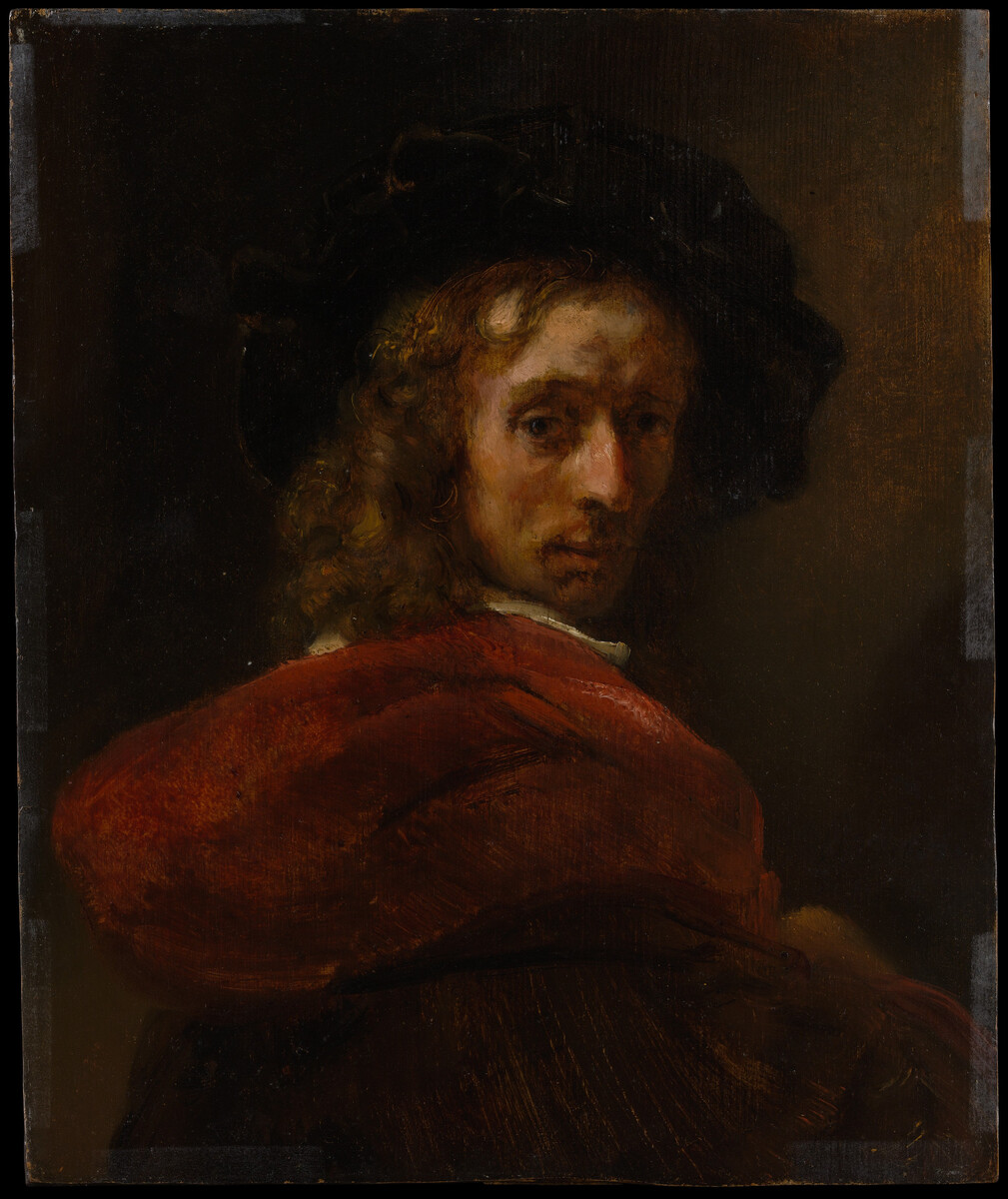
A separate work, 'Man in a Red Cloak', a follower of Rembrandt, mid-1665, oil on panel, 38.4 cm by 31.1 cm, held by the Metropolitan Museum of Art, is described in one supplied source as a presumed sketch for the male sitter in the 'Jewish Bride'.(commons.wikimedia.org, n.d.)

Disputed account

The related 'Man in a Red Cloak' is attributed in the supplied source to a follower of Rembrandt rather than to Rembrandt himself, and the source's title frames the sketch connection as presumed.(commons.wikimedia.org, n.d.)

Collection and display

Link
Custody, rights and the museum record

The Rijksmuseum record is the controlling institutional document for the painting, and it establishes two facts of custody and access that stand apart from questions of subject and style. The picture is on loan from the City of Amsterdam, A. van der Hoop Bequest, so the museum holds it as a borrower rather than as owner; the bequest name places it within a civic collection transferred to Amsterdam rather than within a private or royal gathering. The same record lists the painting's copyright status as public domain and assigns it the persistent identifier https://id.rijksmuseum.nl/200107934. The public domain designation and the persistent identifier serve different purposes: the first states that no copyright restriction attaches to the image or its reproduction, the second fixes a stable digital address so that citations to this specific object do not depend on a changing web page. For a work whose title and dating have shifted in the literature, that fixed identifier is a modest but real scholarly instrument, since it allows later research to refer unambiguously to the object even while the record's own descriptive fields remain open to revision.(Rijksmuseum, n.d.b, Acquisition and rights, credit line; Acquisition and rights; Persistent URL)

The painting is on loan from the City of Amsterdam, A. van der Hoop Bequest.(Rijksmuseum, n.d.b)

The Rijksmuseum record lists the painting's copyright status as public domain and gives the persistent identifier https://id.rijksmuseum.nl/200107934.(Rijksmuseum, n.d.b)

Documented values and qualified estimates

Link
Recorded value and its limits

Interpretation

No public sale, auction or official appraisal figure appears anywhere in the supplied evidence for the painting. What the evidence does contain is a model-generated working insurance range, dated 2026-10-16, of US$80M to US$250M. That figure was derived by treating the confirmed object as an original oil on canvas by Rembrandt from his late period (c. 1665 to c. 1669), of museum-scale dimensions (121.5 x 166.5 cm), held at the Rijksmuseum on loan from the City of Amsterdam as part of the A. van der Hoop Bequest, and recognized in the supplied museum record as one of the artist's major late works with rich documentation and prominent collection history. Because no public sale, auction or official appraisal figure is present in the supplied excerpts, the range is characterised as a conservative order-of-magnitude bracket for a work of this authorship, period, scale and institutional prominence, intentionally wide and anchored above ordinary Old Master insurance thresholds but below the absolute ceiling such a work could command if it ever entered the market, acknowledging that the object is effectively non-market due to its public collection status. No specific comparable sales, private insurance schedules or market quotations were used or are claimed.(Rijksmuseum, n.d.b)(Rijksmuseum, n.d.a)(commons.wikimedia.org, n.d.)

The status of that range needs to be stated in the same terms the record uses. It is a model-generated working insurance range for manual review only; it is not an official insurance value, not an appraisal, not an auction result and not a sale price. It does not reflect access to private insurance records or verified comparable sales, and the actual insurance amount should be set by a qualified appraiser or insurer after examining the physical object, documentation and applicable policy terms. Read alongside the collection facts, the range is best understood as a provisional working hypothesis keyed to authorship, late-period dating, canvas dimensions and institutional prominence, standing in for evidence of market value that the supplied record does not otherwise supply.(Rijksmuseum, n.d.b)(Rijksmuseum, n.d.a)(commons.wikimedia.org, n.d.)

Working estimate

Calculated working insurance estimate, not a sale price: Estimated insurance range: US$80M to US$250M Recorded date: Working calculation, generated 2026-10-16. Methodology: A broad working insurance range was derived by treating the confirmed object as an original oil on canvas by Rembrandt van Rijn from his late period (c. 1665 to c. 1669), of museum-scale dimensions (121.5 x 166.5 cm), held at the Rijksmuseum on loan from the City of Amsterdam as part of the A. van der Hoop Bequest, and recognized in the supplied museum record as one of the artist's major late works with rich documentation and prominent collection history. Because no public sale, auction, or official appraisal figure is present in the supplied excerpts, the range is a conservative order-of-magnitude bracket for a work of this authorship, period, scale, and institutional prominence. The range is intentionally wide and is anchored above ordinary Old Master insurance thresholds but below the absolute ceiling such a work could command if it ever entered the market, acknowledging that the object is effectively non-market due to its public collection status. No specific comparable sales, private insurance schedules, or market quotations were used or are claimed. Qualification: This is a model-generated working insurance range for manual review only. It is not an official insurance value, not an appraisal, not an auction result, and not a sale price. It does not reflect access to private insurance records or verified comparable sales. The actual insurance amount should be set by a qualified appraiser or insurer after examining the physical object, documentation, and applicable policy terms.(Rijksmuseum, n.d.b)(Rijksmuseum, n.d.a)(commons.wikimedia.org, n.d.)

Bibliography

Sources and further reading

References are arranged by author or organisation, with links to the original publications. Where no publication date is recorded, n.d. means no date.

Source notes updated .

  1. 03

    Official · Background reading

    Institutional record for The Jewish Bride. Institutional record for The Jewish Bride.

    A Commons file record for a separate painting, 'Man in a Red Cloak', attributed to a follower of Rembrandt and described as a presumed sketch for the male sitter in the 'Jewish Bride'. Used only to record the related object and its qualified attribution.

    Language
    English
    Link to reference
    Citation text
  2. 02

    Museum

    Rembrandt: The Jewish Bride.

    Link to reference
    Citation text
  3. 01

    Museum · About this artwork

    The Jewish Bride. Isaac and Rebecca, Known as ‘The Jewish Bride’.

    The Rijksmuseum object record for the painting, giving title, artist, dating, materials, dimensions, inscription, description, subject indexing, credit line, documentation, related objects and persistent identifier.

    Language
    English
    Link to reference
    Citation text

Article text and sources · Reading and attribution

An unhandled error has occurred. Reload 🗙