ArchivePortrait of a Lady with an Ostrich-Feather Fan

Artwork record / 49 of 331

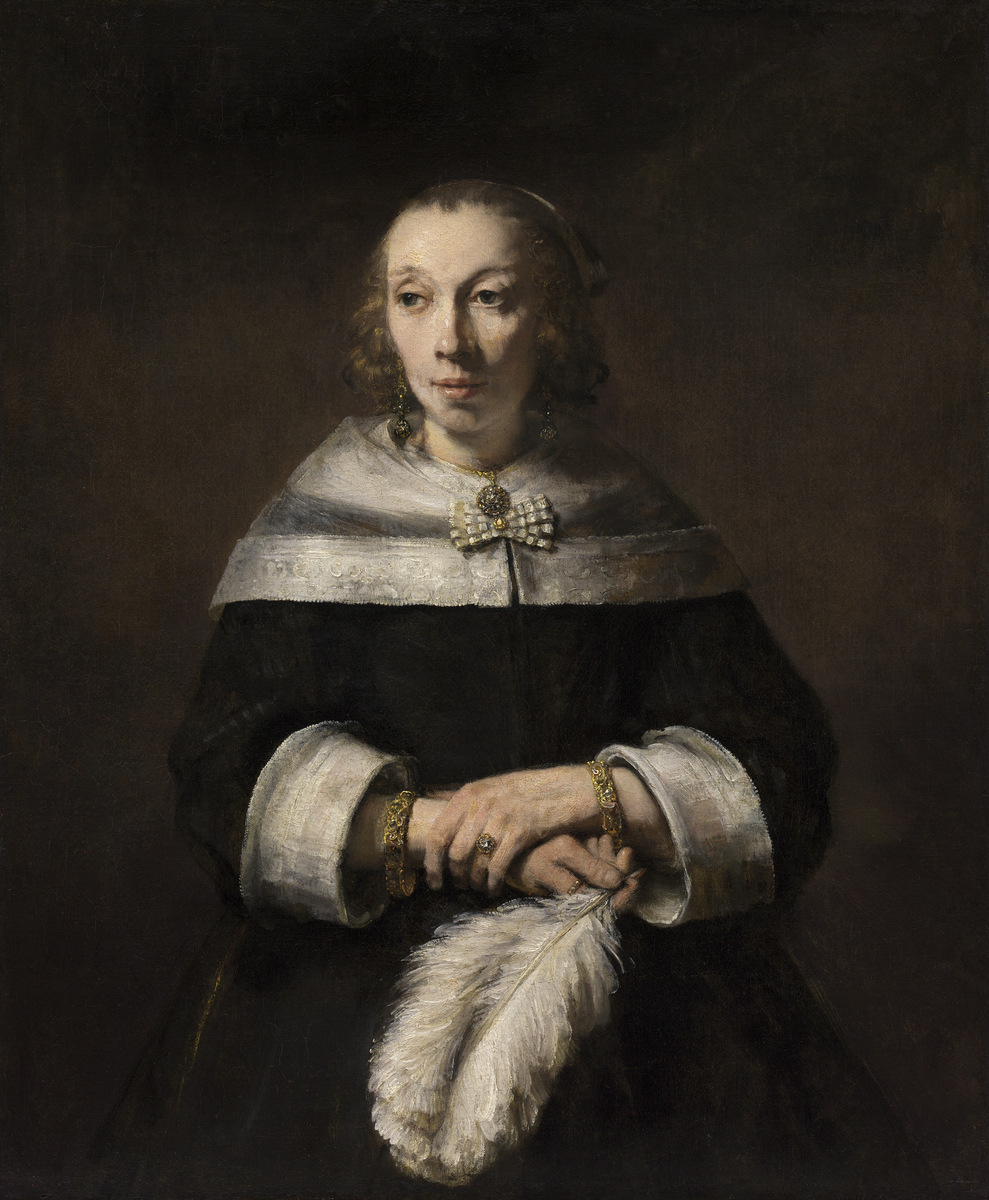
Portrait of a Lady with an Ostrich-Feather Fan by Rembrandt van Rijn (c. 1656/1658)

Artist: Rembrandt van Rijn

A late Rembrandt portrait of Margrieta Wijnants, seated half-length with a white ostrich-feather fan laid across her dark skirt. The evidence for the sitter, date and authorship is secure; what the fan means to her presentation is a matter of careful looking rather than documented fact, and the account stays within that boundary.

Read the story ↓ About the artist ↓ Research and record ↓ Literature and sources ↓ Listen to the article ↓
Article text for AI
Shop this artwork ↓ 0 visits
Datec. 1656/1658CultureDutch Republic PeriodDutch Golden Age, BaroqueCurrent locationNational Gallery of Art, Washington, D.C., United States
Listen to the article
100%
Portrait of a Lady with an Ostrich-Feather Fan by Rembrandt van Rijn (c. 1656/1658)
Loading full-resolution artwork…
Scroll to zoom · drag to pan · double-click to focus Pinch to zoom · drag to explore · double-tap to focus FIELD VIEW / 49
Tools & download
Pixel colour Select a pixel with the eyedropper
No pixel selected

Choose the eyedropper, then click or tap the image. Scroll to zoom for finer selection.

Add text

Hand to pan · Select to move text and drawings · Add as many texts as you like · Scroll to zoom

Portrait of a Lady with an Ostrich-Feather Fan: high-resolution image

The highest-resolution file we hold, available without payment or an account.3,296 × 4,000 pixels.

Download highest-resolution image

Details to notice

About 5 minutes to read
01

Lace-trimmed cape collar

The broad white shoulder cape with a patterned lace border spanning the chest and shoulders; its planar brightness forms the bridge between the lit face, the jewelled clasp and the dark gown.

02

Pearl and jewel bow brooch

The bow-shaped ornament of pearls, gold and a dark gem closing the neck of the gown, plus the drop earring at the right; a small, concentrated passage of luxury detail against the shadowed bodice.

03

Clasped hands, rings and bracelets

The woman's folded hands resting on the fan stem, showing gold bracelets, a jewelled bracelet and rings; a gesture of restraint and a display of material refinement painted with visible brushwork.

Artist portrait of Rembrandt van Rijn
Artist portrait Image credit

Rembrandt. Image source · Public domain

About the artist

Rembrandt van Rijn

15 July 1606 to 4 October 1669

Rembrandt was a Dutch painter and printmaker whose portraits, historical scenes and self-portraits explore expression through light and shadow. Born in Leiden, he trained locally and with Pieter Lastman in Amsterdam before establishing his own workshop. He moved to Amsterdam around 1631, where commissions, teaching and collecting became central to his career.

Born
15 July 1606
Died
4 October 1669
Nationality
Dutch
Birthplace
Leiden, Netherlands
Died in
Amsterdam, Netherlands

The research & record

Study the work.
Follow the evidence.

Find catalogue details, historical context, technical research and the literature behind this artwork.

Article text for AI
Open research text

The artwork record

Research catalogue

Catalogue information and detailed research, with references that link to the bibliography.

Updated .

Identity and catalogue

Link
Title
Portrait of a Lady with an Ostrich-Feather Fan(Wikimedia Commons: Portrait of a Lady, n.d.)
Artist or attribution
Rembrandt van Rijn(Wikimedia Commons: Portrait of a Lady, n.d.)
Object date
c. 1656/1658
Medium and support
oil on canvas transferred to canvas(Wikimedia Commons: Portrait of a Lady, n.d.)
Dimensions
overall: 99.5 x 83 cm (39 3/16 x 32 11/16 in.); framed: 131.8 x 115.2 cm (51 7/8 x 45 3/8 in.)
Current collection or location
National Gallery of Art, Washington, D.C., United States(Wikimedia Commons: Portrait of a Lady, n.d.)
Movement or period
Dutch Golden Age, Baroque
Country or culture
Dutch Republic
Depicted subject
A half-length portrait of a seated woman, identified as Margrieta Wijnants, holding a large white ostrich-feather fan across her dark skirt; painted by Rembrandt around 1656 to 1658.(Wikimedia Commons: Portrait of a Lady, n.d.)
Title variants
Portrait of a Woman with an Ostrich-Feather Fan; Portrait of a Lady
Accession number
1942.9.68
Support
canvas transferred to canvas(Wikimedia Commons: Portrait of a Lady, n.d.)
The catalogue entry

The painting is catalogued as a portrait by Rembrandt van Rijn, dated around 1656 to 1658, with the sitter identified as Margrieta Wijnants. That attribution, date and identification belong to the catalogue record for this exact canvas, not to any inscription on the work itself. Rembrandt himself is documented as a Dutch painter, printmaker and draughtsman who lived from 1606 to 1669 and worked chiefly in Leiden and Amsterdam, so the picture belongs to the later part of a career already divided between those two cities. The date range places the portrait in the second half of the 1650s, but the reader should keep the object date separate from the much later dates attached to the catalogues and exhibitions in which the work has been discussed.(Wikimedia Commons: Portrait of a Lady, n.d., File information and Summary; Depicted people; Artist)

The work's scholarly record is unusually long and traceable. It is catalogued in the Corpus of Rembrandt Paintings VI as number 248b, and it appears in several Rembrandt catalogues raisonnés, including entries from 1908, 1914, 1935, 1968 and 1986. Those years are publication dates of the catalogues, not events in the painting's life, and the sequence shows that the canvas has been carried as an autograph Rembrandt across a span of decades and successive reference works. The Corpus number 248b is the most specific locator supplied here, and it identifies the painting within that volume rather than describing its condition or history. For retrieval, the painting also has a RKDimages identifier of 32825 and a National Gallery of Art artwork ID of 1207, which allow the object to be matched across institutional and scholarly databases.(Wikimedia Commons: Portrait of a Lady, n.d., References)

Materials and dimensions

The support and dimensions are recorded with some care. The work is a portrait painting made in oil on canvas, subsequently transferred to canvas, which means the original canvas was mounted onto or replaced by a second canvas as a conservation measure. The record distinguishes the overall canvas of about 99.5 by 83 centimetres from the framed dimensions of about 131.8 by 115.2 centimetres, so the frame is noticeably larger than the painted surface. That difference matters for how the work is encountered in a gallery: the visible painting is smaller than the whole hung object, and the dimensions given for the canvas are not the dimensions of the frame. The transfer of the support is also a reminder that the physical structure of the picture has been altered since Rembrandt's time, even though the subject and composition are unchanged.(Wikimedia Commons: Portrait of a Lady, n.d., File information and Summary; References)

Exhibition and title

The painting was included in the exhibition Late Rembrandt at the Rijksmuseum, held from 12 February to 17 May 2015. That is the only exhibition supplied in the evidence, and it is a relatively recent public showing of a work whose catalogue history reaches back to 1908. The exhibition title frames the painting's moment within Rembrandt's late career, which is consistent with a date in the second half of the 1650s. The painting's title names the ostrich-feather fan, which the sitter holds across her dark skirt, so the exhibition title, the catalogue title and the visible accessory all point to the same late-career portrait rather than to an earlier or differently described work.(Wikimedia Commons: Portrait of a Lady, n.d., File information and Summary; References)

The catalogue title directs attention to the ostrich-feather fan, and the fan is held across the sitter's dark skirt rather than raised. The evidence supplied identifies the fan and its position but does not describe the sitter's face, clothing beyond the dark skirt, or the background of the picture. What the record does establish is that the white feathered shape and the dark expanse of fabric are the two elements the title itself selects for notice, and that the fan lies flat across the skirt in the lower half of the canvas. The title therefore functions as a description of a documented compositional fact, not as a symbolic programme. No source supplied here assigns a meaning to the fan, and the account should not manufacture one.(Wikimedia Commons: Portrait of a Lady, n.d., Depicted people; References)

Identity and research status

Interpretation

Taken together, these records support a reading of the portrait as an object whose identity has been stabilized by cataloguing and whose physical state has been altered by conservation. The catalogue entry, the accession number, the Widener provenance, the transferred support, the frame larger than the canvas and the 2015 exhibition are all separate kinds of documentation, and none of them substitutes for another. The painting's importance for a history of art lies partly in this density of record: it can be located in a Corpus volume, in successive catalogues raisonnés, in RKDimages and in the National Gallery's own numbering, and it can also be examined as a physical object whose canvas has been transferred and whose frame is substantially larger than the painted surface. What the supplied evidence does not contain is any account of preliminary drawings, workshop participation, or early ownership, so questions of that kind stay open in this research account.(Wikimedia Commons: Portrait of a Lady, n.d., References; Credit line)

The painting is a portrait by Rembrandt van Rijn, dated around 1656 to 1658.(Wikimedia Commons: Portrait of a Lady, n.d.)

The sitter depicted in the portrait is identified as Margrieta Wijnants.(Wikimedia Commons: Portrait of a Lady, n.d.)

The work is catalogued in the Corpus of Rembrandt Paintings VI as number 248b.(Wikimedia Commons: Portrait of a Lady, n.d.)

The painting appears in several Rembrandt catalogues raisonnés, including entries from 1908, 1914, 1935, 1968 and 1986.(Wikimedia Commons: Portrait of a Lady, n.d.)

The painting's RKDimages identifier is 32825, and its National Gallery of Art artwork ID is 1207.(Wikimedia Commons: Portrait of a Lady, n.d.)

Subject and iconography

Link
Composition and the fan

Visual observation

The picture is titled for the ostrich-feather fan, and that title directs attention to the single accessory the sitter holds across her dark skirt rather than to any action she performs. The fan is not raised or flourished; it rests low in the composition, laid over a broad, dark expanse of fabric. Because the skirt is dark and occupies much of the lower picture, the pale fan becomes the most legible form in that zone and functions as a horizontal note of white against the receding cloth, giving the eye a shape to settle on before it travels up to the face. This arrangement is a matter of what the painting shows, not of a documented symbolic programme: the supplied record identifies the fan and its position, and the interpretation of the dark skirt as a deliberate foil belongs to description of the composition rather than to any attributed iconographic scheme.(Wikimedia Commons: Portrait of a Lady, n.d., Title)

The contrast just described is not an artifact of reproduction, since the painting's title itself names the ostrich-feather fan; the physical description of the sitter holding it across her dark skirt is the point of departure for everything else the record establishes about the object. The work is a portrait painting in oil on canvas, and the original canvas has subsequently been transferred to a second canvas. That transfer is a conservation measure: it changes the physical support of the picture, and therefore the material history conservators must reckon with, without altering the subject depicted. Any account of the painting's surface must hold both facts together, the image as it reads and the layered support that now carries it.(Wikimedia Commons: Portrait of a Lady, n.d., Title; Medium and Image title)

The portrait's title names the ostrich-feather fan, which the sitter holds across her dark skirt.(Wikimedia Commons: Portrait of a Lady, n.d.)

Historical context

Link
The Object and Its Maker

Visual observation

Rembrandt van Rijn, the painter, printmaker and draughtsman who lived from 1606 to 1669 and worked chiefly in Leiden and Amsterdam, is the artist to whom this half-length portrait of a seated woman is attributed. The painting is dated to about 1656 to 1658, and the sitter is identified as Margrieta Wijnants. The work is oil on canvas, and its original canvas has been transferred to a second canvas, a conservation measure that changes the physical support of the picture without altering its subject. The portrait's title itself names the ostrich-feather fan, which the sitter holds across her dark skirt, so the accessory is embedded in the object's documented identity rather than supplied by later interpretation.(Wikimedia Commons: Portrait of a Lady, n.d., Artist; Title)

Rembrandt van Rijn was a Dutch painter, printmaker and draughtsman who lived from 1606 to 1669, working chiefly in Leiden and Amsterdam.(Wikimedia Commons: Portrait of a Lady, n.d.)

Materials and technique

Link
Support and medium

The materials record for this portrait is short but consequential. The work is a portrait painting executed in oil on canvas, and its original canvas has subsequently been transferred to a second canvas. The transfer is documented as a conservation measure, not as an original feature of the picture: it changes the physical support of the work, so that the fabric now carrying the paint is not the fabric on which Rembrandt worked. Because the medium is recorded as oil and the support as canvas in both its original and present states, the evidence supports a description of layered oil painting on a flexible textile support, but it does not specify the ground, the priming, the number of paint layers, or the particular pigments used. Those are questions the supplied record leaves open, and they should not be filled in by inference from the image alone.(Wikimedia Commons: Portrait of a Lady, n.d., Medium and Image title; Medium)

Interpretation

Placing the material and technical facts within the object's history clarifies why they matter. The painting is dated to roughly 1656 to 1658, late in Rembrandt's career, and is catalogued in the Corpus of Rembrandt Paintings VI as number 248b, with entries in earlier catalogues raisonnés from 1908, 1914, 1935, 1968 and 1986. Rembrandt himself was a Dutch painter, printmaker and draughtsman active chiefly in Leiden and Amsterdam from 1606 to 1669. The work is now in the National Gallery of Art in Washington, D.C., as accession 1942.9.68, coming from the Widener Collection, and it was shown in Late Rembrandt at the Rijksmuseum from 12 February to 17 May 2015. A painting that has been examined repeatedly across more than a century of cataloguing, and that has undergone a canvas transfer before entering a major public collection, is precisely the kind of object whose physical history and scholarly history run in parallel. The technical record here, however, stops at support and medium; the connoisseurial record is fuller than the material record, and that asymmetry is itself worth noting.(Wikimedia Commons: Portrait of a Lady, n.d., Medium and Image title; Medium; Dimensions)

The work is a portrait painting made in oil on canvas, subsequently transferred to canvas.(Wikimedia Commons: Portrait of a Lady, n.d.)

Condition and conservation

Link
The support and its transfer

The physical state of this portrait is bound up with the question of what the object actually is. The work is a portrait painting made in oil on canvas, and that original canvas has subsequently been transferred to a second canvas, a conservation measure that changes the physical support of the work rather than its subject. The record describes the transfer plainly as part of the medium, so any account of the picture's surface has to be understood as an account of paint that now rests on a later support. Because the surviving evidence does not date the transfer, name the conservator, or record the condition that prompted it, the intervention stands as a documented change of support without a documented occasion; the evidence establishes that the transfer occurred, not when or why.(Wikimedia Commons: Portrait of a Lady, n.d., Medium; Medium and Image title)

Between the painted surface and the room hangs a frame with dimensions out of proportion to the canvas it holds. The framed dimensions are about 131.8 by 115.2 centimetres, against an overall canvas of about 99.5 by 83 centimetres. Read together, those figures establish a substantial difference between the size of the image-bearing fabric and the size of the moulding around it, so the frame is noticeably larger than the canvas rather than fitted tightly to it. The evidence supplies the measurements as dimensions only; it does not state whether the frame is original to the work, whether the current canvas size reflects trimming before or after the transfer, or how the present presentation relates to the picture's earliest framing. Those remain open questions that the recorded figures frame but do not answer.(Wikimedia Commons: Portrait of a Lady, n.d., Dimensions)

The painting belongs to the National Gallery of Art in Washington, D.C., and its acquisition is credited to the Widener Collection. That credit line places the transfer to a second canvas, along with any other physical history the work carries, within an institutional custody whose own records are the source of the condition and dimension data reported here. The collection information identifies where the object's documented care has taken place without itself describing a treatment campaign, a condition report, or a conservation decision beyond the transfer of support. The material facts and the custodial facts therefore sit in the same documentary frame: the work is oil on canvas, transferred to canvas, held by the National Gallery, and credited to the Widener Collection.(Wikimedia Commons: Portrait of a Lady, n.d., Credit line; Medium and Image title; Medium)

Interpretation

What this object's condition history most clearly demonstrates is the separation between the conservator's object and the viewer's object. A transfer of support is one of the more consequential interventions a painting can undergo, since it replaces the ground the paint was made on, yet the surviving documentation records the fact in a single phrase of medium description and nothing about the state of the original canvas that required it. The measurements compound the same problem in the other direction: they are precise enough to establish a large gap between canvas and frame, but not precise enough to explain it. Within the larger history of the care of Dutch seventeenth-century paintings, this pattern is typical rather than exceptional, because the physical history of such works is often thinnest exactly where it matters most. The evidence here supports a careful conclusion: the painting has been materially altered in its support and is presented in a frame much larger than its canvas, and the dates, agents and reasons for either circumstance are not established by the available record.(Wikimedia Commons: Portrait of a Lady, n.d., Medium; Dimensions; Medium and Image title)

The painting's frame is noticeably larger than its canvas: the framed dimensions are about 131.8 by 115.2 centimetres, against an overall canvas of about 99.5 by 83 centimetres.(Wikimedia Commons: Portrait of a Lady, n.d.)

The painting's original canvas has been transferred to a second canvas, a conservation measure that changes the physical support of the work.(Wikimedia Commons: Portrait of a Lady, n.d.)

Provenance and ownership

Link
Documented Ownership and Acquisition

The documented provenance of this portrait begins with the Widener Collection, which is credited as the source of the painting's acquisition by the National Gallery of Art. The acquisition carried the accession number 1942.9.68, and the work is now held in Washington, D.C. That is the full extent of the ownership record supplied here: a named collection of origin, an acquisition by a public institution, and a museum identifier. No intermediate owner, dealer, sale, or transfer is documented in these units, so the chain between the Widener Collection and the National Gallery of Art cannot be reconstructed from the evidence at hand.(Wikimedia Commons: Portrait of a Lady, n.d., Credit line)

Interpretation

The distinction between an unrecorded interval and a proven change of ownership matters here. The evidence documents a named source collection and a dated museum acquisition, and it documents a sequence of catalogue publications beginning in 1908. It does not document any sale, gift, bequest, or private transfer between those points. The Widener Collection attribution should therefore be read as the institution's credited line of acquisition rather than as a reconstructed chain of possession. Nothing in the supplied units dates the Widener Collection's own formation or states when or how the painting entered it, so any account of the earlier provenance would exceed the evidence.(Wikimedia Commons: Portrait of a Lady, n.d., Credit line)

Object, Attribution and Physical History

Physical measurements complicate any simple description of the work's scale. The framed dimensions are about 131.8 by 115.2 centimetres, against an overall canvas of about 99.5 by 83 centimetres. The frame is therefore noticeably larger than the canvas it contains, a difference that belongs to the object's mounting history rather than to its painted surface. The transfer of the original canvas to a second support, and the frame around the result, are two distinct physical interventions recorded in the evidence, and neither is tied by these units to a named restorer, date, or owner. They remain documented conditions of the object with undocumented circumstances.(Wikimedia Commons: Portrait of a Lady, n.d., Credit line)

Interpretation

Read together, the provenance evidence shows a painting whose institutional life is well anchored at both ends and thin in the middle. One end is the Widener Collection, credited as the source of the acquisition, with the accession number 1942.9.68 recording the National Gallery of Art's receipt. The other end is a continuing scholarly and exhibition record, running from catalogue entries in 1908, 1914, 1935, 1968 and 1986, through the Corpus of Rembrandt Paintings VI entry 248b, to the 2015 Late Rembrandt exhibition at the Rijksmuseum. Between those anchors the units supply no intermediate names, dates, or transactions. A responsible provenance account of this object therefore states the credited source and accession, dates the catalogue and exhibition history, and marks the intervening ownership as unrecorded rather than assuming a continuous or disputed line of descent.(Wikimedia Commons: Portrait of a Lady, n.d., Credit line; Artist; Exhibition history)

The painting comes from the Widener Collection, credited as the source of its acquisition by the National Gallery of Art.(Wikimedia Commons: Portrait of a Lady, n.d.)

Exhibition history

Link

The painting was included in the exhibition Late Rembrandt at the Rijksmuseum, held from 12 February to 17 May 2015.(Wikimedia Commons: Portrait of a Lady, n.d.)

Reception and literature

Link
Exhibition and the Late Rembrandt Frame

The documented reception of this portrait begins with its inclusion in Late Rembrandt at the Rijksmuseum, an exhibition that ran from 12 February to 17 May 2015. The exhibition's title is itself a period designation: the painting is dated to around 1656 to 1658, in the second half of the 1650s and late in Rembrandt van Rijn's career (he lived 1606 to 1669 and worked chiefly in Leiden and Amsterdam), so its selection for a show framed around late Rembrandt places it within the phase of his production that curators and scholars have treated as a distinct body of work. The public display at the Rijksmuseum is the most recent documented stage of reception supplied here, and it follows a long scholarly record rather than standing apart from it.(Wikimedia Commons: Portrait of a Lady, n.d., Exhibition history; Artist)

Before and alongside that exhibition, the painting's standing rested on its place in the Rembrandt catalogue literature. It is catalogued in the Corpus of Rembrandt Paintings VI as number 248b, and it appears in several Rembrandt catalogues raisonnés with entries from 1908, 1914, 1935, 1968 and 1986. The span of those entries, from 1908 through the Corpus volume, is the evidence for continuity of attribution: the picture has been treated as an autograph Rembrandt across a long scholarly period, not accepted on a single authority or in a single generation. The Corpus number and the earlier catalogue entries are the concrete form that reception takes in this literature, where the question at stake is authorship and placement within the oeuvre rather than visual appreciation.(Wikimedia Commons: Portrait of a Lady, n.d., Exhibition history; Artist)

Collection and display

Link
Object and attribution

The painting is a half-length portrait by Rembrandt van Rijn, dated about 1656 to 1658 and catalogued in the Corpus of Rembrandt Paintings VI as number 248b. Rembrandt, a Dutch painter, printmaker and draughtsman who lived from 1606 to 1669 and worked chiefly in Leiden and Amsterdam, is the artist to whom the work is attributed in the supplied record. The sitter is identified as Margrieta Wijnants, and the title of the work names the ostrich-feather fan she holds across her dark skirt, so that the accessory is embedded in the picture's identity as much as the sitter's name is. The dating places the canvas in the second half of the 1650s, late in Rembrandt's career.(Wikimedia Commons: Portrait of a Lady, n.d., Collection and Accession number)

In material terms the painting is a portrait made in oil on canvas, and the original canvas has subsequently been transferred to a second canvas. That transfer is a conservation measure: it changes the physical support of the work, the fabric that carries the paint, without altering the subject depicted. The record also notes a marked discrepancy between the framed and unframed dimensions. The framed dimensions are about 131.8 by 115.2 centimetres, against an overall canvas of about 99.5 by 83 centimetres, so the frame is noticeably larger than the canvas it holds. This gap between support and frame is a concrete physical fact about the object as it is now displayed, distinct from the question of how the picture was originally mounted.(Wikimedia Commons: Portrait of a Lady, n.d., Collection and Accession number)

Collection history

The painting belongs to the collection of the National Gallery of Art in Washington, D.C., and carries the accession number 1942.9.68. Its acquisition by that institution is credited to the Widener Collection, given in the record as the source of the acquisition. The work is also identified by two external catalogue numbers: its RKDimages identifier is 32825, and its National Gallery of Art artwork ID is 1207. These identifiers, together with the accession number, are the locators by which the object can be tracked across collection records and image databases.(Wikimedia Commons: Portrait of a Lady, n.d., Collection and Accession number)

Scholarly catalogues and exhibition

The painting's scholarly standing rests on a catalogue history that extends across much of the twentieth century. It appears in several Rembrandt catalogues raisonnés, including entries from 1908, 1914, 1935, 1968 and 1986, and is catalogued in the Corpus of Rembrandt Paintings VI as number 248b. The span of these entries, from 1908 through the Corpus volume, shows that the work has been treated as an autograph Rembrandt across a long period of cataloguing. The publication dates establish the continuity of that treatment; they do not by themselves record the reasoning behind each compiler's judgment, which the supplied evidence does not detail.(Wikimedia Commons: Portrait of a Lady, n.d., Collection and Accession number)

The painting was included in the exhibition Late Rembrandt at the Rijksmuseum, held from 12 February to 17 May 2015. The show's title corresponds to the period to which the canvas is dated, the second half of the 1650s, and the exhibition record therefore places the work within a display context specifically framed around Rembrandt's late production. Beyond the exhibition title and dates, the supplied evidence does not describe the hang, the section of the exhibition in which the painting appeared, or any interpretive claim made about it there.(Wikimedia Commons: Portrait of a Lady, n.d., Collection and Accession number)

Interpretation

Read together, the object-specific evidence establishes a picture whose identity is unusually well pinned down: a named artist, a named sitter, a narrow date range, a specific medium and support history, an institutional accession number, two database identifiers, a credited source collection, a continuous run of catalogue entries, and a recent exhibition appearance. What the evidence does not supply is equally worth stating. It does not record the picture's ownership before the Widener Collection, the circumstances or date of the canvas transfer, the reason the frame is so much larger than the canvas, or any documented symbolic programme attached to the fan. Those gaps are not filled here, and the account should be read as bounded by them.(Wikimedia Commons: Portrait of a Lady, n.d., Collection and Accession number)

The painting belongs to the collection of the National Gallery of Art in Washington, D.C., and carries the accession number 1942.9.68.(Wikimedia Commons: Portrait of a Lady, n.d.)

Documented values and qualified estimates

Link
Recorded values

Interpretation

The only recorded money figure attached to this painting in the supplied material is not a market result at all. It is a calculated working insurance estimate, generated on 2026-10-16, giving a deliberately wide screening range of US$75M to US$150M. The methodology is stated explicitly: the range was calculated conservatively for manual review and is not sourced from any appraisal, auction, or private insurance record. Its inputs are confined to the confirmed context of the object, an autograph Rembrandt van Rijn portrait dated c. 1656/1658, oil on canvas transferred to canvas, approximately 99.5 by 83 cm, held by the National Gallery of Art with Widener Collection provenance and accession number 1942.9.68. The stated reasoning is that Rembrandt is among the most prominent and widely catalogued Old Masters and that a museum-quality late portrait of this scale and quality sits in the uppermost tier of the artist market; because no public sale, official insurance figure, or comparable transaction for this exact painting is supplied, the spread is deliberately wide, and the figure is to be treated as a screening bracket for further specialist review only. The accompanying qualification is equally explicit: this is a model-generated working range, not an official insurance value, appraisal, auction result, or sale price; it does not constitute a certified valuation and should not be used for coverage placement, lending, tax, or legal purposes without review by a qualified fine-art appraiser or insurance specialist, and no comparable sales or private insurance records were used or claimed. For an accumulating research record, the salient fact is the absence behind the number: the object's documented value history in these sources consists of an unsourced modelling exercise, while its documented identity, dating, support, collection, provenance credit and accession number are what actually anchor it.(Wikimedia Commons: Portrait of a Lady, n.d.)

Working estimate

Calculated working insurance estimate, not a sale price: Estimated insurance range: US$75M to US$150M Recorded date: Working calculation, generated 2026-10-16. Methodology: This working range is calculated conservatively for manual review, not sourced from any appraisal, auction, or private insurance record. The calculation uses only the confirmed context: an autograph Rembrandt van Rijn portrait dated c. 1656/1658, oil on canvas transferred to canvas, approximately 99.5 x 83 cm, held by the National Gallery of Art with Widener Collection provenance and accession number 1942.9.68. Rembrandt is among the most prominent and widely catalogued Old Masters, and a museum-quality late portrait of this scale and quality sits in the uppermost tier of the artist market. Because no public sale, official insurance figure, or comparable transaction for this exact painting is supplied, the range is set with a deliberately wide spread. It should be treated as a screening bracket for further specialist review only. Qualification: This is a model-generated working range for manual review, not an official insurance value, appraisal, auction result, or sale price. It does not constitute a certified valuation and should not be used for coverage placement, lending, tax, or legal purposes without review by a qualified fine-art appraiser or insurance specialist. No comparable sales or private insurance records were used or claimed.(Wikimedia Commons: Portrait of a Lady, n.d.)

Bibliography

Sources and further reading

References are arranged by author or organisation, with links to the original publications. Where no publication date is recorded, n.d. means no date.

Source notes updated .

  1. 01

    Secondary · About this artwork

    Wikimedia Commons: Portrait of a Lady (n.d.). Wikimedia Commons file page for Rembrandt van Rijn, Portrait of a Lady with an Ostrich-Feather Fan. Wikimedia Commons.

    Discovery and structured-data record aggregating identity, collection, provenance and exhibition information for this exact painting, original data from the National Gallery of Art open access donation.

    Language
    English
    Link to reference
    Citation text

Article text and sources · Reading and attribution

An unhandled error has occurred. Reload 🗙