Saturn Devouring His Son
Artist: Francisco Goya · 1820-1823
Saturn Devouring His Son: high-resolution image
The highest-resolution file we hold, available without payment or an account.1,661 × 3,051 pixels.
Download highest-resolution imageThe complete story
The story About 3 minutes to read
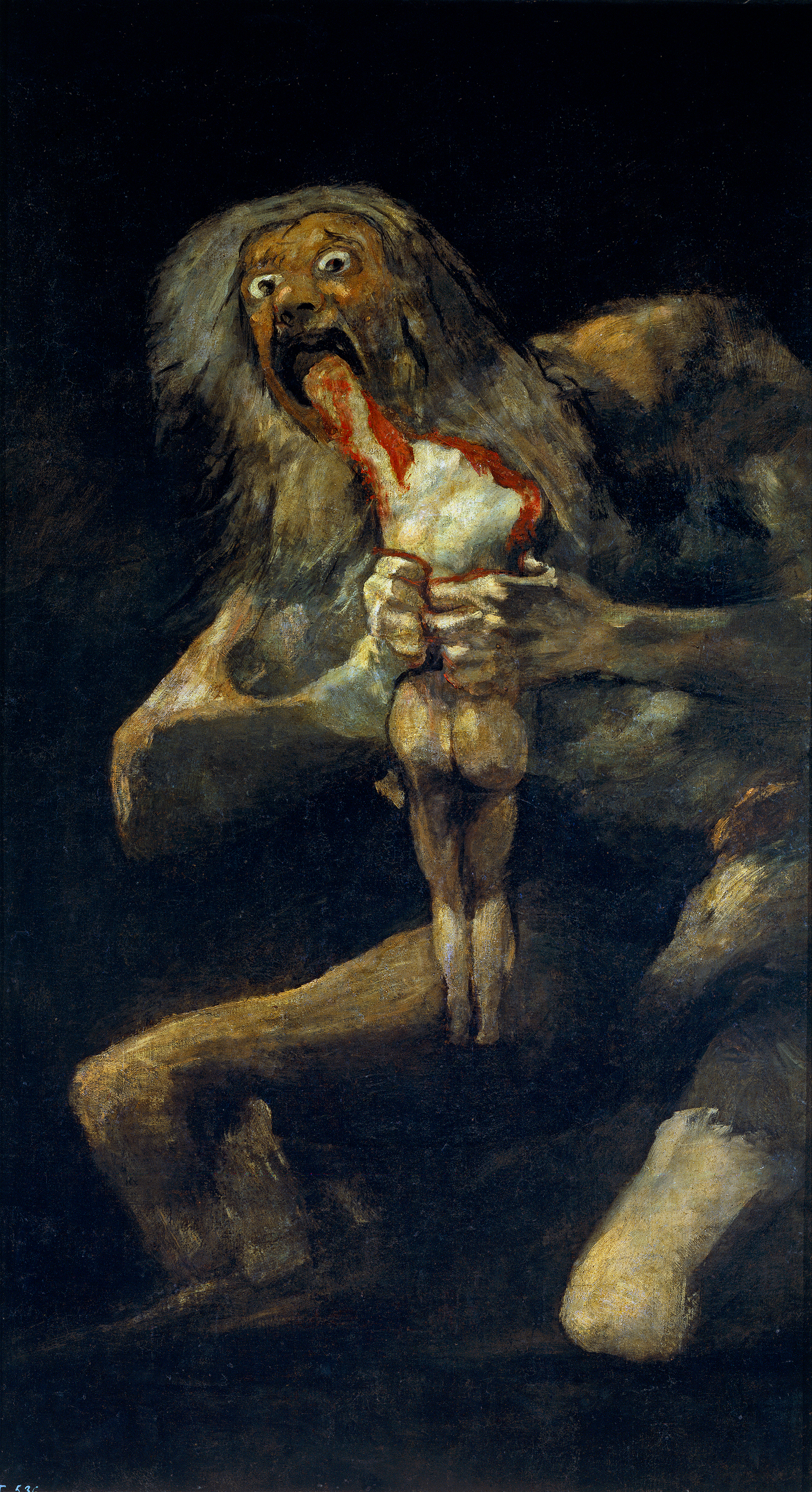
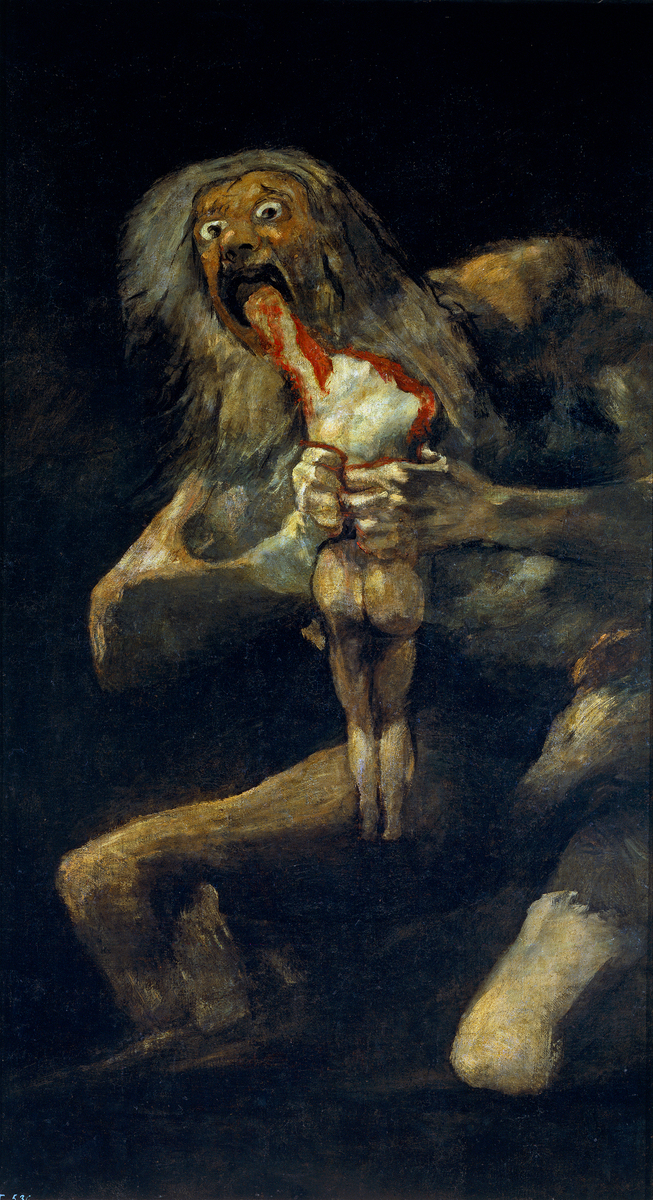
The figure you're looking at is Saturn, and he's eating one of his children. The subject comes from Roman mythology. A prophecy warned Saturn that one of his children would overthrow him and take his throne. He devours them to prevent it. Goya made this painting between 1820 and 1823.
Notice how much of the picture the body fills. The figure crouches low, pressed into a dark ground, so there's almost no setting around him. His eyes are wide and staring. The pale flesh of the child's body stands out against the shadows. There's no distance between us and the act.
This wasn't made for a museum wall. Goya painted it directly on the walls of his own house, the Quinta del Sordo, outside Madrid. It's one of the works known as the Black Paintings, made in the final years of his life. Later the wall paintings were transferred to canvas.
The myth is about a king trying to keep his power. The Prado reads the painting in that light, as an image of the fear of losing power. That reading fits the way Saturn is shown: not as a distant god but as a figure caught in his own dread, gripping what he means to keep and destroying it anyway.
Goya kept the setting bare. There's no palace, no throne, no witnesses. The story's political meaning, a ruler's grip on power, is carried by the bodies alone. That's part of what makes the image so direct. It doesn't illustrate the myth so much as compress it into a single act.
So this is a painting about power and fear, staged in the most intimate and terrible way Goya could find. When you leave, hold on to that crouching figure in the dark. He isn't defending a throne here. He's already alone with what his fear has made him do.
The story and its sources
Historical claims are linked to the records below. Close looking and interpretation are identified in the passage notes.
- Passage 1Documented historySaturn: collection recordSaturn, Goya: subject and Black Paintings
- Passage 2Close looking
- Passage 3Documented historySaturn: collection recordSaturn, Goya: subject and Black Paintings
- Passage 4InterpretationSaturn, Goya: subject and Black Paintings
- Passage 5Documented historySaturn, Goya: subject and Black Paintings
- Passage 6InterpretationSaturn, Goya: subject and Black Paintings
Details to notice
About 2 minutes to readBlood streaming down
The vivid red blood running from Saturn's mouth across the child's body, the painting's most striking chromatic accent.
Surrounding darkness
The enveloping black background that isolates the figure, characteristic of Goya's Black Paintings and intensifying dread.
Saturn's crouched legs
The dim, partially visible legs and feet of the giant crouching in the black void, anchoring the figure in space.
Artist portrait Image credit
Vicente López Portaña. Image source · Public domain
About the artist
Francisco de Goya
30 March 1746 to 16 April 1828
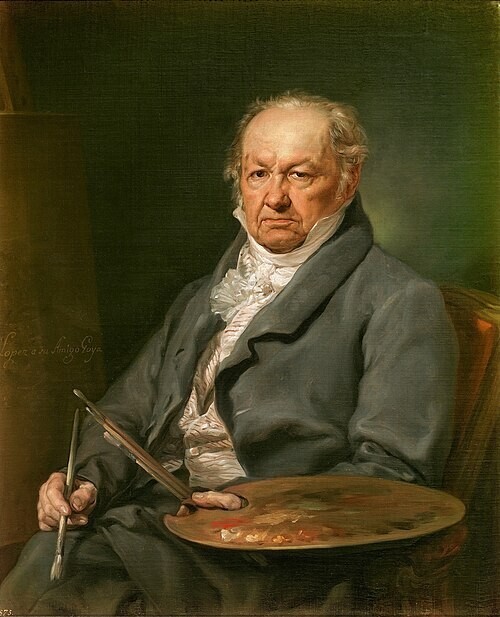
Goya was a Spanish painter and printmaker whose career extended from royal tapestry designs and court portraiture to images of war, repression and unsettling fantasy. Born in Fuendetodos, he trained in Zaragoza and Madrid and became First Painter to Charles IV in 1799. He spent his final years in Bordeaux.
- Born
- 30 March 1746
- Died
- 16 April 1828
- Nationality
- Spanish
- Birthplace
- Fuendetodos, Spain
- Died in
- Bordeaux, France
The research & record
Study the work.
Follow the evidence.
Find catalogue details, historical context, technical research and the literature behind this artwork.
The artwork record
Research catalogue
Catalogue information and detailed research, with references that link to the bibliography.
Updated .
Identity and catalogue
Link- Title
- Saturn Devouring His Son
- Artist or attribution
- Francisco Goya
- Object date
- 1820-1823
- Medium and support
- Mural transferred to canvas
- Dimensions
- Not specified in this review
- Current collection or location
- Museo del Prado, Madrid
- Movement or period
- Black Paintings
- Country or culture
- Spanish
- Depicted subject
- The central scene shows Saturn consuming one of his children. The myth concerns his fear of being overthrown. Goya made this painting on the walls of his own home as part of the Black Paintings.
Read valuation records and their limitations
Catalogue identity
The Museo Nacional del Prado catalogues this work as Saturn, a painting by Francisco Goya made between 1820 and 1823. That span is the date of the object's making, not of its entry into the catalogue or of any later documentation, and the record gives no narrower year within it. The subject is identified through Roman mythology: the scene represents Saturn devouring one of his children. The Prado's own account of the subject explains the mythological motive, that a prophecy foretold one of Saturn's children would overthrow him and take his throne, and that he devours them to prevent it. The gallery's record also places the picture within a named group, the Black Paintings, which Goya made on the walls of his own house, the Quinta del Sordo.(Museo Nacional del Prado, n.d.b)(Museo Nacional del Prado, n.d.a)
From wall to canvas
Within the Black Paintings, Saturn belongs to a series painted directly on the walls of Goya's own house rather than commissioned for a display space. The Prado's subject account gives both the mythological content and the domestic architectural setting, and the collection record gives the frame of 1820 to 1823 for the making. Reading the two records together, the work's identity is doubly determined: by a classical narrative of a god who destroys his offspring to hold a throne, and by the private walls of the Quinta del Sordo. The evidence does not state what Goya intended the room's paintings to mean to viewers, nor who saw them there, so the private setting can be described as documented while any account of the paintings as a designed programme addressed to an audience would exceed the sources.(Museo Nacional del Prado, n.d.a)(Museo Nacional del Prado, n.d.b)
Saturn is a painting by Francisco Goya, made between 1820 and 1823.(Museo Nacional del Prado, n.d.b)
Historical context
LinkRead valuation records and their limitations
Subject and Mythological Frame
The subject of this work is established directly by the Prado's own account: the scene represents Saturn devouring one of his children, drawn from Roman mythology. The same source supplies the narrative logic behind the act, explaining that in the myth Saturn devours his children because a prophecy says one will overthrow him and take his throne. That sequence matters for how the painting is described in later commentary, because the mythological frame supplies both the action and its stated cause, a ruler acting preemptively against a predicted reversal of fortune. The evidence available here identifies the subject and the myth's internal motivation; it does not establish what Goya himself wrote or said about the choice of subject, and no such statement should be supplied from outside this record.(Museo Nacional del Prado, n.d.a)
The painting belongs to a defined group and a defined place of making. According to the Prado, it is one of the Black Paintings that Goya made on the walls of his own house, the Quinta del Sordo. This is the decisive fact of the work's creation circumstances as recorded here: it was not produced as an independent panel or canvas for sale or display in an institutional setting, but as wall painting within the artist's own residence. The evidence units supplied for this section establish the location and the grouping but do not itemize the room, the sequence of the works within the house, or the identity of any collaborator or assistant; those details must not be inferred from the present units.(Museo Nacional del Prado, n.d.a)
Attributed Interpretation
Interpretation
Interpretation of the painting's meaning is attributed rather than settled by these units. The Prado describes fear of losing power as an interpretation of the painting, phrasing that marks the reading as one offered by the institution rather than as a documented intention of the artist. This qualification should be preserved whenever the political or psychological reading of the work is discussed. The mythological evidence establishes that a prophecy-driven loss of power is the story's explicit mechanism, while the Prado's reading extends that mechanism into an interpretation of the image's emotional content. The two are related but not identical: the first is the narrative premise of the subject, the second is a modern interpretive claim about what the painting conveys. The units supplied here do not contain Goya's own statement of intent, correspondence, or contemporary commentary that would settle the question.(Museo Nacional del Prado, n.d.a)
The scene represents Saturn devouring one of his children, drawn from Roman mythology.(Museo Nacional del Prado, n.d.a)
In the myth, Saturn devours his children because a prophecy says one will overthrow him and take his throne.(Museo Nacional del Prado, n.d.a)
The painting is one of the Black Paintings Goya made on the walls of his own house, the Quinta del Sordo.(Museo Nacional del Prado, n.d.a)
Provenance and ownership
LinkRead valuation records and their limitations
From Wall to Collection
The documented history of this work begins with its creation on a wall rather than as a portable picture. The Museo Nacional del Prado, which holds the painting in Madrid, records that Goya made it between 1820 and 1823 and that it was later transferred from wall to canvas. This sequence, creation in mural form and subsequent transfer of the painted surface to a support that could be moved, frames every later question of possession, because the object that entered the Prado's collection is not the physical form in which it was first made. The collection record gives the creation dates and the wall-to-canvas transfer as linked facts about a single work, now catalogued as Saturn.(Museo Nacional del Prado, n.d.b)
The wall on which it was made was a domestic one. The Prado describes the painting as one of the Black Paintings Goya executed on the walls of his own house, the Quinta del Sordo. Placing the work's origin in Goya's own residence is what makes its present location in a public museum collection the endpoint of a relocation rather than an original purpose: the picture was not commissioned for an institutional gallery but belonged to the fabric of a private house before it became a canvas in Madrid. The evidence establishes the house and the collection as successive settings of the same painted surface without specifying the intermediate steps, so the transfer itself remains documented in outcome but not, in these units, in its agents or transactions.(Museo Nacional del Prado, n.d.a)(Museo Nacional del Prado, n.d.b)
Subject and Interpretation
The subject carried across that move is drawn from Roman mythology: Saturn devouring one of his children. The myth supplies the motive the Prado gives for the act, a prophecy that one of Saturn's children will overthrow him and take his throne, which Saturn tries to prevent by devouring them. The Prado also records its own interpretive reading of the painting as an image of the fear of losing power. This reading is attributed to the institution rather than established as Goya's documented intention, and it should be distinguished from the securely transmitted subject matter. Provenance and interpretation meet here in a specific way: the mythic narrative of a ruler destroying what he means to keep is the content that travelled with the painted surface from the Quinta del Sordo into the museum collection, while the political and psychological gloss on that content is an institutional interpretation offered alongside the object's record.(Museo Nacional del Prado, n.d.a)(Museo Nacional del Prado, n.d.b)
Interpretation
Read together, the evidence units describe a single documented trajectory: made on a wall between 1820 and 1823 in Goya's house outside the institutional frame, then transferred to canvas, then held by the Prado in Madrid. The units do not name any owner besides Goya's own household context, do not record a sale, gift, commission or intermediate transfer date, and do not identify who carried out the transfer. Because an unrecorded interval is not the same as a proven change of ownership, the gap between the Quinta del Sordo and the Prado collection should be treated as undocumented in these sources rather than as evidence of a specific transaction. Within that limited frame, the object matters for a larger history of material culture precisely because its biography crosses categories: a mural made for a private dwelling became a canvas in a national collection, and the transfer of medium is itself part of the work's documented identity as the Prado records it.(Museo Nacional del Prado, n.d.b)(Museo Nacional del Prado, n.d.a)
The work was made on a wall and later transferred to canvas; it belongs to the Museo del Prado collection in Madrid.(Museo Nacional del Prado, n.d.b)
Interpretations and debates
LinkRead valuation records and their limitations
The Prado's Reading and Its Limits
Interpretation
The Museo Nacional del Prado describes fear of losing power as an interpretation of this painting, and the institution's wording matters for how the reading should be handled. The Prado presents this as one way of understanding the work rather than as a statement of Goya's intention, so it belongs in the archive as an attributed reading. The same source establishes the subject that the reading is built on: the scene represents Saturn devouring one of his children, drawn from Roman mythology, and in the myth Saturn devours his children because a prophecy says one will overthrow him and take his throne. The interpretation and the narrative are therefore distinct claims from a single source, and the relation between them is inferential. Fear of losing power is offered as a way of glossing a myth about a king trying to prevent a prophesied loss of throne, not as documentation of what Goya thought or said while painting.(Museo Nacional del Prado, n.d.a)
The mythological content and the interpretation are not the same kind of statement, and the difference is worth keeping visible. That Saturn devours a child is documented as the subject and as the myth's own logic: the prophecy, the devouring, and the throne are all part of the story the Prado sets out. Fear of losing power, by contrast, is explicitly labelled by the Prado as an interpretation. Read together, the two claims describe a movement from narrative to meaning: the myth supplies a king who acts to keep what a prophecy says he will lose, and the interpretation proposes that the painting's force lies in that dread of loss. This does not establish that the political or psychological reading was Goya's own stated purpose, and the evidence here does not supply any text by Goya on the question. What the evidence does establish is that a major holding institution publicly frames the work in these terms, which makes the reading part of the painting's documented reception even where it remains an interpretation of the image.(Museo Nacional del Prado, n.d.a)
The setting in which the work was made bears on how far the interpretation can be pressed. The Prado records that the painting is one of the Black Paintings Goya made on the walls of his own house, the Quinta del Sordo. That fact is documentary and places the image in a domestic, privately made context rather than in a commission for a public or court setting as far as the supplied evidence shows. It does not by itself explain the subject, and it should not be used to convert the Prado's interpretation into a statement about Goya's state of mind, since the evidence here says nothing of the sort. What it does establish is that the myth of Saturn and the fear of losing power were available to be painted on the walls of the painter's own house, and that the Prado's reading of the image sits alongside, rather than replaces, the documented circumstances of its making. The interpretation and the Quinta del Sordo provenance are separate findings from the same source and should be cited as such.(Museo Nacional del Prado, n.d.a)
The Prado describes fear of losing power as an interpretation of the painting.(Museo Nacional del Prado, n.d.a)
Further reading
Books for a closer look
Paid links. As an Amazon Associate I earn from qualifying purchases.

Open Library Goya
Kodansha International
Catalogue record lists subjects including catalogues raisonnes, criticism and interpretation, and Spanish painting, indicating a scholarly Goya catalogue that could support study of Goya's paintings such as Saturn Devouring His Son. Object-specific content is not confirmed by the record.
ISBN 0870110837

Open Library Francisco Goya
Counterpoint
Evan S. Connell's Goya study is recorded with criticism and interpretation and biography subjects on Goya, offering interpretive context for his works. It is a general study rather than an object-specific monograph, and no text was consulted.
ISBN 1582433070
Bibliography
Sources and further reading
References are arranged by author or organisation, with links to the original publications. Where no publication date is recorded, n.d. means no date.
Source notes updated .
No recorded sources match these filters. Reset the filters to see the full bibliography.
- 05
Book
Francisco Goya. Counterpoint.
Evan S. Connell's Goya study is recorded with criticism and interpretation and biography subjects on Goya, offering interpretive context for his works. It is a general study rather than an object-specific monograph, and no text was consulted.
- ISBN
- 1582433070
Citation text
- 03
Book
Goya. Kodansha International.
Catalogue record lists subjects including catalogues raisonnes, criticism and interpretation, and Spanish painting, indicating a scholarly Goya catalogue that could support study of Goya's paintings such as Saturn Devouring His Son. Object-specific content is not confirmed by the record.
- ISBN
- 0870110837
Citation text
- 04
Book
Francisco Goya - the Paintings. Independently Published.
Titled Francisco Goya - the Paintings, this record is directly about Goya's painted work, the medium of Saturn Devouring His Son. The catalogue entry gives no further detail, so relevance is limited to the painting focus.
- ISBN
- 9781521566466
Citation text
- 02
Citation text
- 01
Museum
Citation text
Art to live with
Bring this painting
home.
A piece of the archive, made yours. Explore Saturn Devouring His Son in a size and finish that fits your space.
Your text and annotations appear on these editions. Adding to cart saves that design for printing.
Combine this painting with your favourites01 / Find your edition
Made for you
Suggested from your location. Change it if you're sending elsewhere or using a VPN. Prices and delivery are shown in GBP.
1 product
Choose an edition to make it yours
iPhone 12 Mini ? Glossy ? back view
iPhone 12 Mini · Glossy

iPhone 12 Mini ? Glossy ? back view

iPhone 12 Mini ? Glossy ? back view

iPhone 12 Mini ? Glossy ? back view
Tough phone case
GBP 16.21
Delivery GBP 4.19 / Total GBP 20.40
A two-layer phone case with a printed polycarbonate shell and a shock-absorbing inner liner.
Two layers with a shock-absorbing TPU liner
Case & print details
- Device
- Apple · iPhone 12 Mini
- Material
- Polycarbonate shell with a TPU inner liner
- Artwork
- Outer back and wrapped edges from one template
- Finish
- Glossy
- Version
- Standard version
- Printing
- Dye sublimation
- Print file
- 1,122 × 1,831 px · 95 × 155 mm · PNG · 300 dpi recommended
Rear outline and camera openings follow this variant's Printify template. Case depth and small hardware remain illustrative.
Supplier product detailsFit and fill keep the painting’s proportions. Stretch changes them.
Move and zoom the painting on your tough phone case.
Made to order with your design
Made to order
US delivery only
The 30 cm ruler is scaled alongside your selected print. Keep the painting’s proportions with a black background, or stretch it to fill. Frame width, material texture and screen colours are illustrative.
Keep exploring