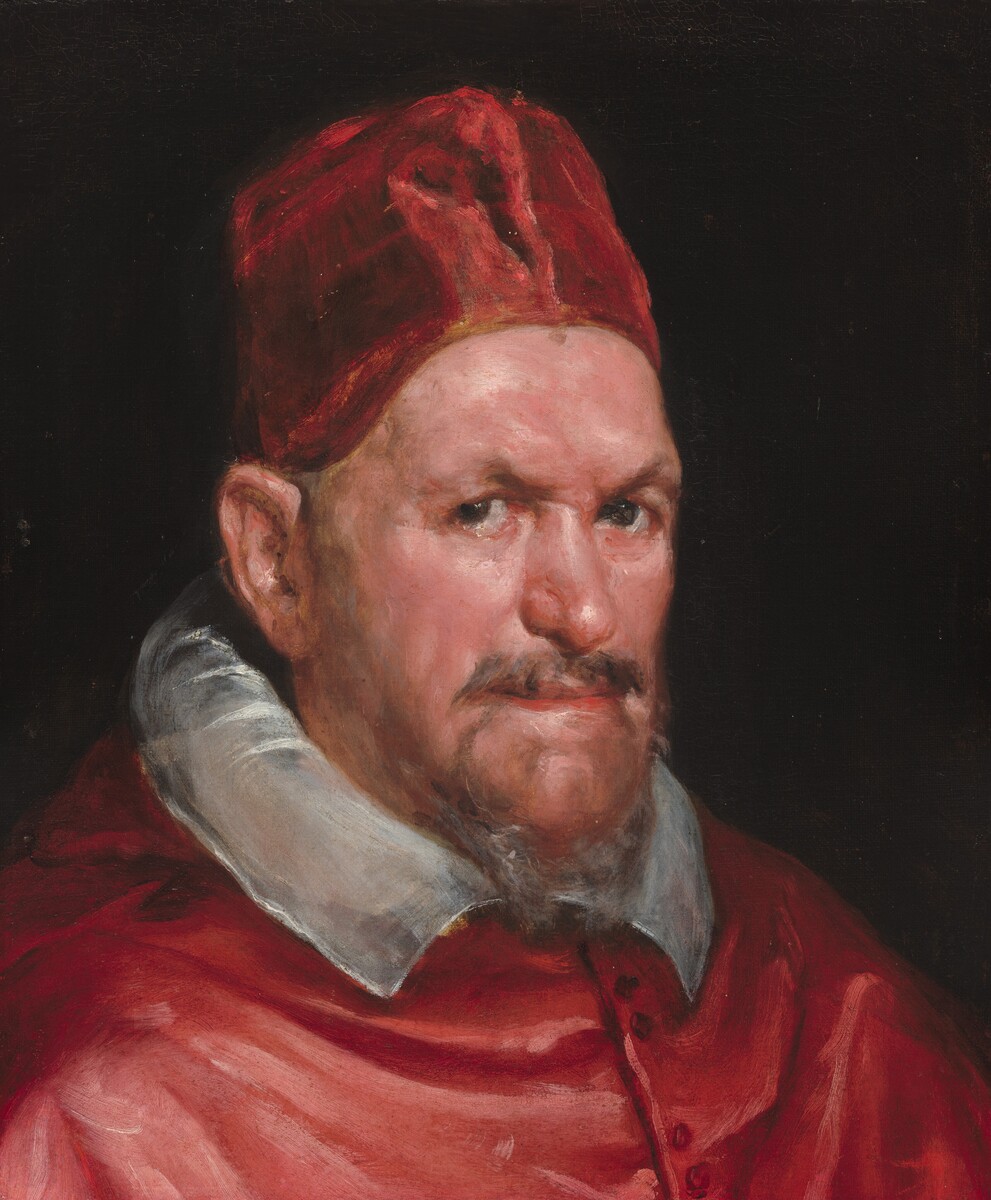
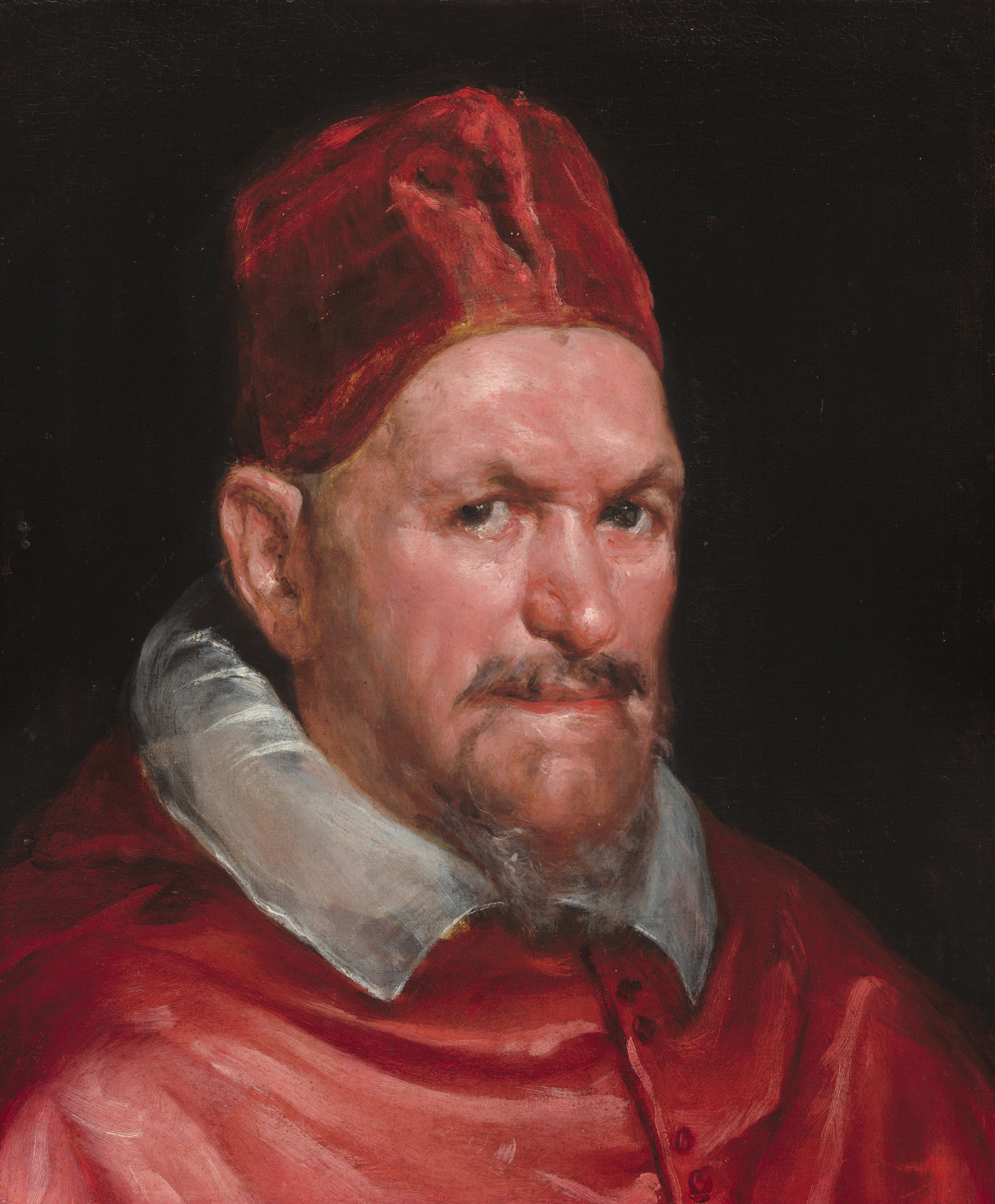
A bust-length portrait of Pope Innocent X, painted around 1650 by an anonymous artist associated with Diego Velázquez. The work shows the pope in crimson, looking at us from the corners of his eyes against a deep shadow. This gallery visit explains what the painting represents and how its visible choices shape that reading.
The red shoulder cape with visible buttons and loose brushwork across the lower half of the portrait, emphasizing the pope's office and the painterly handling of the drapery.
02
White rochet collar
The broad white collar framing the pope's neck and face, providing the painting's sharpest tonal contrast and identifying his ecclesiastical rank.
03
Red papal camauro
The red cap covering the pope's head, a sign of papal office and a strong color accent against the dark background.
Your gallery guide
Pope Innocent X by Circle of Diego Velázquez (c. 1650)
A bust-length portrait of Pope Innocent X, painted around 1650 by an anonymous artist associated with Diego Velázquez. The work shows the pope in crimson, looking at us from the corners of his eyes against a deep shadow. This gallery visit explains what the painting represents and how its visible choices shape that reading.
Editorial review by Artifact Archive automated publishing
Here is Pope Innocent X, painted around 1650 by an artist in the circle of Diego Velázquez.
The subject is a bust-length portrait of the pope, shown from the shoulders up against a dark background.
He wears a crimson-red cap and garment, and his flushed complexion is brightly lit from behind us.
The mahogany-brown background sits deep in shadow, so the figure stands out sharply.
His eyes meet ours from the corners, a sideways glance that gives the portrait its quiet tension.
The National Gallery of Art attributes the painting to an anonymous artist, with Velázquez listed as a related artist.
That means we are looking at a work made within his circle, not a documented autograph painting by Velázquez himself.
The painting's history shows how such attributions shift with time and taste.
It once belonged to Sir Robert Walpole at Houghton Hall, then passed by inheritance to his son and grandson.
In 1779 it was sold through Count Aleksei Musin-Pushkin to Catherine the Great and entered the Imperial Hermitage in Saint Petersburg.
In July 1930 it was sold as a work by Velázquez through Matthiesen Gallery, Colnaghi, and Knoedler to Andrew W. Mellon.
It was deeded to the A.W. Mellon Educational and Charitable Trust in 1932 and gifted to the National Gallery of Art in 1937.
What stays with you is that sideways glance and the way the light catches a face that seems both public and wary.
The painting asks you to look closely, and then to wonder who made it and why it was once thought to be by a master.
The story and its sources
Editorial review by Artifact Archive automated publishing.
Historical claims are linked to the records below. Close looking and interpretation are identified in the passage notes.
A bust-length portrait of Pope Innocent X, shown from the shoulders up, wearing a crimson-red cap and garment and looking at the viewer from the corners of his eyes against a dark background.(www.nga.gov, n.d.)
Title variants
Portrait of Pope Innocent X; Portrait of Innocent X
Attribution qualification
Anonymous artist, associated with Diego Velázquez
Accession number
1937.1.80
Support
canvas
Catalogue entry and attribution
The institutional record for this canvas gives it the title Pope Innocent X and attributes it to an anonymous artist, with Diego Velázquez named as a related artist. That configuration of fields matters for how the object should be described: the title identifies the sitter, but the attribution field does not assign the execution to Velázquez, and the related-artist field records the association without asserting authorship. The National Gallery of Art places the painting at c. 1650, a dating the catalogue attaches to the work itself rather than to any documentary record of its making. The support is canvas and the medium oil, and the picture measures 49.2 by 41.3 centimeters, or 19 3/8 by 16 1/4 inches. It belongs to the National Gallery of Art, Washington, D.C., within the Andrew W. Mellon Collection, under accession number 1937.1.80.(www.nga.gov, n.d., Title and artist; Date; Dimensions)
The catalogue's own language distinguishes what is shown from what is claimed. Shown from the shoulders up, a man with a flushed complexion wears a crimson-red cap and garment and looks out from the corners of his eyes in a vertical portrait. He is lit brightly from the viewer's side, while the mahogany-brown background recedes into deep shadow, so the figure separates sharply from the field behind it. These are description, not proof of authorship, and they sit alongside an attribution that leaves the maker unnamed. The effect of the entry is therefore double: it fixes the subject as Pope Innocent X and the date as c. 1650, while leaving open who painted the canvas that bears that title.(www.nga.gov, n.d., Title and artist; Date)
The National Gallery of Art titles the painting 'Pope Innocent X' and attributes it to an anonymous artist, with Diego Velázquez as a related artist.(www.nga.gov, n.d.)
The National Gallery of Art dates the painting to c. 1650.(www.nga.gov, n.d.)
The overall dimensions are 49.2 × 41.3 cm (19 3/8 × 16 1/4 in.).(www.nga.gov, n.d.)
The National Gallery of Art describes the painting as a vertical portrait showing a man from the shoulders up. He has a flushed complexion and wears a crimson-red cap and garment, and he looks out at the viewer from the corners of his eyes. The lighting is described as coming from behind the viewer, so that the figure is brightly lit while the mahogany-brown background sits deep in shadow. This juxtaposition of a strongly illuminated face and bust against a darkened ground gives the figure a pronounced visual prominence within the small canvas.(www.nga.gov, n.d., Visual Description)
Attribution and format
The Gallery titles the work Pope Innocent X and attributes it to an anonymous artist, listing Diego Velázquez as a related artist, and dates it to about 1650. The medium is oil on canvas, and the overall dimensions are 49.2 by 41.3 centimeters, or 19 3/8 by 16 1/4 inches. The painting belongs to the National Gallery of Art in Washington, D.C., in the Andrew W. Mellon Collection, accession number 1937.1.80. The attribution therefore places the picture within Velázquez's circle rather than identifying it as a documented autograph work by him, even though the composition and subject derive from the tradition of his papal portraiture.(www.nga.gov, n.d., Visual Description; Medium)(Wikimedia Commons: Portrait of Innocent X, n.d., Medium)
What the visual evidence establishes
Interpretation
Read together, the recorded visual facts and the institutional record define what can be securely stated about the object and what cannot. The shoulder-up framing, the crimson cap and garment, the flushed face, the sideways glance and the shadowed mahogany ground are documented features of the picture as described by the Gallery, while the identity of the sitter as Pope Innocent X and the connection to Velázquez rest on the Gallery's title and attribution rather than on an inscription or signature recorded in the evidence. The small dimensions and oil-on-canvas medium confirm that this is a modest-scale bust portrait, a format suited to close viewing, and the deliberate lighting and averted gaze are the principal means by which the anonymous painter creates the portrait's effect.(www.nga.gov, n.d., Visual Description; Medium)(Wikimedia Commons: Portrait of Innocent X, n.d., Medium)
Visual observation
Shown from the shoulders up, a man with a flushed complexion, wearing a crimson-red cap and garment, looks at us from the corners of his eyes in this vertical portrait painting.(www.nga.gov, n.d.)
He is brightly lit from behind us and the mahogany-brown background is deep in shadow.(www.nga.gov, n.d.)
The object's material identity, as recorded by the National Gallery of Art and repeated in the Wikimedia Commons file page, is oil on canvas, and the institutional record gives overall dimensions of 49.2 × 41.3 cm (19 3/8 × 16 1/4 in.). Those two facts, the support and its measurements, are the only documented physical data available in the supplied evidence; everything said below about support preparation, ground layers, pigment, medium additives, tool marks or condition treatment would be an extrapolation beyond what the sources establish. The canvas format is vertical and small, which is consistent with the bust-length, from-the-shoulders-up composition described in the institutional visual description: a restricted scale suited to a portrait head rather than a full figure. Whether the canvas was lined, stretched on its original strainer, primed with a particular ground, or cut down at any point cannot be determined from the supplied evidence and should not be asserted.(www.nga.gov, n.d., Medium; Visual Description)(Wikimedia Commons: Portrait of Innocent X, n.d., Medium)
Evidence base and limits
The evidence base for this work is exclusively documentary and descriptive rather than the product of technical imaging or sampling. The National Gallery of Art record supplies the title Pope Innocent X, an attribution to an anonymous artist with Diego Velázquez as related artist, a date of c. 1650, the medium, dimensions, credit line and accession number 1937.1.80, and a visual description; the Commons page confirms the medium and adds exhibition history and a source link back to the National Gallery. No entry mentions infrared reflectography, X-radiography, cross-sections, pigment analysis, canvas thread counts, dendrochronology of a stretcher, conservation treatment files or condition reports. This distinction matters for a materials-and-technique account: statements about what the picture superficially appears to be made of, and about how its painted surface behaves optically, rest on institutional description and visual observation, while claims about layer structure, binding media or workshop procedure would require examination evidence that is not present here. Any such claim should be labelled as unattributed inference rather than reported findings.(www.nga.gov, n.d., Medium; Visual Description)(Wikimedia Commons: Portrait of Innocent X, n.d., Medium)
Provenance, attribution and the material object
The physical description and the work's institutional position together explain why it matters to a material history of portraiture and of collecting. The picture is catalogued as an anonymous work with Velázquez as related artist, dated c. 1650, and it entered the National Gallery of Art through the Andrew W. Mellon Collection. Its earlier life is documented as changing hands at a high level: owned by Sir Robert Walpole, 1st earl of Orford, at Houghton Hall and passed by inheritance to his son and grandson; sold in 1779 through Count Aleksei Semonovich Musin-Pushkin to Catherine II, empress of Russia, entering the Imperial Hermitage Gallery, Saint Petersburg, inv. no. 418; sold in July 1930 as a work by Velázquez through Matthiesen Gallery, P. & D. Colnaghi & Co., and M. Knoedler & Co. to Andrew W. Mellon; deeded on 30 March 1932 to The A.W. Mellon Educational and Charitable Trust, Pittsburgh; and gifted in 1937 to the National Gallery of Art. These transactions describe material circulation and reattribution, not physical intervention, and nothing in the evidence states that the canvas, its support or its surface were altered in connection with any of them. It also documents that in July 1930 the painting was still being sold as a work by Velázquez, whereas the current catalogue attributes it to an anonymous artist, a change in attribution rather than a change in materials.(www.nga.gov, n.d., Medium)(Wikimedia Commons: Portrait of Innocent X, n.d., Medium)
Synthesis and unresolved questions
Interpretation
Read together, the three units allow a cautious reconstruction of what can and cannot be said about this object's making. The canvas support and its dimensions are documented; the oil medium is documented; the visual effect of frontal light against a shadowed mahogany-brown ground is described; the crimson-red headwear and garment and the flushed flesh tones are observed. What remains unestablished is the ground preparation, the number and sequence of paint layers, the palette ingredients, the brushwork technique and any restoration history, none of which the supplied records address. The sources also differ in scope rather than in substance: the National Gallery record carries the provenance, attribution and visual description, while the Commons page additionally reports that the painting was exhibited at the Kunsthistorisches Museum, Vienna, in the 2014–2015 exhibition Velázquez. The title of that exhibition indicates the framework in which the picture has been shown, but it does not supply further technical information about the canvas and should not be read as confirming an autograph attribution that the object record withholds.(www.nga.gov, n.d., Medium; Visual Description)(Wikimedia Commons: Portrait of Innocent X, n.d., Medium)
The provenance record for this portrait begins with Sir Robert Walpole, 1st earl of Orford, who owned the painting at Houghton Hall. From him it passed by inheritance to his son and then to his grandson, so that the earliest documented phase of its history is a family succession within a single English collection rather than a sequence of open-market transactions. That inheritance chain ended in 1779, when the painting was sold through Count Aleksei Semonovich Musin-Pushkin to Catherine II, empress of Russia, and entered the Imperial Hermitage Gallery in Saint Petersburg, where it was assigned inventory number 418. The record as preserved does not document the intermediate negotiations, the price, or the terms of the 1779 sale; it establishes the seller's agent, the royal buyer, the receiving institution, and the inventory identifier, and it is on those points that the account of the eighteenth-century transfer rests.(www.nga.gov, n.d., Provenance)
The 1930 Sale and the Mellon Gift
In July 1930 the painting was sold as a work by Velázquez through Matthiesen Gallery, P. & D. Colnaghi & Co., and M. Knoedler & Co. to Andrew W. Mellon. The attribution under which the work changed hands is part of the provenance evidence itself, not an inference from later cataloguing: the 1930 sale is documented as a sale of a Velázquez. Two further steps follow. The painting was deeded on 30 March 1932 to The A.W. Mellon Educational and Charitable Trust in Pittsburgh, and in 1937 it was gifted to the National Gallery of Art, where it forms part of the Andrew W. Mellon Collection under accession number 1937.1.80. The gap between the 1930 purchase, the 1932 deed of trust, and the 1937 gift is registered in the record as separate dated acts, and the provenance as published does not narrate what happened to the work between the Hermitage inventory of 1779 and the July 1930 sale.(www.nga.gov, n.d., Provenance)
Attribution and Provenance
Interpretation
The provenance sequence is inseparable from the history of the painting's attribution. The work entered the Imperial Hermitage as part of an imperial collection and was sold in 1930 explicitly as a work by Velázquez, yet the National Gallery of Art today titles it Pope Innocent X and attributes it to an anonymous artist, listing Diego Velázquez as a related artist and dating the picture to about 1650. The institutional record thus presents the object as a product of Velázquez's circle rather than a documented autograph painting. Read against the provenance, the 1930 sale documents what the work was believed to be at the moment Mellon acquired it, while the current attribution documents what sustained examination has since supported. The two are not contradictory pieces of evidence about ownership; they are evidence about how the scholarly assessment of the same physical object changed while its chain of custody remained documented at the points recorded above.(www.nga.gov, n.d., Provenance)
A Documented Object in a Museum Frame
Provenance also has a public afterlife. The painting was exhibited at the Kunsthistorisches Museum, Vienna, in the 2014–2015 exhibition Velázquez, an event that places the work in a display context organized around the artist to whom it was once attributed. The object itself is oil on canvas, with overall dimensions of 49.2 by 41.3 centimeters (19 3/8 by 16 1/4 inches), and it is shown from the shoulders up: a man with a flushed complexion, wearing a crimson-red cap and garment, looks at the viewer from the corners of his eyes against a mahogany-brown background deep in shadow. Those physical and visual particulars are the stable facts against which the changing ownership and attribution records should be read, and together they explain why a comparatively small canvas with a broken autograph attribution nonetheless holds a place in the museum's Mellon Collection and in the exhibition history of Velázquez studies.(Wikimedia Commons: Portrait of Innocent X, n.d., Exhibition history)(www.nga.gov, n.d., Provenance)
The painting was owned by Sir Robert Walpole, 1st earl of Orford, at Houghton Hall, and passed by inheritance to his son and grandson.(www.nga.gov, n.d.)
In 1779 it was sold through Count Aleksei Semonovich Musin-Pushkin to Catherine II, empress of Russia, and entered the Imperial Hermitage Gallery, Saint Petersburg, inv. no. 418.(www.nga.gov, n.d.)
In July 1930 the painting was sold as a work by Velázquez through Matthiesen Gallery, P. & D. Colnaghi & Co., and M. Knoedler & Co. to Andrew W. Mellon.(www.nga.gov, n.d.)
It was deeded on 30 March 1932 to The A.W. Mellon Educational and Charitable Trust, Pittsburgh, and gifted in 1937 to the National Gallery of Art.(www.nga.gov, n.d.)
Provenance timeline
1779
The painting was sold through Count Aleksei Semonovich Musin-Pushkin to Catherine II, empress of Russia, and entered the Imperial Hermitage Gallery, Saint Petersburg.(www.nga.gov, n.d., Provenance)
July 1930
The painting was sold as a work by Velázquez through Matthiesen Gallery, P. & D. Colnaghi & Co., and M. Knoedler & Co. to Andrew W. Mellon.(www.nga.gov, n.d., Provenance)
The exhibition record for this object, as carried on the Wikimedia Commons file page for the digital reproduction, is a single documented appearance: the painting was shown at the Kunsthistorisches Museum, Vienna, in the 2014–2015 exhibition 'Velázquez'. The evidence establishes the venue, the city and the 2014–2015 span together with the exact exhibition title, but it does not supply a catalogue number, a plate, a page reference or a checklist entry for the work, and no lender, installation or display context is recorded. Because the same source states that the painting belongs to the National Gallery of Art, Washington, D.C., as part of the Andrew W. Mellon Collection under accession number 1937.1.80, the Vienna showing is best understood as a loan of an already-collected picture rather than a change in ownership. That distinction matters for how the event is used: the exhibition title 'Velázquez' frames the painting within the master's name, while the National Gallery of Art's own attribution places it with an anonymous artist and lists Diego Velázquez only as a related artist. The exhibition history and the attribution therefore pull in different directions, and the surviving evidence does not indicate how the Vienna display resolved that tension, whether in label text, catalogue entry or wall caption.(Wikimedia Commons: Portrait of Innocent X, n.d., Exhibition history)
The painting's documented exhibition in Vienna is one episode in a much longer institutional life that the provenance record makes unusually legible. It was owned by Sir Robert Walpole, 1st earl of Orford, at Houghton Hall, and passed by inheritance to his son and grandson. In 1779 it was sold through Count Aleksei Semonovich Musin-Pushkin to Catherine II, empress of Russia, and entered the Imperial Hermitage Gallery, Saint Petersburg, under inventory number 418. It left Russia in July 1930, when it was sold as a work by Velázquez through Matthiesen Gallery, P. & D. Colnaghi & Co., and M. Knoedler & Co. to Andrew W. Mellon. It was deeded on 30 March 1932 to The A.W. Mellon Educational and Charitable Trust, Pittsburgh, and gifted in 1937 to the National Gallery of Art. That sequence gives the 2014–2015 Vienna exhibition its institutional footing and also supplies the terms in which the picture has been described over time: from an English aristocratic collection, through an imperial Russian one, to an American public museum, with the 1930 sale explicitly conducted as a work by Velázquez even though the National Gallery of Art now titles it 'Pope Innocent X' and attributes it to an anonymous artist with Velázquez as a related artist.(www.nga.gov, n.d., Provenance)(Wikimedia Commons: Portrait of Innocent X, n.d., Exhibition history)
Read against the object's physical description and dimensions, the exhibition history also clarifies what kind of picture was being lent. It is oil on canvas, measuring 49.2 × 41.3 cm (19 3/8 × 16 1/4 in.) overall, a small bust-length portrait. The National Gallery of Art describes a man with a flushed complexion, shown from the shoulders up, wearing a crimson-red cap and garment, looking at the viewer from the corners of his eyes; he is brightly lit from behind us, and the mahogany-brown background is deep in shadow. Those are the features a viewer encountered in the gallery, whereas the exhibition title 'Velázquez' supplied a name and a canon. The evidence allows the two to be set side by side without collapsing one into the other: a modestly scaled canvas on long-term public view in Washington was, for the 2014–2015 season, presented in Vienna under a title that emphasized the master rather than the anonymous hand to which the owning institution currently assigns it.(Wikimedia Commons: Portrait of Innocent X, n.d., Exhibition history)(www.nga.gov, n.d., Provenance)
Attribution, Unexhibited Status and the Limits of the Record
Interpretation
What the exhibition record does not do is settle the question of authorship, and the evidence is explicit about the limits of what can be claimed. The attribution rests on an institutional statement rather than a signed or documented autograph: the National Gallery of Art titles the painting 'Pope Innocent X' and attributes it to an anonymous artist, with Diego Velázquez as a related artist. The 1930 sale to Mellon is recorded as having been made 'as a work by Velázquez', which shows that the market description and the present curatorial attribution differ, but the supplied evidence does not explain when, why or on whose authority that change occurred, nor does it record a reattribution date, a technical examination, a conservation treatment or a scholarly publication that argued the case. The 2014–2015 Vienna exhibition, titled simply 'Velázquez', sits within that unresolved space. The safest reading of the evidence is that the picture belongs to Velázquez's circle and has been exhibited under a title that foregrounds his name, while its current catalogue entry withholds an autograph attribution.(Wikimedia Commons: Portrait of Innocent X, n.d., Exhibition history)
One further boundary should be marked. The exhibition evidence concerns this painting's display history; the section's evidence does not describe any catalogue in which an object is discussed without being shown, nor does it record a current installation state at the National Gallery of Art or at the Kunsthistorisches Museum beyond the 2014–2015 dates. The four provenance units used here come from the museum's own object record and from the same Wikimedia Commons file page that supplies the Vienna exhibition, and they are cited for the light they throw on the picture's movement between collections rather than for any details of the Vienna installation. On the record as supplied, the painting's exhibition history consists of the documented 2014–2015 'Velázquez' showing in Vienna, and its attribution consists of an anonymous-artist entry with Velázquez as a related artist, a pairing that the evidence presents without reconciliation.(Wikimedia Commons: Portrait of Innocent X, n.d., Exhibition history)(www.nga.gov, n.d., Provenance)
The painting known at the National Gallery of Art as Pope Innocent X is an oil on canvas whose overall dimensions are 49.2 by 41.3 centimeters, that is 19 3/8 by 16 1/4 inches. It is in the collection of the National Gallery of Art, Washington, D.C., as part of the Andrew W. Mellon Collection, accession number 1937.1.80, and the museum dates it to about 1650. The institutional record titles the work Pope Innocent X and attributes it to an anonymous artist, listing Diego Velázquez only as a related artist. The Wikimedia Commons file page for the digital reproduction carries the object under the descriptive title Portrait of Pope Innocent X and the attributional phrase that it belongs to the circle of Diego Velázquez. The distinction matters for how the object is studied: it is a bust-length papal portrait produced within or near Velázquez's ambit, not a documented autograph painting by Velázquez himself, and both the repository title and the attribution fields encode that qualification.(www.nga.gov, n.d., Credit Line and Accession Number)(Wikimedia Commons: Portrait of Innocent X, n.d., Current location and Accession number)
Provenance and the market
The provenance recorded by the National Gallery of Art traces the picture through several collections before it reached Washington. It was owned by Sir Robert Walpole, 1st earl of Orford, at Houghton Hall, and passed by inheritance to his son and then to his grandson. In 1779 it was sold through Count Aleksei Semonovich Musin-Pushkin to Catherine II, empress of Russia, and entered the Imperial Hermitage Gallery, Saint Petersburg, with inventory number 418. In July 1930 it was sold as a work by Velázquez through Matthiesen Gallery, P. & D. Colnaghi & Co., and M. Knoedler & Co. to Andrew W. Mellon. It was deeded on 30 March 1932 to The A.W. Mellon Educational and Charitable Trust, Pittsburgh, and gifted in 1937 to the National Gallery of Art. This sequence is the firm documentary spine of the object's history, and it shows the painting moving from an English country-house collection into one of the great imperial collections of Europe and finally through the twentieth-century art trade into an American public museum.(www.nga.gov, n.d., Credit Line and Accession Number)(Wikimedia Commons: Portrait of Innocent X, n.d., Current location and Accession number)
Reception and display
Interpretation
Read together, the evidence establishes a division between what the object is documented to be and what it has been taken to be at different times. The documented facts are the medium, the dimensions, the c. 1650 date proposed by the museum, the accession number 1937.1.80, the place in the Andrew W. Mellon Collection, the Walpole to Hermitage to Mellon provenance, and the 2014 to 2015 Vienna showing. The attributional facts are that the National Gallery of Art names an anonymous artist with Velázquez as a related artist, while the 1930 sale was conducted as a Velázquez and the Commons file page describes the work by the phrase circle of Diego Velázquez. That division gives the object its place within a larger history of art and material culture: it is a small oil portrait whose composition, lighting and sidelong glance belong to the pictorial language associated with Velázquez's Roman papal portraiture, but whose status as an anonymous or circle work makes it evidence for workshop practice, for the early modern circulation of prestigious images, and for the way collections and the art market have assigned and reassigned authorship.(www.nga.gov, n.d., Credit Line and Accession Number)(Wikimedia Commons: Portrait of Innocent X, n.d., Current location and Accession number)
A calculated working insurance estimate records a range of US$350K to US$2.5M, generated on 2026-10-16 as a broad working range for manual review only. The stated methodology considers the confirmed facts in the supplied context: an oil on canvas portrait of Pope Innocent X, dated c. 1650, approximately 49.2 × 41.3 cm unframed, associated with the circle of Diego Velázquez; the National Gallery of Art listing as by an anonymous artist associated with Diego Velázquez, accession number 1937.1.80, from the Andrew W. Mellon Collection; and a provenance including Sir Robert Walpole, Catherine II of Russia, and the Imperial Hermitage, with a later sale in 1930 as a painting by Velázquez prior to Mellon's acquisition. The methodology states that these historical, institutional, and provenance factors support a conservative range above ordinary unsigned Baroque workshop copies but well below autograph Velázquez levels. The document qualifies itself as model-generated, not an official insurance value, appraisal, auction result, or sale price, and states that it does not rely on comparable sales or private insurance records and that actual insurance values require professional appraisal, condition assessment, and verification of attribution, provenance, and market factors.(www.nga.gov, n.d.)(Wikimedia Commons: Portrait of Innocent X, n.d.)
The recorded valuation is the most explicitly qualified element of the object's documentation, and its own terms limit how it can be used. It is a working calculation for manual review, generated from the supplied context rather than from comparables or private records, and it explicitly declines to function as an appraisal or a sale price. Its reasoning ties the range to the object's institutional standing, its documented provenance through Walpole, Catherine II and the Imperial Hermitage, and its 1930 sale as a Velázquez, while also tying the ceiling of that range to the current attribution by an anonymous artist associated with Velázquez. The gap between the two accounts is therefore not a factual conflict but a historical one: the 1930 sale proceeded under a Velázquez name, and the museum now lists the work as anonymous with Velázquez as a related artist, and the calculated range is framed around the latter, current state of the record.(www.nga.gov, n.d.)(Wikimedia Commons: Portrait of Innocent X, n.d.)
What the evidence establishes
Within a larger history of art and material culture, the object matters less as a candidate autograph Velázquez than as a documented example of how attribution, collection and market description change over centuries. Its movement from Houghton Hall through inheritance, to Catherine II and the Imperial Hermitage as inventory number 418, to the 1930 sale through Matthiesen Gallery, P. & D. Colnaghi & Co. and M. Knoedler & Co. to Andrew W. Mellon, and finally to the National Gallery of Art in 1937, shows a circulation pattern in which a work associated with a major name could be collected and transmitted at the highest levels before its attribution settled elsewhere. The exhibition of the painting at the Kunsthistorisches Museum, Vienna, in 2014–2015 under the Velázquez exhibition title shows that the object continues to be presented in major scholarly contexts even under an anonymous attribution. What the evidence supports is a record of successive valuations and descriptions, not a settled account of authorship.(www.nga.gov, n.d.)(Wikimedia Commons: Portrait of Innocent X, n.d.)
Working estimate
Calculated working insurance estimate, not a sale price: Working insurance range: US$350K to US$2.5M Recorded date: Working calculation, generated 2026-10-16. Methodology: This is a broad working insurance range for manual review only. It is not an appraisal. The calculation considers the confirmed facts in the supplied context: the work is an oil on canvas portrait of Pope Innocent X, dated c. 1650, measuring approximately 49.2 x 41.3 cm unframed, and associated with the circle of Diego Velazquez. The National Gallery of Art, Washington, D.C. lists it as by an anonymous artist associated with Diego Velazquez, accession number 1937.1.80, from the Andrew W. Mellon Collection. The provenance includes Sir Robert Walpole, Catherine II of Russia, and the Imperial Hermitage, and the work was later sold in 1930 as a painting by Velazquez prior to Mellon's acquisition. These historical, institutional, and provenance factors support a conservative range above ordinary unsigned Baroque workshop copies but well below autograph Velazquez levels. The range is intentionally broad and should be refined only after physical inspection, condition assessment, and review of appropriate market and insurance references. Qualification: This is a model-generated working range for manual review. It is not an official insurance value, appraisal, auction result, or sale price. It does not rely on comparable sales or private insurance records. Actual insurance values require professional appraisal, condition assessment, and verification of attribution, provenance, and market factors. The work is listed by the National Gallery of Art as by an anonymous artist associated with Diego Velazquez, not as an autograph work by Velazquez.(www.nga.gov, n.d.)(Wikimedia Commons: Portrait of Innocent X, n.d.)
Bibliography
Sources and further reading
References are arranged by author or organisation, with links to the original publications. Where no publication date is recorded, n.d. means no date.
Source notes updated .
No recorded sources match these filters. Reset the filters to see the full bibliography.
Recorded as a history of Rome and the court of Innocent X Pamfili from 1644 to 1655, with Pope Innocent X himself listed among the authors. The subject matches the sitter's papacy and Roman court, the documented historical setting for portraits of Innocent X, so it offers contextual material for the painting's subject.
Wikimedia Commons file page for the digital reproduction of the painting, providing file title, artist attribution, date, medium, dimensions, collection, accession number, exhibition history, and source link to the National Gallery of Art.
Official object page for the painting at the National Gallery of Art, providing title, attribution, date, medium, dimensions, credit line, accession number, provenance, exhibition history, and a visual description.
Advertising supports the archive. These preferences control aggregate page counting, reading activity and ad-delivery diagnostics. They use no visitor tracking cookie.