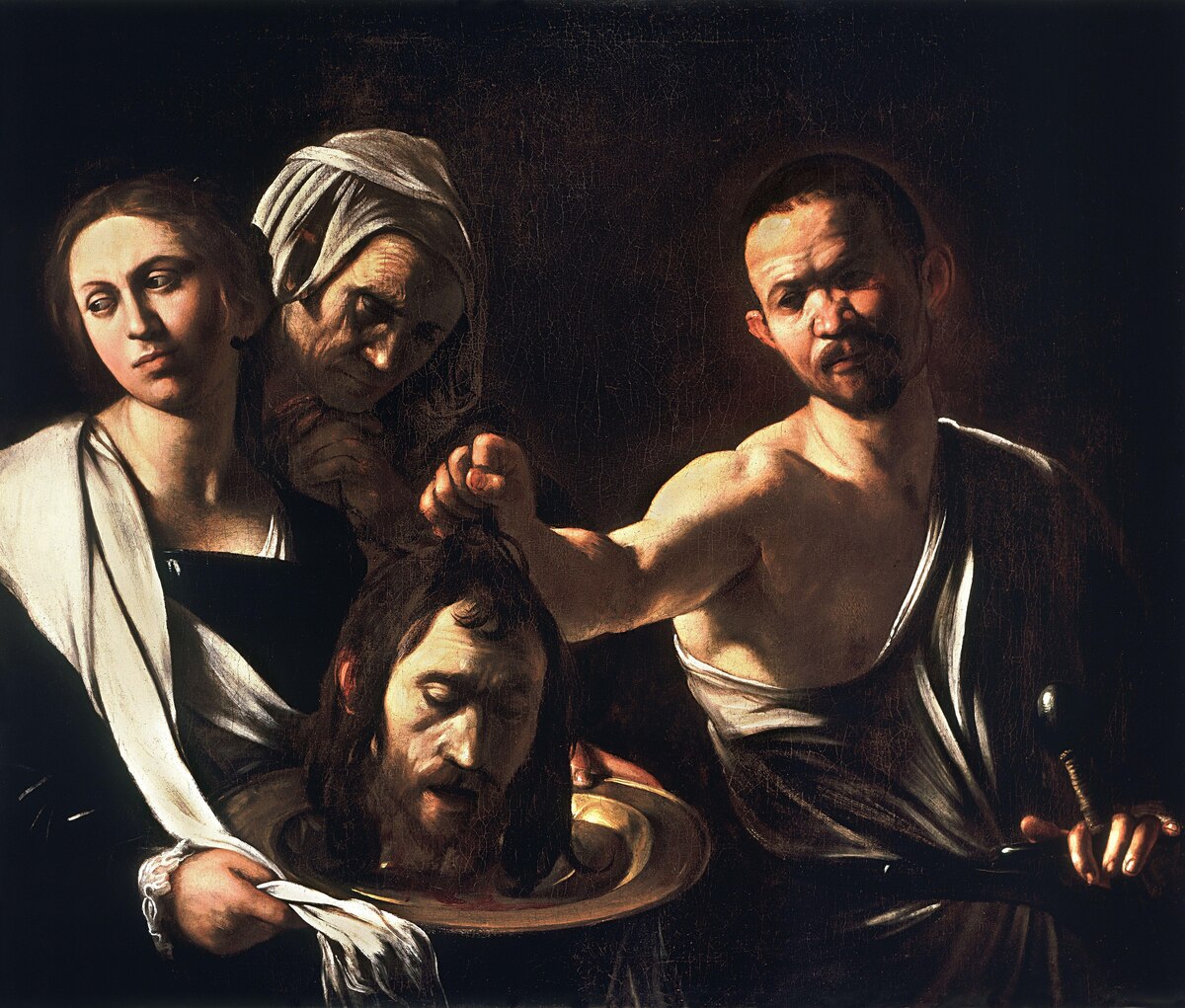
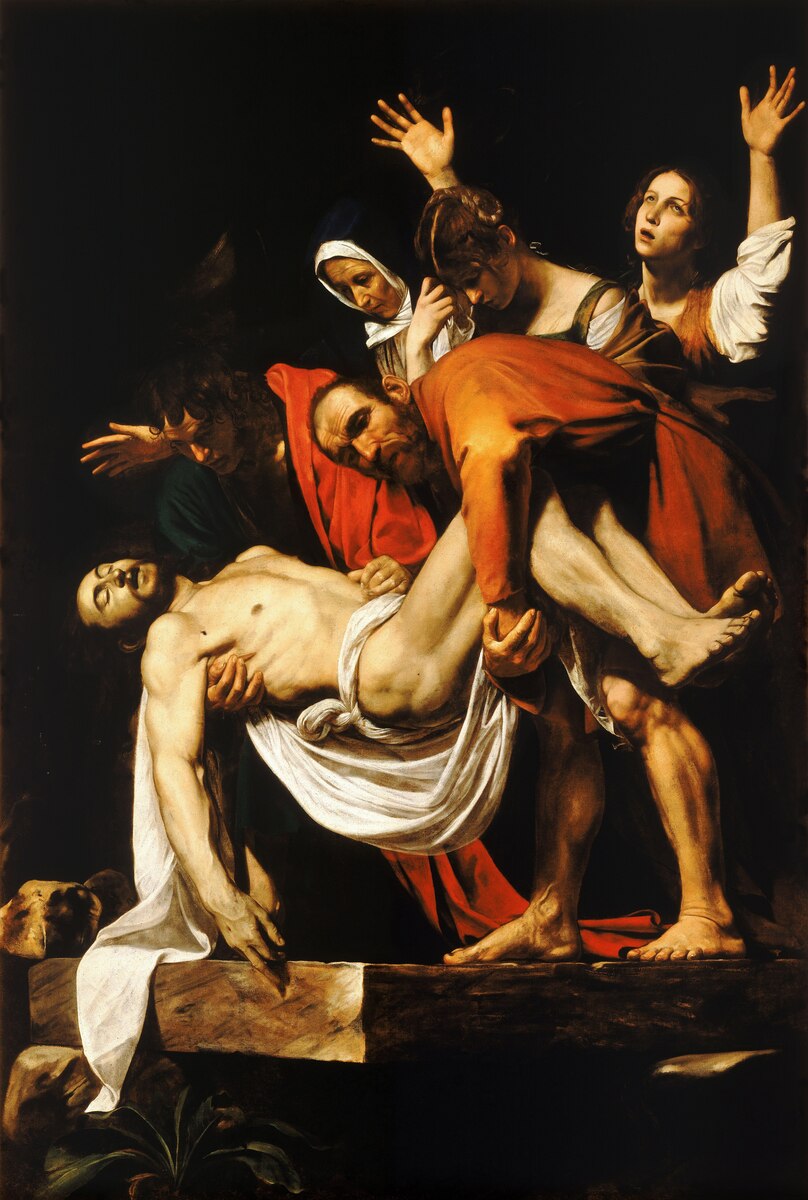
A late painting by Caravaggio showing Salome with the severed head of John the Baptist, made around 1610 and now in the National Gallery, London. This short tour explains the biblical episode, the figures, and how the picture turns a gruesome subject into a quiet, troubling scene.
The elderly attendant, wrapped in a white cloth headdress, presses her hands together and looks down at the head, adding grief and foreboding beside Salome's composure.
02
Hand gripping the head by the hair
The executioner's fist closes on the Baptist's hair to present the severed head above the platter; the gesture is the action that freezes the moment of display.
03
Executioner's face
The bare-shouldered executioner turns his lit face toward the viewer with a challenging, unrepentant look, an unusual direct address that sharpens the picture's confrontation.
Your gallery guide
Salome with the Head of John the Baptist by Caravaggio (Michelangelo Merisi da Caravaggio) (circa 1610)
A late painting by Caravaggio showing Salome with the severed head of John the Baptist, made around 1610 and now in the National Gallery, London. This short tour explains the biblical episode, the figures, and how the picture turns a gruesome subject into a quiet, troubling scene.
Editorial review by Artifact Archive automated publishing
This is Caravaggio's Salome with the Head of John the Baptist, painted around 1610.
It shows the moment after the prophet John has been executed. Salome holds a platter carrying his severed head.
At the centre, an executioner leans forward and presents the head by its hair.
Salome stands slightly behind the platter, her gaze turned away from the face. An older woman watches from the shadowed right.
The subject comes from the New Testament story of Herod Antipas and Herodias. John the Baptist condemned their marriage, and Herodias's daughter Salome danced for Herod. He promised her anything, and she asked for the prophet's head.
Caravaggio painted this late in his short life, in about 1610, the year he died.
Caravaggio keeps the setting dark and close. The light picks out faces and hands, while the background recedes into black.
That narrowing of attention makes the platter the still point of the picture. The horror is present, but it is held at a distance by Salome's turned head and the calm arrangement of the figures.
What stays with you is not the violence but the avoidance. Salome does not look at what she has asked for. The executioner looks down at the head, and the old woman looks on.
Caravaggio gives us a moment after the deed, when the room has gone quiet. The painting asks you to notice who is willing to meet the prophet's eyes and who is not.
This is a religious painting, but it is also a study in complicity and silence. Caravaggio made it near the end of his life, and it remains one of his starkest images. It is now in the National Gallery, London.
The story and its sources
Editorial review by Artifact Archive automated publishing.
Historical claims are linked to the records below. Close looking and interpretation are identified in the passage notes.
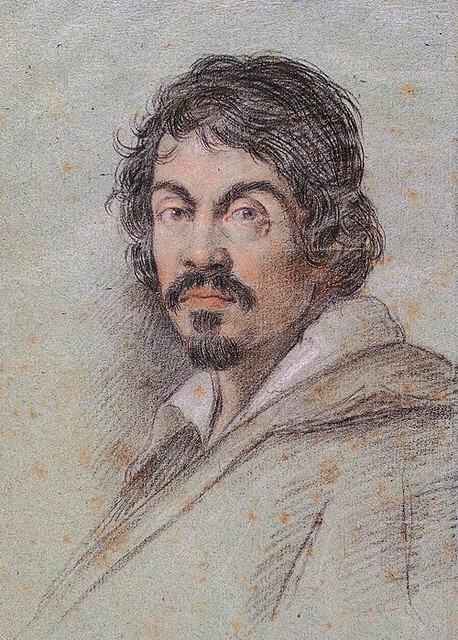
Caravaggio was an Italian painter (1571–1610). Their work is associated with Baroque; Counter-Reformation. Their recorded places of work include Rome; Zagarolo; Naples; Valletta; Syracuse; Genoa; Messina; Milan; Palermo; Paliano.
The painting depicts Salome with the severed head of John the Baptist on a platter. Salome is shown holding the platter, while an executioner presents the head and an old woman looks on. The work represents the biblical episode of the beheading of John the Baptist, a subject from the New Testament narratives of Herod Antipas and Herodias.(Wikimedia Commons: Salome with the Head of John the Baptist, n.d.)
Title variants
Salome receives the Head of John the Baptist; Salome with the Head of St John the Baptist; Salome with the Head of John the Baptist; Salome con la cabeza de Juan el Bautista; Salome z głową Jana Chrzciciela
Accession number
NG6389
Support
canvas
Catalogue identity and attribution
The object is catalogued as 'Salome with the Head of John the Baptist', a religious painting attributed to Caravaggio. Within the catalogue record the attribution is presented as an attribution rather than as an unqualified statement of authorship, and the same record assigns the work a date of circa 1610. That date belongs to the object's own chronology as given by the source, not to the date of any later catalogue, photograph or file entry that transmits the information. The recorded medium is oil on canvas, and the recorded dimensions are 106 cm in height and 91 cm in width, equivalently 41.7 in by 35.8 in. The painting is listed in the collection of the National Gallery, London, under accession number NG6389. The depicted people are recorded as including Salome, and the image is described as showing Salome with the head of John the Baptist, so that subject, genre and named figure are all part of the catalogue identity rather than inferences from the visual account alone.(Wikimedia Commons: Salome with the Head of John the Baptist, n.d., Wikimedia Commons file title; Date field; Dimensions field; Genre field; Depicted people field)
The attribution carried by the catalogue points to an artist whose documented activity is bounded tightly around the object's own date. Caravaggio, that is Michelangelo Merisi da Caravaggio, is recorded as an Italian painter active from 1593 to 1610, born in Milan and died at Porto Ercole. A work dated circa 1610 therefore falls at the extreme end of that documented span, in the same year as the painter's recorded death, which is a chronological relationship established by the two dates rather than a claim about the circumstances of execution. Because the catalogue date is introduced with 'circa', it should be read as an approximate placement within the artist's late activity, and it does not by itself specify a month, a patron, a commission or a location of making. The attribution and the date are consequently interdependent pieces of identity: the painting's place in the catalogue rests on both the name attached to it and the narrow window of years in which that name is documented to have worked.(Wikimedia Commons: Salome with the Head of John the Baptist, n.d., Wikimedia Commons file title; Date field; Artist information)
Interpretation
Read together, the catalogue entries produce a compact but layered identity for the object. Title, attribution, approximate date, medium, dimensions, collection and accession number form the documentary frame; the statement that the work is religious art and that its depicted people include Salome forms the subject frame. Nothing in these units records a signature, a document of commission, a provenance chain or an earlier title variant, so the object's identity as transmitted here is institutional and descriptive rather than archival in the strict sense. The reference to Salome in the depicted-people field is also the point at which the catalogue record of this object touches the wider body of research on the same subject, a connection that the separate context material supports where the figure of the artist and his working dates are concerned.(Wikimedia Commons: Salome with the Head of John the Baptist, n.d., Wikimedia Commons file title; Dimensions field; Genre field; Depicted people field; Artist information)
The object under consideration is an oil on canvas depicting Salome with the head of John the Baptist, attributed to Caravaggio and dated to about 1610. It measures 106 cm in height and 91 cm in width and belongs to the collection of the National Gallery, London, where it carries the accession number NG6389. The work is classified as religious art, and Salome is named among the depicted people. This combination of title, medium, dimensions, date, collection and accession number forms the working identification of the picture, and it is the documentary frame within which any description of the visible surface has to operate. The painting sits at the very end of the artist's life: Caravaggio, that is Michelangelo Merisi da Caravaggio, was an Italian painter active from 1593 to 1610, born in Milan and dead at Porto Ercole. A work dated around 1610 is therefore a late work by a painter whose documented career spans only some seventeen years, which is one reason the picture carries unusual weight in any account of his final phase.(Wikimedia Commons: Salome with the Head of John the Baptist, n.d., Description; Artist information; Medium field)
The object is an oil on canvas measuring 106 cm in height and 91 cm in width, catalogued as Salome with the Head of John the Baptist and attributed to Caravaggio, dated circa 1610. It belongs to the National Gallery, London, under accession number NG6389, and is classed as a religious work. Its depicted subject is Salome with the head of John the Baptist, and Salome is named among the depicted people. The artist, Michelangelo Merisi da Caravaggio, was an Italian painter active from 1593 to 1610, born in Milan and died at Porto Ercole, so the circa 1610 date places the picture at the close of his short career rather than in its middle years. That timing matters for how the work is read within his oeuvre, and it also shapes what any account of its making can and cannot claim: the documentary record supplied here fixes the artist, the subject, the medium and dimensions, and the holding institution, but it does not by itself explain who asked for the picture or why.(Wikimedia Commons: Salome with the Head of John the Baptist, n.d., Artist information)
Interpretation and Open Questions
Interpretation
Read as a whole, the picture can be described as a religious painting that is also a study in complicity and silence, and it is often counted among the starkest of Caravaggio's late images. That characterization rests on the visible disposition of the figures and on the date, which places it in the final year of his life. The evidence supplied here does not name a patron, a commissioning occasion or a provenance history for NG6389, so those questions remain open in this account; the secure elements are the attribution, the circa 1610 date, the medium and dimensions, the London collection and accession number, and the subject as described. The interest of the work for a larger history of art and material culture lies in how a scriptural narrative of royal power, promised reward and judicial killing is compressed into a dark, close interior in which the decisive action has already occurred, leaving the viewer to weigh the positions of the three surviving figures rather than the act itself.(Wikimedia Commons: Salome with the Head of John the Baptist, n.d., Artist information; Description)
The materials record for this painting is compact but precise: it is executed in oil on canvas, with dimensions of 106 cm in height and 91 cm in width. Those two facts govern much of what can be said about how the picture was made. A canvas of roughly a metre by ninety centimetres is a portable, moderately sized support rather than a monumental altarpiece panel, and oil paint on such a support permits the layered build-up, reworking and deep tonal manipulation that define the finished surface. The evidence states the medium and the dimensions directly, so they can be treated as documented properties of the object rather than inferences from its appearance. What the record does not supply is any account of the specific canvas weave, the ground or priming, the preparatory drawing, or the pigments employed, and those gaps should be respected rather than filled by assumption.(Wikimedia Commons: Salome with the Head of John the Baptist, n.d., Medium field)
The painting known as Salome with the Head of John the Baptist is attributed to Caravaggio, the Italian painter Michelangelo Merisi da Caravaggio, who was active from 1593 to 1610, born in Milan and died at Porto Ercole. The work is dated circa 1610, the final year of his life, and is executed in oil on canvas at a height of 106 cm (41.7 in) and a width of 91 cm (35.8 in). It depicts Salome together with the head of John the Baptist and is classed as a religious work. These discovery and verification details come from the institutional record reproduced on the Wikimedia Commons file page for the object.(Wikimedia Commons: Salome with the Head of John the Baptist, n.d., Collection and accession number)
Interpretation
The object belongs to the collection of the National Gallery, London, where it carries accession number NG6389. That accession number and collection location are the documented institutional facts that anchor the painting within a public museum collection and allow it to be identified unambiguously alongside its attribution, title, date, medium and dimensions. Within the larger history of art and material culture, the painting's presence in a major national collection is what makes the object available for sustained study and display, while the convergence of the artist's death year with the circa 1610 dating places it at the close of Caravaggio's short career.(Wikimedia Commons: Salome with the Head of John the Baptist, n.d., Collection and accession number)
The object is an oil on canvas attributed to Caravaggio, titled Salome with the Head of John the Baptist, dated circa 1610, with dimensions of approximately 106 by 91 cm, and held in the collection of the National Gallery, London, under accession number NG6389. It is catalogued as a religious painting of the Baroque period in Italy, and the depicted people include Salome. That combination of artist, title, date, medium, support, size, subject, collection and accession number is the identification and collection context on which every value statement below depends, because the supplied records establish what the painting is and where it is, not what it would sell for. The same record identifies Caravaggio as Michelangelo Merisi da Caravaggio, an Italian painter active from 1593 to 1610, born in Milan and died in Porto Ercole, which places the circa 1610 dating of this canvas at the very end of his activity.(Wikimedia Commons: Salome with the Head of John the Baptist, n.d.)
Recorded values
The only value figure supplied is a calculated working insurance estimate of US$80 million to US$200 million, recorded as a working calculation generated on 2026-10-16. Its methodology is explicitly model-generated and anchored to supplied context only: the artwork's confirmed status as an oil on canvas by Caravaggio, circa 1610, approximately 106 by 91 cm, Baroque, Italy, National Gallery, London, accession NG6389, combined with Caravaggio's museum-level importance and the scale and condition of this composition. The range is described as deliberately broad so that manual review precedes any binding insurance decision, and it applies a wide, conservative uncertainty band. The qualification attached to it states plainly that it is not an official insurance value, appraisal, auction result or sale price, that no verified comparable sale, private insurance schedule or official appraisal is provided, and that no comparable sales or private insurance records were consulted; an actual insurance value would require in-person examination by a qualified fine-art appraiser and review of the institution's collection and risk-management policies.(Wikimedia Commons: Salome with the Head of John the Baptist, n.d.)
The methodology contains a conceptual claim worth separating from the number itself: such an old-master painting of museum quality with secure, long-standing public-collection status is not insurable at replacement cost in the ordinary sense. That reasoning follows from the collection status established by the identification record rather than from any market transaction, and it explains why the produced range is framed as a review aid and not as a price. The estimate therefore documents a method and its limits, alongside the underlying identification facts, rather than establishing a market value for this painting.(Wikimedia Commons: Salome with the Head of John the Baptist, n.d.)
Read as an accumulating research record, the supplied documentation supports the painting's identification, its late date within Caravaggio's short career, and its public-collection context, and it supplies one explicitly qualified valuation exercise while supporting no public valuation of its own. Any later account of the painting's worth has to keep those categories apart: the accession record answers what the object is and where it is, the calculated range answers only what a model produced from that record on a stated date under a stated methodology, and an appraisal, auction result or official insurance schedule remains absent from the evidence rather than merely unmentioned.(Wikimedia Commons: Salome with the Head of John the Baptist, n.d.)
Working estimate
Calculated working insurance estimate, not a sale price: Estimated value: US$80M to US$200M Recorded date: Working calculation, generated 2026-10-16. Methodology: This is a conservative, model-generated working range derived from supplied context only, not an appraisal. The artwork is confirmed as an oil on canvas by Caravaggio, circa 1610, approximately 106 x 91 cm, from the Baroque period in Italy, and held at the National Gallery, London (accession NG6389). Such an old-master painting of museum quality with secure, long-standing public-collection status is not insurable at replacement cost in the ordinary sense. A broad range is therefore estimated by anchoring to Caravaggio's museum-level importance and the scale and condition of this composition, then applying a wide, conservative uncertainty band because no verified comparable sale, private insurance schedule, or official appraisal is provided. The range is deliberately broad to support manual review before any binding insurance decision. Qualification: This is a model-generated working range for manual review only. It is not an official insurance value, appraisal, auction result, or sale price. The supplied sources support the artwork's identification and collection context, not a public valuation. No comparable sales or private insurance records were consulted. Actual insurance values would require an in-person examination by a qualified fine-art appraiser and review of the institution's collection and risk-management policies.(Wikimedia Commons: Salome with the Head of John the Baptist, n.d.)
Bibliography
Sources and further reading
References are arranged by author or organisation, with links to the original publications. Where no publication date is recorded, n.d. means no date.
Source notes updated .
No recorded sources match these filters. Reset the filters to see the full bibliography.
Wikimedia Commons file page providing the primary discovery metadata and an institutional record for the painting. It includes artist, title, date, medium, dimensions, collection, accession number, and a brief description. Used as the discovery and verification source for this object.
Advertising supports the archive. These preferences control aggregate page counting, reading activity and ad-delivery diagnostics. They use no visitor tracking cookie.