Rotterdam
Artist: Wassily Kandinsky · [1904]

Rotterdam: high-resolution image
The original file is hosted by Wikimedia Commons, available without payment or an account.
Open high-resolution image on Wikimedia CommonsThe complete story
The story About 3 minutes to read
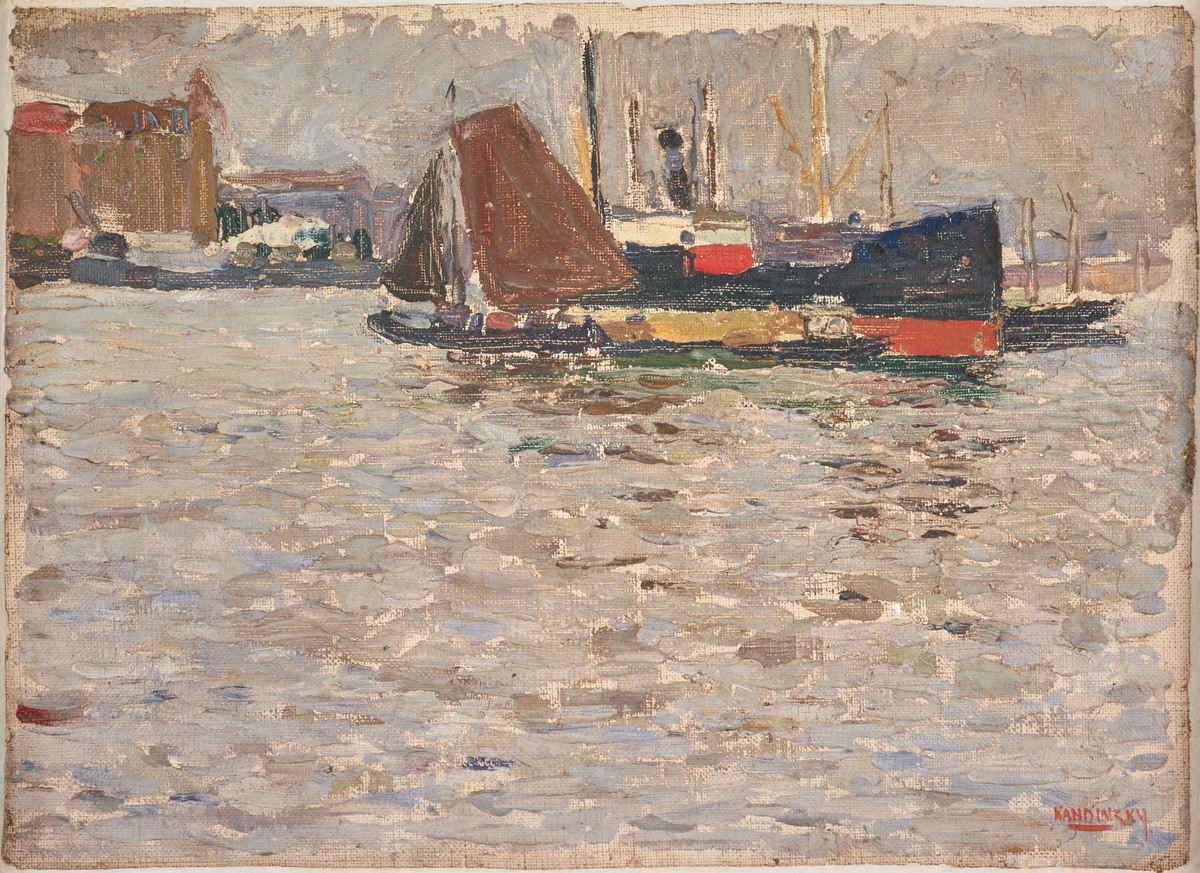
Before you is a view of Rotterdam's harbor, painted in 1904 by Wassily Kandinsky. The subject is a port, with boats on the water. Kandinsky would later become famous for abstraction. In this small scene, he is still looking at real boats in a real harbor.
The museum record names what you see with plain keywords: port, boat, water, Rotterdam, Netherlands. Those are the subjects the collection itself assigns to the painting. So the picture is a working harbor. And the water, boats and city sit together in a confined, small format.
This is an early work. The collection dates it 1904, when Kandinsky was still painting recognisable places rather than pure colour and form. The record lists it under early twentieth-century modernism, before abstraction. That frame helps you see the harbor as a step rather than a departure.
The museum's keywords point outward to Rotterdam in 1904, a real shipping city. What we do not have in this record is a commentary on how the harbour was rendered. So any claim that Kandinsky pushed colour or form toward abstraction here is an inference from looking, not a documented reading. Keep that boundary in mind.
What is firmly known is the subject: boats and water at Rotterdam, painted in 1904. That is what the work is about, and it is enough to start with. Stand close and enjoy a small harbour scene by a painter who would later leave the harbour behind.
The story and its sources
Historical claims are linked to the records below. Close looking and interpretation are identified in the passage notes.
- Passage 1Documented historyInstitutional record for RotterdamInstitutional record for Rotterdam
- Passage 2Close lookingInstitutional record for RotterdamInstitutional record for Rotterdam
- Passage 3Documented historyInstitutional record for RotterdamInstitutional record for Rotterdam
- Passage 4InterpretationInstitutional record for RotterdamInstitutional record for Rotterdam
- Passage 5Documented historyInstitutional record for RotterdamInstitutional record for Rotterdam
Details to notice
About 2 minutes to readKandinsky signature
The red-brown signature at the lower right reads KANDINSKY and is the strongest direct attribution clue visible in the image.
Left shore warehouses
Warehouse blocks, quay structures, and small moored vessels along the left shore establish the industrial Rotterdam setting and give the harbor depth.
Choppy harbor water
Broken gray, blue, and green strokes model the choppy harbor water and the barge's reflection, carrying much of the painting's atmosphere and visible brushwork.
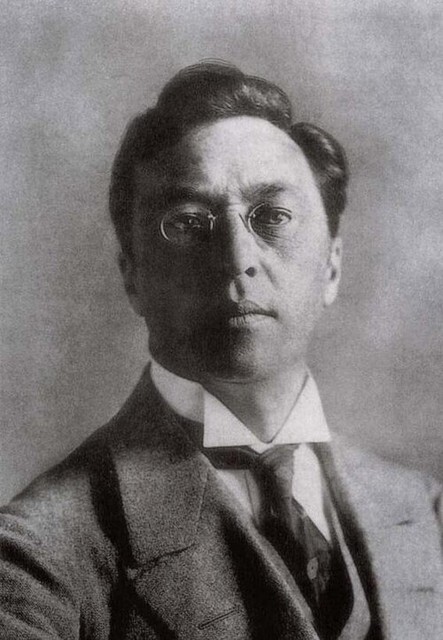
Artist portrait Image credit
未知上傳者. Image source · Public domain
About the artist
Wassily Kandinsky
1866 to 1944
Wassily Kandinsky was an avant-garde painter of Russian origin (1866–1944). Their work is associated with Expressionism; Symbolism; Bauhaus. Their recorded places of work include Paris; Munich; Weimar; Rapallo; The Hague; Russia; Stockholm; Switzerland; Tunis.
- Born
- 1866
- Died
- 1944
- Nationality
- Russian Empire; Russian Soviet Federative Socialist Republic; Soviet Union; France; Germany
- Birthplace
- Moscow
- Died in
- Neuilly-sur-Seine
Biography sources
The research & record
Study the work.
Follow the evidence.
Find catalogue details, historical context, technical research and the literature behind this artwork.
The artwork record
Research catalogue
Catalogue information and detailed research, with references that link to the bibliography.
Updated .
Identity and catalogue
Link- Title
- Rotterdam
- Artist or attribution
- Wassily Kandinsky(www.centrepompidou.fr, n.d.)(collection.centrepompidou.fr, 2024)
- Object date
- [1904]
- Medium and support
- Oil on canvas board(www.centrepompidou.fr, n.d.)(collection.centrepompidou.fr, 2024)
- Dimensions
- 23 x 31.7 cm(www.centrepompidou.fr, n.d.)(collection.centrepompidou.fr, 2024)
- Current collection or location
- Musée National d'Art Moderne, Centre Pompidou, Paris, France (on loan to Palazzo Bonaparte, Rome, Italy, for Kandinsky, 15 September 2026 - 14 February 2027)
- Movement or period
- Early twentieth-century modernism (pre-abstract phase)
- Country or culture
- Russia / France (artist); Netherlands (depicted)
- Depicted subject
- A harbor view of Rotterdam, with the port, boats, and water. The Centre Pompidou record lists iconographic keywords port and boat, subject terms Rotterdam (city), Netherlands (country), and water.
- Title variants
- Rotterdam
- Accession number
- AM 81-65-20(www.centrepompidou.fr, n.d.)(collection.centrepompidou.fr, 2024)
- Support
- Canvas board
- Inscriptions
- Signed bottom right in red: KANDINSKY (S.B.DR. en rouge : KANDINSKY)(www.centrepompidou.fr, n.d.)(collection.centrepompidou.fr, 2024)
Read valuation records and their limitations
The catalogue core: title, attribution, date and support
The painting is catalogued as Rotterdam by Vassily Kandinsky, made in oil on canvas board and dated [1904]. The brackets around the date are part of the institutional record rather than the object's inscription, so the year should be treated as a catalogue dating rather than a date the artist wrote on the work. The support is canvas board (carton entoilé), a modest, portable format consistent with the recorded dimensions of 23 x 31.7 cm. The painting is signed bottom right in red: KANDINSKY. Both the institutional record and the Wikimedia Commons file give the same measurements and title, and the Commons entry cites the Centre Pompidou and Google Art & Culture as its sources, so the two records agree on the core catalogue facts even though the Commons file is only a discovery aid.(www.centrepompidou.fr, n.d., Dimensions)(collection.centrepompidou.fr, 2024, Dimensions)(Wikimedia Commons: Rotterdam, n.d.)
The object's accession identifiers and collection context belong to the identity record as much as to provenance. The inventory number is AM 81-65-20, the same form given by the Commons file and the museum record. The painting belongs to the Musée National d'Art Moderne, Centre Pompidou, Paris, and it entered the collection as a bequest from Nina Kandinsky in 1981. That bequest is the reason the painting is in a French national collection at all, and it places the work within the posthumous settlement of the Kandinsky estate rather than within an early purchase by the museum.(Wikimedia Commons: Rotterdam, n.d.)(www.centrepompidou.fr, n.d., Acquisition)(collection.centrepompidou.fr, 2024, Legs de Nina Kandinsky, 1981)
The subject is fixed by the collection's own indexing. The iconographic keywords are port and boat, and the subject terms are Rotterdam (city), Netherlands (country) and water. These terms describe what the catalogue says the picture shows, not what an independent reading of the painted surface must conclude. They nevertheless establish the object's identity as a harbour scene rather than, for example, a pure landscape or an interior. The title and the keywords work together: the city name and the port subject are the museum's own description of the work's content.(collection.centrepompidou.fr, 2024, Mots clés iconographiques)(www.centrepompidou.fr, n.d., Pays-Bas (pays), Rotterdam (ville), bateau, eau, port)
The artist's biographical data supplied by the collection record show how far the painting sits from the identity Kandinsky later acquired. He was born in Moscow in 1866 and died in Neuilly-sur-Seine in 1944. He became a German citizen in 1928 and a French citizen in 1939. These citizenship dates come decades after the [1904] date of the painting, so they belong to the later life of the artist and not to the circumstances of this work's making. They are still relevant to the object's identity because the catalogue attaches a nationality trajectory to the name under which the painting is filed, and that trajectory is one reason the work is read within a history of European modernism.(collection.centrepompidou.fr, 2024)
Documentation of the image itself is part of the object record. The reference photograph is credited to Centre Pompidou, MNAM-CCI/Adam Rzepka/Dist. GrandPalaisRmn, reference image 4R05546 [1983 CX 0435]. The bracketed number appears to belong to the same reference apparatus as the photograph, so the image record carries its own identifier distinct from the painting's inventory number. The work is in the public domain (Domaine public). That status concerns rights in the work and its reproduction, and it should not be confused with the physical custody of the painting, which remains with the Musée National d'Art Moderne.(www.centrepompidou.fr, n.d., Crédit photographique; Domaine public)(collection.centrepompidou.fr, 2024, Référence image; Domaine public)
The Wikimedia Commons record adds a title variant worth noting for anyone searching the object. It lists the file under the title 'Rotterdam' by Wassily Kandinsky, with the accession number AM 81-65-20 and dimensions of 23 cm by 31.7 cm, sourced from the Centre Pompidou and Google Art & Culture. The spelling of the artist's first name differs from the institutional form Vassily, and the Commons entry is a file description rather than a catalogue entry. Where the two accounts diverge or where Commons gives less information, the official records take precedence; the Commons file remains useful because it confirms the inventory number and dimensions independently and points to a further image source.(Wikimedia Commons: Rotterdam, n.d.)
Vassily Kandinsky made the painting Rotterdam, dated [1904], in oil on canvas board.(www.centrepompidou.fr, n.d.)(collection.centrepompidou.fr, 2024)
The painting measures 23 x 31.7 cm.(www.centrepompidou.fr, n.d.)(collection.centrepompidou.fr, 2024)
The Centre Pompidou record gives the iconographic keywords port and boat, and subject terms Rotterdam (city), Netherlands (country), and water.(collection.centrepompidou.fr, 2024)(www.centrepompidou.fr, n.d.)
The painting is catalogued in Kandinsky: Catalogue raisonné de l'oeuvre peint 1900-1915 (volume 1) by H.K. Roethel and J.K. Benjamin (Flinker, 1982-1983), cat. no. 42, cited p. 49.(collection.centrepompidou.fr, 2024)
Kandinsky was born in Moscow in 1866 and died in Neuilly-sur-Seine in 1944; he became a German citizen in 1928 and a French citizen in 1939.(collection.centrepompidou.fr, 2024)
The reference photograph is credited to Centre Pompidou, MNAM-CCI/Adam Rzepka/Dist. GrandPalaisRmn, reference image 4R05546 [1983 CX 0435].(www.centrepompidou.fr, n.d.)(collection.centrepompidou.fr, 2024)
The work is in the public domain (Domaine public).(www.centrepompidou.fr, n.d.)(collection.centrepompidou.fr, 2024)
Wikimedia Commons lists the file under the title 'Rotterdam' by Wassily Kandinsky, with an accession number of AM 81-65-20 and dimensions of 23 cm by 31.7 cm, sourced from the Centre Pompidou and Google Art & Culture.(Wikimedia Commons: Rotterdam, n.d.)
Subject and iconography
LinkRead valuation records and their limitations
Signature and surface
Visual observation
The painting is signed bottom right in red: KANDINSKY. The signature is the one element of the picture's surface that the institutional records describe directly, including its placement and colour, and it is reported consistently by both records. It therefore anchors the work to its author in a way that the subject keywords do not: the harbour is what the museum says is depicted, while the inscription is a mark on the canvas itself. Beyond that, the records do not describe the brushwork, the palette of the scene, or the detail of the boats and water, so claims about Kandinsky's handling in this picture would rest on looking rather than on the documentation supplied.(www.centrepompidou.fr, n.d., Inscriptions)(collection.centrepompidou.fr, 2024, Inscriptions)
The painting is signed bottom right in red: KANDINSKY.(www.centrepompidou.fr, n.d.)(collection.centrepompidou.fr, 2024)
Materials and technique
LinkRead valuation records and their limitations
The documented support and medium
The documented physical identity of the work is narrow but firm. The Centre Pompidou records describe Rotterdam as oil on canvas board, in French huile sur carton entoilé, that is, a painted canvas that has been mounted onto a cardboard support. That support designation belongs to the collection's technical description of the object and is carried by both institutional records. It matters for how the picture is understood as a made thing: the paint layer sits on a fabric prepared and then adhered to board, a composite support rather than a single rigid panel or a stretched canvas on a strainer. The collaged support also bears on scale, since the painting is recorded at 23 by 31.7 cm, a small format that the canvas board construction helps to explain. Nothing in the supplied record describes the fabric weave, the adhesive, the board's thickness or a manufacturer's stamp, so those aspects of the support remain unexamined here.(www.centrepompidou.fr, n.d., Technique)(collection.centrepompidou.fr, 2024, Technique)
Visual observation
The medium and support are established by institutional record, not by any technical analysis reported in the available evidence. The same two records that give the oil and canvas board also give the picture's other identifying data: the title Rotterdam, the attribution to Vassily Kandinsky, the bracketed date [1904], the dimensions of 23 by 31.7 cm, and the inventory number AM 81-65-20. The bracketed form of the date as transcribed in the collection record is worth preserving, since brackets conventionally signal a dating supplied or inferred rather than inscribed on the work itself. No pigment analysis, ground composition, layer stratigraphy, infrared or ultraviolet imaging, cross-section or conservation treatment is reported in these units, so the account of materials must stop at the level of medium and support. Claims about how the paint was worked, whether it was thinned, scumbled or applied in discrete touches, are visual inferences from looking and are not established by the evidence supplied.(www.centrepompidou.fr, n.d., Technique; Inscriptions)(collection.centrepompidou.fr, 2024, Technique; Inscriptions)
One material fact does connect to what can be seen at the surface. The painting is signed at the lower right in red, with the name KANDINSKY, and this inscription is recorded by both institutional sources. The red of the signature is the only chromatic detail about the work's making that the evidence names, and it is described as a colour observed in the inscription rather than as an identified pigment. The record does not state whether the signature is in the same oil medium as the painting, whether it sits above a varnish, or when it was applied relative to the composition. Because the signature is positioned bottom right and rendered in red, it belongs both to the object's material surface and to its documentary identity as an attributed work, and it is the point where the evidence about making and the evidence about authorship meet. Beyond the red of the inscription, no palette, no individual colour and no pigment name is supplied for the picture itself.(www.centrepompidou.fr, n.d., Inscriptions; Technique)(collection.centrepompidou.fr, 2024, Inscriptions; Technique)
Reproduction and the limits of the record
The painting's making conditions can be situated, though only loosely, within the documented history of its reproduction and study. The work is catalogued in the Roethel and Benjamin catalogue raisonné of the painted oeuvre 1900 to 1915, volume one, as catalogue number 42, cited at page 49, and it is discussed and reproduced in colour in the 1984 to 1985 exhibition catalogue of Kandinsky works from the Musée national d'art moderne, edited by Christian Derouet and Jessica Boissel, at catalogue number 42, pages 48 to 49. It also appears in colour in Panorama Rotterdam: Meesters aan de Maas 1820-1940, published in 2001, at page 120, and in the 2024 H'Art Museum catalogue Kandinsky: pionier van de abstracte kunst at page 34. These citations establish that the small oil on canvas board has been repeatedly photographed and reproduced in colour, which is the practical precondition for studying its surface at a distance, but they do not themselves report any examination of its materials. The catalogue entries and plates are documented as existing and as reproducing the work; their contents on technique are not supplied here and should not be assumed.(www.centrepompidou.fr, n.d., Technique; Inscriptions)(collection.centrepompidou.fr, 2024, Technique; Inscriptions)
Interpretation
Taken together, the evidence supports a deliberately bounded account of technique. What is documented is a small oil painting on canvas board, signed in red at the lower right, assigned catalogue number 42 in the standard raisonné and reproduced in colour on several occasions. What is not documented is the ground, the pigments, the brushes or tools, the number and order of layers, any underdrawing, any varnish or later intervention, and any condition history. The distinction is consequential for the study of Kandinsky's early work: the object's place in a history of modern painting rests here on its support and medium, its date and its reproduction record, while statements about how the harbour was actually painted remain inferences drawn from looking at the image. Those inferences may be reasonable, but they should be marked as such rather than absorbed into the documented description of the work's materials.(www.centrepompidou.fr, n.d., Technique; Inscriptions)(collection.centrepompidou.fr, 2024, Technique; Inscriptions)
The painting is oil on canvas board (huile sur carton entoilé).(www.centrepompidou.fr, n.d.)(collection.centrepompidou.fr, 2024)
Provenance and ownership
LinkRead valuation records and their limitations
The 1981 Bequest and the Limits of the Record
Interpretation
The documented ownership history of Rotterdam is brief and rests on an institutional acquisition rather than a chain of private owners or dealers. According to the Centre Pompidou record, the painting entered the collection as a bequest from Nina Kandinsky in 1981, identified in the record as the Legs de Nina Kandinsky, 1981. The same record is the source for the work's inventory number, AM 81-65-20, which associates the object with that 1981 bequest and identifies it as part of the holdings of the Musée National d'Art Moderne, Centre Pompidou, Paris. The two institutional catalogue entries consulted for this account agree on this point. What the evidence establishes is therefore the transfer by bequest into a public collection and the object's registration there; it does not record any earlier owner, sale, dealer or intermediate location, so the interval between the work's making and the 1981 bequest remains unrecorded rather than proven to have involved any particular transfer.(www.centrepompidou.fr, n.d., Acquisition)(collection.centrepompidou.fr, 2024, Legs de Nina Kandinsky, 1981)
Because the Centre Pompidou record gives the bequest as the means of entry, the provenance that can be stated with confidence is essentially a single documented event: the gift of Nina Kandinsky's collection to the French national museum in 1981, followed by the assignment of the inventory number and the work's registration as part of the Musée National d'Art Moderne. The record also dates the painting to [1904], a bracketed attribution that belongs to the catalogue's dating rather than to a documented commission or sale. The distinction matters for how the object is described: the museum's documentation supports the acquisition and the dating, but it does not supply a narrative of how the painting passed from Kandinsky's hands to Nina Kandinsky's estate, nor why or when the work left the artist's possession. No gap in the record should be read as evidence of a particular route, and no earlier owner should be inferred from the absence of information.(www.centrepompidou.fr, n.d., Acquisition)(collection.centrepompidou.fr, 2024, Legs de Nina Kandinsky, 1981)
The provenance account is also anchored in the object's published documentation. The painting is catalogued in Kandinsky: Catalogue raisonné de l'oeuvre peint 1900-1915 (volume 1) by H.K. Roethel and J.K. Benjamin, published by Flinker in 1982-1983, as catalogue number 42, cited at page 49. It is discussed and reproduced in the 1984-1985 exhibition catalogue Kandinsky: oeuvres de Vassily Kandinsky (1866-1944), Collections du Musée national d'art moderne, edited by Christian Derouet and Jessica Boissel, catalogue number 42, pages 48-49, with a colour reproduction. The work also appears in colour in Panorama Rotterdam: Meesters aan de Maas 1820-1940, published by Kunsthal, Rotterdam, and Scriptum Art, Schiedam, in 2001, page 120, and in the 2024 exhibition catalogue Kandinsky: pionier van de abstracte kunst, published by the H'Art Museum, Amsterdam, the Centre Pompidou, Paris, and WBOOK, 2024, page 34. These publications establish the work's standing in the literature and tie the object to successive curatorial projects, but they are separate from the ownership record: the catalogue raisonné and the exhibition catalogues document study, reproduction and display, not sales or transfers of title.(www.centrepompidou.fr, n.d., Acquisition)(collection.centrepompidou.fr, 2024, Legs de Nina Kandinsky, 1981)
Interpretation
Taken together, the evidence for provenance supports a short, clean account and a set of explicit silences. The documented facts are the bequest from Nina Kandinsky in 1981, the inventory number AM 81-65-20, the holding of the work by the Musée National d'Art Moderne, Centre Pompidou, Paris, its exhibition loans beginning with Hertogenbosch in 1993-1994 and continuing through Rome in 2026-2027, and its publication in the Roethel and Benjamin catalogue raisonné and subsequent catalogues. The silences are equally clear: no dealer, auction, private collection or intermediate owner is named between the work's creation, dated by the museum to [1904], and the 1981 bequest. In a provenance section for this object, that absence should be stated as the current limit of the evidence rather than resolved by inference, and the object's documented significance should be allowed to rest on the bequest, the inventory record, the loans and the cataloguing that the institutional sources actually establish.(www.centrepompidou.fr, n.d., Acquisition; Actuellement à Palazzo Bonaparte)(collection.centrepompidou.fr, 2024, Legs de Nina Kandinsky, 1981; Expositions)
The painting entered the collection as a bequest from Nina Kandinsky in 1981 (Legs de Nina Kandinsky, 1981).(www.centrepompidou.fr, n.d.)(collection.centrepompidou.fr, 2024)
Provenance timeline
- 1981
The painting enters the public collection as a bequest from Nina Kandinsky and belongs to the Musée National d'Art Moderne, Centre Pompidou, Paris.(www.centrepompidou.fr, n.d., Acquisition)(collection.centrepompidou.fr, 2024, Legs de Nina Kandinsky, 1981)
- 1993-1994
The painting is included in the exhibition Light, Sky and Water: The Dutch River Landscape 1780-1920 at the Noordbrabants Museum, Hertogenbosch.(collection.centrepompidou.fr, 2024, Expositions)
- 1999
The painting is included in Kandinsky: Hauptwerke aus dem Centre Georges Pompidou Paris at the Kunsthalle Tübingen.(collection.centrepompidou.fr, 2024, Expositions)
- 2009
The painting is included in the exhibition Kandinsky at the Centre Pompidou, Paris.(collection.centrepompidou.fr, 2024, Expositions)
- 2024
The painting is included in H'ART - Kandinsky at the H'ART Museum, Amsterdam.(collection.centrepompidou.fr, 2024, Expositions)
- 15 September 2026 to 14 February 2027
The Centre Pompidou record states the painting is currently at Palazzo Bonaparte, Rome, for the exhibition Kandinsky.(www.centrepompidou.fr, n.d., Actuellement à Palazzo Bonaparte)(collection.centrepompidou.fr, 2024, Expositions)
Exhibition history
LinkRead valuation records and their limitations
Exhibition history
The exhibition record for Rotterdam is relatively compact but spans three decades and several national contexts. According to the Centre Pompidou collection record, the painting has been included in Light, Sky and Water: The Dutch River Landscape 1780-1920 at the Noordbrabants Museum, Hertogenbosch, in 1993-1994; in Kandinsky: Hauptwerke aus dem Centre Georges Pompidou Paris at the Kunsthalle Tübingen in 1999; in Kandinsky at the Centre Pompidou, Paris, in 2009; in H'ART - Kandinsky at the H'ART Museum, Amsterdam in 2024; and in Kandinsky at Palazzo Bonaparte, Rome, in 2026-2027. The sequence is worth noting because it places a small oil on canvas board made in or dated to 1904, and held since 1981 under the bequest of Nina Kandinsky, in two quite different exhibition frames: a Dutch landscape art context in Hertogenbosch and a Kandinsky monograph context in Tübingen, Paris, Amsterdam and Rome.(collection.centrepompidou.fr, 2024, Expositions; Legs de Nina Kandinsky, 1981)(www.centrepompidou.fr, n.d., Acquisition)
The two institutional records, the Centre Pompidou object record and the collection record, both state that the painting is currently at Palazzo Bonaparte, Rome, Italy, for the exhibition Kandinsky running from 15 September 2026 to 14 February 2027. The same Rome exhibition also appears in the list of past inclusions in the collection record, described there as Kandinsky at Palazzo Bonaparte, Rome (2026-2027). The evidence therefore documents a current venue and a scheduled run of dates; it does not document installation details, hang, or the specific works shown alongside Rotterdam at that venue, and those should not be inferred from the presence of the painting in the exhibition.(www.centrepompidou.fr, n.d., Actuellement à Palazzo Bonaparte)(collection.centrepompidou.fr, 2024, Expositions)
Interpretation
Across this exhibition list, the painting moved between a thematic Dutch landscape exhibition and exhibitions organised around Kandinsky himself and around the Centre Pompidou's holdings of his work. Read together, the venues show the object functioning in two registers simultaneously: as a document of the Dutch river landscape tradition in which a 1904 harbour view can be placed, and as an early work by an artist later identified with abstraction. Neither record supplies a catalogue entry, a wall text or a display rationale for the individual showings, so the significance of the painting within each exhibition remains undocumented in the supplied evidence and should be treated as a reasonable description of exhibition context rather than as an attributed curatorial argument.(collection.centrepompidou.fr, 2024, Expositions)(www.centrepompidou.fr, n.d., Actuellement à Palazzo Bonaparte)
The Centre Pompidou record states the painting is currently at Palazzo Bonaparte, Rome, Italy, for the exhibition Kandinsky, 15 September 2026 to 14 February 2027.(www.centrepompidou.fr, n.d.)(collection.centrepompidou.fr, 2024)
The painting has been included in exhibitions including Light, Sky and Water: The Dutch River Landscape 1780-1920 at the Noordbrabants Museum, Hertogenbosch (1993-1994); Kandinsky: Hauptwerke aus dem Centre Georges Pompidou Paris at the Kunsthalle Tübingen (1999); Kandinsky at the Centre Pompidou, Paris (2009); H'ART - Kandinsky at the H'ART Museum, Amsterdam (2024); and Kandinsky at Palazzo Bonaparte, Rome (2026-2027).(collection.centrepompidou.fr, 2024)
Reception and literature
LinkRead valuation records and their limitations
The painting is discussed and reproduced in the 1984-1985 exhibition catalogue Kandinsky: oeuvres de Vassily Kandinsky (1866-1944), Collections du Musée national d'art moderne, edited by Christian Derouet and Jessica Boissel, cat. no. 42, pp. 48-49, with colour reproduction.(collection.centrepompidou.fr, 2024)
The painting is reproduced in colour in Panorama Rotterdam: Meesters aan de Maas 1820-1940 (Rotterdam: Kunsthal; Schiedam: Scriptum Art, 2001), p. 120.(collection.centrepompidou.fr, 2024)
The painting is reproduced in colour in the 2024 exhibition catalogue Kandinsky: pionier van de abstracte kunst (Amsterdam: H'Art Museum; Paris: Centre Pompidou; WBOOK, 2024), p. 34.(collection.centrepompidou.fr, 2024)
Collection and display
LinkRead valuation records and their limitations
Institutional custody and the 1981 bequest
Institutional custody of the harbour scene known as Rotterdam is recorded in two official entries from the Musée National d'Art Moderne, Centre Pompidou, Paris. Both sources give the inventory number AM 81-65-20 and place the work within that Paris collection, so the object's present administrative identity rests on a consistent pair of records rather than a single catalogue entry. The same two sources also state that the painting entered the collection as a bequest from Nina Kandinsky in 1981, which locates the moment of institutional acquisition; the records do not supply any earlier chain of ownership before that bequest.(www.centrepompidou.fr, n.d., N° d'inventaire)(collection.centrepompidou.fr, 2024, Inv.)
The collection records give the painter as Vassily Kandinsky and date the work to [1904], a bracketed date that the source presents as an attribution rather than an inscription on the object. The medium is oil on canvas board (huile sur carton entoilé), the support measures 23 by 31.7 cm, and the painting is signed bottom right in red: KANDINSKY. Both Centre Pompidou entries reproduce the same attribution, dimensions and inscription. Beyond those physical facts, the record's iconographic keywords are port and boat, and its subject terms are Rotterdam (city), Netherlands (country) and water. The work is listed as in the public domain, and the reference photograph is credited to Centre Pompidou, MNAM-CCI/Adam Rzepka/Dist. GrandPalaisRmn, image 4R05546 [1983 CX 0435].(www.centrepompidou.fr, n.d., N° d'inventaire)(collection.centrepompidou.fr, 2024, Inv.)
Cataloguing, exhibition history and loans
The object's documentary life is recorded in one catalogue raisonné and across several exhibition and reproduction contexts, all reported through the collection record. The painting is catalogued in Kandinsky: Catalogue raisonné de l'oeuvre peint 1900-1915, volume 1, by H.K. Roethel and J.K. Benjamin (Flinker, 1982-1983), catalogue number 42, cited at page 49. It is discussed and reproduced in colour in the 1984-1985 exhibition catalogue Kandinsky: oeuvres de Vassily Kandinsky (1866-1944), Collections du Musée national d'art moderne, edited by Christian Derouet and Jessica Boissel, catalogue number 42, pages 48 to 49. These two entries establish that the painting was already being catalogued and discussed in scholarship and exhibition publication in the early 1980s, close in time to the 1981 bequest.(www.centrepompidou.fr, n.d.)(collection.centrepompidou.fr, 2024)
The Centre Pompidou record lists exhibition appearances and colour reproductions that show how the work has been placed in different frames over three decades. It was included in Light, Sky and Water: The Dutch River Landscape 1780-1920 at the Noordbrabants Museum, 's-Hertogenbosch, in 1993-1994, a context that treats it as part of a Dutch landscape tradition rather than a purely Kandinsky narrative. It appeared in Kandinsky: Hauptwerke aus dem Centre Georges Pompidou Paris at the Kunsthalle Tübingen in 1999, in Kandinsky at the Centre Pompidou, Paris, in 2009, in H'ART - Kandinsky at the H'ART Museum, Amsterdam, in 2024, and in Kandinsky at Palazzo Bonaparte, Rome, in 2026-2027. It is reproduced in colour in Panorama Rotterdam: Meesters aan de Maas 1820-1940 (Rotterdam: Kunsthal; Schiedam: Scriptum Art, 2001), page 120, and in colour in the 2024 catalogue Kandinsky: pionier van de abstracte kunst (Amsterdam: H'Art Museum; Paris: Centre Pompidou; WBOOK, 2024), page 34. The Centre Pompidou record further states that the painting is currently at Palazzo Bonaparte, Rome, for the exhibition Kandinsky running 15 September 2026 to 14 February 2027.(www.centrepompidou.fr, n.d., N° d'inventaire)(collection.centrepompidou.fr, 2024, Inv.)
Interpretation
The record's ancillary biography identifies Kandinsky as born in Moscow in 1866 and dead in Neuilly-sur-Seine in 1944, becoming a German citizen in 1928 and a French citizen in 1939. Those dates place the painting's attributed date of [1904] early in his working life and show that the work was made before either of his later naturalisations. A qualification runs through all of this material: the exhibition, catalogue and scholarly references, including the 2024 Amsterdam catalogue, are reported through the Centre Pompidou record, and the institutional entries themselves are marked as partially consulted. The record establishes what the museum attributes to the object and how the museum frames it. It does not, by itself, provide a visual analysis of how the harbour was painted, so a reading of the picture's handling of colour or form would be an inference drawn by the viewer rather than a claim documented in these sources.(www.centrepompidou.fr, n.d., N° d'inventaire)(collection.centrepompidou.fr, 2024, Inv.)
The painting's inventory number is AM 81-65-20.(www.centrepompidou.fr, n.d.)(collection.centrepompidou.fr, 2024)
The painting belongs to the Musée National d'Art Moderne, Centre Pompidou, Paris.(www.centrepompidou.fr, n.d.)(collection.centrepompidou.fr, 2024)
Bibliography
LinkRead valuation records and their limitations
Catalogue raisonné and the 1984-1985 catalogue
The object-specific literature recorded for Rotterdam is anchored in the standard catalogue raisonné of the artist's early painting: H.K. Roethel and J.K. Benjamin, Kandinsky: Catalogue raisonné de l'oeuvre peint 1900-1915, volume 1 (Flinker, 1982-1983), where the work carries cat. no. 42, cited at p. 49. That entry is the foundational scholarly listing for the picture, establishing its place within the systematic documentation of Kandinsky's painted work from 1900 to 1915. The catalogue raisonné is recorded as the point of reference; the collection record's bibliography, rather than a reading of the full catalogue text, supplies the citation, so the entry establishes the painting's inclusion and numbering but is not here shown to contain any particular argument about the Rotterdam harbour scene.(collection.centrepompidou.fr, 2024, Bibliographie)
Only two years after the raisonné volumes appeared, the painting received substantive catalogue treatment in Kandinsky: oeuvres de Vassily Kandinsky (1866-1944), Collections du Musée national d'art moderne, the 1984-1985 exhibition catalogue edited by Christian Derouet and Jessica Boissel. There Rotterdam appears as cat. no. 42, at pp. 48-49, with a colour reproduction. Because the record describes the work as discussed as well as reproduced, this catalogue is the recorded instance of extended textual attention to the painting, prepared within the Paris museum collection from which the work had come as Nina Kandinsky's 1981 bequest. The matching catalogue number with the raisonné entry shows the two publications keyed to the same numbering, which makes them easy to cross-reference, while the page span distinguishes the exhibition catalogue's more expansive treatment from a bare listing.(collection.centrepompidou.fr, 2024, Bibliographie; Legs de Nina Kandinsky, 1981)(www.centrepompidou.fr, n.d., Acquisition)
Reproduction in thematic and retrospective catalogues
Interpretation
Two further recorded appearances place Rotterdam in colour reproduction in contexts quite different from a monographic Kandinsky catalogue. In Panorama Rotterdam: Meesters aan de Maas 1820-1940, published on the occasion of the Kunsthal Rotterdam exhibition with Scriptum Art of Schiedam in 2001, the painting is reproduced at p. 120. That setting frames the work within a survey of Rotterdam painters active along the Maas between 1820 and 1940, so the picture is presented there through its subject city and its place in a local artistic lineage rather than through Kandinsky's later abstract career. The 2024 exhibition catalogue Kandinsky: pionier van de abstracte kunst, a co-publication of the H'Art Museum in Amsterdam, the Centre Pompidou in Paris and WBOOK, reproduces the work in colour at p. 34, returning it to an artist-centred narrative. Read together, the two reproductions show the same small painting serving two different art-historical framings, one municipal and one avant-garde, which is itself a useful index of how a single early harbour view can be recruited to distinct histories.(collection.centrepompidou.fr, 2024, Bibliographie)
The limits of this bibliography should be stated plainly. What is recorded is that the painting is catalogued by Roethel and Benjamin and reproduced, with discussion noted only for the 1984-1985 catalogue; for the 2001 Rotterdam panorama and the 2024 H'Art catalogue the evidence goes no further than colour reproduction at the cited pages. No content of any of these texts, and no argument advanced within them about composition, colour or the harbour's rendering, is established by the units supplied, and the full texts are not shown to have been consulted. The bibliography therefore documents the painting's presence in scholarship and exhibition publishing across four decades, from 1982-1983 to 2024, while leaving the substance of that scholarship to be verified against the publications themselves.(collection.centrepompidou.fr, 2024, Bibliographie)
Documented values and qualified estimates
LinkRead valuation records and their limitations
A working range and its limits
Interpretation
The only valuation statement in the evidence is a model-generated working insurance range of US$400K to US$1.5M, recorded under a generation date of 2026-10-30. The methodology describes it as a broad, conservative range derived from the confirmed artwork context and supplied institutional records, explicitly not based on comparable sales, private insurance data, or an appraisal. The reasoning given is that the small scale and early pre-abstract status support a lower range than major abstract works, while the artist's prominence, public collection status, and inclusion in the catalogue raisonné (Roethel and Benjamin, no. 42) support a substantial base; a conservative buffer is applied rather than a precise figure. The record itself qualifies the number as a working range for manual review only, not an official insurance value, appraisal, auction estimate, auction result, or sale price, to be verified by a qualified professional before any insurance or financial use. The local system sets the price_date to the generation date, and no appraisal or insurance date is implied.(Wikimedia Commons: Rotterdam, n.d.)(www.centrepompidou.fr, n.d.)(collection.centrepompidou.fr, 2024)
Read together, the records establish what the object is, where it has been, and how it has been catalogued. They do not supply sale history, transaction prices, or a professional valuation, so the working range stands apart from the documented record as an internal calculation. That the painting's documented credentials rest on collection status, catalogue raisonné inclusion, and repeated reproduction in Dutch landscape and Kandinsky catalogues is a more durable measure of its place than any single figure. This is a qualified reading of the evidence rather than a claim the records make.(Wikimedia Commons: Rotterdam, n.d.)(www.centrepompidou.fr, n.d.)(collection.centrepompidou.fr, 2024)
Working estimate
Calculated working insurance estimate, not a sale price: Working insurance range: US$400K to US$1.5M Recorded date: Working calculation, generated 2026-10-30. Methodology: This is a broad, conservative working range derived from the confirmed artwork context and supplied institutional records. It is not based on comparable sales, private insurance data, or an appraisal. The work is an authenticated oil painting by Wassily Kandinsky, dated [1904], an early pre-abstract harbor view, held in the Musee National d'Art Moderne, Centre Pompidou, acquired via the 1981 Nina Kandinsky bequest (accession AM 81-65-20). Its small scale (23 x 31.7 cm) and early period support a lower range than major abstract works, while the artist's prominence, public collection status, and inclusion in the catalogue raisonne (Roethel and Benjamin, no. 42) support a substantial base. The range reflects a broad order-of-magnitude framing for manual review and applies a conservative buffer rather than a precise market or replacement value. The local system will set the price_date to the generation date; no appraisal or insurance date is implied. Qualification: Model-generated working range for manual review only. This is not an official insurance value, appraisal, auction estimate, auction result, or sale price. It does not use comparable sales or private insurance records and should be verified by a qualified professional before any insurance or financial use.(Wikimedia Commons: Rotterdam, n.d.)(www.centrepompidou.fr, n.d.)(collection.centrepompidou.fr, 2024)
Further reading
Books for a closer look
Paid links. As an Amazon Associate I earn from qualifying purchases.

Open Library Kandinsky: Russian and Bauhaus years, 1915-1933.
Solomon R. Guggenheim Museum
Kandinsky monograph/catalogue record whose listed subjects include Centre Georges Pompidou, the Musee national d'art moderne, Catalogs, Catalogues raisonnes and criticism and interpretation. It is the only candidate tied to the artist's museum collection context, making it the closest fit among the returned records for a Kandinsky work held at the Centre Pompidou.
ISBN 0892070447

Open Library Kandinsky, complete writings on art
G.K. Hall
Record of Kandinsky's complete writings on art. Relevant through the named artist and his own documented writings, which can support study of his early-period pictorial concerns, though it is a broad source rather than an object-specific study of Rotterdam.
ISBN 0805799508
Bibliography
Sources and further reading
References are arranged by author or organisation, with links to the original publications. Where no publication date is recorded, n.d. means no date.
Source notes updated .
No recorded sources match these filters. Reset the filters to see the full bibliography.
- 03
Official · About this artwork
Institutional record for Rotterdam. Kandinsky : pionier van de abstracte kunst, p. 34.
H'Art Museum exhibition catalogue reproducing Rotterdam in colour. Metadata supplied by the collection record; the catalogue itself was not consulted.
- Language
- Dutch
- ISBN
- 978-94-625-8636-9
Citation text
- 05
Book
Kandinsky, complete writings on art. G.K. Hall.
Record of Kandinsky's complete writings on art. Relevant through the named artist and his own documented writings, which can support study of his early-period pictorial concerns, though it is a broad source rather than an object-specific study of Rotterdam.
- ISBN
- 0805799508
Citation text
- 04
Book
Kandinsky: Russian and Bauhaus years, 1915-1933. Solomon R. Guggenheim Museum.
Kandinsky monograph/catalogue record whose listed subjects include Centre Georges Pompidou, the Musee national d'art moderne, Catalogs, Catalogues raisonnes and criticism and interpretation. It is the only candidate tied to the artist's museum collection context, making it the closest fit among the returned records for a Kandinsky work held at the Centre Pompidou.
- ISBN
- 0892070447
Citation text
- 01
Secondary · About this artwork
Wikimedia Commons: Rotterdam (n.d.). Wikimedia Commons.
Wikimedia Commons discovery record for the file. Used only as a discovery aid; the official Centre Pompidou records take precedence.
- Language
- English
Citation text
- 02
Official · About this artwork
Official Centre Pompidou object record for Rotterdam. Establishes title, artist, date, medium, dimensions, provenance, inscription, iconographic keywords, current loan and exhibitions.
- Language
- French
Citation text
Art to live with
Bring this painting
home.
A piece of the archive, made yours. Explore Rotterdam in a size and finish that fits your space.
Your text and annotations appear on these editions. Adding to cart saves that design for printing.
Combine this painting with your favourites01 / Find your edition
Made for you
Suggested from your location. Change it if you're sending elsewhere or using a VPN. Prices and delivery are shown in GBP.
1 product
Choose an edition to make it yours
iPhone 12 Mini ? Glossy ? back view
iPhone 12 Mini · Glossy

iPhone 12 Mini ? Glossy ? back view

iPhone 12 Mini ? Glossy ? back view

iPhone 12 Mini ? Glossy ? back view
Tough phone case
GBP 16.34
Delivery GBP 4.22 / Total GBP 20.56
A two-layer phone case with a printed polycarbonate shell and a shock-absorbing inner liner.
Two layers with a shock-absorbing TPU liner
Case & print details
- Device
- Apple · iPhone 12 Mini
- Material
- Polycarbonate shell with a TPU inner liner
- Artwork
- Outer back and wrapped edges from one template
- Finish
- Glossy
- Version
- Standard version
- Printing
- Dye sublimation
- Print file
- 1,122 × 1,831 px · 95 × 155 mm · PNG · 300 dpi recommended
Rear outline and camera openings follow this variant's Printify template. Case depth and small hardware remain illustrative.
Supplier product detailsFit and fill keep the painting’s proportions. Stretch changes them.
Move and zoom the painting on your tough phone case.
Made to order with your design
Made to order
US delivery only
The 30 cm ruler is scaled alongside your selected print. Keep the painting’s proportions with a black background, or stretch it to fill. Frame width, material texture and screen colours are illustrative.
Keep exploring