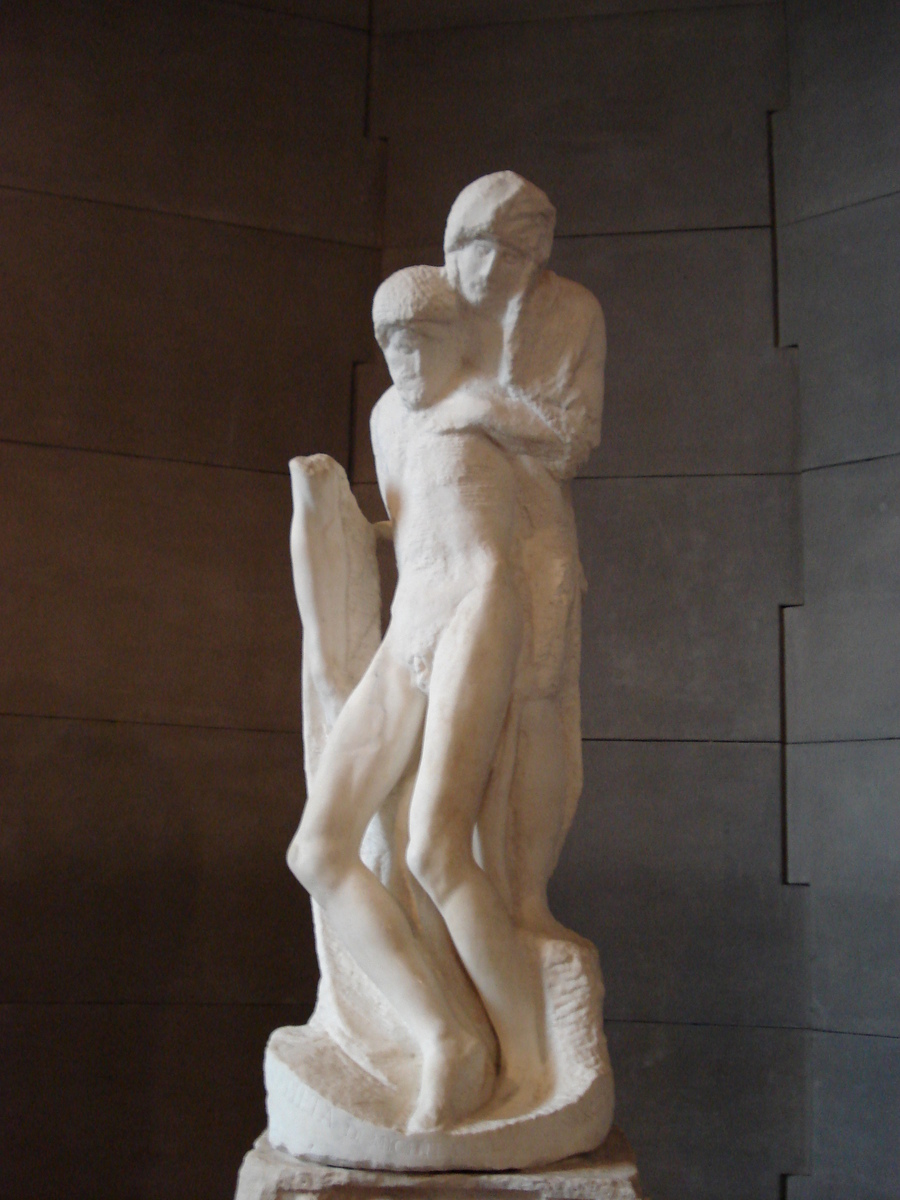
A late, unfinished marble Pietà by Michelangelo, dated 1564, showing the Virgin Mary holding the dead body of Christ. The work is conventionally titled the Rondanini Pietà and is now in the Museo d'arte antica in the Sforza Castle, Milan, but the supplied evidence for its subject and meaning is thin and largely descriptive.
The attenuated crossing legs of the forward figure, one hanging unsupported, standing on the rough excavated stone base whose tool marks show the block was never finished or polished.
02
Rough cut marble strut
The blocky, half-carved marble mass rising at the left of the group, a surviving fragment of the earlier version of the sculpture that Michelangelo carved back into; its raw chisel-cut surface is the clearest evidence of the work's unfinished reworking.
03
Slack hanging torso
The thin, downward-drooping torso and abdomen of the supported figure, whose limp vertical alignment and smoothed but incomplete musculature convey abandonment and weight.
Your gallery guide
Rondanini Pietà by Michelangelo (1564)
A late, unfinished marble Pietà by Michelangelo, dated 1564, showing the Virgin Mary holding the dead body of Christ. The work is conventionally titled the Rondanini Pietà and is now in the Museo d'arte antica in the Sforza Castle, Milan, but the supplied evidence for its subject and meaning is thin and largely descriptive.
Editorial review by Artifact Archive automated publishing
This is a Pietà, the traditional scene of the Virgin Mary mourning over the dead body of Christ. It is attributed to Michelangelo and dated 1564, the year of his death, and it is described as his last, incomplete sculpture.
The work is known as the Rondanini Pietà. That title is a conventional designation rather than an original one, and the carving was never finished.
The most immediate thing you notice is that the marble has not been brought to a smooth finish everywhere. Parts of the surface remain rough, and the forms of the two figures are compressed and vertical rather than spread out.
The Virgin Mary supports the dead Christ from behind, and their bodies are close together. Because the carving is incomplete, some details are only blocked in, so the exact final pose is not fully resolved.
The work is described in the supplied source as Michelangelo's last, incomplete sculpture, dated 1564. It is a three-dimensional marble carving, not a painting.
The Pietà subject itself is traditional: the Virgin mourning over Christ's dead body. That is the scene the sculpture represents, though the unfinished state means the narrative is partly left in the stone.
Because the sculpture is incomplete, we cannot know exactly how Michelangelo intended the finished group to look. The source does not provide a curatorial interpretation of its meaning beyond the subject and its unfinished state.
What we can say is that the rough, blocked-in forms make the traditional Pietà feel more immediate and less polished. The unfinished state is not just a lack of finish; it is part of how the work now reads.
The Rondanini Pietà is now part of the Museo d'arte antica in the Sforza Castle in Milan, Italy. Its title is a later convention, and its incomplete condition is central to its identity.
What the work represents is clear: the Virgin Mary holding the dead Christ. What remains open is how Michelangelo meant to complete it, and that uncertainty is itself part of the sculpture's history.
The story and its sources
Editorial review by Artifact Archive automated publishing.
Historical claims are linked to the records below. Close looking and interpretation are identified in the passage notes.
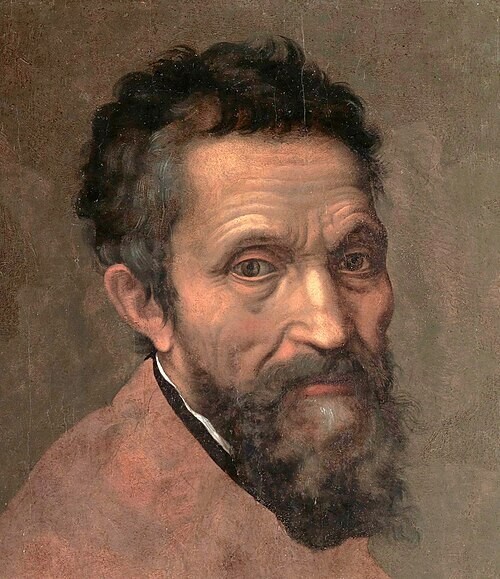
Michelangelo was an Italian artist and architect (1475-1564). Their work is associated with High Renaissance; Renaissance painting. Their recorded places of work include Florence; Bologna; Rome; Venice.
Museo d'arte antica, Castello Sforzesco, Milan, Italy(Bahar, 2007)
Movement or period
Italian Renaissance, late work
Country or culture
Italy
Depicted subject
A Pietà showing the Virgin Mary holding the dead body of Christ. The sculpture is Michelangelo's last, incomplete work, left unfinished at his death and later reworked from an earlier version.(Bahar, 2007)
Attributed to Michelangelo; the work is described in the supplied source as his last, incomplete sculpture.
Dimensions
Unknown
Catalogue identity and attribution
The sculpture treated here is the Rondanini Pietà, catalogued as the work of Michelangelo and dated 1564. The source describes it as his last, incomplete sculpture, and identifies it as a Pietà: the traditional scene of the Virgin Mary mourning over the dead body of Christ. Because the documentation for the object in this account is a Wikimedia Commons file and description page rather than an official institutional catalogue, the attribution, the date and the subject are recorded here as the catalogue information the source transmits, not as independent archival findings. The date 1564 belongs to the object's historical identity as given by that source, and should be distinguished from the much later dates attached to the image and its publication: the photograph was taken by contributor Bahar on 15 May 2007, released under a Creative Commons Attribution-Share Alike 3.0 Unported license among others, and the source's publication year is 2007. A viewer meeting the work through that reproduction is therefore looking at a twenty-first-century photographic record of a sixteenth-century object, with all the questions of lighting, framing and surface registration that such a record entails.(Bahar, 2007, Summary, Description)
The work's customary name is itself part of its catalogue history. The English description calls it "the so called Pietà Rondanini," which signals that the title is a conventional rather than an original designation; the name attaches to the object as a received label, not as a title fixed by the sculptor. Wikimedia Commons also categorises the file under "Pietà Rondanini" and under "Sculptures photographed in 2007," two different kinds of grouping that place the same object simultaneously in an art-historical series of Pietàs and in a modern documentation series of photographic campaigns. The subject, by contrast, is registered in the summary and description as documented: the traditional scene of the Virgin Mary mourning over the dead body of Christ. The work is further described as incomplete, meaning the carving was never finished, and as a sculpture, a three-dimensional carved object rather than a painting. These qualifications together define the object for research purposes: a named but conventionally titled, attributed, dated, unfinished three-dimensional work on a traditional devotional subject, known in this account through a 2007 open-license photograph.(Bahar, 2007, Summary, Description)
Interpretation
Within the larger history of art and material culture, the Rondanini Pietà matters because its condition and its naming expose how canonical objects are constituted through later cataloguing as much as through the moment of making. The source does not provide a curatorial interpretation of the work's meaning beyond the subject and its unfinished state, so any account of intention must remain qualified. What the source does establish is a chain of transmission: an unfinished marble group, conventionally named, attributed to Michelangelo and dated 1564, photographed in 2007 and distributed under open licenses, and categorised under both its art-historical title and its photographic date. The open availability of that image is part of the object's modern afterlife, since it makes the sculpture's rough, unresolved forms accessible to audiences who have not seen the marble itself, while the source's status as a discovery and identification aid rather than an official institutional source sets a limit on how far its statements can be treated as authoritative catalogue data. The object's historical weight lies precisely in this combination of a traditional subject, an attribution that carries the sculptor's name, and an incompleteness that has become inseparable from the work's identity in the literature and in popular reception.(Bahar, 2007, Summary, Description)
The Rondanini Pietà is Michelangelo's last, incomplete sculpture, dated 1564.(Bahar, 2007)
The subject of the work is a Pietà, the traditional scene of the Virgin Mary mourning over the dead body of Christ.(Bahar, 2007)
The English description names the work as 'the so called Pietà Rondanini', indicating the title is a conventional rather than original designation.(Bahar, 2007)
The object as a carved work and the fact of its incompleteness
The Rondanini Pietà is a sculpture, meaning a three-dimensional carved object rather than a painting, and the evidence for this section characterises it in exactly those terms. That distinction matters for how the object is studied: the questions that arise are questions about carving, about the removal of material and about the state in which a carved surface is left, rather than about canvas, ground, brushwork or pigment. In the supplied record the object is additionally described as incomplete, meaning the carving was never finished. The two statements operate at different levels. The first concerns what kind of thing the work is, a solid carved form with volume and mass to be walked around and seen in the round. The second concerns its condition and its history as a made thing, namely that the process of carving stopped before completion. Read together they define the technical profile of the object that this section addresses: a three-dimensional work in carved material whose making was interrupted, and whose present surface therefore preserves stages of work rather than only a finished result. The evidence supplied here does not name the stone or any other material, nor does it describe tools, preparation, layers or pigments, so those questions cannot be answered from this unit; what the unit does establish is the category of object and the unfinished state that governs any account of its technique.(Bahar, 2007, Summary, Description)
The work is a sculpture, a three-dimensional carved object rather than a painting.(Bahar, 2007)
The single condition fact that the supplied evidence establishes for the Rondanini Pietà is that the work is described as incomplete, meaning the carving was never finished. This is a documented description rather than a conservator's condition report: it records the unfinished state of the carving and does not specify particular losses, breaks, abrasions, surface accretions, old restorations, or any intervention carried out on the marble. The evidence likewise supplies no dated condition observation, no treatment materials, no conservation decision, and no environmental measure. Any account of how the object looks or fares today therefore cannot be drawn from this evidence, and the incomplete state should be understood as the recorded condition of the carving, not as a substitute for a modern assessment.(Bahar, 2007, Summary, Description)
The unfinished condition is inseparable from the object's identity as a sculpture, a three-dimensional carved object rather than a painting. Because the carving was never finished, the three-dimensional form itself is the primary carrier of the evidence: the state of the worked stone is part of what the object is, not a separate accident of its later history. The same evidence that identifies the work as a carved object also supports its description as incomplete, so condition and medium are documented together rather than as independent facts. This matters for any account of the sculpture, because questions of finish, surface, and completeness belong to the carved object's own material history.(Bahar, 2007, Summary, Description)
The work is described as incomplete, meaning the carving was never finished.(Bahar, 2007)
The English description on Wikimedia Commons identifies the marble as "the so called Pietà Rondanini," a phrasing that explicitly marks the title as a conventional rather than an original designation. That convention has attached itself to the object for long enough that the Commons category structure treats "Pietà Rondanini" as the operative name, grouping the file under that category together with "Sculptures photographed in 2007." The category assignment also records the photographic encounter itself as a dateable event, while the file's metadata credits the photograph to contributor Bahar, exposed on 15 May 2007 and released under a Creative Commons Attribution-Share Alike 3.0 Unported license among other licenses. These technical and taxonomic facts are modest in themselves, but they register two distinct layers of reception: the settled habit of calling the work by a name its maker did not give it, and the modern circulation of its image through open licensing, which allows the sculpture to be reproduced and re-used well beyond the museum that holds it. The Commons annotation cautions that the page is a discovery and identification aid rather than an official institutional source, a qualification that should govern how much weight is placed on it for claims about attribution, date or condition.(Bahar, 2007, Summary, Description; Summary, Licensing, File history; Categories)
The Wikimedia Commons image of the sculpture was photographed by contributor Bahar on 15 May 2007 and released under a Creative Commons Attribution-Share Alike 3.0 Unported license, among others.(Bahar, 2007)
The sculpture is categorised on Wikimedia Commons under 'Pietà Rondanini' and 'Sculptures photographed in 2007'.(Bahar, 2007)
The Rondanini Pietà is today patrimony of the Museo d'arte antica in the Sforza Castle in Milan, Italy. This places a work whose making is associated with the final year of Michelangelo's life within a civic museum collection housed in the former Sforza stronghold, rather than in a church or private gallery. The collection attribution is the one fact about the sculpture's present situation that the supplied evidence states directly, and it anchors the object's modern identity as a museum-held masterpiece in Milan.(Bahar, 2007, Summary, Description)
The same source that records the Milanese collection also observes that the English description names the work 'the so called Pietà Rondanini', indicating that the title is a conventional rather than an original designation. The subject itself is a Pietà, the traditional scene of the Virgin Mary mourning over the dead body of Christ, so the descriptive noun is grounded in iconography while the qualifying name Rondanini is a later attachment. The evidence establishes the subject and the conventional character of the title but supplies no history of how the name arose or when it entered usage, and that gap should not be filled by inference. What the evidence does make clear is that the work is a sculpture, a three-dimensional carved object rather than a painting, and that it is described as incomplete, meaning the carving was never finished. Incompleteness and conventional naming therefore belong, on this evidence, to the object's basic documentation rather than to any single interpretive account of it.(Bahar, 2007, Summary, Description)
The Wikimedia Commons file page for the sculpture, photographed by contributor Bahar on 15 May 2007, functions as a discovery and identification aid rather than as an official institutional source, and its annotation explicitly frames it that way. The image was released under a Creative Commons Attribution-Share Alike 3.0 Unported license, among others, and the file is categorised on Wikimedia Commons under 'Pietà Rondanini' and 'Sculptures photographed in 2007'. Those categories show how the object circulates in open, user-generated documentation: it is filed both by its conventional name and by the year of photography, so that the photographic record acquires a date of its own distinct from the date of the carving. For research purposes the page is useful for identification and for the licensing status of the image, but it carries no curatorial authority over the sculpture's condition, treatment or display, and it should not be treated as if it did.(Bahar, 2007, Summary, Description)
The Rondanini Pietà is now patrimony of the Museo d'arte antica in the Sforza Castle in Milan, Italy.(Bahar, 2007)
The object under discussion is a three-dimensional marble carving representing the Pietà, the traditional scene of the Virgin Mary mourning over the dead body of Christ. The supplied source describes it as an original marble sculpture securely attributed to Michelangelo and dated 1564, and characterizes it as his last incomplete work. It is held in the Museo d'arte antica in the Castello Sforzesco in Milan, Italy, where it is described as inalienable public patrimony. The source also states that the work is conventionally called the Rondanini Pietà, and it explicitly notes that this title is a conventional rather than an original designation, so the name by which the sculpture is widely known should be treated as a later label rather than the artist's own title.(Bahar, 2007)
The marble has not been brought to a smooth finish everywhere. Parts of the surface remain rough, and the forms of the two figures are compressed and vertical rather than spread out. The Virgin Mary supports the dead Christ from behind, with their bodies held close together. Because the carving is incomplete, some details are only blocked in, and the exact final pose is not fully resolved. The source describes the work as a sculpture, a three-dimensional carved object rather than a painting, so the evidence establishes a marble carving in the round and not a two-dimensional image.(Bahar, 2007)
The subject is the traditional Pietà, the scene of the Virgin mourning over Christ's dead body, and the source states that this is the scene the sculpture represents, although the unfinished state means the narrative is partly left in the stone. The source does not provide a curatorial interpretation of the work's meaning beyond the subject and its unfinished condition. Because the sculpture is incomplete, the evidence does not establish exactly how Michelangelo intended the finished group to look. The rough, blocked-in forms give the traditional Pietà a more immediate and less polished character, and the unfinished state is presented not merely as a lack of finish but as part of how the work now reads.(Bahar, 2007)
Working valuation estimate
A separate working calculation assigns the sculpture an estimated value of US$500 million to US$2 billion, recorded as generated on 2026-10-16. The methodology states that this is a conservative working insurance range derived from the confirmed context: an original marble sculpture securely attributed to Michelangelo, dated 1564, described as his last incomplete work, and held in the Museo d'arte antica in the Castello Sforzesco in Milan. The range is said to reflect the extreme scarcity and art-historical importance of an autograph late Michelangelo marble, offset by its incomplete, non finito state and by its status as inalienable public patrimony unlikely ever to be sold. The calculation states that no confidential collection records or described insurance documentation are used, and that the broad spread is intended for manual review only.(Bahar, 2007)
The valuation unit carries explicit qualifications. It is described as a model-generated working insurance range for manual review, and not as an official insurance value, appraisal, auction result, or sale price. It does not rely on comparable sales, private insurance schedules, or institutional valuation records. Actual insurance coverage, if any, would require a qualified appraiser and policy-specific terms. The same unit records that the pictured file is a Wikimedia Commons photograph by Bahar, and that the range concerns the sculpture rather than the image. This distinction matters because the value figure is attached to the marble object and its institutional context, while the photograph is a separate modern document with its own authorship and licensing.(Bahar, 2007)
Photographic record and its limits
The Wikimedia Commons photograph of the sculpture was taken by contributor Bahar on 15 May 2007 and released under a Creative Commons Attribution-Share Alike 3.0 Unported license, among others. The file page categorizes it under 'Pietà Rondanini' and 'Sculptures photographed in 2007'. The source page gives the English description as 'the so called Pietà Rondanini', indicating that even the descriptive caption treats the title as conventional rather than original. The Commons page is used in this research as a discovery and identification aid rather than as an official institutional source, and it is recorded as only partially consulted. Its license and date belong to the photograph, not to the sixteenth-century marble, and the value range discussed above explicitly concerns the sculpture, not the image.(Bahar, 2007)
Working estimate
Calculated working insurance estimate, not a sale price: Estimated value: US$500M to US$2B Recorded date: Working calculation, generated 2026-10-16. Methodology: Conservative working insurance range derived from confirmed context: an original marble sculpture securely attributed to Michelangelo, dated 1564, described as his last incomplete work, held in the Museo d'arte antica in the Castello Sforzesco, Milan. The range reflects the extreme scarcity and art-historical importance of an autograph late Michelangelo marble, offset by its incomplete, non finito state and its status as inalienable public patrimony unlikely ever to be sold. No confidential collection records or described insurance documentation are used. The broad spread is intended for manual review only. Qualification: This is a model-generated working insurance range for manual review. It is not an official insurance value, appraisal, auction result, or sale price. It does not rely on comparable sales, private insurance schedules, or institutional valuation records. The pictured file is a Wikimedia Commons photograph by Bahar; the range concerns the sculpture, not the image. Actual insurance coverage, if any, would require a qualified appraiser and policy-specific terms.(Bahar, 2007)
Bibliography
Sources and further reading
References are arranged by author or organisation, with links to the original publications. Where no publication date is recorded, n.d. means no date.
Source notes updated .
No recorded sources match these filters. Reset the filters to see the full bibliography.
Wikimedia Commons image file and description page for the Rondanini Pietà, photographed in 2007 and released under open licenses. Used as a discovery and identification aid rather than an official institutional source.
Advertising supports the archive. These preferences control aggregate page counting, reading activity and ad-delivery diagnostics. They use no visitor tracking cookie.