ArchivePietà

Artwork record / 35 of 94

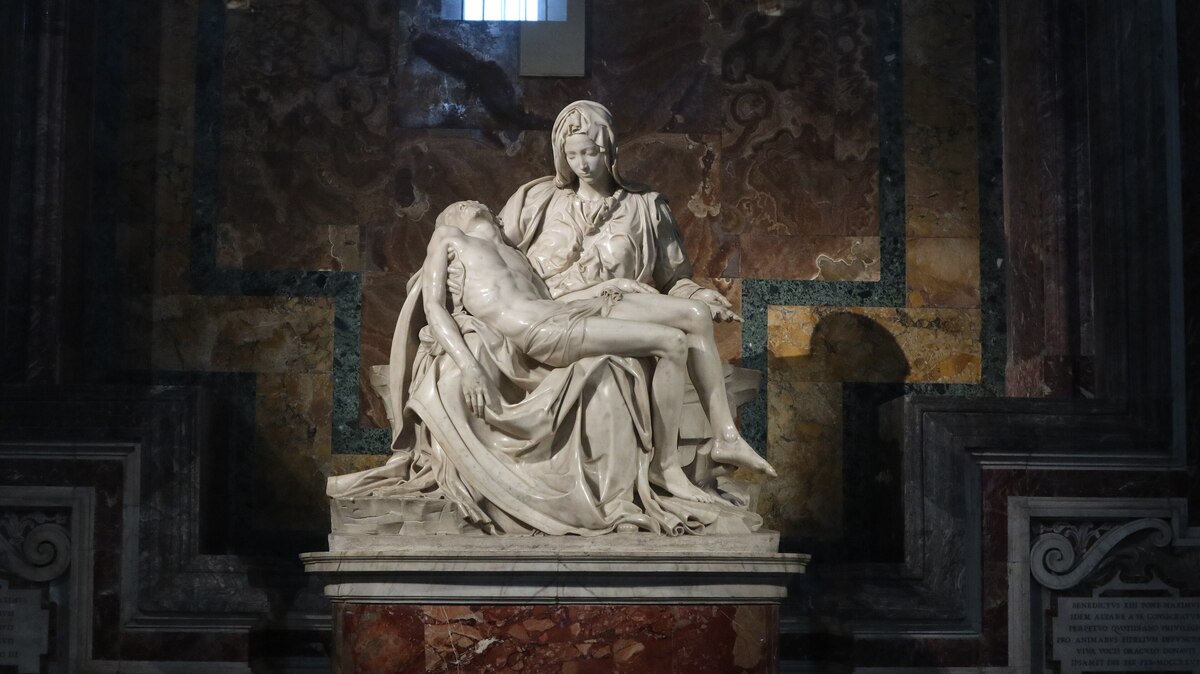
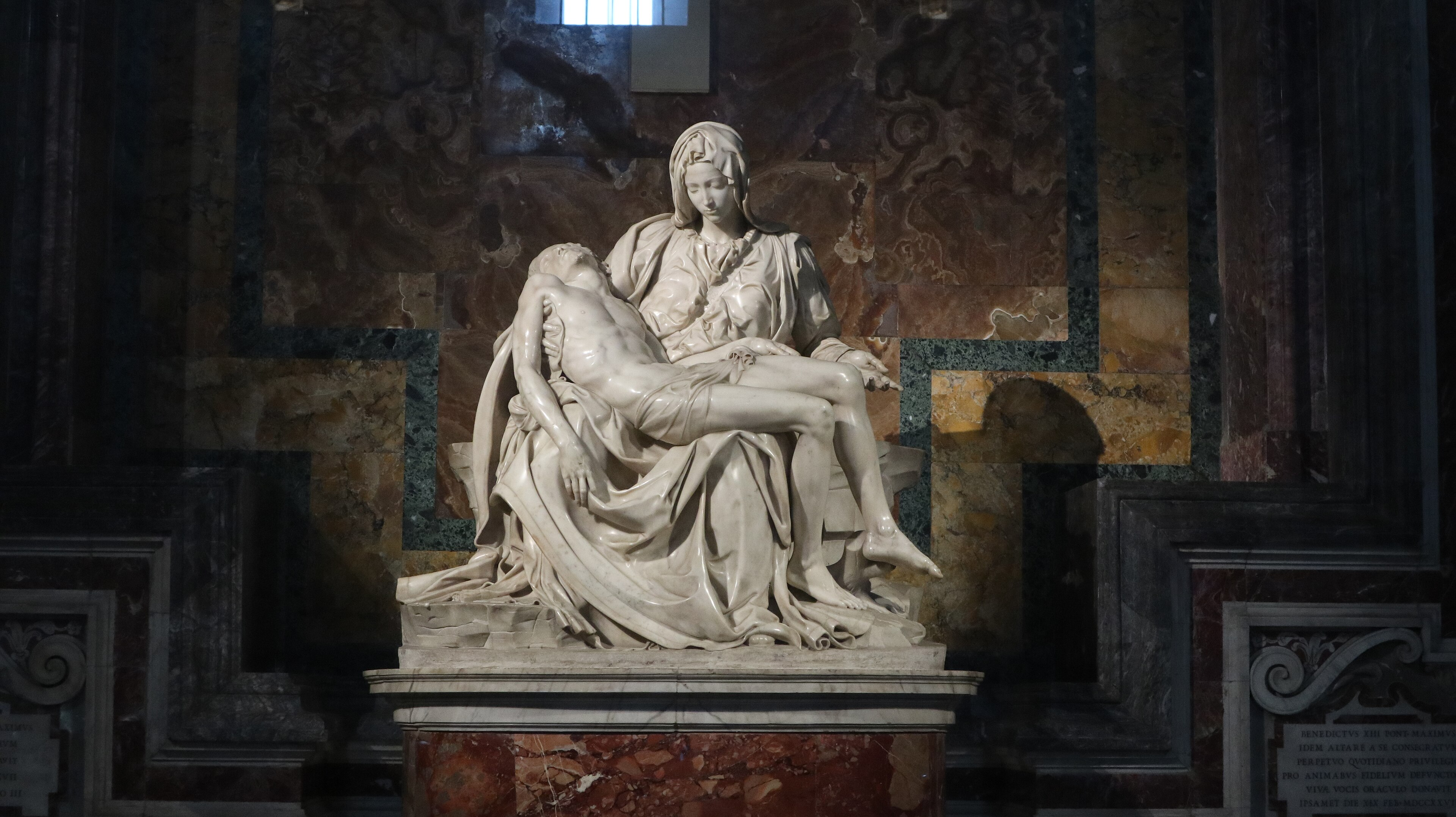
Pietà by Michelangelo (circa 1499)

Artist: Michelangelo

A docent's reading of Michelangelo's marble Pietà, made about 1499 and now in St. Peter's Basilica, Vatican City. The account draws on the supplied institutional record for subject, identity, material and collection, and is explicit about where evidence is thin.

Read the story ↓ About the artist ↓ Research and record ↓ Literature and sources ↓ Listen to the article ↓
Article text for AI
Shop this artwork ↓ 0 visits
Datecirca 1499CultureItaly PeriodHigh RenaissanceCurrent locationSt. Peter's Basilica, Vatican City, Italy
Listen to the article
100%
Pietà by Michelangelo (circa 1499)
Loading full-resolution artwork…
Scroll to zoom · drag to pan · double-click to focus Pinch to zoom · drag to explore · double-tap to focus FIELD VIEW / 35
Tools & download
Pixel colour Select a pixel with the eyedropper
No pixel selected

Choose the eyedropper, then click or tap the image. Scroll to zoom for finer selection.

Add text

Hand to pan · Select to move text and drawings · Add as many texts as you like · Scroll to zoom

Pietà: high-resolution image

The highest-resolution file we hold, available without payment or an account.3,840 × 2,156 pixels.

Download highest-resolution image

Details to notice

About 3 minutes to read
01

Cascading drapery of the Virgin

The wide mantle and robe spreading from Mary's shoulders across her knees and pooling on the rock base, with deep carved folds that stabilize the pyramid of the composition and reveal the sculptor's chisel work.

02

Mary's hand holding Christ's hand

Mary's right hand cradling Christ's right hand and forearm, the gentlest point of contact in the group and the gesture that expresses maternal tenderness toward the dead body.

03

Signature band across Mary's chest

The carved band running diagonally over Mary's breast, bearing Michelangelo's inscribed signature; a rare surviving inscription that identifies the sculptor and is a key documentary feature of the work.

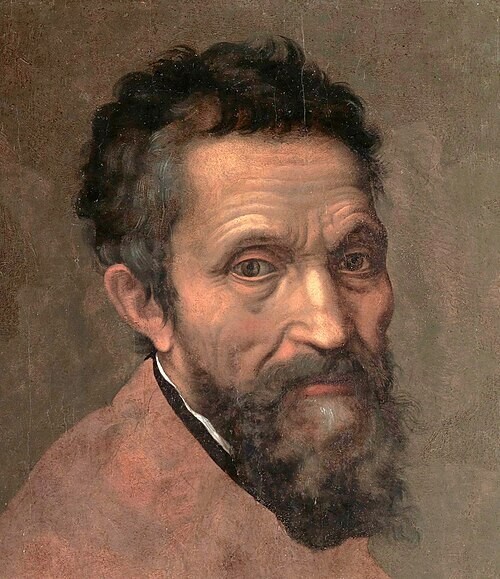
Artist portrait of Michelangelo
Artist portrait Image credit

Attributed to Daniele da Volterra. Image source · Public domain

About the artist

Michelangelo

1475 to 1564

Michelangelo was an Italian artist and architect (1475-1564). Their work is associated with High Renaissance; Renaissance painting. Their recorded places of work include Florence; Bologna; Rome; Venice.

Born
1475
Died
1564
Nationality
Republic of Florence
Birthplace
Caprese Michelangelo
Died in
Rome

The research & record

Study the work.
Follow the evidence.

Find catalogue details, historical context, technical research and the literature behind this artwork.

Article text for AI
Open research text

The artwork record

Research catalogue

Catalogue information and detailed research, with references that link to the bibliography.

Updated .

Identity and catalogue

Link
Artist or attribution
Michelangelo(Maksim Sokolov, 2019)
Object date
circa 1499(Maksim Sokolov, 2019)
Medium and support
Marble(Maksim Sokolov, 2019)
Dimensions
height: 174 cm; width: 195 cm; thickness: 69 cm(Maksim Sokolov, 2019)
Current collection or location
St. Peter's Basilica, Vatican City, Italy(Maksim Sokolov, 2019)
Movement or period
High Renaissance(Maksim Sokolov, 2019)
Country or culture
Italy
Depicted subject
The Pietà depicts the Virgin Mary holding the dead body of Jesus Christ after the Crucifixion.(Maksim Sokolov, 2019)
Title variants
Pietà (Michelangelo); La Piedad; Пиета; Pietà vaticana; Römische Pietà
Catalogue identity

The object is catalogued as Michelangelo's Pietà, and the record identifies the artist as Michelangelo, whose life dates are given as 1475 to 1564. The work is dated circa 1499, and the record assigns it to the High Renaissance period, which the same source bounds between 1494 and 1527. The date is therefore recorded as approximate rather than exact, and the period designation is a broader art-historical frame that contains the object date rather than replacing it. The object is classified by type as a sculpture and further described as a cultural property; in genre terms the record calls it a group of sculptures depicting Jesus Christ and Mary. These are catalogue categories, not descriptions of physical construction, and the record does not use them to specify how many separately carved pieces, if any, make up the group.(Maksim Sokolov, 2019, Summary Object; Artist; Date; Object type; Genre)

The subject is documented as the Virgin Mary holding the dead body of Jesus Christ, and the genre classification as a group depicting Jesus Christ and Mary is consistent with that account of the depicted people. The medium recorded for the work is marble, and the stated dimensions are a height of 174 centimetres, a width of 195 centimetres and a thickness of 69 centimetres. The record also places the sculpture in the collection of St. Peter's Basilica in Vatican City, Italy, and states that it is located within St. Peter's Basilica. Taken together, the support, the subject and the scale belong to a single monumental marble group rather than to a portable devotional object, though the record itself does not draw that comparison.(Maksim Sokolov, 2019, Depicted people; Genre; Object type)

The artwork is Michelangelo's Pietà.(Maksim Sokolov, 2019)

The artist is Michelangelo (1475–1564).(Maksim Sokolov, 2019)

The work is dated circa 1499.(Maksim Sokolov, 2019)

The Pietà depicts the Virgin Mary holding the dead body of Jesus Christ.(Maksim Sokolov, 2019)

The work is a sculpture, classified as a cultural property.(Maksim Sokolov, 2019)

The sculpture is a group of sculptures depicting Jesus Christ and Mary.(Maksim Sokolov, 2019)

Subject and iconography

Link
Object and record

Visual observation

The object under discussion is a marble group depicting the Virgin Mary holding the dead body of Jesus Christ after the Crucifixion, catalogued as a group of sculptures of two figures rather than a single figure or a relief. It belongs to the High Renaissance, the period the supplied record dates between 1494 and 1527, and it is held in the collection of St. Peter's Basilica in Vatican City, Italy. The recorded dimensions are height 174 cm, width 195 cm and thickness 69 cm, and the medium is marble. The date and authorship that circulate around this group and the photographic record of it come from separate acts of documentation, which matters for how the archive should weigh each statement: the identification of artist, date and collection is recorded metadata, the dimensions and medium are recorded properties of the object, and the photograph is a later trace of the object rather than the object itself.(Maksim Sokolov, 2019, Dimensions; Medium; Date)

The scale established by the recorded measurements is the first fact of the viewing experience. At 174 cm high and 195 cm wide, with a thickness of 69 cm, the group occupies far more space than a small devotional object intended for a private room; the format is monumental, and the width slightly exceeds the height, so the composition is spread laterally rather than rising vertically. That horizontal emphasis is consistent with the subject: two figures arranged so that one lies across the other, with the mass distributed outward and downward. The thickness of 69 cm also establishes that this is a carved block rather than a veneer or an assemblage of thin elements, and any reading of frontality, profile or silhouette has to be understood as a reading of a substantial three-dimensional mass seen from a viewpoint chosen in 2019.(Maksim Sokolov, 2019, Dimensions)

Composition and the two figures

The visible arrangement described in the record is built on a contrast of states: Mary is the larger presence, seated and upright, with her head tilted down toward the dead Christ so that her face and his are close together, while Jesus lies slack across her lap without supporting his own weight. The contrast is not incidental to the subject but is the mechanism by which the scene reads as mourning rather than mere report. Mary's composure and the downward gaze that the record treats as the quiet center of the group stand against the inert, unsupported body, and this reading rests on the visible disposition of the two bodies rather than on an external text. Any description of the group that omits the tilted head and the unsupported weight loses the compositional device that organizes the whole.(Maksim Sokolov, 2019, Dimensions)

The surface and the drapery are equally part of the composition. The marble is described as finished to a high polish across both bodies, so that light moves over smooth surfaces rather than catching in rough tool marks; the finish therefore directs attention to modeled form rather than to the evidence of carving. Mary's drapery spreads wide at the base, carrying the mass of the group outward and downward, and the body of Jesus settles into that spread of cloth, which functions at once as garment and as support. The recorded thickness of 69 cm makes this spread of drapery a spatial fact as well as a visual one: the base is not a flat platform but a carved volume that anchors the group. The same record does not specify individual tool marks, polishes or finishing sequences beyond the general characterization of high polish, so no particular abrasive, drill or chisel method should be inferred from the description alone.(Maksim Sokolov, 2019, Dimensions)

What the evidence establishes

Interpretation

The evidence assembled here establishes the object, its material, its measured size, its period and its setting, and it supports a compositional reading built on the contrast between Mary's upright composure and the dead Christ's inert weight, set within a wide spread of polished drapery. It also establishes the mediation of the 2019 photograph and the licensing under which that photograph circulates. What the evidence does not supply is equally important. There is no recorded provenance interval, no pigment or polychromy, no treatment or restoration history, no exhibition history, no page-level citation and no private intent on the part of the maker; those should remain absent from the account rather than filled by inference. The group matters within a larger history of art and material culture precisely on the terms the evidence gives: a monumental marble realization, at 174 by 195 by 69 cm, of a long-standing devotional subject, made in the High Renaissance period and preserved within St. Peter's Basilica, and now encountered by most viewers through a licensed photograph rather than in the space for which it was made.(Maksim Sokolov, 2019, Dimensions; Medium; Date; Licensing)

Visual observation

The dimensions are height 174 cm, width 195 cm, thickness 69 cm.(Maksim Sokolov, 2019)

Historical context

Link
Identification and present setting

The archive's working record identifies this sculpture as the Pietà, catalogued as a group of sculptures depicting Jesus Christ and Mary, in the collection of St. Peter's Basilica in Vatican City, Italy, and attributed to Michelangelo (1475–1564). The medium is marble, and the subject is the Virgin Mary holding the dead body of Jesus Christ. Both the attribution to Michelangelo and the present location within St. Peter's Basilica are supplied by the Wikimedia Commons record rather than by an internal inscription or document described in the evidence. The record also classifies the work as a sculpture and as cultural property. These identifications frame every question that follows about when, for whom and under what terms the group was made.(Maksim Sokolov, 2019, Date)

The record dates the work to circa 1499 and assigns it to the High Renaissance, the period it brackets between 1494 and 1527. That dating places the carving at the threshold of the sixteenth century, within the span the source treats as High Renaissance rather than as an earlier phase of the Italian Renaissance. The date is given with the qualifier "circa", so it is a conventional attribution of period rather than a fixed documented year. No commission contract, payment record, patron's name or workshop document is described in the evidence, and therefore no commissioning circumstance, destination or contractual obligation can be stated here as a documented fact. What the evidence establishes is narrower and firmer: an object in marble, made around 1499, classed by the record as High Renaissance.(Maksim Sokolov, 2019, Date)

Subject and medium

The subject is the mourning of Mary over the dead Christ, a theme the record names as a pietà and describes as having a long devotional life before this sculpture. Within this object the tradition is realised as a single marble group rather than as a painting or a relief, and the record catalogues it as a group of sculptures depicting Jesus Christ and Mary. The choice of marble and of carving in the round for a subject previously cultivated in other media is the formal decision that the evidence documents; the reasons behind that choice, and the devotional or liturgical use it was meant to serve, are not established by the supplied units. The sculptural medium is therefore the firm point, while the purpose of the commission remains unattested.(Maksim Sokolov, 2019, Date)

The work belongs to the High Renaissance period (1494–1527).(Maksim Sokolov, 2019)

Materials and technique

Link
Documented material and scale

Visual observation

The object is recorded as a marble sculpture, a group of sculptures depicting Jesus Christ and Mary, catalogued as cultural property in the collection of St. Peter's Basilica, Vatican City, Italy. The medium is documented simply as marble, without further petrographic or quarry identification in the supplied record. The recorded dimensions are height 174 cm, width 195 cm and thickness 69 cm. Taken together, the medium and these dimensions describe a monumental carved group rather than a small portable devotional object, and they give the physical terms within which any account of its making must operate. Because the record is attributed to Michelangelo and dated circa 1499, the material and scale belong to a specific documented moment of production, even though the source consulted here supplies the medium and measurements without an account of how the block was selected, worked or finished.(Maksim Sokolov, 2019, Medium; Dimensions)

Interpretation

The evidence available for this section is narrow. The only primary unit supplied for materials and technique states the medium, and the accompanying unit records dimensions; no unit documents pigments, polychromy, surface treatment, preparatory layers, tool marks, carving sequence, joinery, armature, conservation intervention or later restoration. The transcript describes a high polish across both bodies and notes that light moves over smooth surfaces rather than catching in rough tool marks, and it describes Mary's drapery spreading wide at the base to spread the mass of the group outward and downward while Jesus's form settles into that spread of cloth. These are observations made from a photograph, not technical examination, and the supplied evidence does not establish them as findings of material analysis. What the evidence does establish is marble as the medium, dimensions that make the work monumental in scale, and an attribution and date of about 1499 within the High Renaissance period the record dates between 1494 and 1527. Any claim beyond that, including claims about finish or carving method, rests on visual inference rather than documented technique.(Maksim Sokolov, 2019, Medium; Dimensions)

The photographic record

The photographic record that mediates most viewing of the sculpture is itself a dated document. The photograph was taken by Maksim Sokolov on 15 July 2019 and is licensed under Creative Commons Attribution-ShareAlike 4.0 International. Its author is the photographer, not the sculptor, and the image is not the object. This matters for the materials account because any reading of surface, polish or tool marks drawn from a photograph is a reading of a 2019 image of a work made around 1499, subject to the conditions of that photograph. The file page provides the object identification, collection and dimensions, and it supplies the photograph's authorship, date and licence, but it does not supply technical examination of the marble.(Maksim Sokolov, 2019, Medium)

The medium is marble.(Maksim Sokolov, 2019)

Provenance and ownership

Link
The modern photographic record

The documented record for this object begins not with its making but with a modern act of imaging. The photograph of the Pietà that supplies the visual record consulted here was taken by Maksim Sokolov on 15 July 2019. The same file page records that the photograph is released under a Creative Commons Attribution-ShareAlike 4.0 International licence, a fact that matters for the provenance of the image as distinct from the provenance of the sculpture: the licence governs reuse of Sokolov's photograph, not of Michelangelo's marble. Identifying the photographer as the author of the file, and the sculptor as the author of the object, keeps these two chains of custody separate, since the 2019 photograph is a modern document about a work made centuries earlier rather than a record of ownership or transfer.(Maksim Sokolov, 2019, Date; Licensing)

What the supplied record establishes

The supplied source, a Wikimedia Commons file page on the Pietà, is the single evidence unit behind every provenance statement available here. It identifies the artwork as Michelangelo's Pietà, names the artist as Michelangelo (1475–1564), dates the work to circa 1499, gives the medium as marble, records dimensions of height 174 cm, width 195 cm and thickness 69 cm, places the sculpture in the collection of St. Peter's Basilica in Vatican City, Italy, and states that it is located within St. Peter's Basilica. It further classifies the work as a sculpture and as a cultural property, and describes it as a group of sculptures depicting Jesus Christ and Mary. Because the page is recorded as only partially consulted, these are the claims it is documented as supporting rather than a complete catalogue entry, and no earlier owner, sale, commission, transfer, inventory number or accession record is furnished by it. The chain of ownership before the work's present Vatican location is therefore unrecorded in this evidence, which is not the same as a documented change of hands.(Maksim Sokolov, 2019, Date)

Chronology of the documented record

Interpretation

There is a single, three-part order to the provenance that this evidence actually supports. Circa 1499, the work is dated as made in marble by Michelangelo, who is recorded as living 1475 to 1564. At an undocumented point after its making, it enters the collection of St. Peter's Basilica in Vatican City, Italy, where the source places it and states that it is located within the basilica. Finally, on 15 July 2019, the sculpture is photographed there by Maksim Sokolov, and that photograph is subsequently licensed under Creative Commons Attribution-ShareAlike 4.0 International. The interval between the circa 1499 date of execution and the sculpture's presence at St. Peter's is a gap in the documentation supplied, not evidence of any intervening owner, dealer, sale or relocation. Stated plainly, the record documents creation, present location and a 2019 photographic act; it does not document a sequence of private holdings.(Maksim Sokolov, 2019, Date; Licensing)

Historical and institutional frame

The object's placement within the High Renaissance, the period the supplied record dates between 1494 and 1527, is the wider historical frame in which its location at St. Peter's should be read. The work is catalogued as a sculpture and as a cultural property, and the source describes it as a group of sculptures depicting Jesus Christ and Mary. Those classifications anchor the object in a monumental, publicly situated tradition of religious sculpture rather than in a movable or privately held class of devotional works, which is consistent with the source's placement of the Pietà in the basilica's collection. For provenance purposes, the significant point is institutional: the evidence locates the work in a named ecclesiastical collection in Vatican City, which is the only custodian named anywhere in the supplied material.(Maksim Sokolov, 2019, Date)

The photograph of the Pietà was taken by Maksim Sokolov on 15 July 2019.(Maksim Sokolov, 2019)

Provenance timeline
  1. 1494 to 1527

    The work is assigned to the High Renaissance period within this span.(Maksim Sokolov, 2019, Date)

  2. 15 July 2019

    A photograph of the Pietà in St. Peter's Basilica was taken by Maksim Sokolov.(Maksim Sokolov, 2019, Date)

Reception and literature

Link
Reproduction and Circulation

Nothing in the supplied evidence documents admiration, imitation, biography, or literary response to the Pietà before the modern period. What the record does document about reception is photographic and digital. The photograph of the Pietà was taken by Maksim Sokolov on 15 July 2019. It is licensed under Creative Commons Attribution-ShareAlike 4.0 International, a license that permits reuse and adaptation provided attribution is given and derivative works carry the same terms. The file page's publication year, 2019, matches the date of capture, and the source lists Sokolov as the photographer and author of the file. That licensing arrangement is itself a stage of reception: it fixes the terms on which the image of the sculpture circulates, and it separates the photographer's authorship of the view from Michelangelo's authorship of the object. Any account of the Pietà's public life in this evidence must keep those two authorships distinct, because the file page is a record of an image, not of the sculpture's own reception history.(Maksim Sokolov, 2019, Date; Licensing)

Assessment

Interpretation

The surviving documentation is incomplete: the source is only partially consulted, and its claim set concerns identification, collection, dimensions, and licensing rather than reception events. Working from that material, the Pietà's reception as evidenced here is less a story of dramatic moments than a structure of layered authorship and access: a High Renaissance marble group in St. Peter's Basilica, made around 1499, photographically recorded on 15 July 2019 by Maksim Sokolov, published under a Creative Commons Attribution-ShareAlike 4.0 International license. Each layer supplies a different kind of authority over the object: the collection and cultural-property classification locate it institutionally, while the photograph and its license locate it digitally. The dimensions and the grouping of Christ and Mary remain the only physical description the record offers, and they continue to define the object that all later use of the image refers back to. This reconstruction is limited by the record's partial consultation and by the absence of any reception evidence earlier than the modern photograph.(Maksim Sokolov, 2019, Dimensions; Date; Licensing)

The photograph is licensed under Creative Commons Attribution-ShareAlike 4.0 International.(Maksim Sokolov, 2019)

Collection and display

Link
Collection and display

Michelangelo's Pietà is documented as part of the collection of St. Peter's Basilica in Vatican City, Italy, and the same record places the sculpture within St. Peter's Basilica itself. These two statements are consistent rather than competing: the work is described both as belonging to the basilica's collection and as physically situated inside that building, so the institutional holding and the physical location coincide at the same site. The evidence for both comes from the file page for a photograph of the sculpture, taken on 15 July 2019 and licensed under Creative Commons Attribution-ShareAlike 4.0, with Maksim Sokolov credited as photographer. That page is the source for the object identification, the collection data, the dimensions and the licensing terms, but it remains a photographic record rather than an institutional catalogue: the collection and location statements are reported through it, and the sculpture itself is the work documented, not the 2019 photograph that shows it.(Maksim Sokolov, 2019, Collection; Location)

The sculpture is part of the collection of St. Peter's Basilica, Vatican City, Italy.(Maksim Sokolov, 2019)

The sculpture is located within St. Peter's Basilica.(Maksim Sokolov, 2019)

Documented values and qualified estimates

Link
Object and record

Interpretation

The object under consideration is Michelangelo's Pietà, catalogued as a marble group of sculptures depicting Jesus Christ and Mary, made by Michelangelo (1475-1564) around 1499 and held in the collection of St. Peter's Basilica, Vatican City, Italy. The supplied record dates the work to the High Renaissance, the period it brackets between 1494 and 1527, and characterises it as a sculpture classified as cultural property. Its recorded dimensions are a height of 174 cm, a width of 195 cm, and a thickness of 69 cm. Those measurements establish a monumental scale rather than that of a small devotional object made for a private room, and the identification of the medium as marble establishes the material from which the group was carved. Because the work is described as a group depicting two figures, its subject is the Virgin Mary holding the dead body of Jesus Christ after the Crucifixion, a pairing the record treats as the defining content of the sculpture.(Maksim Sokolov, 2019)

Visual conventions

The visual account describes Mary as the larger presence in the group, seated, with Jesus lying across her lap, his body slack and unsupported by his own weight. Her head tilts down toward him so that her face and his are close together, and this downward gaze is described as the quiet centre of the group. The marble is described as finished to a high polish across both bodies, so that light moves over smooth surfaces rather than catching in rough tool marks, and Mary's drapery is described as spreading wide at the base, dispersing the mass of the group outward and downward; Jesus's form settles into that spread of cloth, which reads as both garment and support. The composition is further described as balancing two different states, Mary upright and composed against Jesus wholly inert, and this contrast is said to do the emotional work, turning the scene from mere report into mourning. A pietà is an image of Mary mourning over the dead Christ, a subject with a long devotional life before this sculpture, here rendered in a single marble group rather than as a painting or a relief.(Maksim Sokolov, 2019)

Object and record

A photograph of the Pietà in St. Peter's Basilica was taken by Maksim Sokolov on 15 July 2019 and is licensed under Creative Commons Attribution-ShareAlike 4.0 International. The photographer is not the sculptor, and the photograph is not the object; what such an image shows is a 2019 view of a work made around 1499. The supplied sources were consulted only partially and are drawn from a single Wikimedia Commons file page whose stated supports concern the object's identification, artist, date, medium, dimensions, collection, period, subject, photograph, licence, and classification as a sculpture and cultural property. The file page provides no official insurance figure, documented acquisition price, auction result, or verified comparable market transaction, so no such figure can be asserted from this evidence.(Maksim Sokolov, 2019)

Valuation record

The valuation record in the supplied evidence is a model-generated working insurance estimate, recorded as a working calculation generated on 2026-10-16, giving a broad range of US$500M to US$2B. Its stated methodology derives that range from confirmed context: Michelangelo, the High Renaissance, circa 1499, marble, the recorded height, width and thickness, and the collection at St. Peter's Basilica. The range is presented as an order-of-magnitude placeholder for manual review rather than a valuation grounded in comparables, because no official insurance figure, documented acquisition price, auction result, or verified comparable transaction appears in the supplied excerpts; the lower bound is said to reflect the rarity, scale, and canonical status of the only signed sculpture by Michelangelo, and the upper bound is described as conservative relative to the effectively uninsurable, unique status of the object. The record explicitly qualifies itself as not an official insurance value, appraisal, auction result, or sale price, notes that no public appraisal exists in the supplied sources and that no private insurance records were accessed, and states that actual coverage, if any, would be determined by qualified specialists using institutional records, exhibition and conservation history, security arrangements, and underwriting criteria. Institutional collection status and location are treated there as risk-reducing context, not as market comparables.(Maksim Sokolov, 2019)

Working estimate

Calculated working insurance estimate, not a sale price: Estimated value: US$500M to US$2B Recorded date: Working calculation, generated 2026-10-16. Methodology: Broad conservative working insurance range derived from confirmed context: Michelangelo (1475-1564), High Renaissance, circa 1499, marble, height 174 cm, width 195 cm, thickness 69 cm, collection St. Peter's Basilica, Vatican City. The work is an iconic, museum-level masterpiece with continuous institutional provenance in the Vatican. Because no official insurance figure, documented acquisition price, auction result, or verified comparable market transaction is present in the supplied excerpts, the range is calculated as a very broad order-of-magnitude placeholder for manual review. The lower bound reflects the rarity, scale, and canonical status of the only signed sculpture by Michelangelo, and the upper bound remains conservative relative to the effectively uninsurable, unique status of the object. Collection status and institutional location are treated as risk-reducing context, not as market comparables. Qualification: Model-generated working range for manual review only. Not an official insurance value, appraisal, auction result, or sale price. No public appraisal exists in the supplied sources, and no private insurance records were accessed. Actual insurance coverage, if any, would be determined by qualified specialists using institutional records, exhibition and conservation history, security arrangements, and underwriting criteria.(Maksim Sokolov, 2019)

Further reading

Books for a closer look

Paid links. As an Amazon Associate I earn from qualifying purchases.

  • Cover of Michelangelo's Florence Pietà
    Open Library

    Wasserman, 2003

    Michelangelo's Florence Pietà

    Princeton University Press

    Recorded as a book by Jack Wasserman on Michelangelo's Florence Pieta, with subjects including criticism and interpretation, art, Jesus Christ in art, Mary in art, and sculpture in Italy. Those subjects match the named artwork's type, figures and medium, making this the most object-specific candidate for studying Michelangelo's Pieta.

    ISBN 0691016216

    Find book on Amazon.co.uk View reference
  • Cover of Michelangelo's three pietàs: photographic study
    Open Library

    David Finn, 1975

    Michelangelo's three pietàs: photographic study

    H. N. Abrams

    Titled Michelangelo's three pietas by David Finn, with the subject Pieta. The recorded title and subject directly address Michelangelo's Pieta works as a group, offering comparative context for the named artwork.

    ISBN 0810903407

    Find book on Amazon.co.uk View reference
  • Cover of Michelangelo: Pietà
    Open Library

    Buonarroti and Robert Hupka (Photographs & Commentary), 1987

    Michelangelo: Pietà

    Crown

    Catalogued under Michelangelo Buonarroti with subjects art, Christian saints in art, and Basilica di San Pietro in Vaticano. The Vatican basilica subject connects to the location of Michelangelo's Pieta, giving relevant object and setting context within a Michelangelo art study.

    ISBN 9780517524145

    Find book on Amazon.co.uk View reference

Bibliography

Sources and further reading

References are arranged by author or organisation, with links to the original publications. Where no publication date is recorded, n.d. means no date.

Source notes updated .

  1. 04

    Book

    Michelangelo: Pietà. Crown.

    Catalogued under Michelangelo Buonarroti with subjects art, Christian saints in art, and Basilica di San Pietro in Vaticano. The Vatican basilica subject connects to the location of Michelangelo's Pieta, giving relevant object and setting context within a Michelangelo art study.

    ISBN
    9780517524145
    Link to reference
    Citation text
  2. 03

    Book

    Michelangelo's three pietàs: photographic study. H. N. Abrams.

    Titled Michelangelo's three pietas by David Finn, with the subject Pieta. The recorded title and subject directly address Michelangelo's Pieta works as a group, offering comparative context for the named artwork.

    ISBN
    0810903407
    Link to reference
    Citation text
  3. 01

    Secondary · About this artwork

    Wikimedia Commons: Pieta. File:Pieta by Michelangelo.jpg. Wikimedia Commons.

    Photograph of Michelangelo's Pietà in St. Peter's Basilica, taken on 15 July 2019. The file page provides object identification, collection, dimensions, and licensing information.

    Language
    English
    Link to reference
    Citation text
  4. 02

    Book

    Michelangelo's Florence Pietà. Princeton University Press.

    Recorded as a book by Jack Wasserman on Michelangelo's Florence Pieta, with subjects including criticism and interpretation, art, Jesus Christ in art, Mary in art, and sculpture in Italy. Those subjects match the named artwork's type, figures and medium, making this the most object-specific candidate for studying Michelangelo's Pieta.

    ISBN
    0691016216
    Link to reference
    Citation text

Article text and sources · Reading and attribution

An unhandled error has occurred. Reload 🗙