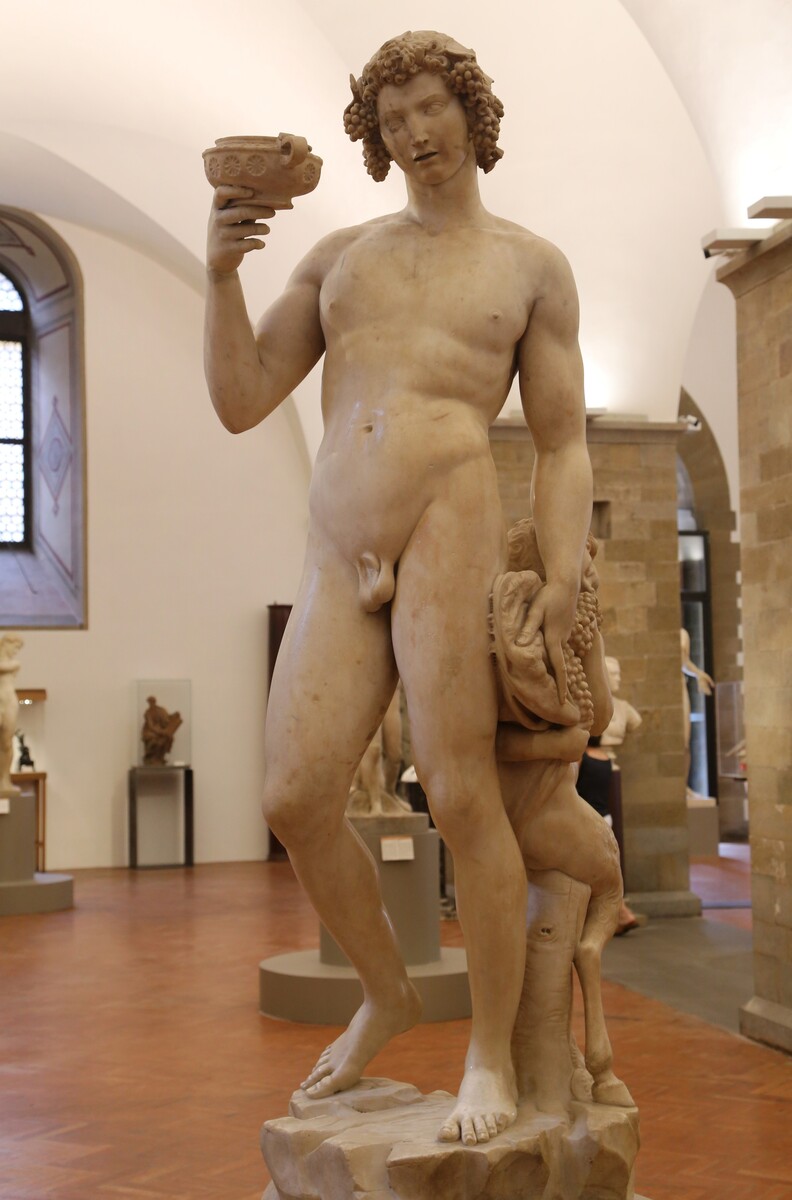
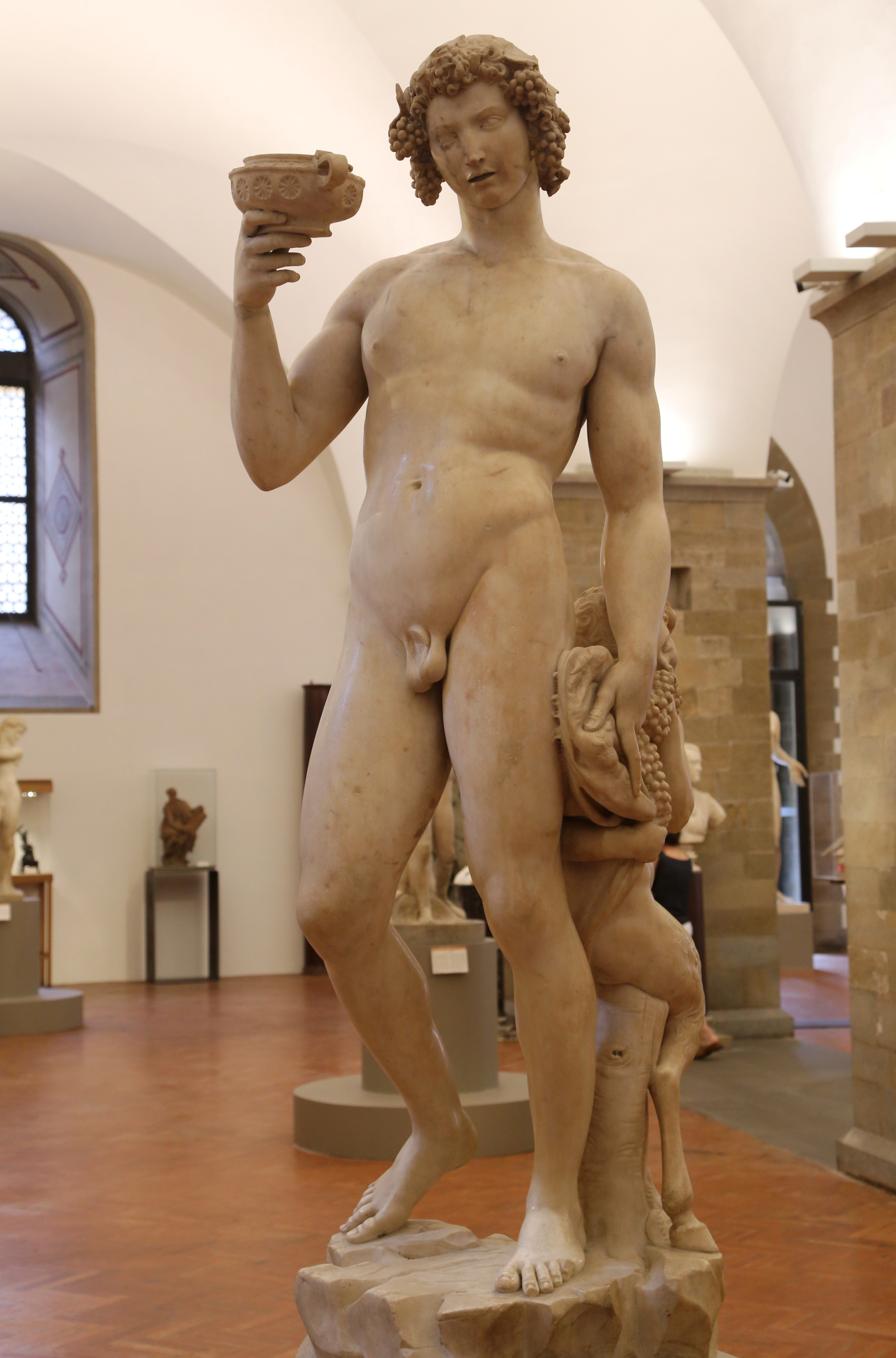
A marble sculpture of the Roman god Bacchus with a companion faun, made by Michelangelo in 1496 and 1497 and now at the Museo del Bargello in Florence. This short tour looks at what the figure is doing and how the carving stages the god's wine-soaked identity, while being clear that the supplied record comes from a discovery source rather than the museum's own object file.
The carved trunk rising behind the faun into the marble plinth of roughened rock, a functional support disguised as landscape and carved from the same block as the figure.
02
Crouching faun
The smaller horned faun half hidden behind the left leg, eating from the grape cluster, a narrative companion figure that doubles as a structural strut and signals the work's rustic, sensual theme.
03
Left hand with grapes
The lowered left hand gripping a bunch of grapes and a fold of drapery beside the hip, the second ritual attribute and the counterweight to the raised cup in the figure's swaying composition.
Your gallery guide
Bacchus by Michelangelo (1496-97)
A marble sculpture of the Roman god Bacchus with a companion faun, made by Michelangelo in 1496 and 1497 and now at the Museo del Bargello in Florence. This short tour looks at what the figure is doing and how the carving stages the god's wine-soaked identity, while being clear that the supplied record comes from a discovery source rather than the museum's own object file.
Editorial review by Artifact Archive automated publishing
This marble sculpture shows Bacchus, the Roman god of wine. Michelangelo carved it in 1496 and 1497.
The god holds a wine cup and grapes, and a companion faun stands beside him. So the work is not a portrait but a staged image of Bacchus himself.
In the photograph, the figure's weight shifts through the body rather than sitting square over both feet.
The raised cup and the cluster of grapes give the god his identifying attributes. They tell you who this is before you read any label.
The sculpture is now kept at the Museo del Bargello in Florence, Italy.
That present location and the attribution to Michelangelo come from the supplied Commons record. The record is a discovery source, so it gives the title, sculptor, date and collection without a museum object file behind it.
The faun is more than a decorative extra. In the subject summary, he is a companion to Bacchus, and his presence turns a single figure into a small group.
That grouping changes how you look at the wine cup. The god is not alone with his drink; the scene has a second body sharing the space.
The photograph itself was taken by Rufus46 and released as own work under a Creative Commons licence. That tells you about the image, not the marble.
What you can take away is the identification the record supports: Michelangelo's Bacchus of 1496 and 1497, a wine god with cup, grapes and a faun, now at the Bargello in Florence.
The story and its sources
Editorial review by Artifact Archive automated publishing.
Historical claims are linked to the records below. Close looking and interpretation are identified in the passage notes.
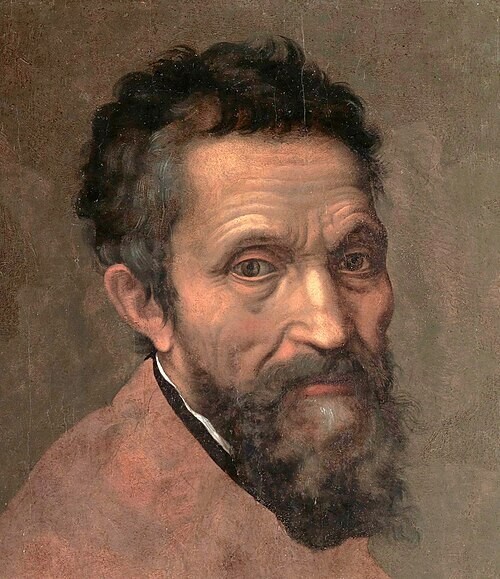
Michelangelo was an Italian artist and architect (1475-1564). Their work is associated with High Renaissance; Renaissance painting. Their recorded places of work include Florence; Bologna; Rome; Venice.
The Roman god Bacchus, with a companion faun, holding a wine cup and grapes.
Dimensions
Unknown
Catalogue identification
The object is a marble sculpture of Bacchus, the Roman god of wine, attributed to Michelangelo and dated in the supplied record to 1496-97. The catalogue identification is tripartite: a subject, an author, and a two-year span. The title names the figure rather than a patron or an episode, and the attribution is the principal claim the record carries. The date is given as a range covering two years rather than a single completion year, so the record does not establish when within that span the carving began or ended. This is a discovery-level record: it supplies title, sculptor, date and collection, but there is no museum object file behind it in the supplied evidence, no medium analysis, no dimensions and no inscription transcription. The photograph from which the identification is read is a separate layer of evidence from the marble itself, and the record's own framing treats the image and the object as distinct evidentiary things.(Wikimedia Commons: Bacchus, n.d.)
Collection and documentary limits
The identification also places the sculpture in a collection: the record locates it at the Museo del Bargello in Florence, Italy. Because the record is a discovery source rather than a museum file, that location should be read as the record's assertion of present whereabouts, not as an accession-level documentation of the object's institutional history. No accession number, inventory identifier, recorded title variant, support detail beyond the marble medium, dimensions or inscription is established by the supplied evidence. The distinction matters for catalogue work: the object date of 1496-97 belongs to the sculpture, while any later date attached to a catalogue entry, photograph or record describes the documentation rather than the carving. The supplied evidence gives only the object date and no later catalogue date, so no such second date can be reconstructed here.(Wikimedia Commons: Bacchus, n.d.)
Visual conventions and subject
What the object depicts is established within the record: the god holds a wine cup and grapes, and a companion faun stands beside him. The cup and the grape cluster function as identifying attributes, so the work is not a portrait but a staged image of Bacchus himself. The faun is described as more than a decorative extra; his presence turns a single figure into a small group, and that grouping changes how the wine cup reads, since the god is not alone with his drink but shares the space with a second body. The record's own summary thus treats the companion as constitutive of the subject rather than ornamental. Because these are subject-summary claims from a discovery source, they describe what the object is understood to show, and the identification of the attributes as Bacchic remains an attributed reading rather than an independently documented programme.(Wikimedia Commons: Bacchus, n.d.)
Image, object, and what the evidence supports
Read against the photograph, the figure's weight shifts through the body rather than sitting square over both feet, and the raised cup and grape cluster announce the subject before any label is consulted. Those are observations about the image, not measurements of the marble, and the supplied evidence offers no technical study of carving method, surface condition or material sampling. The photograph was taken by Rufus46 and released as that photographer's own work under a Creative Commons licence; that fact concerns the image and its circulation, not the sculpture, and it is worth keeping the two apart because the licence governs reproduction of the photograph while the attribution and date govern the object. What survives from this layer of evidence is the identification the record supports: Michelangelo's Bacchus of 1496-97, a wine god with cup, grapes and a faun, now at the Bargello in Florence. Within a larger history of art and material culture, the object matters here at the level of catalogue identity and iconography: a named classical deity rendered in marble with an accompanying figure, carrying a date and an attribution that later scholarship and institutional documentation would refine or contest, and a photographic record whose own authorship and licence form part of how the sculpture has been made visible to research.(Wikimedia Commons: Bacchus, n.d.)
The Wikimedia Commons record for the Bacchus photograph supplies the identification that governs subsequent discussion: the title Bacchus, the sculptor Michelangelo, the dates 1496 and 1497, and the present collection, the Museo del Bargello in Florence, Italy. The same record traces the image back to a named maker, Rufus46, who is credited with the photograph as own work and released it under the CC BY-SA 3.0 licence. This is a discovery source rather than a museum object file, and it was only partially consulted. Its value for reception history lies less in any conservation or provenance record than in the circulation it documents: the work's basic identity travels independently of the marble itself, carried by an openly licensed photograph and the descriptive data attached to it. That distinction matters for how the object has been received. Long before this file existed, the sculpture had already been read as a wine god with cup, grapes and a companion faun; the digital record now fixes those identifying attributes in a reusable format, so that the attribution and the collection line are repeated wherever the image is reproduced. Reception at this stage is therefore administrative and distributive rather than aesthetic: what is transmitted is who made it, when, and where it is kept, together with the name of the person who made the photograph.(Wikimedia Commons: Bacchus, n.d.)
Interpretation
Any history of the sculpture's reception has to hold two registers apart. The first is the object's original function and subject: a marble figure of Bacchus, the Roman god of wine, carved in 1496 and 1497, holding a wine cup and grapes with a faun standing beside him, so that the work is not a portrait but a staged image of the god himself. The second register is everything that has happened to that object since, including its presence in the Museo del Bargello in Florence and the photographs, licences and catalogue entries through which it is now encountered. The source record establishes the collection and the attribution but attaches them to a photograph released under CC BY-SA 3.0, not to an object file. Separating the two registers prevents a common slippage in later commentary, in which the photograph's accessibility is mistaken for the sculpture's history, or a single dramatic episode in that history is allowed to stand for the whole of its reception. What the evidence supports is more modest and more durable: a securely named subject with a faun companion, executed by Michelangelo in a two-year span, now housed in a Florentine museum and publicly illustrated by a maker-credited, freely licensed image.(Wikimedia Commons: Bacchus, n.d.)
The Museo del Bargello in Florence, Italy is the present location of the sculpture. The supplied Commons record is the authority for this placement, and it is a discovery source rather than a museum object file: it gives the title, sculptor, date and collection without the supporting documentation a catalogue record would carry. The location therefore stands as reported information attached to that record, and any further account of the work's collection history would need records beyond the evidence supplied here.(Wikimedia Commons: Bacchus, n.d.)
The Bacchus is a marble sculpture attributed to Michelangelo and dated to 1496 and 1497, according to the Wikimedia Commons record that supplies the object's title, sculptor, date and collection. That same record places the work in the Museo del Bargello in Florence, Italy, and identifies itself as a discovery source rather than a museum object file: it establishes the basic identification and present location without the documentation a catalogue entry, conservation report or institutional record would carry. The distinction matters for what follows, because the object's canonical status and its date, medium and collection are the confirmed facts on which every other claim in this section rests, while details such as exact scale, condition history and institutional records remain outside the supplied evidence.(Wikimedia Commons: Bacchus, n.d.)
A separate working estimate records a value range of US$400 million to US$1 billion for the sculpture, generated on 2026-10-16 as a model-produced broad calculation for manual review. Its stated methodology derives the range from the confirmed context that the work is Michelangelo's Bacchus of 1496-97, carved in marble and held at the Museo del Bargello, and it explains the width of the range by three factors: the extreme rarity and canonical status of a Michelangelo marble, the absence of any confirmed scale or condition details in the excerpt being used, and the sculpture's inalienable museum collection status, which makes any market or insurance figure highly notional and subject to institutional review. The record is explicit that it is not an official insurance value, appraisal, auction result or sale price, that the source provides no public appraisal, insurance schedule or comparable sale, and that no private insurance records or market transactions were consulted; it recommends that institutions obtain a qualified fine-art appraisal and coordinate with insurers and collections counsel before setting coverage. This is a calculation about the object, not a price the object has ever realised in evidence, and it should be read as an illustration of how rarity and collection status shape valuation reasoning rather than as documentation of the work's market history.(Wikimedia Commons: Bacchus, n.d.)
Working estimate
Calculated working insurance estimate, not a sale price: Estimated value: US$400M to US$1B Recorded date: Working calculation, generated 2026-10-16. Methodology: Model-generated broad working range for manual review, based on the confirmed context that this is Michelangelo's Bacchus, dated 1496-97, carved in marble, and held at the Museo del Bargello, Florence. The wide range reflects the extreme rarity and canonical status of a Michelangelo marble sculpture, the absence of any confirmed scale or condition details in the supplied excerpt, and the work's inalienable museum collection status, which makes any market or insurance figure highly notional and subject to institutional review. Qualification: This is a model-generated working range for manual review only. It is not an official insurance value, appraisal, auction result, or sale price. The supplied source does not provide a public appraisal, insurance schedule, or comparable sale. No private insurance records or market transactions were consulted. Institutions should obtain a qualified fine-art appraisal and coordinate with insurers and collections counsel before setting coverage.(Wikimedia Commons: Bacchus, n.d.)
Further reading
Books for a closer look
Paid links. As an Amazon Associate I earn from qualifying purchases.
Recorded title is Bacchus and the single recorded subject is Dionysus (Greek deity), the identical deity the Michelangelo sculpture depicts. As a title-matched study of the figure, it is the closest object-relevant candidate in the returned set, though the record does not document coverage of the marble itself.
References are arranged by author or organisation, with links to the original publications. Where no publication date is recorded, n.d. means no date.
Source notes updated .
No recorded sources match these filters. Reset the filters to see the full bibliography.
02
Book
Andrew Dalby (2004).Bacchus: A Biography. Getty Trust Publications: J. Paul Getty Museum.
Recorded title is Bacchus and the single recorded subject is Dionysus (Greek deity), the identical deity the Michelangelo sculpture depicts. As a title-matched study of the figure, it is the closest object-relevant candidate in the returned set, though the record does not document coverage of the marble itself.
Advertising supports the archive. These preferences control aggregate page counting, reading activity and ad-delivery diagnostics. They use no visitor tracking cookie.