Rain, Steam, and Speed - The Great Western Railway
Artist: Joseph Mallord William Turner · 1844
Rain, Steam, and Speed - The Great Western Railway: high-resolution image
The highest-resolution file we hold, available without payment or an account.3,840 × 2,883 pixels.
Download highest-resolution imageThe complete story
The story About 4 minutes to read
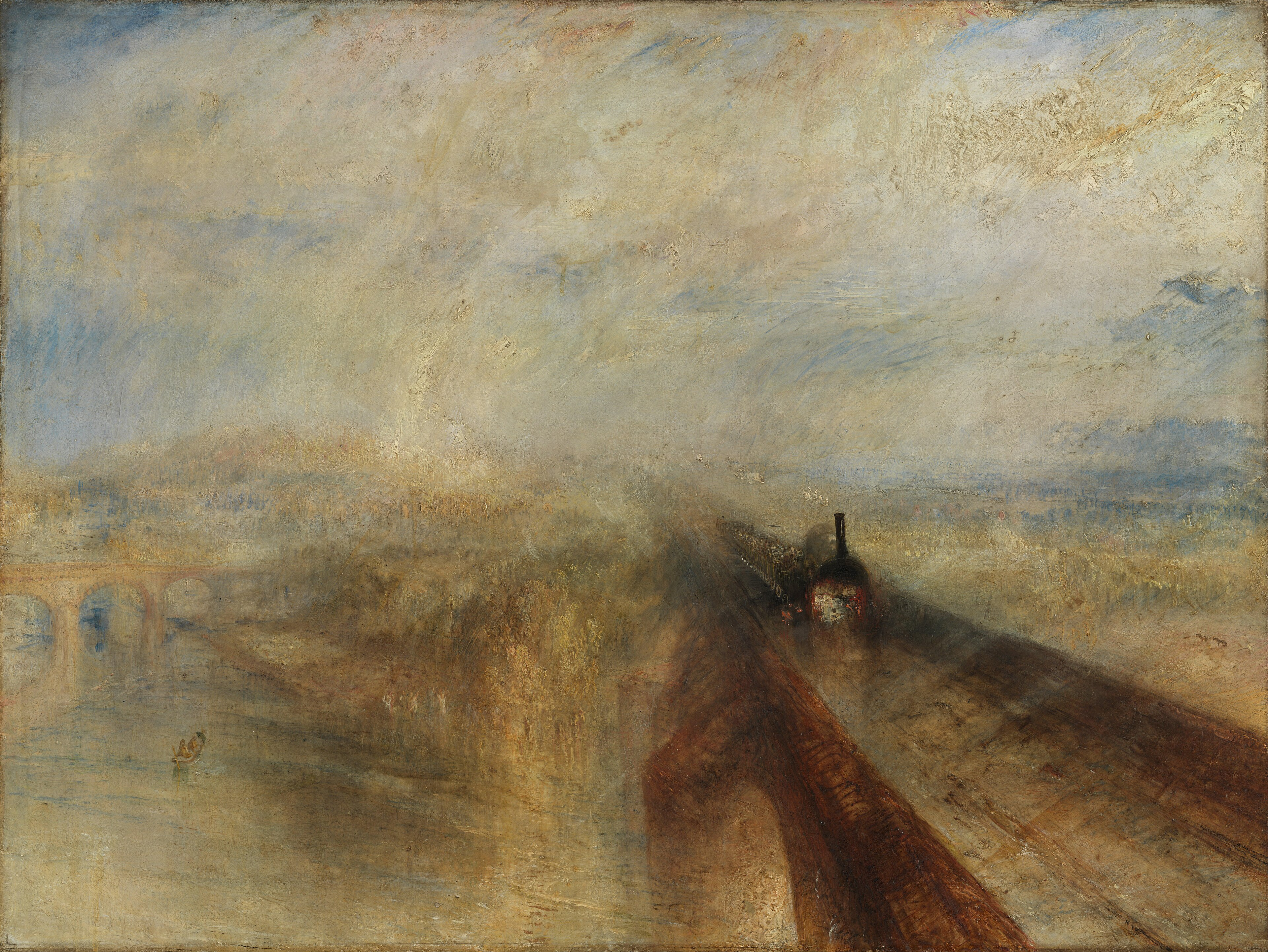
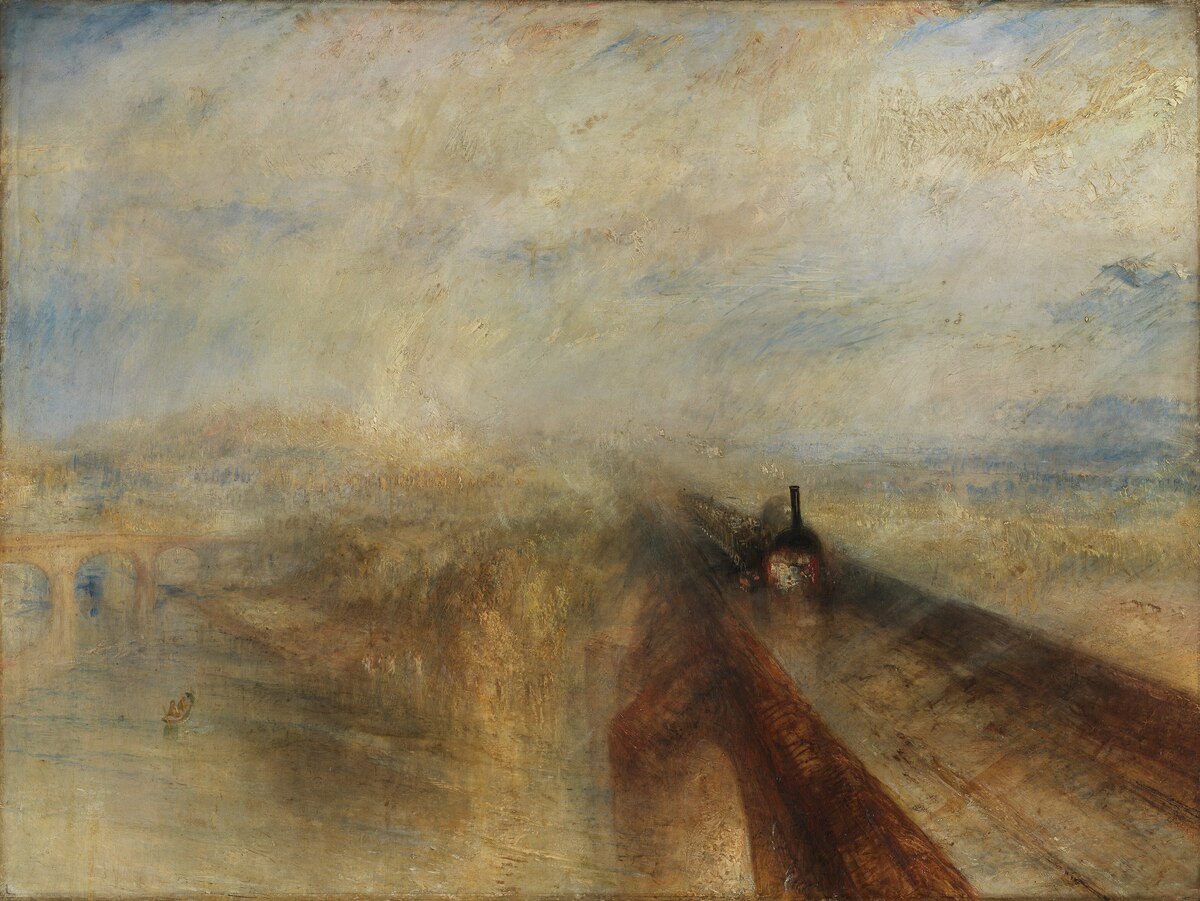
A steam engine is coming straight at us out of the rain. It crosses a long brick viaduct over the Thames at Maidenhead, on the new Great Western line. Turner painted this in 1844, a few years after the line opened. The bridge is Brunel's, and the train is heading west while we look east towards London.
What makes the engine seem so fast is the bridge. Turner shortens its arches abruptly, so the whole structure tips up and rushes into view rather than receding gently. He also thinned the real double track to a single narrow line. The eye follows that line straight into the funnel, and the machine seems to surge forward.
Rain falls steadily, but not enough to hide the country. Sunlight catches the woods and fields on either side of the bridge, so the weather shifts between grey and gold. The steam itself is small: three puffs from the funnel. Turner gives us atmosphere everywhere and lets the engine emerge from it.
Turner painted contemporary life throughout his career, and he was particularly drawn to industry and technology. That matters for how we read this picture. The National Gallery argues it is unlikely to be a rejection of modernity, because Turner treated both the train and Brunel's bridge as subjects worth painting.
There is a hare in this painting, brushed lightly on top of the track about midway along. You probably cannot see it now, because the paint has grown transparent with age. It survives in an 1859 engraving. The artist George Leslie, who as a boy watched Turner finish the picture, later said the hare, not the train, was meant to stand for speed. That is his report, not something Turner wrote down.
Look at what else moves slowly. A small boat sits on the river at the left, and near the right edge a man drives a horse-drawn plough. Both are older, unmechanised kinds of movement, and the Gallery reads them as a contrast with the speed of the train. The countryside is not empty scenery. It is a different pace of life.
The art historian John Gage observed that the title tells us what to expect. Turner is painting rain, steam and speed, not simply a view of a railway. That reading does not deny the train's power. It places the machine inside a larger drama of weather, light and force, where nature and technology share the stage.
So the picture holds two speeds at once. The engine charges out of the rain while a hare, a boat and a plough keep to older measures of movement. Turner makes us feel the change from the old pace to the new, without asking us to choose between them. The bridge, the weather and the paint all carry that sense of force.
The story and its sources
Historical claims are linked to the records below. Close looking and interpretation are identified in the passage notes.
- Passage 1Documented historyOfficial source discovered for Rain, Steam and Speed – The Great Western Railway
- Passage 2InterpretationOfficial source discovered for Rain, Steam and Speed – The Great Western Railway
- Passage 3Close lookingOfficial source discovered for Rain, Steam and Speed – The Great Western Railway
- Passage 4Documented historyOfficial source discovered for Rain, Steam and Speed – The Great Western Railway
- Passage 5Reported traditionOfficial source discovered for Rain, Steam and Speed – The Great Western Railway
- Passage 6InterpretationOfficial source discovered for Rain, Steam and Speed – The Great Western Railway
- Passage 7InterpretationOfficial source discovered for Rain, Steam and Speed – The Great Western Railway
- Passage 8InterpretationOfficial source discovered for Rain, Steam and Speed – The Great Western Railway
Details to notice
About 3 minutes to readSmall rowing boat
A tiny boat with a figure on the calm water at lower left, a quiet human note of pre-industrial life dwarfed by the bridge and the onrushing railway.
Railway track in perspective
The dark, parallel rails sweeping from the lower right into the distance, their drastic foreshortening pulling the viewer onto the line and into the path of the oncoming engine.
Rain and steam vortex
The swirling, scraped and scumbled weather that fills the centre of the canvas, where mist, smoke, rain and distant city haze merge; it conveys speed and atmospheric dissolution rather than solid topography.
Artist portrait Image credit
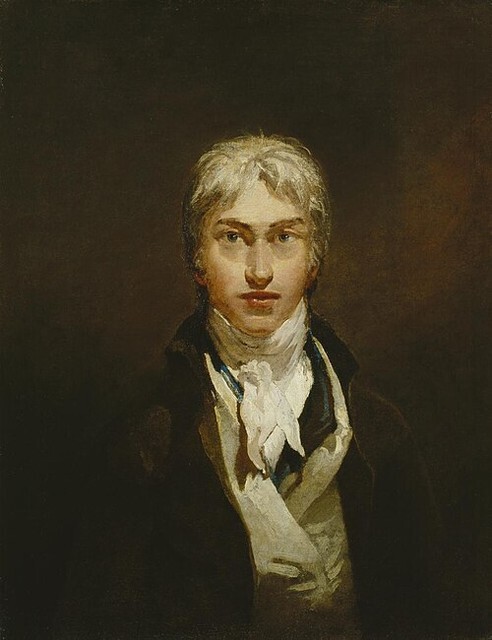
J. M. W. Turner. Image source · Public domain
About the artist
J. M. W. Turner
1775 to 1851
J. M. W. Turner was an English painter and draftsman (c.1775–1851). Their work is associated with Romanticism; English painting. Their recorded places of work include Vienna; Belgium; Prague; Dieppe; Lyon; Paris; Rouen; Berlin; Dresden; Heidelberg; Constance; Bologna; Florence; Naples; Rome; Turin; Venice; Amsterdam; Delft; Dordrecht; Haarlem; Leiden; Rotterdam; The Hague; Utrecht; Lucerne; Rheinfelden; Zurich; Bristol; Chester; Edinburgh; London; Malmesbury; Twickenham.
- Born
- 1775
- Died
- 1851
- Nationality
- Kingdom of Great Britain; United Kingdom of Great Britain and Ireland
- Birthplace
- Covent Garden; Maiden Lane; London
- Died in
- Cheyne Walk; Chelsea; Royal Borough of Kensington and Chelsea
Biography sources
The research & record
Study the work.
Follow the evidence.
Find catalogue details, historical context, technical research and the literature behind this artwork.
The artwork record
Research catalogue
Catalogue information and detailed research, with references that link to the bibliography.
Updated .
Identity and catalogue
Link- Title
- Rain, Steam, and Speed - The Great Western Railway
- Artist or attribution
- Joseph Mallord William Turner(National Gallery, n.d.)
- Object date
- 1844
- Medium and support
- Oil on canvas(National Gallery, n.d.)
- Dimensions
- 91 × 121.8 cm
- Current collection or location
- National Gallery, London(National Gallery, n.d.)
- Movement or period
- Romanticism
- Country or culture
- British
- Depicted subject
- A steam engine rushes towards the viewer as it crosses the Maidenhead Railway Bridge in the rain, with the bridge designed by Isambard Kingdom Brunel, completed in 1838. The view looks east towards London as the train heads west.
- Accession number
- NG538
- Support
- canvas
Read valuation records and their limitations
Catalogue identity
The National Gallery, London, catalogues this painting as Rain, Steam, and Speed - The Great Western Railway, attributed to Joseph Mallord William Turner and dated 1844, the year in which, according to the gallery's account, Turner painted it. The object is oil on canvas and measures 91 by 121.8 centimetres. It belongs to the National Gallery collection under the inventory number NG538. In the section's terms, the 1844 date is the date of the work itself; it is distinct from the later dates that record the painting's institutional life, such as its entry into the national collection through the Turner Bequest in 1856 and its inclusion in exhibitions from the twenty-first century. The accession number and bequest history identify the physical object and its museum record, while the title supplies the terms in which the gallery presents its subject: rain, steam and speed, qualified as a Great Western Railway subject rather than a simple topographical view.(National Gallery, n.d., Key facts; Provenance)
The title variant given above follows the gallery's catalogue form, and the recorded title places the railway explicitly within the work's identity rather than leaving it to the viewer's recognition of the subject. The evidence assembled here does not record further catalogue title variants or a supporting inscription on the canvas, so the identification rests on the gallery's cataloguing rather than on a transcribed signature or text within the painting. What the technical and visual evidence does establish is how the picture was made and what it shows: a steam engine approaching the viewer as it crosses the Maidenhead Railway Bridge in the rain. The bridge is identified as Isambard Kingdom Brunel's Maidenhead Railway Bridge, completed in 1838; elsewhere in the same source it is called the Maidenhead Viaduct, crossing the Thames between Taplow and Maidenhead on the newly laid Great Western line to Bristol and Exeter, in use from July 1839. The view looks east towards London while the train heads west.(National Gallery, n.d., Key facts; Overview; In-depth)
Joseph Mallord William Turner painted Rain, Steam and Speed - The Great Western Railway in 1844.(National Gallery, n.d.)
Subject and iconography
LinkRead valuation records and their limitations
The view and the viaduct
Visual observation
The painting presents a steam engine advancing towards the viewer as it crosses the Maidenhead Railway Bridge in the rain, a composition the National Gallery records as both its subject and its organizing axis. The view works in a counterintuitive direction: the spectator looks east towards London while the train itself travels west, so the oncoming rush of the engine is set against a landscape oriented away from the metropolis. The structure it crosses is the Maidenhead Railway Bridge, designed by Isambard Kingdom Brunel and completed in 1838; the same source also names it the Maidenhead Viaduct, crossing the Thames between Taplow and Maidenhead on the newly laid Great Western line to Bristol and Exeter, in use from July 1839. The painting is oil on canvas, measuring 91 by 121.8 centimetres, and entered the National Gallery with the Turner Bequest in 1856. Nothing in these documented coordinates tells us how to read the picture, but they establish the specific place, structure and line whose visual handling carries much of its meaning.(National Gallery, n.d., Overview; Key facts; In-depth)(Wikipedia fallback: Rain, Steam and Speed – The Great Western Railway, n.d., Description)
The most consequential compositional intervention concerns the bridge itself and the track laid across it. Turner accentuated the speed effect by reducing the double rail track across the bridge to a single narrow line, a deliberate compression of engineered reality into a graphic device. In descriptive accounts of the picture, the surface of the bridge is read together with the train that emerges from it: the arches and the deck lead the eye towards the engine, and the rain envelops the whole. The lower-left corner adds a detail that clarifies the structure's setting: a couple on a boat is visible there, making evident that the bridge is constructed on top of a river. The National Gallery describes this small boat, together with a ploughman near the right edge, as examples of relatively slow, non-mechanised activity that contrast with the speed of the train. These elements are observations of depicted content rather than documentation of Turner's stated intentions, but they establish the layered temporal structure of the scene, in which mechanically accelerated motion is juxtaposed with older, slower rhythms of river and field.(National Gallery, n.d., In-depth; Overview)(Wikipedia fallback: Rain, Steam and Speed – The Great Western Railway, n.d., Description)
Weather, steam and paint
Atmosphere is distributed across the canvas rather than confined to the weather. Rain falls steadily but not so heavily as to entirely obscure the view, and gleams of sunlight fall on the woods and fields either side of the bridge, so that the picture alternates between grey weather and passages of gold. The steam that might be expected to dominate the engine is remarkably restrained: three small puffs emerge from the engine's funnel. This economy of steam concentrates visual attention on the machine and the bridge rather than on a billowing cloud, letting the engine emerge from an environment that is itself painted as active. The technique described in supplementary accounts is consistent with this effect. Turner used thick impasto with a palette knife in the centre and upper right, dabbed dirty putty onto the canvas with a trowel to illustrate the rain, and let sunshine scintillate out of thick, smeary chunks of chrome yellow. Cool tones of crimson lake were used for shadows, and the fire in the steam-engine, though it appears red, is most likely painted with cobalt and pea-green. These material observations connect what a viewer sees to how the paint was physically handled, but the pigment identifications in this account are stated as likelihoods, not as results of technical analysis reported in the official catalogue.(National Gallery, n.d., In-depth)(Wikipedia fallback: Rain, Steam and Speed – The Great Western Railway, n.d., Artistic technique)
Figures, animals and the evidence of change
The human and animal population of the scene extends beyond the engine. On the river on the left, a small boat is visible, and barely visible near the right edge, a man drives a horse-drawn plough. Inside the train, Turner depicted a crowd of waving figures, which the supplementary account reads as a reminder that the railway was a festive and popular entertainment. The waving passengers qualify any simple reading of the train as menace or as pure machine: the railway is shown as a social occasion as well as a technological event. A late addition to the composition is the hare, lightly brushed on top of existing paint roughly midway along the rail track. According to the artist George Leslie, who as a boy had watched Turner putting final touches to the painting the day before it went on public exhibition in 1844, the hare, not the train, was meant to represent speed. That attribution belongs to Leslie's reported recollection and should be weighed as such; the National Gallery nonetheless records that Turner lightly brushed in the hare to represent the speed of the natural world in contrast to the mechanised speed of the engine. The hare is now invisible because the paint has become transparent with age, although it can be seen in an 1859 engraving of the painting. The discrepancy between the present surface and the documented original state is therefore a concrete example of how changes in appearance over time affect what visual evidence can be said to show.(National Gallery, n.d., In-depth)(Wikipedia fallback: Rain, Steam and Speed – The Great Western Railway, n.d., Description)
Contemporary life and the terms of interpretation
Interpretation
Several readings of the picture's symbolism are explicitly speculative and should be distinguished from the documented visual record. Some think the hare is a reference to the limits of technology, or that Turner meant to hint at the danger of man's new technology destroying the sublime elements of nature. It is also noted that Turner considered both hound and hare as the most characteristic emblems of speed and had used these symbols in previous works such as Battle Abbey and Apollo and Daphne, which gives the hare a precedent within Turner's own imagery without settling what it means here. A further speculation holds that Turner played on the idea of an animal chase, aware that a Great Western Firefly type of passenger locomotive engine was named Greyhound, but the engine's rendering is indistinct, which weakens any claim of a legible visual correspondence. Finally, some people interpret the painting as analogous to The Fighting Temeraire, since there seems to be a transition from the past towards the future as the train speeds towards the viewer, and both paintings contrast technology with a peaceful landscape. These are attributed interpretations and reported resemblances; the documented features they build upon are the hare's placement on the track, the indistinct engine, and the coexistence of the train with the boat and plough.(National Gallery, n.d., In-depth)
Visual observation
The painting depicts a steam engine coming towards the viewer as it crosses the Maidenhead Railway Bridge in the rain.(National Gallery, n.d.)
The view is looking east towards London as the train heads to the west.(National Gallery, n.d.)
Turner accentuated the speed effect by reducing the double rail track across the bridge to a single narrow line.(National Gallery, n.d.)
Steam is represented by three small puffs emerging from the engine's funnel.(National Gallery, n.d.)
On the river on the left, a small boat is visible, and barely visible near the right edge, a man drives a horse-drawn plough.(National Gallery, n.d.)
Rain falls steadily but not so heavily as to entirely obscure the view, and gleams of sunlight fall on the woods and fields either side of the bridge.(National Gallery, n.d.)
In the lower-left corner of the painting, a couple on a boat is visible, making evident that the bridge is constructed on top of a river.(Wikipedia fallback: Rain, Steam and Speed – The Great Western Railway, n.d.)
Inside the train, Turner depicted a crowd of waving figures that served as a reminder that the railway was a festive and popular entertainment.(Wikipedia fallback: Rain, Steam and Speed – The Great Western Railway, n.d.)
Historical context
LinkRead valuation records and their limitations
The bridge and the railway
The structure at the centre of this painting is the Maidenhead Railway Bridge, designed by Isambard Kingdom Brunel and completed in 1838. One account of the picture identifies the subject as Brunel's bridge spanning the Thames, while a fuller account describes it as the Maidenhead Viaduct, crossing the river between Taplow and Maidenhead on the newly laid Great Western line to Bristol and Exeter, in use from July 1839. The two names refer to the same crossing, and the slight difference in emphasis is useful: the bridge is both an engineering work by a named designer and a piece of transport infrastructure whose opening date follows the completion of the structure by a year. The painting therefore records a very recent addition to the landscape, a line that was carrying traffic within living memory of the moment it was painted.(National Gallery, n.d., Overview; In-depth)
Turner and the industrial subject
Interpretation
Turner's engagement with this subject belongs to a wider practice. He frequently painted scenes of contemporary life and was particularly interested in industry and technology, and one account describes him as seeming a generation ahead of other artists, among the few painters at the time to consider industrial advancement a commendable subject of art. This background matters for how the bridge and train are read. The National Gallery argues it is unlikely that the painting is a rejection of modernity, since Turner saw both the train and the bridge as subjects worthy of being painted. That is an attributed interpretation rather than a statement of the artist's intention, and it qualifies rather than settles the question of what the machine means in the picture.(National Gallery, n.d., Overview)(Wikipedia fallback: Rain, Steam and Speed – The Great Western Railway, n.d., Background)
The bridge and the railway
Visual observation
The social world of the railway appears within the picture as well as around it. Inside the train, Turner depicted a crowd of waving figures that served as a reminder that the railway was a festive and popular entertainment. This detail connects the painting to the public life of the new line: the train is not only a machine but an occasion, carrying people who are responding to it. The same popular character belonged to the bridge and the line, which had opened to traffic in July 1839 and were still a recent spectacle when the picture was made.(Wikipedia fallback: Rain, Steam and Speed – The Great Western Railway, n.d., Description)(National Gallery, n.d., In-depth)
Turner and the industrial subject
Interpretation
Later accounts of the painting have read its contrast of movement as a larger historical contrast. Some people interpret the work as analogous to The Fighting Temeraire, since there seems to be a transition from the past towards the future as the train speeds towards us, and both paintings contrast technology with a peaceful landscape. This is presented as an interpretation held by some viewers rather than as documented fact, and it differs in kind from the National Gallery's reading of the boat and the plough as examples of relatively slow, non-mechanised activity contrasting with the speed of the train. The two accounts agree that the painting sets different paces against one another; they differ in how far that contrast is taken as a statement about history.(Wikipedia fallback: Rain, Steam and Speed – The Great Western Railway, n.d., Analogues)(National Gallery, n.d., In-depth)
The bridge is the Maidenhead Railway Bridge, designed by Isambard Kingdom Brunel and completed in 1838.(National Gallery, n.d.)
Turner frequently painted scenes of contemporary life and was particularly interested in industry and technology.(National Gallery, n.d.)
The bridge is the Maidenhead Viaduct, crossing the Thames between Taplow and Maidenhead on the newly laid Great Western line to Bristol and Exeter, in use from July 1839.(National Gallery, n.d.)
Turner seemed to be a generation ahead of other artists, as he was among the few painters at the time to consider industrial advancement as a commendable subject of art.(Wikipedia fallback: Rain, Steam and Speed – The Great Western Railway, n.d.)
Materials and technique
LinkRead valuation records and their limitations
Support, medium and scale
Rain, Steam and Speed is an oil on canvas of 91 by 121.8 centimetres, painted by Joseph Mallord William Turner in 1844 and now in the National Gallery, London. The identification of support and dimensions is documented, and it matters for the account of technique that follows: the picture is a moderately large canvas, worked in a medium that allowed Turner to build heavy relief in some areas and to lay very thin, semi-transparent strokes in others. That range of handling, from loaded impasto to a faint brushed addition, is what technical and visual accounts of the surface describe, and it explains why some of Turner's marks remain legible while others have changed with the ageing of the paint.(National Gallery, n.d., Key facts)
Handling, tools and the substance of weather
Accounts of the picture's handling describe an unusually physical application of paint. Thick impasto was worked with a palette knife in the centre and upper right, and dirty putty was dabbed on to the canvas with a trowel to stand for the rain, while sunshine is described as scintillating out of thick, smeary chunks of chrome yellow. This is a reported characterisation of technique rather than a laboratory analysis, and it should be weighed as such: it attributes to Turner the use of tools other than the brush (knife and trowel) and of a coarse, granular material in the paint layer, producing a surface whose relief and texture participate directly in representing weather and light. The passage from the darker, rain-veiled zones to the bright, broken yellows is thus carried by the material itself, not only by drawing or colour choice.(Wikipedia fallback: Rain, Steam and Speed – The Great Western Railway, n.d., Artistic technique)
Colour is described in the same account in ways that complicate what a viewer assumes from appearances. Cool tones of crimson lake are said to serve for shadows, and the fire in the steam-engine, although it appears red, is most likely painted with cobalt and pea-green. That last claim is explicitly framed as a likelihood, not a confirmed finding, and it should not be treated as established pigment analysis. Taken together, the two observations distinguish between what the eye reads in the finished picture and what the paint may actually contain, and they point to a working method in which the sensation of warmth, fire or shadow is produced by contrasts and adjacencies rather than by a single locally appropriate colour. The uncertainty attached to the fire's pigment is itself instructive about the state of the technical evidence for the painting.(Wikipedia fallback: Rain, Steam and Speed – The Great Western Railway, n.d., Artistic technique)
Late additions and the layering of the surface
The hare demonstrates that the making of the picture extended beyond a single campaign of work. It was a late addition, lightly brushed on top of existing paint roughly midway along the rail track. The artist George Leslie, who as a boy had watched Turner putting final touches to the painting the day before it went on public exhibition in 1844, later reported that the hare, not the train, was meant to represent speed. That statement is a reported recollection attributed to Leslie, not a recorded intention of Turner's own, and it should be preserved with that qualification. Materially, the addition is important beyond its meaning: a thin, comparatively lean stroke laid over a dried or partly dried lower layer behaves differently from the rest of the surface and is vulnerable to changes in the upper paint film. The picture therefore records a sequence of decisions, the last of which was applied immediately before exhibition.(National Gallery, n.d., In-depth)
Surface and depicted weather
Interpretation
The centre and upper right, where the heaviest impasto and the brightest yellows are described, correspond to the zones of the picture in which the engine emerges through the weather. The steam itself is represented by three small puffs emerging from the engine's funnel, a modest graphic means set within a surface otherwise loaded with atmospheric paint. Rain falls steadily but not so heavily as to entirely obscure the view, and gleams of sunlight fall on the woods and fields either side of the bridge. The material account and the visual account converge here: the trowel-dabbed texture and the thick yellow chunks are the means by which the described alternation of rain and sunlight is physically produced, while the small funnel puffs remain a drawn, relatively restrained element. The picture's weather is therefore not a wash of uniform atmosphere but a built surface of contrasting applications.(Wikipedia fallback: Rain, Steam and Speed – The Great Western Railway, n.d., Artistic technique)(National Gallery, n.d., In-depth)
Composition, drawing and the impression of speed
Read together, the technical and visual evidence describe a picture in which meaning is carried by material as much as by subject. The tools and substances reported (palette knife, trowel, putty, chrome yellow, crimson lake, cobalt and pea-green) are the means by which rain, sunlight, shadow and fire are given physical presence; the late hare, brushed over existing paint and now transparent, is the clearest instance of a mark whose meaning was added at the end of the process and whose visibility has since changed. The picture matters within a larger history of nineteenth-century art precisely because Turner treated the railway and Brunel's bridge as subjects worthy of painting, a documented institutional reading rather than a private intention. Its surface therefore records both an enthusiasm for new technology and a commitment to painting as a physical craft, and the surviving uncertainties about pigment and intent are part of what the object, examined closely, can be shown to hold.(Wikipedia fallback: Rain, Steam and Speed – The Great Western Railway, n.d., Artistic technique)(National Gallery, n.d., In-depth; Overview)
The painting is oil on canvas, measuring 91 by 121.8 centimetres.(National Gallery, n.d.)
A late addition, the hare was lightly brushed on top of existing paint roughly midway along the rail track.(National Gallery, n.d.)
Turner used thick impasto with a palette knife in the centre and upper right, and dabbed dirty putty on to the canvas with a trowel to illustrate the rain, while sunshine scintillates out of thick, smeary chunks of chrome yellow.(Wikipedia fallback: Rain, Steam and Speed – The Great Western Railway, n.d.)
Turner used cool tones of crimson lake for shadows, and the fire in the steam-engine, though it appears red, is most likely painted with cobalt and pea-green.(Wikipedia fallback: Rain, Steam and Speed – The Great Western Railway, n.d.)
Condition and conservation
LinkRead valuation records and their limitations
The hare as a record of change
The condition history of Rain, Steam and Speed is unusual in that it concerns a detail the artist deliberately kept marginal. The hare was a late addition, lightly brushed on top of existing paint roughly midway along the rail track, rather than being built into the picture from the outset. The National Gallery records that the hare is now invisible because the paint has become transparent with age, but that it can be seen in an 1859 engraving of the painting. This is a dated condition observation inside a record of loss: the engraving preserves visual information about a motif that the painted surface no longer displays clearly. The statement describes the hare as invisible on the Gallery's own account and should not be read as a current treatment report for the canvas, which measures 91 by 121.8 centimetres in oil. Nothing in the supplied evidence records cleaning, lining, retouching, environmental controls or any other intervention, so no conservation campaign or treatment material can be asserted here.(National Gallery, n.d., Overview; In-depth; Key facts)
The loss matters because of what the hare was said to do in the picture. According to the artist George Leslie, who as a boy had watched Turner putting final touches to the painting the day before it went on public exhibition in 1844, the hare, not the train, was meant to represent speed. The National Gallery presents this as Leslie's report rather than Turner's own written statement. The condition record therefore bears directly on interpretation: whatever Leslie saw and remembered is now checked against an engraving made in 1859, not against a legible painted animal. Any account of the hare as a visible emblem on the canvas today would overstate what the surface shows, while treating the motif as never present would ignore both Leslie's testimony and the engraved record.(National Gallery, n.d., Overview; In-depth)
Paint structure and the limits of the record
Interpretation
The hare sits within a surface built from unusually varied and physically assertive paint. One account describes Turner using thick impasto with a palette knife in the centre and upper right, dabbing dirty putty on to the canvas with a trowel to illustrate the rain, while sunshine scintillates out of thick, smeary chunks of chrome yellow; the same source says he used cool tones of crimson lake for shadows and that the fire in the steam-engine, though it appears red, is most likely painted with cobalt and pea-green. These claims come from a supplementary encyclopaedic account rather than the Gallery entry, and the pigment identifications are hedged as most likely rather than as results of analysis reported in the evidence. Because the paint has since become transparent with age in at least the area of the hare, the layered, loaded handling described in that account is also the material condition that makes such change legible: a lightly brushed motif laid over existing paint is exactly the kind of passage vulnerable to shifts in the upper layers. The evidence does not supply a technical study connecting the two observations, so the link remains an inference from the handling and the reported transparency.(Wikipedia fallback: Rain, Steam and Speed – The Great Western Railway, n.d., Artistic technique)(National Gallery, n.d., Overview; In-depth)
Institutional custody and display
The object's institutional history begins with acquisition through the Turner Bequest in 1856, when the painting entered the National Gallery collection. The Bequest is the frame within which later condition and display history has to be understood: the Gallery is the body whose catalogue now records the hare's disappearance, and the same source supplies the painting's exhibition history. The evidence does not document any conservation carried out under the Bequest, and the absence of such records in the supplied units should not be filled in with assumptions about cleaning or restoration. What can be said is that the painting's care has been the responsibility of the institution that received it in 1856 and that the Gallery's own account is the authority for the current visibility of the hare.(National Gallery, n.d., Key facts; Provenance; Overview)
The hare is now invisible because the paint has become transparent with age, but it can be seen in an 1859 engraving of the painting.(National Gallery, n.d.)
Provenance and ownership
LinkRead valuation records and their limitations
The 1856 Turner Bequest
The documented collecting history of Rain, Steam and Speed - The Great Western Railway begins not with a purchase but with a bequest. The National Gallery records that the painting was acquired by the Gallery as part of the Turner Bequest in 1856, the year in which the disposition of J. M. W. Turner's estate brought a large body of his work into public ownership. The same institutional account, in its separate provenance notice, states that the painting became part of the National Gallery collection through the Turner Bequest in 1856. The two statements agree in every particular that they supply, and their agreement is worth noting precisely because the record for this picture is so brief: there is no named intermediary, no recorded sale, no price, and no private owner documented in the evidence supplied here. What the sources establish is a single transfer, dated 1856, from Turner's estate into the national collection; they establish nothing about where the picture hung or who held it between its first public showing and that transfer.(National Gallery, n.d., Key facts; Provenance)
Interpretation
The interval between the picture's first exhibition and its entry into the National Gallery is a gap in the record, not a documented change of ownership. The painting was first exhibited at the Royal Academy in 1844, the year of its making, and it is only in 1856 that the evidence locates it again, within the Turner Bequest. A statement that it belonged to Turner in the intervening years would be consistent with the bequest, but the supplied evidence does not say so in terms, and the absence of any recorded sale, loan or transfer in those twelve years should be read as silence rather than as a chain of undocumented transactions. Scholars working from this evidence can responsibly say that the painting passed from the artist's possession into the national collection by bequest, and should refrain from filling the 1844 to 1856 interval with owners, dealers or locations that no source here names.(Wikipedia fallback: Rain, Steam and Speed – The Great Western Railway, n.d., Lead)(National Gallery, n.d., Key facts; Provenance)
Dating the Object and Its Public Life
Because the provenance record is so compressed, the painting's later institutional life is carried largely by its exhibition history and by the dating of its subject, and these supply the chronological anchors that ownership documents do not. The railway bridge in the picture, the Maidenhead Viaduct, crosses the Thames between Taplow and Maidenhead on the newly laid Great Western line to Bristol and Exeter, and it was in use from July 1839; the same structure is identified as the Maidenhead Railway Bridge, designed by Isambard Kingdom Brunel and completed in 1838. Read against the 1844 exhibition and the 1856 bequest, these dates place the picture a few years after the line opened and more than a decade before it entered the nation's collection. Within the Gallery, the work's public afterlife is attested by loans to Late Turner: Painting Set Free at Tate Britain in 2014 to 2015, The Art of Innovation at the Science Museum in 2019 to 2020, and Turner's Modern World at Tate Britain in 2020 to 2021. These appearances show a picture repeatedly chosen to represent Turner's engagement with industrial modernity, but they are exhibition facts, not ownership events; the collection history remains the 1856 bequest recorded by the Gallery.(National Gallery, n.d., In-depth; Overview; Key facts; Exhibition history)(Wikipedia fallback: Rain, Steam and Speed – The Great Western Railway, n.d., Lead)
The painting was acquired by the National Gallery as part of the Turner Bequest in 1856.(National Gallery, n.d.)
The painting became part of the National Gallery collection through the Turner Bequest in 1856.(National Gallery, n.d.)
Provenance timeline
- 1844
The painting is first exhibited at the Royal Academy.(Wikipedia fallback: Rain, Steam and Speed – The Great Western Railway, n.d., Lead)
- 1856
The painting enters the National Gallery collection as part of the Turner Bequest, recorded as a bequest rather than a purchase.(National Gallery, n.d., Key facts; Provenance)
- 2014-2015
The painting is included in the exhibition Late Turner: Painting Set Free at Tate Britain.(National Gallery, n.d., Exhibition history)
- 2019-2020
The painting is included in the exhibition The Art of Innovation at the Science Museum.(National Gallery, n.d., Exhibition history)
- 2020-2021
The painting is included in the exhibition Turner's Modern World at Tate Britain.(National Gallery, n.d., Exhibition history)
Exhibition history
LinkRead valuation records and their limitations
The 1844 Royal Academy debut and later exhibition history
The exhibition history of Rain, Steam and Speed begins with the Royal Academy in 1844, the year the painting was made. This first public showing is recorded as the painting's debut exhibition, and it places the work in the annual London display through which Turner, as a Royal Academician, routinely brought his current work before the public. The occasion is also the setting for a much-cited recollection: according to the artist George Leslie, who as a boy had watched Turner putting final touches to the picture the day before it went on public exhibition in 1844, the lightly brushed hare on the rail track, not the train, was meant to represent speed. That report belongs to the moment of the 1844 debut and is testimony attributed to Leslie rather than anything Turner himself wrote. The later history of the painting's display is therefore not a record of continuous public exposure but of a small number of documented appearances, each staged by a different kind of institution for a different purpose.(Wikipedia fallback: Rain, Steam and Speed – The Great Western Railway, n.d., Lead)(National Gallery, n.d., Exhibition history)
Later appearances are recorded at three venues. Late Turner: Painting Set Free was held at Tate Britain in 2014-2015, The Art of Innovation at the Science Museum in 2019-2020, and Turner's Modern World at Tate Britain in 2020-2021. Taken together these titles indicate two distinct lines of institutional interest: two Tate Britain exhibitions frame the picture within Turner's own late career and his engagement with the modern world, while the Science Museum showing situates it within a history of invention and technology. The pattern is worth noting because it reflects the painting's double identity, as both a Turner and a document of the railway age, rather than any single established reading.(National Gallery, n.d., Exhibition history)
The painting was first exhibited at the Royal Academy in 1844.(Wikipedia fallback: Rain, Steam and Speed – The Great Western Railway, n.d.)
The painting has been included in exhibitions such as Late Turner: Painting Set Free at Tate Britain (2014-2015), The Art of Innovation at the Science Museum (2019-2020), and Turner's Modern World at Tate Britain (2020-2021).(National Gallery, n.d.)
Interpretations and debates
LinkRead valuation records and their limitations
Speed, Structure and the Terms of the Title
Interpretation
The National Gallery's account locates the painting's sensation of speed primarily in the architecture of the viaduct rather than in the engine alone. Turner used the exaggeratedly abrupt foreshortening of the viaduct, together with the reduction of the real double rail track across the bridge to a single narrow line, so that the structure seems to tip up and rush into view and the eye is drawn straight along the track. This is a composed effect rather than a neutral record: the bridge in the picture, the Maidenhead Railway Bridge, is the structure designed by Isambard Kingdom Brunel and completed in 1838, later described as the Maidenhead Viaduct crossing the Thames between Taplow and Maidenhead on the newly laid Great Western line to Bristol and Exeter, in use from July 1839. The view looks east towards London while the train heads west, so the pictorial compression works against the direction of travel. The art historian John Gage observed that the title makes clear Turner was painting not a view of the Great Western Railway, but an allegory of the forces of nature; the National Gallery's reading of the foreshortening is compatible with that claim, since it treats the bridge as a device for producing an impression of bursting movement rather than as topographical description.(National Gallery, n.d., Overview; In-depth)
A second source frames the work differently, as one that combines the power of nature and technology to create an emotional tension associated with the concept of the sublime. On that account the painting's force lies less in any single motif than in the juxtaposition of elemental weather and human machine, which aligns the reading with Gage's emphasis on an allegory of natural forces while shifting the emotional register toward the sublime. The same source states that Turner seemed to be a generation ahead of other artists, being among the few painters at the time to consider industrial advancement a commendable subject of art. This background claim supports the National Gallery's judgment that the painting is unlikely to be a rejection of modernity, because Turner saw both the train and the bridge as subjects worthy of being painted; it does not establish what Turner privately intended, only how the work's subject matter was received as unusual. The two accounts converge on the picture as a serious treatment of contemporary industry and diverge in emphasis, the Gallery stressing the bridge's role in generating speed and the sublime account stressing the tension between nature and technology.(Wikipedia fallback: Rain, Steam and Speed – The Great Western Railway, n.d., Lead; Background)(National Gallery, n.d., Overview; In-depth)
The Hare: Observation, Report and Speculation
The hare is the painting's most contested element, and the evidence about it has to be kept at several distinct levels. According to the National Gallery, Turner lightly brushed in a hare roughly midway along the rail track to represent the speed of the natural world in contrast to the mechanised speed of the engine, and this was a late addition brushed on top of existing paint. The animal is now invisible because the paint has become transparent with age, although it can be seen in an 1859 engraving of the painting. The Gallery also records a reported tradition: the artist George Leslie, who as a boy had watched Turner putting final touches to the painting the day before it went on public exhibition in 1844, later said that the hare, not the train, was meant to represent speed. That is Leslie's testimony, not a statement written by Turner, and it should be cited as such.(National Gallery, n.d., Overview)(Wikipedia fallback: Rain, Steam and Speed – The Great Western Railway, n.d., Hare)
Further readings of the hare are more speculative and are attributed accordingly. Some think the hare is a reference to the limits of technology, or that Turner meant to hint at the danger of man's new technology destroying the sublime elements of nature; these are offered as interpretations held by some, not as documented intentions. The same source notes that Turner considered both hound and hare as the most characteristic emblems of speed, and had used these symbols in previous works such as Battle Abbey and Apollo and Daphne, which gives the motif a place within the painter's established vocabulary of speed rather than making it unique to this canvas. It is also speculated that Turner played on the idea of an animal chase, aware that a Great Western Firefly type of passenger locomotive engine was named Greyhound, but the engine's rendering is indistinct, so the pun cannot be confirmed from the painted surface. Read together, the hare supports a contrast of speeds and a possible warning about technology, while the claim that it encodes a specific private meaning remains unverifiable.(Wikipedia fallback: Rain, Steam and Speed – The Great Western Railway, n.d., Hare)
Slow Movement and the Human Presence
Against the engine, the picture sets slower kinds of movement. On the river on the left a small boat is visible, and barely visible near the right edge a man drives a horse-drawn plough; the National Gallery reads both the boat and the plough as examples of relatively slow, non-mechanised activity contrasting with the speed of the train. Another description places a couple on a boat in the lower-left corner, making evident that the bridge is constructed on top of a river, which reinforces that the river is a working part of the scene rather than backdrop. The treatment of weather and light is equally active: rain falls steadily but not so heavily as to entirely obscure the view, and gleams of sunlight fall on the woods and fields either side of the bridge, so the atmosphere shifts between grey and gold. These observations of the surface support a reading in which the painting holds competing paces of life at once; they do not by themselves prove that Turner intended the contrast as a moral judgement.(National Gallery, n.d., In-depth)(Wikipedia fallback: Rain, Steam and Speed – The Great Western Railway, n.d., Description)
Analogues and Historical Position
Some people interpret this painting as analogous to The Fighting Temeraire, since there seems to be a transition from the past towards the future as the train speeds towards us, and both paintings contrast technology with a peaceful landscape. This is an attributed comparative reading rather than a documented link, and it complements rather than replaces the Gallery's argument against treating the picture as a rejection of modernity. It also sits alongside the source's observation that inside the train Turner depicted a crowd of waving figures that served as a reminder that the railway was a festive and popular entertainment. Taking these together, the painting can be read as an image of transition in which the machine is both thrilling and disruptive, and in which the older rural and river life is not simply erased but kept in view. The limits of synthesis are clear: the sources establish what can be seen, what the Gallery and other commentators argue, and what Leslie reported, but they supply no written statement of Turner's own intent for the hare, the plough or the waving crowd.(Wikipedia fallback: Rain, Steam and Speed – The Great Western Railway, n.d., Analogues; Description)(National Gallery, n.d., Overview)
Reported traditions and disputed accounts
Reported tradition
The most consequential reported account concerns the hare, a motif that was lightly brushed on top of existing paint roughly midway along the rail track and added late in the painting's making. According to the artist George Leslie, who as a boy had watched Turner putting final touches to the painting the day before it went on public exhibition in 1844, the hare, not the train, was meant to represent speed. This is Leslie's testimony about Turner's intention, recorded as a recollection rather than as a statement written by Turner himself, and it should be weighed as a reported tradition. It nevertheless bears directly on how the painting's two competing emblems of velocity are understood: the engine surges forward through the rain while the hare, in Leslie's account, carries the idea of speed itself.(National Gallery, n.d., In-depth)
Interpretation
A separate and explicitly speculative account approaches the hare through the naming of locomotives. It is speculated that Turner played on the idea of an animal chase, aware that a Great Western Firefly type of passenger locomotive engine was named Greyhound. The same account acknowledges that the engine's rendering in the painting is indistinct, so the proposed link between a named engine and the animal motif cannot be verified from the picture itself. This is a disputed interpretation rather than a documented fact about Turner's intentions, and it coexists with, rather than replaces, Leslie's report that the hare was meant to stand for speed. The two accounts differ in kind: Leslie's is a first-hand recollection of the artist's stated meaning, while the Greyhound speculation infers a possible pun from railway nomenclature that the visual evidence neither confirms nor excludes.(Wikipedia fallback: Rain, Steam and Speed – The Great Western Railway, n.d., Hare)(National Gallery, n.d., In-depth)
Turner used the exaggeratedly abrupt foreshortening of the viaduct to suggest the speed with which the train bursts into view through the rain.(National Gallery, n.d.)
Turner lightly brushed in a hare roughly midway along the rail track to represent the speed of the natural world in contrast to the mechanised speed of the engine.(National Gallery, n.d.)
It is unlikely that the painting is a rejection of modernity, as Turner saw both the train and the bridge as subjects worthy of being painted.(National Gallery, n.d.)
The art historian John Gage observed that the title makes clear Turner was painting not a view of the Great Western Railway, but an allegory of the forces of nature.(National Gallery, n.d.)
Both the boat and the plough are examples of relatively slow, non-mechanised activity, contrasting with the speed of the train.(National Gallery, n.d.)
The work combines the power of nature and technology to create an emotional tension associated with the concept of the sublime.(Wikipedia fallback: Rain, Steam and Speed – The Great Western Railway, n.d.)
Some think the hare is a reference to the limits of technology, or that Turner meant to hint at the danger of man's new technology destroying the sublime elements of nature.(Wikipedia fallback: Rain, Steam and Speed – The Great Western Railway, n.d.)
Turner considered both hound and hare as the most characteristic emblems of speed, and had used these symbols in previous works such as Battle Abbey and Apollo and Daphne.(Wikipedia fallback: Rain, Steam and Speed – The Great Western Railway, n.d.)
Some people interpret this painting as analogous to The Fighting Temeraire, since there seems to be a transition from the past towards the future as the train speeds towards us, and both paintings contrast technology with a peaceful landscape.(Wikipedia fallback: Rain, Steam and Speed – The Great Western Railway, n.d.)
Reported tradition
According to the artist George Leslie, who as a boy had watched Turner putting final touches to the painting the day before it went on public exhibition in 1844, the hare, not the train, was meant to represent speed.(National Gallery, n.d.)
Disputed account
It is speculated that Turner played on the idea of an animal chase, aware that a Great Western Firefly type of passenger locomotive engine was named Greyhound, but the engine's rendering is indistinct.(Wikipedia fallback: Rain, Steam and Speed – The Great Western Railway, n.d.)
Collection and display
LinkRead valuation records and their limitations
The object in the national collection
Rain, Steam and Speed – The Great Western Railway is in the collection of the National Gallery, London, under inventory number NG538. The Gallery records that Turner painted it in 1844 in oil on canvas, measuring 91 by 121.8 centimetres. It entered the national collection through the Turner Bequest in 1856, so the picture's institutional history begins with the posthumous dispersal of the artist's own studio rather than with a private purchase or dealer transaction. The inventory number and bequest route are the documented anchors for the object's identity; any later display history follows from that baseline rather than replacing it.(National Gallery, n.d., Key facts)
The Gallery's subject description locates the scene precisely: a steam engine comes towards the viewer as it crosses the Maidenhead Railway Bridge in the rain. The bridge is the Maidenhead Viaduct, crossing the Thames between Taplow and Maidenhead on the newly laid Great Western line to Bristol and Exeter, in use from July 1839. It was designed by Isambard Kingdom Brunel and completed in 1838. The view looks east towards London while the train heads west. The Gallery identifies the bridge and line as Brunel's engineering, and treats both as subjects Turner chose to paint rather than mere backdrops.(National Gallery, n.d., Key facts)
The Gallery reads the picture's composition as an engine of speed. Turner used the exaggeratedly abrupt foreshortening of the viaduct to suggest the speed with which the train bursts into view through the rain, and he accentuated the effect by reducing the double rail track across the bridge to a single narrow line. Rain falls steadily but not so heavily as to entirely obscure the view, and gleams of sunlight fall on the woods and fields either side of the bridge. Steam is represented by three small puffs emerging from the engine's funnel. These are described as features of the painting itself, not inferences about Turner's intentions.(National Gallery, n.d., Key facts)
The Gallery notes that Turner frequently painted scenes of contemporary life and was particularly interested in industry and technology, and it argues that it is unlikely the painting is a rejection of modernity, since Turner saw both the train and the bridge as subjects worthy of being painted. That reading is attributed to the institution rather than presented as the artist's documented statement. The art historian John Gage, as reported by the Gallery, observed that the title makes clear Turner was painting not a view of the Great Western Railway but an allegory of the forces of nature. The two readings are compatible: Gage's emphasis on nature as allegorical subject does not deny the machine's power, and the Gallery's emphasis on Turner's interest in technology does not reduce the picture to a railway view.(National Gallery, n.d., Key facts)
A hare was lightly brushed on top of existing paint roughly midway along the rail track, a late addition to the composition. It is now invisible because the paint has become transparent with age, but it can be seen in an 1859 engraving of the painting. The artist George Leslie, who as a boy had watched Turner putting final touches to the painting the day before it went on public exhibition in 1844, later said that the hare, not the train, was meant to represent speed. The Gallery records the hare as lightly brushed in to represent the speed of the natural world in contrast to the mechanised speed of the engine. Leslie's account is a reported recollection, and the Gallery presents it as his statement; no written explanation by Turner is cited in the evidence supplied.(National Gallery, n.d., Key facts)
On the river on the left a small boat is visible, and barely visible near the right edge a man drives a horse-drawn plough. The Gallery describes both as examples of relatively slow, non-mechanised activity, contrasting with the speed of the train. Read alongside the foreshortened viaduct and the single narrow rail line, these small figures give the picture multiple speeds at once: the engine's mechanised rush, the hare's natural speed, and the older pace of boat and plough. The contrast is a feature the Gallery draws out from what is depicted, not a claim about a programmatic message.(National Gallery, n.d., Key facts)
Interpretation
The Gallery records that the painting has been included in Late Turner: Painting Set Free at Tate Britain (2014-2015), The Art of Innovation at the Science Museum (2019-2020), and Turner's Modern World at Tate Britain (2020-2021). The three venues mark distinct institutional framings: a Tate survey of Turner's late work, a science museum exhibition on innovation, and a Tate exhibition on Turner's modernity. Each placement locates the picture in a different narrative, and the sequence shows the painting moving between art-historical and history-of-technology contexts while remaining the same documented object, NG538, acquired through the Turner Bequest in 1856.(National Gallery, n.d., Key facts)
The painting is in the collection of the National Gallery, London, with inventory number NG538.(National Gallery, n.d.)
Documented values and qualified estimates
LinkRead valuation records and their limitations
The working valuation and its limits
Interpretation
The recorded material about Turner's Rain, Steam, and Speed includes one explicit value figure, and it is important to describe what kind of figure it is. A working insurance estimate of US$80 million to US$200 million was generated on 2026-10-16. The record describes this not as an appraisal, auction result, or sale price but as a broad, conservative range intended for manual review, calculated from the confirmed artwork context: Joseph Mallord William Turner (1775-1851), the painting dated 1844, oil on canvas, 91 by 121.8 cm, National Gallery, London, accession NG538, entering the collection through the Turner Bequest in 1856. The record states that the range is inferred from Turner's status, the painting's date, medium and scale, its art historical importance, and the prominence of the holding institution, and that no public comparable auction or insurance figure exists for this painting. The record further qualifies that the range is model-generated, has not been reviewed by an appraiser or insurer, and does not rely on private insurance records or comparable sales. It should therefore be treated as a working hypothesis about value rather than as evidence of what the painting would fetch or how it is insured.(National Gallery, n.d.)(Wikipedia fallback: Rain, Steam and Speed – The Great Western Railway, n.d.)
Working estimate
Calculated working insurance estimate, not a sale price: Estimated value: US$80M to US$200M Recorded date: Working calculation, generated 2026-10-16. Methodology: This is a broad, conservative working insurance range for manual review, not an appraisal. It is calculated from the confirmed artwork context: Joseph Mallord William Turner (1775-1851), Rain, Steam, and Speed - The Great Western Railway, 1844, oil on canvas, 91 x 121.8 cm, National Gallery, London, accession NG538, Turner Bequest 1856. The work is a canonical masterpiece of British Romanticism, a highlight of the National Gallery collection, and an iconic image of the Industrial Revolution, which supports a very high value tier. No public comparable auction or insurance figure exists for this painting, so the range is inferred from the artist's status, the painting's date, medium, scale, exceptional art historical importance, and the holding institution's prominence. It is intentionally wide to reflect high uncertainty absent an official valuation. Qualification: This is a model-generated working range for manual review only. It is not an official insurance value, appraisal, auction result, or sale price, and it has not been reviewed by an appraiser or insurer. It is based solely on the supplied public context and does not rely on private insurance records or comparable sales.(National Gallery, n.d.)(Wikipedia fallback: Rain, Steam and Speed – The Great Western Railway, n.d.)
Further reading
Books for a closer look
Paid links. As an Amazon Associate I earn from qualifying purchases.

Open Library Turner
Encyclopaedia Britannica
Catalogued as a Turner exhibition catalogue with the subject heading for Turner, J. M. W. (1775-1851). An exhibition catalogue on Turner is the type of object-focused scholarly record that could address his interest in industry and technology and his paintings of contemporary life, which the National Gallery notes as background to Rain, Steam, and Speed. Relevance rests on the recorded title, author and subjects only.
ISBN 0852290942

Open Library J.M.W. Turner: Galeries nationales du Grand Palais, Paris, 14 octobre 1983-16 janvier 1984 : à l'occasion du cinquantième anniversaire du British Council.
Ministère de la culture, Editions de la Réunion des musées nationaux
Recorded under the title J.M.W. Turner with subject headings including Landscape in art, Painters, Biography, and Turner, J. M. W. (1775-1851), and marked as an exhibition publication. The landscape subject heading aligns with Turner's treatment of the Thames valley and the Maidenhead Railway Bridge in this painting. Relevance is based solely on the catalogue record.
ISBN 2711802388

Open Library Joseph Mallord William Turner
H. N. Abrams
A monographic study by John Walker devoted to Joseph Mallord William Turner, with the catalogue subject heading for Turner. As an artist-specific study it is a reasonable context source for a Turner painting of 1844, though the record gives no indication of any chapter or discussion of Rain, Steam, and Speed itself. Relevance is inferred only from title, author and subject.
ISBN 0810905132
Bibliography
Sources and further reading
References are arranged by author or organisation, with links to the original publications. Where no publication date is recorded, n.d. means no date.
Source notes updated .
No recorded sources match these filters. Reset the filters to see the full bibliography.
- 03
Book
Turner. Encyclopaedia Britannica.
Catalogued as a Turner exhibition catalogue with the subject heading for Turner, J. M. W. (1775-1851). An exhibition catalogue on Turner is the type of object-focused scholarly record that could address his interest in industry and technology and his paintings of contemporary life, which the National Gallery notes as background to Rain, Steam, and Speed. Relevance rests on the recorded title, author and subjects only.
- ISBN
- 0852290942
Citation text
- 04
Book
J.M.W. Turner: Galeries nationales du Grand Palais, Paris, 14 octobre 1983-16 janvier 1984 : à l'occasion du cinquantième anniversaire du British Council. Ministère de la culture, Editions de la Réunion des musées nationaux.
Recorded under the title J.M.W. Turner with subject headings including Landscape in art, Painters, Biography, and Turner, J. M. W. (1775-1851), and marked as an exhibition publication. The landscape subject heading aligns with Turner's treatment of the Thames valley and the Maidenhead Railway Bridge in this painting. Relevance is based solely on the catalogue record.
- ISBN
- 2711802388
Citation text
- 01
Official · About this artwork
Official source discovered for Rain, Steam and Speed – The Great Western Railway. Rain, Steam, and Speed - The Great Western Railway. www.nationalgallery.org.uk.
Official National Gallery catalogue entry providing identification, subject, interpretation, provenance and exhibition history.
- Language
- en
Citation text
- 05
Book
Joseph Mallord William Turner. H. N. Abrams.
A monographic study by John Walker devoted to Joseph Mallord William Turner, with the catalogue subject heading for Turner. As an artist-specific study it is a reasonable context source for a Turner painting of 1844, though the record gives no indication of any chapter or discussion of Rain, Steam, and Speed itself. Relevance is inferred only from title, author and subject.
- ISBN
- 0810905132
Citation text
- 02
Secondary · Background reading
Wikipedia fallback: Rain, Steam and Speed – The Great Western Railway (n.d.). Rain, Steam and Speed – The Great Western Railway. Wikipedia.
Wikipedia fallback article used for supplementary details on technique, symbolism and interpretations not covered by the official source.
- Language
- en
Citation text
Art to live with
Bring this painting
home.
A piece of the archive, made yours. Explore Rain, Steam, and Speed - The Great Western Railway in a size and finish that fits your space.
Your text and annotations appear on these editions. Adding to cart saves that design for printing.
Combine this painting with your favourites01 / Find your edition
Made for you
Suggested from your location. Change it if you're sending elsewhere or using a VPN. Prices and delivery are shown in GBP.
19 products
Choose an edition to make it yours
6 × 8 in · Printed cover · 118 lined pages
6 × 8 in · Printed cover · 118 lined pages
6 × 8 in · Printed cover · 118 lined pages
Notebook
GBP 11.91
Delivery GBP 5.30 / Total GBP 17.21
A 6 × 8 inch spiral notebook with 118 ruled pages (59 sheets), a printed front cover, dark grey back cover and metal spiral binding.
Fit and fill keep the painting’s proportions. Stretch changes them.
Move and zoom the painting on your notebook.
Made to order with your design
Made to order
US delivery only
17.8 × 12.7 cm / 7 × 5 in · Standard
17.8 × 12.7 cm / 7 × 5 in · Standard

7 × 5 in / 17.8 × 12.7 cm · Standard

7 × 5 in / 17.8 × 12.7 cm · Standard

7 × 5 in / 17.8 × 12.7 cm · Standard

7 × 5 in / 17.8 × 12.7 cm · Standard

7 × 5 in / 17.8 × 12.7 cm · Standard
Metal art sign
GBP 19.63
Delivery GBP 17.71 / Total GBP 37.34
A printed aluminium sign with rounded corners and mounting holes.
Fit and fill keep the painting’s proportions. Stretch changes them.
Move and zoom the painting on your metal art sign.
Made to order with your design
Printed aluminium · mounting holes included
US delivery only
iPhone 12 Mini ? Glossy ? back view
iPhone 12 Mini · Glossy

iPhone 12 Mini ? Glossy ? back view

iPhone 12 Mini ? Glossy ? back view

iPhone 12 Mini ? Glossy ? back view
Tough phone case
GBP 16.40
Delivery GBP 4.25 / Total GBP 20.65
A two-layer phone case with a printed polycarbonate shell and a shock-absorbing inner liner.
Two layers with a shock-absorbing TPU liner
Case & print details
- Device
- Apple · iPhone 12 Mini
- Material
- Polycarbonate shell with a TPU inner liner
- Artwork
- Outer back and wrapped edges from one template
- Finish
- Glossy
- Version
- Standard version
- Printing
- Dye sublimation
- Print file
- 1,122 × 1,831 px · 95 × 155 mm · PNG · 300 dpi recommended
Rear outline and camera openings follow this variant's Printify template. Case depth and small hardware remain illustrative.
Supplier product detailsFit and fill keep the painting’s proportions. Stretch changes them.
Move and zoom the painting on your tough phone case.
Made to order with your design
Made to order
US delivery only
40.6 × 30.4 cm / 16 × 12 in · Black
40.6 × 30.4 cm / 16 × 12 in · Black

16 × 12 in / 40.6 × 30.4 cm · Black

16 × 12 in / 40.6 × 30.4 cm · Black

16 × 12 in / 40.6 × 30.4 cm · Black

16 × 12 in / 40.6 × 30.4 cm · Black
Framed art print
GBP 53.30
- 1 framed print
- GBP 53.30
- Delivery to United States
- GBP 14.16
- Total
- GBP 67.46
A ready-to-hang wooden frame with a clear Perspex cover and a semi-gloss printed insert.
Delivery is quoted for all selected copies together.
Fit and fill keep the painting’s proportions. Stretch changes them.
Move and zoom the painting on your framed art print.
Made to order with your design
Wooden frame & protective clear front included
US delivery only
38.1 × 40.6 cm / 15 × 16 in · Natural
38.1 × 40.6 cm / 15 × 16 in · Natural

15 × 16 in / 38.1 × 40.6 cm · Natural

15 × 16 in / 38.1 × 40.6 cm · Natural

15 × 16 in / 38.1 × 40.6 cm · Natural

15 × 16 in / 38.1 × 40.6 cm · Natural

15 × 16 in / 38.1 × 40.6 cm · Natural
Canvas tote bag
GBP 14.25
Delivery GBP 4.33 / Total GBP 18.58
A sturdy cotton canvas tote with reinforced handles and artwork on the front panel.
Fit and fill keep the painting’s proportions. Stretch changes them.
Move and zoom the painting on your canvas tote bag.
Made to order with your design
Front print · reinforced cotton handles
US delivery only
22.9 × 20.3 cm / 9 × 8 in · Standard
22.9 × 20.3 cm / 9 × 8 in · Standard

9 × 8 in / 22.9 × 20.3 cm · Standard

9 × 8 in / 22.9 × 20.3 cm · Standard

9 × 8 in / 22.9 × 20.3 cm · Standard

9 × 8 in / 22.9 × 20.3 cm · Standard
Mouse mat
GBP 7.29
Delivery GBP 4.82 / Total GBP 12.11
A rectangular fabric mouse mat with a rubber backing and rounded corners.
Fit and fill keep the painting’s proportions. Stretch changes them.
Move and zoom the painting on your mouse mat.
Made to order with your design
Made to order
US delivery only
See more13 more products
43.2 × 45.7 cm / 17 × 18 in · Artwork
43.2 × 45.7 cm / 17 × 18 in · Artwork

17 × 18 in / 43.2 × 45.7 cm · Artwork

17 × 18 in / 43.2 × 45.7 cm · Artwork

17 × 18 in / 43.2 × 45.7 cm · Artwork
Woven tote bag
GBP 46.87
Delivery GBP 5.88 / Total GBP 52.75
A woven tote with cotton webbing handles and the painting translated into a woven design.
Fit and fill keep the painting’s proportions. Stretch changes them.
Move and zoom the painting on your woven tote bag.
Made to order with your design
Made to order
US delivery only
25.4 × 25.4 cm / 10 × 10 in · Standard
25.4 × 25.4 cm / 10 × 10 in · Standard

10 × 10 in / 25.4 × 25.4 cm · Standard

10 × 10 in / 25.4 × 25.4 cm · Standard

10 × 10 in / 25.4 × 25.4 cm · Standard

10 × 10 in / 25.4 × 25.4 cm · Standard

10 × 10 in / 25.4 × 25.4 cm · Standard
Matte art print
GBP 11.31
Delivery GBP 7.22 / Total GBP 18.53
An unframed matte poster with archival inks, ready for a frame of your choice.
Fit and fill keep the painting’s proportions. Stretch changes them.
Move and zoom the painting on your matte art print.
Made to order with your design
Unframed · frame it your way
US delivery only
iPhone 12 Mini ? Standard ? back view
iPhone 12 Mini · Standard

iPhone 12 Mini ? Standard ? back view

iPhone 12 Mini ? Standard ? back view

iPhone 12 Mini ? Standard ? back view
Flexible phone case
GBP 15.62
Delivery GBP 4.25 / Total GBP 19.87
A flexible TPU phone case with a frosted finish, a printed back and precise port openings.
Flexible TPU with a frosted, matte finish
Case & print details
- Device
- Apple · iPhone 12 Mini
- Material
- Semi-transparent thermoplastic polyurethane (TPU)
- Artwork
- Back print; rim stays unprinted
- Finish
- Standard
- Version
- Standard version
- Printing
- Dye sublimation
- Print file
- 791 × 1,586 px · 67 × 134.3 mm · PNG · 300 dpi recommended
Rear outline and camera openings follow this variant's Printify template. Case depth and small hardware remain illustrative.
Supplier product detailsFit and fill keep the painting’s proportions. Stretch changes them.
Move and zoom the painting on your flexible phone case.
Made to order with your design
Made to order
S · Standard
S · Standard

S · Standard

S · Standard

S · Standard

S · Standard

S · Standard
Crew socks
GBP 10.66
Delivery GBP 4.43 / Total GBP 15.09
Crew-length polyester and spandex socks with a ribbed cuff, cushioned sole and sublimated artwork.
Fit and fill keep the painting’s proportions. Stretch changes them.
Move and zoom the painting on your crew socks.
Made to order with your design
One pair · design repeated on both socks
US delivery only
12" · Standard
12" · Standard

12" · Standard

12" · Standard

12" · Standard
Laptop sleeve
GBP 26.12
Delivery GBP 4.92 / Total GBP 31.04
A polyester laptop sleeve with a fleece lining, top zip, printed front and black reverse.
Fit and fill keep the painting’s proportions. Stretch changes them.
Move and zoom the painting on your laptop sleeve.
Made to order with your design
Made to order
US delivery only
11oz · single image
11oz · White
11oz · single image
Mug
GBP 7.36
Delivery GBP 6.17 / Total GBP 13.53
A glossy white ceramic mug with a C-shaped handle, available in 11oz and 15oz sizes.
single layout · choose single, double or a repeating pattern in Customise.
Repeat, fit, fill and position your artwork around the mug.
Made to order with your design
Made to order
iPhone 12 Mini ? Standard ? back view
iPhone 12 Mini · Standard

iPhone 12 Mini ? Standard ? back view

iPhone 12 Mini ? Standard ? back view

iPhone 12 Mini ? Standard ? back view

iPhone 12 Mini ? Standard ? back view

iPhone 12 Mini ? Standard ? back view
Biodegradable phone case
GBP 20.96
Delivery GBP 4.25 / Total GBP 25.21
A matte phone case made from plant polymers and bamboo fibre, with the artwork printed on the back.
Flexible plant-polymer shell with a matte finish
Case & print details
- Device
- Apple · iPhone 12 Mini
- Material
- PLA and PBAT polymers with bamboo fibre
- Artwork
- Back print; rim stays unprinted
- Finish
- Standard
- Version
- Standard version
- Printing
- Dye sublimation
- Print file
- 777 × 1,553 px · 65.8 × 131.5 mm · PNG · 300 dpi recommended
Rear outline and camera openings follow this variant's Printify template. Case depth and small hardware remain illustrative.
Supplier product detailsFit and fill keep the painting’s proportions. Stretch changes them.
Move and zoom the painting on your biodegradable phone case.
Made to order with your design
Made to order
40.6 × 30.5 cm / 16 × 12 in · Standard
40.6 × 30.5 cm / 16 × 12 in · Standard

16 × 12 in / 40.6 × 30.5 cm · Standard

16 × 12 in / 40.6 × 30.5 cm · Standard

16 × 12 in / 40.6 × 30.5 cm · Standard
Fine art poster
GBP 17.36
Delivery GBP 7.61 / Total GBP 24.97
A gallery paper print with a smooth art-paper surface. Choose a size that suits the painting.
Fit and fill keep the painting’s proportions. Stretch changes them.
Move and zoom the painting on your fine art poster.
Made to order with your design
Unframed · frame it your way
iPhone 12 Mini ? Standard ? back view
iPhone 12 Mini · Standard

iPhone 12 Mini ? Standard ? back view

iPhone 12 Mini ? Standard ? back view

iPhone 12 Mini ? Standard ? back view
Clear phone case
GBP 15.11
Delivery GBP 4.25 / Total GBP 19.36
A clear phone case with artwork on the back. Leave areas transparent to show the phone underneath.
Clear shell with shock-absorbing TPU sides
Case & print details
- Device
- Apple · iPhone 12 Mini
- Material
- Polycarbonate back and clear TPU sides
- Artwork
- Back print; clear sides stay unprinted
- Finish
- Standard
- Version
- Standard version
- Printing
- Dye sublimation
- Print file
- 732 × 1,527 px · 62 × 129.3 mm · PNG · 300 dpi recommended
Rear outline and camera openings follow this variant's Printify template. Case depth and small hardware remain illustrative.
Supplier product detailsFit and fill keep the painting’s proportions. Stretch changes them.
Move and zoom the painting on your clear phone case.
Made to order with your design
Made to order
15oz · single image
15oz · Standard

15oz · single image

15oz · single image

15oz · single image

15oz · single image

15oz · single image
Travel mug
GBP 32.00
Delivery GBP 5.68 / Total GBP 37.68
A stainless-steel travel mug with a black lid, a tapered base and a printed white exterior.
single layout · choose single, double or a repeating pattern in Customise.
Repeat, fit, fill and position your artwork around the mug.
Made to order with your design
Made to order
US delivery only
2.5 × 3.4 cm / 1 × 1.4 in · Glossy
2.5 × 3.4 cm / 1 × 1.4 in · Glossy

1 × 1.4 in / 2.5 × 3.4 cm · Glossy

1 × 1.4 in / 2.5 × 3.4 cm · Glossy

1 × 1.4 in / 2.5 × 3.4 cm · Glossy

1 × 1.4 in / 2.5 × 3.4 cm · Glossy
Photo keyring
GBP 10.19
Delivery GBP 5.39 / Total GBP 15.58
A rectangular zinc-alloy photo keyring with a glossy insert and a swivel split ring.
Fit and fill keep the painting’s proportions. Stretch changes them.
Move and zoom the painting on your photo keyring.
Made to order with your design
Photo insert · zinc frame & swivel ring
US delivery only
iPhone 15 Pro ? Glossy ? back view
iPhone 15 Pro · Glossy

iPhone 15 Pro ? Glossy ? back view

iPhone 15 Pro ? Glossy ? back view

iPhone 15 Pro ? Glossy ? back view

iPhone 15 Pro ? Glossy ? back view

iPhone 15 Pro ? Glossy ? back view
Slim phone case
GBP 16.37
Delivery GBP 5.79 / Total GBP 22.16
A slim printed phone shell with open ports and a lightweight profile.
Slim, lightweight polycarbonate shell
Case & print details
- Device
- Apple · iPhone 15 Pro
- Material
- Polycarbonate
- Artwork
- Outer back and wrapped edges from one template
- Finish
- Glossy
- Version
- Standard version
- Printing
- Dye sublimation
- Print file
- 1,278 × 1,971 px · 108.2 × 166.9 mm · PNG · 300 dpi recommended
Rear outline and camera openings follow this variant's Printify template. Case depth and small hardware remain illustrative.
Supplier product detailsFit and fill keep the painting’s proportions. Stretch changes them.
Move and zoom the painting on your slim phone case.
Made to order with your design
Made to order
US delivery only
36.6 × 30.7 cm / 14.4 × 12.1 in · Standard
36.6 × 30.7 cm / 14.4 × 12.1 in · Standard

14.4 × 12.1 in / 36.6 × 30.7 cm · Standard

14.4 × 12.1 in / 36.6 × 30.7 cm · Standard

14.4 × 12.1 in / 36.6 × 30.7 cm · Standard
Desk mat
GBP 15.29
Delivery GBP 7.13 / Total GBP 22.42
A smooth polyester desk mat with a natural rubber non-slip base and anti-fray edges, available in three sizes.
Fit and fill keep the painting’s proportions. Stretch changes them.
Move and zoom the painting on your desk mat.
Made to order with your design
Made to order
The 30 cm ruler is scaled alongside your selected print. Keep the painting’s proportions with a black background, or stretch it to fill. Frame width, material texture and screen colours are illustrative.
Keep exploring