Queen María Luisa in a Dress with hooped Skirt
Artist: Francisco Goya · 1789

Queen María Luisa in a Dress with hooped Skirt: high-resolution image
The original file is hosted by Wikimedia Commons, available without payment or an account.
Open high-resolution image on Wikimedia CommonsThe complete story
The story About 3 minutes to read
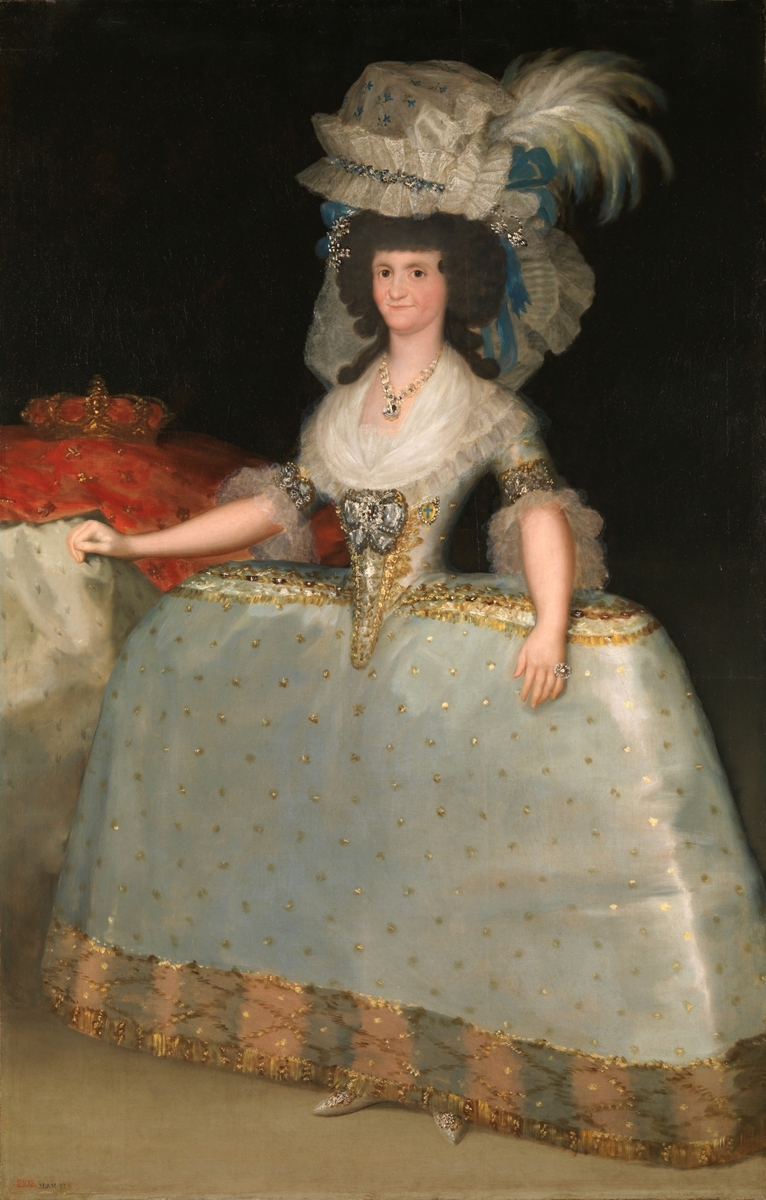
This is Francisco Goya's portrait of Queen María Luisa of Parma, dated 1789. She is shown full length in the Spanish court dress whose hooped underskirt gives the picture its Spanish name, María Luisa con tontillo. The record calls the work a portrait, and treats the tontillo, the hoop that shapes the skirt, as part of its subject rather than a background detail.
Goya's English label for the work describes the queen wearing panniers. A pannier is the same kind of structure as the tontillo: a frame that holds the skirt out wide at the hips. So the painting announces its sitter through dress as much as through face. The record files the image among full-length standing portraits of women in ceremonial dress, which tells us how to approach it: a formal, full-figure presentation of a queen.
The record names a companion piece: a portrait of Carlos IV, catalogued separately. A pendant, in this sense, is a painting made to be seen with another, usually as a pair. That pairing matters for how the queen's portrait reads. She is not presented alone but as one half of a royal couple, and the ceremonial dress belongs to that public, paired presentation.
The supplied record establishes the sitter, the date, the medium, the dress and the pendant. It does not describe her pose or her gestures in prose, and it does not offer a curatorial reading of her expression or the painting's symbolism. That is worth saying plainly. We can see a queen in a hooped court skirt, but the record does not tell us what Goya intended her stance to convey, so I will not put words in his mouth.
What the record does let us understand is the picture's ceremonial purpose. A full-length queen in panniers, made as a pendant to her husband's portrait, presents monarchy through scale, dress and pairing. The tontillo is the key. It turns a person into a formal, public image of a queen, and that is what this portrait is about.
The story and its sources
Historical claims are linked to the records below. Close looking and interpretation are identified in the passage notes.
- Passage 1Documented historyWikimedia Commons: Queen María Luisa in a Dress with hooped Skirt
- Passage 2Documented historyWikimedia Commons: Queen María Luisa in a Dress with hooped Skirt
- Passage 3Documented historyWikimedia Commons: Queen María Luisa in a Dress with hooped Skirt
- Passage 4Documented historyWikimedia Commons: Queen María Luisa in a Dress with hooped Skirt
- Passage 5InterpretationWikimedia Commons: Queen María Luisa in a Dress with hooped Skirt
Details to notice
About 2 minutes to readEmbroidered hem and slippers
The fringed, patterned hem and tiny silver slippers reveal the craftsmanship and exaggerated scale of the queen's formal costume.
Jeweled stomacher
The silver-toned jeweled stomacher and bow anchor the bodice, concentrating the portrait's display of wealth and ceremonial dress.
Crown and red mantle
A gold crown rests on red drapery at left, with the queen's hand nearby, making royal authority an explicit symbolic presence.
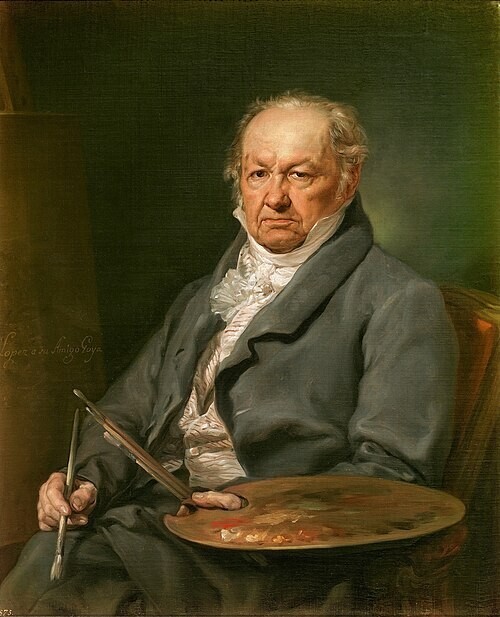
Artist portrait Image credit
Vicente López Portaña. Image source · Public domain
About the artist
Francisco de Goya
30 March 1746 to 16 April 1828
Goya was a Spanish painter and printmaker whose career extended from royal tapestry designs and court portraiture to images of war, repression and unsettling fantasy. Born in Fuendetodos, he trained in Zaragoza and Madrid and became First Painter to Charles IV in 1799. He spent his final years in Bordeaux.
- Born
- 30 March 1746
- Died
- 16 April 1828
- Nationality
- Spanish
- Birthplace
- Fuendetodos, Spain
- Died in
- Bordeaux, France
The research & record
Study the work.
Follow the evidence.
Find catalogue details, historical context, technical research and the literature behind this artwork.
The artwork record
Research catalogue
Catalogue information and detailed research, with references that link to the bibliography.
Updated .
Identity and catalogue
Link- Title
- Queen María Luisa in a Dress with hooped Skirt(Wikimedia Commons: Queen María Luisa in a Dress with hooped Skirt, n.d.)
- Artist or attribution
- Francisco Goya
- Medium and support
- oil on canvas(Wikimedia Commons: Queen María Luisa in a Dress with hooped Skirt, n.d.)
- Dimensions
- 205 x 132 cm(Wikimedia Commons: Queen María Luisa in a Dress with hooped Skirt, n.d.)
- Current collection or location
- Museo del Prado, Madrid, Spain(Wikimedia Commons: Queen María Luisa in a Dress with hooped Skirt, n.d.)
- Movement or period
- Late eighteenth-century Spanish court portraiture
- Country or culture
- Spain
- Depicted subject
- Full-length portrait of Queen María Luisa of Parma in Spanish court dress with panniers, the hooped underskirt known as a tontillo. No narrative action is recorded in the source; the work is a ceremonial court portrait.(Wikimedia Commons: Queen María Luisa in a Dress with hooped Skirt, n.d.)
- Title variants
- María Luisa con tontillo; Maria Luisa de Parma con tontillo; Maria Luisa of Parma wearing panniers; La reina María Luisa con tontillo; Queen María Luisa in a Dress with hooped Skirt(Wikimedia Commons: Queen María Luisa in a Dress with hooped Skirt, n.d.)
- Accession number
- P002862
- Support
- canvas
Read valuation records and their limitations
Titles, attribution and physical record
The work is catalogued under the English title Queen María Luisa in a Dress with hooped Skirt and attributed to Francisco Goya. The record also preserves a Spanish title, María Luisa con tontillo, which names the hooped skirt known as a tontillo as part of the subject rather than leaving it as incidental costume. A third label, given by the record as Maria Luisa of Parma wearing panniers, translates the tontillo into the English term panniers, so the three titles differ in language and in the vocabulary they choose for the same garment. The record classifies the painting as a portrait, and it identifies the sitter as María Luisa of Parma. The work is dated 1789, and the canvas measures 205 centimetres in height and 132 centimetres in width. The record also cites a Fundación Goya en Aragón identifier, number 438, for this work, giving the painting a place in a dedicated Goya research reference system alongside its museum catalogue identity.(Wikimedia Commons: Queen María Luisa in a Dress with hooped Skirt, n.d., Summary, Title and Artist; Summary, Depicted people; Summary, Object type and Genre; Summary, Title; Summary, Title labels; Summary, Date; Summary, Dimensions; References)
The distinction between the object date and the dates recorded in the catalogue literature matters for how the title and attribution are read. The 1789 date belongs to the work itself; the accession identifier, the Fundación Goya en Aragón number 438, and the 1857 inventory entry 2812 cited as a reference are later documentary markers attached to the painting by institutions and scholars. The supplied record does not quote the catalogue entry or the inventory text, so the exact wording under which the painting was registered in 1789 or in 1857 is not established here. What the record does establish is the chain of catalogue apparatus: the work is identified as a portrait of María Luisa of Parma by Goya, dated 1789, and entered in a Goya catalogue by Pierre Gassier and Juliet Wilson as catalogue number 280. The inclusion in that catalogue, cited by the record, is a further layer of attribution and dating evidence, distinct from the painting's own inscription or the museum's inventory number.(Wikimedia Commons: Queen María Luisa in a Dress with hooped Skirt, n.d., Summary, Date; References; Summary, Object type and Genre)
The supplied excerpts do not record the identity of the workshop or assistants who may have painted any part of the canvas, and they record no conservation treatment or technical examination. This absence is part of the evidential picture rather than a finding about the painting's making. The record gives no pigment analysis, no canvas weave study, no radiograph or infrared imaging, and no account of lining, cleaning or restoration. Any statement about Goya's hand in specific passages, about workshop participation, or about the painting's physical condition would therefore go beyond what the record supports. The attribution to Goya stands as a catalogue attribution in the supplied record, and the date 1789 stands as the recorded date, without further technical corroboration being cited.(Wikimedia Commons: Queen María Luisa in a Dress with hooped Skirt, n.d., Summary, Title and Artist; Summary, Date)
Pendant, provenance and collection history
Interpretation
The pendant relationship and the title variants together explain why the painting is best understood as a ceremonial court image rather than a private likeness. The Spanish title names the tontillo, the English label translates it as panniers, and the record's pendant note pairs the queen with Carlos IV. Within a larger history of court portraiture, these catalogue details place the work in a tradition in which royal identity was presented through full-length scale, formal dress and pairing, and in which the garments themselves carried the public message. The record's classification of the work as a portrait, its full-length dimensions of 205 by 132 centimetres, and its documented passage through the Real Colección, the Prado, the Ministry of War, the Museo de Arte Moderno and the Museo de Zaragoza together describe an object whose institutional life was as mobile as its subject was formal. The supplied record does not describe the sitter's pose or gestures in prose, and it offers no curatorial reading of her expression or the painting's symbolism, so the case for the painting's ceremonial function rests on the documented title, dress terminology, scale and pendant relationship rather than on an attributed interpretation of the figure's stance.(Wikimedia Commons: Queen María Luisa in a Dress with hooped Skirt, n.d., Summary, Title; Summary, Title labels; Notes; Summary, Object type and Genre; Summary, Dimensions)
The painting is titled Queen María Luisa in a Dress with hooped Skirt and is by Francisco Goya.(Wikimedia Commons: Queen María Luisa in a Dress with hooped Skirt, n.d.)
The work is dated 1789.(Wikimedia Commons: Queen María Luisa in a Dress with hooped Skirt, n.d.)
The canvas measures 205 centimetres in height and 132 centimetres in width.(Wikimedia Commons: Queen María Luisa in a Dress with hooped Skirt, n.d.)
The work depicts María Luisa of Parma, identified in the record as the sitter.(Wikimedia Commons: Queen María Luisa in a Dress with hooped Skirt, n.d.)
The provided record classifies the work as a portrait.(Wikimedia Commons: Queen María Luisa in a Dress with hooped Skirt, n.d.)
The Spanish title, María Luisa con tontillo, names the hooped skirt known as a tontillo as part of the subject.(Wikimedia Commons: Queen María Luisa in a Dress with hooped Skirt, n.d.)
The English label given by the record is Maria Luisa of Parma wearing panniers, equating the tontillo with panniers.(Wikimedia Commons: Queen María Luisa in a Dress with hooped Skirt, n.d.)
The record cites a Fundación Goya en Aragón identifier, number 438, for this work.(Wikimedia Commons: Queen María Luisa in a Dress with hooped Skirt, n.d.)
Subject and iconography
LinkRead valuation records and their limitations
The recorded composition and dress
Visual observation
The record classifies the painting as a portrait of María Luisa of Parma and files its image categories under full-length standing portraits of women in ceremonial mantles; in the same breath it notes panniers in portrait paintings. That presentational frame is the starting point the record actually establishes for the picture. What the record does not do is describe the sitter's pose or gestures in prose, so the bodily attitude, hands and gaze are not documented here. The visible subject the record does register is the hooped skirt: the Spanish title, María Luisa con tontillo, names the hoop as part of the subject, and the English label Maria Luisa of Parma wearing panniers equates the tontillo with panniers. The strongest claim the supplied material supports is therefore a categorical one, about the type of image and the kind of garment, rather than a description of a particular posture or expression.(Wikimedia Commons: Queen María Luisa in a Dress with hooped Skirt, n.d., Categories)
Dress carries the identification as much as the face. The record treats the tontillo not as a background detail but as part of the work's subject, and the English title's substitution of panniers for tontillo makes the garment, in effect, the work's second name. This is a documented naming convention and a documented classification, not a curatorial reading of the skirt's symbolism: the record supplies no interpretation of what the hoop meant or of how Goya used it to characterise the queen. The distinction matters for the visual evidence, because it separates what is catalogued as the picture's defining feature from what an observer of a reproduction might be tempted to infer from it.(Wikimedia Commons: Queen María Luisa in a Dress with hooped Skirt, n.d., Categories)
The physical support for the image
Interpretation
The date, the full-length standing format and the ceremonial hoop together place the picture at a specific moment in court portraiture, where dress was used to construct a public image of monarchy. The record supports this historical framing through its classification and title rather than through a curatorial essay: it identifies the work as a portrait, dates it, associates it with the queen and names the hoop that shapes the skirt. Reading that combination as a formal, public presentation of a queen is an inference drawn from the catalogued evidence, not a statement the record itself makes about intent or audience.(Wikimedia Commons: Queen María Luisa in a Dress with hooped Skirt, n.d., Categories)
Visual observation
The supplied record places the image categories under full-length standing portraits of women in ceremonial mantles and notes panniers in portrait paintings, but it does not describe the sitter's pose or gestures in prose.(Wikimedia Commons: Queen María Luisa in a Dress with hooped Skirt, n.d.)
Historical context
LinkRead valuation records and their limitations
The pendant pair
The record states that the painting's pendant, or paired companion work, is the portrait Carlos IV (P3224). A pendant in this sense is a work made to be seen with another, usually as a pair, and the record's pairing of the queen with her husband is the only relational fact about presentation that the supplied evidence establishes. It does not state who commissioned the pair, when or for what room, nor whether the two canvases were conceived together from the outset or brought together later. What the pairing does support is a reading of the queen's portrait as one half of a royal couple: the ceremonial dress and the full-figure format belong to a public, paired presentation of monarchy rather than to a private likeness of an individual woman. Any stronger claim about the couple's intended setting or dynastic message would go beyond what the record says.(Wikimedia Commons: Queen María Luisa in a Dress with hooped Skirt, n.d., Notes)
Visual evidence and its limits
Interpretation
Read together, the supplied units support a qualified account of why this canvas matters. Its documented identity as a 1789 oil portrait of María Luisa of Parma, made as the pendant to Goya's Carlos IV, places it within court portraiture at a moment when Goya was working for the Spanish monarchy, and its title makes the tontillo, or panniers, part of the subject rather than background detail. The later record of royal-collection origin, the 1847 entry from the Buen Retiro, the 1857 inventory entry, the 1883 deposit, the 1911 move and the 1972 return show an object whose institutional life continued long after its making, through dispersal and return. The evidence does not settle the commission, the original setting of the pair or the sitter's agency, and it records no technical study of the canvas. What remains securely established is the identification, the date, the medium, the dimensions, the pendant relationship and the documented movements of the work, and those are the grounds on which its place in the history of Spanish court portraiture and museum collections can be argued.(Wikimedia Commons: Queen María Luisa in a Dress with hooped Skirt, n.d., Notes; Categories)
The record states that the painting's pendant, or paired companion work, is Carlos IV (P3224).(Wikimedia Commons: Queen María Luisa in a Dress with hooped Skirt, n.d.)
Materials and technique
LinkRead valuation records and their limitations
Documented medium and support
The supplied record gives the medium of this portrait of María Luisa of Parma as oil on canvas. That entry exhausts the documented materials information in the evidence: the record does not describe a ground or priming layer, a canvas weave or seam structure, a stretcher, any underdrawing or transfer method, or the brushes and other tools used. Nor does it specify individual pigments. The only colorant information available is the general identification of the paint as oil, so any statement about which blues, reds, whites or earths produce the queen's costume, flesh or background would go beyond what these units establish. The evidence supports the identification of oil paint on a canvas support and nothing more granular about the physical make-up of the picture.(Wikimedia Commons: Queen María Luisa in a Dress with hooped Skirt, n.d., Summary, Medium)
Visual observation
Because the record is a cataloguing source rather than a condition or technical report, the medium entry sits alongside descriptive categories rather than examination data. The same record files the image under full-length standing portraits of women in ceremonial mantles and notes panniers in portrait paintings, and these are classifications of subject and format, not observations of paint handling. Reading the oil-on-canvas entry together with those categories clarifies what kind of statement the medium is: a catalogued fact about support and binder. It does not stand in for a description of surface, texture or layer structure.(Wikimedia Commons: Queen María Luisa in a Dress with hooped Skirt, n.d., Summary, Medium; Categories)
Limits of the technical record
Nothing in the supplied excerpts identifies a workshop or assistants who may have painted any part of the canvas, and nothing records a conservation treatment or a technical examination. That absence matters for how the materials evidence should be used. With no examination record, there is no basis in these units for claims about pigments, preparation layers, condition, past cleaning or restoration, or about division of labor between Goya and any studio hand. The oil-on-canvas entry therefore remains the whole of the documented technical description available here, and questions about how the paint was laid down or subsequently altered remain open in this account rather than settled by inference from the visible image.(Wikimedia Commons: Queen María Luisa in a Dress with hooped Skirt, n.d., Summary; Summary, Medium)
The painting is oil on canvas.(Wikimedia Commons: Queen María Luisa in a Dress with hooped Skirt, n.d.)
Condition and conservation
LinkRead valuation records and their limitations
The limits of the conservation record
The surviving documentation for Francisco Goya's full-length portrait of María Luisa of Parma, dated 1789 and painted in oil on canvas, is essentially cataloguing data rather than conservation documentation. The supplied record gives the medium, the title with its Spanish designation of the hooped skirt or tontillo, the pendant relationship to the portrait of Carlos IV, and the collection history, but the excerpts explicitly state that they do not record any conservation treatment or technical examination. This is a significant qualification for the present section: no dated condition report, no analysis of the paint layers or support, no record of lining, cleaning, retouching or environmental control is available here. What follows therefore establishes the documented framework within which condition and treatment questions would have to be asked, and marks clearly where the record is silent.(Wikimedia Commons: Queen María Luisa in a Dress with hooped Skirt, n.d., Summary; Summary, Medium)
The same silence extends to authorship of execution. The excerpts do not identify the workshop or assistants who may have painted any part of the canvas. This matters for conservation because questions of hands and studio participation bear directly on how paint layers, underdrawing and later interventions might be read, and on how any future technical study would need to be framed. The record as supplied leaves that question open rather than resolving it in either direction.(Wikimedia Commons: Queen María Luisa in a Dress with hooped Skirt, n.d., Summary)
Institutional movements and the documentary frame
Interpretation
Taken together, the evidence supports a cautious synthesis. The painting is firmly documented as an oil on canvas of 1789 with a long institutional history, and its movements between Madrid institutions and Zaragoza between 1847 and 1972 are recorded. Against that, the record contains no conservation treatment, no technical examination and no identification of workshop participation, so any statement about the present state of the canvas, its paint surface or past interventions would exceed the supplied evidence. Descriptions of the work's condition drawn from older catalogues or from the periods of its dispersal cannot be assumed to describe the object as it stands today, and the gap between cataloguing data and conservation documentation is itself the most important finding of this section.(Wikimedia Commons: Queen María Luisa in a Dress with hooped Skirt, n.d., Summary; Summary, Medium; Notes; References)
The supplied excerpts do not record the identity of the workshop or assistants who may have painted any part of the canvas, nor any conservation treatment or technical examination.(Wikimedia Commons: Queen María Luisa in a Dress with hooped Skirt, n.d.)
Provenance and ownership
LinkRead valuation records and their limitations
From the Real Colección to the Prado
The provenance recorded for this canvas begins with a claim about its origin: the record's notes state that the painting came from the Real Colección and entered the Museo del Prado in 1847 from the Palacio del Buen Retiro. In the logic of Spanish royal collections, those two statements describe an unbroken institutional path rather than a private sale or a dealer transaction. The work is said to have passed from royal possession into the museum that inherited much of the crown's art, and the Buen Retiro is named as the palace from which the transfer was made. The record does not give an earlier royal inventory number or a date of entry into the Real Colección, so the interval before 1847 remains unrecorded rather than proven; the notes establish the stated route, not the sequence of moves inside the royal collection. Its date of 1789 places the portrait close in time to the court it depicts, and the painting's pendant, Carlos IV (P3224), ties its early history to a paired royal commission, but the record does not document that commission or its circumstances.(Wikimedia Commons: Queen María Luisa in a Dress with hooped Skirt, n.d., Notes)
The record cites the 1857 inventory of the Real Museo, entry 2812, as a reference for the painting. This is the earliest dated catalogue identification supplied for the work in its museum setting: a numbered entry in an institutional inventory compiled a decade after the 1847 entry from the Buen Retiro. The citation is a locator rather than a description, so the evidence establishes that the painting was inventoried under that number in 1857, not what the entry said about attribution, condition or display. It functions as a fixed point of identity against which the later, more mobile history of the canvas can be read, and it anchors the painting within the museum's own documentation rather than only within the transfer notes.(Wikimedia Commons: Queen María Luisa in a Dress with hooped Skirt, n.d., References)
Deposits, transfers and return
The record's notes describe a long sequence of institutional movement after the mid-nineteenth century: the painting was deposited with the Ministry of War in 1883, moved to the Museo de Arte Moderno in 1911, was sent from there to the Museo de Zaragoza, and returned to the Prado in 1972. Read in order, these are documented changes of custody rather than gaps in the record. The 1883 deposit placed the canvas with a government ministry; the 1911 transfer placed it in the modern art museum; a subsequent move took it from Madrid to Zaragoza; and the 1972 return brought it back to the Prado. The record does not give the date of the Zaragoza transfer or its duration, nor does it state the reason for any of these movements, so the account should not be elaborated with explanations the evidence does not supply. What the notes do establish is that for much of the twentieth century the portrait was administered outside the Prado, which matters for any history of its display, access and physical care: a work can remain in public ownership while being absent from the collection whose catalogue number it carries.(Wikimedia Commons: Queen María Luisa in a Dress with hooped Skirt, n.d., Notes)
Interpretation
Taken together, the provenance units separate two kinds of statement. The transfer from the Buen Retiro in 1847 and the 1857 inventory entry are recorded as institutional facts tied to named dates and numbers. The 1883, 1911 and 1972 moves are likewise dated, but the Zaragoza interval is described only as a sending from the Museo de Arte Moderno followed by a return, without dates. The record's notes thus establish a proven chain of custody at the points they name while leaving the intervening periods unrecorded rather than proven, a distinction the research account should keep visible. The accession number P002862 identifies the work in the Prado's collection and the pendant, Carlos IV (P3224), links it to a second canvas whose own provenance is documented separately; the record cites the Gassier and Wilson Goya catalogue, number 280, and a Fundación Goya en Aragón identifier, number 438, as reference points for the work, which place it within the standard cataloguing literature without adding provenance detail.(Wikimedia Commons: Queen María Luisa in a Dress with hooped Skirt, n.d., Notes; References)
The record's notes state that the work came from the Real Colección and entered the Museo del Prado in 1847 from the Palacio del Buen Retiro.(Wikimedia Commons: Queen María Luisa in a Dress with hooped Skirt, n.d.)
The record's notes state that the painting was deposited with the Ministry of War in 1883, moved to the Museo de Arte Moderno in 1911, was sent from there to the Museo de Zaragoza, and returned to the Prado in 1972.(Wikimedia Commons: Queen María Luisa in a Dress with hooped Skirt, n.d.)
The record cites the 1857 inventory of the Real Museo, entry 2812, as a reference for the painting.(Wikimedia Commons: Queen María Luisa in a Dress with hooped Skirt, n.d.)
Provenance timeline
- 1847
The record's notes state that the painting came from the Real Colección and entered the Museo del Prado from the Palacio del Buen Retiro.(Wikimedia Commons: Queen María Luisa in a Dress with hooped Skirt, n.d., Notes)
- 1857
The record cites the 1857 inventory of the Real Museo, entry 2812, as a reference for the painting.(Wikimedia Commons: Queen María Luisa in a Dress with hooped Skirt, n.d., References)
- 1883
The record's notes state that the painting was deposited with the Ministry of War.(Wikimedia Commons: Queen María Luisa in a Dress with hooped Skirt, n.d., Notes)
- 1911
The record's notes state that the painting moved to the Museo de Arte Moderno.(Wikimedia Commons: Queen María Luisa in a Dress with hooped Skirt, n.d., Notes)
- 1972
The record's notes state that the painting, after being sent from the Museo de Arte Moderno to the Museo de Zaragoza, returned to the Prado.(Wikimedia Commons: Queen María Luisa in a Dress with hooped Skirt, n.d., Notes)
Reception and literature
LinkRead valuation records and their limitations
Catalogues and Inventories
The documented reception of this portrait is inseparable from two published instruments that have framed how the work is described and studied. The first is the catalogue of Goya's paintings by Pierre Gassier and Juliet Wilson, which the record cites as catalogue number 280 and which supplies the standard scholarly entry for the canvas. The second is the 1857 inventory of the Real Museo, cited by the record at entry 2812, a mid-nineteenth-century register of the royal collection that anchors the painting in a documented institutional listing rather than only in later cataloguing. Together these references show that the picture entered written record through collection inventory and through twentieth-century catalogue raisonné scholarship, the two channels through which most of Goya's painted oeuvre has been made available to later readers and viewers.(Wikimedia Commons: Queen María Luisa in a Dress with hooped Skirt, n.d., References)
The record cites the Goya catalogue by Pierre Gassier and Juliet Wilson, catalogue number 280, as literature on the work.(Wikimedia Commons: Queen María Luisa in a Dress with hooped Skirt, n.d.)
Collection and display
LinkRead valuation records and their limitations
Collection and display
The painting is recorded as belonging to the collection of the Museo del Prado, Madrid, under accession number P002862. That accession number is the fixed point around which the other collection information gathered in the supplied record can be organized, since the same record carries provenance notes, an inventory reference and catalogue references that all attach to this single Prado object.(Wikimedia Commons: Queen María Luisa in a Dress with hooped Skirt, n.d., Summary, Collection and Accession number)
The provenance notes in the supplied record state that the work came from the Real Colección and entered the Museo del Prado in 1847 from the Palacio del Buen Retiro. The same notes trace a longer and more interrupted institutional life after that entry: the painting was deposited with the Ministry of War in 1883, moved to the Museo de Arte Moderno in 1911, was sent from there to the Museo de Zaragoza, and returned to the Prado in 1972. These movements matter for the object's history because they show that its presence in the Prado is not a single uninterrupted fact but the end point of a sequence of transfers among royal, military, modern-art and regional museum contexts. The record gives no reason for any of these transfers and does not describe the conditions of storage or display at any of the locations, so the sequence should be retained as documented movement rather than explained as deliberate curation.(Wikimedia Commons: Queen María Luisa in a Dress with hooped Skirt, n.d., Summary, Collection and Accession number)
Two further locators in the record support study of the work within collections and catalogues. The record cites the 1857 inventory of the Real Museo, entry 2812, as a reference for the painting, and cites the Goya catalogue by Pierre Gassier and Juliet Wilson, catalogue number 280, as literature on the work. It also gives a Fundación Goya en Aragón identifier, number 438. Together these identifiers allow the Prado object to be followed across an early museum inventory, a standard Goya catalogue and a specialized research resource, which is the practical sense in which a single canvas can be located in more than one documentary system at once.(Wikimedia Commons: Queen María Luisa in a Dress with hooped Skirt, n.d., Summary, Collection and Accession number)
The record also names a pendant, or paired companion work, identified as Carlos IV (P3224). A pendant in this sense is a painting made to be seen with another, usually as a pair, so the record's pairing information places the queen's portrait in a two-part royal presentation rather than as an isolated image. This is a cataloguing relationship established by the record, not a claim about how the two canvases were hung at any particular moment; the supplied evidence does not describe their installation history together.(Wikimedia Commons: Queen María Luisa in a Dress with hooped Skirt, n.d., Summary, Collection and Accession number)
What the collection record establishes and what it leaves open should be kept distinct. It supplies the title, artist, date, medium, dimensions, accession, provenance notes and references, and it classifies the work as a portrait. It places the image categories under full-length standing portraits of women in ceremonial mantles and notes panniers in portrait paintings, but it does not describe the sitter's pose or gestures in prose. The excerpts also do not record the identity of any workshop or assistants who may have painted part of the canvas, nor any conservation treatment or technical examination. Those silences bound what can be said here about display, condition and making, and they are part of the object's research record rather than gaps to be filled by assumption.(Wikimedia Commons: Queen María Luisa in a Dress with hooped Skirt, n.d., Summary, Collection and Accession number)
The painting belongs to the collection of the Museo del Prado, Madrid, with accession number P002862.(Wikimedia Commons: Queen María Luisa in a Dress with hooped Skirt, n.d.)
Documented values and qualified estimates
LinkRead valuation records and their limitations
Interpretation
The object addressed by this section is a 1789 oil on canvas by Francisco Goya depicting María Luisa of Parma, measured at 205 by 132 centimetres and held in the Museo del Prado, Madrid, under accession number P002862. The artwork record classifies the work as a portrait, and its Spanish title, María Luisa con tontillo, names the hooped skirt as part of the subject rather than as incidental setting; the English label supplied with the record, Maria Luisa of Parma wearing panniers, treats the tontillo as equivalent to panniers. These titles and classifications are the framing within which any question of value has to be posed, since the record's own identity data rather than any market document is what the valuation evidence draws upon.(Wikimedia Commons: Queen María Luisa in a Dress with hooped Skirt, n.d.)
The working valuation range and its basis
The only value figure supplied is a calculated working insurance estimate of US$25M to US$100M, recorded as a working calculation generated on 2026-11-16. Its stated methodology is a broad working insurance range calculated for manual review only. The basis given is the confirmed identity of the artwork as a documented 1789 oil portrait by Francisco Goya in the Museo del Prado (accession P002862), together with its large dimensions of 205 by 132 centimetres, its Royal Collection provenance, and its long institutional history. Because no public insurance appraisal, auction result, or comparable sale is supplied, the range is described as derived from the artist's canonical status and the rarity of major court portraits of this scale and date, and as deliberately wide and conservative to reflect market uncertainty and institutional ownership.(Wikimedia Commons: Queen María Luisa in a Dress with hooped Skirt, n.d.)
The estimate is qualified in explicit terms: it is a model-generated working range for manual review only and is not an official insurance value, appraisal, auction estimate, auction result, or sale price. No comparable sales or private insurance records are cited or implied. The artwork is in a public museum collection and is not represented as available for sale, and the qualification directs that a qualified fine-art appraiser or insurance specialist be consulted for any official valuation. Read together, these statements mean the range functions as an internal flag for review rather than as a market fact about the painting, and the width of the band itself records the absence of transaction evidence rather than a measured spread of prices.(Wikimedia Commons: Queen María Luisa in a Dress with hooped Skirt, n.d.)
Provenance and the documentary record
The Royal Collection provenance and long institutional history cited as the basis of the range are elaborated in the artwork record's notes. According to those notes, the work came from the Real Colección and entered the Museo del Prado in 1847 from the Palacio del Buen Retiro. The same notes state that the painting was deposited with the Ministry of War in 1883, moved to the Museo de Arte Moderno in 1911, was sent from there to the Museo de Zaragoza, and returned to the Prado in 1972. These movements establish a documented institutional itinerary extending across more than a century, which is the kind of continuity the valuation evidence invokes when it speaks of long institutional history.(Wikimedia Commons: Queen María Luisa in a Dress with hooped Skirt, n.d.)
The record also cites the 1857 inventory of the Real Museo, entry 2812, as a reference for the painting, and cites as literature on the work the Goya catalogue by Pierre Gassier and Juliet Wilson at catalogue number 280. A Fundación Goya en Aragón identifier, number 438, is given for the work as well. The pendant, or paired companion work, is stated in the record to be Carlos IV (P3224). These citations document the painting's place in cataloguing and reference literature, but none of them is described in the supplied material as a valuation, a sale, or an insurance document, so they cannot be converted into price evidence.(Wikimedia Commons: Queen María Luisa in a Dress with hooped Skirt, n.d.)
The record places the image in categories of full-length standing portraits of women in ceremonial mantles and notes panniers in portrait paintings, but it does not describe the sitter's pose or gestures in prose, and the supplied excerpts do not record the identity of the workshop or assistants who may have painted any part of the canvas, nor any conservation treatment or technical examination. In valuation terms these gaps matter: condition, authorship of execution beyond the recorded attribution, and treatment history are exactly the factors an appraiser or insurer would normally need, and the supplied evidence contains none of them. It is therefore consistent with the evidence to say that the range rests on identity, scale, provenance and reputation alone.(Wikimedia Commons: Queen María Luisa in a Dress with hooped Skirt, n.d.)
Why the object matters beyond price
The value question for this object is inseparable from its status as a royal pendant portrait. The record names Carlos IV (P3224) as the companion work, and the record's own titling treats the hooped skirt, the tontillo or panniers, as part of the subject rather than as background detail. A full-length queen in panniers, made to be seen with her husband's portrait, is a formal public image of monarchy in which dress, scale and pairing do the presenting. That reading is an interpretive synthesis of the recorded title, pendant and dimensions, not a claim about Goya's intentions, which the record does not supply. Within a larger history of material culture, the picture is consequential precisely because the garment is named in the title: the object documents court dress as a component of royal representation, and its value in the working estimate is attached to that documented identity rather than to any recorded transaction.(Wikimedia Commons: Queen María Luisa in a Dress with hooped Skirt, n.d.)
Working estimate
Calculated working insurance estimate, not a sale price: Estimated value: US$25M to US$100M Recorded date: Working calculation, generated 2026-11-16. Methodology: Broad working insurance range calculated for manual review only. The basis is the confirmed identity of the artwork as a documented 1789 oil portrait by Francisco Goya in the Museo del Prado (accession P002862), with large dimensions (205 x 132 cm), Royal Collection provenance, and long institutional history. Because no public insurance appraisal, auction result, or comparable sale is supplied, the range is derived from the artist's canonical status and rarity of major court portraits of this scale and date, and is deliberately wide and conservative to reflect market uncertainty and institutional ownership. It is not an appraisal and should not be used as a final insurance figure without specialist review. Qualification: This is a model-generated working range for manual review only and is not an official insurance value, appraisal, auction estimate, auction result, or sale price. No comparable sales or private insurance records are cited or implied. The artwork is in a public museum collection and is not represented as available for sale. Consult a qualified fine-art appraiser or insurance specialist for any official valuation.(Wikimedia Commons: Queen María Luisa in a Dress with hooped Skirt, n.d.)
Further reading
Books for a closer look
Paid links. As an Amazon Associate I earn from qualifying purchases.

Open Library Goya
Kodansha International
Catalogued as Goya material with subjects including catalogues raisonnés, Museo del Prado and Spanish painting, which matches this Goya court portrait in the Prado collection. The Prado and catalogue raisonné subjects make it the most plausible object-level reference among the Goya candidates, though its contents are not verified here.
ISBN 0870110837
Bibliography
Sources and further reading
References are arranged by author or organisation, with links to the original publications. Where no publication date is recorded, n.d. means no date.
Source notes updated .
No recorded sources match these filters. Reset the filters to see the full bibliography.
- 02
Book
Goya. Kodansha International.
Catalogued as Goya material with subjects including catalogues raisonnés, Museo del Prado and Spanish painting, which matches this Goya court portrait in the Prado collection. The Prado and catalogue raisonné subjects make it the most plausible object-level reference among the Goya candidates, though its contents are not verified here.
- ISBN
- 0870110837
Citation text
- 01
Secondary · About this artwork
Wikimedia Commons: Queen María Luisa in a Dress with hooped Skirt (n.d.). Wikimedia Commons.
Wikimedia Commons file page used here only as a discovery and cataloguing aid. It reproduces the Prado record data for title, artist, date, medium, dimensions, accession, provenance notes and references, but is not itself the museum's catalogue page and is not a full curatorial essay.
- Language
- en
Citation text
Art to live with
Bring this painting
home.
A piece of the archive, made yours. Explore Queen María Luisa in a Dress with hooped Skirt in a size and finish that fits your space.
Your text and annotations appear on these editions. Adding to cart saves that design for printing.
Combine this painting with your favourites01 / Find your edition
Made for you
Suggested from your location. Change it if you're sending elsewhere or using a VPN. Prices and delivery are shown in GBP.
1 product
Choose an edition to make it yours
iPhone 12 Mini ? Glossy ? back view
iPhone 12 Mini · Glossy

iPhone 12 Mini ? Glossy ? back view

iPhone 12 Mini ? Glossy ? back view

iPhone 12 Mini ? Glossy ? back view
Tough phone case
GBP 16.56
Delivery GBP 4.28 / Total GBP 20.84
A two-layer phone case with a printed polycarbonate shell and a shock-absorbing inner liner.
Two layers with a shock-absorbing TPU liner
Case & print details
- Device
- Apple · iPhone 12 Mini
- Material
- Polycarbonate shell with a TPU inner liner
- Artwork
- Outer back and wrapped edges from one template
- Finish
- Glossy
- Version
- Standard version
- Printing
- Dye sublimation
- Print file
- 1,122 × 1,831 px · 95 × 155 mm · PNG · 300 dpi recommended
Rear outline and camera openings follow this variant's Printify template. Case depth and small hardware remain illustrative.
Supplier product detailsFit and fill keep the painting’s proportions. Stretch changes them.
Move and zoom the painting on your tough phone case.
Made to order with your design
Made to order
US delivery only
The 30 cm ruler is scaled alongside your selected print. Keep the painting’s proportions with a black background, or stretch it to fill. Frame width, material texture and screen colours are illustrative.
Keep exploring