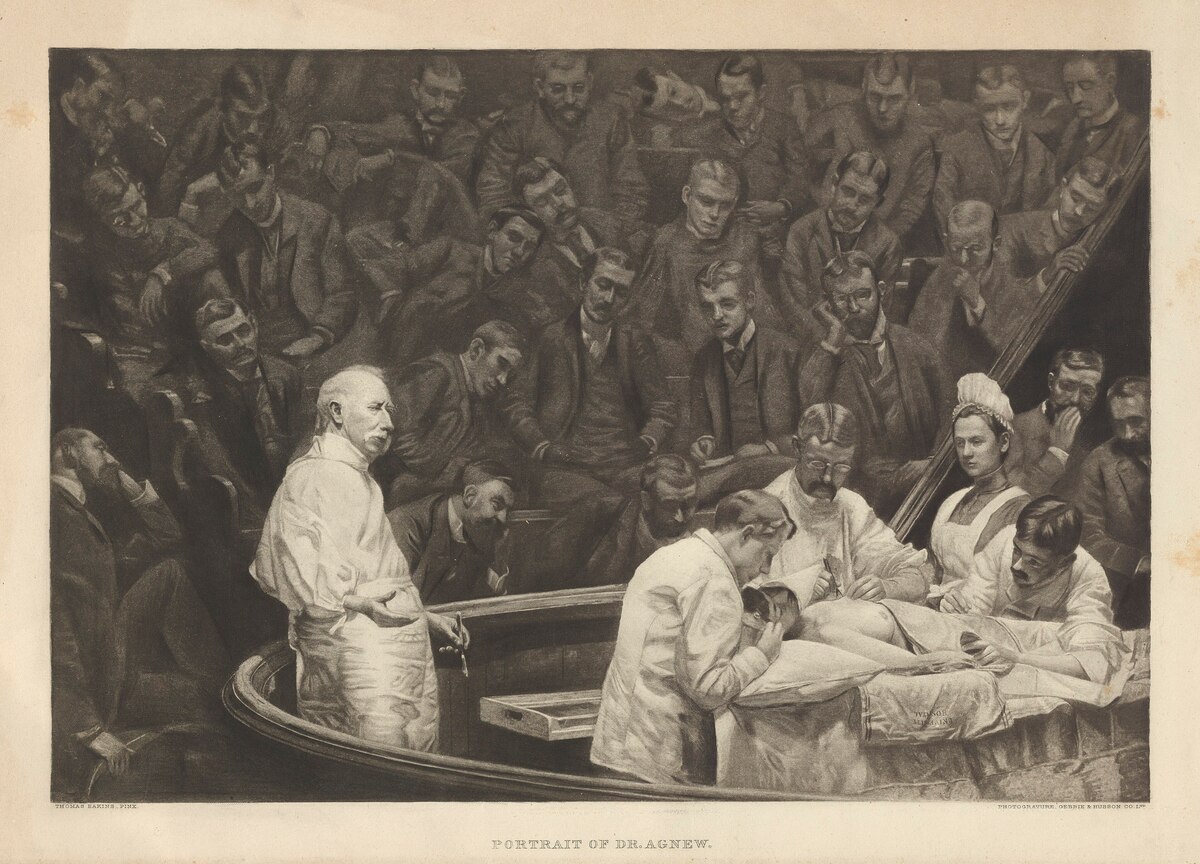
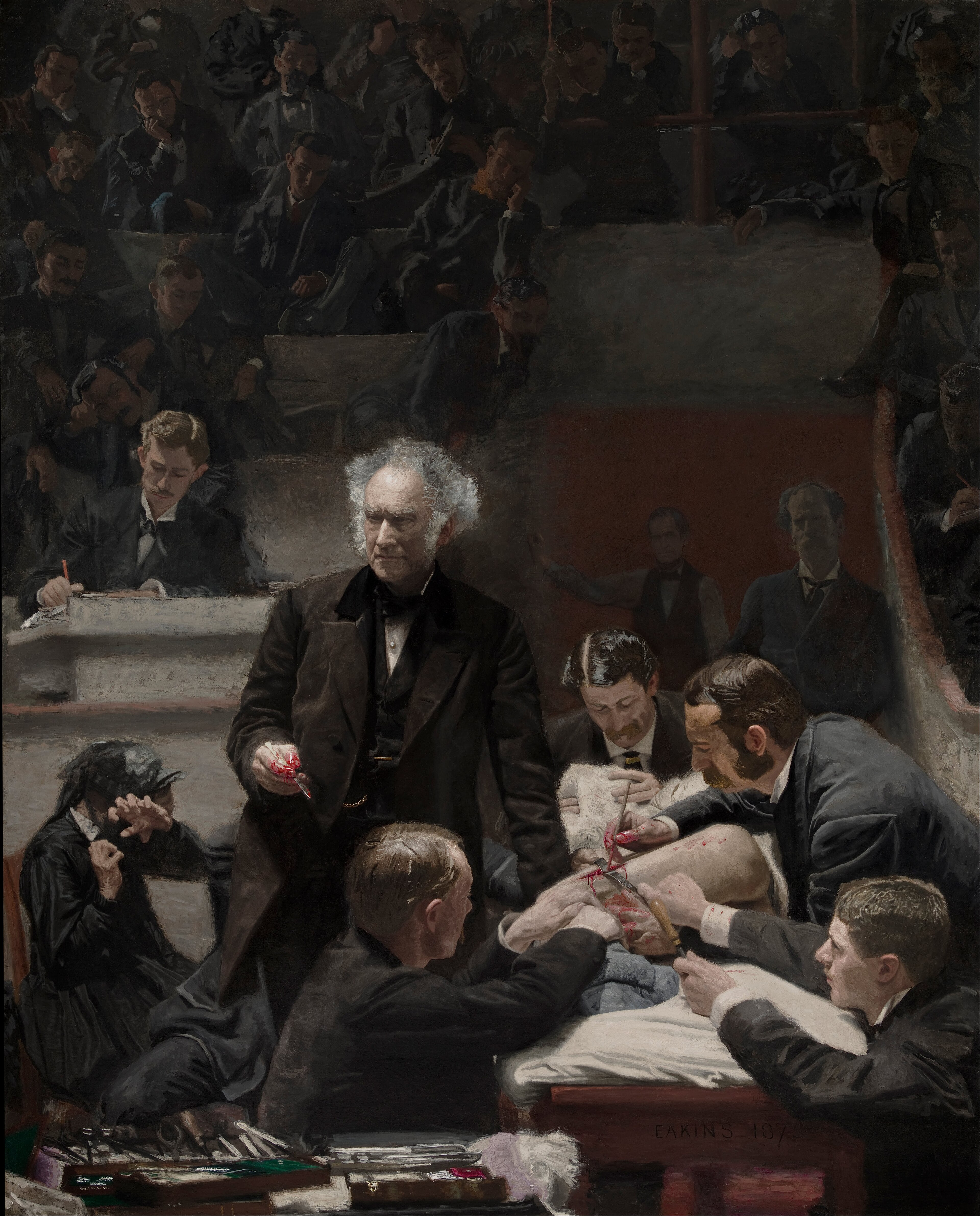
A gallery guide's reading of Thomas Eakins's 1875 group portrait of Dr. Samuel D. Gross, pausing over a surgical demonstration in a Philadelphia amphitheater. The guide connects the painting's subject and setting to the composition, light and gesture that carry its meaning, while noting where the available record leaves questions open.
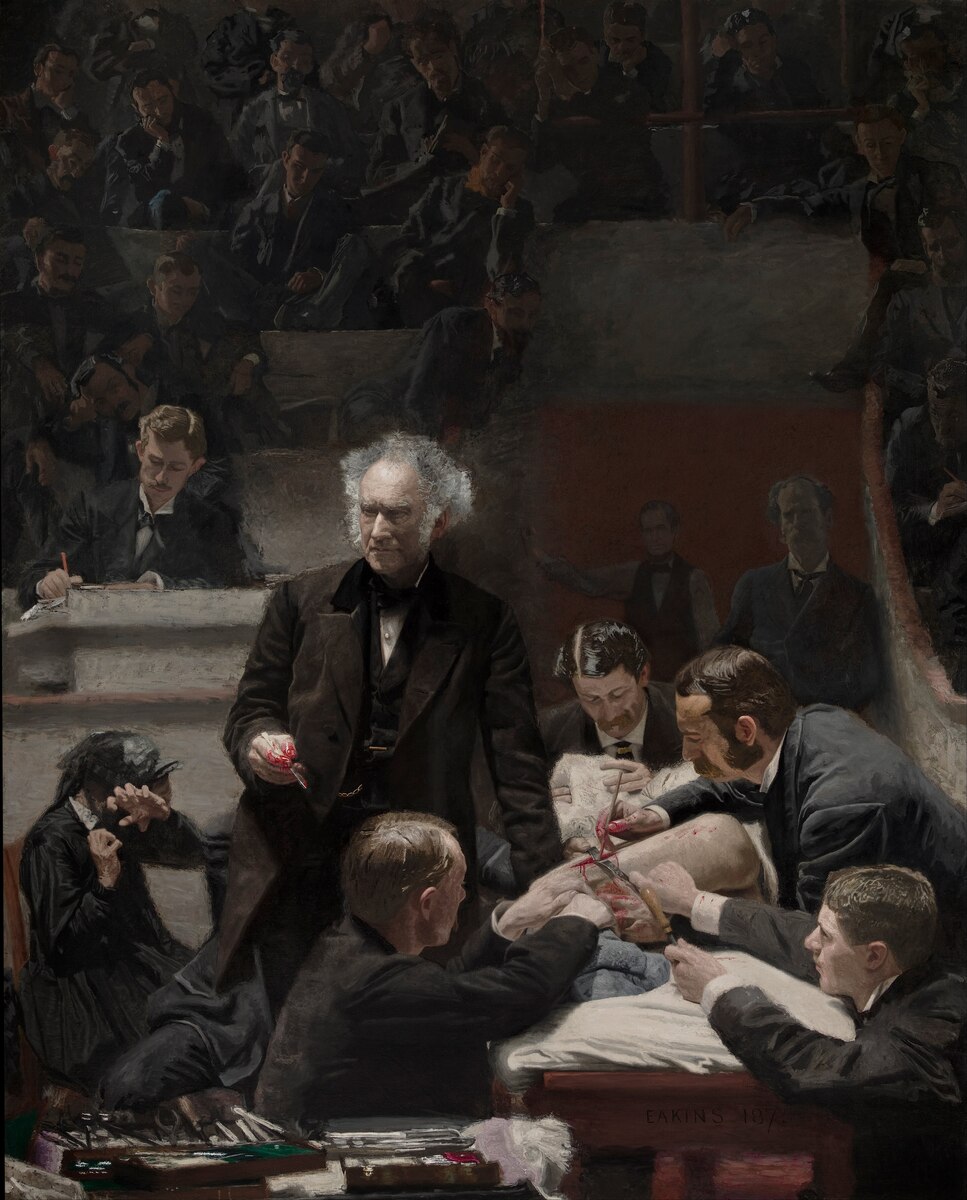
A cluttered still life of scalpels, forceps, sponges and trays along the bottom edge, a clinical inventory that anchors the drama in instruments and craft.
02
Gallery of onlookers
Rows of dark-suited male students and physicians fill the tiered amphitheater above the operating floor, their faces leaning forward or bowed in shadow, enclosing the scene as a collective witness.
03
Note-taking student
A young man in the left tier of seats bends over his paper, pencil in hand, recording the demonstration. His absorbed posture embodies the teaching purpose of the clinic.
Your gallery guide
Portrait of Dr. Samuel D. Gross (The Gross Clinic) by Thomas Eakins (1875)
A gallery guide's reading of Thomas Eakins's 1875 group portrait of Dr. Samuel D. Gross, pausing over a surgical demonstration in a Philadelphia amphitheater. The guide connects the painting's subject and setting to the composition, light and gesture that carry its meaning, while noting where the available record leaves questions open.
Editorial review by Artifact Archive automated publishing
This is Thomas Eakins's Portrait of Dr. Samuel D. Gross, better known as The Gross Clinic. Painted in 1875, it shows the white-haired surgeon Samuel David Gross pausing during a clinical demonstration in a crowded amphitheater.
Gross holds a bloodied scalpel while assistants operate on a patient's thigh. The painting is a group portrait, but its subject is also an event: a teaching clinic witnessed by an audience.
The composition gives Gross the center, and the light supports that choice. His lit forehead and white hair stand out against the darker gallery around him.
The scalpel in his hand is small, yet the light catches it. That makes the instrument a focal point without making it the largest thing in the room.
The patient lies below and to the left, partly obscured by the surgeons working over the thigh. Eakins keeps the operation present but subordinates it to the doctor who pauses to address the audience.
The setting is a crowded amphitheater, an open teaching space for a clinical demonstration. Students and colleagues fill the tiered seats and the floor around the operating table.
Gross is the figure the painting is named for, and the genre is a group portrait. The work belongs to American Realism, and it records a scene of medical instruction rather than a private moment.
The place of creation is recorded as the United States, and the artist, Thomas Eakins, was born in Philadelphia in 1844 and died there in 1916.
What the painting asks you to look at is not the wound but the authority of the man who has stepped back from it. Gross's raised hand and turned head connect him to the audience rather than to the patient.
The dark gallery around him makes his lit face and hand read as a held moment of instruction. The picture turns a surgical procedure into a portrait of professional knowledge being passed on.
The object history notes that the painting was given in 1878 and acquired in 2007; it is now in the collection of the Philadelphia Museum of Art. Those facts place the work in a public collection, but they do not explain its subject.
What the painting represents is documented: Dr. Samuel D. Gross, a clinical demonstration, an amphitheater audience, and assistants at an operating table.
Beyond that, the sources supplied here establish identity and setting more fully than they explain the painting's reception or the artist's private aims. The work's meaning rests on what we can see and on the record of who and what it shows.
The story and its sources
Editorial review by Artifact Archive automated publishing.
Historical claims are linked to the records below. Close looking and interpretation are identified in the passage notes.
Thomas Eakins was an American painter (1844–1916). Their work is associated with French Realism. Their recorded places of work include Philadelphia; Paris; Switzerland; Germany; Spain.
Dr. Samuel D. Gross, a white-haired surgeon, pauses during a clinical demonstration in a crowded amphitheater, holding a bloodied scalpel as assistants operate on a patient's thigh.
Title variants
The Gross Clinic; Portrait of Dr. Samuel D. Gross
Accession number
2007-1-1
Support
Canvas
Catalogue identity
The catalogue identity of the work is recorded as Portrait of Dr. Samuel D. Gross (The Gross Clinic), by Thomas Eakins, dated 1875. The medium is oil on canvas, and the recorded dimensions are 244.0 by 198.3 centimeters. The painting belongs to the collection of the Philadelphia Museum of Art under accession number 2007-1-1. The alternative title The Gross Clinic is also recorded, and the institutional record treats it as a second name for the same object rather than a separate work. The record classifies the work's genre as a group portrait, and it states that the painting depicts Samuel David Gross.(Wikimedia Commons: The Gross Clinic, n.d.)
The artist is identified as Thomas Eakins, an American artist born in Philadelphia, Pennsylvania, in 1844 and died in Philadelphia in 1916. The place of creation is recorded as the United States. These details situate the maker and the work within an American context, and the artist's life dates bracket the 1875 date assigned to the painting, though the evidence supplied does not describe his training, career or intentions. The object date of 1875 is the date of the painting itself and should be kept distinct from later catalogue and collection dates attached to the object, which concern its movement through ownership and institutions rather than its making.(Wikimedia Commons: The Gross Clinic, n.d.)
Object history notes record that the painting was given in 1878 and acquired in 2007. These are provenance events, and they are separate from the 1875 date of execution. The 2007 acquisition corresponds to the accession number 2007-1-1 recorded for the Philadelphia Museum of Art, while the 1878 gift marks an earlier transfer. The evidence establishes the sequence of these events but does not name the donors, the intermediate owners, or the circumstances of transfer, so the history between 1878 and 2007 remains undocumented in the supplied units.(Wikimedia Commons: The Gross Clinic, n.d.)
Interpretation
Taken together, the catalogue units establish an object that is at once a portrait and a record of an event: a group portrait depicting the surgeon Samuel David Gross, painted in 1875 in the United States, now held under a museum accession number that dates from its twentieth-first-century acquisition. The identity record is unusually complete on names, dates, medium, measurements and collection, and correspondingly thin on the work's critical reception and on the artist's private aims. The distinction matters for research use: the catalogue data support statements about what the object is and where it has been, while claims about its meaning must rest on what is depicted and on the documented record of who and what it shows.(Wikimedia Commons: The Gross Clinic, n.d.)
The painting is titled Portrait of Dr. Samuel D. Gross (The Gross Clinic), by Thomas Eakins, dated 1875, oil on canvas, 244.0 x 198.3 cm, in the collection of the Philadelphia Museum of Art, accession number 2007-1-1.(Wikimedia Commons: The Gross Clinic, n.d.)
The object is recorded under the title Portrait of Dr. Samuel D. Gross (The Gross Clinic), painted by Thomas Eakins in 1875 in oil on canvas, measuring 244.0 by 198.3 cm, and held by the Philadelphia Museum of Art under accession number 2007-1-1. Eakins is documented as an American artist born in Philadelphia, Pennsylvania, in 1844 and died in that city in 1916; the place of creation of the painting itself is recorded as the United States. The work is catalogued in the genre of group portrait and depicts Samuel David Gross, the surgeon whose name the title carries. These catalogue facts establish what the object is, who made it, when, in what medium and at what scale, and where it now resides, and they are the necessary footing for any account of its commissioning or social function.(Wikimedia Commons: The Gross Clinic, n.d.)
The Limits of Commissioning Evidence
The documentary record establishes identity and setting with far more completeness than it explains reception or the artist's private aims. It names the sitter, Samuel David Gross, and fixes the represented situation as a clinical demonstration in an amphitheater, with an audience of students and colleagues and assistants working at an operating table on a patient's thigh. It also fixes the genre as group portrait and the medium and date. The supplied evidence does not record the terms of a commission, the identity of a patron, the intended destination of the canvas, the circumstances of its first showing, or Eakins's own statements of purpose. That gap is not a defect to be filled by speculation; it defines the boundary between what the object's documentation supports and what remains outside it. Secure identification of the subject and the depicted event therefore does not settle the history of why the picture was made or for whom.(Wikimedia Commons: The Gross Clinic, n.d.)
The Pictured Event and Its Social World
Interpretation
Within that documented frame, the painting's subject is legible as an event as much as a portrait: Gross pauses during a clinical demonstration, holding a bloodied scalpel while assistants operate on the patient's thigh, in a crowded amphitheater whose tiered seats and floor are filled with students and colleagues. The composition gives Gross the centre and supports the choice with light, so that his lit forehead and white hair stand out against the darker gallery and the small scalpel in his hand becomes a focal point without being the largest thing in the room. The patient lies below and to the left, partly obscured by the surgeons at the thigh, so the operation remains present but subordinate to the doctor who steps back to address the audience. This coordination of lighting, scale and placement is what allows a surgical scene to function as a portrait of professional knowledge being transmitted, and it is the formal ground on which the picture's claim to the history of medical instruction and of American Realism rests.(Wikimedia Commons: The Gross Clinic, n.d.)
The documented object history for the painting known as The Gross Clinic, catalogued as Portrait of Dr. Samuel D. Gross by Thomas Eakins, is unusually spare. The institutional record supplies two dated events and nothing between them: the work was given in 1878, and it was acquired in 2007. Those two dates govern the provenance section, because they are the only documented transfers available in the evidence. Everything the record states about the object's earlier custody is compressed into that single 1878 entry, and the record does not name the donor, the recipient, the terms of the gift, or any intervening owner. The gap between 1878 and 2007 is therefore an unrecorded interval rather than a documented chain of custody, and the account below treats it as such: absence of a recorded transaction between those dates is not evidence of continuous ownership by any particular party, nor evidence that any hypothesized transfer occurred.(Wikimedia Commons: The Gross Clinic, n.d.)
The 2007 acquisition corresponds to the work's present repository. The painting is in the collection of the Philadelphia Museum of Art under accession number 2007-1-1, an identifier consistent with a 2007 accession and confirming that the second documented event in the object history is an institutional acquisition rather than a private sale or loan. The same institutional record supplies the work's core catalogue identity: the title Portrait of Dr. Samuel D. Gross (The Gross Clinic), the artist Thomas Eakins, a date of 1875, oil on canvas, and dimensions of 244.0 by 198.3 cm. Those facts establish what was transferred in 2007 and confirm that the object now held is the same 1875 canvas named in the 1878 entry. The shift from a gift in 1878 to an accession by a public museum in 2007 places the work in a public collection, but the record itself does not explain the subject or the reception, and neither the 1878 nor the 2007 entry carries a provenance narrative for the century in between.(Wikimedia Commons: The Gross Clinic, n.d.)
Catalogue Identity Behind the Provenance
Because the painting's documented provenance begins only in 1878 and resumes in 2007, the object's identity has to be established from the same record rather than from a continuous ownership file. The artist is recorded as Thomas Eakins, an American born in Philadelphia, Pennsylvania, in 1844 and deceased in Philadelphia in 1916. The place of creation is recorded as the United States, which places the making of the canvas in the same national context as the artist's biography and the later museum collection. The work's genre is given as a group portrait, and it depicts Samuel David Gross, the white-haired surgeon whose name appears in the title and whose clinical demonstration forms the painted event. These identifications matter for provenance because they anchor the object described in 1878 and 2007 to a specific maker, a specific year of production, and a specific institutional catalogue entry rather than to an unattributed canvas.(Wikimedia Commons: The Gross Clinic, n.d.)
Read together, the two dated events and the catalogue identity define the limits of what the evidence can support. The object history records a gift in 1878 and an acquisition in 2007; the institutional record supplies the accession number 2007-1-1 and the collection of the Philadelphia Museum of Art; the same source records the title, the alternative name The Gross Clinic, the artist's Philadelphia birth in 1844 and death there in 1916, the genre of group portrait, the subject Samuel David Gross, the place of creation as the United States, and the medium and measured size of oil on canvas at 244.0 by 198.3 cm. What no unit supplies is the identity of the 1878 donor or recipient, the circumstances or location of the transfer, the sequence of custody between 1878 and 2007, or any sale, exhibition, or loan that intervened. The responsible provenance statement is therefore narrow and precise: two documented transactions, one identified public repository, and an interval the surviving record does not account for, rather than a reconstructed ownership chain.(Wikimedia Commons: The Gross Clinic, n.d.)
The institutional record consulted here identifies the painting as Thomas Eakins's Portrait of Dr. Samuel D. Gross (The Gross Clinic), an oil on canvas dated 1875 and measuring 244.0 by 198.3 centimetres, held by the Philadelphia Museum of Art under accession number 2007-1-1. The same record gives the artist's biography in brief: Eakins was an American born in Philadelphia, Pennsylvania, in 1844, who died in that city in 1916. The place of creation is recorded as the United States, and the work is known both by its descriptive institutional title and by the shorter name The Gross Clinic. These are catalogue facts, the sort of identity data a museum supplies so that a single physical object can be tracked across publications, databases and reproductions, and they establish the canvas as a large-scale American painting of the later nineteenth century rather than a small study or fragment.(Wikimedia Commons: The Gross Clinic, n.d.)
The same record's object history notes two moments that bear on how the painting moved into public keeping: a gift in 1878 and an acquisition in 2007. The 1878 entry and the 2007 entry are not equivalent events and should not be collapsed into a single provenance narrative. What the supplied evidence establishes is that the work was given at an early date and later acquired by the museum whose collection now holds it, under the accession number 2007-1-1. The two dates frame a long interval about which this evidence says nothing, and the accounts supplied here do not name donors, intermediaries, owners, prices, venues or the circumstances of either transaction. That silence is part of the record, and it is the reason the collection history can be stated securely at its ends while its middle remains undocumented in the material available.(Wikimedia Commons: The Gross Clinic, n.d.)
Interpretation
Within the larger history of art and material culture, the fact that a painting of this scale, cost and subject entered a gift in 1878 and later passed into a major American museum in 2007 matters beyond the mechanics of ownership. Later nineteenth-century American painting was often circulated through private hands, and the eventual institutional custody documented here is what makes the object continuously available for study, comparison and reproduction. Because the record supplies the accession number and the holding institution, the painting can be located as a specific physical thing, examined against other works of its date and format, and distinguished from copies, prints and photographs that carry its image. The collection facts therefore anchor every other kind of claim that can be made about the work, including claims about what it depicts.(Wikimedia Commons: The Gross Clinic, n.d.)
Subject, setting and genre
The record's description of the picture's content is explicit and can be stated without speculation about the artist's intentions: the painting depicts Samuel David Gross, and its genre is a group portrait. It represents a clinical demonstration held in an amphitheater, with Dr. Gross, an operating table, assistants and an audience of students and colleagues visibly present. Gross appears as a white-haired surgeon who pauses during the demonstration; the audience occupies the tiered seating and the floor around the table, and the operation on the patient is visible but subordinated to the surgeon who addresses those watching. The record thus supports a reading of the picture as a scene of medical instruction and professional portraiture rather than a private or domestic subject, and it identifies the setting as an open teaching space rather than a closed operating room.(Wikimedia Commons: The Gross Clinic, n.d.)
Interpretation
The distinction the sources draw between identity and explanation is worth preserving as a qualification on all interpretation of the work. The supplied evidence establishes what the painting shows and where it now resides, but it does not establish its reception, the artist's private aims or the historical circumstances that surrounded its making and first showing. Where an account of the painting's meaning is offered, it rests on what can be seen in the image and on the documented identification of the people and setting, not on a documented record of contemporary responses. Anyone using this account should therefore treat the descriptive content and the collection data as documented, and treat broader statements about the painting's significance as interpretation that the present evidence supports but does not prove.(Wikimedia Commons: The Gross Clinic, n.d.)
The object treated in this section is Thomas Eakins's Portrait of Dr. Samuel D. Gross, widely known as The Gross Clinic, an oil on canvas dated 1875 and identified in the institutional record as a group portrait. The record gives its dimensions as approximately 244.0 by 198.3 cm, its place of creation as the United States, and its current repository as the Philadelphia Museum of Art, where it carries the accession number 2007-1-1. The same record provides the artist's biography in outline: Eakins was an American artist born in Philadelphia, Pennsylvania, in 1844, who died in Philadelphia in 1916, and the work is associated with American Realism. The subject is named as Samuel David Gross, shown in a documented scene of clinical demonstration rather than a private or domestic moment. Object history entries state that the painting was given in 1878 and acquired by the museum in 2007, and that it is also known by the shorter title The Gross Clinic.(Wikimedia Commons: The Gross Clinic, n.d.)
Accounting for value
No monetary figure for the painting appears in the supplied evidence. What does appear is a model-generated working estimate, dated 2026-10-16, calculated for manual review only, which proposes a broad range of US$80M to US$150M. The methodology described for that range is deliberately coarse: it is derived conservatively from the artwork's confirmed attribution, date, medium, monumental scale and institutional prominence, with a wide spread intended to avoid implying precision. The qualification attached to the estimate is explicit that it is not an official insurance value, appraisal, auction result or sale price, that it does not rely on private insurance records or verified comparable sales, and that any actual insured value would need to be established by a qualified fine-art appraiser or insurance professional through physical inspection, provenance, condition and current market evidence. The reasoning behind treating the object as high-value and high-prominence material rests on its status as a major, widely reproduced American painting in a public collection, not on a transaction or valuation document. The record supplies no current appraisal, private insurance schedule, auction result or sale price, so the range functions as a placeholder for review rather than as evidence about the work's market history. Read together with the catalogue facts, the estimate shows how attribution, date, medium, scale and public stewardship can be converted into a working insurance assumption while leaving the monetary question formally unresolved.(Wikimedia Commons: The Gross Clinic, n.d.)
Working estimate
Calculated working insurance estimate, not a sale price: Estimated value: US$80M to US$150M Recorded date: Working calculation, generated 2026-10-16. Methodology: A broad, conservative working range was calculated for manual review only, using confirmed context from the supplied institutional record. The artwork is an 1875 oil on canvas by Thomas Eakins, an American Realist, at monumental scale (approximately 244.0 x 198.3 cm), held by the Philadelphia Museum of Art with accession number 2007-1-1. The object history in the record notes it was given in 1878 and acquired by the museum in 2007. Its status as a major, widely reproduced American painting in a public collection supports treating it as high-value, high-prominence material for insurance review, but the record does not supply a current appraisal, private insurance schedule, auction result, or sale price. Because no public monetary figure is given, the range is derived conservatively from the artwork's confirmed attribution, date, medium, scale, and institutional prominence, with a broad spread to avoid implying precision. The range is not based on comparable sales, private insurance records, or any official valuation. Qualification: This is a model-generated working range for manual review only. It is not an official insurance value, appraisal, auction result, or sale price. It does not use private insurance records or verified comparable sales. The actual insured value should be determined by a qualified fine-art appraiser or insurance professional using physical inspection, provenance, condition, and current market evidence.(Wikimedia Commons: The Gross Clinic, n.d.)
Further reading
Books for a closer look
Paid links. As an Amazon Associate I earn from qualifying purchases.
Thomas Eakins rediscovered: Charles Bregler's Thomas Eakins collection at the Pennsylvania Academy of the Fine Arts
Yale University Press; Pennsylvania Academy of the Fine Arts
Thomas Eakins rediscovered by Kathleen A. Foster records subjects including Catalogs, Criticism and interpretation, Art collections, Pennsylvania Academy of the Fine Arts, and Eakins, Thomas. Given Eakins's Philadelphia institutional context and the Pennsylvania Academy's role in his career, this catalogue-based study offers documented contextual and interpretive material relevant to his work.
Thomas Eakins rediscovered by Kathleen A. Foster records subjects including Catalogs, Criticism and interpretation, Art collections, Pennsylvania Academy of the Fine Arts, and Eakins, Thomas. Given Eakins's Philadelphia institutional context and the Pennsylvania Academy's role in his career, this catalogue-based study offers documented contextual and interpretive material relevant to his work.
Titled 'An Eakins masterpiece restored' with recorded authors Kathleen A. Foster and Mark S. Tucker, and assigned subjects Criticism and interpretation and Eakins, Thomas. This points to a focused treatment of a major Eakins painting's restoration, making it a plausible scholarly source on The Gross Clinic specifically.
Official institutional record from the Philadelphia Museum of Art, accessed via Wikimedia Commons, providing catalogue identity and collection details.
Advertising supports the archive. These preferences control aggregate page counting, reading activity and ad-delivery diagnostics. They use no visitor tracking cookie.