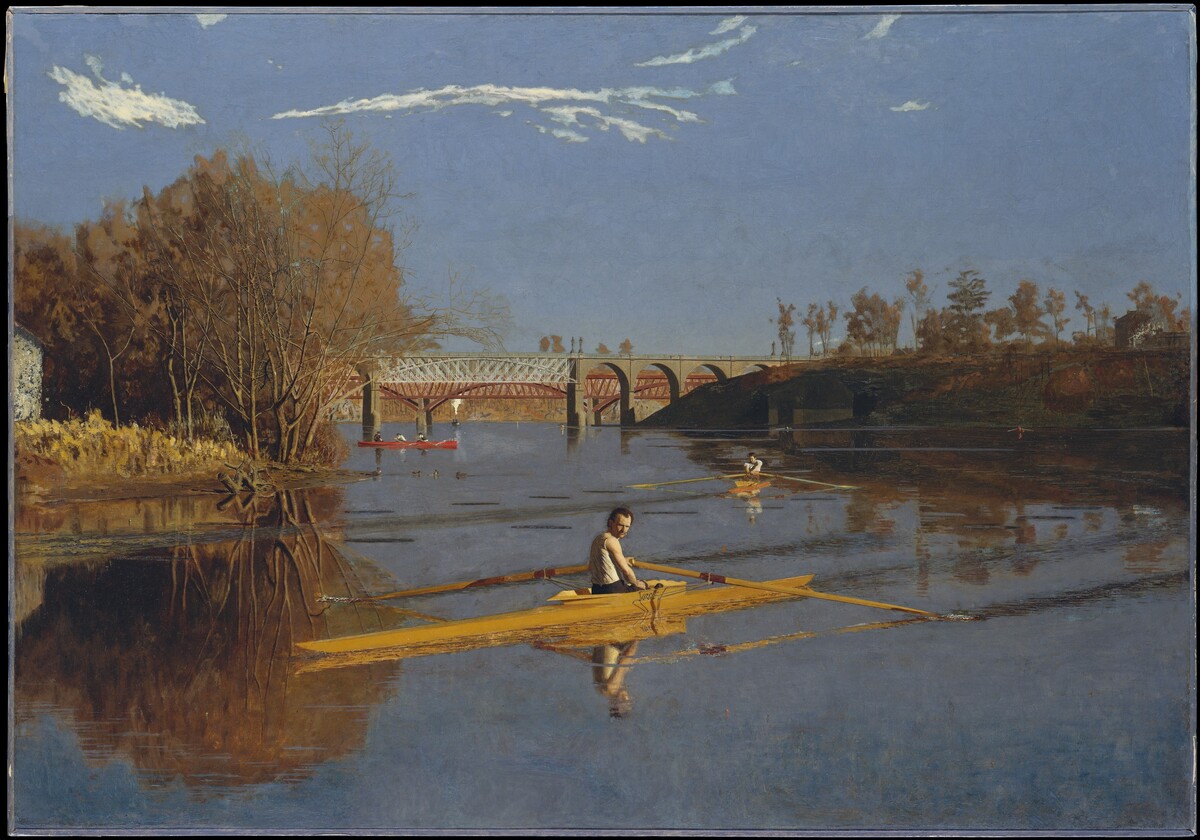
A single sculler holds his oars on the Schuylkill River, while another rower pulls away in the middle distance. Thomas Eakins painted the scene in 1871, and the supplied record identifies the champion in the foreground as Max Schmitt. This short tour looks at how the picture turns a quiet stretch of river into a portrait of a champion and his sport.
The glassy water beneath the shell and bank, where the scull, oars, rower and trees repeat in soft inverted reflections, the craft element that makes the river read as a mirror.
02
Rowed spectator boat
The small red boat with rowers and passengers moving across the middle distance, a sign of the busy regatta life on the river and a scale marker between bridge and foreground.
03
Iron and masonry river bridge
The long bridge crossing the background, its white iron truss and stone arches identifying the Schuylkill setting and giving the flat river scene its horizon and depth.
Your gallery guide
The Champion Single Sculls (Max Schmitt in a Single Scull) by Thomas Eakins (1871)
A single sculler holds his oars on the Schuylkill River, while another rower pulls away in the middle distance. Thomas Eakins painted the scene in 1871, and the supplied record identifies the champion in the foreground as Max Schmitt. This short tour looks at how the picture turns a quiet stretch of river into a portrait of a champion and his sport.
Editorial review by Artifact Archive automated publishing
The man in the foreground is Max Schmitt, a champion single sculler. He sits at the oars in a long racing shell on the Schuylkill River, and the supplied record identifies the scene with rowing and sculling.
Behind him, a second rower works in the middle distance. The title names the painting for Schmitt, but the wide river and the second boat belong to the same picture.
The rowing shell extends in a long horizontal line across the water. Schmitt faces the stern, his body turned toward us, and his oars rest at his sides rather than cutting into the stroke.
The second rower is farther away, smaller, and caught mid-pull. The two figures sit at different distances along the river, so the space reads as a stretch of water rather than a flat backdrop.
Eakins painted the picture in 1871, and the record places its creation in the United States. The subject is a river scene tied to rowing, with Schmitt named as the sculler in the title and in the depiction data.
The painting is an oil on canvas classified in the record as a landscape painting as well as a painting. That double classification fits what we see. The river and its banks share the picture with the athlete.
The record lists the second rower only as part of the scene, without naming him. What the supplied evidence supports is the arrangement. One sculler is brought close and held still. The other is set farther off and shown in motion.
That contrast lets the painting work as a portrait and as a view of the sport at once. Schmitt is the named subject, while the active rower keeps the river from becoming a pure backdrop.
So the painting is not simply a river landscape with a boat on it. It identifies a named champion, places him at rest, and shows the wider life of the river still moving behind him.
Eakins made the scene in 1871, and the supplied record tells us who the lead figure is. The picture holds that identity and the setting together in one quiet view of the sport.
The story and its sources
Editorial review by Artifact Archive automated publishing.
Historical claims are linked to the records below. Close looking and interpretation are identified in the passage notes.
Thomas Eakins was an American painter (1844–1916). Their work is associated with French Realism. Their recorded places of work include Philadelphia; Paris; Switzerland; Germany; Spain.
A single sculler, Max Schmitt, sits at the oars in a long yellow racing shell on the Schuylkill River, while a second rower, traditionally identified as the artist Thomas Eakins himself, works in the middle distance.
Title variants
Max Schmitt in a Single Scull; The Champion Single Sculls
Accession number
34.92
Support
canvas
Catalogue identity and attribution
The catalogue title of the painting is The Champion Single Sculls (Max Schmitt in a Single Scull), a compound title in which a generic competitive designation, the champion single sculls, is set alongside the identifying name of the rower, Max Schmitt, in a single scull. The record attributes the work to Thomas Eakins, described as an American painter born in Philadelphia in 1844 and dead in 1916, and further identified in the same record as an aquarellist, sculptor and photographer. That expanded identification matters for how the attribution is framed: the catalogue does not present Eakins as a painter alone but as a practitioner across watercolour, sculpture and photography, so the attribution to him is an attribution to a maker whose documented activity extended well beyond oil painting. The two elements of the title and the name of the artist are the record's primary acts of identification, and they establish at the outset that the picture is at once a named portrait of a particular sportsman and a work about a class of competition.(Wikimedia Commons: Max Schmitt in a Single Scull, n.d., Title field; Artist field)
Documentation, reception and depicted subject
The supplied record links the painting to the Heilbrunn Timeline of Art History and lists it in 1001 Paintings You Must See Before You Die at page 465. It also notes that the creator's signature appears in another version of the file, identified as the creator's signature, so the record preserves the fact of a signature within a variant file rather than describing its placement or transcription. The file known as The Champion Single Sculls (Max Schmitt in a Single Scull) MET DT86.jpg was donated to Wikimedia Commons as part of a project by the Metropolitan Museum of Art and is released under the CC0 1.0 public domain dedication. These are facts about the circulation and documentation of the image rather than about the painting's physical form, and they are worth keeping distinct from the identification of the object itself: the file donation and rights statement describe the digital surrogate and its licensing, while the signature note and the timeline and book references describe the object's scholarly and popular reception. The painting depicts a river scene associated with rowing and sculling, and a rower named Max Schmitt, according to the same record. The depiction data therefore corroborates the title's naming of Schmitt as the sculler, and it ties the picture to rowing and sculling as documented subjects.(Wikimedia Commons: Max Schmitt in a Single Scull, n.d., Title field; Date and Place of creation fields)
Interpretation
Read together, the evidence describes a work whose identity has several layers that should not be collapsed into one another. The catalogue title, artist attribution, date of 1871, place of creation in the United States, oil on canvas support, dimensions, painting and landscape classifications, museum department, accession number, credit line, gallery location and depiction tags together constitute the object's documented identity. The record's addition of aquarellist, sculptor and photographer to Eakins's identification warns against treating the attribution as that of a painter pure and simple, even while the object itself is documented as an oil painting on canvas. The 1934 acquisition belongs to the object's institutional history and is separated from the 1871 creation by sixty-three years of unrecorded provenance in the supplied evidence. Within the larger history of art and material culture, the conjunction of a named sporting champion, the competitive category of the single sculls, and a river scene is what the evidence establishes: the picture is catalogued at once as a painting, as a landscape, and as a depiction of rowing and sculling with Max Schmitt named in the title and in the depiction data. That combination is why the object matters as a document, since the record preserves in one entry the maker's multi-disciplinary identity, the competitive sport of sculling, and the object's later life in an American art collection, without supporting any claim about the interval between those moments.(Wikimedia Commons: Max Schmitt in a Single Scull, n.d., Title field; Artist field; Date and Place of creation fields; Credit line field)
The artist is Thomas Eakins, an American painter born in 1844 in Philadelphia and died in 1916, also identified in the record as an aquarellist, sculptor and photographer.(Wikimedia Commons: Max Schmitt in a Single Scull, n.d.)
The supplied record identifies the painting's subject as a river scene associated with rowing and sculling, and names a rower, Max Schmitt, as the figure depicted. That is the full extent of the identification the record supplies about the people in the picture. Thomas Eakins, the American painter born in Philadelphia in 1844 and died in 1916, is credited as the creator and is also identified in the record as an aquarellist, a sculptor and a photographer. The painting is dated 1871, with the United States recorded as its place of creation, and it is an oil painting on canvas, classified in the record both as a painting and as a landscape painting. The double classification matches what the depiction evidence establishes: the river and its surroundings share the picture with the named athlete, so the work belongs to landscape and to portraiture at once, without the record having to choose between them.(Wikimedia Commons: Max Schmitt in a Single Scull, n.d., Structured data: depicts field; Date and Place of creation fields; Medium and Object type fields)
Collection and status
Interpretation
Read together, the units establish a consistent picture: a large, wide oil on canvas, painted in 1871 in the United States by a Philadelphia-born artist who worked across painting, watercolour, sculpture and photography, depicting a river scene tied to rowing and sculling and naming Max Schmitt among its figures, and now held in the American Wing of the Metropolitan Museum of Art. What the evidence does not establish should be kept equally clear. The supplied units do not identify the second rower, do not describe the clothing, furnishings, architecture or any further iconography of the scene, and do not report any technical imaging, conservation treatment or change in the painting's appearance over time. Those gaps are worth stating because the painting's documentary record here is rich on identification and thin on visual description, and the difference between the two should not be blurred.(Wikimedia Commons: Max Schmitt in a Single Scull, n.d., Structured data: depicts field; Date and Place of creation fields; Medium and Object type fields; Dimensions field)
The supplied institutional record dates the painting to 1871 and records the United States as its place of creation. The artist is Thomas Eakins, an American painter born in Philadelphia in 1844 and died in 1916; the same record also identifies him as an aquarellist, sculptor and photographer. The work is an oil painting on canvas, catalogued in the record both as a painting and as a landscape painting, and it measures 32 1/4 by 46 1/4 inches, or 81.9 by 117.5 centimetres. Its title in the record is The Champion Single Sculls (Max Schmitt in a Single Scull), and the depiction data associates the scene with a river setting, with rowing and sculling, and with a rower named Max Schmitt. These are the secure identification facts on which any account of the object's commissioning and social world must rest.(Wikimedia Commons: Max Schmitt in a Single Scull, n.d., Date and Place of creation fields; Structured data: depicts field)
The painting is documented in the institutional record as an oil painting on canvas, classified both as a painting and as a landscape painting. Its canvas measures 32 1/4 by 46 1/4 inches, equivalent to 81.9 by 117.5 centimetres. These fields establish the support, the medium and the physical scale of the work as recorded data rather than as visual inference: the record does not describe a panel, a prepared board or a secondary support, nor does it specify a lining, stretcher, ground or priming layer. The double object-type classification is itself notable, because it registers the picture in both figure and landscape categories, a pairing that corresponds to a river scene in which the water, banks and sky occupy the canvas alongside the rower. Nothing in these units documents pigment identification, paint-layer analysis, infrared or X-radiographic examination, sampling or conservation treatment, so claims about specific pigments, underdrawing or later interventions would exceed the evidence. The dimensions are given in the record without a note on whether they describe the canvas, the stretcher or the framed work, and that qualification should be retained.(Wikimedia Commons: Max Schmitt in a Single Scull, n.d., Medium and Object type fields; Dimensions field)
A separate institutional field records that the painting's creator's signature appears in another version of the file, listed under an other versions section. This is a documentary note about file metadata rather than a description of the painted surface, and it does not state where on the canvas a signature is placed, what form it takes, or whether the signature is inscribed, painted or otherwise applied. It also does not establish that the signature has been examined technically or authenticated. What the unit does support is that the institutional record associates a creator's signature with the work through a variant file, which is a provenance of documentation rather than a physical finding. For a materials and technique account, the distinction matters: an inscription attributed to the artist can be a primary mark of authorship, but the evidence here reports its presence in another version of the record, not its physical character, condition or location. The record also does not connect the signature to a date or to a making stage, so any argument that it belongs to the painting's original execution remains an inference rather than a documented fact.(Wikimedia Commons: Max Schmitt in a Single Scull, n.d., Other versions section)
The painting is dated 1871 and its place of creation is recorded as the United States, and it belongs to the Metropolitan Museum of Art, in the department of American Paintings and Sculpture, where it carries the accession number 34.92. The museum acquired the painting in 1934 through the purchase of the Alfred N. Punnett Endowment Fund and the George D. Pratt Gift. This credit line names two distinct funding mechanisms rather than a single donor: a fund established by way of the Alfred N. Punnett Endowment, joined with a gift associated with George D. Pratt, and the record presents the 1934 entry into the collection as a purchase rather than a donation of the object itself. The accession number and the acquisition year correspond, which is consistent with an institutional numbering practice that begins with the year of accession, and this internal agreement between the number and the stated date is one of the few points in the provenance record that is corroborated by more than one field of the same institutional source. No earlier owner, dealer, agent or intermediate transfer is named anywhere in the supplied evidence, so the chain of possession before 1934 is simply unrecorded here rather than documented as unchanged; an absence of recorded owners is not evidence that none existed, and it should not be read as a proven continuity of ownership from the year of creation to the year of acquisition. What can be said precisely is that the evidence establishes a creation date and place, a present repository with a department and an accession number, and a 1934 acquisition with its stated funding sources.(Wikimedia Commons: Max Schmitt in a Single Scull, n.d., Credit line field; Date and Place of creation fields)
The work is an oil painting on canvas, classified in the record both as a painting and as a landscape painting, and the canvas measures 32 1/4 by 46 1/4 inches, or 81.9 by 117.5 centimetres. Those material and dimensional facts belong to the same institutional record that supplies the accession number and the 1934 credit line, which matters for how the acquisition should be understood: the museum's entry describes a finished oil on canvas of a defined size, not a fragmentary or reworked object, and the double classification as painting and landscape painting is recorded rather than inferred. The image is held in Gallery 764 of the Metropolitan Museum of Art, in the American Wing, so the present location is given at the level of a specific gallery as well as a collecting department. The supplied record further notes that the painting's creator's signature appears in another version of the file, that is, in a variant image of the work rather than in the principal file described; the signature is thus reported through an associated file, and this evidence establishes that a signature is documented in the record's file set without itself reproducing or transcribing it. Taken together, these units describe the object as it is catalogued and housed, and they also show the layered character of the record, which distinguishes the primary image file from other versions that carry additional details such as the signature.(Wikimedia Commons: Max Schmitt in a Single Scull, n.d., Credit line field; Date and Place of creation fields)
Rights, Description and Reception
The file known as The Champion Single Sculls (Max Schmitt in a Single Scull) MET DT86.jpg was donated to Wikimedia Commons as part of a project by the Metropolitan Museum of Art and is released under the CC0 1.0 public domain dedication. That rights statement concerns the digital file and its donation, not the ownership of the painting, and conflating the two would be a category error: the CC0 dedication governs reuse of the image file, while the canvas itself remains with the museum under the 1934 acquisition and accession number 34.92. The same record links the painting to the Heilbrunn Timeline of Art History and lists it in 1001 Paintings You Must See Before You Die, page 465, which shows the work circulating in reference and popular survey literature in addition to the institutional catalogue. The page number is supplied for the second reference, while the Timeline link is given without a corresponding locator in the evidence. These references are reception and documentation facts rather than provenance facts in the strict sense, but they bear on provenance inquiry because they demonstrate that the object is repeatedly identified through its museum record and its title, and it is that stable identification, tied to the accession number and the department of American Paintings and Sculpture, that allows the 1934 acquisition to be matched to the same canvas described elsewhere.(Wikimedia Commons: Max Schmitt in a Single Scull, n.d., Credit and Permission sections; References section; Credit line field)
A distinct stage of reception is digital and institutional reproduction. The image file known as The Champion Single Sculls (Max Schmitt in a Single Scull) MET DT86.jpg was donated to Wikimedia Commons as part of a project by the Metropolitan Museum of Art and released under the CC0 1.0 public domain dedication. This matters for reception history because it changes who can see and reuse the painting: an early canvas that once existed only as a physical object in a gallery becomes an open-access resource that can be reproduced, studied and republished without permission barriers. The credit and permission record of the Commons file is itself evidence of a deliberate institutional policy of open circulation, and it is the mechanism by which much of the painting's contemporary visibility is produced.(Wikimedia Commons: Max Schmitt in a Single Scull, n.d., Credit and Permission sections)
Visual observation
Further evidence of canonisation is bibliographic. The supplied record links the painting to the Heilbrunn Timeline of Art History and lists it in 1001 Paintings You Must See Before You Die, page 465. These two references operate differently. The Heilbrunn Timeline is an art-historical and educational resource associated with the museum, placing the work within a narrative of art history, while inclusion in a volume titled 1001 Paintings You Must See Before You Die places it within a popular canon of must-see masterpieces. Taken together with the open-access Commons donation, they show a painting that has moved from a specific 1934 acquisition into general didactic and popular lists, while the underlying subject remains the 1871 river scene and the named sculler Max Schmitt.(Wikimedia Commons: Max Schmitt in a Single Scull, n.d., References section; Structured data: depicts field)
Interpretation
The accumulating reception of the painting therefore has several documented layers that should be kept distinct. Its original function belongs to 1871, when it was made in the United States as a depiction of a river scene and a named rower. Its institutional role begins with the 1934 acquisition through the Alfred N. Punnett Endowment Fund and the George D. Pratt Gift. Its modern public role is amplified by the Metropolitan Museum of Art project that donated the file to Wikimedia Commons under CC0 1.0, and by the reference apparatus that links it to the Heilbrunn Timeline of Art History and to 1001 Paintings You Must See Before You Die at page 465. None of these later roles can be reduced to a single dramatic event; each is a documented stage through which the painting's meanings and audiences have expanded.(Wikimedia Commons: Max Schmitt in a Single Scull, n.d., Date and Place of creation fields; Credit line field; Credit and Permission sections; References section; Structured data: depicts field)
The file known as The Champion Single Sculls (Max Schmitt in a Single Scull) MET DT86.jpg was donated to Wikimedia Commons as part of a project by the Metropolitan Museum of Art and is released under the CC0 1.0 public domain dedication.(Wikimedia Commons: Max Schmitt in a Single Scull, n.d.)
The painting belongs to the Metropolitan Museum of Art, where it falls within the department of American Paintings and Sculpture and carries the accession number 34.92. The museum acquired it in 1934 through the purchase of the Alfred N. Punnett Endowment Fund and the George D. Pratt Gift. These two pieces of institutional information work differently: the accession number identifies the work within the museum's registration system, while the credit line records the funding mechanism by which it entered the collection in that year. The supplied record does not describe the painting's whereabouts or ownership before 1934, so the earlier provenance remains outside the evidence at hand.(Wikimedia Commons: Max Schmitt in a Single Scull, n.d., Collection and Accession number fields)
Within the museum the image is held in Gallery 764, in the American Wing. That display location connects the object to the institution's dedicated presentation of American art, placing a nineteenth-century sculling scene in a gallery context rather than leaving it solely as a registration entry. The record supplied here treats Gallery 764 as the current location of the image, so the account of where it can be seen rests on that institutional statement.(Wikimedia Commons: Max Schmitt in a Single Scull, n.d., Categories section)
The painting known as The Champion Single Sculls (Max Schmitt in a Single Scull) is a securely attributed 1871 oil on canvas by Thomas Eakins, the American painter born in Philadelphia in 1844 and died in 1916, who is also identified in the record as an aquarellist, sculptor and photographer. The record places the work's creation in the United States and classifies it both as a painting and as a landscape painting. Its canvas measures 32 1/4 by 46 1/4 inches, or 81.9 by 117.5 centimetres, and the scene is identified with rowing and sculling on a river, with a rower named Max Schmitt named in the title and in the depiction data. The institutional record also notes that the creator's signature appears in another version of the file. The work belongs to the Metropolitan Museum of Art, in the department of American Paintings and Sculpture, carries the accession number 34.92, and is held in Gallery 764 of the museum's American Wing. The museum acquired it in 1934 through the purchase of the Alfred N. Punnett Endowment Fund and the George D. Pratt Gift. The supplied record further links the painting to the Heilbrunn Timeline of Art History and lists it in 1001 Paintings You Must See Before You Die at page 465.(Wikimedia Commons: Max Schmitt in a Single Scull, n.d.)
Recorded values
The working insurance estimate recorded for the painting is a model-generated figure, dated to a working calculation generated 2026-10-17, and is explicitly not an official insurance value, appraisal, auction result, or sale price. Its stated methodology derives the range from confirmed contextual factors rather than a market transaction: the work is a securely attributed 1871 oil on canvas by an acknowledged major figure in American realism, at a significant scale of approximately 82 by 117.5 cm, with collection history at the Metropolitan Museum of Art since 1934 and status as a celebrated icon of American painting. On those grounds the range is set at US$80M to US$150M, described as broad and conservative in order to reflect institutional-quality importance. The same record qualifies that no public appraisal, auction result, or private insurance figure is available in the supplied context, that the figure does not rely on comparable sales or private insurance records, and that institutional collection status limits direct market comparability; actual insurance coverage should be determined by a qualified appraiser. The estimate therefore records the reasoning behind a provisional valuation tier rather than establishing a price the object has ever commanded.(Wikimedia Commons: Max Schmitt in a Single Scull, n.d.)
Read together, the identification record and the working estimate show two different kinds of value operating on the same object, and they should not be conflated. The identification record supplies the facts that make the object legible within an institutional history of American art: attribution, date, medium, dimensions, subject, accession and credit line, gallery location, and the reception markers of the Heilbrunn Timeline and the 1001 Paintings list. The estimate takes exactly those confirmed contextual factors as its inputs and converts them into a monetary tier, while stating that it is a provisional working range for manual review and not a transaction record. The gap the estimate itself acknowledges, between institutional importance and market comparability, is the reason the range is described as broad and conservative rather than precise. Within a larger history of art and material culture, this makes the object a useful case of how canonical status, durable public collection since 1934, and secure attribution are the terms in which value is argued when no sale has fixed it.(Wikimedia Commons: Max Schmitt in a Single Scull, n.d.)
Working estimate
Calculated working insurance estimate, not a sale price: Estimated value: US$80M to US$150M Recorded date: Working calculation, generated 2026-10-17. Methodology: Working insurance range derived from confirmed contextual factors rather than a market transaction. The object is a securely attributed 1871 oil on canvas by Thomas Eakins, an acknowledged major figure in American realism, at a significant scale of approximately 82 by 117.5 cm. Its collection history at the Metropolitan Museum of Art since 1934 and its status as a celebrated icon of American painting support high valuation tier. The range is set broadly and conservatively to reflect institutional-quality importance while acknowledging that no public appraisal, auction result, or private insurance figure is available in the supplied context. Qualification: This is a model-generated working insurance range for manual review only. It is not an official insurance value, appraisal, auction result, or sale price. It does not rely on comparable sales or private insurance records, and the institutional collection status limits direct market comparability. Actual insurance coverage should be determined by a qualified appraiser.(Wikimedia Commons: Max Schmitt in a Single Scull, n.d.)
Bibliography
Sources and further reading
References are arranged by author or organisation, with links to the original publications. Where no publication date is recorded, n.d. means no date.
Source notes updated .
No recorded sources match these filters. Reset the filters to see the full bibliography.
Wikimedia Commons file page providing the institutional record metadata (title, artist, date, medium, dimensions, collection, accession number, credit line, depiction tags and rights statement) used for identification and collection facts.
Advertising supports the archive. These preferences control aggregate page counting, reading activity and ad-delivery diagnostics. They use no visitor tracking cookie.