Identity and catalogue
Link- Title
- Nighthawks
- Artist or attribution
- Edward Hopper
- Object date
- 1942
- Medium and support
- Oil on canvas
- Dimensions
- 84.1 × 152.4 cm (33 1/8 × 60 in.)
- Current collection or location
- The Art Institute of Chicago, Chicago, United States (Gallery 262)
- Movement or period
- American Realism
- Country or culture
- United States
- Depicted subject
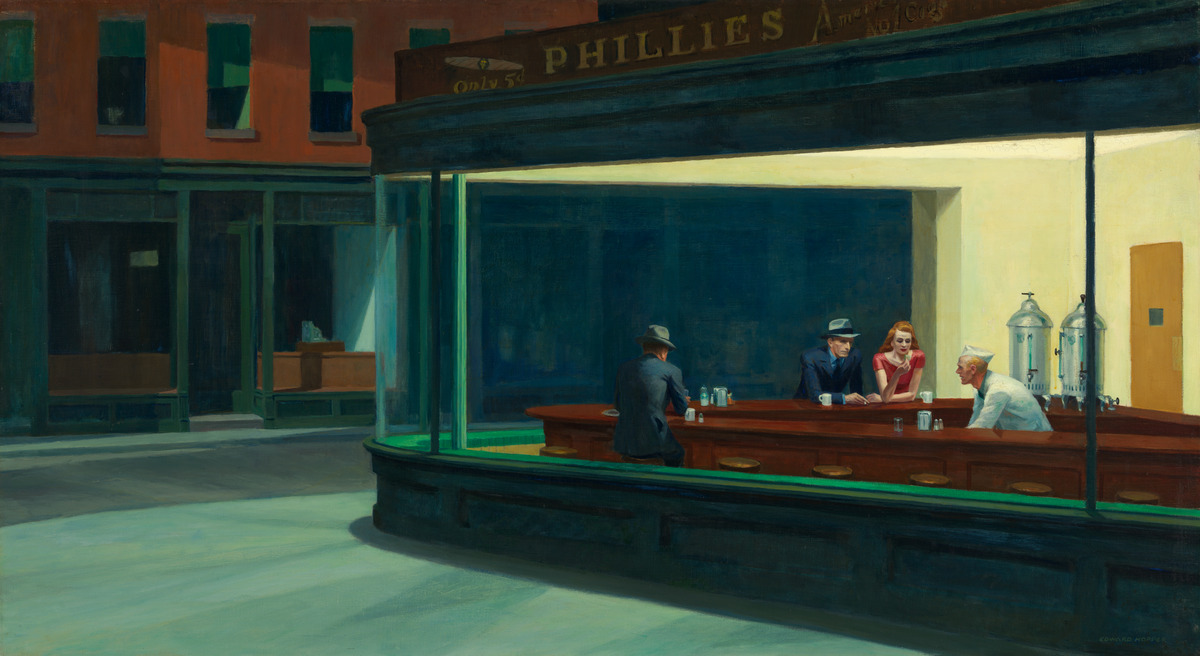
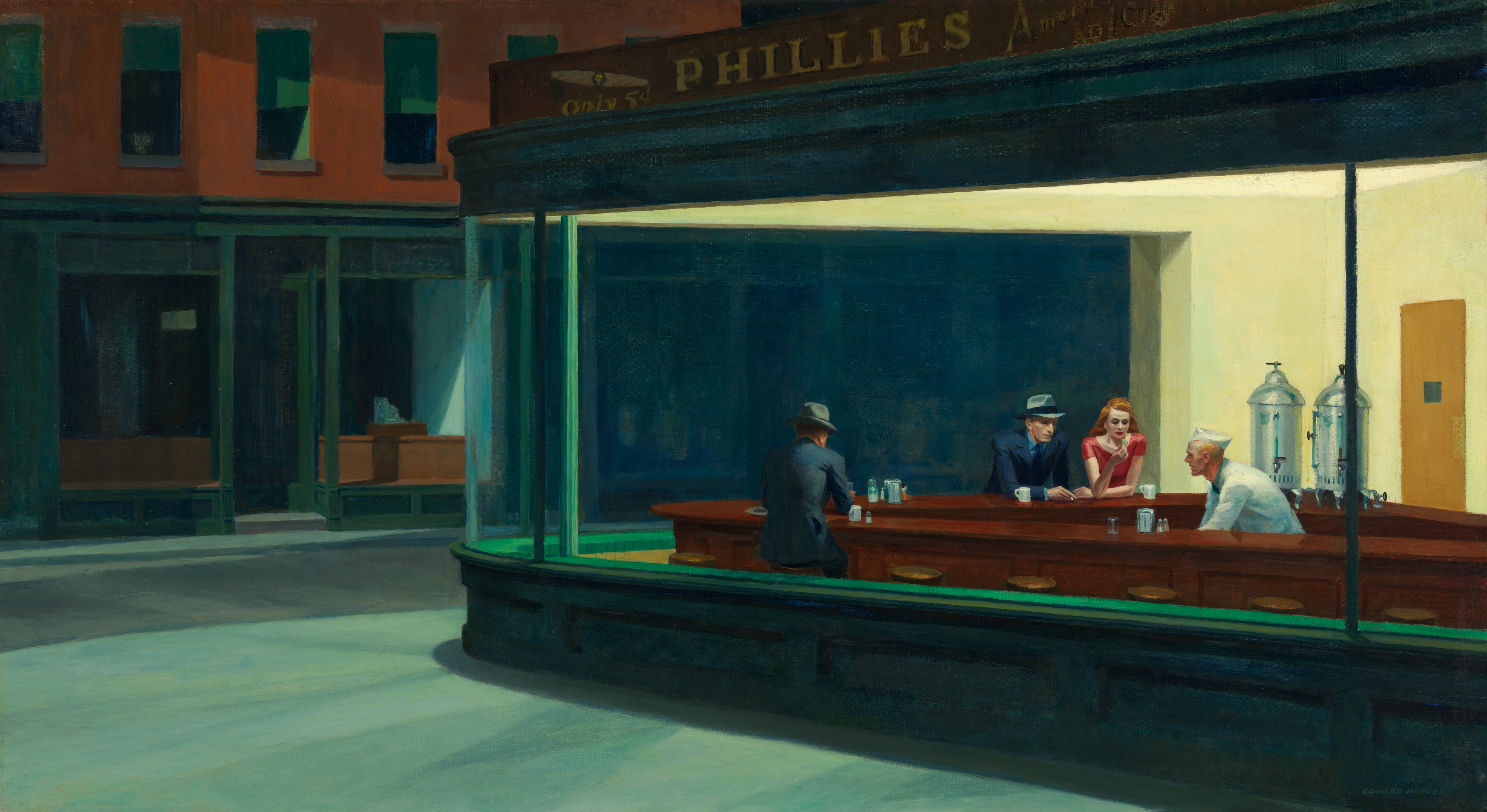
- Four people in a downtown diner late at night, viewed through the diner's large glass window. Three customers sit at the counter opposite a server; the light from the diner illuminates a darkened, deserted urban streetscape.
- Title variants
- Night Hawks
- Accession number
- 1942.51
- Support
- canvas
- Inscriptions
- Signed recto, bottom-right, on wall, in green paint: "EDWARD HOPPER".
Catalogue record
The object is catalogued as Edward Hopper, Nighthawks, 1942, oil on canvas, in the Friends of American Art Collection of the Art Institute of Chicago, reference number 1942.51. The medium is confirmed by the object record, which also notes the inscription: signed recto, bottom-right, on wall, in green paint, EDWARD HOPPER. The title carries a recorded variant: Josephine Hopper's notes state that the intended name of the work was actually Night Hawks. The catalogue date of 1942 belongs to the painting's making rather than to its acquisition, and Josephine Hopper's notes place completion on January 21, 1942. The work is classified as part of the American Realism movement, and has been described as Hopper's best-known work and one of the most recognizable paintings in American art.(The Art Institute of Chicago, n.d.)(Wikipedia fallback: Nighthawks (Hopper), n.d.)
The object and its documented particulars
The Art Institute of Chicago records Edward Hopper's Nighthawks as an oil on canvas of 1942, signed recto at the bottom right on the wall in green paint with the artist's name, and held in the Friends of American Art Collection under reference number 1942.51. The museum places it in the Department of Arts of the Americas and on view in Gallery 262. These are the concrete, verifiable particulars of the object: a medium, a date, a signature whose placement and color the institution specifies, an accession number, and a current location within the museum. The work is classified as part of the American Realism movement, a designation that situates it within a broader stylistic category rather than describing its making. Neither the medium nor the stylistic label tells us why the picture looks as it does, and the evidence does not supply an account of Hopper's working method beyond what later notes report. What the record does establish is that the painting entered a public collection almost immediately, which is itself part of its history: a work now described as Hopper's best-known and among the most recognizable in American art began its public life within months of completion.(The Art Institute of Chicago, n.d.)(Wikipedia fallback: Nighthawks (Hopper), n.d.)
Inspiration, location and the limits of documentation
Against that documentary clarity, the question of what the painting depicts and where it came from is deliberately unsettled. The Art Institute states that although the painting was inspired by a restaurant Hopper had seen on Greenwich Avenue in New York, it is not a realistic transcription of an actual place. Hopper's own recollection, as the museum records it, is that the picture was suggested by a restaurant on Greenwich Avenue where two streets meet, and that he simplified the scene a great deal and made the restaurant bigger. The painter and the museum therefore agree on the direction of the relation: a real establishment prompted the image, and the image departs from it. Where the diner stood is a separate and unresolved question. Jeremiah Moss, writing in The New York Times, argued that a spot often linked to the painting cannot be the location, because a gas station occupied that lot from the 1930s to the 1970s, and concluded that the ultimate truth remains bitterly out of reach. A locating claim and a disconfirming land-use record thus stand against each other, and the safest reading is the one the museum already adopts: inspiration is documented, literal location is not, and the diner is best treated as a transformed source rather than a portrait of a site.(The Art Institute of Chicago, n.d.)
The figures themselves have an attributed studio history that comes through Josephine Hopper's notes rather than from the museum's own description, and it should be separated from what the canvas shows. Her notes record that the intended name of the work was actually Night Hawks, that the painting was completed on January 21, 1942, and that Edward posed for the two men in a mirror while she posed for the girl. The date is more precise than the bare year 1942 supplied elsewhere. The posing account is a reported tradition about the studio, not something a viewer can verify by looking; it describes how the figures were studied rather than narrating a scene within the painting. Its value is that it connects the finished composition to a working process in which the artist and his wife served as available bodies, a mundane fact of studio practice that coexists with, and does not explain away, the picture's air of detachment.(The Art Institute of Chicago, n.d.)
An additional suggestion about the painting's sources is literary, and it is offered as a suggestion rather than a fact: Hopper has been linked to Ernest Hemingway's short story The Killers, which he greatly admired, or to the more philosophical A Clean, Well-Lighted Place. Nothing in the evidence proves that either story is the source. The diner, the late hour and the quiet figures keep inviting the comparison, but the connection remains proposed. This is a different kind of claim from the Greenwich Avenue recollection, which Hopper himself is recorded as making; the Hemingway link is a conjecture about affinities, and it should be weighed as such. A proposed literary antecedent may illuminate how viewers have framed the image, but it does not establish the painting's genesis, and the evidence supplies no statement by Hopper adopting either story as an origin.(The Art Institute of Chicago, n.d.)
What the painting shows and what it withholds
What can be seen in the painting, as the Art Institute describes it, is an all-night diner in which three customers sit at the counter opposite a server, each of the seated figures appearing lost in thought and disengaged from one another. The museum also notes that the composition is tightly organized and spare in details: there is no entrance to the establishment and no debris on the streets. These observations describe formal decisions rather than historical facts, and they bear on the context questions only indirectly, but they matter because they explain why the object resists being reduced to a documentary record of a place. A transcription of a real restaurant would need a door; this picture omits one. The same spareness means the historical materials that survive, a consignment, a sale price, a set of notes, are almost everything we have about the circumstances of making, while the image itself withholds narrative incident and local detail.(The Art Institute of Chicago, n.d.)
Interpretation of the painting's mood has an attributed history of its own. Asked about the loneliness and emptiness people saw in the work, Hopper said that he did not see it as particularly lonely, and then added that unconsciously, probably, he was painting the loneliness of a large city. The Art Institute records the same recollection in nearly identical words, and Wikipedia reports the exchange as a response to a query. The statement is a reported tradition rather than a documented intention stated at the time of painting; the qualifiers unconsciously and probably are the artist's own, and they leave the claim at the level of retrospective intuition. The distinction Hopper draws is nonetheless useful: he declines to localize the loneliness in the figures and relocates it in the city as a whole. That is a claim about scale, not a denial that the picture is somber, and it coexists with the museum's separate reading of the image through harmonious geometric forms and the glow of the diner's electric lighting, which together produce what the museum calls a serene, beautiful and enigmatic scene.(The Art Institute of Chicago, n.d.)
Interpretation
The two evidentiary strands, the administrative record of a sale and the informal record of poses and titles, are not in conflict so much as different in kind, and keeping them apart clarifies what can responsibly be said about the painting's making. The consignment, the May 13, 1942 sale and the $3,000 price are transaction facts attested by the museum and repeated by the encyclopedia. The intended title Night Hawks, the completion date of January 21, 1942 and the mirror posing are notes attributed to Josephine Hopper and transmitted at second hand. The Greenwich Avenue recollection sits between these categories, an artist's statement about a source that the museum accepts while denying the picture the status of a realistic transcription. A later account that the painting is Hopper's best-known work, and one of the most recognizable in American art, belongs to reception rather than to creation. Reading these layers together is what allows the object to be understood historically without inflating any single testimony into the whole story.(Wikipedia fallback: Nighthawks (Hopper), n.d.)(The Art Institute of Chicago, n.d.)
Although inspired by a restaurant Hopper had seen on Greenwich Avenue in New York, the painting is not a realistic transcription of an actual place.(The Art Institute of Chicago, n.d.)
Classified as part of the American Realism movement.(Wikipedia fallback: Nighthawks (Hopper), n.d.)
Materials and technique
LinkDocumented Materials and Support
The Art Institute of Chicago records Nighthawks as oil on canvas, signed recto at the bottom right, on the wall, in green paint: "EDWARD HOPPER". These are the material facts established by the object record: a canvas support, an oil medium, and a visible signature in a specified green paint applied to the wall within the painted scene rather than to a blank margin. The record does not describe the ground layer, priming, canvas weave, brush type, palette beyond the green of the signature, varnish, lining, or any conservation treatment, so those aspects remain outside the documented evidence. The signature's placement is itself part of the composition: it sits on the diner's wall, integrated into the depicted interior.(The Art Institute of Chicago, n.d.)
The same official record supplies the institutional framework attached to the material object: Edward Hopper, Nighthawks, 1942, Art Institute of Chicago, Friends of American Art Collection, reference number 1942.51, held in the Department of Arts of the Americas and on view in Gallery 262. It also records the ownership sequence: the artist, New York; consigned to Frank Rehn Galleries in 1942; sold to the Art Institute of Chicago in 1942, on May 13, 1942, for $3,000. This provenance establishes that the painting entered a public collection within months of its making, a documented fact about its early circulation rather than an inference from its later fame.(The Art Institute of Chicago, n.d.)
Attributed Accounts of Conception
Visual observation
On the question of subject matter, the record states that although the painting was inspired by a restaurant Hopper had seen on Greenwich Avenue in New York, it is not a realistic transcription of an actual place. The museum also records Hopper's own recollection: "unconsciously, probably, I was painting the loneliness of a large city." This is a statement attributed to the artist and preserved by the museum, offered as his recollection rather than as a description of method. It bears on how the painting's making has been framed by the artist himself, while the record simultaneously establishes that the image should not be read as a literal transcription of a specific site.(The Art Institute of Chicago, n.d.)
Documented Materials and Support
The record documents a substantial exhibition history for the painting: the Art Institute of Chicago's Fifty-third Annual Exhibition of American Paintings and Sculpture in 1942, the Whitney Museum of American Art in 1950, 1964, 1980, 2006, and 2013, the Venice Biennale in 1952, and Tate Modern in 2004. These dates and venues are documented facts of institutional display, and they are separate from any claim about the work's materials. They establish that the canvas has traveled and been shown repeatedly across seven decades, a record that also bears indirectly on the object's condition history even though no treatment or examination is recorded.(The Art Institute of Chicago, n.d.)
Attributed Accounts of Conception
Interpretation
A conservative separation is warranted between what the canvas shows and what the object record documents. The record establishes support, medium, signature, date, collection, provenance, price, and exhibition history. The visual observations establish what is depicted and how the composition is organized. The museum's attributions, such as the reading of the scene as serene, beautiful, and enigmatic, are interpretive characterizations offered by the institution. Keeping these categories distinct prevents visual inference from being promoted into technical documentation, and it prevents the artist's remembered intention from being treated as a description of how the paint was actually applied.(The Art Institute of Chicago, n.d.)
Provenance and ownership
LinkDocumented Chain of Ownership
The documented line of ownership begins with the artist. Edward Hopper, working in New York, retained Nighthawks until 1942, the year of its completion, when he consigned it to Frank Rehn Galleries. The Art Institute of Chicago records the sequence as: the artist, New York; consigned to Frank Rehn Galleries, 1942; sold to the Art Institute of Chicago, 1942. Both the museum record and the fallback account agree on the sale date of May 13, 1942, and on the price of $3,000, and the fallback source adds the conversion equivalent to $59,110 in 2025. The phrase within months of its completion, used in the fallback account, places the sale close to the painting's finishing; Josephine Hopper's notes, reported separately, give that completion date as January 21, 1942, which would put the transaction roughly four months later.(The Art Institute of Chicago, n.d.)(Wikipedia fallback: Nighthawks (Hopper), n.d.)
The accession identifier for the work is 1942.51, and the museum records it in the Friends of American Art Collection, held in the Department of Arts of the Americas and on view in Gallery 262. The object is oil on canvas, signed recto, bottom-right, on the wall, in green paint, with the inscription EDWARD HOPPER. These are the material and registration facts that anchor the sale: a purchase made in the same year as the accession number, within a named donor collection, and the painting remains in that public institution.(The Art Institute of Chicago, n.d.)(Wikipedia fallback: Nighthawks (Hopper), n.d.)
The provenance statement runs in one continuous line from the artist to the dealer to the museum, with no intermediate private owner, auction, or estate recorded in the supplied evidence. There is therefore no unrecorded interval to distinguish from a proven change of ownership: the interval between Hopper's completion of the work and the May 13, 1942 sale is covered by the consignment to Frank Rehn Galleries, and no gap in the documented chain is asserted. Where the sources differ is only in detail and format, not in substance: one account gives the chain as a bare sequence, the other adds the date and the inflation equivalent, and neither introduces a competing owner.(The Art Institute of Chicago, n.d.)(Wikipedia fallback: Nighthawks (Hopper), n.d.)
The making of the painting, as distinct from its ownership, is documented in Josephine Hopper's notes. Those notes state that the intended name of the work was actually Night Hawks rather than the form now used, that the painting was completed on January 21, 1942, that Edward posed for the two men in a mirror, and that she posed for the girl. These are reported details about the studio rather than observation of the canvas, and they are attached to the work's early history rather than to any later transfer. The completion date is the only firm date the notes supply for the making; it precedes the May 13 sale and gives that sale its chronology.(The Art Institute of Chicago, n.d.)(Wikipedia fallback: Nighthawks (Hopper), n.d.)
Origin Accounts and Their Limits
The evidence distinguishes what is documented about the object's origin from what is proposed about it. The museum states that although the painting was inspired by a restaurant Hopper had seen on Greenwich Avenue in New York, it is not a realistic transcription of an actual place, and Hopper himself said the picture was suggested by a restaurant on Greenwich Avenue where two streets meet and that he simplified the scene a great deal and made the restaurant bigger. Where exactly that diner stood is disputed: the writer Jeremiah Moss argued in The New York Times that a spot often linked to the painting cannot be the location, because a gas station occupied that lot from the 1930s to the 1970s, and Moss concluded that the ultimate truth remains bitterly out of reach. The literary suggestion that Hopper was inspired by Ernest Hemingway's The Killers, which he greatly admired, or by the more philosophical A Clean, Well-Lighted Place, is likewise stated as a suggestion rather than a fact. None of these origin questions alters the documented ownership sequence, which runs cleanly from artist to gallery to museum.(The Art Institute of Chicago, n.d.)(Wikipedia fallback: Nighthawks (Hopper), n.d.)
Provenance timeline
- 1942
The artist, New York, consigned the painting to Frank Rehn Galleries, and it was sold to the Art Institute of Chicago within the same year.(The Art Institute of Chicago, n.d.)(Wikipedia fallback: Nighthawks (Hopper), n.d.)
- May 13, 1942
The painting was sold to the Art Institute of Chicago for $3,000.(The Art Institute of Chicago, n.d.)(Wikipedia fallback: Nighthawks (Hopper), n.d.)
- 1942
The painting was included in the Art Institute of Chicago's Fifty-third Annual Exhibition of American Paintings and Sculpture.(The Art Institute of Chicago, n.d.)
- 1950
The painting was exhibited at the Whitney Museum of American Art.(The Art Institute of Chicago, n.d.)
- 1952
The painting was exhibited at the Venice Biennale.(The Art Institute of Chicago, n.d.)
- 1964
The painting was exhibited at the Whitney Museum of American Art.(The Art Institute of Chicago, n.d.)
- 1980
The painting was exhibited at the Whitney Museum of American Art.(The Art Institute of Chicago, n.d.)
- 2004
The painting was exhibited at Tate Modern.(The Art Institute of Chicago, n.d.)
- 2006
The painting was exhibited at the Whitney Museum of American Art.(The Art Institute of Chicago, n.d.)
- 2013
The painting was exhibited at the Whitney Museum of American Art.(The Art Institute of Chicago, n.d.)
Exhibition History and Current Display
The exhibition history of Edward Hopper's Nighthawks is unusually long and geographically broad for a painting that entered a public collection within months of its completion. The Art Institute of Chicago records that the work has been widely exhibited, beginning with the museum's own Fifty-third Annual Exhibition of American Paintings and Sculpture in 1942, the year of its completion and acquisition, and continuing through appearances at the Whitney Museum of American Art in 1950, 1964, 1980, 2006 and 2013, the Venice Biennale in 1952, and Tate Modern in 2004. The breadth of this list is significant in itself: the painting circulated both within the annual exhibition culture of its home institution and through recurring survey presentations at the Whitney, which together sustained its visibility across more than six decades, while the Venice Biennale and Tate Modern placements carried it into international and European contexts. The same source supplies its present status, noting that the work belongs to the Art Institute of Chicago, Department of Arts of the Americas, reference number 1942.51, Friends of American Art Collection, and is on view in Gallery 262, so that exhibition history and current display can be distinguished: the painting is not only a loaned or historically shown object but a permanent collection work on continuous public view.(The Art Institute of Chicago, n.d.)(Wikipedia fallback: Nighthawks (Hopper), n.d.)
Reception and Significance
Interpretation
The painting's standing in American art is documented in the reception evidence. It has been described as Hopper's best-known work and as one of the most recognizable paintings in American art, and within months of its completion it was sold to the Art Institute of Chicago for $3,000; the fallback account gives the equivalent value as $59,110 in 2025. The exhibition record and the reception record reinforce each other: a work that entered a public collection almost immediately, at a price recorded in the provenance, went on to be shown at the Art Institute, repeatedly at the Whitney, at the Venice Biennale and at Tate Modern, and is now on view in Gallery 262. That combination of early acquisition, sustained exhibition and wide recognition is what gives Nighthawks its unusual position within a history of American art and material culture, where a single canvas of a late-night diner became one of the most widely circulated images of the country's painting.(The Art Institute of Chicago, n.d.)(Wikipedia fallback: Nighthawks (Hopper), n.d.)
Nighthawks has been widely exhibited, including at the Art Institute of Chicago's Fifty-third Annual Exhibition of American Paintings and Sculpture (1942), the Whitney Museum of American Art (1950, 1964, 1980, 2006, 2013), the Venice Biennale (1952), and Tate Modern (2004).(The Art Institute of Chicago, n.d.)
Reception and literature
LinkEarly Acquisition and Public Standing
The painting now called Nighthawks entered institutional reception with unusual speed. It was sold on May 13, 1942, for $3,000, consigned through Frank Rehn Galleries to the Art Institute of Chicago, within months of its completion. The sale price is reported in the object record and separately glossed as equivalent to $59,110 in 2025. Acquisition so soon after completion, and by a museum rather than a private buyer, placed the work almost immediately in a public frame of reference rather than leaving it within the artist's own circle. The purchase established the institutional custody that would later underwrite both its exhibition history and its status as a reference point in American art.(Wikipedia fallback: Nighthawks (Hopper), n.d.)(The Art Institute of Chicago, n.d.)
That standing is itself part of the documented reception. The painting has been described as Hopper's best-known work and as one of the most recognizable paintings in American art. This is a claim about reputation, not about the canvas, and it is the kind of statement that accumulates through reproduction, exhibition and citation rather than being fixed at the moment of sale. The early museum acquisition and the later descriptive status therefore reinforce one another: the purchase gave the work a stable institutional home, and repeated display and commentary converted that home into wide familiarity. The evidence does not date the moment this reputation attached, only that it is an attributed characterization of the work's place in American art.(Wikipedia fallback: Nighthawks (Hopper), n.d.)
The Artist's Own Words and Their Afterlife
Reported tradition
The most widely repeated account of the painting's meaning comes from Hopper himself, and it is worth preserving its exact shape. Asked about the loneliness and emptiness readers found in the picture, Hopper said he did not see it as particularly lonely, then added that unconsciously, probably, he was painting the loneliness of a large city. The two statements are not simply contradictory. The first resists reading private sadness into the seated figures; the second relocates the affect to the scale of the city rather than to any individual in the scene. This is a reported tradition attributed to the artist, and it has followed the painting ever since as its most quoted interpretive frame. The quotation functions as reception history in its own right, because it was offered in response to how viewers were already reading the work.(Wikipedia fallback: Nighthawks (Hopper), n.d.)
Layered Meanings and the Limits of the Record
Interpretation
Taken together, the evidence shows reception accumulating in distinguishable layers rather than resolving into a single meaning. There is the institutional layer of early acquisition and repeated exhibition; the classificatory layer of American Realism; the artist's own qualified language about loneliness at the scale of a city; the family testimony about title, completion date and posing; the disputed question of the originating site; and the suggested but unproven literary debts. These layers do not replace one another. The painting's original function as a composed, invented scene and its later cultural role as a widely recognized emblem of urban night are separate historical facts that the record allows us to keep apart while describing how they became entangled.(Wikipedia fallback: Nighthawks (Hopper), n.d.)(The Art Institute of Chicago, n.d.)
Interpretations and debates
LinkThe Museum's Reading of Form and Light
Interpretation
The Art Institute of Chicago reads the painting through its harmonious geometric forms and the glow of the diner's electric lighting, arguing that together these produce a scene the museum calls serene, beautiful and enigmatic. This is an attributed curatorial reading rather than a claim about Hopper's stated aims, and it rests on features the museum itself describes: three customers seated at the counter opposite a server, each appearing lost in thought and disengaged from one another. The museum's own account of the composition adds that it is tightly organized and spare in details, with no entrance to the establishment and no debris on the streets. The missing entrance and the emptied street are therefore not incidental omissions but part of the formal structure through which the institution's interpretation is built, since the brightest area of the canvas becomes something visible from outside yet not easily entered.(The Art Institute of Chicago, n.d.)
The Artist's Own Account
Reported tradition
Hopper's own much-quoted recollection, recorded by the Art Institute, complicates any simple equation of the picture with private sadness: "unconsciously, probably, I was painting the loneliness of a large city." The same institution elsewhere reports that when Hopper was asked about loneliness and emptiness in the painting he said he "didn't see it as particularly lonely," before adding the sentence about the large city. Read together, these two statements distinguish a loneliness located in the urban scene at large from loneliness as a subject the figures consciously enact. The qualification "unconsciously, probably" belongs to the artist's own retrospective phrasing and should not be hardened into a documented programme. What the evidence supports is a discrepancy between the artist's refusal of a lonely reading and his concession that the city's loneliness was nonetheless what he was painting.(The Art Institute of Chicago, n.d.)(Wikipedia fallback: Nighthawks (Hopper), n.d.)
Reception, Market, and the Limits of Synthesis
Interpretation
The painting's standing and its early market history are both documented. It has been described as Hopper's best-known work and as one of the most recognizable paintings in American art, and it entered a public collection within months of completion: the Wikipedia fallback states it was sold to the Art Institute of Chicago on May 13, 1942, for $3,000, an amount it equates to $59,110 in 2025. The museum's reading and the artist's remarks converge on the same structural fact the museum describes, that four people share a lit room while the window keeps them visible and the street keeps them apart. The evidential limits of further synthesis lie here: the formal reading, the artist's recollection, the studio reports and the literary suggestions are of different kinds, and none of them licenses a claim about Hopper's private intent beyond what he himself volunteered.(Wikipedia fallback: Nighthawks (Hopper), n.d.)(The Art Institute of Chicago, n.d.)
Reported traditions and disputed accounts
Reported tradition
The accounts that cluster around Edward Hopper's Nighthawks are of several different kinds, and they carry different evidentiary weight. One is a literary proposal, offered as a suggestion rather than a finding: it has been suggested that Hopper was inspired by a short story of Ernest Hemingway's, either "The Killers" (1927), which Hopper greatly admired, or the more philosophical "A Clean, Well-Lighted Place" (1933). Nothing in the supplied record documents Hopper himself naming either story as a source. The suggestion rests on affinity, on the diner setting and the late hour, and Hopper's known admiration for "The Killers" is the strongest element within it. It is best treated as a proposed connection that the painting neither requires nor confirms.(Wikipedia fallback: Nighthawks (Hopper), n.d.)
A second and quite different order of account comes from Josephine Hopper's notes on the painting, which are the source for several particulars that the canvas itself cannot yield. Her notes record that the intended name of the work was actually Night Hawks, and that the painting was completed on January 21, 1942. She also wrote that Edward posed for the two men in a mirror and that she posed for the girl. These are studio facts transmitted through a named witness rather than through the museum's description of the finished object, and they should be read as an account of how the figures were studied. They do not describe a scene depicted in the painting; they describe the making of it, and the date they supply gives the work a precise place in Hopper's activity at the start of 1942.(Wikipedia fallback: Nighthawks (Hopper), n.d.)
Disputed account
A third account concerns the diner itself, and it is explicitly disputed. Hopper said the painting "was suggested by a restaurant on Greenwich Avenue where two streets meet," and that he "simplified the scene a great deal and made the restaurant bigger." Those two statements, in his own words, already separate the painting from any single real interior: the scene was simplified and the restaurant enlarged, so the canvas is not a transcription. The problem lies in fixing the site. According to an article by Jeremiah Moss in The New York Times, the spot often associated with the former location cannot be the location, because a gas station occupied that lot from the 1930s to the 1970s. Moss concluded, "the ultimate truth remains bitterly out of reach." The disagreement is therefore not about whether Hopper worked from a remembered restaurant on Greenwich Avenue, which he asserted, but about whether a specific lot can be identified with it. The gas station occupancy is a documented obstacle to the popular identification, and it leaves Hopper's own attribution of the setting in place while removing the confident pinpoint that has been attached to it.(Wikipedia fallback: Nighthawks (Hopper), n.d.)
Interpretation
Read together, these three strands show how the painting's reputation has accumulated layers that the object does not itself adjudicate. A literary source remains a suggestion; a set of studio particulars rests on Josephine Hopper's notes and supplies the intended title Night Hawks, the completion date of January 21, 1942, and the posing of the two men by Edward in a mirror and of the girl by Josephine; and the location of the originating diner remains contested because the lot commonly proposed was occupied by a gas station from the 1930s to the 1970s. The painting's later standing, as Hopper's best-known work and one of the most recognizable paintings in American art, gives these unresolved questions their cultural weight, since a work of that visibility attracts identification and origin stories faster than it can settle them. Keeping the three accounts distinct, and keeping each attached to the witness who supplied it, is what allows the object to remain the primary document.(Wikipedia fallback: Nighthawks (Hopper), n.d.)
Reported tradition
It has been suggested that Hopper was inspired by a short story of Ernest Hemingway's, either "The Killers" (1927), which Hopper greatly admired, or the more philosophical "A Clean, Well-Lighted Place" (1933).(Wikipedia fallback: Nighthawks (Hopper), n.d.)
In response to a query on loneliness and emptiness in the painting, Hopper said that he "didn't see it as particularly lonely". He said: "Unconsciously, probably, I was painting the loneliness of a large city."(Wikipedia fallback: Nighthawks (Hopper), n.d.)
Josephine Hopper's notes on the painting give details including that the intended name of the work was actually Night Hawks and that the painting was completed on January 21, 1942. Jo Hopper wrote that Edward posed for the two men in a mirror and she for the girl.(Wikipedia fallback: Nighthawks (Hopper), n.d.)
Disputed account
The precise location of the diner that inspired the painting is disputed. Hopper said the painting "was suggested by a restaurant on Greenwich Avenue where two streets meet," and that he "simplified the scene a great deal and made the restaurant bigger." According to an article by Jeremiah Moss in The New York Times, the spot often associated with the former location cannot be the location because a gas station occupied that lot from the 1930s to the 1970s. Moss concluded, "the ultimate truth remains bitterly out of reach."(Wikipedia fallback: Nighthawks (Hopper), n.d.)
Collection and display
LinkObject and institutional record
Nighthawks is in the collection of the Art Institute of Chicago, Department of Arts of the Americas, on view in Gallery 262. The museum records the work as Edward Hopper, Nighthawks, 1942, oil on canvas, in the Friends of American Art Collection, reference number 1942.51. The canvas is signed recto, bottom-right, on the wall, in green paint: "EDWARD HOPPER". The institutional history records the artist in New York; consignment to Frank Rehn Galleries in 1942; and sale to the Art Institute of Chicago in 1942, sold on May 13, 1942, for $3,000. This provenance interval establishes that the painting moved from the artist's studio through a commercial gallery into a public museum within months of completion, a sequence that shapes how the work can be studied today: it is documented as an American painting held by a museum that assigns it to the Department of Arts of the Americas.(The Art Institute of Chicago, n.d.)
The museum's description identifies an all-night diner with three customers seated at the counter opposite a server, each appearing lost in thought and disengaged from one another. The composition is described as tightly organized and spare in details: there is no entrance to the establishment and no debris on the streets. Through harmonious geometric forms and the glow of the diner's electric lighting, Hopper is said to have created a serene, beautiful, yet enigmatic scene. The official object record notes that the painting was inspired by a restaurant Hopper had seen on Greenwich Avenue in New York, but states that it is not a realistic transcription of an actual place. Hopper himself recollected, "unconsciously, probably, I was painting the loneliness of a large city." The museum also records that Nighthawks has been widely exhibited, including at the Art Institute of Chicago's Fifty-third Annual Exhibition of American Paintings and Sculpture in 1942, the Whitney Museum of American Art in 1950, 1964, 1980, 2006 and 2013, the Venice Biennale in 1952, and Tate Modern in 2004. The exhibition list and the collection data together show a work that entered public view immediately and has remained in recurring museum and international exhibition circulation.(The Art Institute of Chicago, n.d.)