ArchivePortland Vase

Artwork record / 216 of 331

Portland Vase by Maker unknown (between 5 and 25 AD)

Artist: Maker unknown

A Roman cameo glass amphora carved with white figures in relief. The British Museum associates the scene with Eros and tentatively with Peleus and Thetis, and records an interpretation of it as a marine or wedding subject. The maker is unknown.

Read the story ↓ About the artist ↓ Research and record ↓ Literature and sources ↓ Listen to the article ↓
Article text for AI
Shop this artwork ↓ 0 visits
Datebetween 5 and 25 ADCultureRoman PeriodRoman, early ImperialCurrent locationBritish Museum, London, United Kingdom
Listen to the article
100%
Portland Vase by Maker unknown (between 5 and 25 AD)
Loading full-resolution artwork…
Scroll to zoom · drag to pan · double-click to focus Pinch to zoom · drag to explore · double-tap to focus FIELD VIEW / 216
Tools & download
Pixel colour Select a pixel with the eyedropper
No pixel selected

Choose the eyedropper, then click or tap the image. Scroll to zoom for finer selection.

Add text

Hand to pan · Select to move text and drawings · Add as many texts as you like · Scroll to zoom

Portland Vase: high-resolution image

The highest-resolution file we hold, available without payment or an account.3,020 × 2,718 pixels.

Download highest-resolution image

Details to notice

About 3 minutes to read
01

Column and architrave

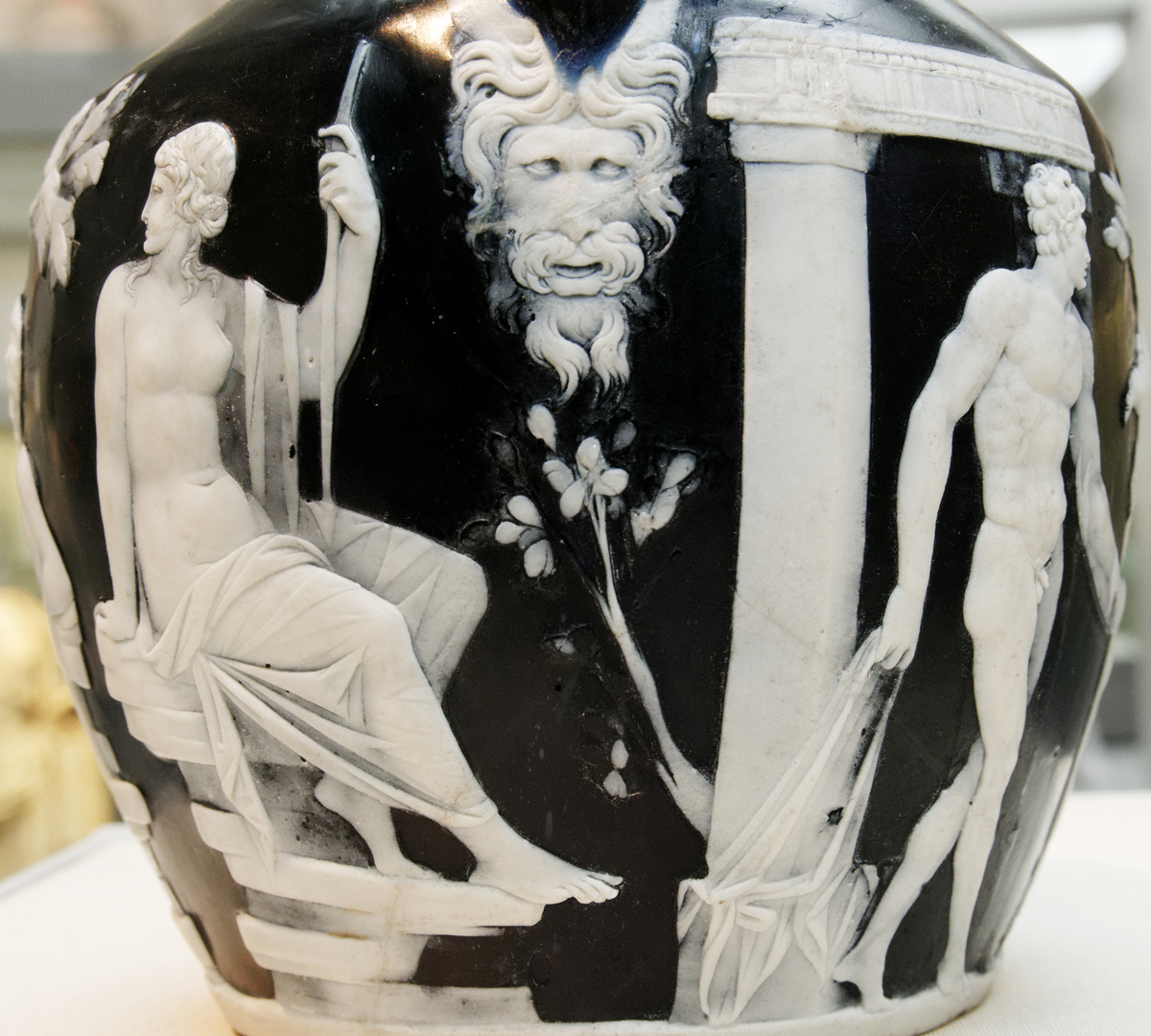
Fluted white column with a molded architrave block above, forming the architectural setting between the plant and the standing youth; shows the varied carving depth of the white overlay.

02

Flowering plant between figures

Slender stalk with white leaves and buds rising between the mask and the column; a symbolic vegetal element that links the figures and is carved in delicate shallow relief.

03

Standing nude youth with spear

Nude male figure in white relief striding toward the right with a spear or staff and knotted cloth at his hip; the carved musculature shows the cameo relief technique at full depth.

Portrait unrecorded

About the makers

Maker unknown

Individual life dates unrecorded

Biographical details and a verified portrait have not yet been recorded for this attribution.

The research & record

Study the work.
Follow the evidence.

Find catalogue details, historical context, technical research and the literature behind this artwork.

Article text for AI
Open research text

The artwork record

Research catalogue

Catalogue information and detailed research, with references that link to the bibliography.

Updated .

Identity and catalogue

Link
Title
Portland Vase(The British Museum, n.d.)
Artist or attribution
Maker unknown
Object date
between 5 and 25 AD(Marie-Lan Nguyen, 2011)
Medium and support
Cameo glass: translucent dark cobalt blue glass with opaque white overlay(The British Museum, n.d.)
Dimensions
H. 24 cm (9 1/4 in.), Diam. 17.7 cm (6 3/4 in.)
Current collection or location
British Museum, London, United Kingdom(The British Museum, n.d.)
Movement or period
Roman, early Imperial
Country or culture
Roman
Depicted subject
An amphora in cameo glass, carved with white figures in relief. The surviving side shows a seated woman and a standing figure; the museum records figures including Eros, and tentatively Peleus and Thetis, while noting the vase's use as a marriage or mythological scene. The vase was said to be from Rome and was reportedly found at Monte del Grano.(The British Museum, n.d.)
Attribution qualification
Maker unknown; the sources do not name a maker or workshop.
Accession number
1945,0927.1
Catalogue identity and registration

The object catalogued as the Portland Vase is an amphora: a closed vessel, worked in cameo glass, and titled by that name in the museum record. The record places it in the British Museum under the registration number 1945,0927.1, and it is on display there in Room 70, Roman Empire. Its separate disc base, registered as 1945.9-27.2, is treated as a distinct entry within the same museum documentation, so base and body carry different registration numbers even though they belong to one object history. A further registration, 1948.10-18.1, was assigned to approximately forty small fragments, most of which were incorporated during the most recent restoration, which means the physical vessel now present is partly the product of an intervention documented under its own number rather than under the main registration alone.(The British Museum, n.d., Object Type; Description)

The vase is dated between 5 and 25 AD. This date belongs to the object, not to any catalogue or publication record: the museum collection record and the institutional-style description of the file differ in other respects, but the Roman date range is stated as the period of the vase itself. The modern documentation that fixes this range is later than the object by roughly two millennia, and the acquisition events recorded in it are later still, so the date of manufacture must be kept separate from the dates of registration, deposit and purchase that structure the surviving paperwork.(Marie-Lan Nguyen, 2011, Date)

Material, form and technique

The material character of the vase is inseparable from its technique. It is cameo glass, made with translucent dark cobalt blue and opaque white glass: a white layer sits over the blue, and the white has been cut back so that figures and ornaments stand in relief against the darker ground. The vase has a cylindrical neck that widens to a sloping shoulder and an ovoid body, and its squat proportions are emphasized by the absence of a foot. The everted mouth has a rounded rim cut unevenly on the upper side so that it is not horizontal, and the neck curves smoothly to the carination of the shoulder; handles run from the centre of the neck to the shoulder. These are descriptive facts about form and cutting, and they establish how the vessel was built and finished before any question of its imagery arises.(The British Museum, n.d., Object Type)

The vase is broken and mended, its bottom is missing, and the underside has been roughly trimmed with the edge left grozed, perhaps in antiquity. Slight iridescence appears in patches all over the inside of the vessel, with slight pitting on the exterior and red streaks and bubbles within the blue glass. The inside of the vessel is ground all over, a treatment probably achieved by a filling of grit. The white design itself may have been reworked after the vase was rediscovered. These observations qualify any reading of the carving: what survives is a repaired body whose interior finish, surface condition and relief may all reflect later treatment as well as Roman manufacture, and the evidence marks the grozing and the reworking with the uncertainty they deserve rather than presenting them as settled fact.(The British Museum, n.d., Object Type)

The figured scene as described

The imagery on the surviving side is described in detail. Above a plant stands a large white relief head with wild, flowing hair, moustache and beard, its eyes carved with drilled pupils and its face presented as a full frontal mask. To one side a semi-nude woman in profile is seated on a bench, drapery over her lap, holding a long vertical staff or spear. A slender stalk with white leaves and buds rises between the mask and the column, carved in delicate shallow relief, and a fluted white column with a moulded architrave block above it forms an architectural setting between the plant and the standing youth. These are the elements that any interpretation has to account for, and they are physical features of the cut glass rather than claims about meaning.(The British Museum, n.d., Object Type)

Competing readings of the subject

Interpretations of the scene diverge, and the evidence preserves that divergence rather than resolving it. The museum record associates the representation with Eros, or Cupid, and tentatively with Peleus and Thetis. A separate description reads the scene as a marine or wedding subject, in which the bearded sea god mask acts as a mythological key: on that reading the seated woman with her staff and the standing youth become participants in a marine or wedding narrative rather than a random pair. The two readings are related, and both remain attributed interpretations, one of them explicitly tentative in the museum record. The vase itself does not settle the question, so the bearded mask can be described as the element that determines how the surrounding figures are understood without being promoted into a documented identification.(The British Museum, n.d., Object Type)

The vase in the literature and in material culture

Interpretation

Positioned within a larger history of art and material culture, the vase is at once a documented object and an unresolved subject. It is cited in or referenced by major glass and art publications, including Harden et al. 1968, Harden 1987, Tait 1991, Whitehouse 2012, and Roberts et al. 2010; Roberts et al. 2010, Roman Cameo Glass in the British Museum (1), is a source for it. That body of reference gives the vase a place in the study of Roman cameo glass that outlasts any single reading of its figures. The documentary record accordingly holds together a Roman date range of 5 to 25 AD, a cameo technique in blue and white glass, a broken and partly reworked body, an acquisition that ran from a loan in 1810 to a purchase in 1945, and a scene that remains a matter of attributed interpretation. The value of the object for research lies in that combination: a technically specific vessel whose condition, provenance and iconography each carry their own level of certainty, and which can be weighed as evidence for Roman luxury glass without converting scholarly proposals about its subject into established fact.(The British Museum, n.d., Object Type)(Marie-Lan Nguyen, 2011, Date)

The object is an amphora, a closed vessel and a cameo glass work, titled the Portland Vase.(The British Museum, n.d.)

The vase is dated between 5 and 25 AD.(Marie-Lan Nguyen, 2011)

The disc base of the vase, registered as 1945.9-27.2, is discussed separately in the museum record.(The British Museum, n.d.)

Subject and iconography

Link
Form and material

Visual observation

The vase is a cameo glass work in which an opaque white layer was cut back to leave figures and ornaments standing in relief over translucent dark cobalt blue glass. Its shape is unusual for an amphora. A cylindrical neck widens to a sloping shoulder and an ovoid body, and the vessel reads as squat above all because it has no foot. The mouth is everted, with a rounded rim that has been cut unevenly on the upper side so that it is not horizontal, and the neck curves smoothly down to the carination of the shoulder. Handles run from the centre of the neck to the shoulder. These formal features belong to the object as it now survives, and they establish a silhouette that is as much a part of the visual evidence as the figural decoration cut into the body. The inside of the vessel is ground all over, a treatment probably achieved by a filling of grit, so the interior surface carries its own evidence of manufacture and finishing.(The British Museum, n.d., Description)

The carved scene

On the surviving side, the figural composition is built from several distinguishable elements. A large white relief head with wild, flowing hair, moustache and beard is set above the plant. Its eyes are carved with drilled pupils, and the face is rendered as a full frontal mask. A semi-nude woman appears in profile, seated on a bench, with drapery over her lap, holding a long vertical staff or spear. Between the mask and the column rises a slender stalk with white leaves and buds, carved in delicate shallow relief. A fluted white column with a moulded architrave block above it forms an architectural setting between the plant and the standing youth. The head, the seated woman, the plant, the column and the youth therefore occupy distinct zones of the design, and the shallow relief of the stalk contrasts with the fuller projection of the mask. The evidence describes what is carved and where it sits, and it distinguishes the frontal mask from the profile figure rather than fusing them into a single description.(Marie-Lan Nguyen, 2011, Description)

Competing identifications

Interpretation

The subject is not fully agreed. The museum record associates the representation with Eros, or Cupid, and tentatively with Peleus and Thetis, so the identification is attributed to the institution and remains qualified by its own wording. A separate institutional-style description reads the scene as a marine or wedding subject, with the bearded sea god mask acting as a mythological key. In that second reading the mask is not merely decorative space-filling but the element that establishes the mythological setting, and the seated woman with her staff and the standing youth become participants in that story. The two readings are related rather than mutually exclusive in the evidence: one names Eros or Cupid and tentatively Peleus and Thetis, the other frames the scene as marine or wedding imagery keyed by the bearded face. The object's carving does not by itself settle which reading should prevail, and the museum record keeps its own naming tentative.(Marie-Lan Nguyen, 2011, Description)

Visual observation

The vase has a cylindrical neck that widens to a sloping shoulder and an ovoid body, with the squatness emphasized by the lack of a foot.(The British Museum, n.d.)

The everted mouth has a rounded rim cut unevenly on the upper side so that it is not horizontal, and the neck curves smoothly to the carination of the shoulder.(The British Museum, n.d.)

The vase has handles from the centre of the neck to the shoulder.(The British Museum, n.d.)

A large white relief head with wild, flowing hair, moustache and beard is set above the plant, with eyes carved with drilled pupils and a full frontal mask.(Marie-Lan Nguyen, 2011)

A semi-nude woman in profile is seated on a bench, drapery over her lap, holding a long vertical staff or spear.(Marie-Lan Nguyen, 2011)

A slender stalk with white leaves and buds rises between the mask and the column, carved in delicate shallow relief.(Marie-Lan Nguyen, 2011)

A fluted white column with a moulded architrave block above forms an architectural setting between the plant and the standing youth.(Marie-Lan Nguyen, 2011)

Materials and technique

Link
Materials and construction of the cameo glass body

The Portland Vase is a cameo glass vessel, an amphora in the British Museum with the registration number 1945,0927.1, and its body is formed from two layers of glass of contrasting character: a translucent dark cobalt blue ground covered by an opaque white layer. The white layer has been cut back so that figures and ornaments remain standing in relief against the blue beneath, which is the basic mechanism of cameo glass working. Because the vessel is a closed form rather than an open bowl, the shaping of its body and the cutting of its relief decoration were interdependent operations on the same object. Published references the museum record cites for the vase, including Harden et al. 1968, Harden 1987, Tait 1991, Whitehouse 2012 and Roberts et al. 2010, place it within the broader study of Roman cameo glass, and Robert et al. 2010, Roman Cameo Glass in the British Museum (1), is named among the sources for it.(The British Museum, n.d., Description)

Working the interior and the underside

The interior of the vessel was ground all over, an operation the museum record attributes probably to a filling of grit, that is, an abrasive charge used to wear down the inner surface. This treatment of the inside belongs to the making or finishing of the vessel rather than to its decoration, and it is distinct from the cutting of the white relief on the exterior. The base of the object is documented separately: the disc base is registered as 1945.9-27.2 and is discussed in its own right in the museum record. The vase is broken and mended, and its bottom is missing; the underside has been roughly trimmed and its edge left grozed, a treatment the record places perhaps in antiquity. A separate registration number, 1948.10-18.1, was assigned to approximately forty small fragments, most of which were incorporated during the most recent restoration, so that the present body is a composite of surviving glass and later joining.(The British Museum, n.d., Description)

The reworking question

Technical examination

The most consequential technical qualification in the record concerns the white design itself: it may have been reworked after its rediscovery. The evidence states this as a possibility, not as a demonstrated sequence, and the record does not identify which areas were altered, when, or by whom. Read together with the broken and mended body, the missing bottom, the roughly trimmed underside and the roughly forty fragments incorporated in the most recent restoration, this possibility means that the white relief visible today cannot be assumed to be entirely ancient in every passage. The caution is specifically about the white design, the layer in which the carved figures and ornaments stand, so it bears directly on any iconographic or technical reading of the carving.(The British Museum, n.d., Description)

What the surface shows

The examination does not stand alone as a single event. The vase is held by the British Museum under the registration number 1945,0927.1, with its disc base registered separately as 1945.9-27.2, and it is on display in Room 70, Roman Empire. Its documented history includes its deposit on loan in the museum in 1810 and its purchase only in 1945 from William Arthur Henry Cavendish Bentinck, 7th Duke of Portland, with funding from James Rose Vallentin, after previous ownership or collections including Margaret Cavendish Harley, Duchess of Portland, Sir William Hamilton, James Byres and the Barberini Palace in Rome. The vase appears in or is referenced by major glass and art publications, including Harden et al. 1968, Harden 1987, Tait 1991, Whitehouse 2012, Roberts et al. 2010, and Robert et al. 2010, Roman Cameo Glass in the British Museum. These records supply the sequence of custody and documentation against which any proposed examination history, restoration campaign or reworking episode has to be situated.(The British Museum, n.d., Description)

The vase is made of cameo glass, with translucent dark cobalt blue and opaque white glass.(The British Museum, n.d.)

The inside of the vessel is ground all over, probably achieved by a filling of grit.(The British Museum, n.d.)

Technical examination

The white design may have been reworked after its rediscovery.(The British Museum, n.d.)

Condition and conservation

Link
Dated condition observations

The British Museum record for the Portland Vase (registration number 1945,0927.1) is the principal published source for the vessel's condition, and it describes an object that is broken and mended, with the bottom missing. The underside has been roughly trimmed and its edge left grozed, an intervention the record suggests may have taken place in antiquity rather than in any modern workshop. Because the base is lost, the vase survives as a body without a foot, and the museum's own formal description treats the squat proportions of the ovoid body as emphasized by that absence. The condition account therefore cannot be separated from the object's silhouette: what viewers see as a characteristic shape is partly the result of damage and of whatever trimming followed it.(The British Museum, n.d., Description)

Alongside the structural damage, the record notes surface and material features that belong to the glass itself rather than to breakage. Slight iridescence appears in patches all over the inside of the vessel, the exterior shows slight pitting, and the blue glass contains red streaks and bubbles. These are observations of the current state of the glass, not a reconstruction of its ancient appearance, and they interact with the museum's separate account of manufacture: the interior of the vessel is ground all over, probably achieved by a filling of grit. Read together, the interior abrasion and the patchy iridescence describe an inner surface that has been worked and then altered by time, while the exterior pitting and internal bubbles and streaks record the character of the glass itself.(The British Museum, n.d., Description)

The fragments and the most recent restoration

The most consequential conservation fact in the record concerns the fragments. A separate registration number, 1948.10-18.1, was assigned to approximately forty small fragments, most of which were incorporated during the most recent restoration. That number, distinct from the vase's own registration of 1945,0927.1, shows that the museum treated the loose pieces as a separate registered entity before most of them were built back into the vessel. The record does not state a date for that most recent restoration, nor does it name the conservator or the adhesives and fill materials used, so the treatment can be described in its institutional outlines but not reconstructed in technical detail from the supplied evidence.(The British Museum, n.d., Description)

Material context for condition

The technical description of the material provides the frame within which condition observations should be read. The vase is made of cameo glass, with translucent dark cobalt blue and opaque white glass, and the white layer has been cut back so that figures and ornaments stand in relief against the blue ground. The red streaks and bubbles noted in the blue glass, and the iridescence and pitting noted on interior and exterior, are therefore features of a two-layer cameo composition rather than of a homogeneous vessel. Conservation decisions about such an object must reckon with the differing behaviour of the two glasses, though the supplied evidence does not record which materials or methods were chosen for that purpose.(The British Museum, n.d., Description)

Interpreting the condition record

Interpretation

Taken together, the condition evidence supports a layered account of the object rather than a single state. The vase is broken and mended with its bottom missing and its underside trimmed and grozed, perhaps in antiquity; roughly forty fragments were separately registered and mostly incorporated in the most recent restoration; the glass shows internal red streaks and bubbles, interior iridescence in patches, and exterior pitting; and the white design may have been reworked after rediscovery. Each of these statements is qualified in the record by suggestion or by silence about dates and agents. The result is an object whose documented form is partly the product of loss, trimming, reassembly and possible reworking, and whose condition history cannot be reduced to a single moment of damage or a single campaign of repair.(The British Museum, n.d., Description)

A separate registration number, 1948.10-18.1, was assigned to approximately forty small fragments, most of which were incorporated during the most recent restoration.(The British Museum, n.d.)

The vase is broken and mended; the bottom is missing, and the underside has been roughly trimmed and the edge left grozed, perhaps in antiquity.(The British Museum, n.d.)

There is slight iridescence in patches all over the inside of the vessel, slight pitting on the exterior, and red streaks and bubbles in the blue glass.(The British Museum, n.d.)

Provenance and ownership

Link
Reported Origin

The documented history of the vase opens with two different statements about where it came from, and the difference between them matters. The museum record states that the vase was said to be from Rome, a reported rather than demonstrated origin. A separate institutional record places the discovery at Monte del Grano. These are not incompatible in themselves, since Monte del Grano lies in the Roman orbit, but they are not the same claim: one is a tradition about the city, the other names a specific site. Neither statement is presented in the evidence as an excavation report with a date, finder or context, so the findspot remains recorded rather than securely established.(The British Museum, n.d., Acquisition notes)(Marie-Lan Nguyen, 2011, Object history)

Owners and Collections

The named owners and collections form a sequence that runs from Rome through British collections and back into a Roman palace collection before the object reached the museum. The record lists the Barberini Palace in Rome, James Byres, Sir William Hamilton, and Margaret Cavendish Harley, Duchess of Portland. The evidence does not supply dates, modes of transfer or intermediate owners for these names; it establishes that they are associated with the vase as previous owners or collections. Because the Barberini Palace appears alongside Byres and Hamilton, the account preserves a movement between Roman and British ownership rather than a single continuous line. Nothing in the evidence documents how the vase passed between these hands, so each link is a recorded association, not a proven transaction.(The British Museum, n.d., Previous owner)

Loan and Acquisition

The vase entered the museum on loan in 1810, decades before the museum owned it. The record states that it was deposited on loan in the museum in 1810 but was only bought by the museum in 1945. This interval is important to the object's status: for roughly one hundred and thirty-five years it was a borrowed object on public view rather than museum property, and the evidence does not describe any change of ownership during that period. The distinction between custody and ownership is therefore documented at both ends of the interval, but the interior of that interval is unrecorded.(The British Museum, n.d., Acquisition notes)

The purchase took place in 1945, from William Arthur Henry Cavendish Bentinck, 7th Duke of Portland, with funding from James Rose Vallentin. This is the documented transfer that ended the loan period and converted the vase into museum property. The record identifies both the seller and the funding source, which distinguishes the transaction from a simple donation. The 7th Duke of Portland connects the 1945 sale to the Portland line already present among the previous owners, but the evidence does not state how the vase passed from the Duchess of Portland's collection to this later duke, so that inheritance or descent is not documented here.(The British Museum, n.d., Acquisition name)

Owners and Collections

Interpretation

Taken together, the provenance units establish a documented endpoint and a reported beginning without filling the middle. The recorded path runs from a reputed Roman origin, through the Barberini Palace and named British collectors, into a long loan at the museum from 1810, and finally to the 1945 purchase. The evidence does not date the Barberini, Byres or Hamilton ownerships, does not describe the transfers between them, and does not explain the gap between the Duchess of Portland and the 7th Duke. An unrecorded interval is not the same as a proven change of ownership, and the account should keep those separate: the sequence of names is supported, the sequence of events connecting them is not.(The British Museum, n.d., Acquisition notes; Previous owner; Acquisition name)(Marie-Lan Nguyen, 2011, Object history)

The vase was said to be from Rome.(The British Museum, n.d.)

The vase's place of discovery is recorded as Monte del Grano.(Marie-Lan Nguyen, 2011)

Previous owners or collections include Margaret Cavendish Harley, Duchess of Portland; Sir William Hamilton; James Byres; and the Barberini Palace, Rome.(The British Museum, n.d.)

The vase was purchased in 1945 from William Arthur Henry Cavendish Bentinck, 7th Duke of Portland, with funding from James Rose Vallentin.(The British Museum, n.d.)

The vase was deposited on loan in the museum in 1810, but was only bought by the museum in 1945.(The British Museum, n.d.)

Provenance timeline
  1. 1810

    The vase was placed on loan to the museum.(The British Museum, n.d., Acquisition notes)

  2. 1945

    The vase was bought by the museum from William Arthur Henry Cavendish Bentinck, 7th Duke of Portland, with funding from James Rose Vallentin, following its earlier loan.(The British Museum, n.d., Acquisition name; Acquisition notes)

Exhibition history

Link
Display and Publication History

The Portland Vase, registered in the British Museum as 1945,0927.1, is currently on display in Room 70, Roman Empire. That display location is the vase's present institutional home and should be kept distinct from the longer history of where the vessel has been kept and how it entered the collection. The object has been the subject of an extensive publication record, appearing in or referenced by major glass and art publications including Harden et al. 1968, Harden 1987, Tait 1991, Whitehouse 2012, and Roberts et al. 2010, with Robert et al. 2010, Roman Cameo Glass in the British Museum (1), serving as a dedicated source for it. That bibliography shows how consistently the vase has been discussed within the specialist literature on Roman cameo glass, even though the evidence supplied here does not detail any particular exhibition in which the object was shown.(The British Museum, n.d., Location; References)

Subject and Interpretive Disagreement

Interpretation

The vase's iconography has been explained in more than one way, and the differences between the accounts are worth preserving. The museum record associates the representation with Eros, or Cupid, and tentatively with Peleus and Thetis. A separate institutional-style description reads the scene as a marine or wedding subject, with a bearded sea god mask acting as a mythological key. Both readings respond to the same carved elements, but they assign the figures to different mythological frames. The evidence does not settle which reading is correct, and the museum's own association with Peleus and Thetis is explicitly tentative. The subject therefore remains an attributed interpretation rather than a documented fact about the object, and the existence of a marine or wedding alternative shows that the uncertainty is not merely a gap in the record but a live disagreement about how the figures should be identified.(The British Museum, n.d., References; Location)(Marie-Lan Nguyen, 2011, Object history)

The vase is on display in Room 70, Roman Empire, at the British Museum.(The British Museum, n.d.)

Reception and literature

Link
Scholarly Reception and the Literature

The Portland Vase entered modern scholarly literature not as a single event but as a fixture across successive generations of glass and art scholarship. The British Museum record notes that the vase appears in or is referenced by major glass and art publications including Harden et al. 1968, Harden 1987, Tait 1991, Whitehouse 2012, and Roberts et al. 2010. That citation span matters because it shows the object being repeatedly re-examined under changing research priorities in Roman glass studies, from mid twentieth century excavation-based cataloguing through later specialist work on cameo glass technique. A parallel reference in the museum record singles out Roman Cameo Glass in the British Museum of 2010 as a source for the vase. These references establish documented, continuing scholarly reception rather than a moment of discovery, and they give the object a place in the literature that is separate from its original function as a vessel.(The British Museum, n.d., References)

Publication history and museum display are two different kinds of reception, and the Portland Vase has both. The museum record states that the vase is in the British Museum under registration number 1945,0927.1 and that it is on display in Room 70, Roman Empire. The room designation places the object within a narrative of Roman imperial material culture rather than within a history of glass alone, and the registration number ties its current public identity to the 1945 purchase. The earlier loan of 1810, recorded separately, means the object was visible in the museum for far longer than it was owned by it, so its reception as a museum object predates its acquisition by well over a century. The vase's appearance in specialist publications and its position in a named gallery are therefore complementary stages: one textual, one physical and continuous.(The British Museum, n.d., Location; Acquisition notes; References)

Competing Readings of the Scene

Visual observation

The British Museum record and the separate institutional-style description give different, though not incompatible, accounts of what the carved scene shows. The museum record associates the representation with Eros, or Cupid, and tentatively with Peleus and Thetis. The other description reads the scene as a marine or wedding subject, with a bearded sea god mask acting as a mythological key. Both are attributed interpretations, and each supplies a different emphasis: one names figures from myth directly, the other identifies the mask as the element that determines the setting. The vase itself does not settle the question, so the two readings stand as documented alternatives rather than as a single accepted identification. This disagreement is one of the clearest pieces of evidence that the object has accumulated meanings over time rather than arriving with one fixed subject.(The British Museum, n.d., References)(Marie-Lan Nguyen, 2011, Description)

Interpretive Synthesis

Interpretation

Interpretive synthesis: the reception history of the Portland Vase is unusual because the object's fame and its scholarly description have run on separate tracks. The publication record, with entries such as Harden et al. 1968, Harden 1987, Tait 1991, Whitehouse 2012 and Roberts et al. 2010, shows the vase being continuously re-examined as a technical and art historical problem, while the museum record, the loan of 1810 and the purchase of 1945 show it being continuously displayed as an object of public interest. These two lines of reception do not always address the same questions. The literature is largely concerned with material, technique and subject, whereas the display history is concerned with the object as a surviving and restored artefact within a named Roman gallery. Keeping both tracks visible is what allows the vase's cultural importance to be understood as the product of many documented stages rather than of any single event, and it explains why the object continues to be studied through both its physical condition and its changing interpretations.(The British Museum, n.d., References; Acquisition notes; Acquisition name; Location)

The vase appears in or is referenced by major glass and art publications, including Harden et al. 1968, Harden 1987, Tait 1991, Whitehouse 2012, and Roberts et al. 2010.(The British Museum, n.d.)

Robert et al. 2010, Roman Cameo Glass in the British Museum (1), is a source for the vase.(The British Museum, n.d.)

Interpretations and debates

Link
Attributed Readings of the Figured Scene

Interpretation

The museum record for the vase identifies the carved representation through associated names, offering Eros, or Cupid, and tentatively Peleus and Thetis as the figures the scene may depict. The phrasing of that record matters to how the identification should be used: the Eros association is stated as an association, and the Peleus and Thetis reading is explicitly tentative, so neither functions as a settled title for the figural group. A separate description of the same object instead reads the scene as a marine or wedding subject and treats the bearded sea god mask as the mythological key that unlocks it. The two accounts are not simply competing labels for one undisputed story; they propose different interpretive frames for the same carved figures, and the mask is the visual element on which the second reading turns. Because the vase itself carries no inscription or label that fixes the subject, the disagreement cannot be resolved from the object alone, and any synthesis has to keep both readings in view while marking which parts are asserted and which are proposed.(The British Museum, n.d., Associated names)(Marie-Lan Nguyen, 2011, Description)

The reading that makes the bearded mask a mythological key rests on a described visual configuration. A large white relief head with wild, flowing hair, moustache and beard is set above the plant, carved with drilled pupils and presented as a full frontal mask. To one side a semi-nude woman sits in profile on a bench, drapery over her lap, holding a long vertical staff or spear. A slender stalk with white leaves and buds rises between the mask and the column in delicate shallow relief, and a fluted white column with a moulded architrave block above it forms an architectural setting between the plant and the standing youth. Read together, these elements supply the components of the marine or wedding interpretation: if the frontal bearded head is a sea god, it establishes a setting in which the seated woman with her staff and the standing youth can be understood as participants in a myth rather than as an unrelated pair. That chain of inference belongs to the description that proposes it, and the museum record continues to hold its own association more cautiously, so the mask's role as a key remains an attributed reading rather than a demonstrated fact about the scene.(Marie-Lan Nguyen, 2011, Description)(The British Museum, n.d., Associated names)

The museum record associates the representation with Eros/Cupid, and tentatively with Peleus and Thetis.(The British Museum, n.d.)

The scene has been interpreted as a marine or wedding subject, with a bearded sea god mask acting as a mythological key.(Marie-Lan Nguyen, 2011)

Collection and display

Link
The object and its making

The object is an amphora, a closed vessel and a cameo glass work, held by the British Museum under registration number 1945,0927.1 and displayed in Room 70, Roman Empire. Its glass consists of translucent dark cobalt blue overlaid with opaque white, and the white layer has been cut back so that figures and ornaments stand in relief against the blue body. Form and surface condition are described together in the museum record: a cylindrical neck widens to a sloping shoulder and an ovoid body, the squatness emphasized by the lack of a foot; the everted mouth has a rounded rim cut unevenly on the upper side so that it is not horizontal, and the neck curves smoothly to the carination of the shoulder. Handles run from the centre of the neck to the shoulder. The inside of the vessel is ground all over, probably achieved by a filling of grit, while slight iridescence appears in patches throughout the interior, with slight pitting on the exterior and red streaks and bubbles within the blue glass.(The British Museum, n.d., Museum number)

The vase is broken and mended, and its bottom is missing; the underside has been roughly trimmed and the edge left grozed, perhaps in antiquity. The white design may have been reworked after its rediscovery, a qualification that bears directly on any reading of the carved figures. Two components are registered separately from the vessel itself: the disc base, registered as 1945.9-27.2 and discussed separately in the museum record, and approximately forty small fragments assigned the number 1948.10-18.1, most of which were incorporated during the most recent restoration. These separate registrations matter because they show that what is now displayed is not a single untouched survival but an assembly whose modern form reflects repeated intervention.(The British Museum, n.d., Museum number)

Attribution and uncertainty

The museum record associates the representation with Eros, or Cupid, and tentatively with Peleus and Thetis. This attribution is the institution's, and the tentativeness is part of the record rather than a settled identification. Because the white design may have been reworked after rediscovery, and because the vessel is broken and mended with its bottom missing, the surviving carved surface is the product of both ancient manufacture and later intervention, which qualifies how confidently any subject can be read from it. The vase is said to be from Rome, a report rather than a documented findspot in the record supplied here.(The British Museum, n.d., Museum number)

Provenance and acquisition

Previous owners or collections named in the record include Margaret Cavendish Harley, Duchess of Portland; Sir William Hamilton; James Byres; and the Barberini Palace, Rome. The vase was deposited on loan in the museum in 1810 but was only bought by the museum in 1945, purchased that year from William Arthur Henry Cavendish Bentinck, 7th Duke of Portland, with funding from James Rose Vallentin. The long gap between loan and purchase is a provenance fact in its own right: the object was accessible to scholars and visitors for well over a century before it entered the collection as museum property.(The British Museum, n.d., Museum number)

Interpretation

The vase appears in or is referenced by major glass and art publications, including Harden et al. 1968, Harden 1987, Tait 1991, Whitehouse 2012, and Roberts et al. 2010; Robert et al. 2010, Roman Cameo Glass in the British Museum (1), is a source for the vase. This publication history, together with the separate registration of base and fragments and the recorded loan of 1810 preceding the 1945 purchase, establishes the object as a repeatedly studied and documented work whose condition and identification have been revisited over time rather than fixed once. Within a larger history of art and material culture, the vase matters as a cameo glass amphora whose layered white-on-blue cutting, damaged body, and contested imagery make the object itself the evidence: what can be seen, what the historical record establishes about ownership and acquisition, and what remains tentative in the museum's own attribution all have to be held together.(The British Museum, n.d., Museum number)

The vase is in the British Museum, with the registration number 1945,0927.1.(The British Museum, n.d.)

Documented values and qualified estimates

Link
Object and materials

Interpretation

The object recorded here is a cameo glass amphora, a closed vessel with a cylindrical neck that widens to a sloping shoulder and an ovoid body, its squat proportions emphasised by the absence of a foot. The everted mouth carries a rounded rim cut unevenly on the upper side so that it is not horizontal, and the neck curves smoothly to the carination of the shoulder; handles run from the centre of the neck to the shoulder. The glass combines translucent dark cobalt blue with opaque white, and the white layer has been cut back so that figures and ornaments stand in relief against the blue. The British Museum holds the vase under accession 1945,0927.1 and displays it in Room 70, Roman Empire; the museum treats the disc base, registered as 1945.9-27.2, separately in its record. A further registration, 1948.10-18.1, was assigned to approximately forty small fragments, most of which were incorporated during the most recent restoration.(The British Museum, n.d.)(Marie-Lan Nguyen, 2011)

Provenance and recorded valuation

Provenance and acquisition history are recorded with care. Previous owners or collections include Margaret Cavendish Harley, Duchess of Portland, Sir William Hamilton, James Byres, and the Barberini Palace in Rome. The vase was deposited on loan in the museum in 1810 but was only bought by the museum in 1945, purchased from William Arthur Henry Cavendish Bentinck, 7th Duke of Portland, with funding from James Rose Vallentin. The early history is reported rather than certain: the vase was said to be from Rome, and the place of discovery is recorded as Monte del Grano. The object's status as a unique, institutionally held masterpiece of ancient cameo glass with major art historical prominence and documented provenance provides the context for a working insurance estimate of US$500,000 to US$2,000,000, generated on 2026-10-17 as a broad, conservative range for manual review only. That figure is explicitly not an official insurance value, appraisal, auction result or sale price; no public appraisal or comparable sale was used to set it, and it is deliberately wide because there are no direct market equivalents in the supplied sources. It should not be relied on for binding insurance, loan, tax or transaction purposes without review by a qualified specialist.(The British Museum, n.d.)(Marie-Lan Nguyen, 2011)

The object appears in or is referenced by major glass and art publications, including Harden et al. 1968, Harden 1987, Tait 1991, Whitehouse 2012, and Roberts et al. 2010, with Roberts et al. 2010, Roman Cameo Glass in the British Museum (1), serving as a source for the vase. This publication history, together with the documented provenance through the Barberini, Hamilton, Byres and Portland collections and the 1810 loan followed by the 1945 purchase, explains why the vase matters beyond its own frame: it is a fixed point in the study of ancient cameo glass and in the later history of collecting. At the same time, the evidence distinguishes what can be seen from what is established. The material layering, the cut-back white relief, the missing bottom, the rough trimming, the iridescence, pitting, red streaks and bubbles, the ground interior, and the possibility that the white design was reworked after rediscovery are all observations or qualified findings recorded in the museum record. The identity of the maker remains uncertain, the subject reading remains disputed between two related interpretations, and the early find history remains reported rather than certain. Holding these together is the point: a documented object and an unresolved myth.(The British Museum, n.d.)(Marie-Lan Nguyen, 2011)

Working estimate

Calculated working insurance estimate, not a sale price: Estimated value: US$500K to US$2M Recorded date: Working calculation, generated 2026-10-17. Methodology: Calculated as a broad, conservative working insurance range for manual review only. The confirmed context identifies the artwork as the Portland Vase, an early Roman cameo glass amphora of uncertain maker, dated between 5 and 25 AD, measuring H. 24 cm and Diam. 17.7 cm, held by the British Museum under accession 1945,0927.1. The British Museum record supports the object type, cameo glass medium, uncertain subject reading involving Eros/Cupid and tentatively Peleus and Thetis, Roman Imperial period, Italian place of creation, Monte del Grano findspot, and the documented acquisition history including the Barberini, Hamilton, Byres, and Portland collections and the 1945 purchase funded with the aid of a bequest from James Rose Vallentin. The range is based on the object's status as a unique, institutionally held masterpiece of ancient cameo glass with major art historical prominence and documented provenance, applied to a broad insurance review figure rather than to any confirmed market or official valuation. No public appraisal or comparable sale was used to set the range, and the figure is intentionally wide to reflect the scarcity of directly comparable objects and the absence of a stated official insurance value in the supplied sources. Qualification: This is a model-generated working range for manual review only. It is not an official insurance value, appraisal, auction result, or sale price. The supplied sources support object identification and provenance context but do not provide a public appraisal, private insurance record, or comparable sale on which to base this figure. Do not rely on this range for binding insurance, loan, tax, or transaction purposes without review by a qualified specialist. The range is deliberately broad and conservative because the artwork is a unique, institutionally held ancient object with no direct market equivalents in the supplied excerpts.(The British Museum, n.d.)(Marie-Lan Nguyen, 2011)

Bibliography

Sources and further reading

References are arranged by author or organisation, with links to the original publications. Where no publication date is recorded, n.d. means no date.

Source notes updated .

  1. 02

    Official · About this artwork

    Institutional record for Portland Vase. File:Portland Vase BM Gem4036 n8.jpg. commons.wikimedia.org.

    Wikimedia Commons file record providing an alternate institutional-style description of the Portland Vase. It supplies the AD 5 to 25 dating, Rome as place of creation, Monte del Grano as place of discovery, and a description interpreting the scene as a marine or wedding subject with a bearded sea god mask. The uploader is the photographer and is not the maker.

    Language
    en
    Link to reference
    Citation text
  2. 01

    Museum · About this artwork

    The Portland Vase.

    This British Museum collection record is the primary source for the vase's identity, date range, materials, condition, subject associations, provenance and acquisition. It is the source of catalogue-style facts including object type, registration number, references and display location.

    Link to reference
    Citation text

Article text and sources · Reading and attribution

An unhandled error has occurred. Reload 🗙