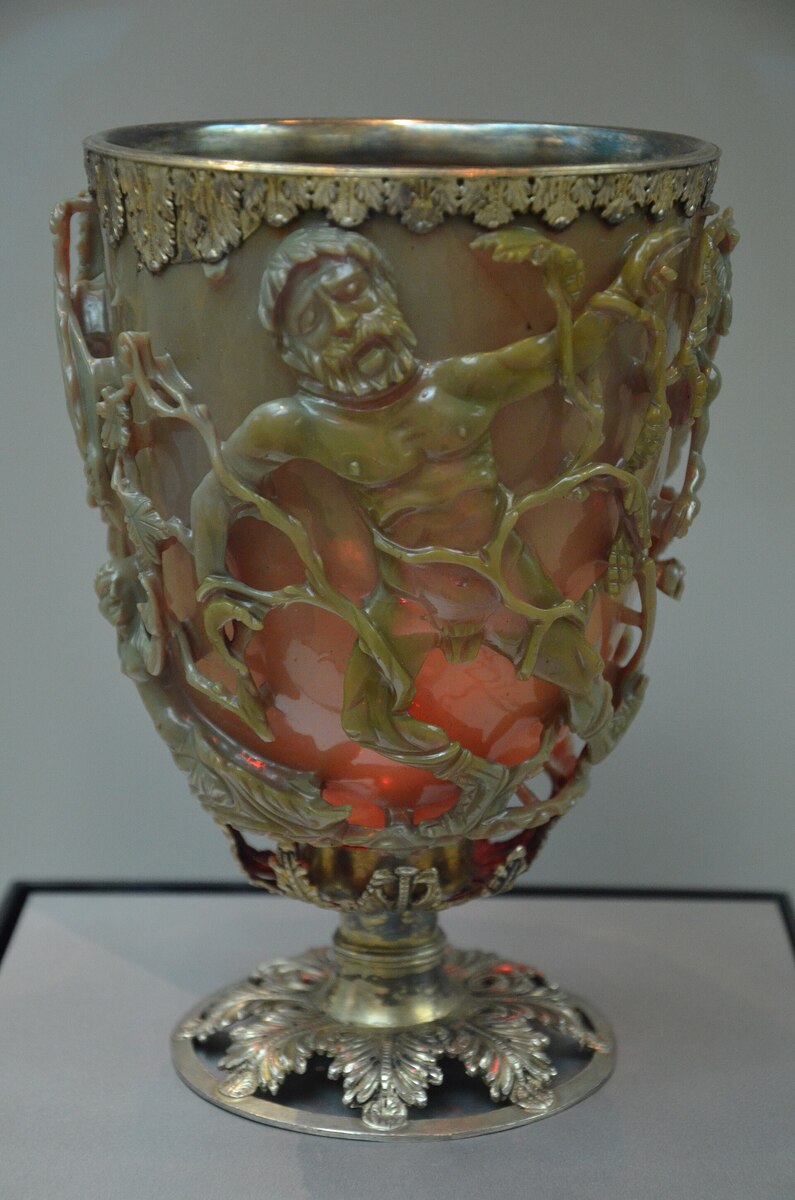
A late Roman cage-cup in the British Museum, carved from glass so that the myth of Lycurgus appears in high relief around the vessel. The narration separates what is visible from what the supplied source establishes and what remains unrecorded.
The flared gilt silver base with radiating acanthus leaves and a moulded knop, the foot that supports the glass vessel and belongs to the late antique metalwork setting.
02
Pierced gilt silver rim
The pierced and engraved gilt silver collar around the lip, ornamented with a fringe of stylised leaves, showing the metal mounting that finishes and protects the fragile glass edge.
03
Carved vine cage with grapes
The delicate openwork network of interlocking olive-green glass branches with leaves and grape clusters that forms the outer cage of the cup and lets the red glass body glow through its gaps.
Your gallery guide
Lycurgus Cup by Maker unknown (4th century AD)
A late Roman cage-cup in the British Museum, carved from glass so that the myth of Lycurgus appears in high relief around the vessel. The narration separates what is visible from what the supplied source establishes and what remains unrecorded.
Editorial review by Artifact Archive automated publishing
This is the Lycurgus Cup, a Roman glass vessel made in the fourth century AD and now in the British Museum in London.
It is named for the scene carved around it: the myth of Lycurgus, entangled in a vine.
That subject is why the object carries the name, and it is the starting point for looking at it.
The cup belongs to the diatreta, or cage-cup, type. The glass was cut away so that figures stand in high relief.
Those figures are not applied to the outside. They remain attached to the inner surface by small hidden bridges behind them.
So what looks like a free-standing carved scene is actually part of the vessel wall, held by supports you cannot easily see from the front.
The object is Roman and it is made of glass. The supplied source dates it to the fourth century AD.
The supplied description calls it one of the finest examples of Roman glassware, and that judgement rests on the difficulty of the cutting.
A cage-cup requires the maker to remove material around the figures while leaving those figures connected to the body of the vessel.
The name comes from the subject. The cup depicts the myth of Lycurgus entwined in a vine.
That is the episode the object preserves: a figure caught in growth, with the vine acting as the binding element.
The myth is not an add-on decoration here. It gives the cup both its modern name and its carved action.
What you can take away is a vessel whose subject and technique are bound together. The vine that entangles Lycurgus is cut from the same glass as the figure.
The cage-cup method makes the myth physical: the scene is held in place by hidden bridges, just as the vine holds the figure in the story.
The supplied evidence establishes the object, its date, its type, its subject and its home in London. It does not record the maker or the exact dimensions, and those gaps should stay open rather than be filled in.
The story and its sources
Editorial review by Artifact Archive automated publishing.
Historical claims are linked to the records below. Close looking and interpretation are identified in the passage notes.
A late Roman cage-cup of the diatretum type, carved from glass so that figures in high relief remain attached to the inner surface by small hidden bridges. It depicts the myth of Lycurgus, the Thracian king, entangled in a vine. The cup takes its name from this subject.(Following Hadrian (Carole Raddato), 2014)
Title variants
Lycurgus cup
Attribution qualification
Maker not named in the supplied sources; the uploader and photographer are not the maker.
Dimensions
Unknown
Catalogue identity and dating
The object catalogued here is the Lycurgus Cup, described in the supplied source as one of the finest examples of Roman glassware and as a work made in the 4th century AD, held at the British Museum, London. That physical description, the material identification as glass, the Roman attribution and the fourth-century dating all come from a single Wikimedia Commons file page and its object description, so they represent one catalogue voice rather than an independent consensus of several institutions. The photograph on that page is dated 14 May 2014 and is credited to Following Hadrian (Carole Raddato), which fixes a modern photographic record of the vessel but is not itself evidence about when the cup was made or when it entered the museum. The date of the object and the date of the photographic documentation therefore need to be kept distinct: the fourth-century AD dating belongs to the object's production, while the 2014 date belongs only to the modern image and its upload.(Following Hadrian (Carole Raddato), 2014, File title and description; File title)
The cup's name is not an ancient inscription but a modern descriptive label derived from its subject. According to the supplied source, it is called the Lycurgus Cup because it depicts the myth of Lycurgus entwined in a vine. The naming therefore rests on the scene carved around the vessel rather than on a recorded ancient title or an identifying text on the object. The same source identifies the object as Roman and made of glass and dates it to the 4th century AD, so the catalogue entry combines a modern subject-based name with a period attribution and a material classification. The evidence supplied does not record a maker, workshop, findspot or accession number, and those absences should remain open rather than being resolved by inference.(Following Hadrian (Carole Raddato), 2014, Description; File title)
The object is the Lycurgus Cup, described as one of the finest examples of Roman glassware made in the 4th century AD, held at the British Museum, London.(Following Hadrian (Carole Raddato), 2014)
The Lycurgus Cup is described in the supplied documentation as an example of the diatreta, or cage-cup, type, a class of Roman glass vessel in which the glass was cut away to produce figures in high relief. The distinctive feature of the type, as the source presents it, is that the carved figures are not attached to the vessel's outer wall: they remain joined to the inner surface by small hidden bridges positioned behind the figures. What reads from the front as a free-standing carved scene is therefore continuous with the body of the cup, carried by supports that a viewer cannot easily see. Understanding the object's materials and technique begins with this structural fact, because it governs everything about how the relief was conceived and how it survives as a single piece of glass rather than an assembly of applied parts.(Following Hadrian (Carole Raddato), 2014, Description)
The cup is an example of the diatreta, or cage-cup type, in which glass was cut away to create figures in high relief attached to the inner surface by small hidden bridges behind the figures.(Following Hadrian (Carole Raddato), 2014)
The Lycurgus Cup is held at the British Museum in London. That single locational fact, the file title of the Wikimedia Commons photograph taken by Carole Raddato (Following Hadrian) on 14 May 2014, is the only holding information the supplied evidence records, and it establishes the cup's present institutional home without describing when or how the object reached the museum. The same source identifies the object as a Roman artifact made of glass and dates it to the fourth century AD, which sets the two fixed points around which the rest of the account can be arranged: a Roman glass vessel of fourth-century date, now in a named London collection.(Following Hadrian (Carole Raddato), 2014, File title)
The cup's modern name derives from its carved subject. The supplied description states that it is called the Lycurgus Cup because it depicts the myth of Lycurgus entwined in a vine; the narrative episode the object preserves is a figure caught in growth, with the vine acting as the binding element. This means the name is a descriptive label attached to the object by reference to its imagery rather than an ancient title recorded on or with the vessel. The evidence supplies the identification of the myth and its entanglement motif, but provides no ancient text, inscription, or document that names the cup in antiquity.(Following Hadrian (Carole Raddato), 2014, File title)
Technique and the diatretum type
Technically, the cup belongs to the diatreta, or cage-cup, type. In this method glass was cut away so that the figures stand in high relief, but the figures are not applied to the outside of the vessel; they remain attached to the inner surface by small hidden bridges behind them. What appears from the front as a free-standing carved scene is therefore part of the vessel wall, held in place by supports that are not easily seen from the front. The supplied description calls the cup one of the finest examples of Roman glassware, a judgement that rests on the difficulty of the cutting: a cage-cup requires the maker to remove material around the figures while leaving those figures connected to the body of the vessel. The choice of the vine as subject and the cage-cup method reinforce each other, since the vine that entangles Lycurgus is cut from the same glass as the figure and the scene is held in place by hidden bridges, much as the vine holds the figure in the story.(Following Hadrian (Carole Raddato), 2014, File title)
Interpretation
Read together, the evidence establishes the object, its Roman origin, its fourth-century AD date, its diatretum type, its Lycurgus subject, and its home in London, but it does not record the maker or the exact dimensions of the cup, and those gaps should remain open rather than be filled by assumption. The object matters within a larger history of Roman glass because the cage-cup technique converts a narrative scene into an integral part of the vessel wall, so that the carving cannot be separated from the container it decorates. That inseparability, rather than any single fact about its subject, is what the supplied evidence most fully supports about the cup's place in material culture.(Following Hadrian (Carole Raddato), 2014, File title)
The object discussed here is the Lycurgus Cup, a Roman glass vessel dated by the supplied source to the fourth century AD and held at the British Museum in London. It is named for the scene carved around it, the myth of Lycurgus entangled in a vine, so that its modern name is bound to its subject rather than to a maker or an owner. The same source describes the cup as one of the finest examples of Roman glassware, a judgement it grounds in the difficulty of the cutting; this is the strongest characterisation the evidence offers, and it is presented as the supplied source's assessment rather than as a measurable attribute. The object is Roman and is made of glass, and beyond that the source records neither the maker nor the exact dimensions, gaps that the working valuation below also treats as unresolved.(Following Hadrian (Carole Raddato), 2014)
The cup belongs to the diatreta, or cage-cup, type. In this technique glass was cut away so that figures stand in high relief, and the figures are not applied to the outside: they remain attached to the inner surface by small hidden bridges behind them. What looks like a free-standing carved scene is therefore part of the vessel wall, held by supports that cannot easily be seen from the front. A cage-cup requires the maker to remove material around the figures while leaving those figures connected to the body of the vessel, and the evidence links the source's high estimation of the object to precisely that difficulty. The vine that entangles Lycurgus in the carved action is cut from the same glass as the figure, so subject and technique are inseparable here rather than merely juxtaposed: the scene is held in place by hidden bridges much as the vine holds the figure in the story.(Following Hadrian (Carole Raddato), 2014)
For recorded values, the single figure the evidence supplies is a model-generated working insurance range of US$500,000 to US$2,000,000, generated on 2026-10-16 as a working calculation for manual review. Its stated methodology derives the bracket from the object's confirmed artwork context: its extreme rarity as a diatretum, its high relief figure carving, gold and silver mounting, and its prominence as one of the finest examples of Roman glassware. The range is deliberately broad because the maker is unknown and the sources do not record dimensions, accession number, condition, ownership, acquisition cost, or any official appraisal; a low six-figure floor is used to avoid undervaluing a unique late Roman masterwork, and a low seven-figure ceiling to avoid overstating value without documented market evidence. The evidence explicitly qualifies that this figure is not an official insurance value, appraisal, auction result, or sale price, and is not based on comparable sales, private insurance data, or documented acquisition records. It must be verified by a qualified professional before any insurance, lending, tax, or sale decision, and the model's own framing of its bracket as intentional and conservative should be read as an attributed rationale rather than as a market fact.(Following Hadrian (Carole Raddato), 2014)
What the record establishes about the object is its identification, its fourth-century AD date, its diatretum type, its high relief cutting with hidden bridges, its Lycurgus subject, its later gilt silver mounts, and its present home in the British Museum. What it does not establish is at least as consequential for valuation and interpretation: maker, exact dimensions, accession number, condition, ownership history, acquisition cost and official appraisal are all unrecorded. The metal mounts are noted as a feature contributing to rarity and value, yet the evidence supplies no date, maker or treatment for them, so the relationship between the fourth-century glass and the later mounting remains an inference from the object's description rather than a documented sequence. These gaps should be kept open rather than filled, because the same absences are the reason the recorded value range is broad and unverifiable from comparables.(Following Hadrian (Carole Raddato), 2014)
Working estimate
Calculated working insurance estimate, not a sale price: Estimated value: US$500K to US$2M Recorded date: Working calculation, generated 2026-10-16. Methodology: Broad working insurance range calculated for manual review only, inferred from confirmed artwork context. The object is a 4th century AD Roman cut and carved glass cage-cup (diatretum) with later gilt silver mounts, identified as the Lycurgus Cup and held in the British Museum, London. Its extreme rarity as a diatretum, high relief figure carving, gold and silver mounting, and prominence as one of the finest examples of Roman glassware support a conservative high-value bracket. Because the maker is unknown and the sources do not record dimensions, accession number, condition, ownership, acquisition cost, or official appraisal, the range is intentionally broad. A low six-figure floor is used to avoid undervaluing a unique late Roman masterwork, and a low seven-figure ceiling is used to avoid overstating value in the absence of documented market evidence. The range is not based on comparable sales, private insurance records, or any public appraisal. Qualification: This is a model-generated working insurance range for manual review. It is not an official insurance value, appraisal, auction result, or sale price. It is not based on comparable sales, private insurance data, or documented acquisition records. All figures are broad and conservative and must be verified by a qualified professional before any insurance, lending, tax, or sale decision.(Following Hadrian (Carole Raddato), 2014)
Bibliography
Sources and further reading
References are arranged by author or organisation, with links to the original publications. Where no publication date is recorded, n.d. means no date.
Source notes updated .
No recorded sources match these filters. Reset the filters to see the full bibliography.
Wikimedia Commons file page supplying the object description, identification as a Roman cage-cup of the 4th century AD in the British Museum, and the myth of Lycurgus subject. Photograph dated 14 May 2014.
Advertising supports the archive. These preferences control aggregate page counting, reading activity and ad-delivery diagnostics. They use no visitor tracking cookie.