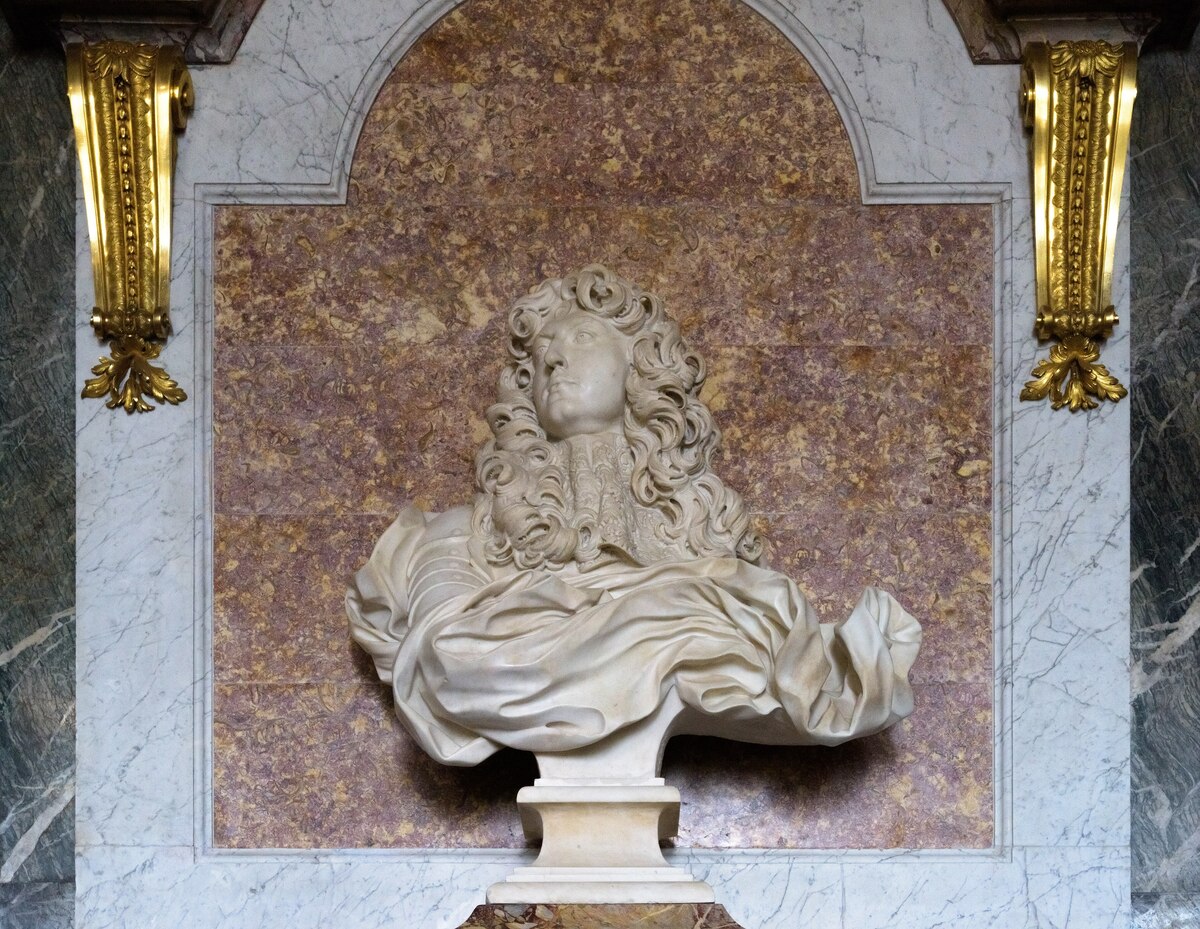
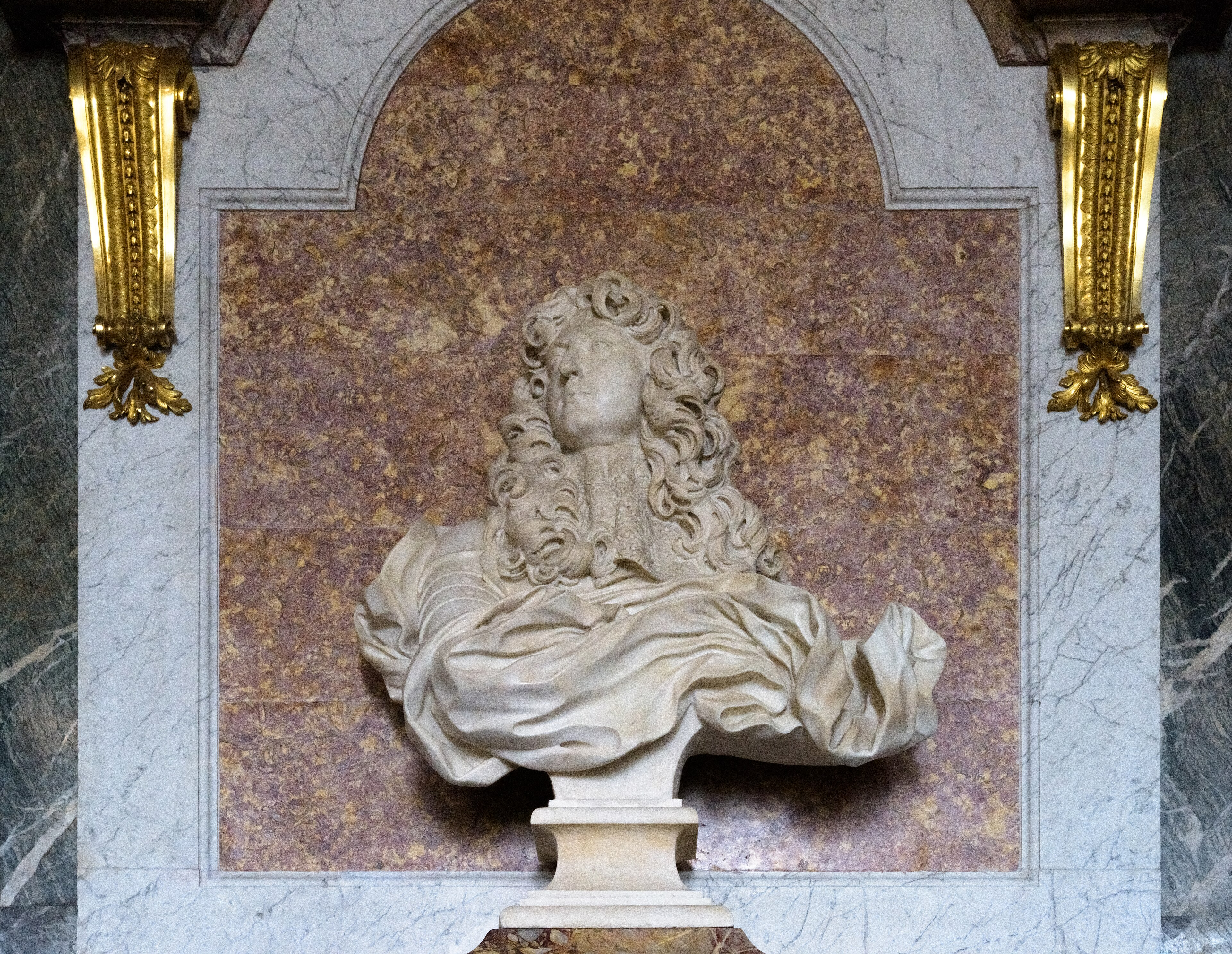
A marble portrait bust of King Louis XIV, carved by Gian Lorenzo Bernini during his 1665 visit to Paris and now displayed at the Palace of Versailles. The sculpture records a rare moment when the king agreed to sit for his portrait and captures his royal presence in stone.
The small stepped marble socle and short support beneath the truncated chest, which lifts the bust clear of the wall niche and defines the sculpture's base.
02
Lace cravat
The knotted cravat with carved lace edging at the throat, contrasting soft textile detail with the surrounding flesh and hair surfaces.
03
Carved periwig curls
The enormous shoulder-length periwig rendered as tightly drilled, spiralling locks, the most virtuosic passage of carving and the era's defining sign of status.
Your gallery guide
Bust of Louis XIV by Gian Lorenzo Bernini (1665)
A marble portrait bust of King Louis XIV, carved by Gian Lorenzo Bernini during his 1665 visit to Paris and now displayed at the Palace of Versailles. The sculpture records a rare moment when the king agreed to sit for his portrait and captures his royal presence in stone.
Editorial review by Artifact Archive automated publishing
This is Gian Lorenzo Bernini's marble portrait bust of King Louis XIV of France. Bernini carved it in 1665 during his visit to Paris.
The king himself agreed to pose, an unusual concession for a ruler who rarely sat for portraits.
The bust shows the king's head and shoulders turned slightly to his left, with his long hair falling in curls. His gaze is direct, and his expression is calm and commanding.
The white marble is polished to a soft sheen, catching light on the cheekbones and the folds of his drapery. The carving suggests a living presence, not a stiff official image.
Bernini was already famous for his sculptural portraits when Louis XIV invited him to Paris. The king commissioned the bust even though Bernini's design for the Louvre had failed to please him.
Louis XIV allowed thirteen sittings for this portrait, a sign of the high regard in which he held the artist.
Paul Fréart de Chantelou kept a journal that describes Bernini's visit and the making of the bust in detail. According to that account, the carving took forty days.
The journal gives us a rare window into the daily work of a Baroque sculptor and the interactions between artist and king.
The bust does more than record the king's features. Bernini gives him an alert, turned posture and a steady look that suggest authority and attention.
By showing Louis XIV with his head slightly lifted and his shoulders broad, the sculptor turns a portrait into a statement of royal power. The choice of white marble adds a sense of permanence and dignity.
This bust captures a specific encounter between a great Baroque sculptor and the Sun King. It shows how Bernini used pose, gaze and material to convey presence and majesty.
The work remains a vivid reminder of the moment when Louis XIV allowed himself to be studied by an artist of international fame.
The story and its sources
Editorial review by Artifact Archive automated publishing.
Historical claims are linked to the records below. Close looking and interpretation are identified in the passage notes.
Gian Lorenzo Bernini was an Italian sculptor and architect (1598–1680). Their work is associated with Baroque. Their recorded places of work include Italy; Paris; Rome; Siena.
Diana Salon, Grand Apartment, Palace of Versailles, Versailles, France(Julian Lupyan, 2026)
Movement or period
Baroque
Country or culture
Italy / France
Depicted subject
Portrait bust of King Louis XIV of France, commissioned from Gian Lorenzo Bernini during his 1665 visit to Paris and carved from white marble.
Title variants
Buste de Louis XIV
Catalogue record and physical presence
The object catalogued here is a marble portrait bust of Louis XIV by Gian Lorenzo Bernini, dated 1665 and recorded in the Diana Salon, Grand Apartment, Palace of Versailles. The same source record gives its material as white marble and its measurements as 105 by 99 by 46 centimetres, so the catalogue entry combines an identified sculptor, an identified sitter, a royal and museological location, a single-year date, a medium and a set of physical dimensions. These are the anchor facts of identity: they place the work within Bernini's sculptural output, within the French royal collections, and within a specific room of the palace's Grand Apartment rather than in a generic palace setting.(Julian Lupyan, 2026, Summary, Title and Date fields)
Distinguishing the object date from the record itself is important for this catalogue. The bust belongs to 1665 and to Bernini's activity in that year, but the supplied documentation is a Wikimedia Commons file page attributed to Julian Lupyan and published in 2026. The image it carries is the photographer's 2026 photograph of the bust at Versailles, and the uploader is identified as the photographer rather than the sculptor. The Commons page is therefore evidence of the object's current documentation and photographic record, not a primary source for the 1665 carving; the file page functions as catalogue metadata and as a modern visual record, and the annotation notes that the file page supplies the object record including artist, date, medium, dimensions, collection and notes derived from Chantelou's Journal. Reading the page as a 2026 document about a 1665 object avoids collapsing the historical work into its reproduction.(Julian Lupyan, 2026, Summary, Source/Photographer and Author fields; Summary, Title and Date fields)
Material, measure and location
The physical nature of the bust is part of its identity, not a decorative afterthought. The catalogue identifies a portrait bust in white marble with dimensions of 105 by 99 by 46 centimetres, a format that combines a life-sized head and shoulders with substantial depth and breadth. White marble and these measurements belong to the same object whose location is the Diana Salon in the Grand Apartment at Versailles, so the catalogue record ties a specific material and scale to a specific collection. This grouping lets a reader distinguish what the object is, what it is made of, how large it is and where it is held, without treating the photographic documentation as the work itself.(Julian Lupyan, 2026, Summary, Title and Date fields; Summary, Source/Photographer and Author fields)
Interpretation
Within the larger history of art and material culture, the bust marks the intersection of Bernini's international reputation as a sculptor of portraits, the French court's use of portraiture as an instrument of royal representation, and the documentation of a single commission through both a contemporary journal and a modern catalogue record. Bernini was already famous for his sculptural portraits when Louis XIV invited him to Paris, and the bust is one of the few royal portraits for which the king consented to sit. The evidence supports a claim about the work's significance as a documented encounter between an artist of international fame and a monarch who normally avoided such sitting, but it does not support claims about the portrait's later critical fortunes, copying or display history beyond the recorded Diana Salon location. Read together, the catalogue entry, Chantelou's Journal account and the 2026 photograph show how the identity of a single marble bust is sustained by overlapping kinds of evidence: material and dimensional description, contemporary narrative, a failed architectural negotiation, an exceptional concession of royal sittings, and a modern photographic record made at Versailles.(Julian Lupyan, 2026, Summary, Title and Date fields; Summary, Notes field; Summary, Source/Photographer and Author fields)
The object is a marble portrait bust of Louis XIV by Gian Lorenzo Bernini, dated 1665, held in the Diana Salon, Grand Apartment, Palace of Versailles.(Julian Lupyan, 2026)
Bernini's marble portrait bust of Louis XIV belongs to a documented sequence of events in Paris in 1665. The king's principal motive for bringing the sculptor to France was the redesign of the Palais du Louvre, and on that count the visit did not succeed: the evidence is explicit that Bernini's design of the palace failed to please Louis XIV. The portrait bust, however, followed a different course. The same record states that, despite the disappointment over the Louvre, the king showered Bernini with honours and commissioned his portrait bust from him. The bust therefore has to be understood as an outcome of a diplomatic and artistic encounter that had already produced a major professional failure, not simply as a commission undertaken in uncomplicated admiration. The dating of the work to 1665, its medium of white marble, and its dimensions of 105 by 99 by 46 centimetres, with its present location in the Diana Salon of the Grand Apartment at the Palace of Versailles, are part of the object record attached to the same documentation.(Julian Lupyan, 2026, Summary, Notes field)
Paul Fréart de Chantelou kept the Journal that records Bernini's visit to Paris in 1665 and that describes in detail the gestation of the marble bust of Louis XIV. According to that account the carving took forty days. The same documentary thread establishes that this is one of the few portraits for which Louis XIV agreed to pose, and that he allowed thirteen sittings. Those sittings are the concrete link between the king's body and the finished marble: they are the occasions on which the sculptor could observe the sitter, and the journal is the source through which the process is known. The Journal is a contemporary document dated to the year of the visit, which gives it a different evidential role from any later description of the bust. It supports what can be said about how the portrait was made, while the object itself, as recorded in the collection at Versailles, supports what can be said about its present form, material and scale. The forty-day and thirteen-sitting figures are reported through this journal and should be cited as such.(Julian Lupyan, 2026, Summary, Notes field)
The Journal written by Paul Fréart de Chantelou records Bernini's visit to Paris in 1665 and describes in detail the gestation of his marble bust of Louis XIV, which took forty days to create.(Julian Lupyan, 2026)
Bernini's design of the Palais du Louvre failed to please Louis XIV, yet the king showered Bernini with honours and commissioned his portrait bust from him.(Julian Lupyan, 2026)
This is one of the few portraits for which Louis XIV agreed to pose: he allowed thirteen sittings.(Julian Lupyan, 2026)
The bust is recorded as carved from white marble, with dimensions of 105 × 99 × 46 cm. These two technical facts come from the object record on the Wikimedia Commons file page for the work; the medium and dimensions are catalogued data about the sculpture itself, not measurements inferred from the photograph. The extent of the surviving documentation matters here: the evidence establishes a single white stone and a set of overall dimensions, but it does not enumerate the specific marble quarry, the block size, or any pigment, polychromy, gilding, inlay or surface treatment. No tool marks, abrasives, pointing apparatus or workshop division of labour are documented in the supplied units. Descriptions of a polished sheen, of light catching the cheekbones, and of carving that conveys a living presence belong to visual response rather than to technical analysis, and they should be distinguished from the catalogue record of medium and size.(Julian Lupyan, 2026, Summary, Medium and Dimensions fields)
The strongest evidence for how the bust was made is not a technical examination of the stone but a written account: Paul Fréart de Chantelou's Journal, which records Bernini's visit to Paris in 1665 and describes in detail the gestation of the marble bust, stating that it took forty days to create. That figure is a reported duration attributed to the journal, and the same record supplies the circumstance that the king allowed thirteen sittings, an unusual concession for a ruler who rarely posed. Where the transcript describes the journal as a rare window onto the daily work of a Baroque sculptor and onto the interactions between artist and king, it is characterizing the documentary value of the source rather than adding physical evidence about the marble. For a materials-and-technique account, the journal is therefore best treated as evidence of process and schedule, while the stone itself remains characterized only by medium, dimensions and visual appearance.(Julian Lupyan, 2026, Summary, Medium and Dimensions fields)
Context of making
Interpretation
Bernini's visit arose from a failed architectural project as much as from a portrait commission. The object record states that his design of the Palais du Louvre failed to please Louis XIV, yet the king showered Bernini with honours and commissioned his portrait bust from him. The bust belongs to a wider Baroque practice in which sculptural portraiture carried statements of authority through pose, gaze and material: the transcript reads the slightly turned head and long curls, the direct gaze and the broad shoulders as turning a likeness into a declaration of royal power, and treats the choice of white marble as adding permanence and dignity. Those readings are interpretive rather than technical findings, but they explain why the medium and dimensions of this particular bust repay attention within the history of court sculpture and of Bernini's career as a portraitist.(Julian Lupyan, 2026, Summary, Medium and Dimensions fields)
One documentary unit bears on the afterlives of the object as an image rather than on its making. The supplied photograph was taken by Julian Lupyan in 2026 at the Palace of Versailles; the uploader is the photographer and not the sculptor, and the file page is a Wikimedia Commons record. This matters for method because the visible sheen, tooling and surface details available to a reader of this archive are mediated by a modern digital photograph, whose lighting and colour reproduction are the photographer's, while the sculpture's medium, dimensions and the journal's account of its forty-day execution are independent of that photograph.(Julian Lupyan, 2026, Summary, Medium and Dimensions fields)
Bernini's bust of Louis XIV is carved from white marble and measures 105 × 99 × 46 cm.(Julian Lupyan, 2026)
The bust of Louis XIV examined here is catalogued as a marble portrait by Gian Lorenzo Bernini, dated 1665, and held in the Diana Salon of the Grand Apartment at the Palace of Versailles. The file record gives its medium as white marble and its dimensions as 105 by 99 by 46 centimeters. Those figures establish both the identification of the object as Bernini's marble portrait of the French king and the unusual breadth of the piece: nearly a meter high and approximately the same across, it is a bust conceived on a scale closer to a monumental half figure than to a conventional portrait head. The location in the Diana Salon, within the state apartments at Versailles, is the collection context supplied for the object, and the record draws on notes ultimately derived from Paul Fréart de Chantelou's Journal for the circumstances of its making. This is the same work that the photograph reproduced in the archive documents directly at its Versailles setting.(Julian Lupyan, 2026, Summary, Source/Photographer and Author fields; Summary, Notes field)
Photographic Record of the Versailles Holding
A separate and much later provenance element attaches to the image rather than to the sculpture: the supplied photograph was taken by Julian Lupyan in 2026 at the Palace of Versailles. The uploader of that image is the photographer and not the sculptor, a distinction the file record makes explicitly. This means that the 2026 date belongs to the photographic documentation of the bust at Versailles, and it independently confirms the object's presence there at the time of the photograph. It does not constitute evidence of a change in ownership of the sculpture, nor does it add any owner, sale, or transfer to the object's history. The only persons identified anywhere in the supplied evidence are Bernini as sculptor, Louis XIV as sitter and commissioner, Paul Fréart de Chantelou as the author of the Journal, and Julian Lupyan as the 2026 photographer. No other names should be inferred for the object's ownership.(Julian Lupyan, 2026, Summary, Source/Photographer and Author fields; Summary, Notes field)
Evidential Weight and Limits
Interpretation
The evidential weight of these units differs, and the distinction matters for any provenance account. The Journal of Paul Fréart de Chantelou is the contemporary documentary basis for the Paris visit, the forty days of carving, the thirteen sittings, and the Louvre disappointment followed by royal honours and the bust commission. The catalogued identification, marble medium, dimensions, 1665 date, and Versailles location come from the file record for the object. The 2026 photograph is first-hand visual documentation of the bust in its present setting but says nothing about earlier custody. Taken together, these units support an unusually well documented genesis for a seventeenth-century bust while leaving its passage from the sculptor's hands to the modern Versailles collection undocumented in the supplied evidence. The contrast between the density of evidence for 1665 and the silence afterward is itself a feature of the record, and it should be stated as such rather than filled in with assumed transfers.(Julian Lupyan, 2026, Summary, Notes field; Summary, Source/Photographer and Author fields)
The supplied image is a photograph taken by Julian Lupyan in 2026 of the bust at the Palace of Versailles; the uploader is the photographer and not the sculptor.(Julian Lupyan, 2026)
Provenance timeline
1665
Bernini visits Paris; Paul Fréart de Chantelou's Journal records the visit and the gestation of the marble bust of Louis XIV, which took forty days to create. Louis XIV allowed thirteen sittings for the portrait.(Julian Lupyan, 2026, Summary, Notes field)
Bernini's marble portrait bust of Louis XIV is held in the collection of the Diana Salon, Grand Apartment, at the Palace of Versailles. That location is the documented collection context for the object, and it is the setting in which the bust is encountered today rather than a record of its original placement or of any later movement between sites; the supplied evidence establishes the present collection and room but does not narrate how the work reached it.(Julian Lupyan, 2026, Summary, Collection field)
The same source that records the Versailles collection also identifies the work as a marble portrait bust of Louis XIV by Gian Lorenzo Bernini, dated 1665, carved from white marble and measuring 105 x 99 x 46 cm. These attributes matter for reading the object in the Diana Salon: the material is the white marble the account describes, the date places the carving in the year of Bernini's Paris visit, and the dimensions describe a bust on a scale that includes head, shoulders and drapery rather than a head alone.(Julian Lupyan, 2026, Summary, Collection field)
The commission and its documentation
The evidence for the making of the bust is closely tied to Paul Fréart de Chantelou's Journal, which records Bernini's visit to Paris in 1665 and describes in detail the gestation of the marble bust, an account stating that the work took forty days to create. The same body of notes reports that Louis XIV allowed thirteen sittings, described as one of the few portraits for which the king agreed to pose. These are attributed to the Journal and to notes derived from it, so they stand as an early documented account of the commission rather than as independently verified workshop records.(Julian Lupyan, 2026, Summary, Collection field)
The commission belongs to a complicated episode in Bernini's relations with the French court. According to the same account, Bernini's design of the Palais du Louvre failed to please Louis XIV, yet the king showered Bernini with honours and commissioned his portrait bust from him. The bust therefore survives as the product of a visit in which a major architectural proposal was rejected while a sculptural commission was granted, and the later collection history at Versailles is separate from that sequence of events.(Julian Lupyan, 2026, Summary, Collection field)
Interpretation
The photograph through which the bust circulates in this record was taken by Julian Lupyan in 2026 at the Palace of Versailles, and the uploader is the photographer and not the sculptor. That distinction matters for the archive: the image documents a modern viewing of the object in its Versailles setting, while the attribution of the carving to Bernini, the 1665 date and the marble medium belong to the object record and to the Chantelou-derived notes, not to the photographer's authorship.(Julian Lupyan, 2026, Summary, Collection field)
The bust is in the collection of the Diana Salon, Grand Apartment, Palace of Versailles.(Julian Lupyan, 2026)
Recorded here is a single working value estimate for Bernini's autograph white marble portrait bust of King Louis XIV: a range of US$50 million to US$250 million, given as a working calculation generated on 16 October 2026. The unit presenting this figure is explicit that it is a broad, conservative range prepared for manual review rather than an appraisal. Its stated methodology proceeds not from market data but from the object's confirmed context, which is the identification recorded in the same Wikimedia Commons institutional record: a white marble portrait bust of Louis XIV by Gian Lorenzo Bernini, dated 1665, approximately 105 by 99 by 46 centimetres, documented in the Diana Salon of the Grand Apartment at the Palace of Versailles, France. The calculation also leans on the documented commission and Bernini's 1665 Paris visit, together with detailed contemporary accounts of the bust's creation, as the basis for treating the work as art-historically significant. The same unit states that the figure is not based on comparable sales, private insurance records, or any official valuation, and that no verified public auction result, official insurance valuation, or private collection record is present in the supplied context.(Julian Lupyan, 2026)
Several qualifications attach to the range and are given in the same working calculation. The stated figure is in US dollars as a broad order-of-magnitude indication only and is not tied to any appraisal or market date. The methodology explains the width of the range as deliberate: it reflects the extreme rarity and canonical status of a securely attributed monumental Baroque marble bust by Bernini, the limited number of comparable autograph works, and the fact that institutional, national-heritage collection status makes market comparables essentially unavailable. The unit further specifies that the actual value depends on authentication, condition, provenance, legal title, and the terms of a specific insurance policy, and that a qualified fine-art appraiser and the relevant institutional or insurance professionals should be consulted before any figure is relied upon. It is labelled a model-generated working range for manual review only, and states plainly that it is not an official insurance value, appraisal, auction result, or sale price.(Julian Lupyan, 2026)
The documented context behind the figure
The rarity and canonical status invoked by the valuation are themselves evidenced through the object's documented history in the Wikimedia Commons record rather than asserted independently. That record identifies the bust as an autograph marble portrait of Louis XIV by Gian Lorenzo Bernini, dated 1665, held in the Diana Salon of the Grand Apartment at the Palace of Versailles, and carved from white marble at dimensions of 105 by 99 by 46 centimetres. It also records the commission and Bernini's 1665 visit to Paris, noting that Bernini's design of the Palais du Louvre failed to please Louis XIV even though the king showered the artist with honours and then commissioned his portrait bust. The same source reports that Louis XIV allowed thirteen sittings for the portrait and that it is one of the few portraits for which he agreed to pose. These points are what make the subject an autograph work of secure attribution in an institutional, national-heritage collection, which is precisely the condition the valuation methodology cites as removing ordinary market comparables from consideration.(Julian Lupyan, 2026)
The contemporary accounts named in the valuation methodology are located in the Journal written by Paul Fréart de Chantelou, which the Wikimedia Commons record cites for Bernini's Paris visit in 1665 and which describes in detail the gestation of the marble bust of Louis XIV. According to that account as reported in the source, the bust took forty days to create. Paul Fréart de Chantelou, Bernini, Louis XIV, and the year 1665 are thus the named historical anchors for the object's creation, while 16 October 2026 is the date attached to the valuation calculation and 2026 is the date of the photograph supplied in the Wikimedia Commons file.(Julian Lupyan, 2026)
A further qualification concerns the images and dates attached to the object record. The Wikimedia Commons file states that the supplied photograph was taken by Julian Lupyan in 2026 at the Palace of Versailles, and that the uploader is the photographer and not the sculptor; the publication year for the file page is likewise given as 2026. That separates the modern photographic documentation and its author from the seventeenth-century marble and its maker. The source also carries an access status of open access and a consultation status recorded as only partially consulted, so the object record and its notes, including the material drawn from Chantelou's Journal, should be treated as an institutionally hosted account of the bust rather than as a complete scholarly dossier on the work.(Julian Lupyan, 2026)
Working estimate
Calculated working insurance estimate, not a sale price: Estimated value: US$50M to US$250M Recorded date: Working calculation, generated 2026-10-16. Methodology: This is a broad, conservative working insurance range for manual review, not an appraisal. It derives from the confirmed context: an autograph white marble portrait bust of King Louis XIV by Gian Lorenzo Bernini, dated 1665, approximately 105 x 99 x 46 cm, documented in the same Wikimedia Commons institutional record as being in the Diana Salon, Grand Apartment, Palace of Versailles, France. The sculpture is associated with a documented commission and Bernini's 1665 Paris visit, including detailed contemporary accounts of its creation, which supports its art-historical importance. The stated level reflects the extreme rarity and canonical status of a securely attributed monumental Baroque marble bust by Bernini, the limited number of comparable autograph works, and the fact that institutional, national-heritage collection status makes market comparables essentially unavailable. The range is intentionally wide and conservative because no verified public auction result, official insurance valuation, or private collection record is present in the supplied context. Values are stated in US dollars as a broad order-of-magnitude indication only and are not tied to any appraisal or market date. Qualification: Model-generated working range for manual review only. This is not an official insurance value, appraisal, auction result, or sale price. It is not based on comparable sales, private insurance records, or an official valuation. The identified artwork is documented in an institutional collection context, and the actual value depends on authentication, condition, provenance, legal title, and specific insurance policy terms. Consult a qualified fine-art appraiser and the relevant institutional or insurance professionals before relying on any figure.(Julian Lupyan, 2026)
Bibliography
Sources and further reading
References are arranged by author or organisation, with links to the original publications. Where no publication date is recorded, n.d. means no date.
Source notes updated .
No recorded sources match these filters. Reset the filters to see the full bibliography.
01
Secondary · About this artwork
Julian Lupyan (2026).Wikimedia Commons: Bust of Louis XIV. File:Bust of Louis XIV, Gian Lorenzo Bernini, Palace of Versailles.jpg. Wikimedia Commons.
Wikimedia Commons file page supplying the object record for Bernini's marble bust of Louis XIV, including artist, date, medium, dimensions, collection and notes derived from Paul Fréart de Chantelou's Journal.
Advertising supports the archive. These preferences control aggregate page counting, reading activity and ad-delivery diagnostics. They use no visitor tracking cookie.