Ovale N°2
Artist: Wassily Kandinsky · 1925

Ovale N°2: high-resolution image
The original file is hosted by Wikimedia Commons, available without payment or an account.
Open high-resolution image on Wikimedia CommonsThe complete story
The story About 4 minutes to read
Here is an abstract painting, not a picture of a scene. The museum describes its subject simply as abstraction, and names geometric figure among its iconographic keywords. So there is no story being told in the usual way. What you have instead is a painted world of geometric forms, made by Wassily Kandinsky in 1925, while the museum associates the work with the Bauhaus. That matters for how you look. Kandinsky isn't showing you a person or a landscape. He's asking you to read shape, colour and arrangement as the subject itself.
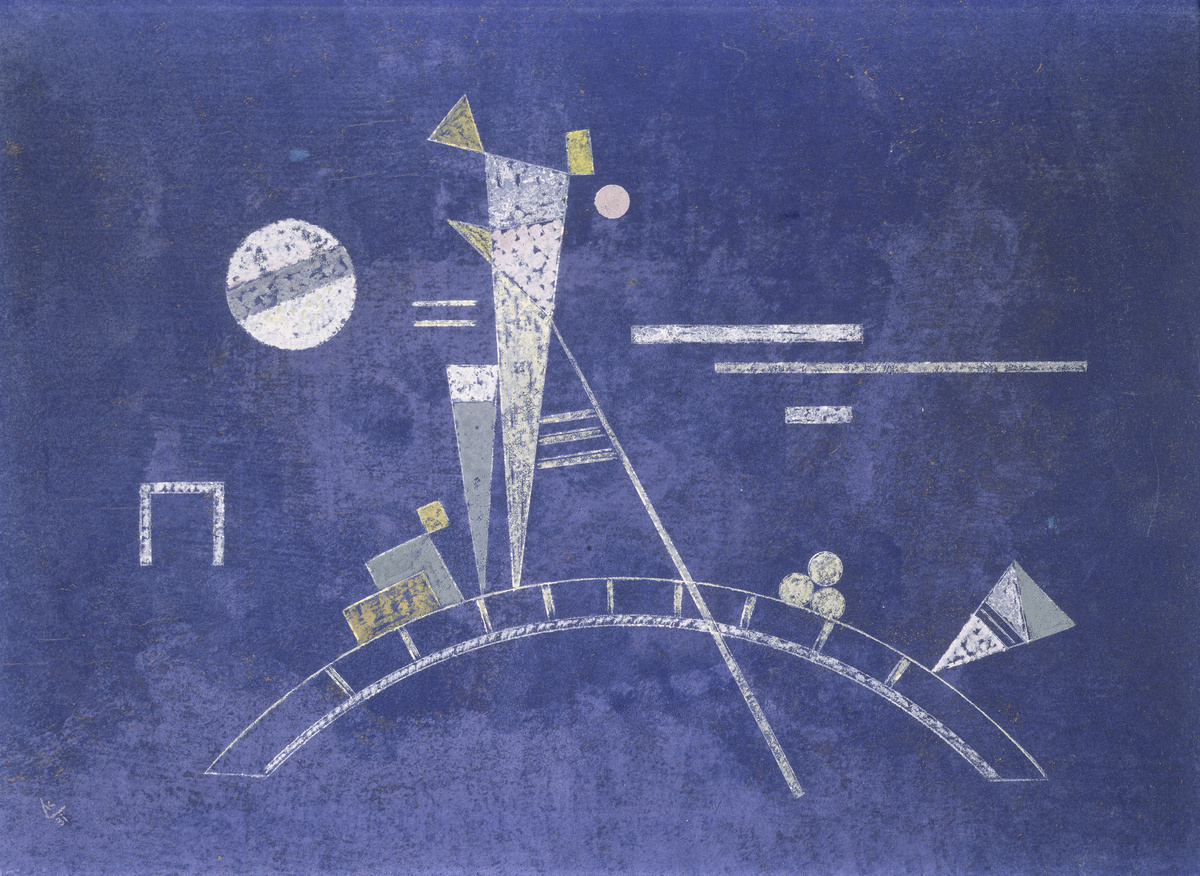
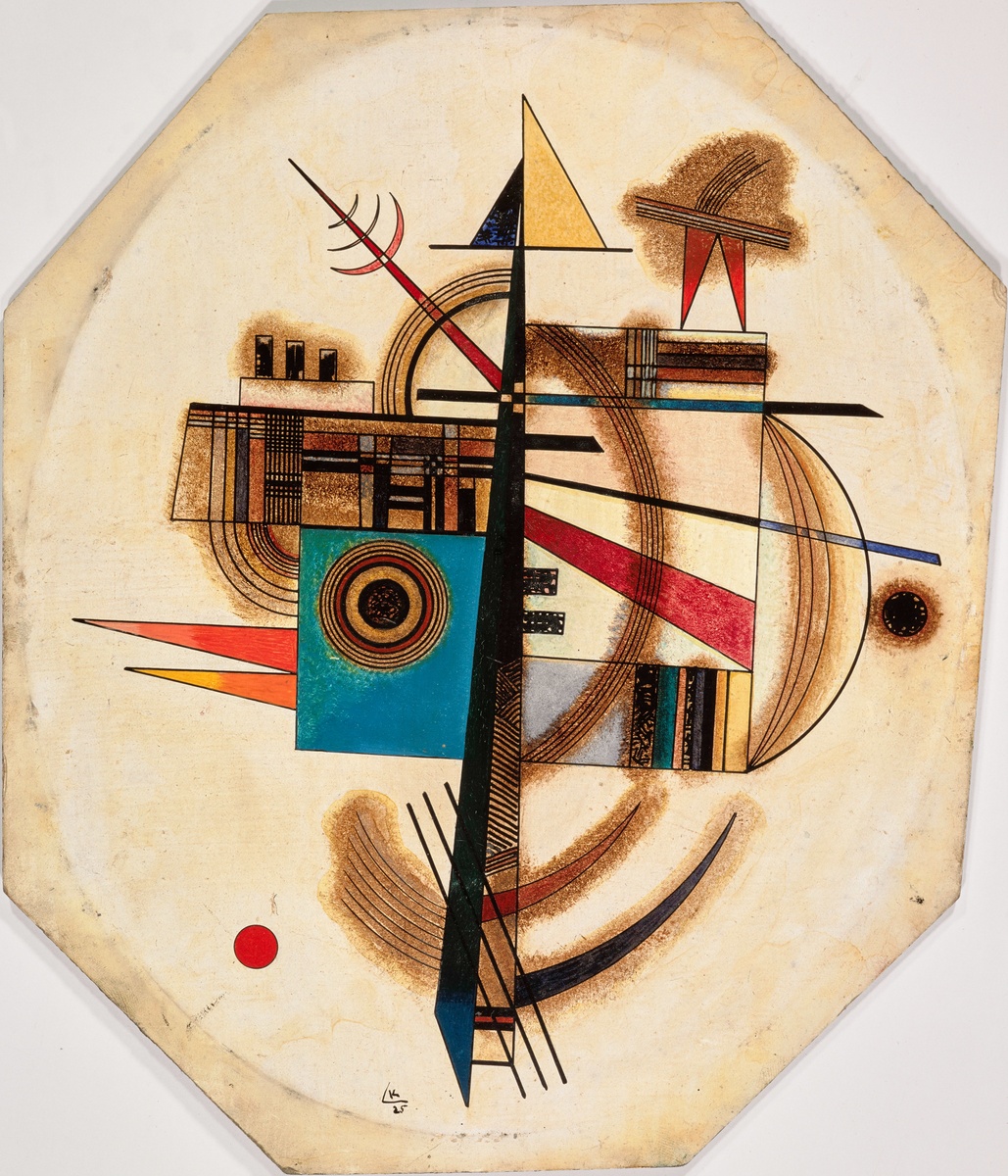
The very first physical thing to notice is the support. This is oil paint on an oval board, so the painted field itself is a rounded shape rather than a rectangle. An oval turns the picture into something closer to an aperture or a lens. Its curved edge becomes part of the composition, not a neutral frame around it. The museum's keywords point you toward geometric figures, so look for the forms that hold the surface. The supplied record doesn't describe their exact arrangement, so I'll leave the individual shapes for your own eye rather than inventing them.
Kandinsky signed the painting at the bottom centre with his monogram and the date, V K 25. On the back of the board, in ink and pencil, he wrote an identifying inscription that includes the title Oval Number Two. The museum places the work within the Bauhaus, the German school of art and design where Kandinsky taught in the 1920s. In that setting, geometry wasn't decoration. It was a shared working language. So the geometric figures here belong to a period idea: that abstract form could be constructed, balanced and analysed, much as a design problem could be.
It's tempting to look for a hidden scene inside an abstract painting, a face or a landscape disguised in the shapes. The supplied evidence doesn't support that reading here. The museum's language is deliberately plain. Abstraction, with geometric figures. That's an interpretation-free description, and it's the honest starting point. What we can say with confidence is that the oval board and the geometric forms work together. The rounded format softens the hard-edged vocabulary inside it, and that tension is part of what you're looking at.
So this is a painting about forms in relation to one another, made at a moment when Kandinsky was teaching and thinking in geometric terms. The oval support keeps reminding you that the picture is an object with an edge. The geometric figures keep drawing you back inside it. You don't need to decode a story. The subject is the arrangement itself, and the format is the first clue to how carefully that arrangement was made.
The story and its sources
Historical claims are linked to the records below. Close looking and interpretation are identified in the passage notes.
- Passage 1Documented historyInstitutional record for Oval #2Institutional record for Oval #2
- Passage 2Close lookingInstitutional record for Oval #2Institutional record for Oval #2
- Passage 3Documented historyInstitutional record for Oval #2Institutional record for Oval #2
- Passage 4InterpretationInstitutional record for Oval #2Institutional record for Oval #2
- Passage 5InterpretationInstitutional record for Oval #2Institutional record for Oval #2
Details to notice
About 3 minutes to readLeft projectile forms
Two long red and orange points shoot horizontally from the left edge toward the turquoise target, creating directional thrust and visual tension.
Lower sweeping arc
A dark crescent and layered ochre arcs sweep beneath the central axis, echoing the upper curves and giving the composition a downward gravitational pull.
Summit triangles
At the apex, a yellow triangle and a smaller dark blue and black triangle meet on a horizontal beam, forming the painting's highest and sharpest geometric crest.
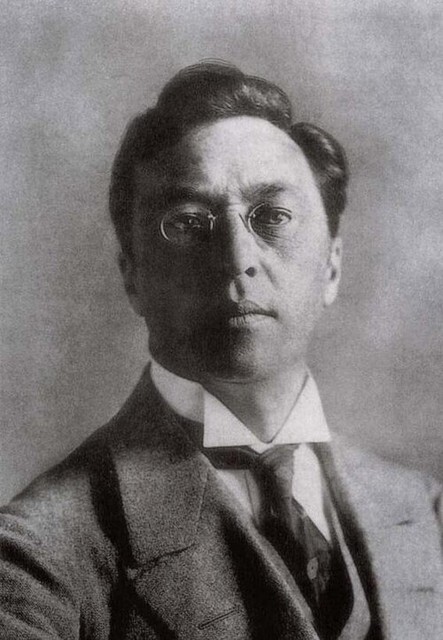
Artist portrait Image credit
未知上傳者. Image source · Public domain
About the artist
Wassily Kandinsky
1866 to 1944
Wassily Kandinsky was an avant-garde painter of Russian origin (1866–1944). Their work is associated with Expressionism; Symbolism; Bauhaus. Their recorded places of work include Paris; Munich; Weimar; Rapallo; The Hague; Russia; Stockholm; Switzerland; Tunis.
- Born
- 1866
- Died
- 1944
- Nationality
- Russian Empire; Russian Soviet Federative Socialist Republic; Soviet Union; France; Germany
- Birthplace
- Moscow
- Died in
- Neuilly-sur-Seine
Biography sources
The research & record
Study the work.
Follow the evidence.
Find catalogue details, historical context, technical research and the literature behind this artwork.
The artwork record
Research catalogue
Catalogue information and detailed research, with references that link to the bibliography.
Updated .
Identity and catalogue
Link- Title
- Ovale N°2
- Artist or attribution
- Wassily Kandinsky
- Object date
- 1925
- Medium and support
- Oil on board
- Dimensions
- 34,5 x 28,7 cm
- Current collection or location
- Musée national d'art moderne, Centre Pompidou, Paris, France
- Movement or period
- Bauhaus abstraction
- Country or culture
- Russian-born artist, French nationality from 1939
- Depicted subject
- Non-narrative abstract painting; the museum records its subject simply as abstraction, with geometric figures. The supplied sources do not describe its internal composition, so only the oval support and the abstraction keyword are documented.
- Title variants
- Oval #2; Ovale N°2; Ovale No 2; Ovale no 2
- Accession number
- AM 81-65-47
- Support
- Oval board
- Inscriptions
- Bottom centre: VK 25 in the artist's monogram form; On the back of the board, in Indian ink and pencil: VK N°3i2/i925/Oval N°2
Read valuation records and their limitations
Catalogue record and attribution
The Musée national d'art moderne, Centre Pompidou, records the work as Ovale N°2, a painting by Vassily Kandinsky dated 1925 and executed in oil on oval board. The same institutional record and the Wikimedia Commons file agree on the medium and on dimensions of 34.5 by 28.7 centimetres, and both give the inventory number AM 81-65-47; the Commons description adds that its image derives from Google Art & Culture. The museum classifies the subject as abstraction, with geometric figure among the iconographic keywords, and associates the work with the Bauhaus movement. These classificatory terms are the museum's descriptive apparatus rather than statements about a depicted narrative: they establish that the institution treats the painted surface itself, and the geometric vocabulary within it, as the subject of the work. The oval format is recorded as the shape of the support, so the curved edge belongs to the physical object and its construction, not merely to a frame around a rectangular field.(Roethel and Benjamin, 1984, Main title, creation date, techniques)(collection.centrepompidou.fr, n.d., Mots clés sujet: abstraction; mots clés iconographiques; Mots clés mouvement, mots clés iconographiques)(Wikimedia Commons: Oval #2, n.d., Description)
Two inscriptions are recorded on the object, and they differ in place and function. At bottom centre the painting bears the artist's monogram and date, VK 25, tying the signature to the year already given in the catalogue date. On the back of the board, in Indian ink and pencil, an inscription identifies the work as VK N°3i2/i925/Oval N°2. That reverse inscription is notable because it carries the work's number and title in the artist's own identifying system, and because it preserves a written form of the title that differs slightly from the museum's display title Ovale N°2. The catalogue title, the title written on the verso and the museum record's rendering should be kept distinct as recorded variants rather than collapsed into a single form.(Roethel and Benjamin, 1984, Inscriptions, MO.D.B.C.; Inscriptions, MO.N.D.T.R.)
Dates of creation and documentation
The 1925 date belongs to the making of the painting and is corroborated by the monogram inscription VK 25 and by the date element in the verso inscription. It should not be confused with the dates attached to the object by later documentation. The museum records that the painting entered the Musée national d'art moderne through the bequest of Nina Kandinsky in 1981, which is the date of its arrival in the collection and the origin of the AM 81-65-47 inventory number. The catalogue raisonné by Hans K. Roethel and Jean K. Benjamin, volume two, number 755, page 707, was published in 1984, and the Centre Pompidou Kandinsky exhibition in which the work appeared, catalogue number 334, ran in 1984 to 1985. Each of these dates documents a later event in the work's archival life, not its creation.(Roethel and Benjamin, 1984, Main title, creation date, techniques; Inscriptions, MO.D.B.C.; Inscriptions, MO.N.D.T.R.; Acquisition)(Wikimedia Commons: Oval #2, n.d., Description)
What the record establishes
Interpretation
Read together, the catalogue data, the two inscriptions and the museum's keywords describe an object whose identity is unusually well documented at the level of naming and dating, while the arrangement of forms on the surface is not specified in the supplied record. What the evidence establishes is the support, the medium, the dimensions, the signature and date, the verso inscription, the inventory number and the institutional classification. It does not describe individual shapes, colours or their placement, and the account should not fill that gap by inference. The significance of the work within a larger history of abstract art rests on what is documented: a 1925 oil on oval board by an artist then associated with the Bauhaus, signed and inscribed by him, later catalogued in the standard raisonné and preserved in the French national collection through the Kandinsky bequest.(Roethel and Benjamin, 1984, Main title, creation date, techniques; Inscriptions, MO.D.B.C.; Inscriptions, MO.N.D.T.R.; Acquisition)(collection.centrepompidou.fr, n.d., Mots clés sujet: abstraction; mots clés iconographiques; Mots clés mouvement, mots clés iconographiques)(Wikimedia Commons: Oval #2, n.d., Description)
Oval #2 is a painting by Vassily Kandinsky, dated 1925, in oil on oval board.(Roethel and Benjamin, 1984)
The museum classifies the painting's subject as abstraction, with the iconographic keyword geometric figure.(collection.centrepompidou.fr, n.d.)
The work bears the artist's monogram and date, VK 25, at bottom centre.(Roethel and Benjamin, 1984)
An inscription in Indian ink and pencil on the back of the board identifies the work as VK N°3i2/i925/Oval N°2.(Roethel and Benjamin, 1984)
The Wikimedia Commons file identifies the painting as oil on board, 34.5 by 28.7 cm, at the Musée national d'art moderne, accession AM 81-65-47, sourced from Google Art & Culture.(Wikimedia Commons: Oval #2, n.d.)
Historical context
LinkRead valuation records and their limitations
Institutional Classification and the Bauhaus Frame
The Musée national d'art moderne, Centre Pompidou, records this painting under the title Ovale N°2 and classifies its subject as abstraction, with the iconographic keyword geometric figure. The same record associates the work with the Bauhaus movement. These are the museum's descriptive categories rather than a narrative account of a scene, and they establish the terms within which the object is catalogued: an abstract composition whose identifying motif is geometric form, situated by the institution in relation to the Bauhaus.(collection.centrepompidou.fr, n.d., Mots clés mouvement, mots clés iconographiques)
The maker is identified as an artist born in Moscow in 1866 who died at Neuilly-sur-Seine in 1944 and became a French national in 1939. Those biographical dates and the change of nationality frame the working life within which the painting was produced, and they place the object in a career that began in imperial Russia and ended in wartime France. The museum's record supplies these facts as artist data; it does not, in the units available here, describe the circumstances of the commission or the household for which the work was made, and no patron or intermediary can be named from this evidence.(collection.centrepompidou.fr, n.d., Artist line)
Interpretation
Taken together, the evidence supports a secure identification of the object and a documented account of its entry into public custody, but it does not document the circumstances of its creation. The museum's classification of the work as abstraction with geometric figures and its association with the Bauhaus describe the painting's place in a movement and a pictorial category; they do not by themselves establish who commissioned it, what household or setting it was made for, or what function it served before 1981. The commissioning history therefore remains open on the supplied evidence, and the social world of the object can be described only at the level of the artist's career, the institutional categories applied to the work, and the later bequest that preserved it.(collection.centrepompidou.fr, n.d., Mots clés mouvement, mots clés iconographiques; Artist line)(Roethel and Benjamin, 1984, Acquisition)
The museum associates the work with the Bauhaus movement and with geometric figures.(collection.centrepompidou.fr, n.d.)
The artist was born in Moscow in 1866 and died in Neuilly-sur-Seine in 1944, becoming a French national in 1939.(collection.centrepompidou.fr, n.d.)
Materials and technique
LinkRead valuation records and their limitations
The documented support and medium
The institutional record for Oval #2 establishes the physical basis of the work before any question of imagery arises: it is oil on oval board, measuring 34.5 by 28.7 centimetres. Both the medium and the shape of the support are documented facts of the object rather than readings of its surface, and they set the terms for everything else the record and the catalogue literature supply. The oval is not a frame added around a rectangular picture; it is the cut shape of the board itself, so the painted field and its boundary coincide. Working in oil on a small, rounded panel of these dimensions placed the painter before a compact, bounded surface whose curved edge participated in the composition. What the record does not state is the preparation of the board, the number of layers, or the tools used, and those particulars should not be inferred from the visible result.(Roethel and Benjamin, 1984, Techniques, dimensions)
Interpretation
The evidence available here supports a distinction that matters for any account of technique. Dimensions and medium rest on the museum's own documentation, while the internal arrangement of forms is not described in the supplied record at all. The museum's iconographic keywords identify geometric figures and its subject description is simply abstraction, but neither statement specifies which shapes appear, how they are distributed, or how they were laid down. Claims about the handling of paint, the sequence of forms, or the relation of colour areas to one another would therefore exceed what these units establish. The secure technical account is narrow and exact: a small oval board painted in oil, with the geometric vocabulary attested only at the level of the institution's descriptive keywords.(Roethel and Benjamin, 1984, Techniques, dimensions)
The work carries the artist's monogram and date, VK 25, at bottom centre, and an inscription in Indian ink and pencil on the back of the board identifying it as VK N°3i2/i925/Oval N°2. These are material traces on the object, distinct in kind from the painted surface: an ink and pencil annotation applied to the reverse of the board, recording a number, a date and a title. The double marking, signed and dated on the front and inscribed on the back, links the physical panel to the title Oval N°2 by which the museum records it. The inscription is evidence of how the painter identified the board, not of how the paint was applied, and the two should not be conflated in a technical description.(Roethel and Benjamin, 1984, Techniques, dimensions)
Documentation and collection
The documented history of the object situates the materials within later scholarship and collection. The painting entered the Musée national d'art moderne through the bequest of Nina Kandinsky in 1981 and is held there under inventory number AM 81-65-47. It is cited and reproduced in the 1984 Kandinsky catalogue raisonné by Hans K. Roethel and Jean K. Benjamin, volume two, number 755, page 707, and it appeared in the Centre Pompidou's Kandinsky exhibition of 1984 to 1985 in Paris as catalogue number 334. These references establish that the board and its inscriptions have been catalogued and exhibited as the same object, but they do not in themselves add technical findings; the catalogue raisonné entry is recorded as cited in the museum record and not consulted directly here.(Roethel and Benjamin, 1984, Techniques, dimensions)
Interpretation
Read together, the documented units describe an object whose technical identity is firm at the level of support and medium and silent at the level of execution. The oval board, the oil medium, the dimensions, the monogram and date, and the ink and pencil inscription on the reverse are all attested; the preparation of the ground, the pigments, the brushes and the order of painting are not. This asymmetry is worth stating plainly because the oval format and the geometric vocabulary invite technical speculation that the evidence cannot carry. What the record does establish is a small painted panel dated 1925, signed by Kandinsky, titled on its back, and preserved with a full catalogue and exhibition history, which is the secure foundation on which any closer examination of its making would have to build.(Roethel and Benjamin, 1984, Techniques, dimensions)
The painting measures 34.5 by 28.7 centimetres and is oil on oval board.(Roethel and Benjamin, 1984)
Provenance and ownership
LinkRead valuation records and their limitations
The 1981 Bequest and the Inventory Number
The documented provenance of Oval No. 2 is short and begins with a single recorded transfer. The painting entered the Musée national d'art moderne through the bequest of Nina Kandinsky in 1981, and it is now held under inventory number AM 81-65-47. The institutional record gives 1981 as the year of entry and names Nina Kandinsky as the bequeathing party, but it states nothing about how the work passed from the artist to her, nor about any owner, dealer, gallery or sale before that bequest. The interval between the painting's making in 1925 and its arrival in the national collection in 1981 is therefore unrecorded in the supplied evidence. That gap should be treated as an absence of documentation, not as evidence that no transfer occurred; a bequest of this kind normally presupposes a prior holding by the testator, but the records cited here do not describe it.(Roethel and Benjamin, 1984, Acquisition)
The inventory number itself carries institutional information. The AM prefix identifies the Musée national d'art moderne, and the number is given identically in both institutional records consulted, so the identification of the work as a MNAM holding is consistent across sources rather than resting on a single entry. The bequest date and the acquisition route are the only provenance events the evidence establishes; no earlier owner, no intermediate transaction and no date of transfer other than 1981 can be asserted from these units.(Roethel and Benjamin, 1984, Acquisition)(collection.centrepompidou.fr, n.d., Mots clés mouvement, mots clés iconographiques)
Chronology and Its Gaps
Interpretation
Placing these events in chronological order clarifies what is documented and what is not. The artist, born in Moscow in 1866 and dying in Neuilly-sur-Seine in 1944, became a French national in 1939; the painting is dated 1925, the year written in the monogram and date VK 25 at bottom centre and echoed in the inscription on the back of the board. The documented institutional sequence then runs: bequest and entry into the Musée national d'art moderne in 1981; citation and reproduction in the Roethel and Benjamin catalogue raisonné in 1984; the Paris exhibition of 1984 to 1985; the Tübingen exhibition of 1999; and the Folklore presentations at Centre Pompidou-Metz and Mucem in 2020 to 2021. The decades between the painting's making and the 1981 bequest, and the periods between the listed exhibitions, remain unrecorded intervals rather than proven changes of ownership or proven continuous storage.(collection.centrepompidou.fr, n.d., Artist line; Expositions)(Roethel and Benjamin, 1984, Acquisition; Bibliography)
The museum's own classification connects the object to a wider art-historical context that bears on how its provenance is understood. The collection record associates the work with the Bauhaus movement and with geometric figures, and classifies its subject as abstraction with geometric figure among the iconographic keywords. This is institutional description rather than provenance in the strict sense, but it explains why a small oval board of 1925 has been treated as a significant holding: it belongs to the period of Kandinsky's Bauhaus teaching, and its documented entry into the French national collection, its catalogue raisonné placement and its repeated selection for loan exhibitions all reflect that valuation.(collection.centrepompidou.fr, n.d., Mots clés mouvement, mots clés iconographiques; Expositions)(Roethel and Benjamin, 1984, Acquisition; Bibliography)
The painting entered the Musée national d'art moderne through the bequest of Nina Kandinsky in 1981.(Roethel and Benjamin, 1984)
Provenance timeline
- 1981
The painting entered the Musée national d'art moderne through the bequest of Nina Kandinsky.(Roethel and Benjamin, 1984, Acquisition)
- 1984 to 1985
The painting was shown in the Centre Pompidou Kandinsky exhibition in Paris, catalogue number 334.(Roethel and Benjamin, 1984, Bibliography)
- 1999
It was shown at the Kunsthalle Tübingen in Kandinsky: Hauptwerke aus dem Centre Georges Pompidou, catalogue number 89.(collection.centrepompidou.fr, n.d., Expositions)
- 2020
It was included in Folklore at Centre Pompidou-Metz.(collection.centrepompidou.fr, n.d., Expositions)
- 2020 to 2021
It was included in Folklore at Mucem, Marseille.(collection.centrepompidou.fr, n.d., Expositions)
Exhibition history
LinkRead valuation records and their limitations
Documented exhibition history
The exhibition history of this oval painting is recorded in the collection file of the Musée national d'art moderne, Centre Pompidou, where it is held under inventory number AM 81-65-47. That history runs from a major Paris retrospective of the early 1980s to thematic displays of the 2020s, and it is documented separately from the question of how the work is shown today. The exhibition list belongs to the museum's own collection record for the exact object, the same record that classifies its subject as abstraction, names geometric figure among its iconographic keywords, and associates it with the Bauhaus. Exhibition data of this kind establishes where and when the painting was publicly displayed under a given catalogue number; it does not by itself describe the installation, the wall texts or the duration of any showing, and none of those details are supplied here. The record should therefore be read as a sequence of documented appearances rather than as a continuous account of the work's public life.(Roethel and Benjamin, 1984, Bibliography)(collection.centrepompidou.fr, n.d., Expositions)
The earliest of the documented appearances is the Centre Pompidou Kandinsky exhibition held in Paris in 1984 to 1985, where the painting was catalogue number 334. This dating places the display almost immediately after the work's entry into the national collections: the painting came to the Musée national d'art moderne through the bequest of Nina Kandinsky in 1981. The same period saw the publication of the standard catalogue raisonné of Kandinsky's paintings by Hans K. Roethel and Jean K. Benjamin, whose second volume appeared in 1984 with this work as number 755 on page 707. For research purposes these facts interlock. A reader consulting the 1984 to 1985 exhibition catalogue can expect entry 334 to correspond to the painting indexed in the raisonné as number 755, and the museum record confirms that the work is both cited and reproduced in that raisonné, although the catalogue itself is noted as not having been consulted directly in the preparation of this record. The convergence of bequest, raisonné and retrospective within a few years is the documentary foundation on which every later reference to the picture rests.(Roethel and Benjamin, 1984, Bibliography; Acquisition)
A second documented showing came in 1999, when the painting was included at the Kunsthalle Tübingen in the exhibition Kandinsky: Hauptwerke aus dem Centre Georges Pompidou, as catalogue number 89. The title of that exhibition is significant for how the object is understood. It framed the painting explicitly as a principal work drawn from the Paris collection, so the loan presented the picture not simply as one Kandinsky among many but as part of a selection of high points from the Musée national d'art moderne. The movement of the work from its permanent collection context into a German venue also returns it, at least geographically, to the country where the museum associates it with the Bauhaus. The evidence records the venue, year, title and catalogue number without describing the installation or the other works shown, so the Tübingen display can be cited as a documented loan but not reconstructed in detail from the supplied units.(collection.centrepompidou.fr, n.d., Expositions)
Two decades later the painting appeared in a thematic rather than monographic context. It was included in Folklore at Centre Pompidou-Metz in 2020 and then at Mucem in Marseille in 2020 to 2021. The exhibition title matters here because it frames the work through a different set of questions from those posed by a Kandinsky retrospective or a selection of collection masterpieces. A canvas classified by its museum as abstraction, with geometric figure among its iconographic keywords and associated with the Bauhaus, was presented within an exhibition devoted to folklore, and the evidence records the inclusion without stating the argument the exhibition made about the work. That gap should be respected. What the record establishes is the fact and the venue of the display, not the interpretation offered by the curators, and the grouping of an abstract Bauhaus-period painting under the heading Folklore is exactly the kind of juxtaposition that a reader should treat as a curatorial proposition to be examined rather than as a statement about the painting's subject.(collection.centrepompidou.fr, n.d., Expositions)
What the exhibition record establishes
Interpretation
Read together, the exhibition record shows a picture whose public life has been organised under three quite different rubrics: a national retrospective of the artist in the mid-1980s, a loan of collection highlights to Germany in 1999, and a cross-disciplinary thematic exhibition in Metz and Marseille in 2020 and 2021. Each appearance is tied to a catalogue number where the evidence supplies one, and none of the entries describes a change in the work's condition, frame or display format. The sequence is also distinct from the work's current display, which the supplied evidence does not document; the museum records establish ownership, inventory number and past exhibitions, not present installation. For the larger history of Kandinsky's reputation, the pattern is instructive. A painting made in 1925 and bequeathed to the French national collection in 1981 was, within a few years, both indexed in the standard raisonné and placed in a major retrospective, and it has since been used to represent the collection abroad and to test the artist's work against an unexpected theme. Exhibition history of this sort is evidence for reception as much as for display: it shows the institutional uses to which a small oval painting on board has been put, while leaving unrecorded the immediate circumstances of each showing.(Roethel and Benjamin, 1984, Bibliography; Acquisition)(collection.centrepompidou.fr, n.d., Expositions)
The painting appeared in the 1984 to 1985 Centre Pompidou Kandinsky exhibition in Paris, catalogue number 334.(Roethel and Benjamin, 1984)
It was shown at the Kunsthalle Tübingen in 1999 in Kandinsky: Hauptwerke aus dem Centre Georges Pompidou, catalogue number 89.(collection.centrepompidou.fr, n.d.)
It was included in Folklore at Centre Pompidou-Metz in 2020 and at Mucem, Marseille, in 2020 to 2021.(collection.centrepompidou.fr, n.d.)
Reception and literature
LinkRead valuation records and their limitations
Documentation and the catalogue raisonné
The documented reception of Ovale N°2 begins with the basic conditions under which the work could be recognised and studied: its inclusion in the standard reference literature on the artist. The painting is cited and reproduced in the 1984 Kandinsky catalogue raisonné compiled by Hans K. Roethel and Jean K. Benjamin, volume two, number 755, page 707. That entry places a small oil on oval board of 1925 within the full sequence of Kandinsky's painted work, where it can be compared with the canvases and boards of the same years. The museum record draws on this catalogue, so the work's place in the scholarly literature is not merely a footnote to its display history; it is the foundation on which later exhibition and catalogue notices rest. The catalogue itself was not consulted directly for this account, and the evidence here supplies its volume, entry number and page rather than its text or its discussion of the painting.(Roethel and Benjamin, 1984, Bibliography)
The painting is cited and reproduced in the 1984 Kandinsky catalogue raisonné by Hans K. Roethel and Jean K. Benjamin, volume two, number 755, page 707.(Roethel and Benjamin, 1984)
Collection and display
LinkRead valuation records and their limitations
Institutional identity and cataloguing
The painting known as Ovale N°2 (Oval #2) belongs to the Musée national d'art moderne, Centre Pompidou, under inventory number AM 81-65-47, a number recorded both in the museum's collection database entry and in the catalogue raisonné documentation cited by the museum. That inventory code, rather than any of the descriptive titles the work has carried, is what fixes the identity of the physical object within the national collection and links the museum's own records to the published catalogue entry. The museum record supplies the work's basic technical and historical framing: it treats the subject as abstraction, keywords it under geometric figure, and associates it with the Bauhaus, with which the museum connects its making. The same record gives the artist's biography in brief, noting that Kandinsky was born in Moscow in 1866, died at Neuilly-sur-Seine in 1944, and became a French national in 1939, facts that situate the painting's 1925 date within a life that moved between Russia, Germany and France.(collection.centrepompidou.fr, n.d., Inv.)(Roethel and Benjamin, 1984, Inventory no.)
The museum's collection database is the source for the exhibition history it records for this exact work. According to that record, the painting was shown at the Kunsthalle Tübingen in 1999 in the exhibition Kandinsky: Hauptwerke aus dem Centre Georges Pompidou, as catalogue number 89, and it was later included in Folklore at Centre Pompidou-Metz in 2020 and at Mucem, Marseille, in 2020 to 2021. These entries matter for the object's reception history because they show the painting travelling between very different framings: a loan exhibition of Kandinsky masterworks drawn from the Pompidou's own holdings, and a later thematic exhibition on folklore staged across two institutions. The record documents the loans without explaining the selection rationale, so the reasons the work suited the folklore theme are not established by the supplied evidence and should not be inferred here.(collection.centrepompidou.fr, n.d., Inv.)(Roethel and Benjamin, 1984, Inventory no.)
The same institutional record provides the biographical and bibliographic anchors that connect the object to wider scholarship. It states that Hans K. Roethel and Jean K. Benjamin cited and reproduced the painting in their 1984 catalogue raisonné of Kandinsky's paintings, volume two, number 755, page 707, and it places the work in the Centre Pompidou's own Kandinsky exhibition of 1984 to 1985 in Paris as catalogue number 334. The catalogue raisonné reference is a consequential form of documentation: it places the painting within the numbered corpus of Kandinsky's painted work, where the museum's inventory number sits alongside a scholarly number rather than replacing it. The exhibition entry, appearing in the same period as the catalogue volume, indicates that the painting was publicly shown in Paris in the mid-1980s, though the supplied evidence does not describe the hang, the checklist context or any critical response to that display.(collection.centrepompidou.fr, n.d., Inv.)(Roethel and Benjamin, 1984, Inventory no.)
Interpretation
Read together, these records establish a double life for the object: it is both a museum accession with a French national inventory number and a catalogued item in the international literature on Kandinsky. The inventory number AM 81-65-47 and the catalogue raisonné number 755 identify the same painting in different systems, and the museum record explicitly links them. The exhibition history the record preserves, spanning Tübingen in 1999 and the Metz and Marseille venues in 2020 to 2021, shows the work being mobilised for two quite distinct kinds of display, one monographic and one thematic. That the same canvas, or rather the same oval board, can serve both purposes is itself part of its significance: it is treated as a key work within Kandinsky's own development and also as an object that can be set beside broader cultural themes. The evidence supports the fact of these appearances and their catalogue numbers, but it does not supply installation details, lender agreements or reception, so the account stops at what the museum records.(collection.centrepompidou.fr, n.d., Inv.)(Roethel and Benjamin, 1984, Inventory no.)
The painting belongs to the Musée national d'art moderne, Centre Pompidou, with inventory number AM 81-65-47.(collection.centrepompidou.fr, n.d.)(Roethel and Benjamin, 1984)
Documented values and qualified estimates
LinkRead valuation records and their limitations
The working insurance estimate
Interpretation
The only valuation figure supplied is explicitly a model-generated working range, dated as a working calculation generated 2026-10-30, and given as US$2M to US$6M. Its stated methodology builds the range only from confirmed context: an authentic, catalogued 1925 oil on oval board by Wassily Kandinsky from his Bauhaus period, 34.5 by 28.7 cm, inventoried as AM 81-65-47 and cited in Roethel and Benjamin at cat. no. 755, held by the Musée national d'art moderne through the 1981 Nina Kandinsky bequest, and shown in several museum exhibitions. The reasoning is that a major museum-held Bauhaus-period oil by this artist would carry a high insurance figure, while the modest size and the board rather than canvas support argue for keeping the range on the lower side of what a museum-grade Kandinsky oil might command. No public sale, appraisal or insurance record is supplied, and no comparable sales or private insurance records were used or consulted, which is why the range is kept wide.(Roethel and Benjamin, 1984)(collection.centrepompidou.fr, n.d.)(Wikimedia Commons: Oval #2, n.d.)
The estimate carries qualifications that should travel with the number wherever it is repeated. It is a model-generated working range for manual review only and is not an official insurance value, a formal appraisal, an auction estimate, a sale price or a market valuation. The methodology states that a qualified fine-art appraiser or insurer should set any actual insurance value, and the range is intended only as a starting point for manual review by a qualified specialist. The evidence therefore establishes a documented object with a strong museum and catalogue record, and separately establishes a provisional, self-limiting numerical range that depends entirely on that record. The two should not be conflated: the catalogue entry, accession number and exhibition history are documented, while US$2M to US$6M is a generated planning figure whose authors and inputs are openly declared as limited.(Roethel and Benjamin, 1984)(collection.centrepompidou.fr, n.d.)(Wikimedia Commons: Oval #2, n.d.)
Working estimate
Calculated working insurance estimate, not a sale price: Working range: US$2M to US$6M Recorded date: Working calculation, generated 2026-10-30. Methodology: This is a broad, conservative working range built only from the confirmed context. The object is an authentic, catalogued 1925 oil on oval board by Wassily Kandinsky, from his Bauhaus period, 34.5 x 28.7 cm, inventoried as AM 81-65-47 and cited in the Roethel and Benjamin catalogue raisonne (cat. no. 755). It belongs to the Musee national d'art moderne, Centre Pompidou, having entered through the Nina Kandinsky bequest of 1981, and has been shown in several museum exhibitions. A major museum-held Bauhaus-period oil by this artist would carry a high insurance figure. Because it is small and on board rather than a large canvas, and because no public sale, appraisal, or insurance record is supplied, the range is kept wide and on the lower side of what a museum-grade Kandinsky oil might command. It is intended only as a starting point for manual review by a qualified specialist. Qualification: Model-generated working range for manual review only. This is not an official insurance value, a formal appraisal, an auction estimate, a sale price, or a market valuation. No comparable sales or private insurance records were used or consulted. A qualified fine-art appraiser or insurer should set any actual insurance value.(Roethel and Benjamin, 1984)(collection.centrepompidou.fr, n.d.)(Wikimedia Commons: Oval #2, n.d.)
Further reading
Books for a closer look
Paid links. As an Amazon Associate I earn from qualifying purchases.

Open Library Kandinsky: Russian and Bauhaus years, 1915-1933.
Solomon R. Guggenheim Museum
A catalogue titled Kandinsky whose recorded subjects include Abstract Art, Abstract Painting, Catalogs, Exhibitions, Centre Georges Pompidou, Musee national d'art moderne, Bauhaus and Catalogues raisonnes. Those subjects connect directly to this 1925 Bauhaus-period abstraction in the Musee national d'art moderne, Centre Pompidou, and the record's exhibition and catalogue themes make it the most object-adjacent candidate. Contents were not consulted.
ISBN 0892070447

Open Library Concerning the spiritual in art
Dover Publications
Kandinsky's Concerning the Spiritual in Art, recorded under Aesthetics and Modern Painting with the artist as subject. It is relevant as the artist's primary statement on non-narrative abstract painting, matching the museum's documented subject of abstraction. This is background to the artist, not a study of Oval No. 2 itself, and its text was not consulted.
ISBN 0486234118
Bibliography
Sources and further reading
References are arranged by author or organisation, with links to the original publications. Where no publication date is recorded, n.d. means no date.
Source notes updated .
No recorded sources match these filters. Reset the filters to see the full bibliography.
- 03
Official · About this artwork
Institutional record for Oval #2. Musée national d'art moderne, Ovale N°2, collection record.
Collection database entry with the museum's subject, movement and iconographic keywords and the exhibition list for the exact work.
- Language
- French
Citation text
- 02
Official · About this artwork
Institutional record for Oval #2. Kandinsky. Catalogue raisonné de l'oeuvre peint. Deuxième volume 1916-1944, 2, pp. cat. no. 755, p. 707. www.centrepompidou.fr.
Catalogue raisonné entry for the exact painting, cited in the museum record; not consulted directly here.
- Language
- French
- ISBN
- 2-900971-00-4
Citation text
- 05
Book
Concerning the spiritual in art. Dover Publications.
Kandinsky's Concerning the Spiritual in Art, recorded under Aesthetics and Modern Painting with the artist as subject. It is relevant as the artist's primary statement on non-narrative abstract painting, matching the museum's documented subject of abstraction. This is background to the artist, not a study of Oval No. 2 itself, and its text was not consulted.
- ISBN
- 0486234118
Citation text
- 04
Book
Kandinsky: Russian and Bauhaus years, 1915-1933. Solomon R. Guggenheim Museum.
A catalogue titled Kandinsky whose recorded subjects include Abstract Art, Abstract Painting, Catalogs, Exhibitions, Centre Georges Pompidou, Musee national d'art moderne, Bauhaus and Catalogues raisonnes. Those subjects connect directly to this 1925 Bauhaus-period abstraction in the Musee national d'art moderne, Centre Pompidou, and the record's exhibition and catalogue themes make it the most object-adjacent candidate. Contents were not consulted.
- ISBN
- 0892070447
Citation text
- 01
Secondary · About this artwork
Wikimedia Commons: Oval #2 (n.d.). Wikimedia Commons, Kandinsky, Ovale No 2, 1925 (Google Art & Culture). Wikimedia Commons.
Discovery source; agrees with the museum record on title, date, medium, dimensions and accession.
- Language
- English
Citation text
Art to live with
Bring this painting
home.
A piece of the archive, made yours. Explore Ovale N°2 in a size and finish that fits your space.
Your text and annotations appear on these editions. Adding to cart saves that design for printing.
Combine this painting with your favourites01 / Find your edition
Made for you
Suggested from your location. Change it if you're sending elsewhere or using a VPN. Prices and delivery are shown in GBP.
1 product
Choose an edition to make it yours
iPhone 12 Mini ? Glossy ? back view
iPhone 12 Mini · Glossy

iPhone 12 Mini ? Glossy ? back view

iPhone 12 Mini ? Glossy ? back view

iPhone 12 Mini ? Glossy ? back view
Tough phone case
GBP 16.34
Delivery GBP 4.22 / Total GBP 20.56
A two-layer phone case with a printed polycarbonate shell and a shock-absorbing inner liner.
Two layers with a shock-absorbing TPU liner
Case & print details
- Device
- Apple · iPhone 12 Mini
- Material
- Polycarbonate shell with a TPU inner liner
- Artwork
- Outer back and wrapped edges from one template
- Finish
- Glossy
- Version
- Standard version
- Printing
- Dye sublimation
- Print file
- 1,122 × 1,831 px · 95 × 155 mm · PNG · 300 dpi recommended
Rear outline and camera openings follow this variant's Printify template. Case depth and small hardware remain illustrative.
Supplier product detailsFit and fill keep the painting’s proportions. Stretch changes them.
Move and zoom the painting on your tough phone case.
Made to order with your design
Made to order
US delivery only
The 30 cm ruler is scaled alongside your selected print. Keep the painting’s proportions with a black background, or stretch it to fill. Frame width, material texture and screen colours are illustrative.
Keep exploring