On the Shore (Am Ufer)
Artist: Wassily Kandinsky · circa 1903

On the Shore (Am Ufer): high-resolution image
The original file is hosted by Wikimedia Commons, available without payment or an account.
Open high-resolution image on Wikimedia CommonsThe complete story
The story About 3 minutes to read
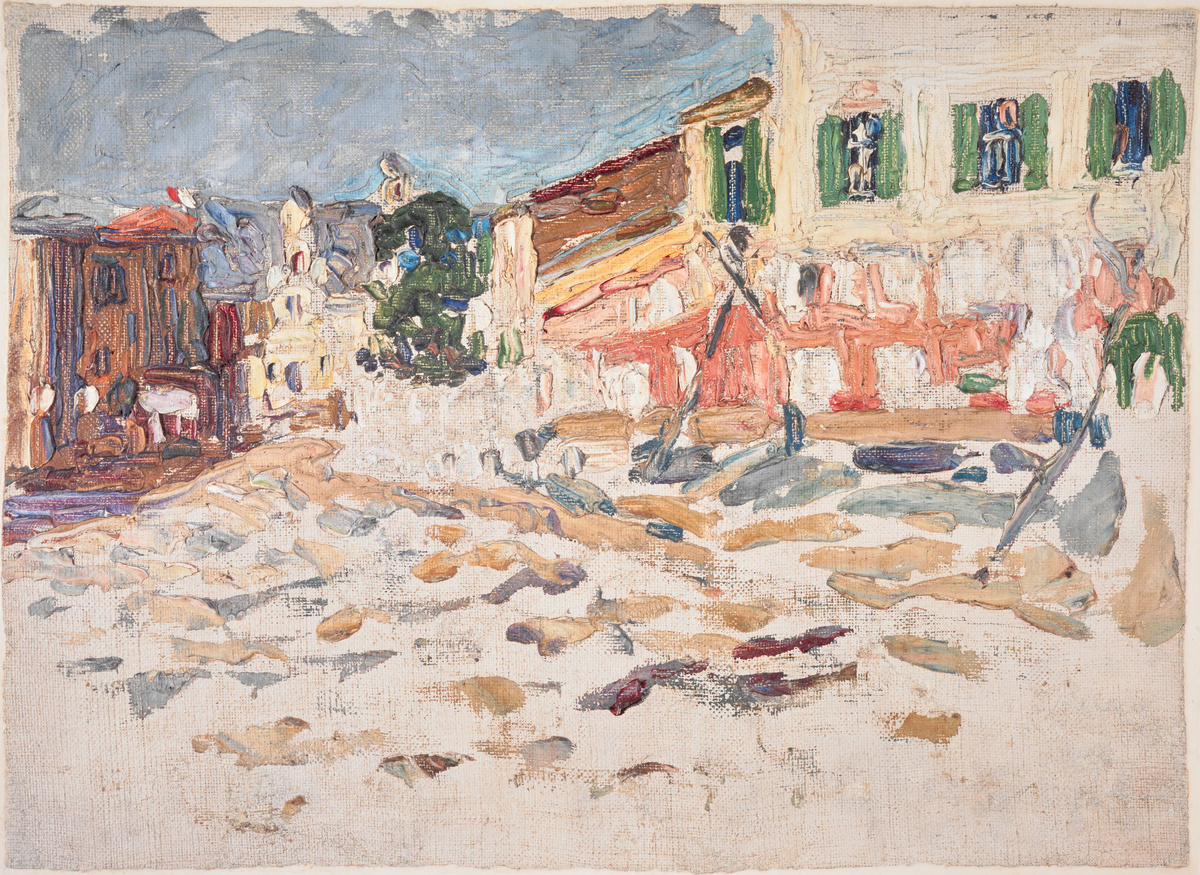
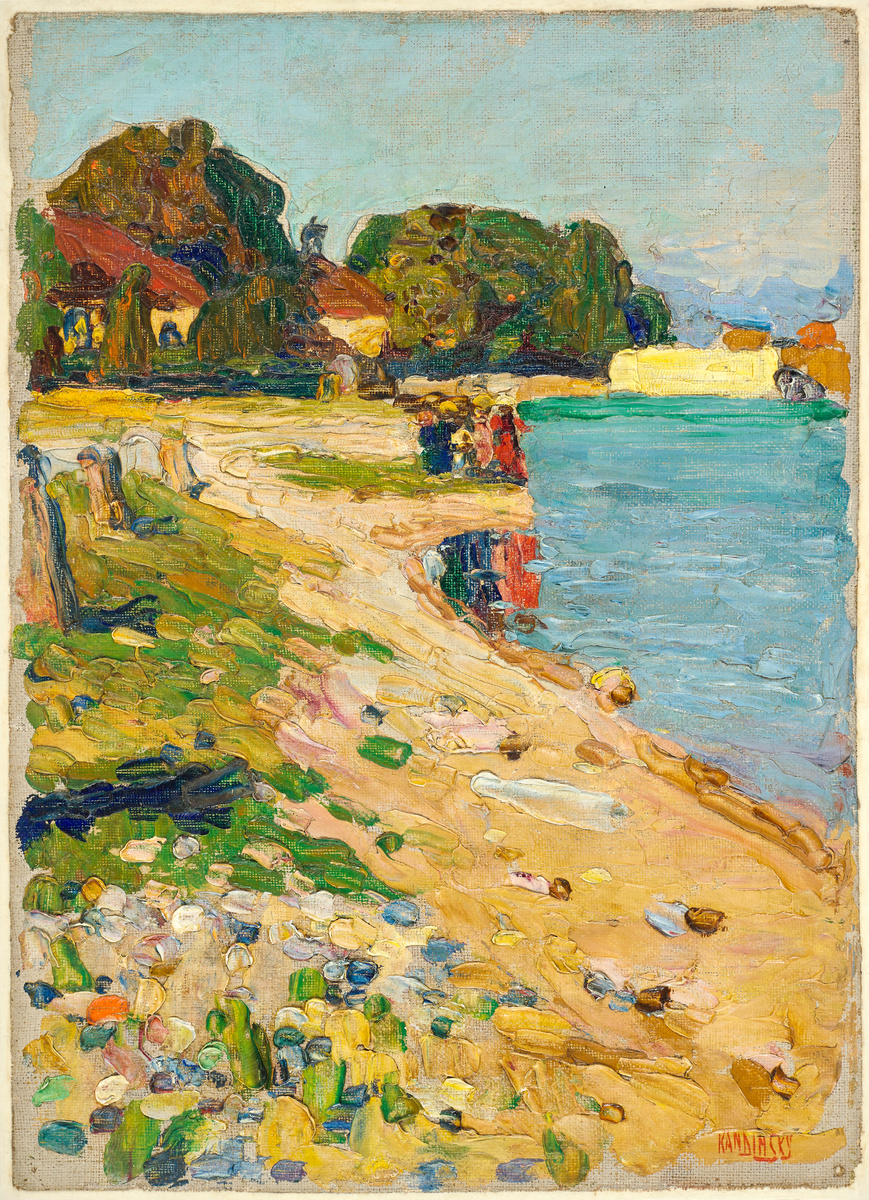
This small painting shows a coastal scene, with tiny figures in bright clothes gathered at the water's edge. Behind them, red-roofed cottages sit below a wooded hill, and a broad stretch of beach and sea opens out. Kandinsky painted it around 1903, early in his career, and it is called On the Shore.
The figures form the main human incident. Their small scale against the wide beach makes the landscape feel large and open. Look at how they are painted: dark blue and red vertical strokes below them read as reflections in the water. The same broken colour links the figures to the sea.
In the lower foreground, thick, separately laid strokes of green, ochre, blue and white describe stones and grass. The surface is tactile, almost mosaic-like. At the upper left, the red roofs and dense green hill give the picture a dark tonal anchor. On the far bank, a bright yellow horizontal form, likely a building or beached boat, is the strongest high-value accent across the blue water.
The painting is oil on canvas board. That support helps explain the intimate scale and the freedom of the brushwork. It belongs to Kandinsky's early Post-Impressionist period, before the abstract works for which he became known. Here he is still describing a real place, but with a technique that lets colour and touch carry much of the effect.
The broken strokes do more than describe textures. They unify the scene: the figures, their reflections, the beach and the water are all made of similar marks. That makes the human incident feel part of the landscape rather than separate from it. The bright yellow accent across the water also frames the bay, giving the eye a resting point.
So On the Shore is a coastal view, but also a study in how paint builds a world. The small figures at the water's edge are not just staffage; they anchor the scale and draw the eye into the reflections. Kandinsky's early attention to surface and colour here looks forward to the expressive freedom of his later work, while keeping the landscape legible.
The story and its sources
Historical claims are linked to the records below. Close looking and interpretation are identified in the passage notes.
- Passage 1Close lookingWikimedia Commons: Shore
- Passage 2Close lookingWikimedia Commons: Shore
- Passage 3Close lookingWikimedia Commons: Shore
- Passage 4Documented historyWikimedia Commons: Shore
- Passage 5InterpretationWikimedia Commons: Shore
- Passage 6InterpretationWikimedia Commons: Shore
Details to notice
About 2 minutes to readArtist signature
The orange-red surname KAMENSKY is visible at the lower right, providing the key internal evidence for the proposed attribution.
Yellow far-shore structure
A bright yellow horizontal form on the far bank, likely a building or beached boat, creates the strongest high-value accent across the blue water and frames the bay.
Reflections in the water
Dark blue and red vertical strokes below the group read as their reflection in the water, showing how the painter unifies figures and sea through broken color.
Artist portrait Image credit
未知上傳者. Image source · Public domain
About the artist
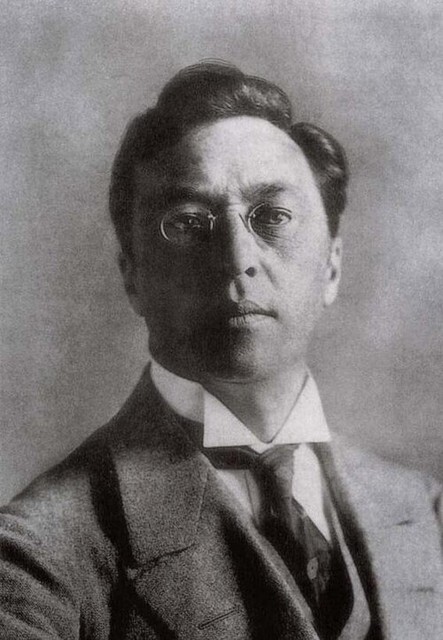
Wassily Kandinsky
1866 to 1944
Wassily Kandinsky was an avant-garde painter of Russian origin (1866–1944). Their work is associated with Expressionism; Symbolism; Bauhaus. Their recorded places of work include Paris; Munich; Weimar; Rapallo; The Hague; Russia; Stockholm; Switzerland; Tunis.
- Born
- 1866
- Died
- 1944
- Nationality
- Russian Empire; Russian Soviet Federative Socialist Republic; Soviet Union; France; Germany
- Birthplace
- Moscow
- Died in
- Neuilly-sur-Seine
Biography sources
The research & record
Study the work.
Follow the evidence.
Find catalogue details, historical context, technical research and the literature behind this artwork.
The artwork record
Research catalogue
Catalogue information and detailed research, with references that link to the bibliography.
Updated .
Identity and catalogue
Link- Title
- On the Shore (Am Ufer)(Wikimedia Commons: Shore, n.d.)
- Artist or attribution
- Wassily Kandinsky
- Object date
- circa 1903
- Medium and support
- oil on canvas board(Wikimedia Commons: Shore, n.d.)
- Dimensions
- 32 x 22.9 cm(Wikimedia Commons: Shore, n.d.)
- Current collection or location
- Musée National d'Art Moderne, Centre Georges Pompidou, Paris, France(Wikimedia Commons: Shore, n.d.)
- Movement or period
- Post-Impressionism (early Kandinsky)
- Country or culture
- Russia / Germany (artist), France (collection)
- Depicted subject
- A coastal scene with small, brightly dressed figures at the water's edge, red-roofed cottages below a wooded hill, and a broad expanse of water and beach, painted in a broken, impasto technique.(Wikimedia Commons: Shore, n.d.)
- Title variants
- Shore; On the Shore; Rivage
- Accession number
- AM 81-65-26
- Support
- canvas board
Read valuation records and their limitations
Catalogue identity
The object is catalogued as "On the Shore" (Am Ufer), attributed to Wassily Kandinsky and dated circa 1903. The title is recorded in both English and German, and the circa qualifier marks the date as approximate rather than fixed to a single year. This catalogue identity, together with the attribution, is the frame within which any further examination of the work takes place; the approximately 1903 date belongs to the object as catalogued and should be kept distinct from any later catalogue, file or reference date attached to the record itself, which the supplied evidence does not give.(Wikimedia Commons: Shore, n.d., File title and description)
The recorded dimensions are 32 cm in height and 22.9 cm in width. The slightly greater height gives the picture a portrait-oriented format, and the modest measurements place it among small-scale works. These figures are the catalogue's measurements, recorded alongside the title and date in the same descriptive record.(Wikimedia Commons: Shore, n.d., Dimensions)
The painting is titled 'On the Shore' (Am Ufer) by Wassily Kandinsky, dated circa 1903.(Wikimedia Commons: Shore, n.d.)
The dimensions are 32 cm in height and 22.9 cm in width.(Wikimedia Commons: Shore, n.d.)
Subject and iconography
LinkRead valuation records and their limitations
The recorded composition
Visual observation
The visual evidence for this coastal painting is recorded as a set of observed features rather than as documented identifications: small, brightly dressed figures clustered at the water's edge, red-roofed cottages beneath a wooded hill, a foreground of separately laid strokes, reflections rendered in dark blue and red, and a bright yellow horizontal form on the far bank. These observations derive from the vision-derived semantic focus candidates recorded for the work in the Wikimedia Commons file page for Kandinsky's 'Am Ufer', and they should be treated as descriptive readings of the image rather than as facts confirmed by an official museum record, since that page is used as a discovery aid and no official museum record was supplied.(Wikimedia Commons: Shore, n.d., Vision-derived semantic focus candidates, figures_at_waters_edge; Vision-derived semantic focus candidates, cottages_below_wooded_hill; Vision-derived semantic focus candidates, impasto_pebble_cluster; Vision-derived semantic focus candidates, figures_reflected_in_water; Vision-derived semantic focus candidates, yellow_far_shore_structure)
The human incident in the picture is small in scale but central in attention. The figures are described as clustered at the water's edge in bright dress, and they function simultaneously as the main narrative event and as a scale marker against the broad beach. Read together with the red-roofed cottages and the dense green wooded hill at the upper left, the figures establish the coastal village setting, while the hill and roofs supply the picture's dark tonal anchor against which the lighter beach, water and sky are measured. The yellow horizontal form on the far bank, described as likely a building or a beached boat, is the strongest high-value accent across the blue water and effectively frames the bay. That form is an identification offered with qualification: the record says what it is likely to be, not what it demonstrably is, and it should be cited as such.(Wikimedia Commons: Shore, n.d., Vision-derived semantic focus candidates, figures_at_waters_edge; Vision-derived semantic focus candidates, cottages_below_wooded_hill; Vision-derived semantic focus candidates, yellow_far_shore_structure)
Paint handling and reflection
The surface is described as having thick, separately laid strokes of green, ochre, blue and white in the lower foreground, marking stones and grass and producing a tactile, mosaic-like quality. The same broken colour is used for the reflections: dark blue and red vertical strokes below the cluster of figures read as their reflection in the water. The observation therefore links two registers of the picture, the landscape ground and the human incident, through a shared handling of paint. The medium recorded for the work is oil on canvas board, a support consistent with the intimate dimensions of the picture, though the vision-derived observations themselves describe surface effect and do not establish the support independently.(Wikimedia Commons: Shore, n.d., Vision-derived semantic focus candidates, impasto_pebble_cluster; Vision-derived semantic focus candidates, figures_reflected_in_water; Description)
Interpretation
The value structure described in the record is worth stating as a relation rather than as a list of parts: the red roofs and dense green hill form the darkest mass; the broad beach and blue water open the middle of the picture; and the yellow form on the far bank supplies the strongest high-value accent. The dark upper-left anchor and the bright far-bank accent together direct the eye across the bay, so that the small cluster of figures at the water's edge sits between the two poles of the composition. This reading is an interpretation of the recorded observations rather than a claim about the painter's intention.(Wikimedia Commons: Shore, n.d., Vision-derived semantic focus candidates, figures_at_waters_edge; Vision-derived semantic focus candidates, cottages_below_wooded_hill; Vision-derived semantic focus candidates, yellow_far_shore_structure)
Observation and identification
Visual observation
The yellow form is the clearest instance in this evidence of the gap between observation and identification. It is described as a bright yellow horizontal form on the far bank, likely a building or beached boat; the record does not resolve which. Similarly, the reflections are read as such from their position and colour rather than chemically or optically confirmed, and the foreground strokes are described as reading as stones and grass. These are visual readings derived from the vision-derived semantic focus candidates, and they retain the uncertainty of semantic description rather than the authority of technical analysis. No technical imaging, pigment analysis or conservation record is supplied in this evidence, so changes in appearance over time cannot be documented here.(Wikimedia Commons: Shore, n.d., Vision-derived semantic focus candidates, impasto_pebble_cluster; Vision-derived semantic focus candidates, figures_reflected_in_water; Vision-derived semantic focus candidates, yellow_far_shore_structure)
The painting depicts a coastal scene with small, brightly dressed figures clustered at the water's edge, forming the main human incident and a scale marker against the broad beach.(Wikimedia Commons: Shore, n.d.)
Red-roofed cottages sit beneath a dense green wooded hill at the upper left, establishing the coastal village setting and the picture's dark tonal anchor.(Wikimedia Commons: Shore, n.d.)
Thick, separately laid strokes of green, ochre, blue and white describe stones and grass in the lower foreground, revealing the painting's tactile, mosaic-like surface.(Wikimedia Commons: Shore, n.d.)
Dark blue and red vertical strokes below the cluster of figures read as their reflection in the water, showing how the painter unifies figures and sea through broken colour.(Wikimedia Commons: Shore, n.d.)
A bright yellow horizontal form on the far bank, likely a building or beached boat, creates the strongest high-value accent across the blue water and frames the bay.(Wikimedia Commons: Shore, n.d.)
Materials and technique
LinkRead valuation records and their limitations
Support and medium
The documented material basis of the painting is narrow but firm: the work is executed in oil on canvas board. This is the only support and medium recorded in the available description, which supplies no further information about the ground, the priming, the thickness or weave of the canvas, the dimensions or construction of the board, or any varnish, retouching or conservation treatment. The description also does not record pigments, binding media analysis, sampling, imaging, or any other technical examination. Any account of how the paint was prepared or layered therefore rests on what the painted surface visibly shows rather than on laboratory or documentary evidence, and the two kinds of statement should be kept distinct.(Wikimedia Commons: Shore, n.d., Description)
Broken colour and surface
Interpretation
The figures at the water's edge are painted in bright clothing and clustered at the shoreline, forming the main human incident and a scale marker against the broad beach. Their small scale, set against the wide beach and the broken strokes of the shore, means the human incident is described with the same kind of mark as the landscape around it rather than modelled in separate, finer detail. Within a history of coastal painting this matters because it shows a small, rapidly worked oil on board being used to test how far descriptive texture and divided colour could carry a scene, while the subject remained a legible shore with identifiable figures, cottages and a bay. The evidence available documents the medium and the visible handling; it does not document the artist's intentions, working sequence or the place depicted beyond the generic coastal setting the image itself presents.(Wikimedia Commons: Shore, n.d., Description; Vision-derived semantic focus candidates, figures_at_waters_edge)
The medium is oil on canvas board.(Wikimedia Commons: Shore, n.d.)
Collection and display
LinkRead valuation records and their limitations
Institutional location
The painting known as On the Shore (Am Ufer) is recorded as belonging to the Musée National d'Art Moderne, Centre national d'art et de culture Georges-Pompidou, Paris, where it carries the accession number AM 81-65-26. That single, specific piece of collection data is the firmest institutional fact the available evidence supplies. The source that records it is a Wikimedia Commons file page, and its own annotation describes it as a discovery aid rather than an official museum record. The collection and accession number should therefore be treated as an attributed report from that page, not as a confirmation drawn directly from the museum's own catalogue. The same page is also the origin of the title, the attribution to Wassily Kandinsky and the approximate date of circa 1903, so the object's basic identification and its institutional home come from one and the same secondary source.(Wikimedia Commons: Shore, n.d., Collection and accession number)
Reading the collection record alongside the physical description in the same source shows why the object's display context matters. The page records oil on canvas board at 32 cm in height by 22.9 cm in width, an intimate scale that sits comfortably with the reduced dimensions of a museum collection number and with the freedom of handling described in the image. The canvas-board support and the small format help explain the thick, separately laid strokes of green, ochre, blue and white in the lower foreground, where stones and grass are built up as a tactile, mosaic-like surface. The material facts and the visual facts reinforce one another: the picture was made to be held close as much as to fill a wall, and its broken colour is legible at that distance.(Wikimedia Commons: Shore, n.d., Collection and accession number)
The visible object and its record
The compositional description on the same page adds a further reason the work rewards close viewing in a collection setting. Small, brightly dressed figures cluster at the water's edge and serve at once as the main human incident and as a scale marker against the broad beach. Red-roofed cottages sit beneath a dense green wooded hill at the upper left and give the picture its dark tonal anchor, while a bright yellow horizontal form on the far bank, probably a building or a beached boat, is the strongest high-value accent across the blue water and frames the bay. Dark blue and red vertical strokes below the figures read as their reflection, so that figures and sea are unified through broken colour. Together these features describe a coastal village view in which paint handling, rather than narrative incident, carries much of the effect.(Wikimedia Commons: Shore, n.d., Collection and accession number)
Interpretation
Because the only supplied evidence is a Commons page marked partially consulted, the collection account should be built to accommodate whatever an official museum record might add or revise. Dates, medium, dimensions and accession number all currently rest on that one secondary source, and no provenance interval, acquisition date, gallery history or display history is established by the evidence supplied. The value of the object within a larger history of material culture is nonetheless clear enough from what is documented: a small oil on canvas board of about 1903, held in a major national modern art collection under an identifiable accession number, and described as an early coastal landscape in which the handling of paint is as consequential as the place depicted. That combination of modest scale, institutional standing and painterly ambition is itself a meaningful fact about how early twentieth-century landscape painting entered public collections.(Wikimedia Commons: Shore, n.d., Collection and accession number)
The painting is in the collection of the Musée National d'Art Moderne, Centre national d'art et de culture Georges-Pompidou, Paris, with accession number AM 81-65-26.(Wikimedia Commons: Shore, n.d.)
Documented values and qualified estimates
LinkRead valuation records and their limitations
The Recorded Valuation Figure
Interpretation
The only value figure supplied for Wassily Kandinsky's painting On the Shore (Am Ufer) is not a market record. It is a calculated working insurance estimate, recorded as a working calculation generated on 2026-10-30, giving a broad range of US$1.5M to US$4M. The methodology described in that calculation builds the bracket from four object-specific factors: the confirmed attribution to Kandinsky, the early date circa 1903, the medium of oil on canvas board, and the modest scale of 32 by 22.9 cm. To these it adds institutional context, since the work is held in a major public collection, the Musee National d'Art Moderne, Centre Georges Pompidou, Paris, under accession number AM 81-65-26, and it places the picture within an early Post-Impressionist period. The range is described as deliberately wide so that it does not imply precision.(Wikimedia Commons: Shore, n.d.)
The qualifications attached to this figure are as consequential as the figure itself. The calculation states explicitly that the supplied excerpt contains no market price, appraisal, or private insurance figure, and that the range does not rely on comparable sales or private insurance records. It is characterized as model-generated and intended for manual review only, not as an official insurance value, appraisal, auction result, or sale price, and it is said to require verification by a qualified professional before any insurance or financial use. Read together, these statements place the number in the category of an internal working heuristic rather than a documented valuation event: no sale, no appraisal, and no insurer's schedule stands behind it in the evidence supplied.(Wikimedia Commons: Shore, n.d.)
The Descriptive Basis
Within the larger history of valuation, the case illustrates how a working range can be derived from documented attributes without any transaction behind it. The attribution, the circa 1903 date, the oil-on-canvas-board medium, the small dimensions, and the public collection each contribute stated support to the bracket, yet the calculation itself insists that these premises support only a conservative bracket for manual review. The evidentiary chain therefore runs from a discovery-level description of the object to a model-generated financial heuristic, and the intermediate documents that would normally anchor a valuation, such as an appraisal, an auction record, or an insurer's figure, are expressly absent from the supplied material.(Wikimedia Commons: Shore, n.d.)
Working estimate
Calculated working insurance estimate, not a sale price: Estimated value: US$1.5M to US$4M Recorded date: Working calculation, generated 2026-10-30. Methodology: Broad working range calculated from the confirmed attribution, early date circa 1903, oil on canvas board medium, and modest 32 x 22.9 cm scale. The work is held in a major public collection, the Musee National d'Art Moderne, Centre Georges Pompidou, Paris, with accession number AM 81-65-26. The institutional context and early Post-Impressionist period support a conservative insurance-calculation bracket for manual review, but the supplied excerpt does not provide a market price, appraisal, or private insurance figure. The range is deliberately wide to avoid implying precision. Qualification: This is a model-generated working insurance range for manual review only. It is not an official insurance value, appraisal, auction result, or sale price. The range does not rely on comparable sales or private insurance records and should be verified by a qualified professional before any insurance or financial use.(Wikimedia Commons: Shore, n.d.)
Further reading
Books for a closer look
Paid links. As an Amazon Associate I earn from qualifying purchases.

Open Library Kandinsky: Russian and Bauhaus years, 1915-1933.
Solomon R. Guggenheim Museum
A catalogue of writings by Wassily Kandinsky whose recorded subjects include Catalogs, Centre Georges Pompidou, Musée national d'art moderne (Paris), and criticism and interpretation. This aligns with the painting's documented collection at the Musée National d'Art Moderne, Centre Pompidou, and with study of Kandinsky's early work. The record describes a catalogue, not a verified discussion of On the Shore.
ISBN 0892070447

Open Library Kandinsky, complete writings on art
G.K. Hall
Recorded as Kandinsky's complete writings on art, with subjects modern art and twentieth-century art. As the artist's own collected texts, it is relevant to the artist behind On the Shore (circa 1903) and to the period context of his painting theory and practice, though the catalogued record does not confirm mention of this specific canvas.
ISBN 0805799508
Bibliography
Sources and further reading
References are arranged by author or organisation, with links to the original publications. Where no publication date is recorded, n.d. means no date.
Source notes updated .
No recorded sources match these filters. Reset the filters to see the full bibliography.
- 03
Book
Kandinsky, complete writings on art. G.K. Hall.
Recorded as Kandinsky's complete writings on art, with subjects modern art and twentieth-century art. As the artist's own collected texts, it is relevant to the artist behind On the Shore (circa 1903) and to the period context of his painting theory and practice, though the catalogued record does not confirm mention of this specific canvas.
- ISBN
- 0805799508
Citation text
- 02
Book
Kandinsky: Russian and Bauhaus years, 1915-1933. Solomon R. Guggenheim Museum.
A catalogue of writings by Wassily Kandinsky whose recorded subjects include Catalogs, Centre Georges Pompidou, Musée national d'art moderne (Paris), and criticism and interpretation. This aligns with the painting's documented collection at the Musée National d'Art Moderne, Centre Pompidou, and with study of Kandinsky's early work. The record describes a catalogue, not a verified discussion of On the Shore.
- ISBN
- 0892070447
Citation text
- 01
Secondary · About this artwork
Wikimedia Commons: Shore (n.d.). Wikimedia Commons.
Wikimedia Commons file page for Kandinsky's 'Am Ufer', providing title, artist, date, medium, dimensions, collection and accession number. Used as a discovery aid; no official museum record was supplied.
Citation text
Art to live with
Bring this painting
home.
A piece of the archive, made yours. Explore On the Shore (Am Ufer) in a size and finish that fits your space.
Your text and annotations appear on these editions. Adding to cart saves that design for printing.
Combine this painting with your favourites01 / Find your edition
Made for you
Suggested from your location. Change it if you're sending elsewhere or using a VPN. Prices and delivery are shown in GBP.
1 product
Choose an edition to make it yours
iPhone 12 Mini ? Glossy ? back view
iPhone 12 Mini · Glossy

iPhone 12 Mini ? Glossy ? back view

iPhone 12 Mini ? Glossy ? back view

iPhone 12 Mini ? Glossy ? back view
Tough phone case
GBP 16.34
Delivery GBP 4.22 / Total GBP 20.56
A two-layer phone case with a printed polycarbonate shell and a shock-absorbing inner liner.
Two layers with a shock-absorbing TPU liner
Case & print details
- Device
- Apple · iPhone 12 Mini
- Material
- Polycarbonate shell with a TPU inner liner
- Artwork
- Outer back and wrapped edges from one template
- Finish
- Glossy
- Version
- Standard version
- Printing
- Dye sublimation
- Print file
- 1,122 × 1,831 px · 95 × 155 mm · PNG · 300 dpi recommended
Rear outline and camera openings follow this variant's Printify template. Case depth and small hardware remain illustrative.
Supplier product detailsFit and fill keep the painting’s proportions. Stretch changes them.
Move and zoom the painting on your tough phone case.
Made to order with your design
Made to order
US delivery only
The 30 cm ruler is scaled alongside your selected print. Keep the painting’s proportions with a black background, or stretch it to fill. Frame width, material texture and screen colours are illustrative.
Keep exploring