Nymphenburg
Artist: Vassily Kandinsky · 1904

Nymphenburg: high-resolution image
The original file is hosted by Wikimedia Commons, available without payment or an account.
Open high-resolution image on Wikimedia CommonsThe complete story
The story About 3 minutes to read
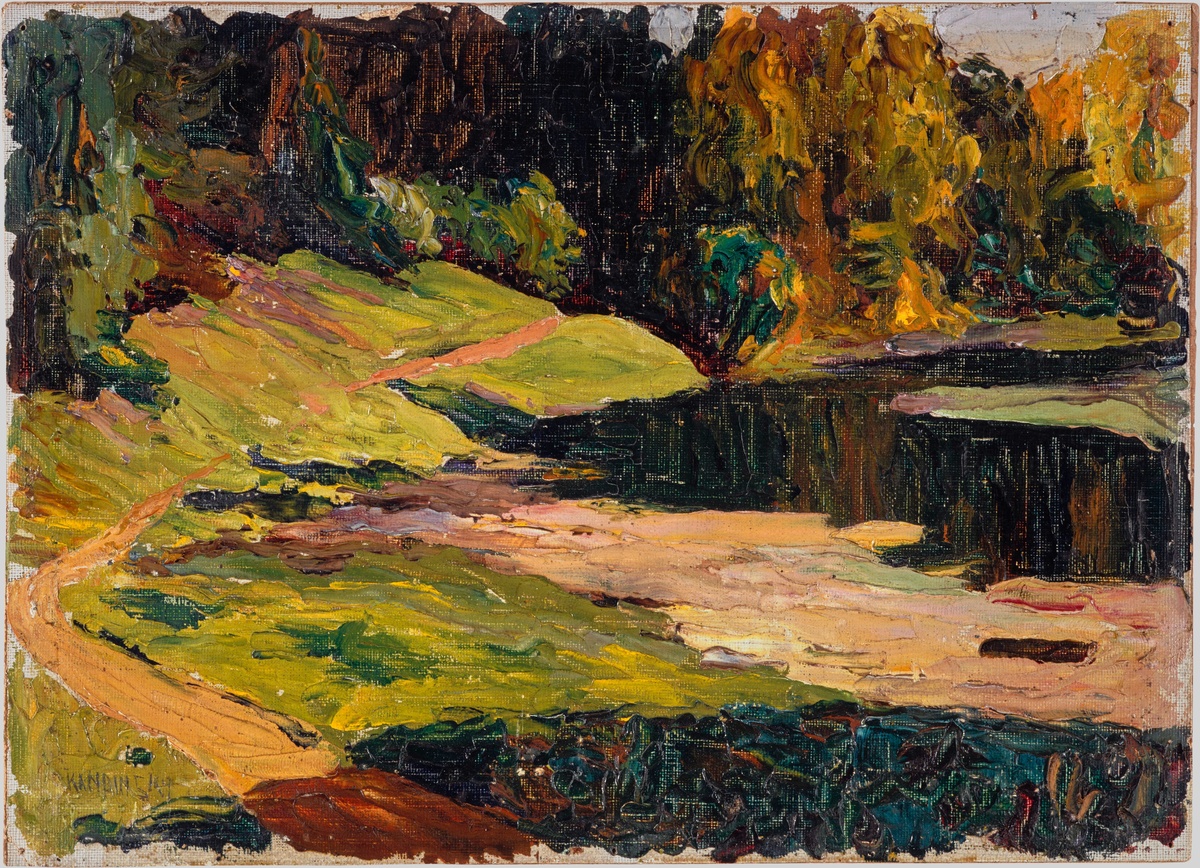
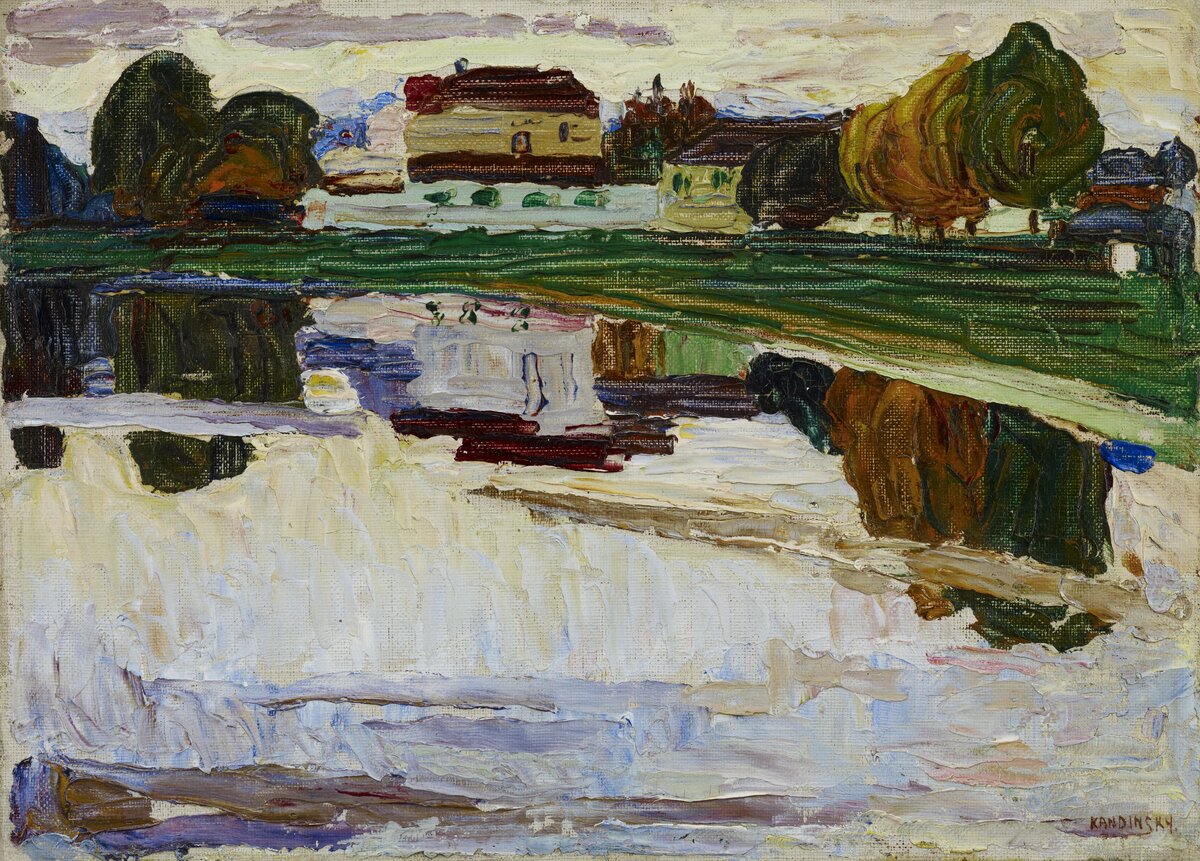
This is Vassily Kandinsky's Nymphenburg, painted in 1904. It shows the Nymphenburg palace, its ochre facade and red roof standing across a stretch of dark green canal water. Kandinsky made this small picture years before the abstract paintings he's best known for. Here he's still working from a real place, and the palace is easy to recognise.
Look at the water first. It's painted a deep, dark green, and it takes up much of the lower half of the picture. Across that dark surface you can see the palace and, near the centre, a pale pavilion with fragments of red roof caught in the reflection. The contrast does the work. The building sits in warmer ochre and red tones, while the canal holds cool green, so the palace seems to float above its own image.
Kandinsky was Russian, born in 1866, and he would later live and work in France. In 1904 he was painting landscapes like this one, still tied to observed places. The Nymphenburg palace near Munich gives the picture its name and its subject, and the museum dates the painting to that year.
The Commons description calls this a Symbolist landscape. That label points to the way the picture works: the scene is recognisable, but colour and reflection carry more weight than exact architectural detail. So the painting asks you to read the palace and its mirror image together, as a mood and a pattern rather than a precise record of a building.
What stays with you is that dark green water holding the palace's pale reflection at the centre. The building and its image are painted as one scene. It's an early landscape by an artist who would soon leave such direct observation behind, and it shows him already thinking in colour and reflection.
The story and its sources
Historical claims are linked to the records below. Close looking and interpretation are identified in the passage notes.
- Passage 1Documented historyInstitutional record for Nymphenburg
- Passage 2Close lookingWikimedia Commons: NymphenburgInstitutional record for Nymphenburg
- Passage 3Documented historyInstitutional record for Nymphenburg
- Passage 4InterpretationWikimedia Commons: Nymphenburg
- Passage 5InterpretationWikimedia Commons: NymphenburgInstitutional record for Nymphenburg
Details to notice
About 2 minutes to readKandinsky signature
Hand-painted dark signature at the lower right, visible against the pale foreground and important direct evidence for attribution.
Golden tree mass
Golden-green trees at the right, built from curling palette-knife strokes, frame the palace view and balance the dark trees on the left.
Pale impasto foreground
Broad white and lavender paint layers form the dominant foreground expanse, with strong palette-knife ridges that lead the eye toward the canal reflection.
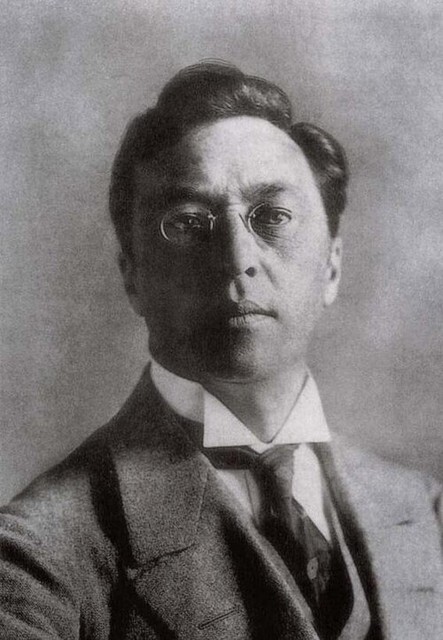
Artist portrait Image credit
未知上傳者. Image source · Public domain
About the artist
Wassily Kandinsky
1866 to 1944
Wassily Kandinsky was an avant-garde painter of Russian origin (1866–1944). Their work is associated with Expressionism; Symbolism; Bauhaus. Their recorded places of work include Paris; Munich; Weimar; Rapallo; The Hague; Russia; Stockholm; Switzerland; Tunis.
- Born
- 1866
- Died
- 1944
- Nationality
- Russian Empire; Russian Soviet Federative Socialist Republic; Soviet Union; France; Germany
- Birthplace
- Moscow
- Died in
- Neuilly-sur-Seine
Biography sources
The research & record
Study the work.
Follow the evidence.
Find catalogue details, historical context, technical research and the literature behind this artwork.
The artwork record
Research catalogue
Catalogue information and detailed research, with references that link to the bibliography.
Updated .
Identity and catalogue
Link- Title
- Nymphenburg
- Artist or attribution
- Vassily Kandinsky
- Object date
- 1904
- Medium and support
- Oil on canvasboard
- Dimensions
- 9 1/2 x 12 3/4 in. (24.1 x 32.4 cm)
- Current collection or location
- Minneapolis Institute of Art, Minneapolis, Minnesota
- Movement or period
- Symbolism
- Country or culture
- Russia
- Depicted subject
- A Symbolist landscape showing the Nymphenburg palace, with its ochre facade, red roof and windows, seen across dark green canal water that reflects a pale pavilion and red roof fragments at the center.
- Title variants
- Landscape
- Accession number
- 81.106.1
- Support
- canvasboard
Read valuation records and their limitations
Title, attribution and catalogue data
The Minneapolis Institute of Art records the painting under the title Nymphenburg, attributing it to Vassily Kandinsky and dating it to 1904. The medium is given as oil on canvasboard, and the work carries the accession number 81.106.1. These catalogue elements form the primary identity of the object: a titled, dated, attributed and accession-numbered work in a public collection. The support, canvasboard rather than stretched canvas, is recorded alongside the medium and is part of how the institution describes the physical object rather than a later interpretive claim about its appearance.(Minneapolis Institute of Art, n.d., Details)
The object date of 1904 belongs to the making of the painting and should be kept distinct from the later catalogue and acquisition dates that also attach to the work. The 1981 accession number records when the Winston share entered the museum, not when the painting was made. Likewise, the artist biography in the same record places Kandinsky's birth in Russia in 1866, his activity in France and his death in 1944, all of which frame the 1904 date without altering it. The painting therefore sits early in the documented arc of a Russian-born artist who would later be active in France.(Minneapolis Institute of Art, n.d., Details; Artist Life; Nationality)
The object is titled Nymphenburg, made by Vassily Kandinsky in 1904, oil on canvasboard, in the Minneapolis Institute of Art, accession number 81.106.1.(Minneapolis Institute of Art, n.d.)
Historical context
LinkRead valuation records and their limitations
The documented object
The Minneapolis Institute of Art records the painting as Nymphenburg, made by Vassily Kandinsky in 1904, in oil on canvasboard, measuring 9 1/2 by 12 3/4 inches (24.1 by 32.4 centimeters), under accession number 81.106.1. The same record gives the artist's biography in institutional terms: Russian, born in Russia in 1866, active in France, and dying in 1944. These are the secure anchors for any discussion of the work's circumstances. The small scale of the support and the designation of canvasboard rather than stretched canvas place the picture among portable, modestly scaled landscape studies, and the 1904 date locates it in the period before the abstract work for which Kandinsky later became known. The object record also states that the painting is on view in Gallery 359, an institutional fact about its current display rather than about its creation.(Minneapolis Institute of Art, n.d., Artist Life; Nationality)
Interpretation
The subject identification should be distinguished by evidential role rather than treated as a single settled fact. The Commons description describes the painting as a Symbolist landscape, places its subject at Nymphenburg, gives a date of 1904 and an origin in Russia. This is a secondary, wiki-based description that repeats details from the museum record, so the Nymphenburg subject and the 1904 date rest on the institutional record, while the stylistic label and the phrasing of the subject belong to the Commons account and should be attributed to it. The institutional record supplies the title Nymphenburg, which names the place near Munich associated with the palace, but the identification of the exact vantage point and the reason Kandinsky chose it are not established by the supplied evidence and are not asserted here.(Wikimedia Commons: Nymphenburg, n.d., Description English; Place of creation)(Minneapolis Institute of Art, n.d., Artist Life; Nationality)
The artist is recorded as Russian, born in Russia in 1866 and active in France, dying in 1944.(Minneapolis Institute of Art, n.d.)
Materials and technique
LinkRead valuation records and their limitations
Documented support and medium
The institutional record for Nymphenburg documents the work as oil on canvasboard, measuring 9 1/2 by 12 3/4 inches, or 24.1 by 32.4 centimeters. Both the medium and the dimensions are recorded in the object record of the Minneapolis Institute of Art, which holds the painting under accession number 81.106.1 as the gift of Mr. and Mrs. Donald Winston. This is the extent of the technically documented material information supplied here: the support is identified as canvasboard rather than canvas or panel, and the paint as oil. No ground, priming, pigment analysis, layer structure, tool marks or conservation treatment is recorded in the available evidence. Any account of how the surface was built up therefore remains an inference from appearance rather than a result of technical examination, and the description that follows should be read on that footing.(Minneapolis Institute of Art, n.d., Medium; Dimension)
Surface as described
The existing description of the painted surface emphasizes a division of color and tone that structures the composition. The canal water in the lower half is described as a deep, dark green, while the palace across it is characterized by warmer ochre and red tones, its red roof standing against an ochre facade. Near the center, a pale pavilion with fragments of red roof is described as caught in the reflection, so that the building and its image are read together as one scene rather than as a structure and a separate mirrored motif. These are observations of appearance, and the supplied evidence does not include pigment identification or sampling that would establish which materials produced the green, ochre and red passages. They describe the visible result, not a documented account of the paints used.(Minneapolis Institute of Art, n.d., Medium; Dimension)
Place in the artist's development
Interpretation
The chronological record establishes why the material description matters within a larger history of the artist's work. The artist is recorded as Russian, born in Russia in 1866 and active in France, dying in 1944, and the museum dates Nymphenburg to 1904. At that date, as the existing description notes, Kandinsky was still painting landscapes tied to observed places, years before the abstract paintings for which he is best known. The modest scale recorded in the dimensions, a study-sized format on canvasboard, is consistent with a landscape made from a real place rather than an ambitious exhibition canvas, and it places the object at a point in his development when representation of a specific site was still the working premise. The evidence dates and locates the work and the artist's biography but does not record where or under what circumstances the painting was executed, so no studio or travel account is asserted here.(Minneapolis Institute of Art, n.d., Medium; Dimension)
The work is oil on canvasboard, measuring 9 1/2 by 12 3/4 inches (24.1 by 32.4 centimeters).(Minneapolis Institute of Art, n.d.)
Provenance and ownership
LinkRead valuation records and their limitations
Documented Transfers
The documented history of this painting begins with Galerie Valentien in Stuttgart, which is recorded as holding the work by 1958. The institutional record for Nymphenburg does not state when or how the painting entered that gallery, nor what earlier ownership, if any, preceded it; the interval before 1958 is therefore unrecorded rather than proven to be a period of continuous private or public ownership. The evidence supports the gallery's possession by that date and no earlier transfer.(Minneapolis Institute of Art, n.d., Provenance)
From Galerie Valentien the painting is recorded as passing through the Paul Kantor Gallery in Los Angeles and then to Donald and Elizabeth Winston, who owned it jointly with their daughter Betsy Wyman. The record describes a single line of movement from Stuttgart through Los Angeles to the Winston family, and the joint holding is stated as a fact of ownership shared among the three named individuals. The evidence does not assign a date to the Kantor Gallery transaction or to the Winstons' acquisition, so the chronology of this segment rests on the sequence given rather than on dated instruments.(Minneapolis Institute of Art, n.d., Provenance)
Ownership was later divided between two gifts to the Minneapolis Institute of Art. The Winston share was given to the museum in 1981, and the Wyman share followed in 1992. The accession number 81.106.1 and the credit line naming Mr. and Mrs. Donald Winston correspond to the 1981 gift, while the 1992 transfer completed the museum's title to the work. This two-stage arrival explains why the object's credit line names the Winstons even though a second family owner, Betsy Wyman, also relinquished her share eleven years later. The painting is listed as being on view in Gallery 359.(Minneapolis Institute of Art, n.d., Provenance)
Reading the Record
Interpretation
The provenance record is a chain of documented holdings rather than a continuous biography of the object. Between the named moments (Galerie Valentien by 1958, the Kantor Gallery, the joint Winston and Wyman ownership, the 1981 gift and the 1992 gift) the evidence gives no transaction dates for the earlier links, and it does not state the circumstances of the painting's creation or its movement before 1958. Those gaps should be read as silences in the record, not as evidence that nothing happened. What the record does establish is the sequence of custodians and the two dated gift transactions that brought the work into a public collection.(Minneapolis Institute of Art, n.d., Provenance)
The ownership history is inseparable from the object's identity as a small early landscape by an artist recorded as Russian, born in Russia in 1866, active in France and deceased in 1944. Nymphenburg is dated 1904, oil on canvasboard, measuring 9 1/2 by 12 3/4 inches (24.1 by 32.4 centimeters), and titled after the palace near Munich. The modest scale and portable support are consistent with a work made for sale and circulation, which helps explain how it could move from a Stuttgart gallery through a Los Angeles dealer to a family collection and eventually into a museum. The provenance thus documents not only who held the painting but the kind of market and collecting network through which an early twentieth-century landscape by this artist travelled.(Minneapolis Institute of Art, n.d., Provenance; Artist Life; Nationality)
Galerie Valentien, Stuttgart, held the painting by 1958; it passed through the Paul Kantor Gallery, Los Angeles, to Donald and Elizabeth Winston, jointly owned with their daughter Betsy Wyman; the Winston share was given to Mia in 1981 and the Wyman share in 1992.(Minneapolis Institute of Art, n.d.)
Provenance timeline
- by 1958
The painting is held by Galerie Valentien in Stuttgart.(Minneapolis Institute of Art, n.d., Provenance)
- 1981
The share of Donald and Elizabeth Winston is given to the Minneapolis Institute of Art.(Minneapolis Institute of Art, n.d., Provenance)
- 1992
The share of Betsy Wyman, daughter of the Winstons, is given to the Minneapolis Institute of Art.(Minneapolis Institute of Art, n.d., Provenance)
Interpretations and debates
LinkRead valuation records and their limitations
The Object and Its Record
Interpretation
The Commons file description characterizes the painting as a Symbolist landscape and places its subject at Nymphenburg, repeating the date of 1904 and identifying the place of creation as Russia. The institutional record supplies the title, author, date, medium and dimensions independently, so title, date and subject place rest on two accounts, while the Symbolist label and the Russian place of creation appear in the Commons description alone. The difference matters for interpretation: the painting's identity as a Nymphenburg view is well supported, whereas the stylistic category and the geography of making are attributed to one descriptive source and should not be treated as settled documentary facts.(Wikimedia Commons: Nymphenburg, n.d., Description English; Place of creation)
Reading the Scene
The title and the Commons description together establish the subject as the Nymphenburg palace near Munich, seen across a stretch of water. The account in the Commons description treats the scene as a landscape organized around that place rather than as an architectural study, and the museum's title corroborates the location. What the evidence does not supply is any contemporary statement by Kandinsky about the picture, any exhibition history beyond the present display, or any recorded pigment analysis, so readings of the painting's color and handling remain visual description rather than technical finding.(Wikimedia Commons: Nymphenburg, n.d., Description English; Place of creation)(Minneapolis Institute of Art, n.d., Artist Life; Nationality)
Provenance and Collection History
Read together, the two records support a careful synthesis. The painting is a small oil on canvasboard dated 1904, titled for a specific palace near Munich, made by an artist documented as Russian-born and later active in France, and now held in Minneapolis after passing through Stuttgart and Los Angeles dealers and two family gifts. The Symbolist designation and the Russian place of creation belong to the Commons description and should be attributed to it rather than folded into the museum's data. Within a history of early twentieth-century landscape painting, the object's interest lies in this combination: a place-specific view on a modest portable support, made by an artist whose later career moved away from such direct observation, and preserved with a provenance that traces its passage from the European art trade to an American public collection.(Wikimedia Commons: Nymphenburg, n.d., Description English; Place of creation)(Minneapolis Institute of Art, n.d., Artist Life; Nationality)
The Commons description calls the painting a Symbolist landscape and places its subject at Nymphenburg, with a date of 1904 and origin in Russia.(Wikimedia Commons: Nymphenburg, n.d.)
Collection and display
LinkRead valuation records and their limitations
Nymphenburg is held by the Minneapolis Institute of Art, where the object record credits it as a gift of Mr. and Mrs. Donald Winston. The institutional record further notes that the painting is on view in Gallery 359, so its current public presentation can be located to a specific room within that museum. These two pieces of information, the credit line and the display location, belong to the museum's own account of the object and situate it within the institution's collection and exhibition spaces rather than describing any earlier setting in which it may have hung.(Minneapolis Institute of Art, n.d., Credit; On View)
The museum record and the sequence of ownership
The same institutional record supplies the framework within which those collection details should be read: the painting is titled Nymphenburg, made by Vassily Kandinsky in 1904, executed in oil on canvasboard, and registered under accession number 81.106.1. The artist is described as Russian, born in Russia in 1866, active in France at the end of his life, and dying in 1944. The record gives the dimensions as 9 1/2 by 12 3/4 inches, or 24.1 by 32.4 centimeters. It also sets out a provenance sequence: Galerie Valentien, Stuttgart, held the painting by 1958; it then passed through the Paul Kantor Gallery, Los Angeles, to Donald and Elizabeth Winston, jointly owned with their daughter Betsy Wyman; the Winston share was given to the Institute of Art in 1981 and the Wyman share in 1992. This account explains why the credit reads as it does and why the accession number begins with the year 1981, while the full holding was only completed in 1992. Within the larger history of collecting, it is a compact example of how a twentieth-century European painting moved through a European dealer, an American gallery, and a family's joint ownership before arriving at a public museum in stages.(Minneapolis Institute of Art, n.d., Credit; On View)
The painting is in the collection of the Minneapolis Institute of Art, gift of Mr. and Mrs. Donald Winston.(Minneapolis Institute of Art, n.d.)
The object record lists the painting as on view in Gallery 359.(Minneapolis Institute of Art, n.d.)
Documented values and qualified estimates
LinkRead valuation records and their limitations
Valuation and its limits
Interpretation
No public auction comparables, last sale, or official appraisal are among the supplied records. The only valuation figure available is a model-generated working insurance estimate, recorded as a calculation generated on 2026-10-30, giving a deliberately wide bracket of US$400K to US$1.5M for manual review. Its stated methodology derives the range conservatively from confirmed context: an early 1904 Symbolist oil by a major modern artist, held in a major public museum collection with documented provenance through Galerie Valentien and the Paul Kantor Gallery and a later gift to the museum. The range reflects the artist's market prominence, the early date within his career, and the oil medium, while the modest scale on canvasboard is said to temper value relative to larger oils. The record itself qualifies the figure as not an official insurance value, appraisal, auction estimate, auction result, or sale price; it is not based on comparable sales or private insurance records, and actual insured values should be established by a qualified appraiser or the collection's registrar.(Wikimedia Commons: Nymphenburg, n.d.)(Minneapolis Institute of Art, n.d.)
Working estimate
Calculated working insurance estimate, not a sale price: Estimated value: US$400K to US$1.5M Recorded date: Working calculation, generated 2026-10-30. Methodology: Broad working range derived conservatively from confirmed context: an early 1904 Symbolist oil by Vassily Kandinsky, a major modern artist, held in a major public museum collection (Mia, accession 81.106.1) with documented provenance through Galerie Valentien, Stuttgart, and Paul Kantor Gallery, Los Angeles, and a later gift to the museum. The range reflects the artist's market prominence, the early date within his career, the oil medium, and the modest scale (24.1 x 32.4 cm) on canvasboard, which tempers value relative to larger oils. Because no public auction comparables, last sale, or official appraisal were supplied, the figures are a deliberately wide bracket for manual review rather than a point estimate. Qualification: Model-generated working insurance range for manual review only. This is not an official insurance value, appraisal, auction estimate, auction result, or sale price. It is not based on comparable sales or private insurance records, and actual insured values should be established by a qualified appraiser or the collection's registrar.(Wikimedia Commons: Nymphenburg, n.d.)(Minneapolis Institute of Art, n.d.)
Further reading
Books for a closer look
Paid links. As an Amazon Associate I earn from qualifying purchases.

Open Library Nymphenburg
Prestel; Prestel Pub
Prestel guidebook on Nymphenburg palace with pictorial works and architectural subjects, including Nymphenburg in Munich and buildings and structures. Relevant to identifying the ochre facade, red roof and canal setting shown in Kandinsky's landscape.
ISBN 3791323709

Open Library Kandinsky: Russian and Bauhaus years, 1915-1933.
Solomon R. Guggenheim Museum
Kandinsky catalogue record with exhibition, criticism and interpretation subjects and Russian painting themes. Provides art-historical context on the artist whose 1904 Symbolist landscape is the artwork, though it is not specific to this painting.
ISBN 0892070447
Bibliography
Sources and further reading
References are arranged by author or organisation, with links to the original publications. Where no publication date is recorded, n.d. means no date.
Source notes updated .
No recorded sources match these filters. Reset the filters to see the full bibliography.
- 03
Book
Nymphenburg. Prestel; Prestel Pub.
Prestel guidebook on Nymphenburg palace with pictorial works and architectural subjects, including Nymphenburg in Munich and buildings and structures. Relevant to identifying the ochre facade, red roof and canal setting shown in Kandinsky's landscape.
- ISBN
- 3791323709
Citation text
- 02
Official · About this artwork
Institutional record for Nymphenburg. Nymphenburg, Vassily Kandinsky. collections.artsmia.org.
Official object record for the painting, giving title, artist, date, medium, dimensions, credit line, accession number, provenance and display location.
- Language
- en
Citation text
- 04
Book
Kandinsky: Russian and Bauhaus years, 1915-1933. Solomon R. Guggenheim Museum.
Kandinsky catalogue record with exhibition, criticism and interpretation subjects and Russian painting themes. Provides art-historical context on the artist whose 1904 Symbolist landscape is the artwork, though it is not specific to this painting.
- ISBN
- 0892070447
Citation text
- 01
Secondary · About this artwork
Wikimedia Commons: Nymphenburg (n.d.). Vassily Kandinsky - Nymphenburg - 81.106.1 - Minneapolis Institute of Arts. Wikimedia Commons.
Commons file page used for discovery; describes the painting as a Symbolist landscape and repeats provenance and accession details from the museum.
- Language
- en
Citation text
Art to live with
Bring this painting
home.
A piece of the archive, made yours. Explore Nymphenburg in a size and finish that fits your space.
Your text and annotations appear on these editions. Adding to cart saves that design for printing.
Combine this painting with your favourites01 / Find your edition
Made for you
Suggested from your location. Change it if you're sending elsewhere or using a VPN. Prices and delivery are shown in GBP.
1 product
Choose an edition to make it yours
iPhone 12 Mini ? Glossy ? back view
iPhone 12 Mini · Glossy

iPhone 12 Mini ? Glossy ? back view

iPhone 12 Mini ? Glossy ? back view

iPhone 12 Mini ? Glossy ? back view
Tough phone case
GBP 16.34
Delivery GBP 4.22 / Total GBP 20.56
A two-layer phone case with a printed polycarbonate shell and a shock-absorbing inner liner.
Two layers with a shock-absorbing TPU liner
Case & print details
- Device
- Apple · iPhone 12 Mini
- Material
- Polycarbonate shell with a TPU inner liner
- Artwork
- Outer back and wrapped edges from one template
- Finish
- Glossy
- Version
- Standard version
- Printing
- Dye sublimation
- Print file
- 1,122 × 1,831 px · 95 × 155 mm · PNG · 300 dpi recommended
Rear outline and camera openings follow this variant's Printify template. Case depth and small hardware remain illustrative.
Supplier product detailsFit and fill keep the painting’s proportions. Stretch changes them.
Move and zoom the painting on your tough phone case.
Made to order with your design
Made to order
US delivery only
The 30 cm ruler is scaled alongside your selected print. Keep the painting’s proportions with a black background, or stretch it to fill. Frame width, material texture and screen colours are illustrative.
Keep exploring