Identity and catalogue
Link- Title
- Mont Sainte-Victoire and the Viaduct of the Arc River Valley
- Artist or attribution
- Paul Cézanne
- Object date
- 1882–1885
- Movement or period
- Post-Impressionism / mature period of Cézanne
- Country or culture
- France
- Depicted subject
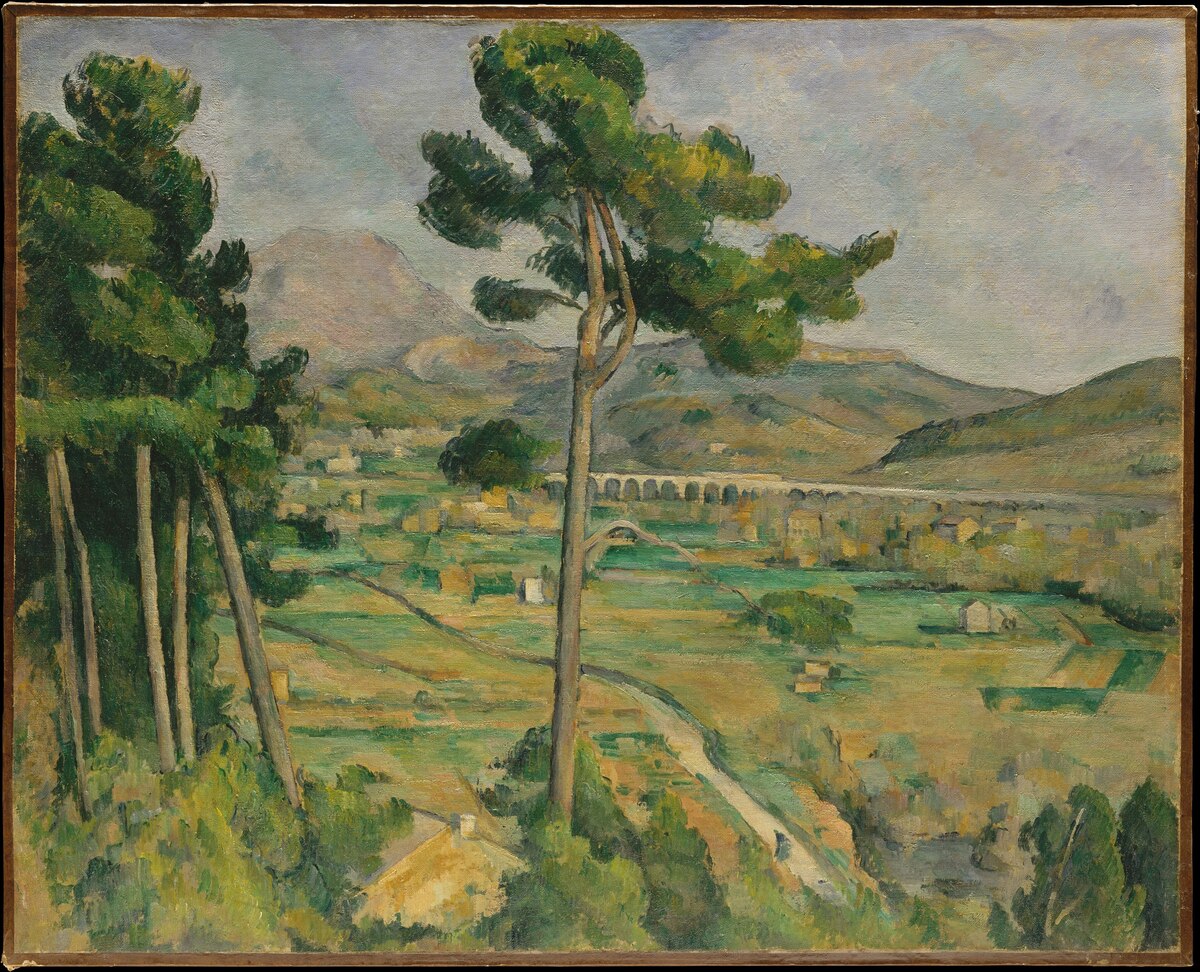
- A landscape painting of Montagne Sainte-Victoire and the valley of the Arc River, with Cézanne's hometown of Aix-en-Provence visible in the background. The railway bridge of the Aix–Marseille line, crossing the Arc River valley, appears near the center-right of the composition. Cézanne uses layers of horizontal planes to build depth and draw the eye into the view.(Wikipedia fallback: Mont Sainte-Victoire and the Viaduct of the Arc River Valley, n.d.)
- Support
- Canvas
Catalogue title, medium and date
Mont Sainte-Victoire and the Viaduct of the Arc River Valley is an oil painting on canvas completed by the French artist Paul Cézanne between 1882 and 1885. The dated span belongs to the making of the picture, not to any later catalogue or publication event, so the object's own chronology must be kept distinct from the dates of the texts that describe it. The work depicts Montagne Sainte-Victoire together with the valley of the Arc River, with Cézanne's hometown of Aix-en-Provence appearing in the background. The title itself is descriptive in a way that matches the evidence: it names both the mountain and the viaduct, the two features that the composition is built around, and it locates them within a specific river valley rather than presenting a generic mountain view. Because the title carries the viaduct, the picture is catalogued as a landscape of infrastructure as much as of terrain, and that double subject governs the painting's identity from the outset.(Wikipedia fallback: Mont Sainte-Victoire and the Viaduct of the Arc River Valley, n.d., Lead paragraph)
The mountain was not a single subject for Cézanne but a repeated one. He depicted it several other times, including in Mont Sainte-Victoire seen from Bellevue, in Mont Sainte-Victoire with Large Pine, and in Plain by Mont Sainte-Victoire, as well as in paintings titled simply Mont Sainte-Victoire now in the holdings of the Courtauld Institute of Art in London and the National Gallery of Scotland in Edinburgh. Those recurring titles matter for cataloguing because the plain title Mont Sainte-Victoire does not by itself distinguish one canvas from another; attribution to the present work depends on the fuller title with its viaduct and valley, which separates this painting from the related views held in London and Edinburgh. Within this group, the object is defined as much by the railway bridge crossing the valley as by the mountain that gives the wider series its name.(Wikipedia fallback: Mont Sainte-Victoire and the Viaduct of the Arc River Valley, n.d., Description section)
Cézanne depicted the same mountain several other times, including in Mont Sainte-Victoire seen from Bellevue, Mont Sainte-Victoire with Large Pine, and Plain by Mont Sainte-Victoire, as well as in paintings titled simply Mont Sainte-Victoire in the holdings of the Courtauld Institute of Art in London and the National Gallery of Scotland in Edinburgh.(Wikipedia fallback: Mont Sainte-Victoire and the Viaduct of the Arc River Valley, n.d.)
Subject and iconography
LinkVisual observation
The composition of this oil painting on canvas centers on two interlocking subjects: Montagne Sainte-Victoire, which rises above Cézanne's native Aix-en-Provence, and the railway bridge on the Aix–Marseille line, which crosses the Arc River Valley. The bridge is depicted near the center-right of the composition, and the valley of the Arc River opens below the mountain. Together the mountain and the viaduct hold the whole composition together. A third element, Cézanne's hometown of Aix-en-Provence, appears in the background of the depicted view.(Wikipedia fallback: Mont Sainte-Victoire and the Viaduct of the Arc River Valley, n.d., Description section, citing Tomoki Akimaru, 'Cézanne and the Railway (3)', Art Critique+, AICA Japan, 6 September 2024)
Composition and the Construction of Depth
Interpretation
The spatial construction of the view is described as an exploration of depth built through layering: horizontal planes stacked one behind another draw the eye into the landscape. This is the visual mechanism through which the account explains the painting's organization, and it is also the mechanism the source connects to Cézanne's stated aim at this time, to make of Impressionism something solid and durable, like the art of museums. The railway bridge reads as an interruption of those horizontal planes, and that interruption is what gives the valley its depth. In this reading, the picture is not merely a view of a famous mountain but a view organized around a new railway crossing an old valley, with the layers of land carrying the eye between the two.(Wikipedia fallback: Mont Sainte-Victoire and the Viaduct of the Arc River Valley, n.d., Description section, citing Voorhies, 'Paul Cézanne (1839–1906)', Heilbrunn Timeline of Art History, Metropolitan Museum of Art, October 2004; Background section, citing Voorhies, Heilbrunn Timeline of Art History, and 'Cezanne, 1878-1890 (20/1)', Impressionists Gallery)
The Railway, the Letter, and the Painting's Date
Visual observation
The visible subject and the historical record converge on a specific place and moment. The Aix–Marseille railway line opened on October 15, 1877. Only half a year later, on April 14, 1878, Cézanne wrote to his friend Émile Zola praising Mont Sainte-Victoire, seen from the train as it crossed the Arc River Valley bridge, as a 'beau motif' ('beautiful motif'). The railway bridge that is visible near the center-right of the present painting is therefore the same structure the letter describes, though the letter predates the painting's accepted date range of 1882 to 1885.(Wikipedia fallback: Mont Sainte-Victoire and the Viaduct of the Arc River Valley, n.d., Description section, citing Paul Cézanne, Correspondance, ed. Rewald, 1978, p. 165; Description section, citing Tomoki Akimaru, 'Cézanne and the Railway (3)', Art Critique+, AICA Japan, 6 September 2024)
Format, Medium, and the Mature Period
The source frames the painting's making within a shift in Cézanne's relation to Impressionism. It states that Cézanne began working on Impressionism in his artworks in the late nineteenth century, nearing the end of his career, away from his post-impressionist former paintings, with the aim 'to make of Impressionism something solid and durable, like the art of museums.' The account is internally unusual in two respects and these should be preserved rather than smoothed over: it locates the turn toward Impressionism near the end of the career while also placing this painting in the mature period, and it characterizes the earlier work as post-impressionist. The layered horizontal planes visible in the painting are presented as how the aim of solidity and durability becomes visible in this particular canvas.(Wikipedia fallback: Mont Sainte-Victoire and the Viaduct of the Arc River Valley, n.d., Background section, citing Voorhies, Heilbrunn Timeline of Art History, and 'Cezanne, 1878-1890 (20/1)', Impressionists Gallery; Description section, citing Voorhies, 'Paul Cézanne (1839–1906)', Heilbrunn Timeline of Art History, Metropolitan Museum of Art, October 2004)
The Mont Sainte-Victoire Series
Mont Sainte-Victoire was not a single subject for Cézanne but one he depicted several other times. Among the works the source names are Mont Sainte-Victoire seen from Bellevue, Mont Sainte-Victoire with Large Pine, and Plain by Mont Sainte-Victoire, as well as paintings titled simply Mont Sainte-Victoire in the holdings of the Courtauld Institute of Art in London and the National Gallery of Scotland in Edinburgh. The present painting's association with the series is therefore not simply a matter of shared subject: the viaduct of the Arc River Valley and the view from the railway bridge distinguish this canvas from those other treatments of the same mountain, while the mountain itself links it to a sustained, repeated engagement.(Wikipedia fallback: Mont Sainte-Victoire and the Viaduct of the Arc River Valley, n.d., Description section, citing Tomoki Akimaru, 'Cézanne and the Railway (3)', Art Critique+, AICA Japan, 6 September 2024; Description section, citing Paul Cézanne, Correspondance, ed. Rewald, 1978, p. 165)
The object and its making
The subject of this research account is an oil painting on canvas by the French artist Paul Cézanne, completed between 1882 and 1885, depicting Montagne Sainte-Victoire and the valley of the Arc River with Cézanne's hometown of Aix-en-Provence in the background. It is held in the collection of the Metropolitan Museum of Art in New York. The painting measures 65.5 cm by 81.7 cm (25.8 by 32.2 inches) and is described as one of Cézanne's smallest works. The supplied evidence identifies it as an artwork, and the account of its making places it in what the excerpt calls Cézanne's mature period, a period in which Cézanne began working on Impressionism in the late nineteenth century, nearing the end of his career and moving away from his earlier post-impressionist paintings. The source articulates his aim at this time in his own reported words: to make of Impressionism something solid and durable, like the art of museums.(Wikipedia fallback: Mont Sainte-Victoire and the Viaduct of the Arc River Valley, n.d., Background section, citing Voorhies, Heilbrunn Timeline of Art History, and 'Cezanne, 1878-1890 (20/1)', Impressionists Gallery)
The identification of the painting and its subject rests on secure institutional and art-historical grounds, but the circumstances of its creation are documented less directly. The evidence establishes the dates 1882 to 1885, the medium of oil on canvas, and the Met's current possession, while the source itself is a Wikipedia article used because no official museum source excerpt was provided, and it is marked as partially consulted. Within this account, the painting appears in a sequence of other depictions of the same mountain, including Mont Sainte-Victoire seen from Bellevue, Mont Sainte-Victoire with Large Pine, Plain by Mont Sainte-Victoire, and paintings titled simply Mont Sainte-Victoire in the holdings of the Courtauld Institute of Art in London and the National Gallery of Scotland in Edinburgh. The comparison matters because it shows the mountain was a recurring subject for Cézanne rather than a single commission, and because it situates this canvas within a larger practice of returning to the same motif.(Wikipedia fallback: Mont Sainte-Victoire and the Viaduct of the Arc River Valley, n.d., Background section, citing Voorhies, Heilbrunn Timeline of Art History, and 'Cezanne, 1878-1890 (20/1)', Impressionists Gallery; Background section, citing Rewald, Cézanne and America, 1989)
The railway, the letter and the creation account
A dated documentary thread connects the painting's subject to a specific moment in Cézanne's life and to a modern transport route. The Aix to Marseille railway line opened on October 15, 1877. Only half a year later, on April 14, 1878, Cézanne wrote to his friend Émile Zola praising Mont Sainte-Victoire, seen from the train as it crossed the Arc River Valley bridge, as a beau motif, a beautiful motif. The letter is a contemporary document, and it records Cézanne's own response to the view from the railway at a date shortly after the line opened. It establishes the two elements that would later be read together: the mountain and the bridge carrying the line across the Arc valley.(Wikipedia fallback: Mont Sainte-Victoire and the Viaduct of the Arc River Valley, n.d., Description section, citing Paul Cézanne, Correspondance, ed. Rewald, 1978, p. 165)
Interpretation
The supplied account argues that around the time of the letter to Zola, at the age of thirty-nine, Cézanne began for the first time a series of paintings devoted to Mont Sainte-Victoire in his native Aix-en-Provence, and it states that it is therefore highly probable that this celebrated series was inspired by the scenery viewed from the window of a moving train. That reading is offered as a probability, not as settled fact about Cézanne's intention, and it should be reported with that qualification intact. The chronology supports the sequence of dates and the fact of the series, while the claim about inspiration remains an inference. The distinction matters for how the artwork is described: the painting can be securely identified and dated, while its commissioning or creative trigger is a hypothesis built from the letter and the timing of the railway's opening.(Wikipedia fallback: Mont Sainte-Victoire and the Viaduct of the Arc River Valley, n.d., Description section, citing Paul Cézanne, Correspondance, ed. Rewald, 1978, p. 165; Description section, citing Tomoki Akimaru, 'Cézanne and the Railway (1)', Art Critique+, AICA Japan, 6 September 2024)
Visual evidence and formal organization
Reading the formal structure alongside the documentary chronology suggests why this canvas matters within a larger history of art and material culture. Cézanne's stated aim to make of Impressionism something solid and durable, like the art of museums is visible in the way the valley is built from stacked horizontal bands rather than dissolved into atmosphere. The railway bridge, a product of the new Aix to Marseille line that opened in 1877, is embedded within that durable structure near the center-right. The painting therefore joins two histories: the long-standing motif of Mont Sainte-Victoire above Aix-en-Provence, which Cézanne treated repeatedly, and the arrival of a modern transport route across the same valley, which he had praised in writing to Zola. The evidence supports the connection between the subject and the new line as documented in the letter and in the placement of the bridge; it does not establish that the painting was commissioned by or for any railway interest, and the source does not document a patron for this canvas.(Wikipedia fallback: Mont Sainte-Victoire and the Viaduct of the Arc River Valley, n.d., Background section, citing Voorhies, Heilbrunn Timeline of Art History, and 'Cezanne, 1878-1890 (20/1)', Impressionists Gallery; Description section, citing Tomoki Akimaru, 'Cézanne and the Railway (3)', Art Critique+, AICA Japan, 6 September 2024; Description section, citing Voorhies, 'Paul Cézanne (1839–1906)', Heilbrunn Timeline of Art History, Metropolitan Museum of Art, October 2004)
Provenance and later reception
The chronological distance between the painting and the later accounts of it is itself part of the evidence. The painting was completed 21 years before Cézanne's artistic career finished, and his output continued for approximately twenty-one years after it was made. In 1989, the work was described as one of Cézanne's greatest, in a Wikipedia passage flagged as needing attribution to a specific source. The attribution of that judgment is therefore uncertain, and it is a statement of reception rather than a property of the object. Read together with the Havemeyer provenance and the Met's acquisition, the reception evidence shows the painting moving from a private collection into a museum and, in later writing, into a canon of Cézanne's most admired works. The 1989 evaluation should be reported as an attributed and flagged claim, not as a documented fact about the work's quality.(Wikipedia fallback: Mont Sainte-Victoire and the Viaduct of the Arc River Valley, n.d., Background section, citing Rewald, Cézanne and America, 1989; Description section, citing Harris, Nathaniel, The Art of Cézanne, 1989; Lead paragraph and Background section, citing Weitzenhoffer, The Havemeyers: Impressionism Comes to America, 1986, pp. 251–252)
Only half a year after the opening of the Aix–Marseille railway line on October 15, 1877, Cézanne wrote to his friend Émile Zola on April 14, 1878, praising Mont Sainte-Victoire, seen from the train as it crossed the Arc River Valley bridge, as a 'beau motif' ('beautiful motif').(Wikipedia fallback: Mont Sainte-Victoire and the Viaduct of the Arc River Valley, n.d.)
Cézanne began working on Impressionism in his artworks in the late nineteenth century, nearing the end of his career, away from his post-impressionist former paintings. His aim was 'to make of Impressionism something solid and durable, like the art of museums.' The excerpt states the painting was made in the 'mature' period of Cézanne's work.(Wikipedia fallback: Mont Sainte-Victoire and the Viaduct of the Arc River Valley, n.d.)
Cézanne's artistic output continued for approximately twenty-one years after this painting was completed. The excerpt states the painting was completed 21 years before Cézanne's artistic career finished.(Wikipedia fallback: Mont Sainte-Victoire and the Viaduct of the Arc River Valley, n.d.)
Materials and technique
LinkDocumented materials and format
The documented medium for this object is oil on canvas, completed by Paul Cézanne between 1882 and 1885. The work measures 65.5 cm × 81.7 cm (25.8 in × 32.2 in) and is identified in the supplied account as one of Cézanne's smallest works. It is in the collection of the Metropolitan Museum of Art in New York. No further technical information about support preparation, ground layers, pigment identification, brushwork, or condition is supplied for this object; the account of materials and technique therefore depends on the medium statement and on what can be seen in the composition.(Wikipedia fallback: Mont Sainte-Victoire and the Viaduct of the Arc River Valley, n.d., Description section, citing The Metropolitan Museum of Art)
The source places the painting in Cézanne's mature period, made between 1882 and 1885, and describes his aim at that time as making of Impressionism something solid and durable, like the art of museums. That direction is characterized as a move toward Impressionism nearing the end of his career, away from his post-impressionist former paintings. Read against the documented medium of oil on canvas and the painting's small scale, the account does not state a distinct technical procedure, such as a specific ground, palette, or layering method, but it does link the period's ambition to how the picture is organized.(Wikipedia fallback: Mont Sainte-Victoire and the Viaduct of the Arc River Valley, n.d., Description section, citing The Metropolitan Museum of Art)
Observed construction versus technical examination
Visual observation
The technical examination supplied for this object is limited to its measurements and medium, so statements about construction must be distinguished from visual inference. The composition is described as exploring the creation of depth using layers to build up a set of horizontal planes that draw the eye into the view. That is offered as an observation about how the picture works visually, not as a report of a physical layer analysis. The small scale recorded in the documentation and the layered depth described in the account are separate kinds of evidence, one measured and one seen.(Wikipedia fallback: Mont Sainte-Victoire and the Viaduct of the Arc River Valley, n.d., Description section, citing The Metropolitan Museum of Art; Description section, citing Voorhies, 'Paul Cézanne (1839–1906)', Heilbrunn Timeline of Art History, Metropolitan Museum of Art, October 2004)
Provenance and ownership
LinkDocumented Ownership and the 1929 Bequest
Interpretation
The documented ownership history of this painting begins with the American collectors and patrons Henry and Louisine Havemeyer, who at some point owned the work. On Henry Havemeyer's death in 1907 the painting passed to Louisine Havemeyer, so that event marks a documented transfer of possession within a single household rather than a change of hands between unrelated parties. Following Louisine's death in 1929 the work was donated to the Metropolitan Museum of Art, the gift forming part of the Havemeyer collection of 142 artworks. The surviving evidence records these three moments, ownership by the Havemeyers jointly or successively, Louisine's sole possession after 1907, and the 1929 donation, but it does not record how or when the painting first entered the Havemeyer collection, nor any dealer, auction, or intermediate owner before them. The interval between the work's execution and its appearance in the Havemeyer holdings is therefore an unrecorded gap, not a demonstrated continuity of ownership, and the absence of a record should not be read as proof that none existed.(Wikipedia fallback: Mont Sainte-Victoire and the Viaduct of the Arc River Valley, n.d., Lead paragraph and Background section, citing Weitzenhoffer, The Havemeyers: Impressionism Comes to America, 1986, pp. 251–252)
The dates associated with the object situate that provenance in a longer chronology of Cézanne's career. The painting is dated between 1882 and 1885, which the source identifies as Cézanne's mature period, and its production is placed within a stretch of roughly twenty-one further years of artistic output after its completion. Within the same source's account of his development, Cézanne began working on Impressionism relatively late, away from his earlier practice, with the stated aim of making of Impressionism something solid and durable, like the art of museums. Read against the Havemeyer record, these dates establish that the bequest of 1929 occurred well after the artist's death rather than during his lifetime, and they frame the painting as a mature-period work that entered an American collection only through the activity of twentieth-century collectors and their estate.(Wikipedia fallback: Mont Sainte-Victoire and the Viaduct of the Arc River Valley, n.d., Lead paragraph and Background section, citing Weitzenhoffer, The Havemeyers: Impressionism Comes to America, 1986, pp. 251–252; Background section, citing Voorhies, Heilbrunn Timeline of Art History, and 'Cezanne, 1878-1890 (20/1)', Impressionists Gallery; Background section, citing Rewald, Cézanne and America, 1989)
The Motif, the Series, and Later Assessment
Interpretation
The provenance and the subject matter converge in ways that matter for the object's place in a larger history. The painting depicts Montagne Sainte-Victoire and the valley of the Arc River, with Cézanne's home town of Aix-en-Provence in the background; it measures 65.5 by 81.7 centimetres and is described as one of the smallest works of his career. He treated the same mountain on other occasions, in paintings known as Mont Sainte-Victoire seen from Bellevue, Mont Sainte-Victoire with Large Pine, and Plain by Mont Sainte-Victoire, as well as in works titled simply Mont Sainte-Victoire now held by the Courtauld Institute of Art in London and the National Gallery of Scotland in Edinburgh. In 1989 the present work was described as one of Cézanne's greatest, an assessment recorded in a passage flagged as needing attribution to a specific source, and so best treated as an attributed evaluation rather than an established fact. Taken together, the small scale, the serial treatment of the mountain, and the eventual passage of this canvas into a major public collection via the Havemeyers show a single motif moving from provincial landscape subject to internationally collected museum object within a few decades.(Wikipedia fallback: Mont Sainte-Victoire and the Viaduct of the Arc River Valley, n.d., Lead paragraph and Background section, citing Weitzenhoffer, The Havemeyers: Impressionism Comes to America, 1986, pp. 251–252; Description section, citing Harris, Nathaniel, The Art of Cézanne, 1989)
Provenance timeline
- 1907
After Henry Havemeyer dies, the painting passes to Louisine Havemeyer.(Wikipedia fallback: Mont Sainte-Victoire and the Viaduct of the Arc River Valley, n.d., Lead paragraph and Background section, citing Weitzenhoffer, The Havemeyers: Impressionism Comes to America, 1986, pp. 251–252)
- 1929
Following Louisine Havemeyer's death, the work is donated to the Metropolitan Museum of Art as part of the Havemeyer collection of 142 artworks.(Wikipedia fallback: Mont Sainte-Victoire and the Viaduct of the Arc River Valley, n.d., Lead paragraph and Background section, citing Weitzenhoffer, The Havemeyers: Impressionism Comes to America, 1986, pp. 251–252)
Reception and literature
LinkEarly Admiration and Scholarly Evaluation
The documented reception of Mont Sainte-Victoire and the Viaduct of the Arc River Valley begins within the scholarly literature on Cézanne rather than at the moment of its making. In 1989 the painting was described as one of Cézanne's greatest works, an evaluation attributed in the supplied source to Nathaniel Harris's The Art of Cézanne of that year. The same source passage is flagged as needing attribution to a specific source, which means the claim arrives with a qualification built into it: the superlative judgement is reported from a secondary account and its exact wording and context have not been independently verified here. The date matters for the account of reception because it places one strong evaluative statement about the picture a century after its creation, within a mature tradition of Cézanne monograph writing, not among the responses of Cézanne's own contemporaries. Nothing in the supplied evidence records how the painting was received when it was made between 1882 and 1885, so the documented history of admiration starts later than the documented history of the object itself.(Wikipedia fallback: Mont Sainte-Victoire and the Viaduct of the Arc River Valley, n.d., Description section, citing Harris, Nathaniel, The Art of Cézanne, 1989)
Visual observation
That 1989 evaluation should be read alongside the technical and art-historical description the same source supplies, because the reasons given for the picture's importance are not only about its subject but about how it constructs space. In this painting, Cézanne explores the creation of depth using layers to build up a set of horizontal planes that draw the eye into the view, an observation attributed in the source to Susan Alyson Stein's Heilbrunn Timeline of Art History essay on Cézanne of October 2004. Later appreciation therefore attaches to a describable pictorial method, the stacking of horizontal bands of land, water and field so that each successive plane sits slightly higher on the canvas and the eye moves inward and upward toward the mountain. The railway bridge on the Aix–Marseille line, which crosses the Arc River Valley, is depicted near the center-right of the composition, so the viaduct interrupts those horizontal planes and, in the logic of the description, is what gives the valley its depth. Read together, the evaluative claim and the formal description show a reception in which the painting's importance is argued through its handling of depth rather than through its famous motif alone.(Wikipedia fallback: Mont Sainte-Victoire and the Viaduct of the Arc River Valley, n.d., Description section, citing Voorhies, 'Paul Cézanne (1839–1906)', Heilbrunn Timeline of Art History, Metropolitan Museum of Art, October 2004; Description section, citing Harris, Nathaniel, The Art of Cézanne, 1989; Description section, citing Tomoki Akimaru, 'Cézanne and the Railway (3)', Art Critique+, AICA Japan, 6 September 2024)
The Havemeyer Collection and Public Display
The evidence for how the picture entered the history of collecting and public display is unusually specific and belongs to the reception of the object as much as to its provenance. The painting was once owned by the art collectors and patrons Henry and Louisine Havemeyer; after Henry died in 1907 the work passed to Louisine, and it was donated to the Metropolitan Museum of Art following her death in 1929 as part of the Havemeyer collection of 142 artworks. This sequence establishes several successive cultural roles for the object: a privately owned painting in a major American collection of Impressionist and Post-Impressionist art, then a widow's holding, then a public museum object within a large and deliberately formed gift. The reported date of Louisine's death, 1929, and the figure of 142 works situate the picture within a documented act of institutional philanthropy rather than a single celebrated transaction. The supplied evidence does not record the terms of acquisition by the Havemeyers, the price, or the intermediate dealers, so the account of reception here concerns ownership and eventual public access, not the market history of the work.(Wikipedia fallback: Mont Sainte-Victoire and the Viaduct of the Arc River Valley, n.d., Lead paragraph and Background section, citing Weitzenhoffer, The Havemeyers: Impressionism Comes to America, 1986, pp. 251–252; Description section, citing Harris, Nathaniel, The Art of Cézanne, 1989)
The Mature Period and the Series
Visual observation
Chronological qualification is part of the picture's later cultural framing. The source states that Cézanne's artistic output continued for approximately twenty-one years after this painting was completed and that the painting was completed twenty-one years before Cézanne's artistic career finished, a point cited to Rewald's Cézanne and America of 1989. The formulation places the work at a midpoint rather than at the end of a career, which is consequential for how its achievement has been described: the 1989 judgement that it is one of Cézanne's greatest works was made about a painting produced roughly two decades before the artist stopped working, not about a late summation. The same source reports that the painting measures 65.5 cm by 81.7 cm (25.8 in by 32.2 in) and is one of Cézanne's smallest works in his artistic career. Scale is not neutral in reception; a small canvas carrying a large mountain and a wide valley invites attention to compression and construction, and the source's own emphasis on layered depth acquires additional point when the dimensions are kept in view. The supplied evidence offers no exhibition history, no record of critical reviews, and no account of reproduction in print, so these remarks describe the framing available in the source rather than a complete history of the picture's public life.(Wikipedia fallback: Mont Sainte-Victoire and the Viaduct of the Arc River Valley, n.d., Background section, citing Rewald, Cézanne and America, 1989; Description section, citing Voorhies, 'Paul Cézanne (1839–1906)', Heilbrunn Timeline of Art History, Metropolitan Museum of Art, October 2004; Description section, citing Harris, Nathaniel, The Art of Cézanne, 1989)
Evidence and Attribution
The source that carries all of these claims is a Wikipedia article used as a fallback because no official museum source excerpt was provided, and it is described in the supplied materials as partially consulted. That status shapes how the reception account should be weighed. The article supplies the painting's title, artist, date range, medium, current location, subject, provenance, and scholarly context, including Cézanne's correspondence with Émile Zola and the railway's role in inspiring the Mont Sainte-Victoire series, but the evaluative sentence about the painting being among Cézanne's greatest is expressly flagged as needing attribution to a specific source, and the attribution given elsewhere in the article to Harris's 1989 book appears in a citation rather than in continuous argument. The article also states that the painting is in the collection of the Metropolitan Museum of Art in New York, which is the institutional fact that underwrites its later accessibility. In assembling the reception of this object, then, the strongest documented strand is provenance and the strongest argued strand is the relation between the railway view and the Mont Sainte-Victoire series; the aesthetic superlative is reported and qualified, and the source's own annotation notes that it is a fallback used in the absence of museum documentation.(Wikipedia fallback: Mont Sainte-Victoire and the Viaduct of the Arc River Valley, n.d., Description section, citing Harris, Nathaniel, The Art of Cézanne, 1989; Lead paragraph and Background section, citing Weitzenhoffer, The Havemeyers: Impressionism Comes to America, 1986, pp. 251–252; Background section, citing Voorhies, Heilbrunn Timeline of Art History, and 'Cezanne, 1878-1890 (20/1)', Impressionists Gallery)
Accumulated Meanings
Interpretation
Taken together, the supplied evidence supports a layered account of how this painting has been understood rather than a single dramatic moment of recognition. A documented visual observation places the viaduct near the center-right, cutting the horizontal planes that build depth; a documented letter of April 14, 1878, six months after the Aix–Marseille line opened on October 15, 1877, shows Cézanne calling the view from the train a beautiful motif; a reported inference, offered as highly probable rather than certain, links that letter to the beginning of the Mont Sainte-Victoire series at the age of thirty-nine; an attributed periodisation places the canvas in the mature period of 1882 to 1885, with the aim of making Impressionism solid and durable; a provenance record traces the work from Henry and Louisine Havemeyer through Henry's death in 1907 and Louisine's in 1929 to the Metropolitan Museum of Art as part of a gift of 142 works; a chronological note sets the painting about twenty-one years before the end of Cézanne's working life; and a 1989 evaluation, itself flagged for attribution, ranks the picture among his greatest. The mountain series extends across several other canvases named in the source, and the surviving records do not document the picture's earliest critical notices or its reproduction history. The value of the object for a history of art and material culture lies in this accumulation: a small painting made at a midpoint in a long career, structured by layered horizontals that carry the eye toward a mountain, depicting a valley newly crossed by a railway, later absorbed into an American public collection, and finally assessed in monographic literature. Each stage added a role, and none of them cancels the others.(Wikipedia fallback: Mont Sainte-Victoire and the Viaduct of the Arc River Valley, n.d., Description section, citing Harris, Nathaniel, The Art of Cézanne, 1989; Description section, citing Voorhies, 'Paul Cézanne (1839–1906)', Heilbrunn Timeline of Art History, Metropolitan Museum of Art, October 2004; Description section, citing Tomoki Akimaru, 'Cézanne and the Railway (3)', Art Critique+, AICA Japan, 6 September 2024; Description section, citing Paul Cézanne, Correspondance, ed. Rewald, 1978, p. 165; Background section, citing Rewald, Cézanne and America, 1989; Background section, citing Voorhies, Heilbrunn Timeline of Art History, and 'Cezanne, 1878-1890 (20/1)', Impressionists Gallery; Lead paragraph and Background section, citing Weitzenhoffer, The Havemeyers: Impressionism Comes to America, 1986, pp. 251–252)
Interpretations and debates
LinkThe Railway, the Letter to Zola, and the Mountain Series
Interpretation
The account of this painting turns on a small set of dates and documents that anchor it to a particular moment in Cézanne's career. The Aix–Marseille railway line opened on October 15, 1877, and only half a year later, on April 14, 1878, Cézanne wrote to his friend Émile Zola praising Mont Sainte-Victoire, seen from the train as it crossed the Arc River Valley bridge, as a 'beau motif' or 'beautiful motif'. Around the time of that same letter, at the age of thirty-nine, Cézanne began for the first time a series of paintings devoted to Mont Sainte-Victoire in his native Aix-en-Provence. The supplied account states that it is therefore highly probable that this celebrated series was inspired by the scenery viewed from the window of a moving train. The sequence of evidence is precise, but the conclusion built on it is a probability claim rather than a documented statement about what Cézanne intended, and it should be weighed as such.(Wikipedia fallback: Mont Sainte-Victoire and the Viaduct of the Arc River Valley, n.d., Description section, citing Paul Cézanne, Correspondance, ed. Rewald, 1978, p. 165; Description section, citing Tomoki Akimaru, 'Cézanne and the Railway (1)', Art Critique+, AICA Japan, 6 September 2024)
Limits of the Evidence
Read together, the evidence separates what is seen from what is inferred. The bridge near the center-right of the composition, the stacked horizontal planes that build depth, and the identification of the site as the Arc River valley with Aix-en-Provence beyond are observations attributed to the source's description. The 1877 opening, the 1878 letter to Zola, and the beginning of the mountain series at age thirty-nine are documented dates and events. The claim that the series was inspired by the view from a moving train is offered by the supplied account as highly probable, not as settled fact; the claim that the painting belongs to a mature period and embodies an aim of making Impressionism solid and durable is likewise an attributed characterization rather than an inscription by the artist. Keeping these registers apart is what allows the work to be placed in a larger history: a new railway crossing an old valley is visible in the composition at the same time that the mountain series begins, and the picture's layered construction of depth is the mechanism by which that coincidence of subject and method is made legible. Beyond that convergence, the supplied evidence does not establish the maker's private intention, and any further synthesis would have to be qualified accordingly.(Wikipedia fallback: Mont Sainte-Victoire and the Viaduct of the Arc River Valley, n.d., Description section, citing Tomoki Akimaru, 'Cézanne and the Railway (1)', Art Critique+, AICA Japan, 6 September 2024; Description section, citing Tomoki Akimaru, 'Cézanne and the Railway (3)', Art Critique+, AICA Japan, 6 September 2024; Description section, citing Voorhies, 'Paul Cézanne (1839–1906)', Heilbrunn Timeline of Art History, Metropolitan Museum of Art, October 2004; Background section, citing Voorhies, Heilbrunn Timeline of Art History, and 'Cezanne, 1878-1890 (20/1)', Impressionists Gallery; Description section, citing Paul Cézanne, Correspondance, ed. Rewald, 1978, p. 165)
Collection and display
LinkThe single object this account concerns is Mont Sainte-Victoire and the Viaduct of the Arc River Valley, an oil painting on canvas completed by the French artist Paul Cézanne between 1882 and 1885. It depicts the Montagne Sainte-Victoire together with the valley of the Arc River, with Cézanne's hometown of Aix-en-Provence in the background, and it is now in the collection of the Metropolitan Museum of Art in New York. The work measures 65.5 by 81.7 centimetres, or 25.8 by 32.2 inches, a scale the source excerpt identifies as among the smallest in Cézanne's career. Because the supplied excerpt is a Wikipedia fallback compiled because no official museum source excerpt was provided, and because it was only partially consulted, the attribution of the work's date range, medium and dimensions rests on that fallback article rather than on a catalogue entry or conservation record.(Wikipedia fallback: Mont Sainte-Victoire and the Viaduct of the Arc River Valley, n.d., Lead paragraph and infobox)
The railway, the letter and the series
The composition is organised around two features that the source treats as its twin subjects: the mountain and the railway bridge that crosses the Arc River Valley near the centre right of the picture. The railway arrived in this landscape when the Aix to Marseille line opened on 15 October 1877. Half a year later, on 14 April 1878, Cézanne wrote to his friend Émile Zola praising Mont Sainte-Victoire, seen from the train as it crossed the Arc River valley bridge, as a beau motif, a beautiful motif. Around the time of that letter, at the age of thirty-nine, Cézanne began for the first time a series of paintings devoted to Mont Sainte-Victoire in his native Aix-en-Provence. The supplied account concludes from this sequence that it is therefore highly probable that the celebrated series was inspired by scenery viewed from the window of a moving train; that conclusion is offered as a probability and not as a settled fact about Cézanne's intention, and it should be weighed as an inference drawn from the letter's date and content rather than as a documented statement by the artist.(Wikipedia fallback: Mont Sainte-Victoire and the Viaduct of the Arc River Valley, n.d., Lead paragraph and infobox)
The source places the painting in what it calls Cézanne's mature period and describes his stated aim at this time as making of Impressionism something solid and durable, like the art of museums. The excerpt also records that Cézanne began working on Impressionism in his artworks in the late nineteenth century, nearing the end of his career, and away from his post-impressionist former paintings. The technique the source singles out in this canvas is the creation of depth through layers that build up a set of horizontal planes drawing the eye into the view, with the viaduct cutting across those horizontal planes so that the small interruption gives the valley its depth. This is a description of pictorial construction as the excerpt reports it, not a record of the artist's own working method or of any technical examination of the surface.(Wikipedia fallback: Mont Sainte-Victoire and the Viaduct of the Arc River Valley, n.d., Lead paragraph and infobox)
Provenance and reception
Provenance and reception attach to the work through the Havemeyer collection. The painting was once owned by the art collectors and patrons Henry and Louisine Havemeyer. After Henry died in 1907 the work passed to Louisine, and it was donated to the Metropolitan Museum of Art following her death in 1929 as part of the Havemeyer collection of 142 artworks. Separately, the supplied excerpt records that in 1989 the work was described as one of Cézanne's greatest, in a Wikipedia passage flagged as needing attribution to a specific source; because the passage is flagged in this way, the claim cannot presently be assigned to a named critic or institution, and it should be treated as an unattributed evaluation rather than as a documented judgement of the painting's standing.(Wikipedia fallback: Mont Sainte-Victoire and the Viaduct of the Arc River Valley, n.d., Lead paragraph and infobox)
The painting belongs to a larger body of work on the same subject. Cézanne depicted the same mountain several other times, including in Mont Sainte-Victoire seen from Bellevue, Mont Sainte-Victoire with Large Pine, and Plain by Mont Sainte-Victoire, as well as in paintings titled simply Mont Sainte-Victoire held by the Courtauld Institute of Art in London and the National Gallery of Scotland in Edinburgh. The excerpt further states that Cézanne's artistic output continued for approximately twenty-one years after this painting was completed, that is, that the painting was completed twenty-one years before his artistic career finished. These statements locate the Metropolitan Museum canvas within a sustained, repeated engagement with a single native landmark rather than as an isolated view, and they give the work a position some two decades before the end of Cézanne's activity, in the early years of a motif he would return to across the rest of his working life.(Wikipedia fallback: Mont Sainte-Victoire and the Viaduct of the Arc River Valley, n.d., Lead paragraph and infobox)
What the evidence establishes
Interpretation
Read together, the evidence separates what can be seen in the painting from what the historical record establishes and from what has been inferred. The visible organisation of the picture around the mountain and the viaduct, and the layering of land, water and field into horizontal planes, are matters of observation reported by the source. The opening of the Aix to Marseille line on 15 October 1877, the letter to Zola of 14 April 1878 calling the mountain seen from the train a beau motif, and Cézanne's age of thirty-nine when he began the first Mont Sainte-Victoire series are matters the excerpt presents as documented. The claim that the series was therefore inspired by the view from a moving train, and the broader characterisation of the moment as his mature period and of the painting as one of his greatest, are inferences and attributed evaluations rather than settled facts. Within a history of art and material culture, the work matters because it registers a new nineteenth-century railway viaduct crossing an old valley in the same frame as the mountain that Cézanne would repeatedly paint, and because its donation in 1929 as part of the 142-work Havemeyer collection ties that composition to the formation of a major American museum collection of modern French painting. Any fuller account of the object's materials, condition or exhibition history must await evidence beyond the one fallback excerpt supplied here.(Wikipedia fallback: Mont Sainte-Victoire and the Viaduct of the Arc River Valley, n.d., Lead paragraph and infobox)
Documented values and qualified estimates
LinkObject, medium and collection history
Interpretation
The object is an oil painting on canvas by the French artist Paul Cézanne, executed between 1882 and 1885, and it depicts Montagne Sainte-Victoire together with the valley of the Arc River, with Cézanne's hometown of Aix-en-Provence appearing in the background. It is held in the collection of the Metropolitan Museum of Art in New York, having entered that collection through the Havemeyer bequest of 1929. The painting was once owned by the collectors and patrons Henry and Louisine Havemeyer; after Henry died in 1907 the work passed to Louisine, and it was donated to the Metropolitan following her death in 1929 as part of the Havemeyer collection of 142 artworks. The supplied account places the picture in the mature period of Cézanne's work and describes it as one of the smallest works in his career, with dimensions of 65.5 cm by 81.7 cm (25.8 in by 32.2 in).(Wikipedia fallback: Mont Sainte-Victoire and the Viaduct of the Arc River Valley, n.d.)
Railway, correspondence and the mountain series
The subject matter is tied to a specific piece of modern infrastructure. The railway bridge on the Aix to Marseille line, which crosses the Arc River Valley, is depicted near the center-right of the composition, and the railway line itself opened on 15 October 1877. Only about half a year later, on 14 April 1878, Cézanne wrote to his friend Émile Zola praising Mont Sainte-Victoire, seen from the train as it crossed the Arc River Valley bridge, as a beau motif, a beautiful motif. Around the time of that letter, at the age of thirty-nine, Cézanne began for the first time a series of paintings devoted to Mont Sainte-Victoire in his native Aix-en-Provence. The supplied account states that it is therefore highly probable that this celebrated series was inspired by scenery viewed from the window of a moving train, a reading offered as a probability rather than as a settled fact about the artist's intention.(Wikipedia fallback: Mont Sainte-Victoire and the Viaduct of the Arc River Valley, n.d.)
Composition, method and the wider series
The composition is organised around layered depth. In this painting Cézanne explores the creation of depth by using layers to build up a set of horizontal planes that draw the eye into the view, and the railway bridge cutting across the Arc River Valley is described in the source as appearing near the center-right of the picture. The same account relates the picture to a stated aim of Cézanne's at this stage of his career, made as he moved from his earlier post-impressionist work toward Impressionism near the end of his career: to make of Impressionism something solid and durable, like the art of museums. Within the Mont Sainte-Victoire series the source also lists other treatments of the same mountain, including Mont Sainte-Victoire seen from Bellevue, Mont Sainte-Victoire with Large Pine, and Plain by Mont Sainte-Victoire, as well as paintings titled simply Mont Sainte-Victoire in the holdings of the Courtauld Institute of Art in London and the National Gallery of Scotland in Edinburgh.(Wikipedia fallback: Mont Sainte-Victoire and the Viaduct of the Arc River Valley, n.d.)
Qualified and unsourced claims
Two claims in the supplied material carry explicit qualifications. The description of the work in 1989 as one of Cézanne's greatest comes from a Wikipedia passage flagged as needing attribution to a specific source, so that assessment should be treated as an unsourced evaluative statement rather than documented institutional judgement. The source also states that Cézanne's artistic output continued for approximately twenty-one years after this painting was completed, describing the painting as finished twenty-one years before Cézanne's career ended. The excerpt is the only supplied source for the object, and it is recorded as partially consulted, which limits how far its date range, provenance details and reception comments can be pressed beyond what it states.(Wikipedia fallback: Mont Sainte-Victoire and the Viaduct of the Arc River Valley, n.d.)
Recorded valuation figure and its limits
The single supplied valuation unit is not a market figure. A working calculation generated on 16 October 2026 produced an estimated insurance range of US$50 million to US$150 million, expressly as a conservative working band for manual review. The methodology states that because the object is in a major public institutional collection and no official museum valuation or public auction comparable was supplied, the range is a broad, high-level working band intended only to bracket possible insurance exposure. It draws on the artist's canonical status, the documented historical provenance, the confirmed medium and modest scale noted in the recorded dimensions, and the lack of direct institutional verification in the supplied source. The unit qualified the figure as model-generated: it is not an official insurance value, appraisal, auction result or sale price, no comparable sales were supplied or relied upon, no private insurance records were accessed, and the range should be replaced by a qualified appraisal or museum-confirmed valuation before any insurance or financial use. The evidence therefore establishes a review placeholder, not a documented value for the painting.(Wikipedia fallback: Mont Sainte-Victoire and the Viaduct of the Arc River Valley, n.d.)
Working estimate
Calculated working insurance estimate, not a sale price: Estimated insurance range: US$50M to US$150M Recorded date: Working calculation, generated 2026-10-16. Methodology: Conservative working insurance range for manual review based on the supplied confirmed context: Paul Cézanne, Mont Sainte-Victoire and the Viaduct of the Arc River Valley, 1882-1885, oil on canvas, 65.5 cm x 81.7 cm, from Cézanne's mature period and his celebrated Mont Sainte-Victoire series, held in the Metropolitan Museum of Art as part of the Havemeyer bequest of 1929 and described in the excerpt as one of Cézanne's greatest works. Because the object is in a major public institutional collection and no official museum valuation or public auction comparable was supplied, the range is expressed as a broad, high-level working band intended only to bracket possible insurance exposure for manual review, not as a market valuation. The range reflects the artist's canonical status, the work's documented historical provenance, the confirmed medium and modest scale, and the lack of direct institutional verification in the supplied source. Qualification: This is a model-generated working insurance range for manual review only. It is not an official insurance value, appraisal, auction result, or sale price. No comparable sales were supplied or relied upon, and no private insurance records were accessed. The range is a broad conservative placeholder based on confirmed context and should be replaced by a qualified appraisal or museum-confirmed valuation before any insurance or financial use.(Wikipedia fallback: Mont Sainte-Victoire and the Viaduct of the Arc River Valley, n.d.)