A gallery guide to Lucas Cranach the Elder's allegorical painting Melancholy of 1532, tracing its winged personification, its playing putti and sleeping dog, and the dark riders gathering above the castle landscape.
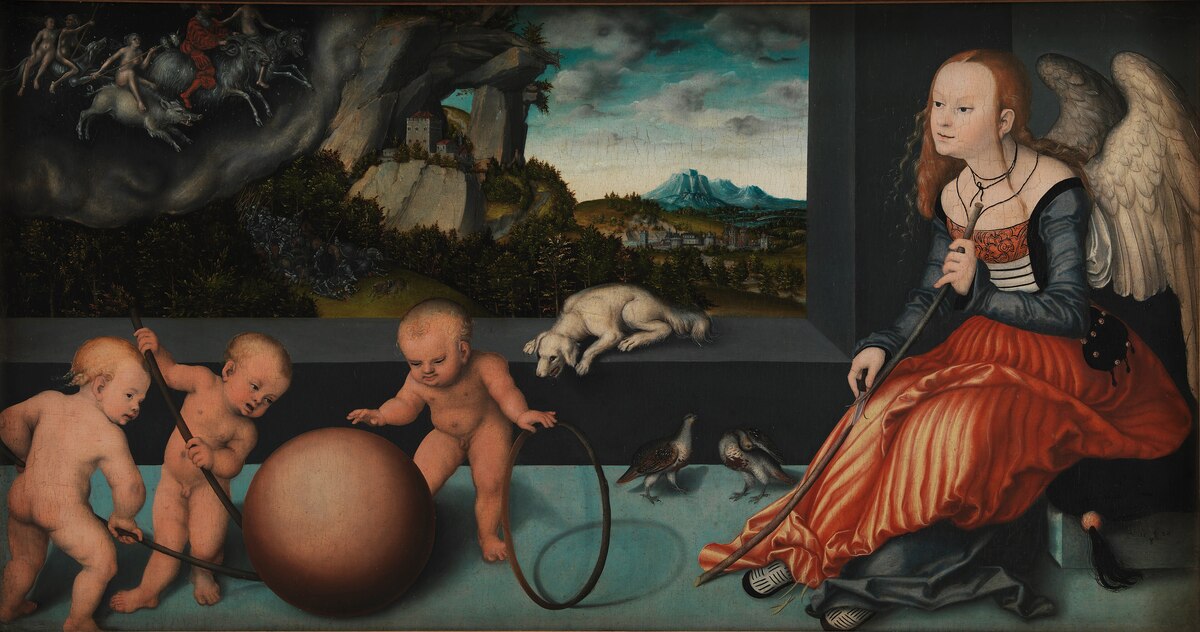
A rocky outcrop with a castle, a village, and distant blue mountains opens behind the ledge, situating the allegory in a vast stormy world.
02
Two Partridges
Two partridges stand on the floor before the woman, precise still-life details with symbolic and narrative value.
03
Sleeping White Dog
A white dog lies curled asleep on the stone ledge, a quiet sign of idleness or melancholy in the middle ground.
Your gallery guide
Melancholy by Lucas Cranach the Elder (1532)
A gallery guide to Lucas Cranach the Elder's allegorical painting Melancholy of 1532, tracing its winged personification, its playing putti and sleeping dog, and the dark riders gathering above the castle landscape.
Editorial review by Artifact Archive automated publishing
This is Lucas Cranach the Elder's Melancholy, painted in 1532. It is an allegory, which means its figures stand for an idea rather than a single real event.
The main figure is a winged woman who personifies melancholy. She sits at the centre of the composition, surrounded by small winged children called putti, a sleeping white dog, two partridges, and a castle landscape.
Above her, a dark cloud carries a group of riders. The scene is quiet and strange at once, and the painting asks you to read its parts as a connected idea.
Cranach sets the winged woman low in the picture, near the ground. Around her, the putti handle a ball and a hoop, as if they are absorbed in a game.
The white dog lies asleep beside them. Two partridges are visible in the landscape. The castle rises in the distance, and the dark cloud of riders hangs over the scene.
These details are not incidental decoration. They are the visual vocabulary through which the allegory is built.
The work is identified as an allegory of Melancholia. In this reading, the winged woman embodies the condition of melancholy, and the surrounding elements belong to that theme.
The putti with their ball and hoop, the sleeping dog, and the partridges are part of the composition as the source describes it. The castle landscape and the dark cloud of riders complete the setting.
One caution matters when you look at this painting. The Commons record notes that the image is different from another version titled Melancholia, so more than one work with a similar title exists.
That means the title alone will not always lead you to this exact panel. What fixes this one is its date, its maker, and its place in the Danish national collection.
The painting belongs to Statens Museum for Kunst in Copenhagen. Its catalogue number is KMSsp722, and it was acquired in 1759.
It is also listed in The Paintings of Lucas Cranach of 1979 and in the CORPUS CRANACH digital catalogue raisonne. Those references confirm its place in the study of Cranach's work.
For now, the essential thing to carry away is this. Cranach has turned an inner condition into a scene you can walk around with your eyes: a winged woman, playing children, a sleeping dog, and riders gathering in the dark above a castle.
The story and its sources
Editorial review by Artifact Archive automated publishing.
Historical claims are linked to the records below. Close looking and interpretation are identified in the passage notes.
Lucas Cranach the Elder was a German painter and printmaker (1472–1553). Their work is associated with German Renaissance. Their recorded places of work include Lutherstadt Wittenberg; Vienna; Weimar.
An allegorical painting in which a winged female personification of Melancholy sits with putti, a sleeping dog, partridges, and a dark cloud of riders, set before a castle landscape.
Title variants
Melancholia; Melancholie
Accession number
KMSsp722
Support
panel
Cataloguing the Panel
The catalogue entry for this panel identifies Lucas Cranach the Elder (1472-1553) as the artist and gives the title as Melancholy, with Melancholia recorded as a variant catalogue title. The work is dated 1532 and classified in the summary as an allegory. These three fields establish the basic identity of the object: a sixteenth-century painting by a named artist, assigned to a specific year within his career, and categorised by genre rather than by narrative subject. Attribution and date are catalogue assertions, and the title itself circulates in more than one form, so the naming should be treated as a catalogue convention rather than a fixed inscription on the work.(Wikimedia Commons: Melancholy, n.d., Summary, artist and title fields; Summary, Date field; Summary, Genre field)
Beyond the local catalogue fields, the work is referenced in The Paintings of Lucas Cranach (1979) as FR276 and in the CORPUS CRANACH digital catalogue raisonné as CC-MHM-300-001. These two citations are what allow the panel to be traced across the scholarly literature on Cranach rather than only through its museum record; the print reference number and the digital corpus identifier are complementary systems of locating the same object. The Wikimedia Commons record also notes that the image file is different from another version titled Melancholia, indicating that more than one work of similar title exists. Consequently, neither the title alone nor an image search by title reliably identifies this panel; the artist, the 1532 date, the accession number and the corpus identifiers together are what distinguish it from other Melancholia compositions in the Cranach literature.(Wikimedia Commons: Melancholy, n.d., Summary, artist and title fields; Summary, Collection and Object history fields)
The painting is by Lucas Cranach the Elder (1472-1553) and is titled Melancholy (also catalogued as Melancholia).(Wikimedia Commons: Melancholy, n.d.)
The composition of this 1532 panel is recorded as a single scene rather than a set of independent motifs. Its parts are a winged female figure, putti handling a ball and hoop, a sleeping white dog, two partridges, a castle landscape, and a dark cloud with riders. The record classifies the object's genre as allegory, and the same structured data that lists these depicted elements also files the work under 1530s allegorical paintings, sitting angels, and people with dogs. The listed contents therefore do double duty: they describe what is visible and they place the panel within the institution's and catalogue's own categories of subject matter. Because the painting is oil on the same support system recorded for the work, and measures 51 cm by 97 cm, the field it offers is markedly horizontal, wider than it is tall, so the winged figure, the putti with their playthings, the animal and bird motifs, the distant architecture, and the celestial riders must be read across a laterally extended format rather than stacked in a tall one.(Wikimedia Commons: Melancholy, n.d., Structured data: depicts; categories list; Summary, Medium and Dimensions fields)
The composition's elements are not merely enumerated in the record; they are the grounds on which the work is called an allegory of Melancholia. The winged woman is the figure through whom that condition is personified, while the putti with a ball and hoop, the sleeping white dog, the two partridges, the castle landscape and the dark cloud of riders belong to the same allegorical program as the source describes it. The category of sitting angels in the structured data attaches to the winged figures in the scene, and people with dogs attaches to the sleeping animal, showing how institutional description converts visible motifs into searchable subject terms. What the evidence establishes is the identification of the panel as an allegory of Melancholia and the inventory of motifs that carry it; it does not, on its own, explain the meaning of each individual motif, so the individual correspondences between the ball and hoop, the dog, the partridges or the riders and the idea of melancholy should be treated as part of the attributed allegorical reading rather than as separately documented facts.(Wikimedia Commons: Melancholy, n.d., Structured data: depicts; categories list)
Identifying this panel among related works
Interpretation
Taken together, the physical and documentary evidence frames how the visual account should be read. The panel is oil on a support recorded in the same summary as the medium, with the stated dimensions of 51 cm by 97 cm, which is the material fact against which proportions and viewing conditions must be judged. The work's attribution to Cranach, its 1532 date, and its listing as FR276 and CC-MHM-300-001 establish it within the Cranach literature, while the structured categories of 1530s allegorical paintings, sitting angels, and people with dogs show how the depicted contents have been indexed. The allegorical identification and the enumeration of motifs are attributed to the source record; the panel's presence in Statens Museum for Kunst, its accession number, its 1759 acquisition, and its room 201A location are collection facts. Keeping these registers distinct is what allows the visual evidence to be used without overstating it, and it is also why this horizontally extended allegory matters beyond a single museum object: it documents how an inner condition was rendered as a legible scene of figures, animals, landscape and sky, and how such a scene has since been titled, catalogued and reproduced for study.(Wikimedia Commons: Melancholy, n.d., Summary, Medium and Dimensions fields; Structured data: depicts; categories list; Summary, References field)
Visual observation
The composition includes a winged female figure, putti handling a ball and hoop, a sleeping white dog, two partridges, a castle landscape, and a dark cloud with riders.(Wikimedia Commons: Melancholy, n.d.)
The one technical description supplied for this panel is a medium and format statement: the work is oil on panel, with a height of 51 cm and a width of 97 cm. These are the only material facts the present evidence establishes. The medium is significant in the context of early sixteenth-century German painting, since oil on a prepared wooden support was the standard vehicle for this kind of finely finished allegorical cabinet picture, and the elongated horizontal format gives the composition its panoramic sweep. Nothing in the evidence supplies the species of wood, the number or joinery of the panel members, the ground or priming layers, the presence or absence of underdrawing, or any pigment identification. Accordingly, the material record here should be read as a documented medium and set of dimensions rather than as a full technical examination.(Wikimedia Commons: Melancholy, n.d., Summary, Medium and Dimensions fields)
Interpretation
A discrepancy in the source metadata deserves to be recorded because it bears directly on how the material evidence is catalogued. The medium field states oil on panel, while the Commons structured categories for this work include 1530s oil on copper paintings alongside the 1530s allegorical paintings grouping. The categories are an institution's indexing apparatus rather than a physical examination, so they do not override the stated medium, but they do show that the object's support has been described inconsistently in the digital record. Any account of Cranach's materials for this work should therefore distinguish the explicit medium statement from the category labels, and should treat the support question as one that only direct examination could settle.(Wikimedia Commons: Melancholy, n.d., Summary, Medium and Dimensions fields)
The image as a research document
The evidence does not describe the making process itself. There is no information about how the panel was prepared, whether the design was transferred by drawing or by some other means, whether the paint was laid in thin translucent layers or with opaque body colour, or what tools and brushes were used. The closest thing to working evidence is the reproduction itself: the file is described as a faithful photographic reproduction of a two-dimensional public domain work of art, sourced from the Google Cultural Institute at maximum zoom level. That establishes the quality and provenance of the image available for study, and it explains why fine surface detail can be inspected at high magnification, but it is a record of the photograph rather than of Cranach's hand. Technical claims about layering, brushwork, and modelling must rest on examination of the panel, not on the photograph's resolution.(Wikimedia Commons: Melancholy, n.d., Summary, Medium and Dimensions fields)
Place in the corpus
Interpretation
The object is Lucas Cranach the Elder's Melancholy, dated 1532, and it is held by Statens Museum for Kunst (National Gallery of Denmark), Copenhagen, under accession number KMSsp722, acquired in 1759. It is referenced in The Paintings of Lucas Cranach (1979) as FR276 and in the CORPUS CRANACH digital catalogue raisonne as CC-MHM-300-001, and it is currently displayed in room 201A. In the wider history of art, these coordinates matter because they place a securely dated 1532 panel by Cranach at the centre of the study of his allegorical work, with a stable catalogue identity and a long institutional history. For the materials question specifically, the date and attribution are what allow the panel to be compared with other documented Cranach works of the 1530s, even though the present evidence does not supply that comparative analysis.(Wikimedia Commons: Melancholy, n.d., Summary, Medium and Dimensions fields)
One qualification carries over from the catalogue record into any material discussion. The Commons note states that the image is different from another version titled Melancholia, indicating that more than one work with a similar title exists. This means that the title alone is not a reliable identifier for the panel described here; what fixes this object is its maker, its 1532 date, and its place in the Danish national collection. For a materials study, that distinction is practical as well as historical: descriptions, condition reports, or technical data attached to a different Melancholia should not be transferred to this panel, and the accession number KMSsp722 together with the catalogue references FR276 and CC-MHM-300-001 are the identifiers that keep the records separate.(Wikimedia Commons: Melancholy, n.d., Summary, Medium and Dimensions fields)
The documented ownership history of this panel begins with its entry into the Danish royal collection. The painting is in the collection of Statens Museum for Kunst, the National Gallery of Denmark, in Copenhagen, where it carries accession number KMSsp722, and the record states that it was acquired in 1759. That single documented transfer is the only acquisition event the evidence supplies for the object, and it is a substantial one: an acquisition date of 1759 places the panel in Danish hands more than two centuries after its making and well before the modern national gallery structure in which it is now catalogued. The accession number KMSsp722 functions as the object's stable institutional identifier and ties the physical painting to the collection record in which the 1759 acquisition is recorded.(Wikimedia Commons: Melancholy, n.d., Summary, Collection and Object history fields)
The evidence does not document any owner, sale or transfer between the painting's creation and the 1759 acquisition, and it does not name an individual or institution that held the work before it entered the Danish collection. This is an unrecorded interval, not a proven continuity of possession by any one party. The absence of provenance entries for those years should not be read as evidence that no transfers occurred; it means the supplied record does not establish them. Similarly, the accession number and the 1759 acquisition date identify the present institutional home and its acquisition event, but they do not by themselves describe the chain of custody that preceded it.(Wikimedia Commons: Melancholy, n.d., Summary, Collection and Object history fields)
Catalogue References
Two further records help specify what the accession number and catalogue numbers refer to. The painting is currently displayed in room 201A at Statens Museum for Kunst, according to the Wikimedia Commons record, so the object is not solely a catalogue entry but a work on view in a named gallery space. The image widely circulated of this panel is a faithful photographic reproduction of a two-dimensional public domain work of art, sourced from the Google Cultural Institute at maximum zoom level. That provenance of the reproduction is distinct from the provenance of the painting itself: it documents the route by which a photographic surrogate entered public circulation, not the route by which the physical panel entered the Danish collection in 1759. Keeping the two histories separate matters when a single accession record is used to anchor both an object and its most familiar image.(Wikimedia Commons: Melancholy, n.d., Licensing section; Summary, Collection and Object history fields)
The provenance of this panel should be read together with a qualification stated in the record: the Commons entry notes that the image is different from another version titled Melancholia, indicating that more than one work with a similar title exists. For provenance purposes this means the catalogue references, the title and even the accession number KMSsp722 identify one specific painting among related versions, and the title alone will not always lead to this exact panel. What fixes this object is the combination of maker, date and place in the Danish national collection, together with its accession and catalogue numbers. The evidence does not establish the provenance of those other versions, nor does it establish a relationship of copying or descent between them and this panel; it establishes only that the title is shared and that the works are distinct.(Wikimedia Commons: Melancholy, n.d., Summary, Collection and Object history fields; Summary, References field)
The reception history of Cranach's Melancholy begins with something unusual: the single most widely circulated image of the work is itself a modern scholarly reproduction rather than a print or copy made in the artist's lifetime. The Wikimedia Commons file is described as a faithful photographic reproduction of a two-dimensional public domain work of art, sourced from the Google Cultural Institute at maximum zoom level. That provenance matters for how the picture is now known. Because the source image is a maximum-zoom capture of a publicly held painting, viewers encounter details of surface and design at a resolution that no earlier reproductive medium, whether engraving, photograph or slide, would have supplied. The high-resolution file, rather than the physical panel in Copenhagen, is for many audiences the actual object of attention and the basis of further reproduction and reuse.(Wikimedia Commons: Melancholy, n.d., Licensing section)
Cataloguing and the Scholarly Corpus
The cataloguing of the painting anchors its place in the scholarly literature. The work is referenced in The Paintings of Lucas Cranach (1979) as FR276 and in the CORPUS CRANACH digital catalogue raisonné as CC-MHM-300-001. These two citations represent different stages in the documentation of Cranach's oeuvre. The printed 1979 volume belongs to the era of the traditional catalogue raisonné, in which each accepted painting received a numbered entry; the CORPUS CRANACH reference belongs to the digital phase of the same project, in which entries are identified by alphanumeric codes and can be updated. Both systems of numbering confirm that this panel has been accepted into the standard corpus of Cranach's work, and both supply the identifiers by which reception, attribution and comparison proceed.(Wikimedia Commons: Melancholy, n.d., Summary, References field)
The file is a faithful photographic reproduction of a two-dimensional public domain work of art, sourced from the Google Cultural Institute at maximum zoom level.(Wikimedia Commons: Melancholy, n.d.)
The work is referenced in The Paintings of Lucas Cranach (1979) as FR276 and in the CORPUS CRANACH digital catalogue raisonné as CC-MHM-300-001.(Wikimedia Commons: Melancholy, n.d.)
The single evidence unit supplied for this section is a Wikimedia Commons file page for Lucas Cranach the Elder's Melancholy, and the only object-specific claim it makes about rival versions is a negative one: according to that record, the image it hosts is different from another version titled 'Melancholia', which indicates that more than one work with a similar title exists. The record does not name that other version, does not date it, does not say who made it or where it is, and does not characterize the relationship between the two works. What the unit establishes, then, is a caution about identification rather than a documented pairing: a similar title cannot by itself be trusted to retrieve this particular painting, and any search or citation keyed on the word alone risks collapsing distinct objects into one. Because the note is framed as a difference between versions rather than as a claim of authorship, derivation or priority, it should be reported as a qualification the Commons record itself raises, not as a finding about which work came first or which served as a model.(Wikimedia Commons: Melancholy, n.d., Summary, Other versions field)
The same Commons record supplies the identifiers that do fix this object independently of its title: the painting is attributed to Lucas Cranach the Elder, whose life dates are given as 1472 to 1553, is dated to 1532, and is described as oil on panel measuring 51 cm in height by 97 cm in width. It is held by Statens Museum for Kunst (the National Gallery of Denmark) in Copenhagen under accession number KMSsp722, with an acquisition date of 1759, and the record states that the work is currently displayed in room 201A. These are the coordinates that make the otherwise ambiguous title usable: maker, year, support, dimensions, collection, accession number and acquisition history together distinguish the panel the record describes from any other work sharing a 'Melancholia' title. The acquisition date of 1759 places the panel in the Danish royal or national collection well before the nineteenth-century formation of many European museum holdings, though the record as supplied does not explain the circumstances of that acquisition, and this account should not supply them.(Wikimedia Commons: Melancholy, n.d., Summary, Other versions field)
Interpretation
Beyond the file-level description, the record carries catalogue and subject information that situates the panel in Cranach scholarship and in the museum's classifications. The work is referenced in The Paintings of Lucas Cranach (1979) as FR276 and in the CORPUS CRANACH digital catalogue raisonné as CC-MHM-300-001, so two separate numbering systems, one print and one digital, can be used to locate it in the literature. It is identified as an allegory of Melancholia and categorized among 1530s allegorical paintings; the record's structured data also places it among 1530s oil on copper paintings, among sitting angels, among people with dogs, and among other subjects. The oil-on-copper category sits uneasily beside the stated medium of oil on panel, and the evidence does not resolve that discrepancy, so it should be carried as a tension in the Commons metadata rather than silently harmonized; the remaining categories correspond to visible content rather than to contested claims. The genre designation of allegory matches the iconographic description supplied, in which the composition includes a winged female figure, putti handling a ball and hoop, a sleeping white dog, two partridges, a castle landscape, and a dark cloud with riders, all of which the record treats as belonging to the allegorical reading. The file itself is described as a faithful photographic reproduction of a two-dimensional public domain work of art, sourced from the Google Cultural Institute at maximum zoom level, which means the image under discussion is a documentary surrogate of the panel rather than the panel itself, and its fidelity is asserted by that record rather than demonstrated here.(Wikimedia Commons: Melancholy, n.d., Summary, Other versions field)
The Allegorical Identification
The Wikimedia Commons record for this panel identifies it as an allegory of Melancholia and places it within a set of descriptive categories: 1530s allegorical paintings, 1530s oil on copper paintings, sitting angels, people with dogs, and other subjects. That categorical framing is itself the record's primary act of interpretation, since it asserts both a subject (melancholy personified) and a set of recurring motifs that connect the picture to other works sharing similar components. The categories are assigned by the Commons structured data rather than by a signed argument, so they should be treated as an attributed reading rather than as a statement of the maker's intention. Two elements of the categorization are worth separating. The allegorical identification concerns what the picture means, while the motif categories (sitting angels, people with dogs) concern what the picture shows. A third category, oil on copper, concerns material and, as discussed below, sits in tension with the medium recorded elsewhere in the same record.(Wikimedia Commons: Melancholy, n.d., Categories section)
The work is identified as an allegory of Melancholia and is categorized among 1530s allegorical paintings, 1530s oil on copper paintings, sitting angels, people with dogs, and other subjects in the Commons structured data.(Wikimedia Commons: Melancholy, n.d.)
Disputed account
According to the Wikimedia Commons record, the image is different from another version titled 'Melancholia', indicating more than one work with a similar title exists.(Wikimedia Commons: Melancholy, n.d.)
The object is a 1532 allegorical painting by Lucas Cranach the Elder (1472-1553), titled Melancholy and also catalogued as Melancholia. It is oil on panel, 51 cm high by 97 cm wide. The Wikimedia Commons record identifies it as an allegory, a work whose figures stand for an idea. In the Commons structured data the work is placed among 1530s allegorical paintings, and also among 1530s oil on copper paintings; the medium statement in the summary is oil on panel and the structured category is oil on copper. The painting is held by Statens Museum for Kunst, the National Gallery of Denmark, Copenhagen, under accession number KMSsp722, and was acquired in 1759. According to the Commons record it is currently displayed in room 201A of that museum.(Wikimedia Commons: Melancholy, n.d., Summary, Current location field)
The composition described in the record includes a winged female figure, putti handling a ball and hoop, a sleeping white dog, two partridges, a castle landscape, and a dark cloud with riders. The written account treats these elements as the visual vocabulary through which the allegory is constructed rather than as incidental decoration: the winged woman personifies melancholy, the putti are absorbed in their game, the dog sleeps beside them, the partridges appear in the landscape, the castle rises in the distance, and the cloud of riders hangs above the scene. The work is identified as an allegory of Melancholia, and the Commons structured data files it among subjects including sitting angels and people with dogs as well as the broader allegorical and decade categories.(Wikimedia Commons: Melancholy, n.d., Summary, Current location field)
Identification and documentation
The Commons record notes that its image differs from another version titled Melancholia, indicating that more than one work with a similar title exists. The title alone therefore does not identify this panel; what fixes it is the combination of maker, date and collection. Scholarship locates the work through named reference systems as well: it appears in The Paintings of Lucas Cranach (1979) as FR276 and in the CORPUS CRANACH digital catalogue raisonne as CC-MHM-300-001. The image file itself is described as a faithful photographic reproduction of a two-dimensional public domain work of art, sourced from the Google Cultural Institute at maximum zoom level.(Wikimedia Commons: Melancholy, n.d., Summary, Current location field)
The painting is in the collection of Statens Museum for Kunst (National Gallery of Denmark), Copenhagen, with accession number KMSsp722, and was acquired in 1759.(Wikimedia Commons: Melancholy, n.d.)
The painting is currently displayed in room 201A at Statens Museum for Kunst, according to the Wikimedia Commons record.(Wikimedia Commons: Melancholy, n.d.)
The single value figure attached to this object is not a market result but a model-generated working insurance estimate, recorded on 2026-10-16 as a range of US$8M to US$25M. Its stated methodology is a broad, conservative screening range produced for manual review only, keyed to the painting's confirmed context: Lucas Cranach the Elder (1472-1553) as artist, a date of 1532, oil on panel, dimensions of 51 by 97 cm, and current holding at Statens Museum for Kunst, Copenhagen, under accession number KMSsp722, with object history noting acquisition in 1759. The estimate is framed as reflecting the insurance profile of a securely attributed, catalogued, museum-held Cranach allegorical painting of substantial scale whose institutional provenance traces to the eighteenth century. A wide low-to-high spread is used precisely because the underlying excerpts supplied no official appraisal, insurance schedule, or named comparable sale, and because a public collection is not an open-market setting; the lower bound is described as a conservative floor for a confirmed Cranach panel of this size and subject, and the upper bound as remaining below the highest conceivable private-market levels for top-tier Cranach works. The accompanying qualification is explicit that this is not an official insurance value, appraisal, auction result, or sale price, that no comparable sales, private insurance records, or market transactions were accessed or invented, and that actual insurance values may differ materially on condition, authenticity verification, provenance review, exhibition history, and institutional or market considerations. The category label applied to this unit is interpretation, which is the correct weight: the number belongs to the reception and risk-management apparatus around a museum object, not to the documented creation, form or cultural history of the panel itself.(Wikimedia Commons: Melancholy, n.d.)
Working estimate
Calculated working insurance estimate, not a sale price: Estimated value: US$8M to US$25M Recorded date: Working calculation, generated 2026-10-16. Methodology: Broad conservative working insurance range derived for manual review only. The confirmed context identifies Lucas Cranach the Elder (1472-1553), a major German Northern Renaissance painter, as the artist; the work is dated 1532, is oil on panel, measures 51 by 97 cm, and is held at Statens Museum for Kunst, Copenhagen, with accession number KMSsp722 and object history noting acquisition in 1759. The range reflects the high insurance profile of a securely attributed, catalogued, museum-held Cranach the Elder allegorical painting of substantial scale, with an institutional provenance traceable to the eighteenth century. A wide low-to-high spread is used because no official appraisal, insurance schedule, or named comparable sale was supplied in the excerpts, and because the painting is in a public collection rather than on the open market. The lower bound reflects a conservative floor for a confirmed Cranach panel of this size and subject, while the upper bound remains below the highest conceivable private-market levels for top-tier Cranach works and is intended only as a review prompt. Qualification: Model-generated working range for manual review only. This is not an official insurance value, appraisal, auction result, or sale price. No comparable sales, private insurance records, or market transactions were accessed or invented. The range is not a substitute for a qualified fine-art appraisal or formal insurance valuation. Actual insurance values may differ materially based on condition, authenticity verification, provenance review, exhibition history, and institutional or market considerations. Use only as a preliminary screening estimate.(Wikimedia Commons: Melancholy, n.d.)
Further reading
Books for a closer look
Paid links. As an Amazon Associate I earn from qualifying purchases.
Lucas Cranach the Elder: art and devotion of the German Reformation
University Press Of America
Recorded as a study of Lucas Cranach the Elder by Bonnie Noble, with subject headings including criticism and interpretation of Cranach, painting, German, and art and religion / Reformation and art. This is an object-specific scholarly source on the named artist and his intellectual and religious context, which is the best documented fit for research on Cranach's Melancholy among the returned candidates.
Lucas Cranach the Elder: Painting Materials, Techniques and Workshop Practice
Amsterdam University Press
Recorded with subjects on Cranach the Elder, criticism and interpretation, German painting, artists' materials, and artists' studios. A technical and art-historical study of the artist, relevant for examining the making and attribution of Cranach works such as Melancholy, though the record does not specify that this painting is discussed.
Recorded as a study of Lucas Cranach the Elder by Bonnie Noble, with subject headings including criticism and interpretation of Cranach, painting, German, and art and religion / Reformation and art. This is an object-specific scholarly source on the named artist and his intellectual and religious context, which is the best documented fit for research on Cranach's Melancholy among the returned candidates.
Recorded with subjects on Cranach the Elder, criticism and interpretation, German painting, artists' materials, and artists' studios. A technical and art-historical study of the artist, relevant for examining the making and attribution of Cranach works such as Melancholy, though the record does not specify that this painting is discussed.
Advertising supports the archive. These preferences control aggregate page counting, reading activity and ad-delivery diagnostics. They use no visitor tracking cookie.