María Teresa de Borbón y Vallabriga, later Condesa de Chinchón
Artist: Francisco Goya · 1783
María Teresa de Borbón y Vallabriga, later Condesa de Chinchón: high-resolution image
The highest-resolution file we hold, available without payment or an account.3,541 × 4,096 pixels.
Download highest-resolution imageThe complete story
The story About 3 minutes to read
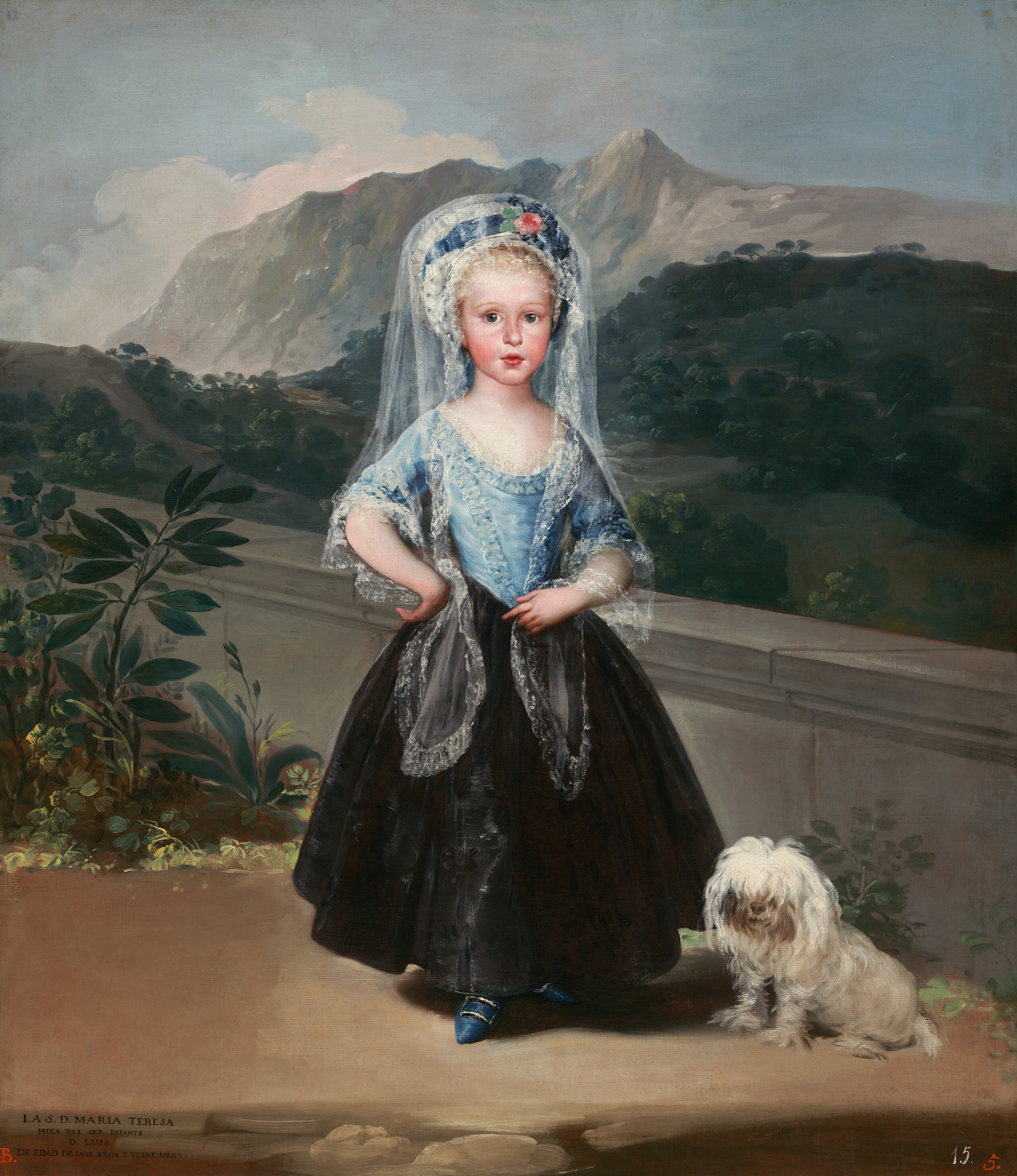
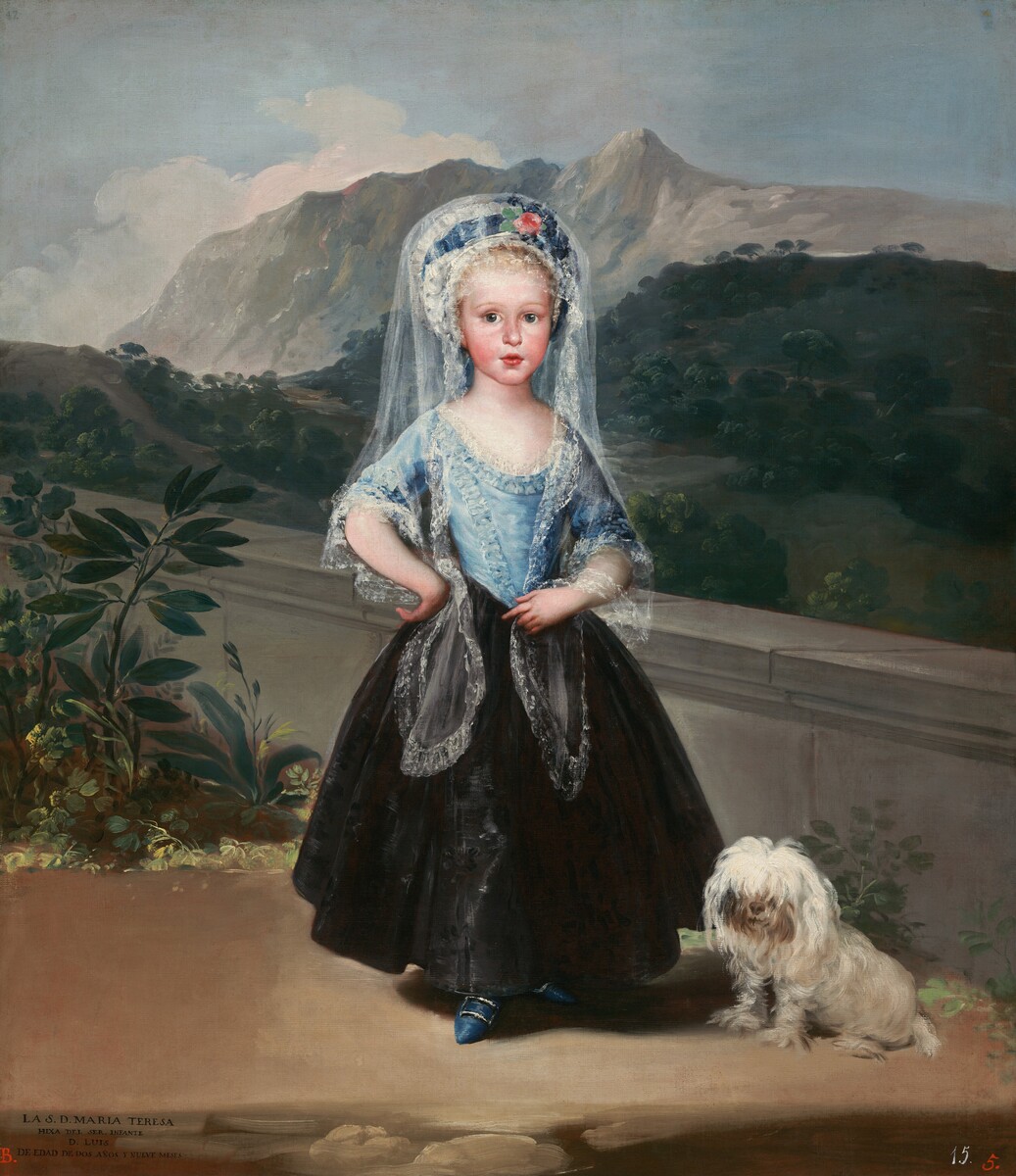
This is Francisco Goya's portrait of María Teresa de Borbón y Vallabriga, painted in 1783. She was a child when Goya made the picture, and she later became the Condesa de Chinchón. The title itself carries both moments: the girl before us, and the title she would hold later in life.
The supplied record describes a full-length child portrait. María Teresa stands outdoors, with a mountain landscape behind her and a small white dog at her side. Goya worked in oil on canvas, a medium that lets a painter build the landscape and the figure with layered colour and light.
A portrait like this places a child in a setting larger than herself. The landscape opens the space behind her, while the dog stands close by her side, a small companion within the picture. That contrast between the wide outdoors and the near presence of the animal is one way the composition holds our attention on the girl.
The title asks us to hold two identities together: the young María Teresa Goya painted, and the Condesa de Chinchón she later became. The portrait documents the first, and the title records the second. Looking at the painting, we see the child. The later title is a fact about her life that the picture itself cannot show us.
This is Goya's 1783 portrait of a child who would grow into a titled woman, painted outdoors with a mountain landscape and a small white dog. It exists today in the National Gallery of Art. Goya made the work in oil on canvas, and the record of the painting preserves both the girl and the name she would later carry.
The story and its sources
Historical claims are linked to the records below. Close looking and interpretation are identified in the passage notes.
- Passage 1Documented historyWikimedia Commons: María Teresa de Borbón y Vallabriga, later Condesa de Chinchón
- Passage 2Documented historyWikimedia Commons: María Teresa de Borbón y Vallabriga, later Condesa de Chinchón
- Passage 3Interpretation
- Passage 4InterpretationWikimedia Commons: María Teresa de Borbón y Vallabriga, later Condesa de Chinchón
- Passage 5Documented historyWikimedia Commons: María Teresa de Borbón y Vallabriga, later Condesa de Chinchón
Details to notice
About 2 minutes to readPainted inscription
The inscription at the lower left names María Teresa as the daughter of the Infante Don Luis and records her age as two years and nine months, anchoring the portrait's identity.
Mountain landscape
The cloud-wrapped rocky peak and dark wooded slopes establish the outdoor setting and make the small figure stand out against the scale of nature.
White dog
A small shaggy white dog sits at the lower right, a lively animal companion that balances the sitter's formal pose and adds intimacy.
Artist portrait Image credit
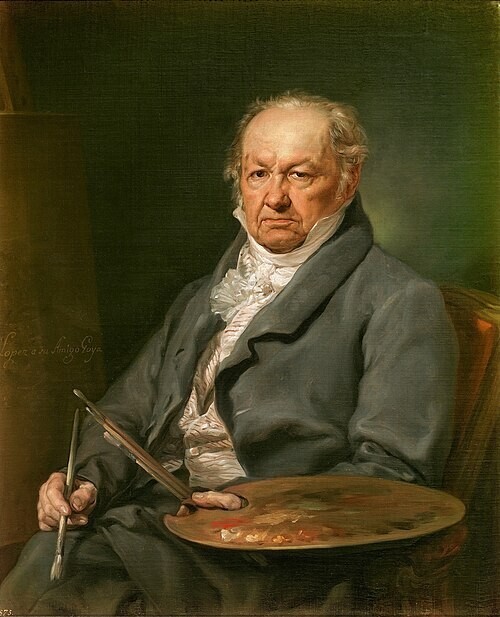
Vicente López Portaña. Image source · Public domain
About the artist
Francisco de Goya
30 March 1746 to 16 April 1828
Goya was a Spanish painter and printmaker whose career extended from royal tapestry designs and court portraiture to images of war, repression and unsettling fantasy. Born in Fuendetodos, he trained in Zaragoza and Madrid and became First Painter to Charles IV in 1799. He spent his final years in Bordeaux.
- Born
- 30 March 1746
- Died
- 16 April 1828
- Nationality
- Spanish
- Birthplace
- Fuendetodos, Spain
- Died in
- Bordeaux, France
The research & record
Study the work.
Follow the evidence.
Find catalogue details, historical context, technical research and the literature behind this artwork.
The artwork record
Research catalogue
Catalogue information and detailed research, with references that link to the bibliography.
Updated .
Identity and catalogue
Link- Title
- María Teresa de Borbón y Vallabriga, later Condesa de Chinchón
- Artist or attribution
- Francisco Goya(Wikimedia Commons: María Teresa de Borbón y Vallabriga, later Condesa de Chinchón, n.d.)
- Object date
- 1783(Wikimedia Commons: María Teresa de Borbón y Vallabriga, later Condesa de Chinchón, n.d.)
- Medium and support
- oil on canvas(Wikimedia Commons: María Teresa de Borbón y Vallabriga, later Condesa de Chinchón, n.d.)
- Dimensions
- overall: 134.5 x 117.5 cm (52 15/16 x 46 1/4 in.); framed: 154.3 x 136.8 x 5.7 cm (60 3/4 x 53 7/8 x 2 1/4 in.)(Wikimedia Commons: María Teresa de Borbón y Vallabriga, later Condesa de Chinchón, n.d.)
- Current collection or location
- National Gallery of Art, Washington, D.C.(Wikimedia Commons: María Teresa de Borbón y Vallabriga, later Condesa de Chinchón, n.d.)
- Movement or period
- Spanish Enlightenment portraiture
- Country or culture
- Spain
- Depicted subject
- Full-length child portrait of María Teresa de Borbón y Vallabriga, daughter of the Infante Don Luis, standing outdoors before a mountain landscape with a small white dog at her side.
- Title variants
- María Teresa de Borbón y Vallabriga, later Condesa de Chinchón
- Accession number
- 1970.17.123(Wikimedia Commons: María Teresa de Borbón y Vallabriga, later Condesa de Chinchón, n.d.)
- Support
- canvas
Read valuation records and their limitations
Catalogue Entry
The painting is catalogued as María Teresa de Borbón y Vallabriga, later Condesa de Chinchón, and is attributed to Francisco Goya. The date recorded for the work is 1783, and its overall dimensions are given as 134.5 by 117.5 centimeters, or 52 15/16 by 46 1/4 inches. The supplied record supports these points about title, maker, date and size. The record also identifies the medium as oil on canvas and places the painting in the National Gallery of Art under accession number 1970.17.123. The Wikimedia Commons discovery record used here was only partially consulted, and its compiler notes that the museum record was not directly consulted, so these catalogue facts rest on the supplied excerpt rather than on a fresh reading of the museum file.(Wikimedia Commons: María Teresa de Borbón y Vallabriga, later Condesa de Chinchón, n.d.)
The title itself holds two moments of the sitter's life, the child Goya portrayed and the later title of Condesa de Chinchón. In the title, the name marks her as the person depicted, and the phrase later Condesa de Chinchón records a dignity she came to hold after the picture was made. The title is therefore not a description of what the canvas shows but a later catalogue identification. The picture documents the girl as she was in 1783, and the title records what she became. This gap between the object and its name is part of the painting's identity as a museum object, and it matters for how any later account dates or describes the work.(Wikimedia Commons: María Teresa de Borbón y Vallabriga, later Condesa de Chinchón, n.d.)
Ownership history is recorded separately from the facts of creation. The painting is credited to the Ailsa Mellon Bruce Collection, a collection name that attaches to the work's institutional history rather than to its making in 1783. The date of the painting and the date of its entry into that collection are different kinds of information, and the two must not be conflated in the catalogue record. The supplied evidence establishes the collection credit and the 1783 painting date as distinct facts, and it does not supply an acquisition date or a sequence of earlier owners.(Wikimedia Commons: María Teresa de Borbón y Vallabriga, later Condesa de Chinchón, n.d.)
The painting is titled María Teresa de Borbón y Vallabriga, later Condesa de Chinchón.(Wikimedia Commons: María Teresa de Borbón y Vallabriga, later Condesa de Chinchón, n.d.)
The painting was made by Francisco Goya.(Wikimedia Commons: María Teresa de Borbón y Vallabriga, later Condesa de Chinchón, n.d.)
The painting is dated 1783.(Wikimedia Commons: María Teresa de Borbón y Vallabriga, later Condesa de Chinchón, n.d.)
The painting's overall dimensions are 134.5 by 117.5 centimeters, or 52 15/16 by 46 1/4 inches.(Wikimedia Commons: María Teresa de Borbón y Vallabriga, later Condesa de Chinchón, n.d.)
Materials and technique
LinkRead valuation records and their limitations
Documented medium and support
The painting is recorded as oil on canvas, the medium and support in which Francisco Goya worked on this full-length portrait, dated 1783, of María Teresa de Borbón y Vallabriga, later Condesa de Chinchón. The same record fixes the work's overall dimensions at 134.5 by 117.5 centimeters, or 52 15/16 by 46 1/4 inches, a scale consistent with a full-length figure rather than a bust or head study. It also places the picture in the National Gallery of Art under accession number 1970.17.123, credited to the Ailsa Mellon Bruce Collection. These are the concrete material facts the supplied documentation establishes: medium, support, size, holding and collection credit. Descriptions of how paint is layered to build the landscape and the figure, or how colour and light are handled, belong to the visual reading of the picture rather than to the supplied technical record, and should be distinguished from it accordingly.(Wikimedia Commons: María Teresa de Borbón y Vallabriga, later Condesa de Chinchón, n.d.)
The painting is oil on canvas.(Wikimedia Commons: María Teresa de Borbón y Vallabriga, later Condesa de Chinchón, n.d.)
Provenance and ownership
LinkRead valuation records and their limitations
The Documented Record
The provenance record supplied for this painting is brief but precise. The work is credited to the Ailsa Mellon Bruce Collection, and the National Gallery of Art accession number recorded for it is 1970.17.123. Those two facts establish the painting's present institutional identification: an accession number assigned within the National Gallery's numbering system, and a named collection credit under which the picture is filed. The title associated with the record is María Teresa de Borbón y Vallabriga, later Condesa de Chinchón, the artist is Francisco Goya, the date is 1783, the medium is oil on canvas, and the overall dimensions are 134.5 by 117.5 centimeters, or 52 15/16 by 46 1/4 inches. These details matter to provenance because they are the identifiers by which any future owner, sale, loan, or treatment record can be matched to this exact canvas rather than to another Goya portrait of the same sitter.(Wikimedia Commons: María Teresa de Borbón y Vallabriga, later Condesa de Chinchón, n.d.)
What the Record Does and Does Not Establish
The evidence units supplied here do not record a chronological chain of owners, transfers, sale dates, or intermediate holdings. What they document is the painting's current credit line and accession number, a pairing that places the object within the Ailsa Mellon Bruce Collection at the National Gallery of Art. No earlier owner, dealer, auction, or gift transaction is named in the supplied evidence, and no interval between the painting's creation in 1783 and its later institutional placement is described. That absence should be read as an unrecorded interval, not as evidence of continuous ownership or of an undocumented transfer. The distinction is important for provenance research: a gap in the record is a gap in the record, whereas a proven change of ownership requires a dated instrument, catalogue entry, or comparable document, none of which is present in these units.(Wikimedia Commons: María Teresa de Borbón y Vallabriga, later Condesa de Chinchón, n.d.)
The Collection Credit and Its Identifier
The collection credit itself is the principal provenance datum in the supplied evidence. Because the painting is credited to the Ailsa Mellon Bruce Collection and carries an accession number, the record identifies both a holding entity and an object-level identifier, the two elements that let a researcher distinguish this canvas from other versions, copies, or related portraits. The accession number 1970.17.123 is the specific locator attached to the work in that numbering, and the collection name is the attribution of custody under which the object is recorded. The supplied evidence does not state the date of the collection's formation, the terms of any bequest or gift, or the mechanism by which the painting entered the National Gallery of Art; those questions remain outside what these units establish.(Wikimedia Commons: María Teresa de Borbón y Vallabriga, later Condesa de Chinchón, n.d.)
Interpretation
Reading the record as a whole, the provenance information and the object description are interlocked. The title, artist, date, medium, and dimensions identify the physical object, while the collection credit and accession number locate that object within a specific institutional holding. For a painting of 1783 by Goya depicting María Teresa de Borbón y Vallabriga, later Condesa de Chinchón, this combination allows the work to be tracked as a discrete museum object rather than as a generic image of the sitter. The evidence therefore supports a description of present custody and identification, and it leaves the earlier history of ownership open. Any fuller provenance narrative would need documents beyond the units supplied here.(Wikimedia Commons: María Teresa de Borbón y Vallabriga, later Condesa de Chinchón, n.d.)
The painting is credited to the Ailsa Mellon Bruce Collection.(Wikimedia Commons: María Teresa de Borbón y Vallabriga, later Condesa de Chinchón, n.d.)
Collection and display
LinkRead valuation records and their limitations
Collection and display
The painting is now held by the National Gallery of Art, where it carries the accession number 1970.17.123. That number and the present location are the institutional facts the supplied record establishes about the work's current custody; both are documented in the museum record for the picture, and both are independent of the painting's subject, date and authorship. The accession number indicates the year of accession within the museum's numbering convention and a position within the group of works registered in that year, and the work is likewise credited to the Ailsa Mellon Bruce Collection, so the object's history includes its passage into a named collection within a public institution as well as its place in that institution's general holdings. Beyond these registration facts the supplied record does not describe how the painting left the sitter's family, when it entered the Ailsa Mellon Bruce Collection, or under what terms it came to the National Gallery of Art, so no chain of ownership should be reconstructed from the accession number alone.(Wikimedia Commons: María Teresa de Borbón y Vallabriga, later Condesa de Chinchón, n.d.)
The painting belongs to the National Gallery of Art.(Wikimedia Commons: María Teresa de Borbón y Vallabriga, later Condesa de Chinchón, n.d.)
The National Gallery of Art accession number for the painting is 1970.17.123.(Wikimedia Commons: María Teresa de Borbón y Vallabriga, later Condesa de Chinchón, n.d.)
Documented values and qualified estimates
LinkRead valuation records and their limitations
The object and its recorded identity
Interpretation
The object record identifies the work as Francisco Goya's 1783 portrait of María Teresa de Borbón y Vallabriga, later Condesa de Chinchón, executed in oil on canvas at 134.5 by 117.5 centimeters (52 15/16 by 46 1/4 inches). The painting is held at the National Gallery of Art, Washington, D.C., under accession number 1970.17.123, credited to the Ailsa Mellon Bruce Collection. The double form of the title registers two moments in the sitter's life: the child Goya painted in 1783 and the title she later assumed. The picture itself documents only the first; the second is carried by the naming convention that collection and cataloguing have attached to it. The same record establishes the medium and dimensions that underlie any discussion of the work's standing, since those are the confirmed physical facts on which the valuation material below explicitly rests.(Wikimedia Commons: María Teresa de Borbón y Vallabriga, later Condesa de Chinchón, n.d.)
The working valuation and its qualifications
A separate working document, dated 2026-11-16, sets out a broad estimated value range of US$20 million to US$45 million for the painting. Its stated methodology ties that range directly to the confirmed identity recorded above: Goya, 1783, oil on canvas, the portrait of María Teresa de Borbón y Vallabriga, secure museum status at the National Gallery of Art, accession 1970.17.123, Ailsa Mellon Bruce Collection. On that basis the document places the work among scarce, high-value Old Master and Spanish Enlightenment portraits. Crucially, the range is not derived from transaction data, public appraisal, auction result, or private insurance figure, none of which the document says were supplied or accessed, and no comparable sales were used. The same evidence supplies the qualification that the estimate is a model-generated planning figure, deliberately wide and conservative for a non-market institutional holding, and not an official insurance value, appraisal, auction estimate, or sale price.(Wikimedia Commons: María Teresa de Borbón y Vallabriga, later Condesa de Chinchón, n.d.)
The valuation document's own terms limit how such a figure should be used. It states that actual schedules would require a qualified appraiser's inspection and market analysis, and that the range must be reviewed and replaced by a qualified fine-art appraiser before any insurance, lending, or tax decision. It also records that it does not reflect any actual policy schedule, market transaction, or professional valuation. Read alongside the object record, the valuation is best understood as an internal, review-stage estimate whose authority rests entirely on the documented identity and institutional status of the painting, not on any market evidence. The documentary record of the painting therefore stands on its own terms, and the monetary range is a separate, provisional layer attached to that record.(Wikimedia Commons: María Teresa de Borbón y Vallabriga, later Condesa de Chinchón, n.d.)
Working estimate
Calculated working insurance estimate, not a sale price: Estimated value: US$20M to US$45M Recorded date: Working calculation, generated 2026-11-16. Methodology: Broad working range calculated for manual review only. The basis is the confirmed object identity (Francisco Goya, 1783 oil on canvas portrait of Maria Teresa de Borbon y Vallabriga, later Condesa de Chinchon, 134.5 x 117.5 cm) and its secure museum status in the National Gallery of Art, Washington, D.C., accession 1970.17.123, from the Ailsa Mellon Bruce Collection, as recorded in the supplied object record. These factors place the work among scarce, high-value Old Master and Spanish Enlightenment portraits. The range is deliberately wide and conservative for a non-market, institutional holding of this caliber. No public appraisal, auction result, or private insurance figure was supplied or accessed, so no comparable sales were used and the range is not derived from transaction data. Actual schedules would require a qualified appraiser's inspection and market analysis. Qualification: This is a model-generated working range for manual review only. It is not an official insurance value, appraisal, auction estimate, auction result, or sale price. It does not reflect any actual policy schedule, market transaction, or professional valuation. The range is a broad planning figure and must be reviewed and replaced by a qualified fine-art appraiser before any insurance, lending, or tax decision. No private insurance records or comparable sales were accessed.(Wikimedia Commons: María Teresa de Borbón y Vallabriga, later Condesa de Chinchón, n.d.)
Further reading
Books for a closer look
Paid links. As an Amazon Associate I earn from qualifying purchases.

Open Library Goya
Kodansha International
Catalogue record lists Goya as subject with catalogues raisonnés, exhibitions, and Spanish painting among its subjects, which fits a documented 1783 Goya portrait of María Teresa de Borbón y Vallabriga. Record alone does not confirm this painting is discussed.
ISBN 0870110837

Open Library Francisco Goya
Counterpoint
Recorded as a Goya artist biography and criticism/interpretation study, offering documented context on Goya's career around the 1783 court portrait of the Infante Don Luis's daughter. It is a general study, not an object-specific catalogue.
ISBN 1582433070
Bibliography
Sources and further reading
References are arranged by author or organisation, with links to the original publications. Where no publication date is recorded, n.d. means no date.
Source notes updated .
No recorded sources match these filters. Reset the filters to see the full bibliography.
- 04
Book
Francisco Goya. Counterpoint.
Recorded as a Goya artist biography and criticism/interpretation study, offering documented context on Goya's career around the 1783 court portrait of the Infante Don Luis's daughter. It is a general study, not an object-specific catalogue.
- ISBN
- 1582433070
Citation text
- 02
Book
Goya. Kodansha International.
Catalogue record lists Goya as subject with catalogues raisonnés, exhibitions, and Spanish painting among its subjects, which fits a documented 1783 Goya portrait of María Teresa de Borbón y Vallabriga. Record alone does not confirm this painting is discussed.
- ISBN
- 0870110837
Citation text
- 03
Book
Francisco Goya - the Paintings. Independently Published.
Titled 'Francisco Goya - the Paintings', directly addressing Goya's painted oeuvre, the medium of the supplied artwork. Its catalogue record has no listed subjects, so relevance rests only on the title indicating a survey of Goya's paintings.
- ISBN
- 9781521566466
Citation text
- 01
Secondary · About this artwork
Wikimedia Commons: María Teresa de Borbón y Vallabriga, later Condesa de Chinchón (n.d.). Wikimedia Commons file page for María Teresa de Borbón y Vallabriga, later Condesa de Chinchón. Wikimedia Commons.
Discovery record. Supplies the file title, artist, date, medium, dimensions, collection and accession number, with license marked public domain. Museum record not directly consulted; only the supplied excerpt was used.
Citation text
Art to live with
Bring this painting
home.
A piece of the archive, made yours. Explore María Teresa de Borbón y Vallabriga, later Condesa de Chinchón in a size and finish that fits your space.
Your text and annotations appear on these editions. Adding to cart saves that design for printing.
Combine this painting with your favourites01 / Find your edition
Made for you
Suggested from your location. Change it if you're sending elsewhere or using a VPN. Prices and delivery are shown in GBP.
1 product
Choose an edition to make it yours
iPhone 12 Mini ? Glossy ? back view
iPhone 12 Mini · Glossy

iPhone 12 Mini ? Glossy ? back view

iPhone 12 Mini ? Glossy ? back view

iPhone 12 Mini ? Glossy ? back view
Tough phone case
GBP 16.56
Delivery GBP 4.28 / Total GBP 20.84
A two-layer phone case with a printed polycarbonate shell and a shock-absorbing inner liner.
Two layers with a shock-absorbing TPU liner
Case & print details
- Device
- Apple · iPhone 12 Mini
- Material
- Polycarbonate shell with a TPU inner liner
- Artwork
- Outer back and wrapped edges from one template
- Finish
- Glossy
- Version
- Standard version
- Printing
- Dye sublimation
- Print file
- 1,122 × 1,831 px · 95 × 155 mm · PNG · 300 dpi recommended
Rear outline and camera openings follow this variant's Printify template. Case depth and small hardware remain illustrative.
Supplier product detailsFit and fill keep the painting’s proportions. Stretch changes them.
Move and zoom the painting on your tough phone case.
Made to order with your design
Made to order
US delivery only
The 30 cm ruler is scaled alongside your selected print. Keep the painting’s proportions with a black background, or stretch it to fill. Frame width, material texture and screen colours are illustrative.
Keep exploring