Manuel Osorio Manrique de Zuñiga (1784–1792)
Artist: Francisco Goya · 1787–88
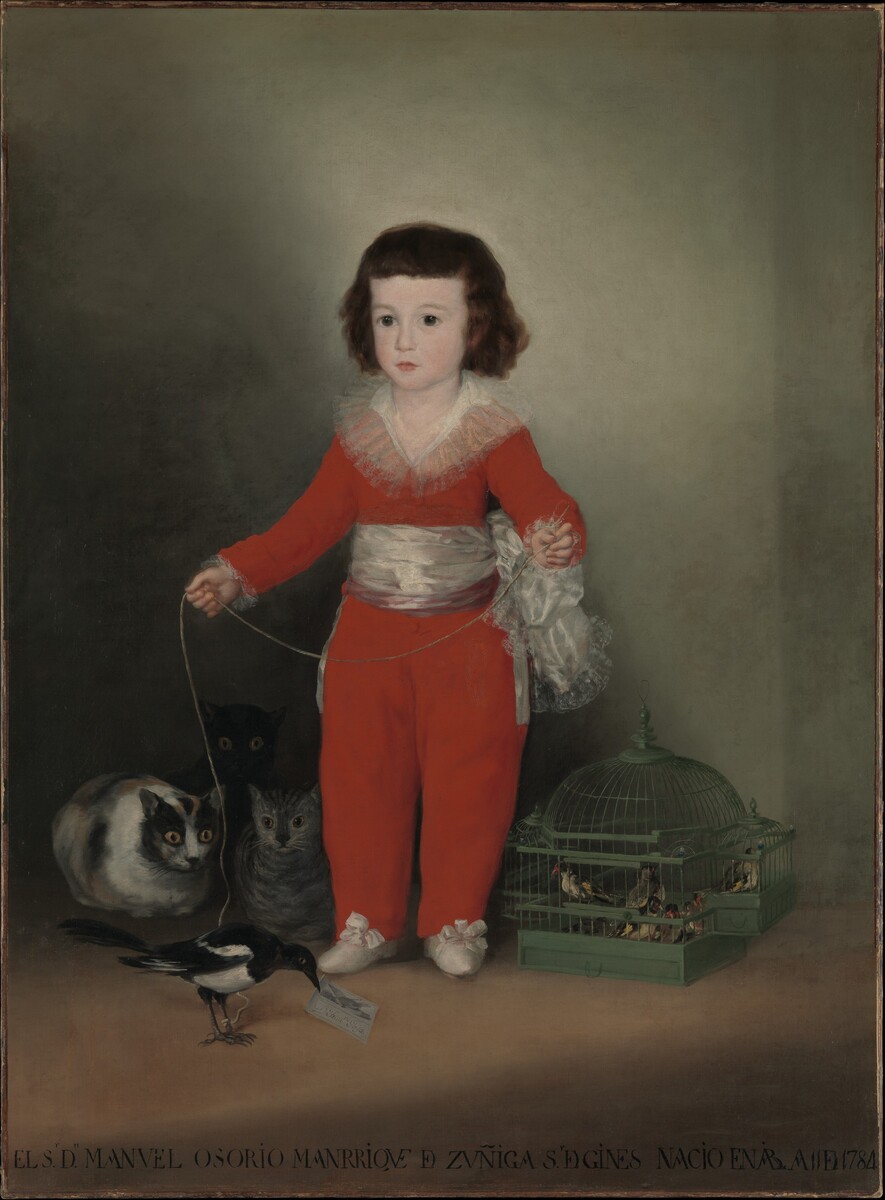
Manuel Osorio Manrique de Zuñiga (1784–1792): high-resolution image
The highest-resolution file we hold, available without payment or an account.2,855 × 3,873 pixels.
Download highest-resolution imageThe complete story
The story About 2 minutes to read
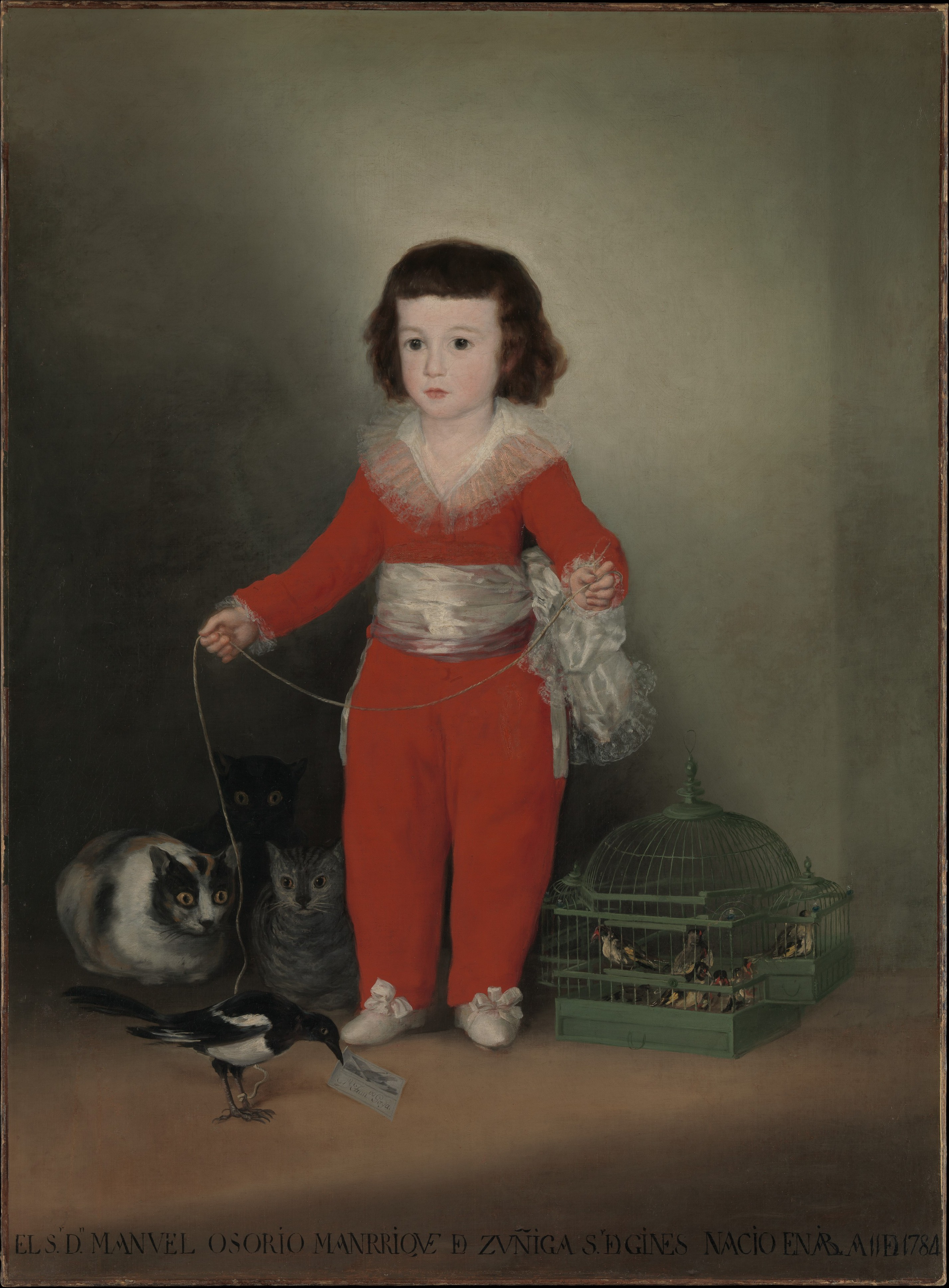
This is a portrait by Francisco Goya of a young boy, Manuel Osorio Manrique de Zuñiga. The catalogue gives his life dates as 1784 to 1792, which means he was a small child when Goya painted him in 1787 and 1788.
What we can say with certainty from the record is who is shown and who made the picture. Goya worked in oil on canvas, a standard medium for a formal portrait of this kind, and the painting is a modest cabinet scale rather than a grand full-length.
The date matters because of what it tells us about the boy's age. Manuel was born in 1784 and died in 1792, so this portrait records him at around three or four years old, several years before his early death.
That short life changes how we might approach the picture, but we should be careful here. The record does not tell us how the family regarded the portrait, or what Goya intended it to express. Reading it as a memorial would go beyond the supplied evidence.
So the secure understanding is a portrait of a named child by a named artist, made in a specific two-year window. The child's dates are part of the title itself, and they frame the image as a record of a very young life rather than of an adult sitter.
The story and its sources
Historical claims are linked to the records below. Close looking and interpretation are identified in the passage notes.
- Passage 1Documented historyWikimedia Commons: Manuel Osorio Manrique de Zuñiga (1784–1792)
- Passage 2Close lookingWikimedia Commons: Manuel Osorio Manrique de Zuñiga (1784–1792)
- Passage 3Documented historyWikimedia Commons: Manuel Osorio Manrique de Zuñiga (1784–1792)
- Passage 4InterpretationWikimedia Commons: Manuel Osorio Manrique de Zuñiga (1784–1792)
- Passage 5Documented historyWikimedia Commons: Manuel Osorio Manrique de Zuñiga (1784–1792)
Details to notice
About 2 minutes to readRed costume and pale sash
The boy's vivid red suit, broad white sash, and lace collar form the painting's strongest color and status signal, with his hands visible at the edges of the garment.
Cage of small birds
A green domed birdcage at lower right contains several small birds, setting captivity against the tethered magpie and the prowling cats.
Three watchful cats
A calico, a black cat, and a tabby crouch together at the boy's lower left, their fixed eyes creating a tense contrast with the bird.
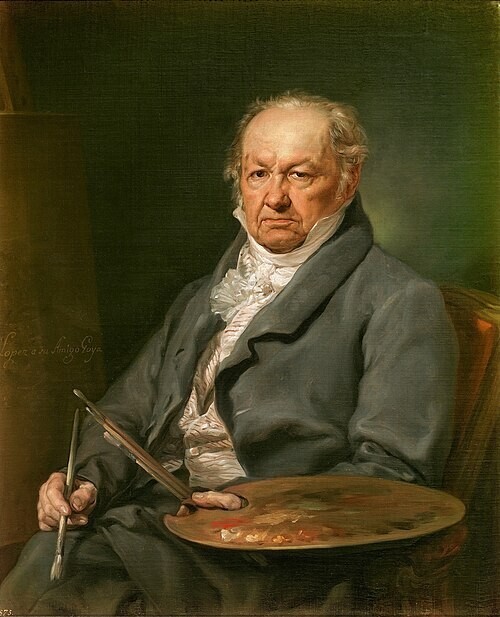
Artist portrait Image credit
Vicente López Portaña. Image source · Public domain
About the artist
Francisco de Goya
30 March 1746 to 16 April 1828
Goya was a Spanish painter and printmaker whose career extended from royal tapestry designs and court portraiture to images of war, repression and unsettling fantasy. Born in Fuendetodos, he trained in Zaragoza and Madrid and became First Painter to Charles IV in 1799. He spent his final years in Bordeaux.
- Born
- 30 March 1746
- Died
- 16 April 1828
- Nationality
- Spanish
- Birthplace
- Fuendetodos, Spain
- Died in
- Bordeaux, France
The research & record
Study the work.
Follow the evidence.
Find catalogue details, historical context, technical research and the literature behind this artwork.
The artwork record
Research catalogue
Catalogue information and detailed research, with references that link to the bibliography.
Updated .
Identity and catalogue
Link- Title
- Manuel Osorio Manrique de Zuñiga (1784–1792)
- Artist or attribution
- Francisco Goya(Wikimedia Commons: Manuel Osorio Manrique de Zuñiga (1784–1792), n.d.)
- Object date
- 1787–88(Wikimedia Commons: Manuel Osorio Manrique de Zuñiga (1784–1792), n.d.)
- Medium and support
- Oil on canvas(Wikimedia Commons: Manuel Osorio Manrique de Zuñiga (1784–1792), n.d.)
- Dimensions
- 50 x 40 in. (127 x 101.6 cm)(Wikimedia Commons: Manuel Osorio Manrique de Zuñiga (1784–1792), n.d.)
- Current collection or location
- The Metropolitan Museum of Art
- Country or culture
- Spanish
- Depicted subject
- Portrait of Manuel Osorio Manrique de Zuñiga, identified by the supplied source as the sitter, painted by Francisco Goya in 1787–88. The supplied excerpt does not describe the painting's composition, attributes, or symbolic content.
- Title variants
- Manuel Osorio Manrique de Zuñiga (1784–1792)
- Accession number
- 49.7.41(Wikimedia Commons: Manuel Osorio Manrique de Zuñiga (1784–1792), n.d.)
- Support
- Canvas
- Period
- Unknown
Read valuation records and their limitations
Catalogue identity
The object is catalogued under the title Manuel Osorio Manrique de Zuñiga (1784–1792) and attributed to Francisco Goya. The title itself carries the sitter's life dates, so the catalogue entry identifies the picture both by the person depicted and by the span of his short life. The work is dated 1787–88, a two-year window that belongs to the making of the painting and is distinct from the 1784–1792 dates enclosed in the title, which describe the sitter rather than the execution of the canvas. Any account of the picture therefore has to hold two chronologies apart: the child's lifespan, and the moment of painting within it. The catalogue gives the medium as oil on canvas and the dimensions as 50 by 40 inches, or 127 by 101.6 centimetres, a size consistent with a portrait on a modest, close-viewed scale rather than a grand full-length. The painting belongs to The Metropolitan Museum of Art, accession number 49.7.41, credited to The Jules Bache Collection, 1949, and these accession identifiers are part of its documented catalogue identity alongside the title, attribution, date, support and measurements.(Wikimedia Commons: Manuel Osorio Manrique de Zuñiga (1784–1792), n.d.)
The painting is titled Manuel Osorio Manrique de Zuñiga (1784–1792) and was painted by Francisco Goya.(Wikimedia Commons: Manuel Osorio Manrique de Zuñiga (1784–1792), n.d.)
The work is dated 1787–88.(Wikimedia Commons: Manuel Osorio Manrique de Zuñiga (1784–1792), n.d.)
The painting measures 50 by 40 inches, or 127 by 101.6 centimetres.(Wikimedia Commons: Manuel Osorio Manrique de Zuñiga (1784–1792), n.d.)
Materials and technique
LinkRead valuation records and their limitations
Support and medium
The documented physical description of Manuel Osorio Manrique de Zuñiga (1784–1792) is concise: it is an oil painting on canvas. The catalogue record, attributed to the Metropolitan Museum of Art object page, gives no further account of the weave, ground, priming, pigment, medium or varnish, and no technical imaging or sampling results are reported in the supplied evidence. Any statement about how the paint was built up, what pigments were used, or whether the work was lined, cleaned or otherwise treated would therefore go beyond what these units establish. What the record does securely support is the identification of the support as canvas and the medium as oil.(Wikimedia Commons: Manuel Osorio Manrique de Zuñiga (1784–1792), n.d.)
The same record supplies dimensions of 50 by 40 inches, or 127 by 101.6 centimetres, and places the work in The Metropolitan Museum of Art under accession number 49.7.41, credited to The Jules Bache Collection, 1949. These are catalogue facts about the object as it now exists, not observations about its making. The proportions describe a vertical rectangular canvas at a scale suited to a single seated or standing figure rather than a large multi-figure composition, but the evidence does not describe the stretcher, tacking margins, original format or whether the present dimensions reflect the painting as Goya left it. Distinguishing the documented medium and measurements from inferences about handling and preparation is essential here: the former are recorded, the latter are not.(Wikimedia Commons: Manuel Osorio Manrique de Zuñiga (1784–1792), n.d.)
The painting is oil on canvas.(Wikimedia Commons: Manuel Osorio Manrique de Zuñiga (1784–1792), n.d.)
Collection and display
LinkRead valuation records and their limitations
Collection and display
The painting is catalogued as Manuel Osorio Manrique de Zuñiga (1784–1792), painted by Francisco Goya, and it belongs to The Metropolitan Museum of Art under accession number 49.7.41, credited to The Jules Bache Collection, 1949. The title itself carries the sitter's life dates, 1784 to 1792, so the biographical frame and the identification of the child are embedded in the work's recorded name rather than supplied only by external commentary. The accession credit places the object within a twentieth-century collection formation, the Jules Bache Collection, whose transfer to the Metropolitan in 1949 is the provenance fact the record establishes; the record does not document earlier owners, intermediate sales or the circumstances by which the picture reached Bache.(Wikimedia Commons: Manuel Osorio Manrique de Zuñiga (1784–1792), n.d.)
The same catalogue data fixes the physical character of the object: it is oil on canvas, dated 1787–88, and measures 50 by 40 inches, or 127 by 101.6 centimetres. Those dimensions describe a cabinet-scale portrait rather than a grand full-length, and the two-year date range, rather than a single year, is the precision the record offers. The medium and support are the ordinary materials of a formal late eighteenth-century portrait, but the record does not describe the picture's condition, its framing history, any conservation treatment, or the pigments used, and none of those should be assumed from the catalogue entry alone.(Wikimedia Commons: Manuel Osorio Manrique de Zuñiga (1784–1792), n.d.)
The life dates in the title establish the sitter's age at the time of painting: born in 1784 and dead in 1792, Manuel was around three or four years old when Goya painted him in 1787 and 1788, and he died only a few years afterward. This chronology is the most consequential fact the record supplies beyond identification, because it frames the image as a portrait of a very young child made within his short lifetime. What the record does not establish is how the family regarded the portrait, what Goya intended it to express, or whether it functioned as a memorial; reading it that way would exceed the documented evidence and belongs to interpretation rather than to the catalogue data.(Wikimedia Commons: Manuel Osorio Manrique de Zuñiga (1784–1792), n.d.)
Interpretation
Taken together, the documented facts support a secure minimum: a named child painted by a named artist, in oil on canvas, within a specific two-year window, now held in a named public collection under a specific accession number and collection credit. That minimum is what the object page and its derivative catalogue record actually establish. The larger significance of the picture within Goya's portraiture or within histories of childhood depiction is not documented by these units, and the present account therefore treats the work's importance as resting on its secure identification, its date, its materials and dimensions, and its collection history rather than on any symbolism or narrative the evidence does not contain.(Wikimedia Commons: Manuel Osorio Manrique de Zuñiga (1784–1792), n.d.)
The painting belongs to The Metropolitan Museum of Art, accession number 49.7.41, credited to The Jules Bache Collection, 1949.(Wikimedia Commons: Manuel Osorio Manrique de Zuñiga (1784–1792), n.d.)
Documented values and qualified estimates
LinkRead valuation records and their limitations
The object and its recorded identity
Interpretation
The object under consideration is a portrait by Francisco Goya of Manuel Osorio Manrique de Zuñiga, whose life dates, 1784 to 1792, are embedded in the work's title. The painting is dated 1787–88, is executed in oil on canvas, and measures 50 by 40 inches (127 by 101.6 centimetres). It belongs to The Metropolitan Museum of Art, where it carries accession number 49.7.41 and the credit line The Jules Bache Collection, 1949. These identification data derive from a Wikimedia Commons catalogue record that points to the Metropolitan Museum of Art object page; that record provides identification context and does not itself offer curatorial interpretation of the sitter or the picture's symbolism. The conjunction of dates is what fixes the portrait's biographical situation: a boy born in 1784 and painted in 1787–88 was around three or four years old at the time, and he died in 1792, only a few years after the sittings. The title's parenthetical life dates therefore frame the image as a document of a very young life rather than of an adult sitter, while the recorded medium and dimensions describe a formal child's portrait in oil on canvas.(Wikimedia Commons: Manuel Osorio Manrique de Zuñiga (1784–1792), n.d.)
The working valuation and its limits
No public valuation of the painting accompanies the identification record. The only valuation figure in the supplied material is a model-generated working insurance estimate, dated 2026-11-16, giving a broad range of US$5M to US$15M. That estimate states its own methodology: it is derived from confirmed context alone, namely a Goya oil-on-canvas portrait of 1787–88 at 50 by 40 inches, held by The Metropolitan Museum of Art under accession 49.7.41 with the credit line The Jules Bache Collection, 1949. The range is described as anchored on the artist's canonical status, the early date of this child portrait, the large scale and oil medium, and the documented institutional collection history. The authors of the estimate expressly state that no comparable sales or private insurance records were reviewed, which is why the band is deliberately wide, and that it is meant only to prioritize a manual review. It is qualified as not an official insurance value, appraisal, auction estimate, auction result or sale price, and as unsuitable for binding coverage or financial decisions; any actual schedule value should be established by a qualified fine-art appraiser or by the insuring institution. Because the underlying source is a catalogue record rather than a valuation document, the monetary figure should be treated as an internal working calculation about this object, not as evidence of what the painting is worth or has fetched.(Wikimedia Commons: Manuel Osorio Manrique de Zuñiga (1784–1792), n.d.)
Working estimate
Calculated working insurance estimate, not a sale price: Estimated value: US$5M to US$15M Recorded date: Working calculation, generated 2026-11-16. Methodology: Broad working range derived from the confirmed context only: an oil-on-canvas portrait by Francisco Goya dated 1787-88, 50 x 40 in. (127 x 101.6 cm), held by The Metropolitan Museum of Art under accession 49.7.41 with the credit line The Jules Bache Collection, 1949. The range is anchored on the artist's canonical status and the early date of this child portrait, the large scale and oil medium, and the documented institutional collection history. No comparable sales or private insurance records were reviewed, so the band is deliberately wide and is meant only to prioritize a manual review; a qualified fine-art appraiser or the insuring institution should establish any actual schedule value. Qualification: This is a model-generated working range for manual review only. It is not an official insurance value, appraisal, auction estimate, auction result, or sale price, and it must not be used for binding coverage or financial decisions. The supplied source is a Wikimedia Commons catalogue record pointing to the Metropolitan Museum of Art object page; it provides identification context, not a public valuation. No comparable sales or private insurance data were accessed or inferred.(Wikimedia Commons: Manuel Osorio Manrique de Zuñiga (1784–1792), n.d.)
Further reading
Books for a closer look
Paid links. As an Amazon Associate I earn from qualifying purchases.

Open Library Goya
Kodansha International
Catalogued as a Goya catalogue raisonné and exhibition catalogs with criticism and interpretation material on Goya, this record is the closest match to object-specific study of a Goya portrait. Its listed subjects indicate raisonné and catalogue content rather than a general survey, which suits research on a specific Goya canvas, though the record does not document this portrait individually.
ISBN 0870110837
Bibliography
Sources and further reading
References are arranged by author or organisation, with links to the original publications. Where no publication date is recorded, n.d. means no date.
Source notes updated .
No recorded sources match these filters. Reset the filters to see the full bibliography.
- 02
Book
Goya. Kodansha International.
Catalogued as a Goya catalogue raisonné and exhibition catalogs with criticism and interpretation material on Goya, this record is the closest match to object-specific study of a Goya portrait. Its listed subjects indicate raisonné and catalogue content rather than a general survey, which suits research on a specific Goya canvas, though the record does not document this portrait individually.
- ISBN
- 0870110837
Citation text
- 03
Book
Francisco Goya - the Paintings. Independently Published.
Titled Francisco Goya - the Paintings, this candidate is recorded as a treatment of Goya's painted work by the artist. A survey of his paintings is a plausible general reference for a Goya oil portrait, but the record carries no subjects and nothing links it specifically to the Manuel Osorio portrait, so relevance is limited to the painter and medium.
- ISBN
- 9781521566466
Citation text
- 01
Secondary · About this artwork
Wikimedia Commons: Manuel Osorio Manrique de Zuñiga (1784–1792) (n.d.). Wikimedia Commons.
Wikimedia Commons record for the painting, carrying catalogue data attributed to the Metropolitan Museum of Art object page. Used here for identification only; it does not supply curatorial interpretation of subject or symbolism.
Citation text
Art to live with
Bring this painting
home.
A piece of the archive, made yours. Explore Manuel Osorio Manrique de Zuñiga (1784–1792) in a size and finish that fits your space.
Your text and annotations appear on these editions. Adding to cart saves that design for printing.
Combine this painting with your favourites01 / Find your edition
Made for you
Suggested from your location. Change it if you're sending elsewhere or using a VPN. Prices and delivery are shown in GBP.
1 product
Choose an edition to make it yours
iPhone 12 Mini ? Glossy ? back view
iPhone 12 Mini · Glossy

iPhone 12 Mini ? Glossy ? back view

iPhone 12 Mini ? Glossy ? back view

iPhone 12 Mini ? Glossy ? back view
Tough phone case
GBP 16.56
Delivery GBP 4.28 / Total GBP 20.84
A two-layer phone case with a printed polycarbonate shell and a shock-absorbing inner liner.
Two layers with a shock-absorbing TPU liner
Case & print details
- Device
- Apple · iPhone 12 Mini
- Material
- Polycarbonate shell with a TPU inner liner
- Artwork
- Outer back and wrapped edges from one template
- Finish
- Glossy
- Version
- Standard version
- Printing
- Dye sublimation
- Print file
- 1,122 × 1,831 px · 95 × 155 mm · PNG · 300 dpi recommended
Rear outline and camera openings follow this variant's Printify template. Case depth and small hardware remain illustrative.
Supplier product detailsFit and fill keep the painting’s proportions. Stretch changes them.
Move and zoom the painting on your tough phone case.
Made to order with your design
Made to order
US delivery only
The 30 cm ruler is scaled alongside your selected print. Keep the painting’s proportions with a black background, or stretch it to fill. Frame width, material texture and screen colours are illustrative.
Keep exploring