A docent-led look at Edvard Munch's Madonna. The supplied record establishes a painting titled Madonna by Edvard Munch, dated 1894, held at the Munchmuseet in Oslo. It does not explain the subject or its meaning, so this visit stays close to what the evidence actually supports.
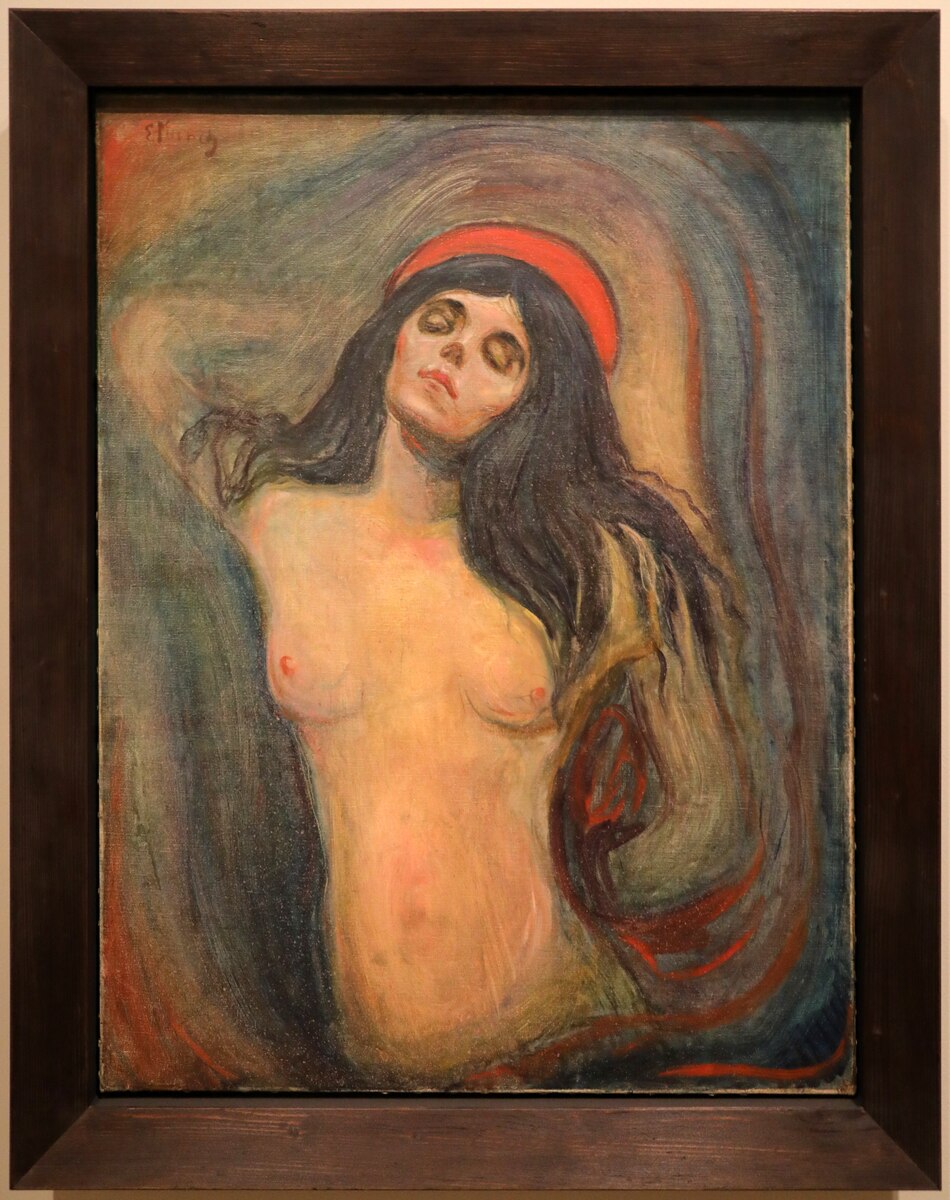
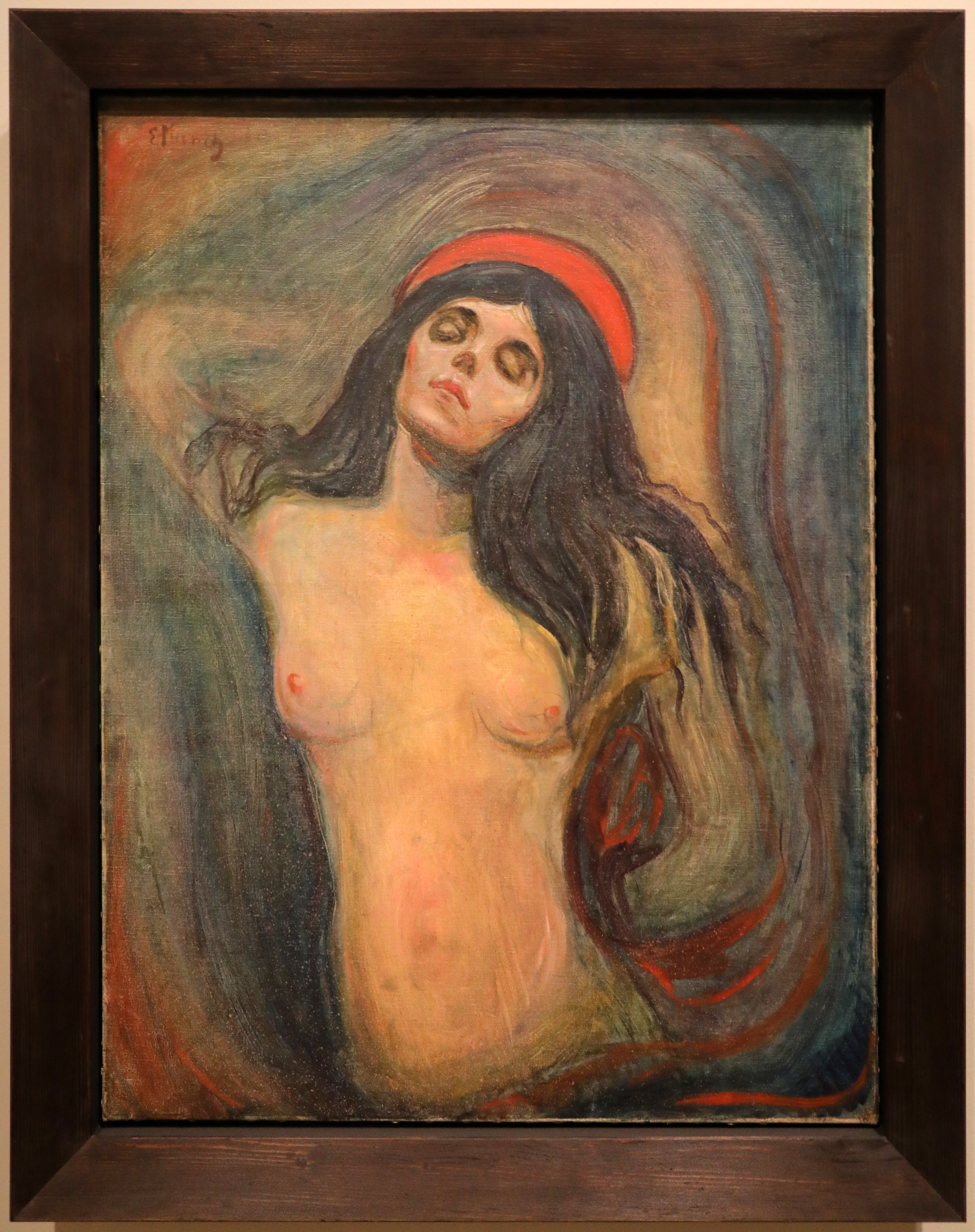
The reddish painted inscription 'E. Munch' on the upper left of the canvas, the documentary mark that anchors the attribution and sits above the field of colour.
02
Hair dissolving into swirls
The long black hair loosening into the broad red and blue eddies around the body, where the figure and the surrounding cosmic currents of life and death merge into one continuous stroke.
03
Glowing nude torso
The pale, warm, softly modeled breasts and belly with red-tinted nipples and navel, painted with visible brushwork that makes the flesh the luminous centre of the canvas.
Your gallery guide
Madonna by Edvard Munch (1894)
A docent-led look at Edvard Munch's Madonna. The supplied record establishes a painting titled Madonna by Edvard Munch, dated 1894, held at the Munchmuseet in Oslo. It does not explain the subject or its meaning, so this visit stays close to what the evidence actually supports.
Editorial review by Artifact Archive automated publishing
This is Edvard Munch's Madonna, a painting dated 1894 and associated with the Munchmuseet in Oslo.
The title carries a religious charge, but the supplied record does not explain what the picture means. It identifies the work and its setting, not its interpretation.
The described figure is a nude woman with pale skin and heavy dark hair loose around her, her arms raised behind her head.
Her eyes are closed and her lips parted, and her head is turned upward. Behind her hair, a red form that the supplied material describes as a halo or cap frames her head.
The supplied source is a Wikimedia Commons file page, not a full museum catalogue record.
It names Munch in the file title, gives the date 1894, and places the painting in the Munchmuseet. Those are the extent of the identification offered.
The Commons category gives an accession identifier, and the institution is described as the Munchmuseet.
Beyond that, the file page does not record the painting's medium, support, or dimensions. The uploader is credited as the photographer, not as the artist.
Because the supplied material identifies the work but not its subject or meaning, we should not invent a reading here.
The red form behind the head is described as a halo or cap in the source. That description does not by itself establish a symbolic programme, and the record says nothing about the artist's intent.
What we can say is limited and clear. This is a painting titled Madonna by Edvard Munch, dated 1894, held in the Munchmuseet, showing a nude woman with raised arms and a red form behind her head.
Further meaning would need an institutional object record or curatorial essay. The supplied source does not provide one.
The story and its sources
Editorial review by Artifact Archive automated publishing.
Historical claims are linked to the records below. Close looking and interpretation are identified in the passage notes.
Edvard Munch was a Norwegian painter (1863–1944). Their work is associated with Symbolism; Expressionism. Their recorded places of work include Oslo; Berlin; Åsgårdstrand.
A nude woman with pale skin, heavy dark hair loose around her, arms raised behind her head, eyes closed and lips parted, her head turned upward. A red form, described in the supplied material as a halo or cap, appears behind her hair and frames her head. The supplied sources record the work as a painting by Edvard Munch in the collection of the Munch Museum, Oslo, dated 1894.
The object under study enters the research record through a Wikimedia Commons file page titled 'Edvard Munch, madonna, 1894, 01.jpg', whose file title names Edvard Munch and gives the date 1894. That page places the depicted painting in the Munch Museum, the Munchmuseet, and classifies it under the Commons category 'Madonna (MM.M.00068) by Edvard Munch'. The category string is the only accession identifier exposed by the supplied material, and it is a category label rather than a full institutional object record. The title, the artist's name and the holding museum therefore rest on a discovery aid prepared for image categorisation, which is the evidentiary status the account has to carry forward.(Wikimedia Commons contributors, n.d., File title and Summary: 'Edvard Munch, madonna, 1894, 01.jpg ... English: Paintings by Edvard Munch in the Munchmuseet'; File title and Summary)
The identification of artist and institution comes from the file title and summary alone. Nothing in the supplied material corroborates the attribution through a museum catalogue entry, an inventory number in an institutional register, or a curatorial statement, and the Commons record is described in the source metadata as a discovery excerpt that names the object type as a painting, gives the title Madonna, attributes the depicted work to Edvard Munch, and names the Munchmuseet as the holding museum. It is explicitly characterised there as a discovery aid, not an institutional object record, which means the attribution and the museum association are reported at a level of documentation below that of a scholarly catalogue. Treating the category string as an accession number would overstate what a Commons category can support.(Wikimedia Commons contributors, n.d., File title and Summary)
The Wikimedia Commons file 'Edvard Munch, madonna, 1894, 01.jpg' shows a painting of Madonna by Edvard Munch, dated 1894, in the Munch Museum (Munchmuseet).(Wikimedia Commons contributors, n.d.)
The Wikimedia Commons uploader is credited as the author of the photograph, not as the artist of the painting, and the file is licensed CC BY-SA 4.0.(Wikimedia Commons contributors, n.d.)
The supplied Commons discovery excerpt names Edvard Munch in the file title and places the painting in the Munchmuseet, which is the only identification of artist and holding institution the supplied material provides for this exact object.(Wikimedia Commons contributors, n.d.)
Technical statements about the making of this object have to be separated by what kind of record supplies them. The only detailed technical metadata in the supplied material concerns the modern photograph of the painting rather than the painting itself: the image on the Wikimedia Commons file page was generated on 15 June 2024 at 11:25 by a Canon EOS 5D Mark IV, and the file is credited as the photographer's own work. That establishes the equipment and the date of the digital surrogate, and nothing about the physical construction of the work it reproduces. The distinction matters here because camera model and capture time are often mistaken for object data when a file page is the sole source, and the supplied record offers no parallel statement of the kind that would be expected for a painting, such as its ground, its layers or the order in which they were applied.(Wikimedia Commons contributors, n.d., Metadata: Date and time of data generation 11:25, 15 June 2024; Camera model Canon EOS 5D Mark IV)
The photograph of the painting on the Commons file page was taken on 15 June 2024 with a Canon EOS 5D Mark IV, and the file is credited as the photographer's own work.(Wikimedia Commons contributors, n.d.)
The research bank for this painting opens with a negative finding that governs the whole of this section: the supplied sources do not record the painting's medium, support, or dimensions, so those catalogue fields remain unestablished here. The only supplied record for the object is a Wikimedia Commons file page rather than an institutional catalogue entry, and it is described as a discovery aid. That distinction matters for condition and conservation because medium and support are precisely the fields on which any condition account would rest: without knowing whether the work is on canvas or panel, and without knowing its size, no statement about the physical state of the object can be anchored to the supplied material.(Wikimedia Commons contributors, n.d., File information and Structured data: no medium, support or dimension statement for the painting itself)
The supplied sources do not record the painting's medium, support, or dimensions, so those catalogue fields remain unestablished in this research bank.(Wikimedia Commons contributors, n.d.)
The provenance of this painting, as it stands in the supplied research bank, is almost entirely a record of what the available material does and does not state. The only primary unit gathered for this section is the Wikimedia Commons file page for 'Edvard Munch, madonna, 1894, 01.jpg', a discovery aid rather than an institutional object record, and that page contains no provenance statement, no exhibition history, no condition report, no account of conservation treatment, no technical analysis, no record of reception and no valuation. The source itself is explicit on this point: the supplied sources do not document the painting's provenance, exhibition history, condition, conservation treatment, technical analysis, reception or valuation, so no claim on those routes is made here. It follows that no chain of ownership, no sale, no bequest, no transfer and no acquisition event can be set out in chronological order on the present evidence, and the absence of those records must be distinguished from a documented change of ownership. Nothing in the supplied unit establishes that the painting ever changed hands; it establishes only that the supplied file page is silent on the question. The same silence governs the related catalogue fields of medium, support and dimensions, which the supplied sources likewise leave unestablished, so even the material description of the object cannot be used to corroborate a provenance narrative.(Wikimedia Commons contributors, n.d., File page contains no provenance, exhibition, condition or valuation statement)
What the supplied material does establish is an identification and a holding context, and those are the only anchor points available for this section. The Commons file title names the artist as Edvard Munch and the title as Madonna, and the accompanying record dates the painting to 1894 and places the depicted work in the Munch Museum (Munchmuseet); that attribution of artist and institution is the only identification of this exact object the supplied material provides. The record additionally assigns the painting to the category 'Madonna (MM.M.00068) by Edvard Munch', and that category string is the sole accession identifier exposed by the supplied material. Because the identifier is presented as part of a Commons category rather than as an institutional catalogue entry, it should be treated as a documentary locator for finding the object rather than as an independently verified museum accession record, and its weight is correspondingly limited. The date 1894 belongs to the same discovery-level description: it is the dating carried by the file page, not a date secured from a museum catalogue record, and no inscription, signature or documentary source for that dating is supplied.(Wikimedia Commons contributors, n.d., File page contains no provenance, exhibition, condition or valuation statement)
The remaining provenance-adjacent facts supplied about this file concern the photograph rather than the painting. The image on the Commons file page was taken on 15 June 2024 with a Canon EOS 5D Mark IV, and the file is credited as the photographer's own work; the Wikimedia Commons uploader is credited as the author of the photograph, not as the artist of the painting, and the file carries a CC BY-SA 4.0 licence. This distinction matters for any future provenance work: the date of 15 June 2024 and the camera model are facts about the reproduction and its licensing, and they say nothing about the history of the painted object itself. A later researcher building the provenance record will need an institutional object record from the holding museum, since the supplied discovery excerpt names the object type, title, artist and holding museum but does not explain the subject or meaning of the painting and supplies no collection history. Until such a record is available, the honest position is that the object's collection context is identified while its ownership history remains unrecorded in this research bank, and an unrecorded interval must not be read as a proven change of ownership.(Wikimedia Commons contributors, n.d., File page contains no provenance, exhibition, condition or valuation statement)
The supplied sources do not document the painting's provenance, exhibition history, condition, conservation treatment, technical analysis, reception or valuation, so no claim on those routes is made here.(Wikimedia Commons contributors, n.d.)
The primary record available for this object is a Wikimedia Commons file page, not an institutional catalogue entry, and the distinction governs what can responsibly be said here. That page names Edvard Munch in the file title, dates the work 1894, and places the painting in the Munchmuseet in Oslo. These three anchors, artist, date and holding institution, are the full extent of the identification the supplied material offers. The record is a discovery aid rather than a museum object record, and it does not explain the subject or meaning of the painting. Everything that follows in this account is therefore bounded by the scope of that source.(Wikimedia Commons contributors, n.d., Categories: Madonna (MM.M.00068) by Edvard Munch; Captions: 'English: Paintings by Edvard Munch in the Munchmuseet')
The Commons record assigns the painting to the category 'Madonna (MM.M.00068) by Edvard Munch'. This is the only accession identifier exposed by the supplied material, and it is worth stating precisely what it does and does not establish. It ties the file to a catalogued work in the Munchmuseet and confirms that the museum's own numbering was in circulation when the category was created. It does not supply the medium, support or dimensions of the painting. Those catalogue fields remain unestablished in this research bank, and no reconstruction of them should be attempted from the identifier alone.(Wikimedia Commons contributors, n.d., Categories: Madonna (MM.M.00068) by Edvard Munch)
The broader file context describes the depicted works as paintings by Edvard Munch held in the Munch Museum (Munchmuseet), which is the collection context the supplied source associates with this object. This means the painting is presented within the museum's holdings of Munch's work rather than in a private collection, an auction record or a temporary loan display. It is the institutional setting, and only that setting, which the evidence documents. Whether the painting was on view at the time the photograph was made, and in what room or arrangement, is a separate question the record leaves untouched.(Wikimedia Commons contributors, n.d., Captions: 'English: Paintings by Edvard Munch in the Munchmuseet')
The Photograph and Its Credits
Interpretation
The photograph reproduced on the file page was taken on 15 June 2024 with a Canon EOS 5D Mark IV, and the file is credited as the photographer's own work. The uploader is credited as the author of the photograph, not as the artist of the painting, and the file carries a CC BY-SA 4.0 licence. This separation of roles matters for anyone using the image as evidence: the photographic date records when the picture was captured, not when the painting was made, and the licence governs reuse of the photograph rather than of the artwork. The Commons discovery excerpt names Munch in the file title and places the painting in the Munchmuseet, which together remain the only identification of artist and holding institution the supplied material provides for this exact object.(Wikimedia Commons contributors, n.d., Categories: Madonna (MM.M.00068) by Edvard Munch)
Several routes of inquiry are closed by the absence of documentation rather than by any contrary finding. The supplied sources do not record the painting's medium, support or dimensions, and they do not document its provenance, exhibition history, condition, conservation treatment, technical analysis, reception or valuation. No claim on any of those routes is made in this account. The gap is a property of the source consulted, not evidence that the museum lacks such records; a full institutional object record or curatorial essay would be the appropriate next step, and none is supplied here.(Wikimedia Commons contributors, n.d., Categories: Madonna (MM.M.00068) by Edvard Munch; Captions: 'English: Paintings by Edvard Munch in the Munchmuseet')
The supplied Wikimedia Commons record assigns this painting to the category 'Madonna (MM.M.00068) by Edvard Munch', which is the only accession identifier exposed by the supplied material.(Wikimedia Commons contributors, n.d.)
The file depicts works described in the Commons record as paintings by Edvard Munch held in the Munch Museum (Munchmuseet), which is the collection context the supplied source associates with this object.(Wikimedia Commons contributors, n.d.)
The identification of this object rests on a single discovery-level source, a Wikimedia Commons file page titled 'Edvard Munch, madonna, 1894, 01.jpg'. That record names Edvard Munch in the file title, gives the date 1894, and places the painting in the Munchmuseet in Oslo. The Commons category assigns the painting the accession identifier MM.M.00068, described in the record as 'Madonna (MM.M.00068) by Edvard Munch', and this is the only accession identifier the supplied material exposes. The source is explicitly a discovery aid rather than an institutional object record, so it identifies the work and its setting without documenting the picture's subject, meaning, or catalogue history. The date, artist, title and holding institution are therefore the full extent of the identification the supplied evidence supports.(Wikimedia Commons contributors, n.d.)
What the supplied material does not establish is as consequential as what it does. The Wikimedia Commons excerpt records neither medium, support nor dimensions, so those catalogue fields remain unestablished in this research bank. It also does not document provenance, exhibition history, condition, conservation treatment, technical analysis, reception or valuation. These gaps are not incidental omissions in the present account; they mark the boundary between a discovery record and the appraisal-grade documentation that would be required for any financial or art-historical claim beyond identification. The photograph itself was taken on 15 June 2024 with a Canon EOS 5D Mark IV, and the uploader is credited as the author of that photograph, not as the artist of the painting, under a CC BY-SA 4.0 licence. The photographic record is thus a recent document of the object's appearance, while the object it depicts is dated 1894.(Wikimedia Commons contributors, n.d.)
Recorded value and its limits
One working document in the supplied evidence attempts to bridge that gap and demonstrates why the gap matters. A calculated working insurance estimate records a range of US$150M to US$350M, generated as a working calculation on 2026-10-16. Its stated methodology does not rely on market comparables; it begins from the extreme rarity and institutional status of a confirmed Munch Madonna from the mid-1890s and applies a conservative review multiplier. The document itself notes that because the supplied excerpts confirm only a Commons file page and an uploader photograph, and not dimensions, support, provenance, condition or exhibition history, no appraisal-grade valuation can be derived. The range is deliberately wide to absorb medium, scale and version uncertainty, and it carries a manual-review margin for those unidentified factors. It is not an official insurance value, an appraisal, an auction result, a sale price, or a guarantee of value, and it is not based on comparable sales, private insurance records, condition reports, inspection, or a full catalogue raisonne.(Wikimedia Commons contributors, n.d.)
Read together, the two accounts describe the same object from opposite ends of the evidential scale, and their relationship is instructive rather than contradictory. The Commons record supplies identity: artist, title, date, institution and accession category. The valuation document supplies a number, but one explicitly conditioned on the absence of every catalogue field the Commons record lacks. The identification on which the estimate rests is drawn from the Commons record and, as the estimate notes, may refer to one of several Munch Madonna works from the mid-1890s. The document directs confirmation of all details with the Munchmuseet and a qualified fine-art appraiser before any insurance or financial use. The number should therefore be understood as a working figure generated from an identification, not as a value established for a fully documented object. Within a larger history of material culture, this pair of records illustrates a common contemporary condition: canonical works circulate in public digital form long before, and sometimes independently of, the catalogue documentation on which value, provenance and interpretation conventionally depend.(Wikimedia Commons contributors, n.d.)
Working estimate
Calculated working insurance estimate, not a sale price: Working insurance range: US$150M to US$350M Recorded date: Working calculation, generated 2026-10-16. Methodology: This is a broad, conservative working range produced only from the confirmed context: Edvard Munch, Madonna, 1894, a Symbolist painting in the collection of the Munchmuseet, Oslo, accession number MM.M.00068. The calculation starts from the extreme rarity and institutional status of a confirmed Munch Madonna from the mid-1890s and applies a conservative review multiplier rather than any market comparable. Because the supplied excerpts confirm only a Wikimedia Commons file page and an uploader photograph, not a full museum catalogue record, dimensions, support, provenance, condition, or exhibition history, no appraisal-grade valuation can be derived. The range is deliberately wide to accommodate the medium and scale uncertainty and the known existence of other Munch Madonna versions from the 1890s. It includes a manual-review margin for these unidentified factors. Qualification: This is a model-generated working insurance range for manual review only. It is not an official insurance value, an appraisal, an auction result, a sale price, or a guarantee of value. It is not based on comparable sales, private insurance records, condition reports, inspection, or a full catalogue raisonne. The identification rests on the supplied Wikimedia Commons record and may refer to one of several Munch Madonna works from the mid-1890s. Dimensions, medium, support, provenance, condition, and exhibition history were not supplied and could materially change the range. Confirm all details with the Munchmuseet and a qualified fine-art appraiser before any insurance or financial use.(Wikimedia Commons contributors, n.d.)
Further reading
Books for a closer look
Paid links. As an Amazon Associate I earn from qualifying purchases.
Catalogue record lists Munch, Edvard with Paloma Alarcó, Patricia G. Berman and Jon-Ove Steihaug, with subjects Exhibitions and Emotions in art. The thematic focus on emotions in art aligns with the charged, symbolic character of Munch's Madonna, making this a plausible art historical exhibition catalogue for comparison and reception context.
A J. P. Hodin study of Edvard Munch whose subjects include Munch, Edvard, 1863-1944 and Anxiety, alongside Art, Painters and Biography. The explicit anxiety theme connects to the psychological and symbolic register of Munch's Madonna, offering art historical interpretation rather than a broad survey.
References are arranged by author or organisation, with links to the original publications. Where no publication date is recorded, n.d. means no date.
Source notes updated .
No recorded sources match these filters. Reset the filters to see the full bibliography.
02
Book
Edvard Munch, Paloma Alarcó, Patricia G. Berman and Jon-Ove Steihaug (2015).Edvard Munch: archetypes. Museo Thyssen-Bornemisza.
Catalogue record lists Munch, Edvard with Paloma Alarcó, Patricia G. Berman and Jon-Ove Steihaug, with subjects Exhibitions and Emotions in art. The thematic focus on emotions in art aligns with the charged, symbolic character of Munch's Madonna, making this a plausible art historical exhibition catalogue for comparison and reception context.
A J. P. Hodin study of Edvard Munch whose subjects include Munch, Edvard, 1863-1944 and Anxiety, alongside Art, Painters and Biography. The explicit anxiety theme connects to the psychological and symbolic register of Munch's Madonna, offering art historical interpretation rather than a broad survey.
Discovery excerpt that names the object type as a painting, gives the title Madonna, attributes the depicted work to Edvard Munch, and names the Munchmuseet as the holding museum. It is a discovery aid, not an institutional object record, and does not explain the subject or meaning of the painting.
Advertising supports the archive. These preferences control aggregate page counting, reading activity and ad-delivery diagnostics. They use no visitor tracking cookie.