The story About 5 minutes to read
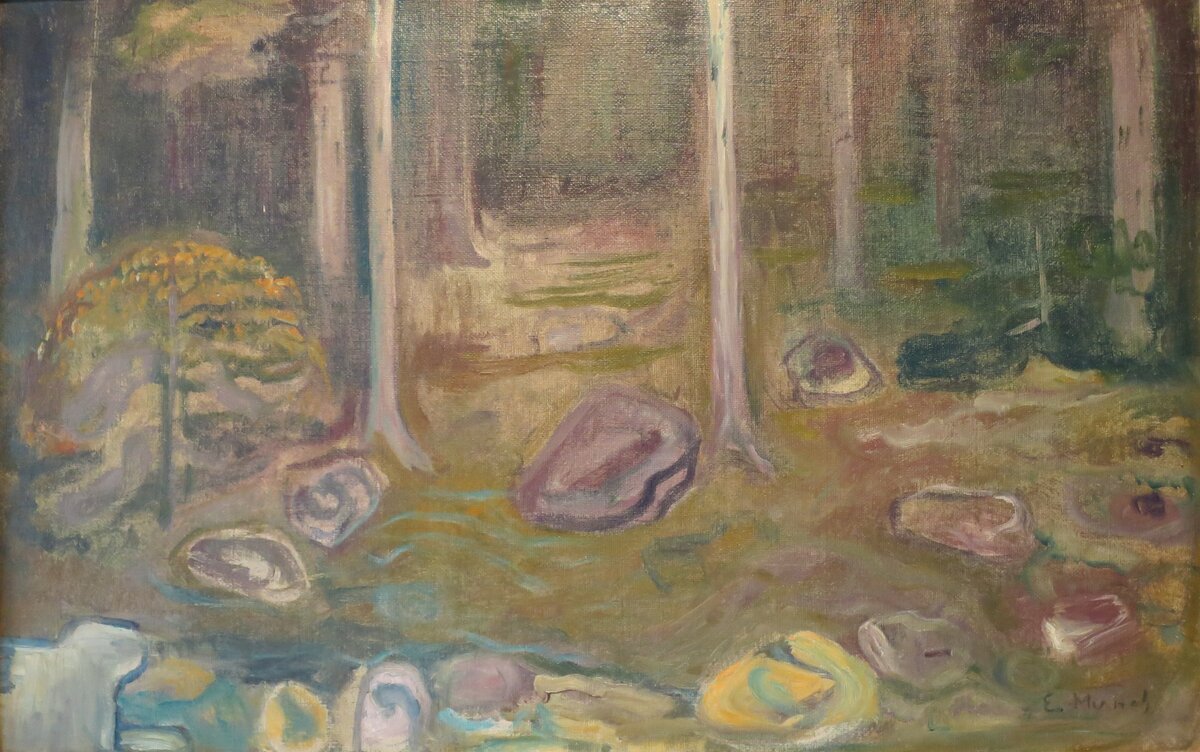
This is Forest, painted by Edvard Munch in 1894. It is an oil sketch, and the file record for the object also labels it Sketch for Ashes, after a finished painting by Munch.
The two titles point in different directions, and the supplied record does not reconcile them. So the honest starting point is the object itself: a small horizontal painting from Munch's Symbolist years, now in Bergen.
What you see is a wide, low format. That shape matters, because it sets the proportions of everything else in the picture.
Beyond that, I have to stop. The record tells us the painting is called Forest, and in Norwegian Skogsinteriør, which means forest interior. It does not describe the trees, the light, the figures or the ground.
I will not fill those in for you. The facts I can give you are the title, the artist, the date, the medium and the collection, and I would rather leave the rest open than invent a scene.
Two titles are attached to this canvas, and they conflict. The object title is Forest, with the Norwegian variant Skogsinteriør, while the source file itself is named Sketch for Ashes.
The record leaves that disagreement standing. Both names are part of the object's history, even if only one can be its formal title.
The painting is catalogued as number 279 in Woll's Edvard Munch: Complete Paintings: Catalogue Raisonné, and it carries the accession number SS.00128 in Bergen. Those numbers identify this exact canvas, not another work with a similar name.
The date is 1894. That places the painting in the decade when Munch was working through the series he called the Frieze of Life, though the record here does not tie this canvas to that series.
It was exhibited much later, in a 2023 show at KODE about the collector Rolf Stenersen. The record notes that exhibition, which tells us how the painting has been shown in recent years.
The painting is in the collection of KODE Art museums and composer homes in Bergen.
Here is the difficulty worth naming. The alternate title says this is a sketch for Ashes, but the supplied evidence gives no description of what this canvas depicts and no reading of how it relates to that finished work.
Without that, I cannot tell you what Munch meant by it, or whether the forest is a setting, a mood or something else. The record simply does not say.
What I can say is that a sketch is usually a working image, made in the process of thinking toward something larger. That much is general knowledge about sketches, not a claim about this specific canvas.
So the takeaway is modest but real. This is an 1894 oil by Munch, held in Bergen, and it is known both as Forest, or Skogsinteriør, and as a sketch connected to Ashes.
The evidence lets us name the object and place it, and it stops there. That gap is not a failure of the painting. It is a limit of the record, and it is worth saying plainly.