Identity and catalogue
Link- Title
- Anxiety
- Artist or attribution
- Edvard Munch
- Object date
- 1894
- Medium and support
- Painting
- Movement or period
- Symbolism
- Country or culture
- Norwegian
- Depicted subject
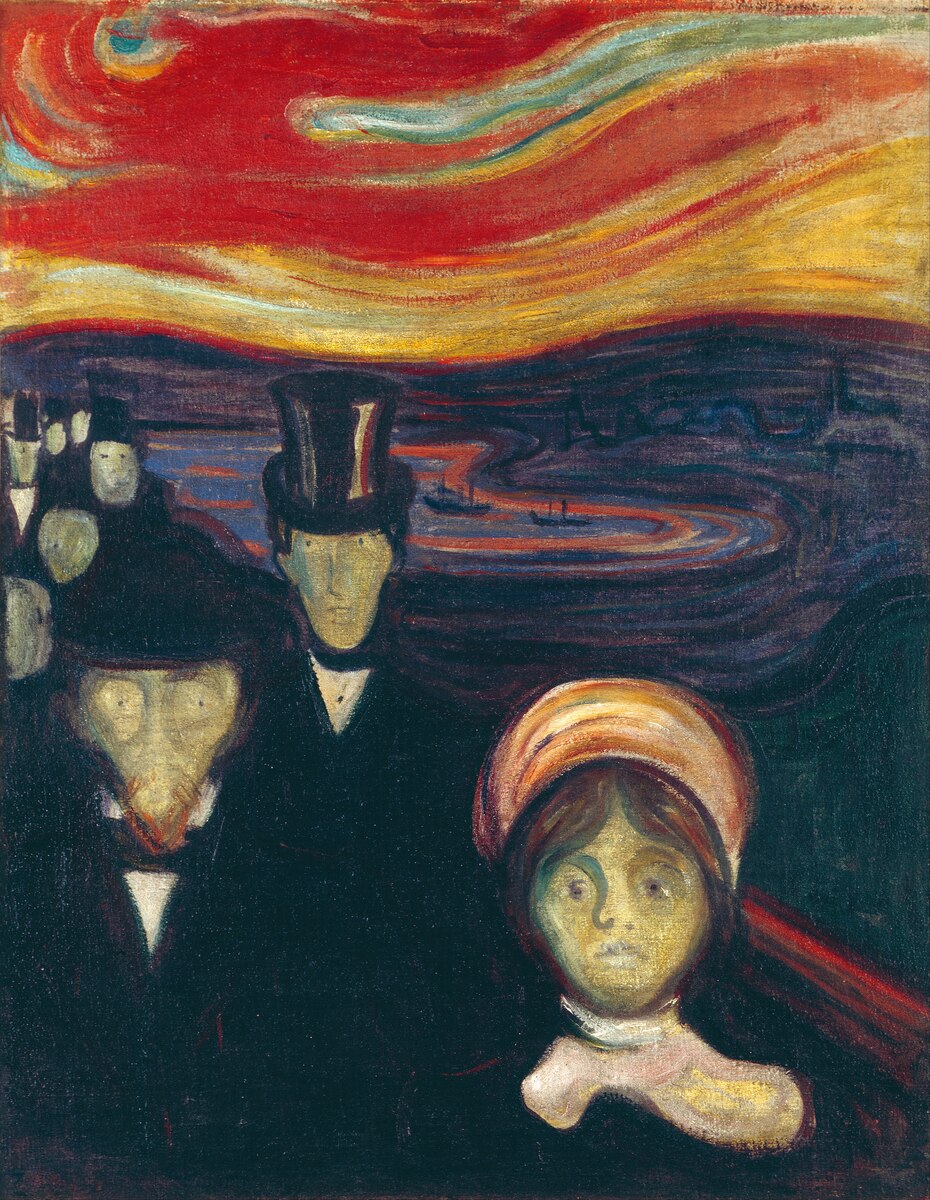
- Painted in 1894, Anxiety shows a group of pale-faced people walking toward the viewer along a footbridge or bridge, beneath a blood-red, stormy sky above a fjord landscape. The composition combines the setting from The Scream with figures drawn from Evening on Karl Johan, and belongs to Munch's Frieze of Life.(Wikipedia fallback: Anxiety (Munch), n.d.)
- Dimensions
- Unknown
Catalogue identity and dating
The object at the centre of this record is Anxiety, known in Norwegian as Angst, an 1894 painting by the Norwegian painter Edvard Munch. That identification, together with the date and authorship, is the baseline the supplied evidence establishes; the source is a Wikipedia fallback article rather than an official museum object record, so the registration data is reported rather than independently documented here. No support, dimensions, inscriptions or accession number are supplied. The same source locates the painting in Munch's Frieze of Life and records that it is exhibited at the Munch Museum, which is the only institutional placement the evidence gives. Within this section the object date, 1894, must be kept distinct from the dates of the later catalogue and print activity: the 1896 prints after the motif belong to a separate phase of the work's history and do not date the painting itself.(Wikipedia fallback: Anxiety (Munch), n.d.)
A documented title variant belongs to the object's early exhibition history. In the first exhibition as part of the Frieze of Life, Munch gave the painting the title Red Clouds. This recorded variant has to be held alongside the present catalogue title rather than treated as a mistake: it shifts emphasis toward the sky and away from the walking figures, whereas Anxiety names the feeling rather than the weather. The evidence does not state the date of that first Frieze of Life exhibition, nor when or by whom the title changed, so the interval between the two titles remains open.(Wikipedia fallback: Anxiety (Munch), n.d.)
Composition, setting and colour as described
The evidence describes a group of people walking toward the viewer under a blood-red sky, on a footbridge or bridge, with greenish-pale faces and wide-open eyes that stare directly at the viewer and seem to press toward them. Three figures are particularly prominent in the foreground: a woman wearing a bonnet or halo-like hat, a man wearing a top hat, and another man wearing a hat and a goatee. The image borrows its setting from The Scream: a railing cutting diagonally across the picture space with lines falling from the top left to the bottom right, a steep precipice revealing a city and a fjord navigated by ships in the distance, and a blood-red sky with stormy cloud formations.(Wikipedia fallback: Anxiety (Munch), n.d.)
Two attributed readings treat the setting and palette as active carriers of feeling rather than backdrop. According to Gerd Woll, the signal colors and color contrasts have an alarming effect and underscore a feeling of uncertainty and fear that emanates from the composition of the painting. According to Uwe M. Schneede, the feeling of uncertainty and fear can also be attributed to the turbulent, threatening sky and the depth of the landscape. Both are scholarly attributions recorded in the source, and each assigns the emotional charge to a different part of the image, the chromatic structure in Woll's account and the meteorological and spatial depth in Schneede's.(Wikipedia fallback: Anxiety (Munch), n.d.)
The compositional relationship to earlier works is set out with more than one formulation in the evidence. Arne Eggum describes Anxiety as a synthesis of two earlier depictions of feelings of anxiety, namely the paintings Evening on Karl Johan (1892) and Despair (1892), and its further development The Scream (1893), with Munch transferring the figures from the first painting, with their fearful, staring faces, to the landscape on the east coast of the Oslo Fjord in the latter painting. The source article states more generally that the painting is a synthesis of the earlier motifs Evening on Karl Johan (1892) and The Scream (1893). Reinhold Heller, by contrast, considers the combination in Anxiety far more successful than the transfer of the Jappe Nilssen figure from the beach in Melancholy to the bridge in The Scream in the second painting, Despair, which was also created in 1894 but, according to Heller, lacks the intensity of its two predecessors. The two accounts therefore agree that Anxiety gathers earlier material but differ over which predecessors are the operative ones and over the relative success of the composite result.(Wikipedia fallback: Anxiety (Munch), n.d.)
The crowd, the city and the mourning reading
The crowd carries competing interpretations in the scholarship. Reinhold Heller interprets the green-faced mass of anonymous people, who in their dark clothes are reminiscent of a funeral procession, not only as obstacles in the viewer's path, but as modern city dwellers who are accustomed to constantly encountering ugliness and alienated from the majestic nature that lies before them. In this context, Arne Eggum speaks of a funeral procession of ghosts that the viewer looks directly into the eyes. The two readings converge on procession imagery and on the crowd's opacity, but Heller's reading is explicitly social, making the figures products of urban modernity, while Eggum's is spectral and confrontational.(Wikipedia fallback: Anxiety (Munch), n.d.)
Munch's own written statement about the Anxiety prints offers a textual counterpart to the procession reading: in his publication The Tree of Knowledge of Good and Evil, he wrote, I see all people behind their masks, smiling, calm faces, pale corpses rushing restlessly along a winding path whose end is death. The statement is attributed to Munch and to the prints rather than to the painting, and it is recorded in the evidence as his published formulation about the motif. It matters for the painting only insofar as it shows that the artist himself, at the level of publication, framed the crowd as masked and funereal. Contemporary reception of this aspect of his work is also recorded in attributed voices: according to Oskar Kokoschka, Munch's greatness lay in his ability to diagnose the panic that lay beneath and behind so-called progress; Akseli Gallen-Kallela described that Munch does not make art for art's sake, which would be child's play for him, but for the sake of the terrible fear that torments him; and Joseph Beuys explained that art was a means for Munch to free himself from this fear, which gave rise to his new world of art, a newly acquired world.(Wikipedia fallback: Anxiety (Munch), n.d.)
Biographical accounts and their limits
A personal-experience account of the oncoming crowd is attributed specifically to Arne Eggum. Eggum relates it to an experience that already served as the starting point for Evening on Karl Johan: late one evening, the 22-year-old Munch was walking restlessly along Karl Johans gate, the main boulevard of Kristiania, now Oslo, in search of his lover Milly Thaulow, whom he gave the pseudonym Mrs. Heiberg in his literary writings, when a crowd of people streamed towards him on the boulevard, Munch had an anxiety attack and felt as if he were about to fall. The identification of the walk with the painting is Eggum's reading of a documented episode in Munch's life, not a fact the painting itself records.(Wikipedia fallback: Anxiety (Munch), n.d.)
A diary passage supplies the texture of that moment in Munch's own words, as recorded in the evidence: he could not feel his legs, they seemed to refuse to carry him, all the people passing by looked so strange and peculiar, and he thought they were staring at him, all those faces, pale in the evening light. The biographical circumstances surrounding the episode are also stated: Milly Thaulow was three years older than Munch and married to his cousin Carl Thaulow, a brother of the painter Frits Thaulow, and the relationship was a forbidden love affair at the end of which Munch declared that after that he gave up all hope of ever being able to love. The evidence does not date the diary passage or the affair, so the connection between the writing and the painting remains attributed and chronologically loose.(Wikipedia fallback: Anxiety (Munch), n.d.)
Within the personal reading, individual figures receive names. In Anxiety, Eggum identifies Mrs. Heiberg as the woman in the foreground under the idealized halo and Mr. Heiberg as the man with the top hat; the fact that the woman with the bonnet has tripled in the prints also fits into the picture for him, because Munch had admitted elsewhere that he always saw Mrs. Heiberg in every woman who passed by. This is a further attributed identification built on the same biographical frame, and it should be weighed as such.(Wikipedia fallback: Anxiety (Munch), n.d.)
Not all readers weigh the personal story the same way. Gerd Woll sees the composition of the painting less influenced by personal experience and more as a concentrated expression of mood and feeling, as is typical of symbolism; in doing so, Munch also picks up on a current of the zeitgeist, the feeling of social decay that was widespread in the Fin de siecle. Against Eggum's biographical identification of the figures, Woll's reading is formal and symbolic, locating the painting's meaning in the representation of feeling and in a period mood rather than in a record of a specific night on the boulevard. The disagreement is therefore about what kind of evidence the picture is: a transposed personal episode for Eggum, a symbolist condensation of an era's unease for Woll.(Wikipedia fallback: Anxiety (Munch), n.d.)
One new figure and the Berlin connection
While most of the figures in Anxiety can be traced back to those in its predecessor, Evening on Karl Johan, the figure with the goatee on the left edge of the painting is new. Eggum sees him as a representation of the Polish writer Stanislaw Przybyszewski, whom Munch had met in the artistic bohemian circle around the Berlin restaurant The Black Piglet and whom he portrayed several times, including in the Frieze of Life motifs Jealousy and Red Virginia Creeper. Eggum interprets the inclusion of the Przybyszewski figure in Anxiety as a tribute to the friend who, with his novel Requiem, provided Munch with the formulas for his anxiety motifs, which he successfully translated into paintings such as The Scream, and as an indication that Anxiety was created in Berlin, just like the portraits. This is a strong claim, because it uses a single new figure to argue for a place of creation; the evidence records it as Eggum's interpretation rather than as a documented fact, and the pointed-bearded Przybyszewski figure is no longer present in the prints from the following year.(Wikipedia fallback: Anxiety (Munch), n.d.)
The 1896 prints after the motif
In 1896, Munch created a lithograph and a woodcut based on the Anxiety motif, presumably within a few months of each other. In both prints the railing that dominated the perspective of the painting has been omitted and the figures are spread across the entire foreground, and instead of the man with the goatee there are now three female figures with bonnets grouped around the man with the top hat. Technical detail is recorded for the lithograph: its printing stone was partially colored in two colors, the broad black lines were applied with lithographic ink, and the clothes merge into a single dense black area; the lithograph is mirrored opposite the painting, and Munch contributed a two-color print in black and red to Ambroise Vollard's 1896 compilation Les Peintres-Graveurs. The woodcut exists as a monochrome print in red or black and as a two-color print, and Arne Eggum finds it even more concentrated and at the same time more unreal than the lithograph.(Wikipedia fallback: Anxiety (Munch), n.d.)
Interpretation
Taken together, the painting and the prints show a motif that was reworked rather than merely copied, and the differences are specific: the loss of the railing removes the plunging perspective that the painting shares with The Scream, the figures occupy the whole width of the image, and the goateed man is replaced by three bonneted women. Read alongside the diary and the publication, the prints also show the motif migrating from an individual night on a boulevard into a general statement about people behind their masks and pale corpses on a path whose end is death, which is how Munch framed the prints in The Tree of Knowledge of Good and Evil. The evidence does not establish which version later scholarship or the museum treats as definitive, nor does it record a catalogue raisonne number, edition size or the location of individual impressions; the two versions should be kept distinct and their relationship described as a series of connected works sharing one subject rather than as a single object.(Wikipedia fallback: Anxiety (Munch), n.d.)
Subject and iconography
LinkComposition and setting
Visual observation
Anxiety is described as showing a group of people walking towards the viewer beneath a blood-red sky, so that the encounter with the picture is frontal and unavoidable rather than staged to one side. The setting is said to be borrowed from The Scream: a railing cuts diagonally across the picture space with lines falling from the top left to the bottom right, a steep precipice opens to reveal a city and a fjord navigated by ships in the distance, and the sky is blood-red with stormy cloud formations. This is a description of visible arrangement, not a claim that the two paintings show the same place, and it establishes how the plunging perspective that organizes The Scream also organizes Anxiety. The figures themselves are seen on a footbridge or bridge: a group with greenish-pale faces and wide-open eyes, staring directly at the viewer and seeming to press towards them. Three figures are particularly prominent in the foreground, a woman wearing a bonnet or halo-like hat, a man wearing a top hat, and another man wearing a hat and a goatee. Beyond the observation lies a question the evidence raises but does not settle in visual terms alone, namely what relation of motif and date links this composition to the works described elsewhere in the research record.(Wikipedia fallback: Anxiety (Munch), n.d.)
The same motif was reworked as prints in 1896, and the visual evidence for those reworkings is precise about what changed. Two prints based on the motif Anxiety were created in 1896, a lithograph and a woodcut. In both, the railing that dominated the perspective of the painting has been omitted, and the figures are spread across the entire foreground; instead of the man with the goatee there are now three female figures with bonnets grouped around the man with the top hat. The effect of removing the railing is to take away the structure that carried the eye into depth, leaving the crowd to occupy the front plane and press outward. The lithograph is additionally described as mirrored opposite the painting, so that its composition reverses the direction of the painted version. A further print, created in the same year, 1896, and based on the same Anxiety motif, is recorded in the materials and technique context. The pointed-bearded Przybyszewski figure who appears in the painting is no longer present in the prints from the following year, which is the clearest documented difference between the painted and printed states of the motif.(Wikipedia fallback: Anxiety (Munch), n.d.)
The image borrows its setting from The Scream: a railing cutting diagonally across the picture space with lines falling from the top left to the bottom right, a steep precipice revealing a city and a fjord navigated by ships in the distance, and a blood-red sky with stormy cloud formations.(Wikipedia fallback: Anxiety (Munch), n.d.)
Biographical Readings: The Boulevard, the Diary and Milly Thaulow
Interpretation
Arne Eggum relates the oncoming crowd in the painting to a personal experience of Munch's, which already served as the starting point for Evening on Karl Johan: late one evening, the 22-year-old Munch was walking restlessly along Karl Johans gate, the main boulevard of Kristiania, now Oslo, in search of his lover Milly Thaulow, whom he gave the pseudonym Mrs. Heiberg in his literary writings. A crowd of people streamed towards him on the boulevard, Munch had an anxiety attack, and he felt as if he were about to fall. Munch's diaries give the texture of that moment: he described that he could not feel his legs, they seemed to refuse to carry him, that all the people passing by looked so strange and peculiar, and that he thought they were staring at him, all those faces, pale in the evening light. The diary wording is documented as Munch's own account, while the link between that experience and the composition is Eggum's interpretation. The relationship that frames the episode is also documented: Milly Thaulow was three years older than Munch and married to his cousin Carl Thaulow, a brother of the painter Frits Thaulow; the relationship was a forbidden love affair, at the end of which Munch declared that after that he gave up all hope of ever being able to love.(Wikipedia fallback: Anxiety (Munch), n.d.)
The 1896 Prints and Munch's Own Words
In 1896, Munch created a lithograph and a woodcut based on the Anxiety motif, and the prints reconsider the scene. In both, the railing that dominated the perspective of the painting has been omitted, and the figures are spread across the entire foreground; instead of the man with the goatee, there are now three female figures with bonnets grouped around the man with the top hat. The lithograph is mirrored opposite the painting. Its printing stone was partially coloured in two colours, the broad black lines were applied with lithographic ink, and the clothes merge into a single dense black area; Munch contributed a two-colour print in black and red to Ambroise Vollard's 1896 compilation Les Peintres-Graveurs. The woodcut exists as a monochrome print in red or black and as a two-colour print, and Arne Eggum finds it even more concentrated and at the same time more unreal than the lithograph. Munch himself wrote about the Anxiety prints in his publication The Tree of Knowledge of Good and Evil: I see all people behind their masks, smiling, calm faces, pale corpses rushing restlessly along a winding path whose end is death.(Wikipedia fallback: Anxiety (Munch), n.d.)
What Is Documented and What Is Attributed
Interpretation
Taken together, the evidence supports a layered account rather than a single origin story. The documented elements are the 1894 painting, its composition, its place in the Frieze of Life and its exhibition at the Munch Museum, its early title Red Clouds in the first Frieze of Life exhibition, the 1896 lithograph and woodcut with their changed foregrounds and techniques, and Munch's own diary and publication writings. The interpretive elements are the competing explanations: Eggum's synthesis of earlier anxiety paintings and his biographical identifications of Mrs. Heiberg, Mr. Heiberg and Przybyszewski, together with his inference that Anxiety was made in Berlin; Woll's symbolist reading of mood and the Fin de siecle sense of social decay; and Heller's reading of the crowd as modern city dwellers and as a funeral procession. Secure identification of the subject and its sources therefore does not settle the commissioning or creation history of the painting, and the evidence supplied here does not document a commission, an owner, or a dated exhibition beyond the first Frieze of Life showing.(Wikipedia fallback: Anxiety (Munch), n.d.)
Munch described in his diaries that he could not feel his legs, they seemed to refuse to carry him, that all the people passing by looked so strange and peculiar, and that he thought they were staring at him, all those faces, pale in the evening light.(Wikipedia fallback: Anxiety (Munch), n.d.)
Milly Thaulow was three years older than Munch and married to his cousin Carl Thaulow, a brother of the painter Frits Thaulow. The relationship was a forbidden love affair, at the end of which Munch declared that after that he gave up all hope of ever being able to love.(Wikipedia fallback: Anxiety (Munch), n.d.)
In his publication The Tree of Knowledge of Good and Evil, Munch wrote about the Anxiety prints: I see all people behind their masks, smiling, calm faces, pale corpses rushing restlessly along a winding path whose end is death.(Wikipedia fallback: Anxiety (Munch), n.d.)
Materials and technique
LinkThe 1894 painting and the 1896 prints
The 1894 painting Anxiety and the two prints made after its motif in 1896 belong to the same compositional family but not to the same technique. The painting is the work that the surviving account dates to 1894; the following year Munch created a lithograph and a woodcut based on the Anxiety motif. The two prints appear to have been produced within a few months of each other, which places them in a single concentrated episode of graphic work rather than in two separate campaigns. For the study of materials and technique, the prints are the better documented objects: the account describes the lithograph's printing stone and its inks, while the same account also records that the woodcut exists as a monochrome print in red or black and as a two-color print. The painting's own pigments, ground, and layer structure are not specified in the supplied evidence, so the reconstruction of the motif across media must rest on the prints' documented methods and on what the images show rather than on an unrecorded account of the canvas.(Wikipedia fallback: Anxiety (Munch), n.d.)
The lithograph's making is the most fully described technique in the evidence. It was printed from a stone that was partially colored in two colors, and the broad black lines were applied with lithographic ink. The evidence states that in the resulting image the clothes merge into a single dense black area, which is a description of how the drawn lines and the printed tone combine rather than a separate physical analysis. Munch contributed a two-color print in black and red to Ambroise Vollard's 1896 compilation Les Peintres-Graveurs, which is a concrete documented use of the two-color process in a published portfolio of the same year. The description of the stone as partially colored, together with the black and red impression sent to Vollard, establishes that color was introduced at the printing stage as well as through the lithographic ink, and that the black was carried by drawn lines rather than by an overall dark ground.(Wikipedia fallback: Anxiety (Munch), n.d.)
The two prints also document a deliberate change in composition, and the change bears on technique because it concerns what was drawn and printed. In the painting the railing dominated the perspective, and the account of the prints states that in both 1896 images the railing has been omitted and the figures are spread across the entire foreground. The man with the goatee who appears in the painting is replaced in the prints by three female figures with bonnets grouped around the man with the top hat. The same evidence notes that the lithograph is mirrored opposite the painting, which is a fact about the direction of the printed image relative to the painted one and not merely a matter of taste; it is one of the technical consequences of transferring a motif to a printing stone. What the prints therefore establish is a documented reworking of the motif in which the architectural framing that organized the painted space was removed and the human group was redistributed across the whole sheet.(Wikipedia fallback: Anxiety (Munch), n.d.)
Interpretations of colour and composition
Interpretation
The motif's development across media and earlier works is also a matter of attributed scholarly synthesis. Arne Eggum describes Anxiety as a synthesis of two earlier depictions of feelings of anxiety, namely the paintings Evening on Karl Johan of 1892 and Despair of 1892, and its further development The Scream of 1893, with Munch transferring the figures from the first painting, with their fearful, staring faces, to the landscape on the east coast of the Oslo Fjord used in the latter. Reinhold Heller considers the combination in Anxiety far more successful than the transfer of the Jappe Nilssen figure from the beach in Melancholy to the bridge in The Scream in the second painting, Despair, which was also created in 1894 but, according to Heller, lacks the intensity of its two predecessors. These are judgments about composition and effect by named scholars; they explain why the picture is studied as a node in a sequence of motifs rather than as an isolated canvas, and they do not describe materials or processes.(Wikipedia fallback: Anxiety (Munch), n.d.)
The goateed figure and the Berlin connection
A separate line of interpretation connects the oncoming crowd to an episode in Munch's life, and the account is attributed to Eggum. Eggum relates the crowd in the painting to a personal experience of Munch's which already served as the starting point for Evening on Karl Johan: late one evening, the twenty-two-year-old Munch was walking restlessly along Karl Johans gate, the main boulevard of Kristiania, now Oslo, in search of his lover Milly Thaulow, whom he gave the pseudonym Mrs. Heiberg in his literary writings. A crowd of people streamed towards him on the boulevard, Munch had an anxiety attack and felt as if he were about to fall. Within this reading, Eggum identifies Mrs. Heiberg as the woman in the foreground under the idealized halo and Mr. Heiberg as the man with the top hat, and he notes that the woman with the bonnet has tripled in the prints, which fits his view because Munch had admitted elsewhere that he always saw Mrs. Heiberg in every woman who passed by. The multiplication of the bonneted woman is thus both a documented compositional change between the painting and the prints and the point at which an attributed biographical interpretation attaches to the print technique.(Wikipedia fallback: Anxiety (Munch), n.d.)
The artist's statements and later reception
Munch's own published statement about the Anxiety prints is the closest the evidence comes to an artist's account of what the prints were meant to convey. In The Tree of Knowledge of Good and Evil he wrote about the Anxiety prints: I see all people behind their masks, smiling, calm faces, pale corpses rushing restlessly along a winding path whose end is death. The sentence is about the prints rather than the painting, and it speaks of masks, calm faces, and pale corpses, language that resonates with the bonneted figures and the greenish-pale faces of the painted group. Read alongside the documented change in which the railing was omitted and the figures spread across the foreground in the prints, the statement helps explain why the print versions were described by Eggum as even more concentrated and at the same time more unreal than the lithograph. The quotation is evidence of Munch's own formulation; it is not evidence of pigment, support, or printing method.(Wikipedia fallback: Anxiety (Munch), n.d.)
Interpretation
The evidence also records how later commentators framed the anxiety motifs, and these statements belong to reception rather than to technique. According to Oskar Kokoschka, Munch's greatness lay in his ability to diagnose the panic that lay beneath and behind so-called progress. Akseli Gallen-Kallela described that Munch does not make art for art's sake, which would be child's play for him, but for the sake of the terrible fear that torments him. Joseph Beuys explained that art was a means for Munch to free himself from this fear, which gave rise to his new world of art, a newly acquired world. These are attributed views about the function of the work in Munch's life and in modern art, offered by artists rather than by conservators; they do not describe how the painting or the prints were made, and they should be separated from the technical description of the lithographic stone, the two-color printing, and the woodcut variants that the same body of evidence supplies.(Wikipedia fallback: Anxiety (Munch), n.d.)
What the technical record does and does not establish
The material and technical record is uneven, and the unevenness matters for how the object is studied. The prints are documented as to process: a lithographic stone partially colored in two colors, broad black lines applied in lithographic ink, clothes merging into a dense black area, a two-color black-and-red impression in Vollard's 1896 Les Peintres-Graveurs, and a woodcut existing both as a monochrome print in red or black and as a two-color print. The painting, by contrast, is documented in the supplied evidence only by its date of 1894, its motif, its exhibition history, and the attributed readings of its colour and composition; its support, preparation, pigments, and layering are not established here. A connected account of Anxiety's materials therefore has to distinguish what technical examination of the prints documents from what visual description and scholarly interpretation establish about the painting, and it has to leave open the questions about the canvas that the evidence does not answer.(Wikipedia fallback: Anxiety (Munch), n.d.)
In 1896, two prints based on the motif Anxiety were created, presumably within a few months of each other: a lithograph, which is mirrored opposite the painting, and a woodcut. In both, the railing that dominated the perspective of the painting has been omitted, and the figures are spread across the entire foreground. Instead of the man with the goatee, there are now three female figures with bonnets grouped around the man with the top hat.(Wikipedia fallback: Anxiety (Munch), n.d.)
The Anxiety lithograph has a printing stone that was partially colored in two colors. The broad black lines were applied with lithographic ink, and the clothes merge into a single dense black area. Munch contributed a two-color print in black and red to Ambroise Vollard's 1896 compilation Les Peintres-Graveurs.(Wikipedia fallback: Anxiety (Munch), n.d.)
The Anxiety woodcut exists as a monochrome print in red or black and as a two-color print. Arne Eggum finds it even more concentrated and at the same time more unreal than the lithograph.(Wikipedia fallback: Anxiety (Munch), n.d.)
Reception and literature
LinkBiographical and Literary Readings
Visual observation
Arne Eggum's account of the motif's genesis is presented as an interpretation connecting the oncoming crowd to a personal experience that already stood behind Evening on Karl Johan: late one evening the twenty-two-year-old Munch walked restlessly along Karl Johans gate, the main boulevard of Kristiania, now Oslo, in search of his lover Milly Thaulow, whom he called Mrs. Heiberg in his literary writings, when a crowd streamed toward him and he had an anxiety attack, feeling as if he were about to fall. Milly Thaulow was three years older than Munch and married to his cousin Carl Thaulow, a brother of the painter Frits Thaulow; the relationship was a forbidden love affair at the end of which Munch declared that he afterward gave up all hope of ever being able to love. Within this biographical framework, Eggum identifies Mrs. Heiberg as the woman in the foreground under the idealized halo and Mr. Heiberg as the man with the top hat, and he holds that the tripling of the woman with the bonnet in the prints fits the pattern, because Munch admitted elsewhere that he always saw Mrs. Heiberg in every woman who passed by. Eggum is also the scholar who describes Anxiety as a synthesis of two earlier depictions of anxiety, the paintings Evening on Karl Johan (1892) and Despair (1892), with its further development The Scream (1893), Munch having transferred the figures from the first painting, with their fearful, staring faces, into the landscape on the east coast of the Oslo Fjord used in the latter.(Wikipedia fallback: Anxiety (Munch), n.d.)
Interpretation
The crowd in Anxiety carries a double life in the scholarship, and the two readings are not identical in emphasis. Reinhold Heller interprets the green-faced mass of anonymous people, who in their dark clothes recall a funeral procession, not only as obstacles in the viewer's path but as modern city dwellers accustomed to constantly encountering ugliness and alienated from the majestic nature that lies before them; in the same context Arne Eggum speaks of a funeral procession of ghosts that the viewer looks directly into the eyes. Gerd Woll, for her part, sees the composition as less influenced by personal experience and more as a concentrated expression of mood and feeling, as is typical of symbolism, with Munch picking up a current of the zeitgeist, the feeling of social decay widespread in the fin de siecle. These accounts can be read as competing or as complementary: the biographical reading locates meaning in a specific night on a boulevard, while the symbolist reading locates it in a general condition of the era. The evidence attributes each position to its scholar rather than establishing one as the documented meaning of the picture.(Wikipedia fallback: Anxiety (Munch), n.d.)
Prints, Reproduction and the Circulation of the Motif
The graphic versions of the motif represent a distinct and documented stage in the picture's public life. In 1896, Munch created a lithograph and a woodcut based on the Anxiety motif, presumably within a few months of each other. In both prints the railing that dominated the perspective of the painting has been omitted and the figures are spread across the entire foreground, and instead of the man with the goatee there are now three female figures with bonnets grouped around the man with the top hat. The pointed-bearded Przybyszewski figure, whom Eggum identified in the painting on the left edge as a representation of the Polish writer Stanislaw Przybyszewski, whom Munch met in the Berlin bohemian circle around the restaurant The Black Piglet and portrayed several times, including in the Frieze of Life motifs Jealousy and Red Virginia Creeper, is no longer present in the prints from the following year. Eggum interpreted the inclusion of that figure in the painting as a tribute to the friend who, with his novel Requiem, provided Munch with the formulas for his anxiety motifs, and as an indication that Anxiety was created in Berlin, just like the portraits. The disappearance of the figure in the prints therefore marks a documented change in the motif's cast between the painting and its graphic afterlife.(Wikipedia fallback: Anxiety (Munch), n.d.)
The technical character of the prints is documented separately for each medium and shapes how the motif was received. The Anxiety lithograph has a printing stone that was partially coloured in two colors, the broad black lines were applied with lithographic ink, and the clothes merge into a single dense black area; Munch contributed a two-color print in black and red to Ambroise Vollard's 1896 compilation Les Peintres-Graveurs. The lithograph is mirrored opposite the painting. The Anxiety woodcut exists as a monochrome print in red or black and as a two-color print, and Arne Eggum finds it even more concentrated and at the same time more unreal than the lithograph. These production details explain why the prints read differently from the canvas: the elimination of the railing, the redistribution of the figures across the foreground, the compression of the clothing into solid black or two-color blocks, and the reversal of the composition in the lithograph all restructure the viewer's relationship to the crowd and to the space it occupies.(Wikipedia fallback: Anxiety (Munch), n.d.)
Later Artistic and Critical Appropriation
Interpretation
Later commentators extended the reception of Anxiety and of Munch's anxiety motifs into wider claims about art and modernity. According to Oskar Kokoschka, Munch's greatness lay in his ability to diagnose the panic that lay beneath and behind so-called progress. Akseli Gallen-Kallela described that Munch does not make art for art's sake, which would be child's play for him, but for the sake of the terrible fear that torments him. Joseph Beuys explained that art was a means for Munch to free himself from this fear, which gave rise to his new world of art, a newly acquired world. Each of these statements is attributed to its author rather than presented as a documented fact about Munch's intentions, and each recasts the motif in a different register: diagnosis of a social condition, testimony to personal torment, and liberation through creative work. Read together with Munch's own sentence about masks and pale corpses, they show how the picture's meaning accumulated through the interpretations of later artists rather than remaining fixed at the moment of its making.(Wikipedia fallback: Anxiety (Munch), n.d.)
Interpretations and debates
LinkAttributed readings of the painting
Interpretation
The scholarship on Anxiety does not offer one settled reading but several attributed interpretations that differ in what they take the painting's primary source to be: earlier motifs, personal memory, formal mood or period feeling. Arne Eggum describes Anxiety as a synthesis of two earlier depictions of feelings of anxiety, namely the paintings Evening on Karl Johan (1892) and Despair (1892), and its further development The Scream (1893); in his account Munch transferred the figures from the first painting, with their fearful, staring faces, to the landscape on the east coast of the Oslo Fjord used in the latter. A closely related formulation in the same source states that the painting is a synthesis of the earlier motifs Evening on Karl Johan (1892) and The Scream (1893). These two formulations should be kept distinct: one names Despair (1892) alongside Evening on Karl Johan as the transferred material, the other names The Scream (1893). What both establish is a compositional genealogy rather than a claim about intention, and the visual evidence independently supports the borrowing of setting: the image takes from The Scream a railing cutting diagonally across the picture space with lines falling from the top left to the bottom right, a steep precipice revealing a city and a fjord navigated by ships in the distance, and a blood-red sky with stormy cloud formations.(Wikipedia fallback: Anxiety (Munch), n.d.)
Reinhold Heller compares this procedure with another 1894 work and judges the outcomes differently. He considers the combination in Anxiety far more successful than the transfer of the Jappe Nilssen figure from the beach in Melancholy to the bridge in The Scream in the second painting, Despair, which was also created in 1894 but, according to Heller, lacks the intensity of its two predecessors. The comparison is therefore both a claim about Anxiety and a ranking of Munch's 1894 production: the same year produced at least two works built by moving a motif from one setting into another, and Heller finds only one of them fully achieved. Any account of Anxiety's status among Munch's mid-1890s pictures consequently rests on an evaluative judgment attributed to Heller, not on a documented fact of reception.(Wikipedia fallback: Anxiety (Munch), n.d.)
Gerd Woll and Uwe M. Schneede locate the affect of the picture in its formal means. According to Gerd Woll, the signal colors and color contrasts have an alarming effect and underscore a feeling of uncertainty and fear that emanates from the composition of the painting. According to Uwe M. Schneede, the feeling of uncertainty and fear can also be attributed to the turbulent, threatening sky and the depth of the landscape. The two readings are complementary rather than competing: Woll assigns the effect to palette and chromatic contrast, Schneede to the atmospheric sky and the recession of the terrain. Both are interpretations about what produces an emotional response in the viewer, and neither claims to recover Munch's own stated aim. The observation that the painting shows a group of people walking towards the viewer under a blood-red sky is consistent with these readings but does not by itself establish them.(Wikipedia fallback: Anxiety (Munch), n.d.)
The crowd is where the interpretations diverge most sharply. Reinhold Heller interprets the green-faced mass of anonymous people, who in their dark clothes are reminiscent of a funeral procession, not only as obstacles in the viewer's path, but as modern city dwellers who are accustomed to constantly encountering ugliness and alienated from the majestic nature that lies before them. In this context, Arne Eggum speaks of a funeral procession of ghosts that the viewer looks directly into the eyes. The shared element is the funeral metaphor, drawn from dark clothing and the frontal advance of the group; the difference is what the metaphor is made to mean, Heller reading a sociological condition of urban modernity and alienation from nature, Eggum a spectral confrontation with the viewer. The visual evidence supplies the terms both readings depend on: on the footbridge or bridge is a group of people with greenish-pale faces and wide-open eyes, staring directly at the viewer and seeming to press toward them, and a blood-red sky hangs over them. Neither scholar's reading can be verified against the evidence supplied here; both are attributed interpretations of observed features.(Wikipedia fallback: Anxiety (Munch), n.d.)
Identified figures and the personal reading
A second, more specific line of interpretation identifies individual figures. While most of the figures in Anxiety can be traced back to those in its predecessor, Evening on Karl Johan, the figure with the goatee on the left edge of the painting is new, and Eggum sees him as a representation of the Polish writer Stanislaw Przybyszewski, whom Munch had met in the artistic bohemian circle around the Berlin restaurant The Black Piglet and whom he portrayed several times, including in the Frieze of Life motifs Jealousy and Red Virginia Creeper. Eggum interprets the inclusion of the Przybyszewski figure in Anxiety as a tribute to the friend who, with his novel Requiem, provided Munch with the formulas for his anxiety motifs, which he successfully translated into paintings such as The Scream, and as an indication that Anxiety was created in Berlin, just like the portraits. Two distinct claims are bundled here and should be separated: an identification of a depicted person, and a proposition about where the painting was made. The identification rests on Eggum's reading; the attribution of place is drawn from it rather than from an independent document in the supplied evidence. The physical description of three particularly prominent foreground figures, a woman wearing a bonnet or halo-like hat, a man wearing a top hat, and another man wearing a hat and a goatee, gives the identification its pictorial footing.(Wikipedia fallback: Anxiety (Munch), n.d.)
Arne Eggum relates the oncoming crowd in the painting to a personal experience of Munch's, which already served as the starting point for Evening on Karl Johan: late one evening, the 22-year-old Munch was walking restlessly along Karl Johans gate, the main boulevard of Kristiania, now Oslo, in search of his lover Milly Thaulow, whom he gave the pseudonym Mrs. Heiberg in his literary writings; a crowd of people streamed towards him on the boulevard, Munch had an anxiety attack and felt as if he were about to fall. The documented circumstances of the relationship give this account its context: Milly Thaulow was three years older than Munch and married to his cousin Carl Thaulow, a brother of the painter Frits Thaulow, and the relationship was a forbidden love affair, at the end of which Munch declared that after that he gave up all hope of ever being able to love. Munch's own diary supplies the experiential texture that Eggum's reading presupposes: he described that he could not feel his legs, they seemed to refuse to carry him, that all the people passing by looked so strange and peculiar, and that he thought they were staring at him, all those faces, pale in the evening light. The diary is documented testimony by Munch about an episode of this kind; the application of that episode to the picture's composition is Eggum's interpretation, not Munch's statement about Anxiety.(Wikipedia fallback: Anxiety (Munch), n.d.)
Eggum carries the personal reading into the foreground pair. In Anxiety, he identifies Mrs. Heiberg as the woman in the foreground under the idealized halo and Mr. Heiberg as the man with the top hat, and the fact that the woman with the bonnet has tripled in the prints also fits into the picture for him, because Munch had admitted elsewhere that he always saw Mrs. Heiberg in every woman who passed by. This is the most speculative layer of the interpretation: it converts a pictorial type, a woman in a bonnet, into a recurring biographical identity, and it uses the later prints to reinforce the reading of the painting. The evidence for the identification is Eggum's, supported by Munch's reported remark rather than by any inscription, document or title on the object itself. It should be distinguished from the visual observation that a woman in a bonnet or halo-like hat is one of the three prominent foreground figures.(Wikipedia fallback: Anxiety (Munch), n.d.)
Between private memory and period mood
Gerd Woll weighs the personal story differently. She sees the composition of the painting less influenced by personal experience and more as a concentrated expression of mood and feeling, as is typical of symbolism, and in doing so, in her reading, Munch also picks up on a current of the zeitgeist, the feeling of social decay that was widespread in the Fin de siecle. The disagreement with Eggum is one of emphasis and of explanatory frame rather than of fact: both accept that the picture gathers a crowd in a charged setting, but Woll locates its meaning in symbolist concentration and period mood, while Eggum locates it in a specific evening on Karl Johans gate and specific persons. It is worth noting that the title under which the picture first appeared belongs to the same debate about what the work is about: in the first exhibition as part of the Frieze of Life, Munch gave the painting the title Red Clouds.(Wikipedia fallback: Anxiety (Munch), n.d.)
The later prints and the limits of identity reading
The later prints show how unstable the figure group was, which matters for any interpretation that treats the painted figures as fixed identities. In 1896, two prints based on the motif Anxiety were created, presumably within a few months of each other: a lithograph, which is mirrored opposite the painting, and a woodcut; in both, the railing that dominated the perspective of the painting has been omitted, and the figures are spread across the entire foreground, and instead of the man with the goatee there are now three female figures with bonnets grouped around the man with the top hat. The observation that the pointed-bearded Przybyszewski figure is no longer present in the prints from the following year confirms this at the level of the individual motif. Eggum's identification of the goateed figure as Przybyszewski therefore describes a feature specific to the painting and its immediate context, not a constant of the motif: in the print versions the figure is replaced, and any biographical reading keyed to him cannot simply be carried over to them.(Wikipedia fallback: Anxiety (Munch), n.d.)
Between private memory and period mood
Taken together, the supplied interpretations describe a picture whose meaning has been argued over rather than settled, and the argument is structured by what each reader treats as primary evidence. Woll and Schneede build outward from composition, color and landscape; Heller from the social type of the crowd and the modernity it encodes; Eggum from Munch's biography, the diary episode on Karl Johans gate and the persons he identifies in the foreground. The observations available in the evidence, the blood-red sky, the diagonal railing borrowed from The Scream, the greenish-pale frontal faces, and the three prominent figures, are compatible with all of these readings and therefore underdetermine them. The qualifications matter: the identification of Mrs. and Mr. Heiberg and of Przybyszewski are Einar Eggum's attributions; the claim that Anxiety was made in Berlin is derived from his reading of one figure rather than independently documented here; and the substitution of the goateed man by three bonneted women in the 1896 prints shows the figure group was not fixed. On the evidence supplied, the soundest synthesis is a qualified one: Anxiety recombines an earlier crowd motif with the landscape and sky of The Scream, and its interpretations divide over whether its anxiety belongs to a remembered evening, to a symbolist mood, to the experience of modern urban crowds, or to the era's sense of social decay.(Wikipedia fallback: Anxiety (Munch), n.d.)
According to Gerd Woll, the signal colors and color contrasts have an alarming effect and underscore a feeling of uncertainty and fear that emanates from the composition of the painting.(Wikipedia fallback: Anxiety (Munch), n.d.)
Arne Eggum describes Anxiety as a synthesis of two earlier depictions of feelings of anxiety, namely the paintings Evening on Karl Johan (1892) and Despair (1892), and its further development The Scream (1893). Munch transferred the figures from the first painting, with their fearful, staring faces, to the landscape on the east coast of the Oslo Fjord in the latter painting.(Wikipedia fallback: Anxiety (Munch), n.d.)
Reinhold Heller considers the combination in Anxiety far more successful than the transfer of the Jappe Nilssen figure from the beach in Melancholy to the bridge in The Scream in the second painting, Despair, which was also created in 1894 but, according to Heller, lacks the intensity of its two predecessors.(Wikipedia fallback: Anxiety (Munch), n.d.)
While most of the figures in Anxiety can be traced back to those in its predecessor, Evening on Karl Johan, the figure with the goatee on the left edge of the painting is new. Eggum sees him as a representation of the Polish writer Stanislaw Przybyszewski, whom Munch had met in the artistic bohemian circle around the Berlin restaurant The Black Piglet in Berlin and whom he portrayed several times, including in the Frieze of Life motifs Jealousy and Red Virginia Creeper.(Wikipedia fallback: Anxiety (Munch), n.d.)
Eggum interprets the inclusion of the Przybyszewski figure in Anxiety as a tribute to the friend who, with his novel Requiem, provided Munch with the formulas for his anxiety motifs, which he successfully translated into paintings such as The Scream, and as an indication that Anxiety was created in Berlin, just like the portraits.(Wikipedia fallback: Anxiety (Munch), n.d.)
Arne Eggum relates the oncoming crowd in the painting to a personal experience of Munch's, which already served as the starting point for Evening on Karl Johan: late one evening, the 22-year-old Munch was walking restlessly along Karl Johans gate, the main boulevard of Kristiania, now Oslo, in search of his lover Milly Thaulow, whom he gave the pseudonym Mrs. Heiberg in his literary writings. A crowd of people streamed towards him on the boulevard. Munch had an anxiety attack and felt as if he were about to fall.(Wikipedia fallback: Anxiety (Munch), n.d.)
In Anxiety, Eggum identifies Mrs. Heiberg as the woman in the foreground under the idealized halo and Mr. Heiberg as the man with the top hat. The fact that the woman with the bonnet has tripled in the prints also fits into the picture for him, because Munch had admitted elsewhere that he always saw Mrs. Heiberg in every woman who passed by.(Wikipedia fallback: Anxiety (Munch), n.d.)
Gerd Woll sees the composition of the painting less influenced by personal experience and more as a concentrated expression of mood and feeling, as is typical of symbolism. In doing so, Munch also picks up on a current of the zeitgeist, the feeling of social decay that was widespread in the Fin de siecle.(Wikipedia fallback: Anxiety (Munch), n.d.)
Reinhold Heller interprets the green-faced mass of anonymous people, who in their dark clothes are reminiscent of a funeral procession, not only as obstacles in the viewer's path, but as modern city dwellers who are accustomed to constantly encountering ugliness and alienated from the majestic nature that lies before them.(Wikipedia fallback: Anxiety (Munch), n.d.)
Documented values and qualified estimates
LinkThe status of the valuation
Interpretation
The valuation material attached to Edvard Munch's Anxiety is a working document rather than a market record. It records a calculated working insurance estimate of US$50M to US$120M, generated on 2026-10-16, and states plainly that it is a model-generated range for manual review only, not an official insurance value, appraisal, auction result, or sale price, and not evidence of access to private insurance records, museum records, or confidential valuations. The same document notes that the supplied source contains no public valuation, sale price, or official appraisal, so the identification and context of the work are the only things the source actually supports. This distinction matters because it separates what has been asserted about the painting's worth from what the documentation can carry: the number exists, but its evidentiary status is deliberately limited.(Wikipedia fallback: Anxiety (Munch), n.d.)
The range itself was constructed, and the record explains how. The methodology anchors on the institutional, museum-held status of the work and applies a high-value assignment for a canonical Munch painting of the 1890s, then discounts heavily. The discounting is attributed to what was not supplied: no dimensions, support, condition, accession record, or official museum appraisal, and a source described as a Wikipedia fallback rather than an official museum record. The range was left intentionally wide to avoid false precision, and the document states directly that the missing dimensions, support, condition, accession number, and inscriptions materially limit valuation accuracy. The record does not say which specific figures or comparables produced the upper and lower bounds, and no such detail should be inferred from it.(Wikipedia fallback: Anxiety (Munch), n.d.)
The contextual basis for the valuation is the same identification that the object record establishes: Anxiety (Norwegian: Angst) is an 1894 painting by the Norwegian painter Edvard Munch, part of his Frieze of Life, exhibited at the Munch Museum, and described as a synthesis of earlier motifs Evening on Karl Johan and The Scream with a prominent art historical position. The source annotation specifies that this is a Wikipedia fallback article supplied as the only source excerpt, that no official museum object record was supplied, that it was partially consulted, and that it is open access. Any value attached to the painting therefore inherits the limits of a fallback source: it supports artwork identification and context, and nothing more.(Wikipedia fallback: Anxiety (Munch), n.d.)
What the object is
Because the only supplied valuation is a constructed range, the object's documented significance rests instead on what the painting is and what it did. The work shows a group of people walking toward the viewer under a blood-red sky. The setting borrows from The Scream: a railing cutting diagonally across the picture space with lines falling from the top left to the bottom right, a steep precipice revealing a city and a fjord navigated by ships in the distance, and a blood-red sky with stormy cloud formations. On the footbridge, a group of people with greenish-pale faces and wide-open eyes stare directly at the viewer and seem to press toward them. Three figures are particularly prominent in the foreground: a woman wearing a bonnet or halo-like hat, a man wearing a top hat, and another man wearing a hat and a goatee.(Wikipedia fallback: Anxiety (Munch), n.d.)
The value case also depends on the painting's place in a sequence of works. Arne Eggum describes Anxiety as a synthesis of two earlier depictions of feelings of anxiety, the paintings Evening on Karl Johan (1892) and Despair (1892), and its further development The Scream (1893), with Munch transferring the figures from the first painting, with their fearful, staring faces, to the landscape on the east coast of the Oslo Fjord used in the latter. Reinhold Heller considers the combination in Anxiety far more successful than the transfer of the Jappe Nilssen figure from the beach in Melancholy to the bridge in The Scream in the second painting, Despair, which was also created in 1894 but, according to Heller, lacks the intensity of its two predecessors. That comparative judgment is Heller's, not a documented fact about the canvas.(Wikipedia fallback: Anxiety (Munch), n.d.)
The record of the painting's title bears directly on how its value has been framed. In the first exhibition as part of the Frieze of Life, Munch gave the painting the title Red Clouds, which shifts emphasis toward the sky and away from the walking figures, whereas the title in current use names the feeling rather than the weather. A valuation that anchors on the work as a canonical 1890s Munch therefore depends on an identification that was itself once differently named in exhibition. The valuation record notes that the work is a major Frieze of Life painting described as a synthesis of motifs from Evening on Karl Johan and The Scream, but it supplies no exhibition history, provenance interval, or transaction record, so nothing in the file connects the historical titles to the monetary figures.(Wikipedia fallback: Anxiety (Munch), n.d.)
Interpretive disagreement
Where the accounts diverge, the difference is about what generates the picture's force rather than about its price. Gerd Woll reads the signal colors and color contrasts as alarming, underscoring a feeling of uncertainty and fear that emanates from the composition of the painting; Uwe M. Schneede attributes that same feeling of uncertainty and fear to the turbulent, threatening sky and the depth of the landscape. The valuation document does not adjudicate between these readings. It simply treats the painting's canonical standing as given for the purpose of a broad range, which is the practical consequence of an interpretive literature that agrees on importance while disagreeing on cause.(Wikipedia fallback: Anxiety (Munch), n.d.)
A scholarly disagreement divides the personal from the symbolic. Arne Eggum relates the oncoming crowd in the painting to a personal experience of Munch's, already the starting point for Evening on Karl Johan: late one evening, the twenty-two-year-old Munch was walking restlessly along Karl Johans gate, the main boulevard of Kristiania, now Oslo, in search of his lover Milly Thaulow, whom he gave the pseudonym Mrs. Heiberg in his literary writings, when a crowd of people streamed toward him; Munch had an anxiety attack and felt as if he were about to fall. Eggum identifies Mrs. Heiberg as the woman in the foreground under the idealized halo and Mr. Heiberg as the man with the top hat, and notes that the woman with the bonnet has tripled in the prints, which fits because Munch admitted elsewhere that he always saw Mrs. Heiberg in every woman who passed by. Gerd Woll, by contrast, sees the composition less influenced by personal experience and more as a concentrated expression of mood and feeling, as is typical of symbolism, in which Munch also picks up a current of the zeitgeist, the feeling of social decay widespread in the fin de siecle.(Wikipedia fallback: Anxiety (Munch), n.d.)
The crowd carries a second layer of interpretation. Reinhold Heller interprets the green-faced mass of anonymous people, who in their dark clothes are reminiscent of a funeral procession, not only as obstacles in the viewer's path but as modern city dwellers accustomed to constantly encountering ugliness and alienated from the majestic nature before them; in that context Arne Eggum speaks of a funeral procession of ghosts that the viewer looks directly into the eyes. Munch's own writing supports a related figure of speech: in his publication The Tree of Knowledge of Good and Evil he wrote about the Anxiety prints that he saw all people behind their masks, smiling, calm faces, pale corpses rushing restlessly along a winding path whose end is death. The valuation document treats none of this as price-relevant, which is itself informative about the kind of claim a working estimate can and cannot make.(Wikipedia fallback: Anxiety (Munch), n.d.)
One figure in the composition is treated as new rather than derived. While most of the figures in Anxiety can be traced back to those in its predecessor, Evening on Karl Johan, the figure with the goatee on the left edge of the painting is new; Eggum sees him as a representation of the Polish writer Stanislaw Przybyszewski, whom Munch met in the artistic bohemian circle around the Berlin restaurant The Black Piglet and whom he portrayed several times, including in the Frieze of Life motifs Jealousy and Red Virginia Creeper. Eggum interprets the inclusion of the Przybyszewski figure as a tribute to the friend who, with his novel Requiem, provided Munch with the formulas for his anxiety motifs, which he successfully translated into paintings such as The Scream, and as an indication that Anxiety was created in Berlin, just like the portraits. The pointed-bearded Przybyszewski figure is no longer present in the prints from the following year. Eggum's reading of the figure, of the tribute, and of Berlin as the place of creation is attributed interpretation, not documented fact, and the valuation file records no provenance evidence that would corroborate or contradict it.(Wikipedia fallback: Anxiety (Munch), n.d.)
Reproduction and the print record
The prints made after the motif are part of the object's record and change what the image is. In 1896, two prints based on the motif Anxiety were created, presumably within a few months of each other: a lithograph, which is mirrored opposite the painting, and a woodcut. In both, the railing that dominated the perspective of the painting has been omitted, and the figures are spread across the entire foreground; instead of the man with the goatee, there are now three female figures with bonnets grouped around the man with the top hat. The lithograph has a printing stone that was partially colored in two colors, with the broad black lines applied with lithographic ink so that the clothes merge into a single dense black area. Munch contributed a two-color print in black and red to Ambroise Vollard's 1896 compilation Les Peintres-Graveurs. The Anxiety woodcut exists as a monochrome print in red or black and as a two-color print, and Arne Eggum finds it even more concentrated and at the same time more unreal than the lithograph.(Wikipedia fallback: Anxiety (Munch), n.d.)
The valuation file gives no market signal for any of these works. It states that the supplied source supports artwork identification and context only and does not contain a public valuation, sale price, or official appraisal, and that the calculated range is intended only to support manual review. The 1896 prints and their editions, the two-color lithograph, and the Vollard compilation are documented in the record, but the record attaches no prices, edition sizes, or sales to them. Reading the estimate as if it summarized the market for the motif in any of its media would go beyond what the document establishes.(Wikipedia fallback: Anxiety (Munch), n.d.)
Contemporary and later commentary places the work in a larger cultural history of anxiety. According to Oskar Kokoschka, Munch's greatness lay in his ability to diagnose the panic that lay beneath and behind so-called progress. Akseli Gallen-Kallela described that Munch does not make art for art's sake, which would be child's play for him, but for the sake of the terrible fear that torments him. Joseph Beuys explained that art was a means for Munch to free himself from this fear, which gave rise to his new world of art, a newly acquired world. These are attributed statements by named commentators, and the valuation record does not use them; they belong to reception history rather than to appraisal.(Wikipedia fallback: Anxiety (Munch), n.d.)
Interpretive disagreement
Munch's own diary passage, which Eggum ties to the genesis of the crowd, supplies the language that the painting's defenders treat as its emotional source: Munch wrote that he could not feel his legs, that they seemed to refuse to carry him, that all the people passing by looked so strange and peculiar, and that he thought they were staring at him, all those faces, pale in the evening light. Biographically, Milly Thaulow was three years older than Munch and married to his cousin Carl Thaulow, a brother of the painter Frits Thaulow, and the relationship was a forbidden love affair at the end of which Munch declared that after that he gave up all hope of ever being able to love. These details are reported in the source as context for the painting; the valuation document does not incorporate them, and they should not be read into the monetary range.(Wikipedia fallback: Anxiety (Munch), n.d.)
Reproduction and the print record
Taken together, the file records a single hard fact about value and a much richer set of facts about meaning. The document explicitly limits its own authority: it is not an official insurance value, appraisal, auction result, or sale price, it does not represent access to private insurance records, museum records, or any confidential valuation, and the missing dimensions, support, condition, accession number, and inscriptions materially limit valuation accuracy. The identification of Anxiety as an 1894 Munch in the Munch Museum collection, the description of the composition and its three prominent foreground figures, the Frieze of Life placement, the 1896 lithograph and woodcut, and the attributed readings by Woll, Schneede, Eggum, Heller, Kokoschka, Gallen-Kallela and Beuys all come from the same partially consulted fallback article. The prudent conclusion is that the object's documented importance is art historical and clearly substantial, while its recorded monetary value remains a transparently constructed, deliberately wide, non-official working figure for manual review.(Wikipedia fallback: Anxiety (Munch), n.d.)
Working estimate
Calculated working insurance estimate, not a sale price: Estimated value: US$50M to US$120M Recorded date: Working calculation, generated 2026-10-16. Methodology: Conservative working insurance range calculated from the supplied confirmed context for Edvard Munch, Anxiety, 1894, oil painting in the collection of the Munch Museum, Oslo. The work is a major Frieze of Life painting, described as a synthesis of motifs from Evening on Karl Johan and The Scream, with a prominent art historical position. A broad range was derived by anchoring on the institutional, museum-held status of the work, applying a high-value assignment for a canonical Munch painting of the 1890s, then discounting heavily because no dimensions, support, condition, accession record, or official museum appraisal was supplied and because the source is a Wikipedia fallback rather than an official museum record. The range is intentionally wide to avoid false precision and is intended only to support manual review. Qualification: This is a model-generated working insurance range for manual review only. It is not an official insurance value, appraisal, auction result, or sale price. It does not represent access to private insurance records, museum records, or any confidential valuation. The supplied source supports artwork identification and context only; it does not contain a public valuation, sale price, or official appraisal. Dimensions, support, condition, accession number, and inscriptions were not supplied, which materially limits valuation accuracy.(Wikipedia fallback: Anxiety (Munch), n.d.)