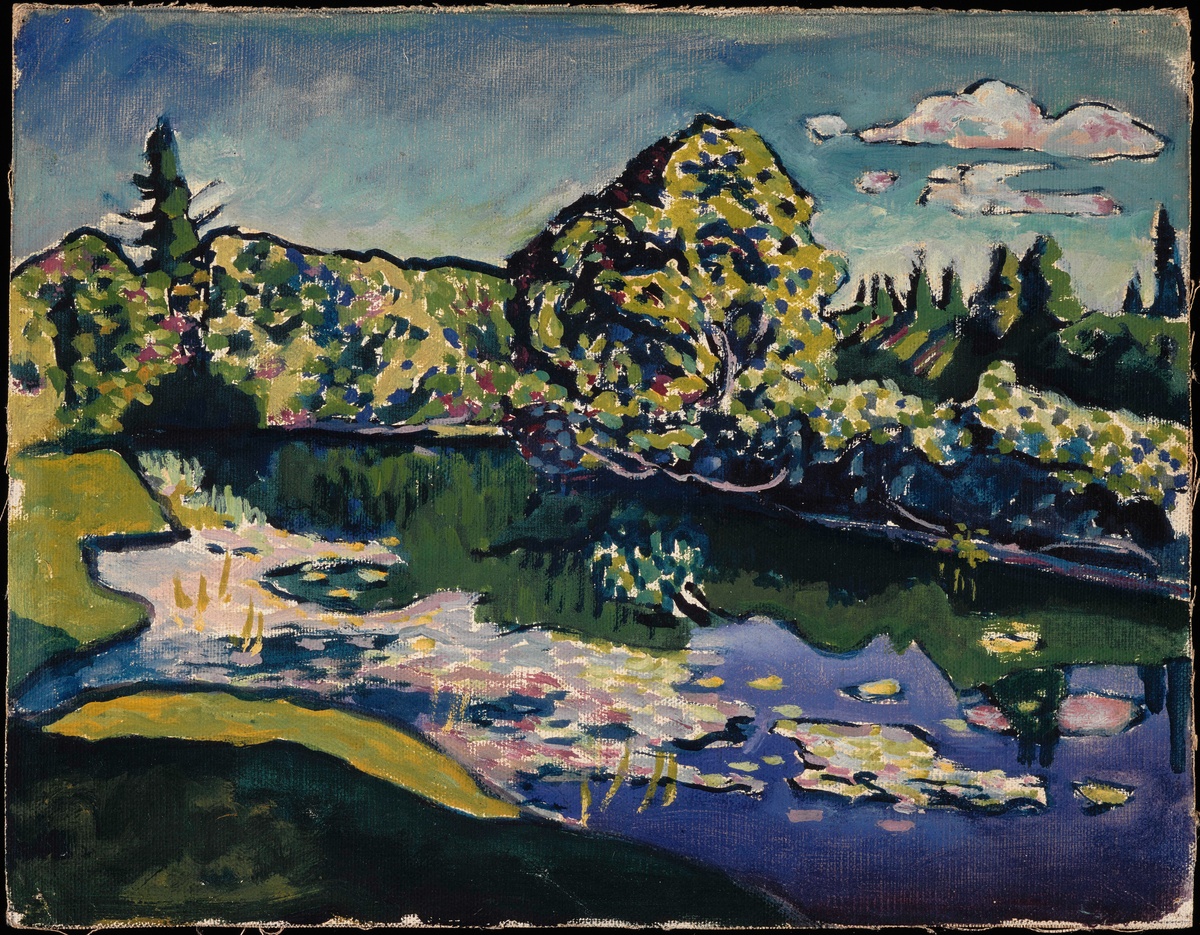
Kochel, Lake and Herzogstand
Artist: Wassily Kandinsky · 1902

Kochel, Lake and Herzogstand: high-resolution image
The original file is hosted by Wikimedia Commons, available without payment or an account.
Open high-resolution image on Wikimedia CommonsThe complete story
The story About 3 minutes to read
This is a landscape by Wassily Kandinsky, painted in 1902. The subject is spelled out in its title. Kochel, Lake and Herzogstand names a lake in the Bavarian Alps and the mountain mass that rises above its far shore. It belongs to an early moment in the artist's long career. By 1902 Kandinsky had been living and working in Munich, and the lakes and mountains south of the city were within reach for study from nature.
The record describes only the essentials of the view. Lake, mountain, and far shore. No figures, no action, no story. That restraint is telling. In a landscape like this, the work of the picture lies in how the water and the mountain occupy the landscape format. The lake stretches out below. The Herzogstand rises above the water on the far side.
The painting is oil on canvas board. That support is thinner and more rigid than stretched canvas, and it was a common choice for painters working on a modest scale, especially when painting outdoors. The dimensions given in the record are close to the size of a sheet of paper, which puts the work in the category of a small panel rather than a display-scale landscape.
Certain things the record does not tell us. The supplied source is a Wikimedia Commons record, which references a Centre Pompidou object page and a Google Arts & Culture image but does not supply the text of either. So the subject and attribution are documented, but the museum's own account of the painting, and any interpretation of how Kandinsky treated this scene, still needs checking against the institutional record.
What we can say with confidence is modest and clear. This is a painted view of the Kochel lake and the Herzogstand, made by Kandinsky in 1902 on a small canvas board. It shows a young painter in Munich looking at the Alpine landscape close at hand, and the actual handling of this particular scene is something the museum's own record will clarify.
The story and its sources
Historical claims are linked to the records below. Close looking and interpretation are identified in the passage notes.
- Passage 1Documented historyWikimedia Commons: Kochel, Lake and Herzogstand
- Passage 2Close lookingWikimedia Commons: Kochel, Lake and Herzogstand
- Passage 3Documented historyWikimedia Commons: Kochel, Lake and Herzogstand
- Passage 4Documented historyWikimedia Commons: Kochel, Lake and Herzogstand
- Passage 5Documented historyWikimedia Commons: Kochel, Lake and Herzogstand
Details to notice
About 2 minutes to readKandinsky signature
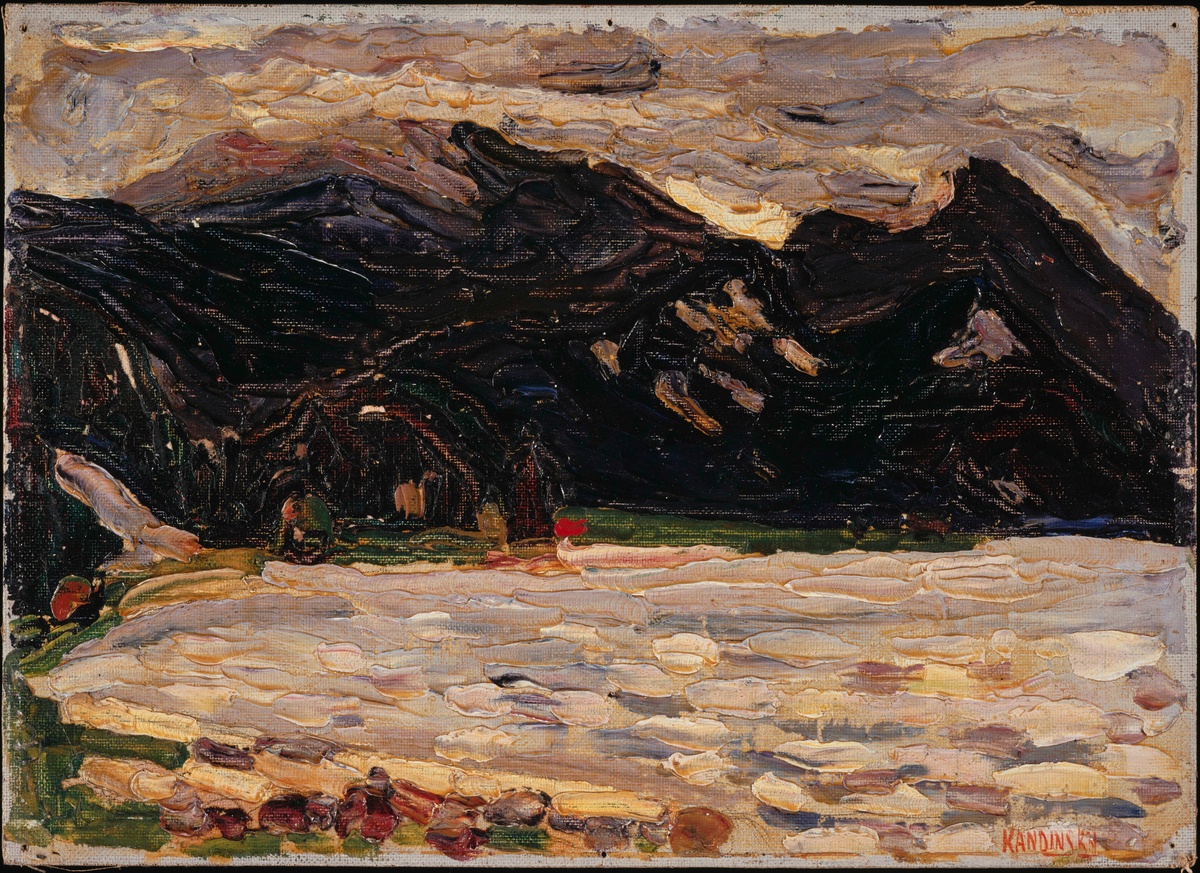
The red painted signature at the lower right is a key identifying mark and a visible trace of the artist's working hand.
Small shoreline buildings
Tiny huts and a red accent gather at the base of the mountain, giving human scale and a focal point along the green shore between the dark ridge and pale water.
Luminous lake surface
The foreground lake is built from broad, creamy and mauve strokes of thick paint, creating a shimmering surface that contrasts with the nearly black mountain above.
Artist portrait Image credit
未知上傳者. Image source · Public domain
About the artist
Wassily Kandinsky
1866 to 1944
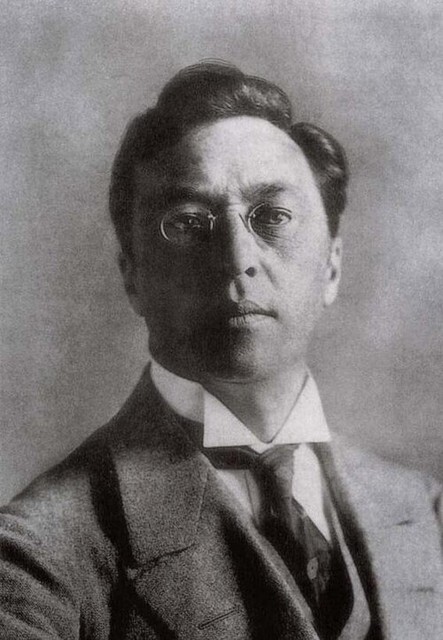
Wassily Kandinsky was an avant-garde painter of Russian origin (1866–1944). Their work is associated with Expressionism; Symbolism; Bauhaus. Their recorded places of work include Paris; Munich; Weimar; Rapallo; The Hague; Russia; Stockholm; Switzerland; Tunis.
- Born
- 1866
- Died
- 1944
- Nationality
- Russian Empire; Russian Soviet Federative Socialist Republic; Soviet Union; France; Germany
- Birthplace
- Moscow
- Died in
- Neuilly-sur-Seine
Biography sources
The research & record
Study the work.
Follow the evidence.
Find catalogue details, historical context, technical research and the literature behind this artwork.
The artwork record
Research catalogue
Catalogue information and detailed research, with references that link to the bibliography.
Updated .
Identity and catalogue
Link- Title
- Kochel, Lake and Herzogstand(Wikimedia Commons: Kochel, Lake and Herzogstand, n.d.)
- Artist or attribution
- Wassily Kandinsky
- Object date
- 1902
- Medium and support
- Oil on canvas board(Wikimedia Commons: Kochel, Lake and Herzogstand, n.d.)
- Dimensions
- 23.05 cm × 32.06 cm(Wikimedia Commons: Kochel, Lake and Herzogstand, n.d.)
- Current collection or location
- Musée National d'Art Moderne, Centre national d'art et de culture Georges-Pompidou, Paris(Wikimedia Commons: Kochel, Lake and Herzogstand, n.d.)
- Movement or period
- Landscape painting, early twentieth-century German landscape tradition
- Country or culture
- German (painted in Germany; artist Russian-born)
- Depicted subject
- A landscape showing the Kochel lake with the Herzogstand mountain mass rising above its far shore, painted in oil on canvas board in 1902.(Wikimedia Commons: Kochel, Lake and Herzogstand, n.d.)
- Title variants
- Kochel, lake and Herzogstand; Kochel, See mit Herzogstand; Kochel, lac et Herzogstand(Wikimedia Commons: Kochel, Lake and Herzogstand, n.d.)
- Accession number
- AM 81-65-13
- Support
- Canvas board
Read valuation records and their limitations
Catalogue identity
The work is catalogued as a landscape painting by Wassily Kandinsky, titled Kochel, Lake and Herzogstand, and dated 1902. The title identifies the subject directly: the Kochel lake in the Bavarian Alps and the Herzogstand, the mountain mass that rises above its far shore. The record presents the attribution and the 1902 date as catalogue fields, so the object date belongs to the painting itself, while the cataloguing activity that fixes title, attribution and alternate names is a later documentary layer. The same record registers the work under two alternate language titles, Kochel, See mit Herzogstand in German and Kochel, lac et Herzogstand in French, which show the title circulating in more than one linguistic context rather than a single fixed form.(Wikimedia Commons: Kochel, Lake and Herzogstand, n.d., Title, artist, date fields; Title field alternative language labels)
The recorded dimensions are approximately 23 cm in height and 32 cm in width, a small format close to the size of a sheet of paper. Such a scale places the painting in the category of a small panel rather than a display-scale landscape, and the size is consistent with a study made close at hand. These measurements are catalogue values, given as approximate, and they describe the support as recorded rather than any framing or later mounting.(Wikimedia Commons: Kochel, Lake and Herzogstand, n.d., Dimensions field)
The Wikimedia Commons record from which these facts derive references a Centre Pompidou object page and a Google Arts & Culture asset, but the texts of those pages are not supplied here. The identification of the painting, its attribution, date, dimensions and alternate titles therefore rests on the Commons record as the available evidence, while the museum's own catalogue description, and any account it gives of the painting's handling or history, remain to be checked against the institutional record. This qualification matters for how the object is described: the subject and attribution are documented in the supplied material, but the fuller institutional account is referenced rather than read.(Wikimedia Commons: Kochel, Lake and Herzogstand, n.d., References field)
The work is a landscape painting titled Kochel, Lake and Herzogstand, painted by Wassily Kandinsky in 1902.(Wikimedia Commons: Kochel, Lake and Herzogstand, n.d.)
The painting measures approximately 23 cm in height and 32 cm in width.(Wikimedia Commons: Kochel, Lake and Herzogstand, n.d.)
The work is recorded under the alternate titles Kochel, See mit Herzogstand (German) and Kochel, lac et Herzogstand (French).(Wikimedia Commons: Kochel, Lake and Herzogstand, n.d.)
The Wikimedia Commons record references a Centre Pompidou object page and a Google Arts & Culture asset, but the page texts themselves are not supplied here.(Wikimedia Commons: Kochel, Lake and Herzogstand, n.d.)
Subject and iconography
LinkRead valuation records and their limitations
The Subject and the Limits of the Record
Visual observation
The supplied record identifies the subject of this small landscape as the Kochel lake, with the Herzogstand mountain mass rising above its far shore. That is the whole of the described view: the record specifies a lake, a distant shoreline and a mountain above the water, and it states explicitly that it does not describe figures, actions or any narrative content. The account of what can be seen therefore rests on a subject identification carried by the title and the source's description rather than on a detailed visual inventory. Nothing in the evidence describes colour, brushwork, light, weather, foreground incident, buildings other than the mountain and lake, or the handling of the water surface, so the picture's internal composition can only be characterised at the level of the named elements and their spatial relation: water below, far shore, and the Herzogstand above it.(Wikimedia Commons: Kochel, Lake and Herzogstand, n.d., Title description)
The landscape depicts the Kochel lake with the Herzogstand mountain mass rising above its far shore; the record does not describe figures, actions or narrative.(Wikimedia Commons: Kochel, Lake and Herzogstand, n.d.)
Materials and technique
LinkRead valuation records and their limitations
Documented support and medium
The documented material facts for Kochel, Lake and Herzogstand are few and precise. The work is a painting in oil on canvas board, recorded under that medium designation in the Wikimedia Commons discovery record for the file. The same record gives its measurements as approximately 23 cm in height and 32 cm in width, and identifies it as a landscape by Wassily Kandinsky dated 1902, held in the collection of the Musée National d'Art Moderne at the Centre national d'art et de culture Georges-Pompidou in Paris under accession number AM 81-65-13, with German and French alternate titles. These are catalog-level facts about support and format. They establish what the object is made of in the most general terms, and they establish its physical scale, but they do not describe how the paint was applied, what pigments were used, or how the board was prepared.(Wikimedia Commons: Kochel, Lake and Herzogstand, n.d., Medium field)
Interpretation
The medium statement matters because canvas board is a composite support rather than a simple one: a fabric facing mounted on a rigid backing, thinner and more rigid than stretched canvas. The record itself supplies only the term, not a description of the board's construction, its manufacturer, its priming, or its condition. Any account of why a painter might choose such a support, for example its portability for work away from the studio, is a general inference about the material class rather than a documented fact about this panel. The evidence supports the identification of oil on canvas board and nothing further about the layers, ground or paint film.(Wikimedia Commons: Kochel, Lake and Herzogstand, n.d., Medium field)
The dimensions place the painting at a modest scale, close to that of a sheet of paper in its longer dimension. Combined with the rigid board support, the recorded height and width describe a small panel rather than a large display canvas. This is a material and format observation drawn from the catalog measurements, and it bears on how the landscape is composed: the lake and mountain are compressed into a format of roughly 23 by 32 centimetres. The record does not state whether the board was used outdoors or in the studio, so the small scale should not by itself be treated as proof of plein-air practice for this particular work.(Wikimedia Commons: Kochel, Lake and Herzogstand, n.d., Medium field)
Interpretation
What the painting depicts and what it is made of belong to different kinds of evidence and should be kept distinct. The record describes the landscape as the Kochel lake with the Herzogstand mountain mass rising above its far shore, and notes that it describes no figures, actions or narrative. That is a description of subject matter, not an account of technique. The materials evidence establishes oil paint on a canvas board support of a given size; it does not establish the colors, brushwork, finish or layering visible in the image, and the supplied record does not report a technical examination of the paint surface. The two strands, subject and medium, are documented at catalog level, while questions of handling and pigment remain outside the evidence provided here.(Wikimedia Commons: Kochel, Lake and Herzogstand, n.d., Medium field; Title description)
The materials record also carries a qualification about its own sources. The Wikimedia Commons entry references a Centre Pompidou object page and a Google Arts & Culture asset but does not supply the text of either, and the image is credited to Google Art & Culture and marked public domain in the supplied record. The medium, dimensions and collection data therefore rest on the Commons record as an intermediary. The museum's own account of the painting, which might document preparation, pigments or treatment, has not been consulted in the evidence assembled here. Claims about technique beyond oil on canvas board should be attributed to whatever technical source eventually supplies them, not inferred from the present record.(Wikimedia Commons: Kochel, Lake and Herzogstand, n.d., Medium field)
The painting's medium is oil on canvas board.(Wikimedia Commons: Kochel, Lake and Herzogstand, n.d.)
Reception and literature
LinkRead valuation records and their limitations
The Evidence Available for Reception
Reception evidence for this painting is unusually thin in the supplied record, and the account has to begin with that limit. The Wikimedia Commons file record identifies the work as Kochel, Lake and Herzogstand by Wassily Kandinsky, dated 1902, oil on canvas board, approximately 23 by 32 cm, in the collection of the Musée National d'Art Moderne at the Centre national d'art et de culture Georges-Pompidou, Paris, accession number AM 81-65-13, with alternate titles Kochel, See mit Herzogstand and Kochel, lac et Herzogstand. None of the units supplied here documents a critical review, an exhibition history, a sale, a catalogue entry or a statement of the artist's intention. The reception that can be written from this evidence is therefore the reception embodied in the record itself: how the object has been catalogued, titled, attributed, licensed and circulated as a reference image. That is a real and consequential stage of modern reception, but it is not the same as a history of how viewers and critics responded to the painting, and the two should not be conflated.(Wikimedia Commons: Kochel, Lake and Herzogstand, n.d., Source/Photographer and license fields)
The one reception event the supplied units actually establish is reproduction and licensing. The image is credited to Google Art & Culture and marked public domain in the supplied record. This tells us that the painting has been photographed or digitised and distributed through a major cultural platform, and that the Commons record treats the resulting image as free of copyright restrictions. It does not tell us when the photograph was made, who made it, whether it was made for the museum or for the platform, or how the museum itself describes the work. The credit and licence fields document a channel of circulation, not a judgment about the picture, and the record's own reference to a Centre Pompidou object page and a Google Arts & Culture asset is noted without the text of either being supplied. Any claim about how the museum presents or interprets the painting therefore remains unverified here.(Wikimedia Commons: Kochel, Lake and Herzogstand, n.d., Source/Photographer and license fields)
Subject and the Circulating Image
Interpretation
Read together, these units support a modest but useful synthesis about how this object accrues meaning. The painting's documented identity rests on a chain of institutional and platform records: a museum collection and accession number, alternate titles in German and French, a Commons file, and a Google Arts & Culture image declared public domain. Each link fixes something, the title, the attribution, the medium, the dimensions, the collection, the rights status, and each link also narrows what the record says, since none of the supplied units reports the museum's own account of the painting or any interpretation of how Kandinsky handled this scene. The honest conclusion is that this small Alpine view is well documented as an object and barely documented as a received work. Its place in a larger history of art would have to be argued from that documented identity and from direct study of the painting, not from a reception history the evidence does not contain.(Wikimedia Commons: Kochel, Lake and Herzogstand, n.d., Source/Photographer and license fields; Title description)
The image is credited to Google Art & Culture and marked public domain in the supplied record.(Wikimedia Commons: Kochel, Lake and Herzogstand, n.d.)
Collection and display
LinkRead valuation records and their limitations
Institutional holding
The painting is documented as part of the collection of the Musée National d'Art Moderne at the Centre national d'art et de culture Georges-Pompidou in Paris, where it carries the accession number AM 81-65-13. That single documented unit of collection data establishes the institutional home of the work and supplies a stable identifier connecting the object to a specific holding. It also defines a division of evidence that governs any account of the picture: the collection and accession facts are documented, while other descriptions of the work derive from a discovery and identification record whose underlying museum and image-source texts are not themselves supplied. The Centre Pompidou object page is referenced by that record but its text is not included, so the museum's own catalogue entry, its account of the painting's history within the collection, and any treatment or display information remain outside the supplied evidence and must be checked against the institutional record rather than assumed.(Wikimedia Commons: Kochel, Lake and Herzogstand, n.d., Collection and accession number fields)
The painting belongs to the collection of the Musée National d'Art Moderne at the Centre national d'art et de culture Georges-Pompidou in Paris, with accession number AM 81-65-13.(Wikimedia Commons: Kochel, Lake and Herzogstand, n.d.)
Documented values and qualified estimates
LinkRead valuation records and their limitations
Documented particulars
Interpretation
The identification record for this painting establishes its core particulars: it is a landscape titled Kochel, Lake and Herzogstand, painted by Wassily Kandinsky in 1902 in oil on canvas board, measuring approximately 23 cm in height and 32 cm in width. The work is recorded as belonging to the collection of the Musée National d'Art Moderne at the Centre national d'art et de culture Georges-Pompidou in Paris under accession number AM 81-65-13, and it also carries the alternate titles Kochel, See mit Herzogstand in German and Kochel, lac et Herzogstand in French. The subject is the Kochel lake with the Herzogstand mountain mass rising above its far shore; the record describes no figures, actions or narrative. The same record references a Centre Pompidou object page and a Google Arts & Culture asset, but the texts of those pages are not supplied, so the museum's own account of the painting remains to be checked directly. The image is credited to Google Art & Culture and marked public domain in the supplied record. These facts about artist, date, medium, dimensions and holding are the anchors on which any valuation or interpretation of the object must rest.(Wikimedia Commons: Kochel, Lake and Herzogstand, n.d.)
Recorded value estimate
A working insurance estimate has been generated for the painting: a range of US$2M to US$8M, recorded as a working calculation dated 2026-10-30. Its stated methodology is a model-generated range that conservatively anchors on the confirmed context: a 1902 early landscape in oil on canvas board by Kandinsky, small in scale at about 23 x 32 cm, held in the permanent collection of the Musée National d'Art Moderne, Centre Pompidou, under accession AM 81-65-13. The calculation deliberately relies on the confirmed artist, period, medium, documented museum provenance and modest size; no public auction or insurance comparables were supplied or used, and the range is intentionally wide in order to support manual review. It is qualified as a working estimate only, not an official insurance value, appraisal, auction result or sale price, and as not reflecting verified market data, private insurance schedules or confirmed comparable sales. The museum's own record was referenced but not supplied, so confidence in the identification remains medium pending direct institutional verification, and the estimate is to be refined using institutional collection records and professional appraisal input, with a qualified fine-art appraiser and the owning institution consulted for any formal insurance valuation.(Wikimedia Commons: Kochel, Lake and Herzogstand, n.d.)
The value range and the identification share the same evidential base, and the relationship between them is worth stating plainly. Because the two-million-to-eight-million figure is explicitly derived from the confirmed artist, date, medium, size and museum provenance, it is a valuation of the object as currently identified, not an independent confirmation of that identification. The record itself keeps confidence in the identification at medium strength pending direct institutional verification and notes that the museum's own record was referenced but not supplied. In practical terms, the number documents a provisional working method and its stated inputs rather than a settled market or insurance position, and it should be read as a prompt for manual review and professional appraisal rather than as evidence about the painting's market standing.(Wikimedia Commons: Kochel, Lake and Herzogstand, n.d.)
Working estimate
Calculated working insurance estimate, not a sale price: Estimated value: US$2M to US$8M Recorded date: Working calculation, generated 2026-10-30. Methodology: This broad working range is a model-generated estimate based on the confirmed context: a 1902 early landscape oil on canvas board by Wassily Kandinsky, small scale (about 23 x 32 cm), held in the permanent collection of the Musee National d'Art Moderne, Centre Pompidou (accession AM 81-65-13). The calculation conservatively anchors on the confirmed artist, period, medium, documented museum provenance, and the work's modest size. No public auction or insurance comparables were supplied or used. The range is intentionally wide to support manual review and should be refined using institutional collection records and professional appraisal input. Qualification: This is a model-generated working range for manual review only. It is not an official insurance value, appraisal, auction result, or sale price. It does not reflect verified market data, private insurance schedules, or confirmed comparable sales. The museum's own record was referenced but not supplied; confidence in the identification remains medium pending direct institutional verification. Consult a qualified fine-art appraiser and the owning institution for formal insurance valuation.(Wikimedia Commons: Kochel, Lake and Herzogstand, n.d.)
Further reading
Books for a closer look
Paid links. As an Amazon Associate I earn from qualifying purchases.

Open Library Kandinsky: Russian and Bauhaus years, 1915-1933.
Solomon R. Guggenheim Museum
Catalogue record lists Kandinsky as author and includes subjects Centre Georges Pompidou, Musée national d'art moderne, Catalogs, Collections publiques, and Catalogues raisonnés, which connect to this painting's documented collection at the Musée National d'Art Moderne, Centre Pompidou. The Pompidou and catalogue subjects make it the most object-adjacent candidate for a collection-based study of a Kandinsky landscape.
ISBN 0892070447

Open Library Kandinsky, complete writings on art
G.K. Hall
Catalogue records Kandinsky's complete writings on art, relevant as documentation of the artist's own texts. It bears on Kandinsky as author of the painting's period, but the record gives no indication of commentary on Kochel, Lake and Herzogstand specifically.
ISBN 0805799508
Bibliography
Sources and further reading
References are arranged by author or organisation, with links to the original publications. Where no publication date is recorded, n.d. means no date.
Source notes updated .
No recorded sources match these filters. Reset the filters to see the full bibliography.
- 03
Book
Kandinsky, complete writings on art. G.K. Hall.
Catalogue records Kandinsky's complete writings on art, relevant as documentation of the artist's own texts. It bears on Kandinsky as author of the painting's period, but the record gives no indication of commentary on Kochel, Lake and Herzogstand specifically.
- ISBN
- 0805799508
Citation text
- 02
Book
Kandinsky: Russian and Bauhaus years, 1915-1933. Solomon R. Guggenheim Museum.
Catalogue record lists Kandinsky as author and includes subjects Centre Georges Pompidou, Musée national d'art moderne, Catalogs, Collections publiques, and Catalogues raisonnés, which connect to this painting's documented collection at the Musée National d'Art Moderne, Centre Pompidou. The Pompidou and catalogue subjects make it the most object-adjacent candidate for a collection-based study of a Kandinsky landscape.
- ISBN
- 0892070447
Citation text
- 01
Secondary · About this artwork
Wikimedia Commons: Kochel, Lake and Herzogstand (n.d.). Wikimedia Commons file: Kochel Lake and Herzogstand - Wassily Kandinsky, GAC. Wikimedia Commons.
Discovery and identification record for this exact painting, including title, artist, date, medium, dimensions, collection, accession number and references to the museum and Google Arts & Culture.
- Language
- en
Citation text
Art to live with
Bring this painting
home.
A piece of the archive, made yours. Explore Kochel, Lake and Herzogstand in a size and finish that fits your space.
Your text and annotations appear on these editions. Adding to cart saves that design for printing.
Combine this painting with your favourites01 / Find your edition
Made for you
Suggested from your location. Change it if you're sending elsewhere or using a VPN. Prices and delivery are shown in GBP.
4 products
Choose an edition to make it yours
17.8 × 12.7 cm / 7 × 5 in · Standard
17.8 × 12.7 cm / 7 × 5 in · Standard

7 × 5 in / 17.8 × 12.7 cm · Standard

7 × 5 in / 17.8 × 12.7 cm · Standard

7 × 5 in / 17.8 × 12.7 cm · Standard

7 × 5 in / 17.8 × 12.7 cm · Standard

7 × 5 in / 17.8 × 12.7 cm · Standard
Metal art sign
GBP 19.57
Delivery GBP 17.65 / Total GBP 37.22
A printed aluminium sign with rounded corners and mounting holes.
Fit and fill keep the painting’s proportions. Stretch changes them.
Move and zoom the painting on your metal art sign.
Made to order with your design
Printed aluminium · mounting holes included
US delivery only
40.6 × 30.4 cm / 16 × 12 in · Black
40.6 × 30.4 cm / 16 × 12 in · Black

16 × 12 in / 40.6 × 30.4 cm · Black

16 × 12 in / 40.6 × 30.4 cm · Black

16 × 12 in / 40.6 × 30.4 cm · Black

16 × 12 in / 40.6 × 30.4 cm · Black
Framed art print
GBP 53.10
- 1 framed print
- GBP 53.10
- Delivery to United States
- GBP 14.11
- Total
- GBP 67.21
A ready-to-hang wooden frame with a clear Perspex cover and a semi-gloss printed insert.
Delivery is quoted for all selected copies together.
Fit and fill keep the painting’s proportions. Stretch changes them.
Move and zoom the painting on your framed art print.
Made to order with your design
Wooden frame & protective clear front included
US delivery only
25.4 × 25.4 cm / 10 × 10 in · Standard
25.4 × 25.4 cm / 10 × 10 in · Standard

10 × 10 in / 25.4 × 25.4 cm · Standard

10 × 10 in / 25.4 × 25.4 cm · Standard

10 × 10 in / 25.4 × 25.4 cm · Standard

10 × 10 in / 25.4 × 25.4 cm · Standard

10 × 10 in / 25.4 × 25.4 cm · Standard
Matte art print
GBP 11.27
Delivery GBP 7.19 / Total GBP 18.46
An unframed matte poster with archival inks, ready for a frame of your choice.
Fit and fill keep the painting’s proportions. Stretch changes them.
Move and zoom the painting on your matte art print.
Made to order with your design
Unframed · frame it your way
US delivery only
40.6 × 30.5 cm / 16 × 12 in · Standard
40.6 × 30.5 cm / 16 × 12 in · Standard

16 × 12 in / 40.6 × 30.5 cm · Standard

16 × 12 in / 40.6 × 30.5 cm · Standard

16 × 12 in / 40.6 × 30.5 cm · Standard
Fine art poster
GBP 17.30
Delivery GBP 7.58 / Total GBP 24.88
A gallery paper print with a smooth art-paper surface. Choose a size that suits the painting.
Fit and fill keep the painting’s proportions. Stretch changes them.
Move and zoom the painting on your fine art poster.
Made to order with your design
Unframed · frame it your way
The 30 cm ruler is scaled alongside your selected print. Keep the painting’s proportions with a black background, or stretch it to fill. Frame width, material texture and screen colours are illustrative.
Keep exploring