Josefa de Castilla Portugal y van Asbrock de Garcini (1775–about 1850)
Artist: Francisco Goya · 1804
Josefa de Castilla Portugal y van Asbrock de Garcini (1775–about 1850): high-resolution image
The highest-resolution file we hold, available without payment or an account.3,233 × 4,000 pixels.
Download highest-resolution imageThe complete story
The story About 3 minutes to read
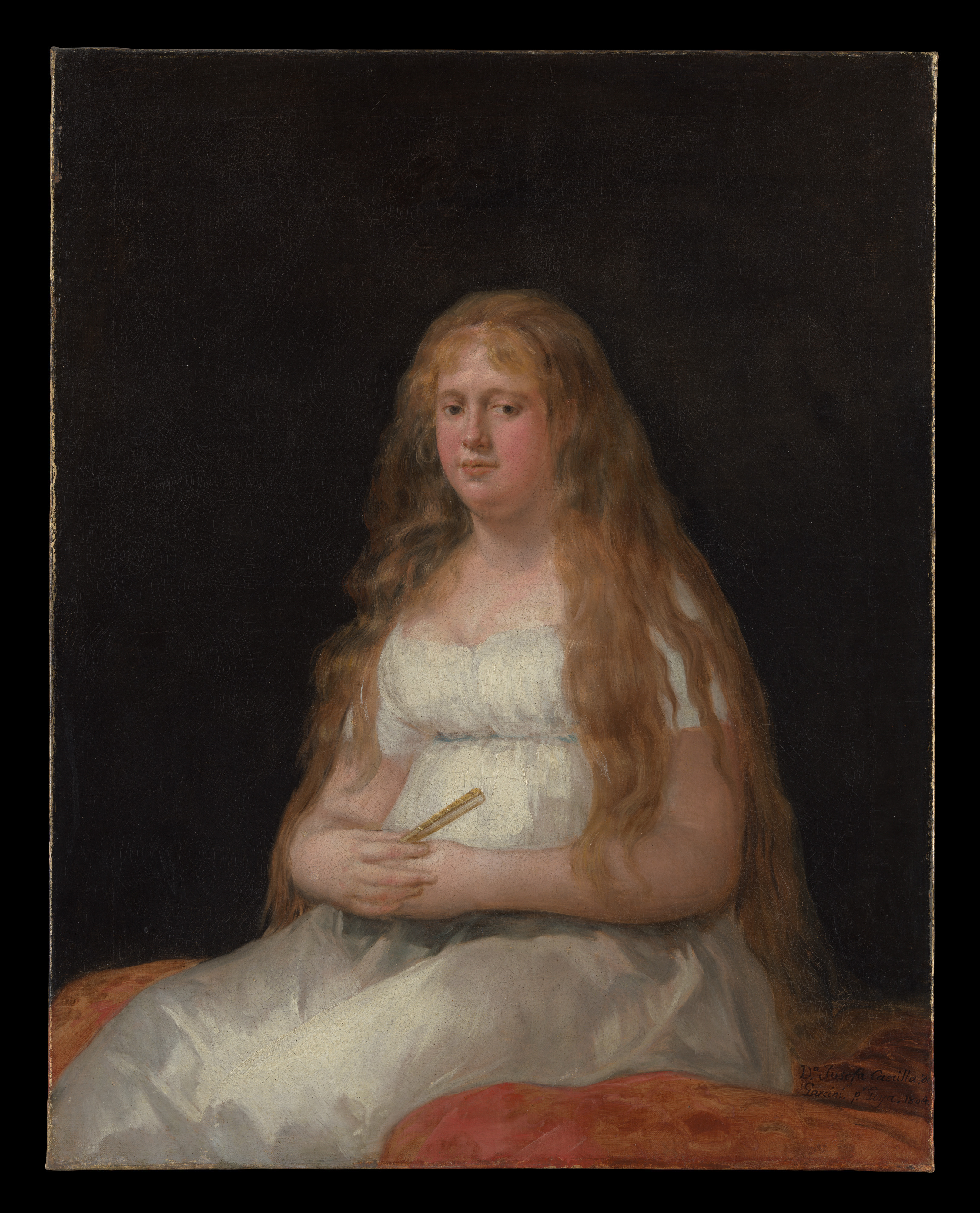
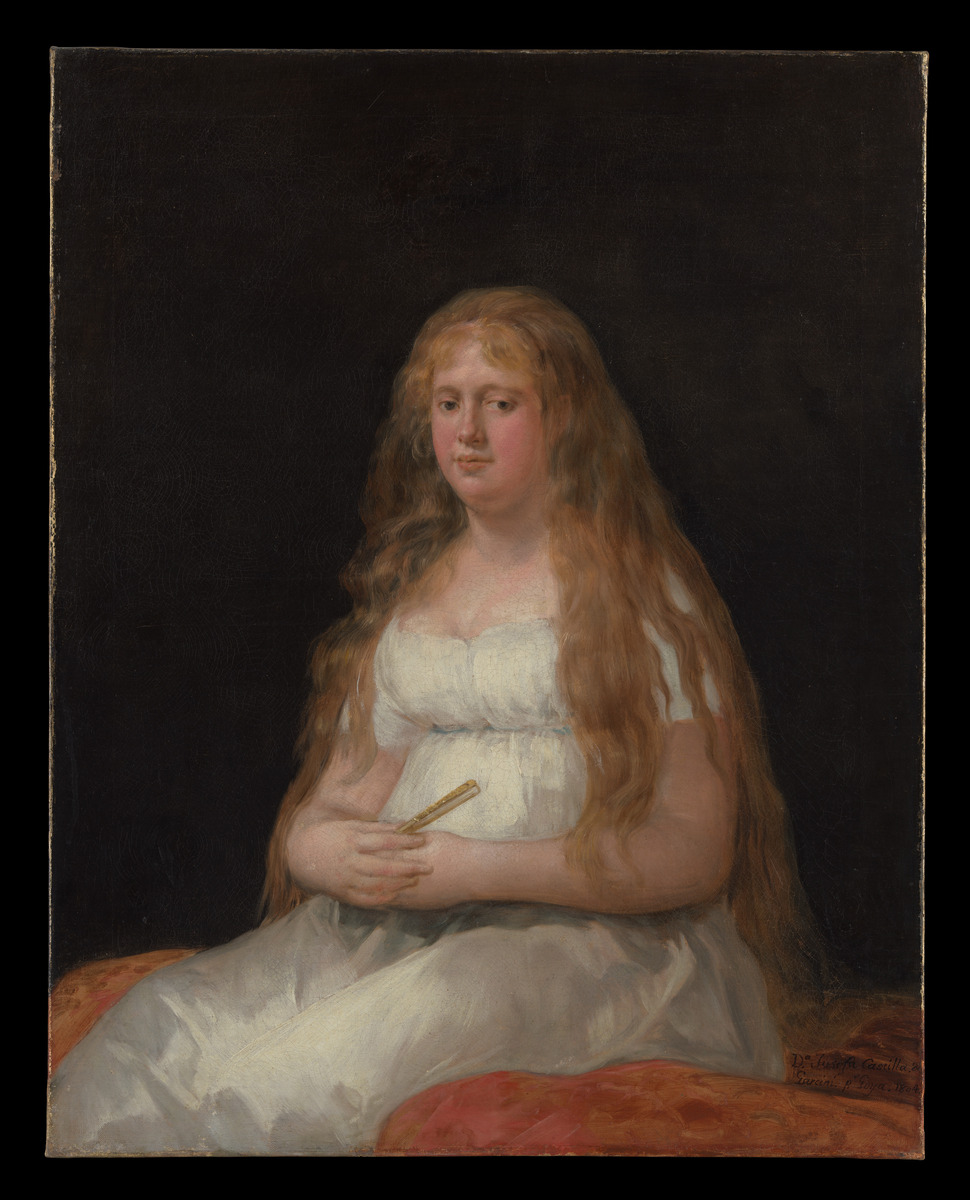
This is Goya's portrait of Josefa de Castilla Portugal y van Asbrock de Garcini, painted in 1804. She sits before us in a white high-waisted gown, her hands clasped around a narrow gold object. It is a portrait, not a scene from a story. What Goya gives us is a young woman presented formally, yet with a quality of private informality that the painting quietly insists on.
Start with her face. She has a youthful face, flushed cheeks, and a gaze that meets us directly but stays slightly withdrawn. That combination is the portrait's psychological centre. She is present to the viewer, but not entirely offered up to us.
Below the face, her clasped hands hold a narrow gold object. The gesture is small and contained, and it anchors the seated pose. Her white muslin gown has a high waist and a thin blue sash. The fabric is carefully rendered across the bodice and waist, so the dress reads as both fashionable and precisely observed.
The high-waisted gown belongs to Empire-period fashion, the style of the early nineteenth century. Through it, the portrait places Josefa within a current, cultivated mode of dress. The sash and the pale fabric keep the figure light and upright. Formality here is carried by fashion and posture rather than by heavy setting or display.
Then there is her hair. Long and unplaited, it spills down the right side of her body past the waist, and it dominates the silhouette. In a formal portrait, loosened hair of this kind reads as unusually intimate. The source describes it as conveying an informal intimacy, and you can see why: it works against the polish of the gown.
Put the parts together and the balance becomes clear. The unbound hair and the direct gaze together make a portrait that holds formal presentation and a sense of private, unguarded character at once. So this is not simply a record of a fashionable woman. Goya gives us someone composed for company, and yet partly kept to herself.
The story and its sources
Historical claims are linked to the records below. Close looking and interpretation are identified in the passage notes.
- Passage 1Documented historyWikimedia Commons: Josefa de Castilla Portugal y van Asbrock de Garcini (1775–about 1850)
- Passage 2Close lookingWikimedia Commons: Josefa de Castilla Portugal y van Asbrock de Garcini (1775–about 1850)
- Passage 3Close lookingWikimedia Commons: Josefa de Castilla Portugal y van Asbrock de Garcini (1775–about 1850)
- Passage 4InterpretationWikimedia Commons: Josefa de Castilla Portugal y van Asbrock de Garcini (1775–about 1850)
- Passage 5InterpretationWikimedia Commons: Josefa de Castilla Portugal y van Asbrock de Garcini (1775–about 1850)
- Passage 6InterpretationWikimedia Commons: Josefa de Castilla Portugal y van Asbrock de Garcini (1775–about 1850)
Details to notice
About 2 minutes to readRed inscription
The red lettering at the lower right appears to name the sitter and carry the artist's signature and date, making it essential for documentary verification.
Unbound blonde hair
Long, unplaited blonde hair spills down the right side of her body past the waist, dominating the silhouette and conveying an unusually informal intimacy.
White Empire gown and sash
The white high-waisted muslin gown and thin blue sash reveal Empire-period fashion and the careful rendering of fabric across the bodice and waist.
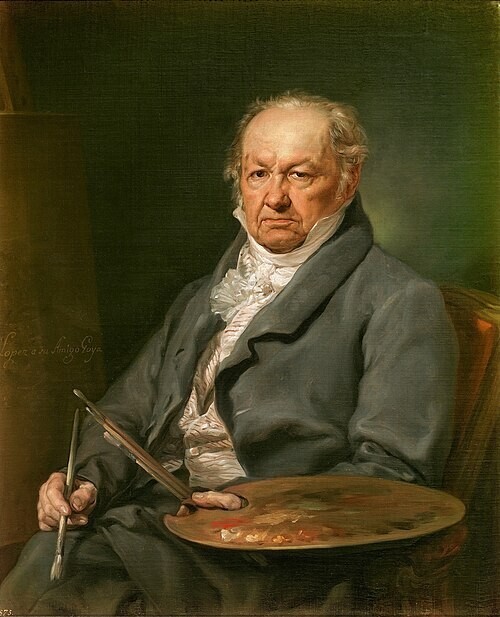
Artist portrait Image credit
Vicente López Portaña. Image source · Public domain
About the artist
Francisco de Goya
30 March 1746 to 16 April 1828
Goya was a Spanish painter and printmaker whose career extended from royal tapestry designs and court portraiture to images of war, repression and unsettling fantasy. Born in Fuendetodos, he trained in Zaragoza and Madrid and became First Painter to Charles IV in 1799. He spent his final years in Bordeaux.
- Born
- 30 March 1746
- Died
- 16 April 1828
- Nationality
- Spanish
- Birthplace
- Fuendetodos, Spain
- Died in
- Bordeaux, France
The research & record
Study the work.
Follow the evidence.
Find catalogue details, historical context, technical research and the literature behind this artwork.
The artwork record
Research catalogue
Catalogue information and detailed research, with references that link to the bibliography.
Updated .
Identity and catalogue
Link- Title
- Josefa de Castilla Portugal y van Asbrock de Garcini (1775–about 1850)
- Artist or attribution
- Francisco Goya
- Object date
- 1804
- Medium and support
- Oil on canvas(Wikimedia Commons: Josefa de Castilla Portugal y van Asbrock de Garcini (1775–about 1850), n.d.)
- Dimensions
- 41 x 32 3/8 in. (104.1 x 82.2 cm)
- Current collection or location
- The Metropolitan Museum of Art(Wikimedia Commons: Josefa de Castilla Portugal y van Asbrock de Garcini (1775–about 1850), n.d.)
- Movement or period
- Romanticism
- Country or culture
- Spain
- Depicted subject
- A portrait of Josefa de Castilla Portugal y van Asbrock de Garcini, seated and holding a narrow gold object, wearing a white Empire gown with a blue sash and her hair unbound.
- Title variants
- Josefa de Castilla Portugal y van Asbrock de Garcini
- Accession number
- 55.145.2
- Support
- Canvas
- Inscriptions
- Red inscription at the lower right, appearing to name the sitter and carry the artist's signature and date(Wikimedia Commons: Josefa de Castilla Portugal y van Asbrock de Garcini (1775–about 1850), n.d.)
Read valuation records and their limitations
Catalogue record and attribution
The object is catalogued as a portrait by Francisco Goya of Josefa de Castilla Portugal y van Asbrock de Garcini, whose life dates are given as 1775 to about 1850, and the work carries the date 1804. The approximate close of the sitter's lifespan is itself recorded with a qualification, a reminder that the biographical frame around the portrait rests partly on estimate rather than exact record. The painting belongs to the collection of The Metropolitan Museum of Art under accession number 55.145.2, credited as the Bequest of Harry Payne Bingham, 1955, so the documented history of the canvas includes its twentieth-century transfer into a public collection as well as its early nineteenth-century making.(Wikimedia Commons: Josefa de Castilla Portugal y van Asbrock de Garcini (1775–about 1850), n.d., Object record)
Interpretation
The attribution and the 1804 date should be kept distinct in kind. The date 1804 is the date of the work, established for the painting itself, and is not to be confused with later catalogue or accession dates such as the 1955 bequest that brought the picture to the Metropolitan. The attribution to Goya, the identification of the sitter and the dating of the canvas form the core of the catalogue entry, and the object record presents them together as the painting's identity rather than as separate, independently qualified claims.(Wikimedia Commons: Josefa de Castilla Portugal y van Asbrock de Garcini (1775–about 1850), n.d., Object record)
Inscribed red lettering at the lower right appears to name the sitter and to carry the artist's signature and date. The record describes this inscription cautiously, as something that "appears to" perform these functions, which makes the lettering essential for documentary verification rather than automatically conclusive. The inscription is thus the point where the painted surface, the named individual and the authorship claim meet: it is the primary internal evidence for who is shown and under whose hand and date the portrait was made, and it is precisely because the reading is framed as apparent that it warrants close attention alongside the catalogue attribution.(Wikimedia Commons: Josefa de Castilla Portugal y van Asbrock de Garcini (1775–about 1850), n.d., Object record)
The painting is a portrait by Francisco Goya of Josefa de Castilla Portugal y van Asbrock de Garcini (1775–about 1850), dated 1804.(Wikimedia Commons: Josefa de Castilla Portugal y van Asbrock de Garcini (1775–about 1850), n.d.)
Subject and iconography
LinkRead valuation records and their limitations
The recorded composition
Visual observation
The portrait is an oil on canvas measuring 41 x 32 3/8 in. (104.1 x 82.2 cm), a scale that supports a seated figure presented at close to life size within a relatively shallow field. Working outward from the face, the recorded composition proceeds through the clasped hands and the narrow gold object they hold, the white high-waisted muslin gown with its thin blue sash, the long unplaited blonde hair falling down the right side of the body, and finally the red lettering at the lower right. Each of these elements is described in the object record as an observable feature of the painting, and each anchors a different kind of claim: the gown a dating and fashion argument, the hair and gaze a psychological one, the inscription a documentary one. Reading them in this order keeps observation distinct from inference, since only the inscription is described as carrying naming, signature and date information, and that is characterized as apparent rather than fully deciphered.(Wikimedia Commons: Josefa de Castilla Portugal y van Asbrock de Garcini (1775–about 1850), n.d., Object record)
The face is described as youthful, with flushed cheeks and a gaze that is direct but slightly withdrawn, and this combination is identified in the record as the primary psychological focus of the portrait. The description is careful to hold two effects together rather than resolve them: the sitter meets the viewer, yet the engagement is qualified. The same record treats the unbound hair and the direct gaze jointly, as producing a portrait that balances formal presentation with a sense of private, unguarded character. That formulation is an attributed reading of the visual evidence rather than a documented fact about the sitter's temperament, and it should be weighed as such. What the object record does establish is the visual configuration itself, a frontal or near-frontal face with modeled color in the cheeks and eyes directed outward, from which the psychological description is drawn.(Wikimedia Commons: Josefa de Castilla Portugal y van Asbrock de Garcini (1775–about 1850), n.d., Object record)
At the center of the seated pose, the clasped hands hold a narrow gold object, a gesture the record describes as small and contained and as drawing attention to a refined, self-contained presentation. The record does not identify the object beyond its material appearance and narrow form, so its function remains open in the supplied evidence. What the observation supports is compositional rather than iconographic: the hands form the pivot of the pose and concentrate the viewer's attention at the midpoint of the figure, reinforcing the restrained, closed quality that the face and hair also establish.(Wikimedia Commons: Josefa de Castilla Portugal y van Asbrock de Garcini (1775–about 1850), n.d., Object record)
Dress, hair and the problem of informality
The white high-waisted muslin gown with a thin blue sash is described as revealing Empire-period fashion, with the fabric carefully rendered across the bodice and waist. The identification of the dress as Empire-period is a fashion-historical classification attributed in the record, and it is the clearest internal indication of the portrait's place in early nineteenth-century dress. The note on the rendering of fabric matters because it describes a painterly fact as well as a sartorial one: the gown is not merely labeled as fashionable but observed closely enough at bodice and waist to register the fall and tension of thin cloth. On the supplied evidence the dress establishes period style and careful execution; it does not by itself establish the sitter's age, rank or occasion.(Wikimedia Commons: Josefa de Castilla Portugal y van Asbrock de Garcini (1775–about 1850), n.d., Object record)
Long, unplaited blonde hair spills down the right side of the body past the waist, dominating the silhouette. The record calls this an unusually informal intimacy, a judgment about decorum that depends on comparison with conventions of formal portraiture not otherwise detailed in the evidence. The observation itself is secure: the hair is loose, it falls to one side, and it extends beyond the waist, so that it shapes the outline of the figure as much as the gown does. The interpretation of informality should be retained as the source's characterization rather than restated as a documented social meaning. Together with the qualified directness of the gaze, the hair is what makes the portrait resist a purely ceremonial reading, and the record explicitly frames the two features as a balance between formal presentation and private character.(Wikimedia Commons: Josefa de Castilla Portugal y van Asbrock de Garcini (1775–about 1850), n.d., Object record)
Red lettering at the lower right appears to name the sitter and to carry the artist's signature and date. The wording is hedged, and the hedge is consequential: the inscription is described as appearing to do these things, so the naming, signature and dating function as the object record reports them rather than as a transcription the supplied evidence provides. This is nevertheless the element on which documentary verification of the portrait depends, since the painted figure alone cannot secure a name, an author or a year. The inscription's position at the lower right is also a compositional fact, placing the identifying text at the margin of the seated figure rather than within the field of the pose.(Wikimedia Commons: Josefa de Castilla Portugal y van Asbrock de Garcini (1775–about 1850), n.d., Object record)
Interpretation
Read together, the recorded features describe a portrait organized around restraint: a contained gesture at the center, pale fabric and a thin sash keeping the figure light and upright, and loose hair providing the one element of visual expansion against an otherwise closed presentation. The record's own synthesis is that the unbound hair and direct gaze produce a balance of formal presentation and unguarded character. That synthesis is best treated as an interpretation grounded in described visual evidence, not as evidence of the sitter's private feelings or the painter's intention, neither of which the supplied units document. Nor does the evidence describe a setting, furnishings or architectural background, so the account of the composition must remain centered on the figure and the inscription rather than on an interior.(Wikimedia Commons: Josefa de Castilla Portugal y van Asbrock de Garcini (1775–about 1850), n.d., Object record)
Visual observation
The sitter is depicted with a youthful face, flushed cheeks, and a direct but slightly withdrawn gaze, which forms the primary psychological focus of the portrait.(Wikimedia Commons: Josefa de Castilla Portugal y van Asbrock de Garcini (1775–about 1850), n.d.)
Her clasped hands hold a narrow gold object, creating the central gesture of the seated pose and drawing attention to the refined, self-contained presentation.(Wikimedia Commons: Josefa de Castilla Portugal y van Asbrock de Garcini (1775–about 1850), n.d.)
She wears a white high-waisted muslin gown with a thin blue sash, revealing Empire-period fashion and the careful rendering of fabric across the bodice and waist.(Wikimedia Commons: Josefa de Castilla Portugal y van Asbrock de Garcini (1775–about 1850), n.d.)
Long, unplaited blonde hair spills down the right side of her body past the waist, dominating the silhouette and conveying an unusually informal intimacy.(Wikimedia Commons: Josefa de Castilla Portugal y van Asbrock de Garcini (1775–about 1850), n.d.)
Red lettering at the lower right appears to name the sitter and carry the artist's signature and date, making it essential for documentary verification.(Wikimedia Commons: Josefa de Castilla Portugal y van Asbrock de Garcini (1775–about 1850), n.d.)
Materials and technique
LinkRead valuation records and their limitations
Support, medium and dimensions
The documented physical record is brief but firm. The Metropolitan Museum of Art object record describes the work as oil on canvas measuring 41 by 32 3/8 inches, that is 104.1 by 82.2 centimeters, a scale consistent with a portrait intended for a domestic or private setting rather than a monumental public display. Beyond the identification of the medium and support, the supplied evidence does not record a ground layer, pigment analysis, lining or stretching history, cleaning campaign, or condition report. Claims about how the paint was applied, about specific colorants, or about later interventions would therefore exceed what these units establish and are not made here.(Wikimedia Commons: Josefa de Castilla Portugal y van Asbrock de Garcini (1775–about 1850), n.d., Object record)
Inscription and verification
Interpretation
Taken together, the evidence separates cleanly into what is documented and what is inferred. Medium, support and dimensions are stated as facts of the object record, while the face, hands, gold object, gown, sash and long unplaited hair are observational descriptions of the finished picture. The inscription in red is reported by appearance rather than by transcription. No unit supplied here records a canvas weave analysis, infrared image, cross section or conservation treatment, so the making of the portrait can be discussed through its described effects but not reconstructed layer by layer. That gap is itself part of the present state of research and should remain visible in any account of the work.(Wikimedia Commons: Josefa de Castilla Portugal y van Asbrock de Garcini (1775–about 1850), n.d., Object record)
Medium is oil on canvas, with dimensions 41 x 32 3/8 in. (104.1 x 82.2 cm).(Wikimedia Commons: Josefa de Castilla Portugal y van Asbrock de Garcini (1775–about 1850), n.d.)
Interpretations and debates
LinkRead valuation records and their limitations
Formality, Informality and the Limits of Intention
Interpretation
The attributed reading holds that the unbound hair and the direct gaze together produce a portrait balancing formal presentation with a sense of private, unguarded character. This is a scholar's or institution's interpretation, not a statement about what the maker privately intended, and the evidence does not license any claim about Goya's thoughts or motives. The reading also rests on a visible tension within the picture: the loosened hair works against the polish of the carefully described gown, while the contained gesture of the hands keeps the figure composed. The painting is thus characterized as placing an individual before the viewer in cultivated, current dress, the Empire-period fashion of the high waist and sash, and at the same time withholding part of her from easy access. Formal presentation is carried by fashion and posture rather than by heavy setting or display, and the unguarded element is carried by the hair and the slightly withdrawn gaze. That balance is the interpretive contribution most specific to this object, and it should be weighed as an attributed account of the painted evidence.(Wikimedia Commons: Josefa de Castilla Portugal y van Asbrock de Garcini (1775–about 1850), n.d., Object record)
The two halves of the argument rest on different kinds of support and carry different degrees of evidential weight. The fashion is describable and comparable: a white high-waisted muslin gown with a thin blue sash belongs to Empire-period dress of the early nineteenth century, so the clothing locates the sitter within a current and cultivated mode that can be checked against dated garments and other portraits. The psychological claim is softer. A direct yet withdrawn gaze and the effect of unguarded character are qualities perceived in the paint, and the record's own language, describing the hair as conveying an informal intimacy, signals that intimacy is an effect produced for the viewer rather than a biographical fact about the sitter. The most durable stratum of interpretation is therefore the tension between current, formal dress and loosened hair, since both are visible and comparable, while the characterological reading should be reported as an attributed view that later scholarship may refine or dispute.(Wikimedia Commons: Josefa de Castilla Portugal y van Asbrock de Garcini (1775–about 1850), n.d., Object record)
The unbound hair and direct gaze together create a portrait that balances formal presentation with a sense of private, unguarded character.(Wikimedia Commons: Josefa de Castilla Portugal y van Asbrock de Garcini (1775–about 1850), n.d.)
Collection and display
LinkRead valuation records and their limitations
Institutional custody and the 1955 bequest
The object's documented location is The Metropolitan Museum of Art, where it carries accession number 55.145.2 and is credited as the Bequest of Harry Payne Bingham, 1955. This institutional record establishes the painting's present custody and the route by which it entered a public collection: a bequest made in 1955, recorded under the donor's name. The accession number and bequest credit are the fixed documentary anchors for the work, the points to which any further archival, exhibition or conservation research on this canvas can be tied. The available evidence attaches these collection facts to the same portrait identified in the record as Francisco Goya's depiction of Josefa de Castilla Portugal y van Asbrock de Garcini (1775 to about 1850), dated 1804, and describes it as oil on canvas measuring 41 by 32 3/8 inches, or 104.1 by 82.2 cm. Collection history and object description therefore belong to a single documented entry rather than to separate competing accounts.(Wikimedia Commons: Josefa de Castilla Portugal y van Asbrock de Garcini (1775–about 1850), n.d., Object record)
The painting is in the collection of The Metropolitan Museum of Art, accession number 55.145.2, credited as the Bequest of Harry Payne Bingham, 1955.(Wikimedia Commons: Josefa de Castilla Portugal y van Asbrock de Garcini (1775–about 1850), n.d.)
Documented values and qualified estimates
LinkRead valuation records and their limitations
Recorded values
Interpretation
Recorded value for the painting exists only as a working calculation. A model-generated insurance estimate, generated 2026-11-16 and intended for manual review only, proposes a broad range of US$20M to US$40M. The stated basis is a confirmed, documented Goya oil portrait dated 1804, a mature-period work by one of the most prominent Spanish Romantic painters; the relatively modest scale for a full-length seated portrait (about 104 x 82 cm) is said to temper the upper bound. The painting's presence at The Metropolitan Museum of Art under accession 55.145.2 is cited as suggesting museum-quality status, but explicitly not as establishing transferable market value, and the 1955 Bingham bequest is treated as acquisition context rather than a current price. The calculation states that no auction results, appraisals, insurance records or comparable sales were supplied, and that no documented comparables are cited. The range is described as intentionally wide and anchored to Goya's standing as a canonical artist; the calculator itself recommends refinement by a qualified appraiser using documented comparables and a condition assessment.(Wikimedia Commons: Josefa de Castilla Portugal y van Asbrock de Garcini (1775–about 1850), n.d.)
The qualification attached to that figure carries as much evidential weight as the figure itself. It is not an official insurance value, appraisal, auction estimate, auction result or sale price; no comparable sales or private insurance records were used, and a final value would require review by a qualified fine-art appraiser together with confirmation of condition, provenance and title. Read beside the object record, the estimate rests on the 1804 date and Goya attribution rather than on any transaction history: the bequest is the only provenance interval supplied, the dimensions are the only physical measurements given, and the inscription is the only documentary feature described. On the evidence supplied, the precise sum cannot be treated as a finding about the painting's worth; what can be documented is the institutional holding, the bequest, the attribution and date, and the stated method and limits of the working range. Valuation here is a procedural record with explicit caveats, not a market fact, and any use of the number should preserve those caveats intact.(Wikimedia Commons: Josefa de Castilla Portugal y van Asbrock de Garcini (1775–about 1850), n.d.)
Working estimate
Calculated working insurance estimate, not a sale price: Estimated value: US$20M to US$40M Recorded date: Working calculation, generated 2026-11-16. Methodology: Broad working range calculated for manual review only. Basis: a confirmed, documented Francisco Goya oil portrait dated 1804, a mature-period work by one of the most prominent Spanish Romantic painters. Scale is modest for a full-length seated portrait at roughly 104 x 82 cm, which tempers the upper bound. The work is held at The Metropolitan Museum of Art (accession 55.145.2), suggesting museum-quality status but not establishing transferable market value; the 1955 Bingham bequest provides acquisition context, not a current price. No auction results, appraisals, or insurance records were supplied, and no comparable sales are cited. The range is intentionally wide and anchored to Goya's standing as a canonical artist; it should be refined by a qualified appraiser using documented comparables and condition assessment. Qualification: This is a model-generated working insurance range for manual review only. It is not an official insurance value, appraisal, auction estimate, auction result, or sale price. No comparable sales or private insurance records were used. Final values require review by a qualified fine-art appraiser and confirmation of condition, provenance, and title.(Wikimedia Commons: Josefa de Castilla Portugal y van Asbrock de Garcini (1775–about 1850), n.d.)
Further reading
Books for a closer look
Paid links. As an Amazon Associate I earn from qualifying purchases.

Open Library Goya
Kodansha International
A Goya catalogue with subjects including catalogues raisonnés, exhibitions, Spanish painting, and Goya criticism and interpretation. These recorded categories make it a plausible scholarly reference for studying a documented 1804 Goya portrait such as this one, though the record does not confirm this specific painting is discussed.
ISBN 0870110837

Open Library Francisco Goya
Counterpoint
A biographical and critical study of Goya by Evan S. Connell, with subjects on Goya criticism and interpretation and Spanish artists. It offers documented context on the artist's career and period, which can inform understanding of an 1804 portrait, though the record gives no evidence of discussion of this specific sitter or painting.
ISBN 1582433070
Bibliography
Sources and further reading
References are arranged by author or organisation, with links to the original publications. Where no publication date is recorded, n.d. means no date.
Source notes updated .
No recorded sources match these filters. Reset the filters to see the full bibliography.
- 04
Book
Francisco Goya. Counterpoint.
A biographical and critical study of Goya by Evan S. Connell, with subjects on Goya criticism and interpretation and Spanish artists. It offers documented context on the artist's career and period, which can inform understanding of an 1804 portrait, though the record gives no evidence of discussion of this specific sitter or painting.
- ISBN
- 1582433070
Citation text
- 02
Book
Goya. Kodansha International.
A Goya catalogue with subjects including catalogues raisonnés, exhibitions, Spanish painting, and Goya criticism and interpretation. These recorded categories make it a plausible scholarly reference for studying a documented 1804 Goya portrait such as this one, though the record does not confirm this specific painting is discussed.
- ISBN
- 0870110837
Citation text
- 03
Book
Francisco Goya - the Paintings. Independently Published.
Titled 'Francisco Goya - the Paintings', this candidate is directly framed around Goya's painted oeuvre, the medium of the artwork in question. Its subject field is empty, so relevance rests on the title's scope as a paintings-focused Goya reference rather than confirmed coverage of this portrait.
- ISBN
- 9781521566466
Citation text
- 01
Secondary · About this artwork
Wikimedia Commons: Josefa de Castilla Portugal y van Asbrock de Garcini (1775–about 1850) (n.d.). Wikimedia Commons.
Wikimedia Commons file page providing the discovery title and linking to the Metropolitan Museum of Art object record.
Citation text
Art to live with
Bring this painting
home.
A piece of the archive, made yours. Explore Josefa de Castilla Portugal y van Asbrock de Garcini (1775–about 1850) in a size and finish that fits your space.
Your text and annotations appear on these editions. Adding to cart saves that design for printing.
Combine this painting with your favourites01 / Find your edition
Made for you
Suggested from your location. Change it if you're sending elsewhere or using a VPN. Prices and delivery are shown in GBP.
1 product
Choose an edition to make it yours
iPhone 12 Mini ? Glossy ? back view
iPhone 12 Mini · Glossy

iPhone 12 Mini ? Glossy ? back view

iPhone 12 Mini ? Glossy ? back view

iPhone 12 Mini ? Glossy ? back view
Tough phone case
GBP 16.56
Delivery GBP 4.28 / Total GBP 20.84
A two-layer phone case with a printed polycarbonate shell and a shock-absorbing inner liner.
Two layers with a shock-absorbing TPU liner
Case & print details
- Device
- Apple · iPhone 12 Mini
- Material
- Polycarbonate shell with a TPU inner liner
- Artwork
- Outer back and wrapped edges from one template
- Finish
- Glossy
- Version
- Standard version
- Printing
- Dye sublimation
- Print file
- 1,122 × 1,831 px · 95 × 155 mm · PNG · 300 dpi recommended
Rear outline and camera openings follow this variant's Printify template. Case depth and small hardware remain illustrative.
Supplier product detailsFit and fill keep the painting’s proportions. Stretch changes them.
Move and zoom the painting on your tough phone case.
Made to order with your design
Made to order
US delivery only
The 30 cm ruler is scaled alongside your selected print. Keep the painting’s proportions with a black background, or stretch it to fill. Frame width, material texture and screen colours are illustrative.
Keep exploring