Fragile (Fragil)
Artist: Wassily Kandinsky · 1931

Fragile (Fragil): high-resolution image
The original file is hosted by Wikimedia Commons, available without payment or an account.
Open high-resolution image on Wikimedia CommonsThe complete story
The story About 4 minutes to read
This is Fragile, or Fragil, painted by Wassily Kandinsky in 1931. It has no figures and no story in the usual sense. Its subject is a construction of geometric forms held in a balance that feels ready to shift. The official record tells us the title, the artist and the date, and that the work is abstract, associated with the Bauhaus. That much is firm. What the shapes mean beyond their own arrangement is not explained there.
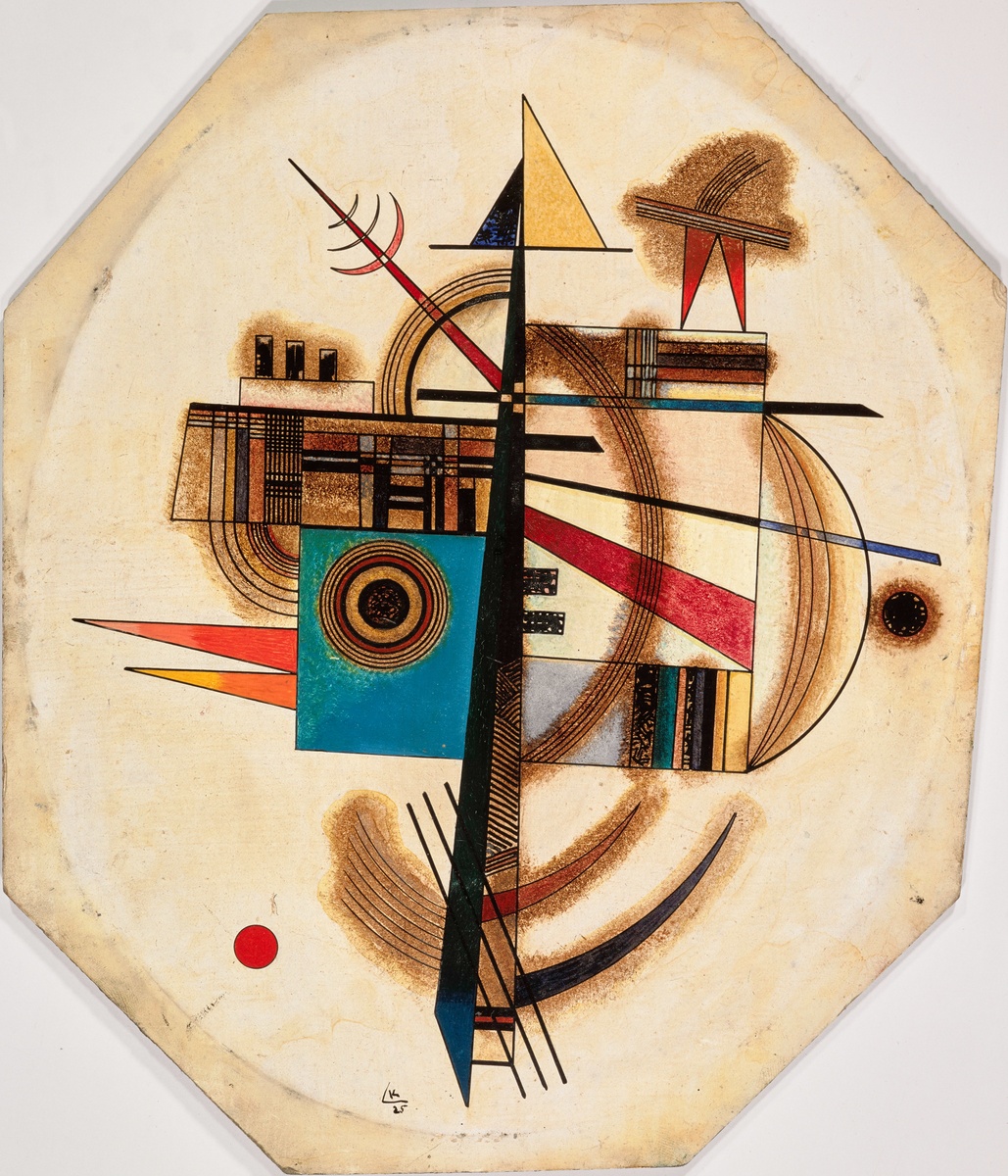
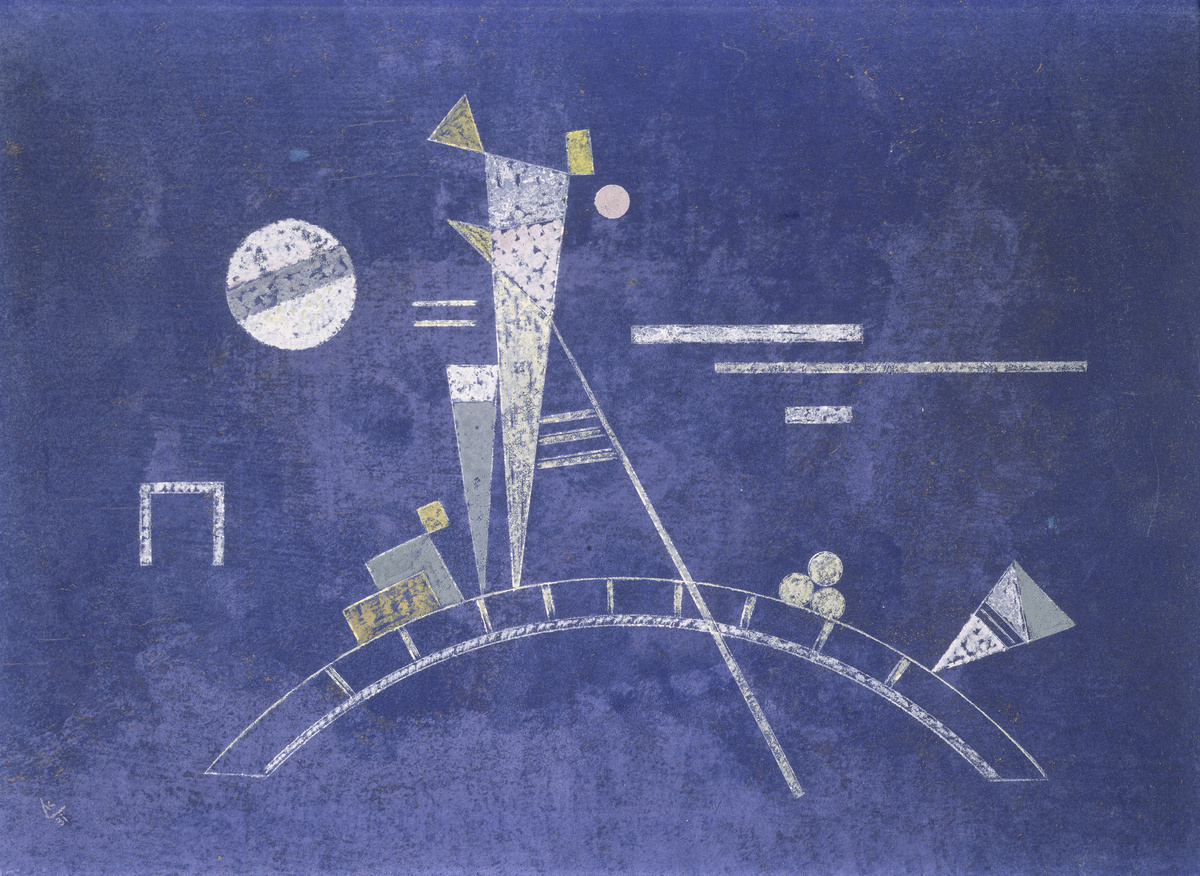
Start at the centre, where a tall tower rises. It's built from white triangles and tapered planes, with a rough texture, and tipped with yellow accents. It leans slightly, and that asymmetry is what makes it feel precarious. The tower doesn't sit on a solid base. A long, shallow arch runs beneath it, like a bridge with thin railings, and round forms rest along that span.
Around this central structure, other shapes keep their distance. At the upper left hangs a pale orb crossed by bands, like a moon. At the right, a triangle is cut with stripes, suggesting a sail. On the left, an open white angular shape reads almost like a doorway or a bracket. At the right, three thin white horizontal marks sit quietly. Each element seems to float rather than rest.
The painting belongs to Kandinsky's Bauhaus years. By 1931 he was working with geometry as a language, and this picture is built entirely from such parts. The official record places it in that movement and describes it as abstract. The medium is tempera on board. That choice suits the crisp edges and flat, chalky surfaces you see in the shapes, rather than the blended depth of oil painting.
So how does the title work? The centre's official record notes that Fragile suggests a theme of precarious balance, but it does not give a fuller reading of the picture's meaning. That leaves the title as a prompt rather than a key. Looking again, the prompt fits. A tall, top-heavy tower, a thin bridge, and scattered forms that never touch all produce a sense of tension held in place. The balance is the subject.
There is also a personal note in the work. An inscription in Russian dedicates it, in translation, to my Ninoussia for Easter, 1931, Dessau. Dessau was where the Bauhaus was based at the time. That dedication doesn't explain the geometry. But it does place this small, carefully balanced painting in a private, domestic moment, made as a gift rather than a public statement.
What stays with you is the arrangement itself. A tower that leans, a bridge that spans, an orb and a sail that keep their distance. Nothing quite supports anything else, yet the whole holds. Fragile asks you to feel that balance rather than decode it. The title names the condition the composition creates, and the painting makes that condition visible in forms.
The story and its sources
Historical claims are linked to the records below. Close looking and interpretation are identified in the passage notes.
- Passage 1Documented historyInstitutional record for Fragile
- Passage 2Close lookingWikimedia Commons: Fragile
- Passage 3Close lookingWikimedia Commons: Fragile
- Passage 4Documented historyInstitutional record for Fragile
- Passage 5InterpretationInstitutional record for Fragile
- Passage 6Documented historyInstitutional record for Fragile
- Passage 7InterpretationWikimedia Commons: FragileInstitutional record for Fragile
Details to notice
About 3 minutes to readHorizontal signal bars
Three thin white horizontal marks at the right, acting like signals or horizon lines and contrasting with the vertical tower.
Left angular glyph
Open white angular glyph resembling a doorway or architectural bracket, adding symbolic structure against the blue field.
Triangular sail form
Striped triangular form at the right, poised on the bridge and echoing the angular construction of the central tower.
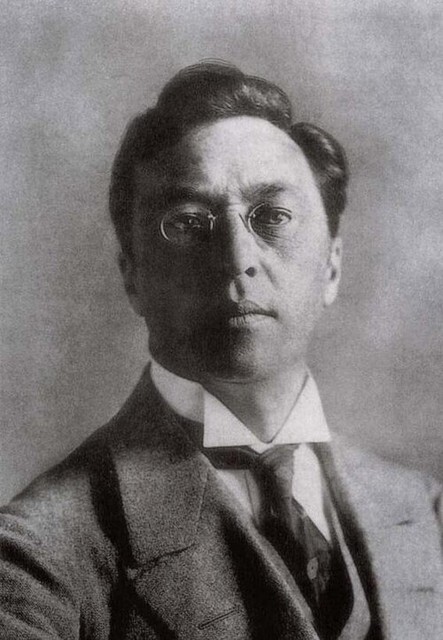
Artist portrait Image credit
未知上傳者. Image source · Public domain
About the artist
Wassily Kandinsky
1866 to 1944
Wassily Kandinsky was an avant-garde painter of Russian origin (1866–1944). Their work is associated with Expressionism; Symbolism; Bauhaus. Their recorded places of work include Paris; Munich; Weimar; Rapallo; The Hague; Russia; Stockholm; Switzerland; Tunis.
- Born
- 1866
- Died
- 1944
- Nationality
- Russian Empire; Russian Soviet Federative Socialist Republic; Soviet Union; France; Germany
- Birthplace
- Moscow
- Died in
- Neuilly-sur-Seine
Biography sources
The research & record
Study the work.
Follow the evidence.
Find catalogue details, historical context, technical research and the literature behind this artwork.
The artwork record
Research catalogue
Catalogue information and detailed research, with references that link to the bibliography.
Updated .
Identity and catalogue
Link- Title
- Fragile (Fragil)
- Artist or attribution
- Wassily Kandinsky
- Object date
- 1931
- Medium and support
- Tempera on board
- Dimensions
- 34.7 x 48.4 cm
- Current collection or location
- Musée national d'art moderne, Centre Pompidou, Paris, on deposit at the Musée d'arts de Nantes since 2 December 1986
- Movement or period
- Bauhaus abstraction
- Country or culture
- Russia / Germany / France
- Depicted subject
- An abstract composition of geometric forms, including a tall precarious central tower, a banded moon-like orb, an arched bridge, a triangular sail form, an angular glyph, and horizontal signal bars, arranged in a dreamlike space. The work is non-narrative; its subject is the tense, fragile balance of its geometric components, as suggested by its title.
- Title variants
- Fragil; Fragile
- Accession number
- AM 81-65-142
- Support
- Board (carton)
- Inscriptions
- MO.D.B.G. : VK 3i; MO.N.D.T.R.à l'encre de Chine : VK N°552/i93i Fragil 49 X 35; DE.R.en russe : A ma Ninoussia pour Pâques, 1931, Dessau
Read valuation records and their limitations
Catalogue identity
The institutional record catalogues the work as Fragile (Fragil), painted by Wassily Kandinsky in 1931. It records the medium as tempera on board (carton) and the dimensions as 34.7 by 48.4 centimetres. The record associates the picture with the Bauhaus movement and describes it as abstract. These identifications, together with the object date of 1931, are the fixed points from which any further account of the work must proceed; the later catalogue, exhibition and collection dates discussed below are separate events in the object's documented afterlife and should not be conflated with the year of execution.(www.centrepompidou.fr, n.d., Title and artist; Dimensions; Mots clés mouvement)
The institutional record identifies the painting as Fragile, with the variant Fragil also given, and attributes it to Wassily Kandinsky with a date of 1931. The record also supplies the technical description on which much of the object's physical character depends: the medium is tempera on board, or carton, and the support measures 34.7 by 48.4 centimetres, a small format for a painting of this period. The work is described as abstract and as associated with the Bauhaus movement, the school with which Kandinsky was connected and where, according to the dedication discussed below, he was working in 1931.(www.centrepompidou.fr, n.d., Title and artist; Dimensions; Mots clés mouvement)
The object carries an inscription in Russian, recorded in translation as "A ma Ninoussia pour Pâques, 1931, Dessau" (To my Ninoussia for Easter, 1931, Dessau). The inscription is significant for several reasons. It gives a location, Dessau, and an occasion, Easter 1931, and it names a recipient, Ninoussia, in an intimate dedicatory form. The date in the inscription coincides with the catalogued date of 1931, and Dessau is consistent with the Bauhaus association recorded for the work. The dedication is documented in the institutional record; what it reveals about the painter's personal relationships, beyond the fact of the dedication itself, is not established by this evidence and should not be inferred from it.(www.centrepompidou.fr, n.d., Inscriptions; Title and artist; Mots clés mouvement)
Collection and catalogue record
The catalogue title and the inscribed dedication sit alongside the work's later institutional history. The painting was acquired by the Musée national d'art moderne in 1981 as a bequest from Nina Kandinsky, and it is in the collection of the Musée national d'art moderne, Centre Pompidou, Paris, on deposit at the Musée d'arts de Nantes since 2 December 1986. The 1981 bequest date and the 1986 deposit date are collection events that postdate the 1931 execution by half a century and more; they belong to the object's museum life, not to its making. The fact that the work entered the national collection through Nina Kandinsky's bequest is recorded in the institutional record and provides the documented link between the painting's early private context and its later public one, without supplying the intervening ownership history.(www.centrepompidou.fr, n.d., Acquisition; Title and artist; Inscriptions)
The institutional record also documents the work's exhibition and publication history, which is more extensive than the object's small scale might suggest. It has been included in "Kandinsky: collections du Centre Georges Pompidou" at the Musée des Beaux-Arts de Nantes in 1998, in "Punkt und Linie zu Fläche: Kandinsky am Bauhaus" in Jena in 2009, in "Kandinsky" at the Palazzo Reale in Milan in 2013-2014 and at other venues, and in "Kandinsky" at the H'ART Museum in Amsterdam in 2024. The catalogues recorded include the 1984-1985 Kandinsky exhibition catalogue (cat. no. 467), the 1997 Nantes catalogue (cat. no. 78), the 2009 Jena catalogue (cat. II/37), the 2013 Milan catalogue (cat. no. 73), the 2014 retrospective catalogue (cat. no. 99), the 2015 Madrid catalogue (cat. no. 77) and the 2024 Amsterdam catalogue, where it is reproduced on page 106. These references establish the work's repeated inclusion in the scholarly and public presentation of Kandinsky's Bauhaus-period output, while the differences in catalogue numbering reflect separate publication projects rather than any change in the object itself.(www.centrepompidou.fr, n.d., Title and artist; Mots clés mouvement; Acquisition)
Interpretation
What the record establishes and what it leaves open should be kept distinct. The title, attribution, date, medium, dimensions, inscription, Bauhaus association and abstract character are documented in the institutional record. The record notes that the title Fragile suggests a theme of precarious balance but does not provide a specific interpretation of the work's meaning. The inscription places the painting in a private, dedicatory context at Dessau in 1931, yet it does not explain the composition's geometry. Reading the title as a prompt to perceive balance rather than a key to decode the forms is therefore an interpretive move, consistent with the record's caution, and not a documented reading of the picture.(www.centrepompidou.fr, n.d., Title and artist; Inscriptions; Mots clés mouvement)
The painting is titled Fragile (Fragil) and was created by Wassily Kandinsky in 1931.(www.centrepompidou.fr, n.d.)
The dimensions are 34.7 by 48.4 centimetres.(www.centrepompidou.fr, n.d.)
The work bears an inscription in Russian: 'A ma Ninoussia pour Pâques, 1931, Dessau' (To my Ninoussia for Easter, 1931, Dessau).(www.centrepompidou.fr, n.d.)
The work is associated with the Bauhaus movement and is abstract.(www.centrepompidou.fr, n.d.)
Subject and iconography
LinkRead valuation records and their limitations
The recorded composition
Visual observation
The composition described for the Wikimedia Commons image of Fragile is organised around a tall, asymmetrical central tower built from textured white triangles and tapered planes and capped by yellow geometric accents. Around this vertical core, the description records a pale banded orb at the upper left; a long, shallow arched bridge with thin railings that spans the lower third and carries round forms; a striped triangular sail form at the right; an open white angular glyph at the left resembling a doorway or bracket; and three thin white horizontal marks at the right. These are observational descriptions of forms, not identifications of what the forms depict, and they should be weighed as such: the tower, orb, bridge and sail are named by analogy to things in the visible world, while the work's own institutional record calls it an abstract composition featuring geometric figures.(Wikimedia Commons: Fragile, n.d., Description)(www.centrepompidou.fr, n.d., Technique)
Materials, scale and support
The medium recorded in the institutional documentation is tempera on board (carton), and the painting measures 34.7 by 48.4 centimetres. The small scale matters when reading the composition: the described elements, a leaning tower, a thin-railed bridge, a banded orb and a striped triangle, are packed into a comparatively intimate surface, and the support is board rather than canvas. The institutional record also supplies the firm identification on which any visual reading rests: the title Fragile (Fragil), the artist Wassily Kandinsky, the date 1931, and the classification of the work as abstract and associated with the Bauhaus movement.(www.centrepompidou.fr, n.d., Technique)(Wikimedia Commons: Fragile, n.d., Description)
Title, balance and the limits of interpretation
The Centre Pompidou record notes that the title Fragile suggests a theme of precarious balance but does not provide a specific interpretation of the work's meaning. That qualification is important for any account of the visual evidence: the asymmetry of the central tower and the shallow span of the bridge beneath it can be described, and the title can be connected to the idea of precariousness, but the institution stops short of decoding the picture. What the shapes mean beyond their own arrangement is not established by the source. The visual evidence therefore supports a reading of the composition as an arrangement of forms held in tension, while the meaning of those forms remains unattributed beyond the title's suggestion.(Wikimedia Commons: Fragile, n.d., Description)
Reading the visual evidence against the record
Interpretation
The description of the composition and the institutional record agree on the fundamentals: the work is abstract, geometric, dated 1931 and associated with the Bauhaus. Where they differ is in kind rather than substance. The visual description names forms by resemblance, a tower, an orb, a bridge, a sail, a doorway-like glyph, while the institutional record describes geometric figures and declines to interpret them. This difference is not a contradiction but a distinction between observation and identification. The tower's asymmetry and the bridge's shallow arch can be seen and described; whether they carry symbolic weight is not established by the sources. The painting's significance within a larger history of art lies in its position as a Bauhaus-period work by Kandinsky, made in Dessau in 1931 and dedicated on a specific occasion, and in its later public life as a bequest-held, frequently exhibited and catalogued object in French national collections.(Wikimedia Commons: Fragile, n.d., Description)(www.centrepompidou.fr, n.d., Technique)
Visual observation
The composition includes a tall, asymmetrical central tower made of textured white triangles and tapered planes, capped by yellow geometric accents; a pale banded orb at upper left; a long shallow arched bridge with thin railings spanning the lower third, carrying round forms; a striped triangular sail form at the right; an open white angular glyph at the left resembling a doorway or bracket; and three thin white horizontal marks at the right.(Wikimedia Commons: Fragile, n.d.)
Materials and technique
LinkRead valuation records and their limitations
Support and medium
The institutional record for Fragile (Fragil) gives a compact but decisive account of how the picture was made at the level of support and medium. Wassily Kandinsky executed the work in 1931 in tempera on board, the French carton of the record, and at 34.7 by 48.4 centimetres it is a small panel rather than a stretched canvas of exhibition scale. Those two facts, the tempera binder and the rigid board support, are the only material data the supplied evidence states directly, and they come from the museum's catalogue entry rather than from any published examination report. Everything else about surface, layering or handling in what follows must therefore be separated carefully into what the record documents, what the image shows, and what can only be inferred from the combination of the two.(www.centrepompidou.fr, n.d., Technique)
Interpretation
What the image makes visible is a composition assembled from discrete geometric elements that keep clear edges: a tall, asymmetrical central tower built of textured white triangles and tapered planes and capped by yellow accents; a pale banded orb at upper left; a long shallow arched bridge with thin railings across the lower third, carrying round forms; a striped triangular sail form at the right; an open white angular shape at the left resembling a doorway or bracket; and three thin white horizontal marks at the right. These are observations of the reproduction, not technical findings, and the description is a viewing aid rather than a condition or materials report. Even so, the observed character of the forms bears on questions of technique: the shapes are described as flat planes meeting at crisp boundaries, with texture reported in the white triangles of the tower, and it is precisely this kind of partitioned, edge-defined imagery that a tempera medium on a rigid board is suited to carrying. The record does not describe the paint application itself, so the fit between medium and appearance should be treated as a reasoned correspondence, not as a documented procedure.(Wikimedia Commons: Fragile, n.d., Description)(www.centrepompidou.fr, n.d., Technique)
Documentation and setting
The documentary framework around the object explains why its materials matter to more than connoisseurship. The Centre Pompidou record states that the painting is in the collection of the Musée national d'art moderne, Paris, and has been on deposit at the Musée d'arts de Nantes since 2 December 1986, having entered the national collection in 1981 as a bequest from Nina Kandinsky. A small tempera on board, then, has been sustained for decades through loan and deposit rather than remaining fixed in a single gallery. The record also gives an inscription in Russian dedicating the work, in translation, to Ninoussia for Easter, 1931, Dessau. Dessau was the Bauhaus centre at the time, and the dedication situates the making of the panel in a domestic, gift context in that Bauhaus setting. The inscription is evidence for the circumstances of the work's creation and giving; it does not describe pigments, preparation or tools, and no such description appears in the supplied units.(www.centrepompidou.fr, n.d., Technique)
The medium is tempera on board (carton).(www.centrepompidou.fr, n.d.)
Provenance and ownership
LinkRead valuation records and their limitations
Documented Ownership
The documented ownership history of Fragil (Fragile) begins with a single recorded transfer: the painting entered the Musée national d'art moderne in 1981 as a bequest from Nina Kandinsky. The institutional record for the work states this acquisition plainly and does not describe any intervening sale, dealer, or private collection between the artist and that bequest. The evidence therefore establishes the 1981 bequest as the documented moment of entry into public collection, while leaving the preceding chain of custody unrecorded in the supplied units. An absence of recorded owners is not evidence of a change of ownership; it is an unrecorded interval, and should be described as such rather than filled with inferred transfers.(www.centrepompidou.fr, n.d., Acquisition)
The same institutional record also fixes a second, later movement of the object: since 2 December 1986 the painting has been on deposit at the Musée d'arts de Nantes, while remaining in the collection of the Musée national d'art moderne, Centre Pompidou, Paris. This distinction matters for provenance. A deposit is an administrative placement of a work owned by one institution at another venue, not a transfer of title, so the 1986 date marks a change of location and custodial arrangement rather than a change of owner. The object's provenance proper still runs from Nina Kandinsky's bequest to the national collection; Nantes holds it on long-term deposit.(www.centrepompidou.fr, n.d., Acquisition)
The work's own inscription adds a layer to this record that is dedicatory rather than proprietary. In Russian it reads, in translation, "To my Ninoussia for Easter, 1931, Dessau." The dedication names a recipient and a date and place of giving, and the institutional record identifies Nina Kandinsky as the bequest donor in 1981. The evidence supplied does not explicitly state that Ninoussia is Nina Kandinsky, though the pairing of the dedication and the bequest in the same institutional account is consistent with a personal link between the two. That link should be presented as the record presents it, without asserting a formal identification the units do not make.(www.centrepompidou.fr, n.d., Acquisition)
Because the painting entered the national collection through a bequest rather than a purchase, its documented provenance is inseparable from the history of the Kandinsky bequest as a whole, though the supplied evidence covers only this work. The record supplies no acquisition price, no dealer name, no intermediate owner and no earlier provenance interval, so any account of the painting's path from the Dessau dedication of 1931 to the 1981 bequest must remain open. The responsible formulation is that the object is documented in the national collection from 1981 and at Nantes from 1986, with the preceding half century unrecorded in these units.(www.centrepompidou.fr, n.d., Acquisition)
The painting was acquired by the Musée national d'art moderne in 1981 as a bequest from Nina Kandinsky.(www.centrepompidou.fr, n.d.)
Provenance timeline
- 1981
The Musée national d'art moderne acquires the painting as a bequest from Nina Kandinsky.(www.centrepompidou.fr, n.d., Acquisition)
- 1998
Included in the exhibition Kandinsky: collections du Centre Georges Pompidou at the Musée des Beaux-Arts de Nantes.(www.centrepompidou.fr, n.d., Expositions)
- 2009
Included in the exhibition Punkt und Linie zu Fläche: Kandinsky am Bauhaus in Jena.(www.centrepompidou.fr, n.d., Expositions)
- 2013-2014
Included in the exhibition Kandinsky at the Palazzo Reale in Milan.(www.centrepompidou.fr, n.d., Expositions)
- 2024
Included in the exhibition Kandinsky at the H'ART Museum in Amsterdam.(www.centrepompidou.fr, n.d., Expositions)
Exhibition history
LinkRead valuation records and their limitations
Exhibition history
The institutional record for Fragil (Fragile) documents a substantial exhibition history for the painting, but it presents that history as a list of titles and venues rather than as a sequence of installations. According to the Centre Pompidou record, the work appeared in 'Kandinsky: collections du Centre Georges Pompidou' at the Musée des Beaux-Arts de Nantes in 1998; in 'Punkt und Linie zu Fläche: Kandinsky am Bauhaus' in Jena in 2009; in 'Kandinsky' at the Palazzo Reale in Milan in 2013-2014; and in 'Kandinsky' at the H'ART Museum in Amsterdam in 2024. The same entry adds 'and other venues' without naming them, so the list should be treated as partial rather than exhaustive. The evidence distinguishes each project by its exact title, city and year, which matters because several of these exhibitions carry the single word 'Kandinsky' and can only be told apart by venue and date.(www.centrepompidou.fr, n.d., Expositions)
The record's exhibition list also separates the history of showing the work from its present institutional situation. The painting entered the Musée national d'art moderne in 1981 as a bequest from Nina Kandinsky and has been on deposit at the Musée d'arts de Nantes since 2 December 1986. Read together, this means that the Nantes venue of the 1998 exhibition was not an incidental stop on a tour: it was the institution then holding the work on deposit. The evidence does not state whether the painting travelled to Jena, Milan or Amsterdam, only that it was included in exhibitions at those venues, so the logistics of loans and travel must remain unstated.(www.centrepompidou.fr, n.d., Acquisition; Expositions)
Catalogues and numbering
Beyond the exhibition entries, the Centre Pompidou bibliography gives catalogue numbers that anchor the work in a series of publications, some of which correspond to the exhibition years and some of which extend beyond them. The record lists the 1984-1985 Kandinsky exhibition catalogue (cat. no. 467), the 1997 Nantes exhibition catalogue (cat. no. 78), the 2009 Jena catalogue (cat. II/37), the 2013 Milan catalogue (cat. no. 73), the 2014 retrospective catalogue (cat. no. 99), the 2015 Madrid catalogue (cat. no. 77) and the 2024 Amsterdam catalogue, where it is reproduced at page 106. These entries are important for two reasons. First, they show the object appearing in catalogues dated to 1984-1985, 1997 and 2015 that are not matched by any venue in the exhibition list supplied here, so a catalogue reference cannot be assumed to correspond to an exhibition named in the same section. Second, the numbering systems differ, with the Jena catalogue using a Roman numeral prefix while the others use plain sequential numbers, a reminder that catalogue numbers belong to their own publications and are not interchangeable across projects.(www.centrepompidou.fr, n.d., Expositions)
Interpretation
Taken together, the exhibition and bibliography entries show that Fragile has been repeatedly brought into public view and repeatedly reproduced in print, from the mid-1980s into the 2020s. The evidence does not describe the installation, wall texts or reception of any of these exhibitions, and it does not reproduce the interpretation offered in any catalogue; the record gives titles, venues, dates, numbers, pages and plates only. What the documents do establish, however, is that the object's dating to 1931 and its Bauhaus association, together with its dedication to 'ma Ninoussia pour Pâques, 1931, Dessau', have been presented to successive publics in Nantes, Jena, Milan and Amsterdam. The exhibition record therefore matters less as a story of fame than as a measure of how a small, privately dedicated tempera on board from Dessau has been continually recontextualized by later institutions, each framing it within a different account of Kandinsky's work.(www.centrepompidou.fr, n.d., Expositions; Acquisition)
The painting has been included in several exhibitions, including 'Kandinsky: collections du Centre Georges Pompidou' at the Musée des Beaux-Arts de Nantes in 1998, 'Punkt und Linie zu Fläche: Kandinsky am Bauhaus' in Jena in 2009, 'Kandinsky' at the Palazzo Reale in Milan in 2013-2014 and other venues, and 'Kandinsky' at the H'ART Museum in Amsterdam in 2024.(www.centrepompidou.fr, n.d.)
Reception and literature
LinkRead valuation records and their limitations
The work is catalogued in several publications, including the 1984-1985 Kandinsky exhibition catalogue (cat. no. 467), the 1997 Nantes exhibition catalogue (cat. no. 78), the 2009 Jena catalogue (cat. II/37), the 2013 Milan catalogue (cat. no. 73), the 2014 retrospective catalogue (cat. no. 99), the 2015 Madrid catalogue (cat. no. 77), and the 2024 Amsterdam catalogue (reproduced p. 106).(www.centrepompidou.fr, n.d.)
Interpretations and debates
LinkRead valuation records and their limitations
The Documentary Frame
Interpretation
The Centre Pompidou record describes the work as an abstract composition featuring geometric figures and notes that the title Fragile suggests a theme of precarious balance, while explicitly stating that the institution does not provide a specific interpretation of the work's meaning. This distinction matters for how the painting is discussed: the balance reading is an attributed suggestion attached to the title by the holding institution, not a documented statement of the artist's intention and not a decoding of individual forms. The record also establishes that the title itself is Fragile (Fragil), so the word is part of the work's documented identity rather than a later critical imposition.(www.centrepompidou.fr, n.d., Mots clés sujet)
Reading the Composition
Connecting the described forms to the title requires care about what kind of claim is being made. The leaning, top-heavy tower, the shallow bridge beneath it and the surrounding forms that keep their distance can be read as producing a condition of balance held in suspension, and that reading is consistent with the Centre Pompidou's suggestion that Fragile evokes precarious balance. But the same record declines to specify the work's meaning, and no supplied evidence attributes a programmatic significance to the orb, the sail, the glyph or the horizontal marks. The interpretation is therefore best stated as a qualified synthesis: the title names a condition that the visible arrangement supports, while the individual shapes remain formally described rather than symbolically decoded.(Wikimedia Commons: Fragile, n.d., Description)(www.centrepompidou.fr, n.d., Mots clés sujet)
The work is an abstract composition featuring geometric figures, and its title 'Fragile' suggests a theme of precarious balance, though the Centre Pompidou does not provide a specific interpretation of the work's meaning.(www.centrepompidou.fr, n.d.)
Collection and display
LinkRead valuation records and their limitations
Collection and deposit
The documented collecting history of Wassily Kandinsky's Fragile (Fragil), painted in 1931, is short but decisive for how the object can now be studied. It belongs to the collection of the Musée national d'art moderne, Centre Pompidou, Paris, and has been on deposit at the Musée d'arts de Nantes since 2 December 1986. Both facts are carried by the two official institutional records consulted, the Centre Pompidou resource page and the collection database entry, which agree on the deposit and its exact date rather than offering competing versions. The pairing of a Paris national collection with a long-term loan to a regional museum means that the work's present public visibility in Nantes is an administrative arrangement, not a change of ownership; the holding institution remains the Musée national d'art moderne. Any account of where the painting can be seen today should therefore distinguish the owner from the borrowing venue.(www.centrepompidou.fr, n.d., Collection and deposit)(collection.centrepompidou.fr, n.d., En dépôt depuis le 02/12/1986)
The painting is in the collection of the Musée national d'art moderne, Centre Pompidou, Paris, and has been on deposit at the Musée d'arts de Nantes since 2 December 1986.(www.centrepompidou.fr, n.d.)(collection.centrepompidou.fr, n.d.)
Bibliography
LinkRead valuation records and their limitations
Catalogue record
The object-specific literature on Fragile (Fragil), the 1931 tempera on board by Wassily Kandinsky, is recorded through its catalogue appearances rather than through a body of independently described studies. The institutional record of the Musée national d'art moderne, Centre Pompidou, lists the work in seven publications: the 1984-1985 Kandinsky exhibition catalogue (cat. no. 467), the 1997 Nantes exhibition catalogue (cat. no. 78), the 2009 Jena catalogue (cat. II/37), the 2013 Milan catalogue (cat. no. 73), the 2014 retrospective catalogue (cat. no. 99), the 2015 Madrid catalogue (cat. no. 77), and the 2024 Amsterdam catalogue, where it is reproduced on page 106. This register is a record of inclusion, not of contents: it establishes where the painting has been published and under which catalogue numbers, but it does not describe what any of those texts argue about the work.(www.centrepompidou.fr, n.d., Bibliographie)
Interpretation
Two features of this list deserve emphasis because they shape what the scholarship can be said to contain. First, the numbering is inconsistent in kind: most entries are exhibition catalogue numbers, but the 2024 Amsterdam entry is cited by page of reproduction (p. 106), which records the presence of an image rather than a discussion. Second, the sequence spans four decades, from 1984-1985 to 2024, and crosses several national contexts of exhibition and publication. That breadth documents sustained visibility for a small work, yet none of these entries is described as a monograph or a dedicated study, and the record does not attribute a specific interpretation of the picture's meaning to any of them. The Centre Pompidou's own account notes that the title suggests a theme of precarious balance while declining to offer a fuller reading, and the bibliography as recorded does not supply one.(www.centrepompidou.fr, n.d., Bibliographie)
Publication and display
The publication history can be read alongside the work's institutional and exhibition life without collapsing the two. Fragile entered the Musée national d'art moderne in 1981 as a bequest from Nina Kandinsky, and it has been on deposit at the Musée d'arts de Nantes since 2 December 1986. Several of the catalogues correspond to exhibitions in which the painting is documented as having been shown, among them the 2009 Jena exhibition Punkt und Linie zu Fläche: Kandinsky am Bauhaus, the 2013-2014 Kandinsky exhibition at the Palazzo Reale in Milan, and the 2024 Kandinsky exhibition at the H'ART Museum in Amsterdam. The catalogue list and the exhibition list are related but not identical, so the presence of a catalogue number should be treated as a publication fact in its own right rather than as proof of a particular hanging or of a particular argument.(www.centrepompidou.fr, n.d., Bibliographie; Acquisition)
Interpretation
For research purposes, the most defensible statement is that Fragile has a well-documented publication record and a comparatively thin recorded interpretive literature. The catalogues establish that curators and editors across four decades judged the painting worth including and, in the 2024 case, reproducing, which situates it within the larger history of Kandinsky's Bauhaus-period geometric work and within the reception of that work in European museum culture. What those texts say about the balance of forms, the Easter dedication to Ninoussia, or the Dessau context cannot be reconstructed from the citation data alone, and a catalogue listing does not establish that its complete text was read. Any fuller account of the scholarship would require consultation of the individual catalogues, and until then the record should be cited for inclusion and reproduction, not for interpretation.(www.centrepompidou.fr, n.d., Bibliographie; Acquisition)
Documented values and qualified estimates
LinkRead valuation records and their limitations
Documentation and display
Interpretation
A calculated working insurance estimate dated 2026-10-30 places the value at US$3M to US$9M. The methodology describes a broad conservative working range derived from confirmed context only: the 1931 Bauhaus-period tempera on board (34.7 x 48.4 cm), the complete official Centre Pompidou record (accession AM 81-65-142), the Nina Kandinsky bequest of 1981, the extensive exhibition and catalogue literature, and the Easter 1931 Dessau dedication inscription. The reasoning is explicit about direction: institutional collection status, provenance, documentation and exhibition history support a high-tier valuation, while the modest scale and the tempera-on-board medium temper the upper bound. The estimate is a model-calculated working envelope for manual insurance review, not a market-derived figure, and no comparable sales or private insurance records were used.(www.centrepompidou.fr, n.d.)(collection.centrepompidou.fr, n.d.)(Wikimedia Commons: Fragile, n.d.)
The estimate carries a qualification that must travel with the number wherever it is cited. It is a model-generated working insurance range for manual review only, not an official insurance value, an appraisal, an auction result or a sale price; no comparable sales or private insurance data were used, and the figure requires review by a qualified fine-art appraiser before any use. The calculation draws on the same institutional and collection sourcing that underpins the object record, including the image documentation, so the figure is an attributed, model-generated interpretation of confirmed context rather than an institutional statement of value.(www.centrepompidou.fr, n.d.)(collection.centrepompidou.fr, n.d.)(Wikimedia Commons: Fragile, n.d.)
Read together, these accounts separate three registers of evidence that should not be collapsed. The documented register (title, date, medium, dimensions, accession, bequest, deposit, inscriptions, exhibitions, catalogues) is what the calculation cites as confirmed context, and those facts carry the valuation rather than any inference drawn from the shapes. The observational register (the tower, bridge, orb, sail and glyph) supports description but is not a statement of meaning, since the institutional record withholds a specific interpretation. The calculative register is a working envelope whose own qualification limits its authority. The value of the object in the scholarly sense rests on the density of documentation around a small, personally dedicated Bauhaus tempera, while any monetary figure remains provisional until reviewed by a qualified appraiser.(www.centrepompidou.fr, n.d.)(collection.centrepompidou.fr, n.d.)(Wikimedia Commons: Fragile, n.d.)
Working estimate
Calculated working insurance estimate, not a sale price: Estimated value: US$3M to US$9M Recorded date: Working calculation, generated 2026-10-30. Methodology: Broad conservative working range derived from confirmed context only: a 1931 Bauhaus-period Kandinsky tempera on board (34.7 x 48.4 cm) with the complete official Centre Pompidou record (accession AM 81-65-142), the Nina Kandinsky bequest of 1981, extensive exhibition and catalogue literature, and an inscription dedicating the work to Nina Kandinsky for Easter 1931 in Dessau. Institutional collection status, provenance, documentation, and exhibition history support a high-tier valuation, while the modest scale and tempera-on-board medium temper the upper bound. The range is a model-calculated working envelope for manual insurance review, not a market-derived figure; no comparable sales or private insurance records were used. Qualification: Model-generated working insurance range for manual review only. This is not an official insurance value, appraisal, auction result, or sale price. No comparable sales or private insurance data were used, and the figure requires review by a qualified fine-art appraiser before any use.(www.centrepompidou.fr, n.d.)(collection.centrepompidou.fr, n.d.)(Wikimedia Commons: Fragile, n.d.)
Further reading
Books for a closer look
Paid links. As an Amazon Associate I earn from qualifying purchases.

Open Library Kandinsky: Russian and Bauhaus years, 1915-1933.
Solomon R. Guggenheim Museum
A Kandinsky catalogue whose recorded subjects include Catalogs, Exhibitions, Centre Georges Pompidou, Musée national d'art moderne (Paris), Bauhaus, and Criticism and interpretation. These subjects align directly with the documented evidence for Fragile (Fragil): a 1931 Bauhaus-associated abstract work in the Centre Pompidou / Musée national d'art moderne collection, on deposit in Nantes and included in a 1998 Nantes exhibition of Centre Pompidou Kandinsky collections. This is the strongest object-adjacent candidate among the records.
ISBN 0892070447

Open Library Concerning the spiritual in art
Dover Publications
Kandinsky's foundational treatise on the spiritual dimension of abstract art, with recorded subjects Aesthetics, Art Modern, Painting, and Kandinsky themes and motives. It supplies the artist's stated framework for non-narrative abstract composition, which is relevant background for interpreting an abstract work like Fragile whose meaning the Centre Pompidou leaves unspecified.
ISBN 0486234118
Bibliography
Sources and further reading
References are arranged by author or organisation, with links to the original publications. Where no publication date is recorded, n.d. means no date.
Source notes updated .
No recorded sources match these filters. Reset the filters to see the full bibliography.
- 03
Official · About this artwork
Institutional record for Fragile. Vassily KANDINSKY - Fragil (Fragile) | Musée national d’art moderne – Centre Pompidou.
Collection record with detailed provenance, exhibition history, and bibliography.
- Language
- French
Citation text
- 05
Book
Concerning the spiritual in art. Dover Publications.
Kandinsky's foundational treatise on the spiritual dimension of abstract art, with recorded subjects Aesthetics, Art Modern, Painting, and Kandinsky themes and motives. It supplies the artist's stated framework for non-narrative abstract composition, which is relevant background for interpreting an abstract work like Fragile whose meaning the Centre Pompidou leaves unspecified.
- ISBN
- 0486234118
Citation text
- 04
Book
Kandinsky: Russian and Bauhaus years, 1915-1933. Solomon R. Guggenheim Museum.
A Kandinsky catalogue whose recorded subjects include Catalogs, Exhibitions, Centre Georges Pompidou, Musée national d'art moderne (Paris), Bauhaus, and Criticism and interpretation. These subjects align directly with the documented evidence for Fragile (Fragil): a 1931 Bauhaus-associated abstract work in the Centre Pompidou / Musée national d'art moderne collection, on deposit in Nantes and included in a 1998 Nantes exhibition of Centre Pompidou Kandinsky collections. This is the strongest object-adjacent candidate among the records.
- ISBN
- 0892070447
Citation text
- 01
Secondary · About this artwork
Wikimedia Commons: Fragile (n.d.). File:Kandinsky, Wassily - Fragil, 1931, GAC.jpg. Wikimedia Commons.
Wikimedia Commons file page providing an image of the painting and basic metadata, used as discovery aid.
- Language
- English
Citation text
- 02
Official · About this artwork
Institutional record for Fragile. Fragil (Fragile) - Centre Pompidou.
Official institutional record for the painting, providing title, artist, date, medium, dimensions, provenance, inscriptions, exhibitions, and bibliography.
- Language
- French
Citation text
Art to live with
Bring this painting
home.
A piece of the archive, made yours. Explore Fragile (Fragil) in a size and finish that fits your space.
Your text and annotations appear on these editions. Adding to cart saves that design for printing.
Combine this painting with your favourites01 / Find your edition
Made for you
Suggested from your location. Change it if you're sending elsewhere or using a VPN. Prices and delivery are shown in GBP.
1 product
Choose an edition to make it yours
iPhone 12 Mini ? Glossy ? back view
iPhone 12 Mini · Glossy

iPhone 12 Mini ? Glossy ? back view

iPhone 12 Mini ? Glossy ? back view

iPhone 12 Mini ? Glossy ? back view
Tough phone case
GBP 16.34
Delivery GBP 4.22 / Total GBP 20.56
A two-layer phone case with a printed polycarbonate shell and a shock-absorbing inner liner.
Two layers with a shock-absorbing TPU liner
Case & print details
- Device
- Apple · iPhone 12 Mini
- Material
- Polycarbonate shell with a TPU inner liner
- Artwork
- Outer back and wrapped edges from one template
- Finish
- Glossy
- Version
- Standard version
- Printing
- Dye sublimation
- Print file
- 1,122 × 1,831 px · 95 × 155 mm · PNG · 300 dpi recommended
Rear outline and camera openings follow this variant's Printify template. Case depth and small hardware remain illustrative.
Supplier product detailsFit and fill keep the painting’s proportions. Stretch changes them.
Move and zoom the painting on your tough phone case.
Made to order with your design
Made to order
US delivery only
The 30 cm ruler is scaled alongside your selected print. Keep the painting’s proportions with a black background, or stretch it to fill. Frame width, material texture and screen colours are illustrative.
Keep exploring