El pescador de caña (Fisherman with his Rod)
Artist: Francisco Goya · circa 1775

El pescador de caña (Fisherman with his Rod): high-resolution image
The original file is hosted by Wikimedia Commons, available without payment or an account.
Open high-resolution image on Wikimedia CommonsThe complete story
The story About 3 minutes to read
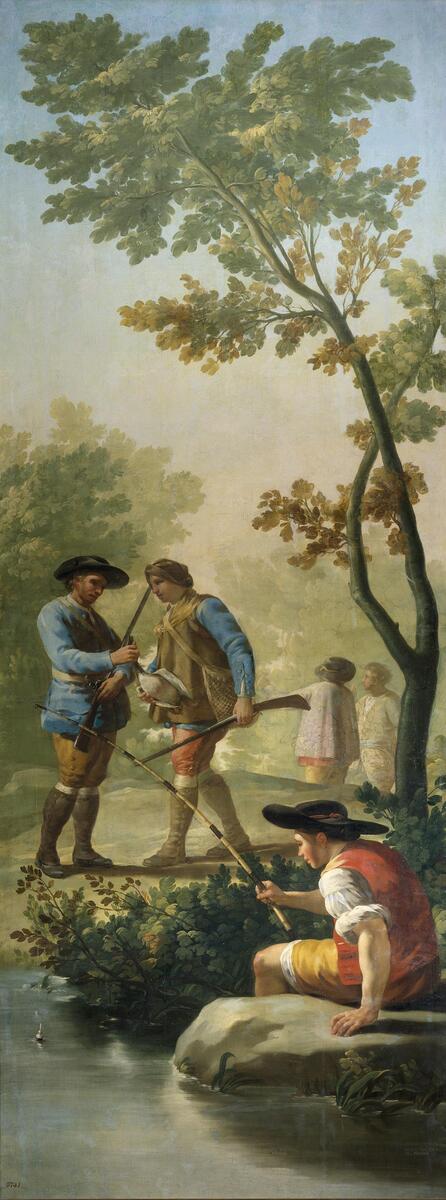
Before you is a fisherman with his rod, painted by Francisco Goya around seventeen seventy-five. The record identifies the figure and his tackle, and nothing more about the moment shown. It is a design for a tapestry, one of Goya's cartoons made to be woven rather than simply hung as a picture.
Look first at the canvas itself. It is exceptionally tall and narrow, nearly three metres high. That proportion belongs to a tapestry cartoon, where the design had to suit a woven panel. The shape governs how the fisherman fills the space, though the supplied record does not describe the background or his pose in detail.
A tapestry cartoon is a full-scale painted design from which weavers worked. Goya produced a series of them for the Spanish court. The record files this canvas among those cartones para tapices. It is oil on canvas, made to carry the composition across into wool.
The supplied record does not narrate a fuller episode. We know the fisherman and his rod, and that is the subject it gives us. So the honest reading stays close to that figure. Any story about what he is catching, or what he is thinking, would go beyond the evidence here.
What we can say is that this is a working design, shaped by its narrow format and its destination in tapestry. The fisherman with his rod is the subject, and Goya painted him for weaving. The rest of the scene, and its meaning, remain for further research to establish.
The story and its sources
Historical claims are linked to the records below. Close looking and interpretation are identified in the passage notes.
- Passage 1Documented historyInstitutional record for fisherman with his rod
- Passage 2Close lookingInstitutional record for fisherman with his rod
- Passage 3Documented historyInstitutional record for fisherman with his rod
- Passage 4Documented historyInstitutional record for fisherman with his rod
- Passage 5InterpretationInstitutional record for fisherman with his rod
Details to notice
About 2 minutes to readFishing float
A tiny white float and line mark the fisherman's cast in the stream at lower left, a quiet narrative detail that connects the angler to the water.
Distant travelers
Two small figures, including one in a pink cape, walk along the path behind the hunters, adding depth and a second social vignette.
Large oak tree
The tall oak rises through the right half of the canvas, its trunk and canopy framing the figures and giving the narrow scene vertical structure.
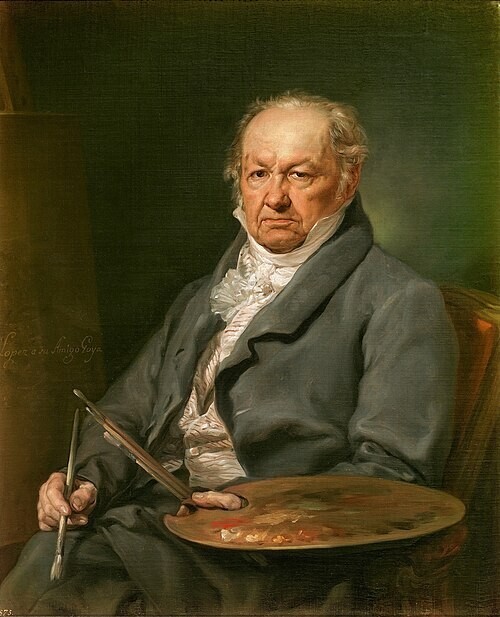
Artist portrait Image credit
Vicente López Portaña. Image source · Public domain
About the artist
Francisco de Goya
30 March 1746 to 16 April 1828
Goya was a Spanish painter and printmaker whose career extended from royal tapestry designs and court portraiture to images of war, repression and unsettling fantasy. Born in Fuendetodos, he trained in Zaragoza and Madrid and became First Painter to Charles IV in 1799. He spent his final years in Bordeaux.
- Born
- 30 March 1746
- Died
- 16 April 1828
- Nationality
- Spanish
- Birthplace
- Fuendetodos, Spain
- Died in
- Bordeaux, France
The research & record
Study the work.
Follow the evidence.
Find catalogue details, historical context, technical research and the literature behind this artwork.
The artwork record
Research catalogue
Catalogue information and detailed research, with references that link to the bibliography.
Updated .
Identity and catalogue
Link- Title
- El pescador de caña (Fisherman with his Rod)
- Artist or attribution
- Francisco Goya(commons.wikimedia.org, n.d.)
- Object date
- circa 1775
- Medium and support
- oil on canvas(commons.wikimedia.org, n.d.)
- Dimensions
- 289 × 110 cm(commons.wikimedia.org, n.d.)
- Current collection or location
- Museo del Prado, Madrid, Spain(commons.wikimedia.org, n.d.)
- Movement or period
- Spanish 18th-century tapestry cartoons
- Country or culture
- Spain
- Depicted subject
- A cartoon for a tapestry showing a fisherman with his rod, paired in the source record with hunters examining a captured bird in a tall, narrow composition.(commons.wikimedia.org, n.d.)
- Title variants
- El pescador de caña; Fisherman with his rod
- Accession number
- P005542
- Support
- canvas
Read valuation records and their limitations
The catalogue identity
The institutional record for this canvas gives a compact but specific identity: it names the work El pescador de caña, attributes it to Francisco Goya, describes the medium as oil on canvas, and assigns a date of circa 1775. These are the catalogue's own terms, and they matter for how the object should be cited. The title is a descriptive one, naming a fisherman with his rod rather than a narrative episode, and the attribution to Goya is the record's attribution rather than an independent re-examination reported in the excerpt. The dating is likewise approximate, expressed as "circa," so the object's date should be kept distinct from the later dates at which catalogues, repositories or reference works described and indexed it. Nothing in the supplied file converts the approximate object date into a secure one.(commons.wikimedia.org, n.d., Summary, title and date fields)
Beyond author, title, medium and date, the record fixes the work's position within the reference apparatus used to study Goya. It lists the painting under the Gassier and Wilson catalogue number 66 and under Fundación Goya en Aragón ID 7. These identifiers function differently from the title and date: they are the coordinates by which the painting is located in published and institutional catalogues, and they allow the exact work to be distinguished from other Goya compositions that may share a subject or a title. Recording them alongside the attribution is part of keeping the identity of this canvas stable across sources, especially where a descriptive title such as El pescador de caña could plausibly be attached to more than one image.(commons.wikimedia.org, n.d., References field)
The same record classifies the painting among Goya's cartones para tapices, the designs made for tapestry. This classification is not a decorative aside to the identity; it explains why a painting of this kind exists at all. A tapestry cartoon is a full-scale painted design from which weavers worked, so the canvas belongs to a category of object made in the service of another medium rather than solely as an independent picture. The record supports the classification without describing the weaving for which this particular design was destined, and it does not supply a series history or a commission narrative here. The carton classification therefore should be stated as the record states it, as the work's documented category, while the surrounding workshop and commission circumstances remain to be established from other sources.(commons.wikimedia.org, n.d., Description field; Summary, title and date fields)
Institutional identifiers and open questions
A further catalogue fact, carried in the same source's supporting claims, is that the canvas belongs to the Museo del Prado under accession number P005542. The accession number is a second institutional identifier, distinct from the Gassier and Wilson and Fundación Goya en Aragón numbers, and it ties the object to a specific holding rather than to a catalogue entry alone. The supplied excerpt does not, however, document the painting's provenance, its exhibition history, its condition, any conservation treatment, or its critical reception, so the route by which the work reached the Prado and the history of its display and care remain open research questions. The accession record establishes present custody and identification; it does not by itself establish the object's earlier movements.(commons.wikimedia.org, n.d., Summary, title and date fields; Whole excerpt)
The file identifies the painting as El pescador de caña by Francisco Goya, oil on canvas, dated circa 1775.(commons.wikimedia.org, n.d.)
The source lists the work under the Gassier and Wilson catalogue number 66 and the Fundación Goya en Aragón ID 7.(commons.wikimedia.org, n.d.)
Subject and iconography
LinkRead valuation records and their limitations
The recorded subject and its limits
Visual observation
The institutional record supplied for this canvas describes its subject only as a fisherman with his rod; it does not narrate a detailed episode, setting, catch or action. That restraint is itself consequential for interpretation. The visible presence of the figure and his tackle is what the record establishes, and any account of what he is doing, what he hopes to catch or what the scene means would exceed the documentation available. This section therefore distinguishes throughout between what the record states about the composition and what would be inference from it. The same record catalogues the work among Goya's cartones para tapices, designs made for tapestry, which places the figure within a functional class of object rather than a freestanding easel picture made for display alone.(commons.wikimedia.org, n.d., Description field)
The source describes the painting's subject only as a fisherman with his rod, without narrating a detailed episode.(commons.wikimedia.org, n.d.)
Historical context
LinkRead valuation records and their limitations
The documented object and its classification
The object under study is catalogued as a work by Francisco Goya, an oil on canvas dated circa 1775, held by the Museo del Prado under accession number P005542 and listed under the Gassier and Wilson catalogue number 66 and the Fundación Goya en Aragón ID 7. The canvas measures 289 by 110 centimetres, an unusually tall and narrow format. These identifications are the secure documentary frame within which any account of commission, function and meaning has to be built, and they come from the institutional record rather than from the painted surface itself.(commons.wikimedia.org, n.d., Description field)
The record files the painting among Goya's cartones para tapices, the full-scale designs made for tapestry. That classification is consequential: it establishes that the canvas was conceived as a working design to be translated into woven wool rather than simply as a picture for hanging, and it locates the work within Goya's production of tapestry cartoons for the Spanish court. The tall, narrow proportions recorded for the canvas are consistent with a design intended to suit a woven panel, so the format can be read as a condition of the object's function; the supplied record does not, however, describe the background or the figure's pose in enough detail to say how Goya organised the composition within that shape.(commons.wikimedia.org, n.d., Description field)
The work is catalogued among Goya's cartones para tapices, designs made for tapestry.(commons.wikimedia.org, n.d.)
Materials and technique
LinkRead valuation records and their limitations
Support, medium and format
The documented physical record for this painting is brief but specific. The institutional record describes the work as executed in oil on canvas, and it gives the canvas dimensions as 289 by 110 centimetres. Both facts come from catalogued fields in the record, so they belong to the documented description of the object rather than to visual inference drawn from a reproduction. The same record classifies the painting among Goya's cartones para tapices, the full-scale painted designs made for tapestry, and it dates the work to circa 1775. The medium and support, in other words, are not incidental to the type of object this is: an oil painting on canvas serving as the design from which a woven panel was to be produced. No further layer information, preparation, ground, pigment, tool or making technique is supplied by the evidence available here, and the account below stays within what these units establish.(commons.wikimedia.org, n.d., Medium field; Dimensions field)
The dimensions carry particular weight for the study of technique. A canvas of 289 by 110 centimetres is unusually tall and narrow, and that proportion is recorded as a property of the support itself. Because the painting is catalogued as a tapestry cartoon, the elongated format can be understood in relation to the woven panel the design was intended to serve, since a cartoon had to match the shape of the textile it would be translated into. This is a relationship between documented format and documented function rather than a claim about how the surface was actually painted. The record does not describe the background, the figure's pose in detail, or the compositional means by which the fisherman fills the tall field. What the evidence supports is the coincidence of an extreme vertical format with the work's classification as a design for weaving.(commons.wikimedia.org, n.d., Dimensions field; Medium field)
Limits of the technical record
Visual observation
The subject the record provides is limited: a fisherman with his rod, without a narrated episode. This observation belongs to the descriptive field of the institutional record and should not be expanded into a scene. For a study of materials and technique, the point is that no evidence unit here documents the handling of paint, the brushes or other tools employed, the pigments selected, any preparatory drawing transferred to the canvas, or the condition and treatment history of the surface. The same record explicitly leaves provenance, exhibitions, condition, conservation treatment and critical reception undocumented in the supplied excerpt. Those remain open research routes rather than settled questions, and the narrow format and oil medium are the full extent of the technical description the evidence establishes for this canvas.(commons.wikimedia.org, n.d., Description field; Medium field; Dimensions field)
The canvas measures 289 by 110 centimetres, an unusually tall and narrow format.(commons.wikimedia.org, n.d.)
The painting is executed in oil on canvas.(commons.wikimedia.org, n.d.)
Provenance and ownership
LinkRead valuation records and their limitations
The Documented Record
The provenance of the painting is, on the supplied evidence, an open question rather than a settled sequence. The record excerpt consulted states that it does not document provenance for this work, and the same passage extends that gap to exhibitions, condition, conservation treatment and critical reception. No owner, sale, gift, transfer, dealer, auction or date of entry into the Prado collection is supplied. The accession number P005542 confirms that the painting is registered in the Museo del Prado's numbering system, but the record as excerpted does not state when or by what route the work reached that collection. The interval between the painting's creation around 1775 and its present registration at the Prado therefore remains unrecorded here.(commons.wikimedia.org, n.d., Whole excerpt)
Interpretation
An unrecorded interval must be distinguished from a proven change of ownership. The absence of provenance documentation in the excerpt is a limit of the source consulted, not evidence that the painting passed through no hands, and equally not evidence of any particular transfer. Nothing in the supplied units names a prior owner or a transaction, so no ownership sequence can be reconstructed from them, and the gap should be carried forward as a research route rather than filled by inference from the painting's status as a court-related tapestry design.(commons.wikimedia.org, n.d., Whole excerpt; Description field)
The supplied excerpt does not document provenance, exhibitions, condition, conservation treatment, or critical reception for this work, leaving those research routes open.(commons.wikimedia.org, n.d.)
Collection and display
LinkRead valuation records and their limitations
The Prado record
The painting El pescador de caña is held by the Museo del Prado under accession number P005542, and it is attributed to Francisco Goya with a date of about 1775. The institutional record identifies it as oil on canvas, measuring 289 by 110 centimetres, an unusually tall and narrow format. It also files the work among Goya's cartones para tapices, the full-scale painted designs made for tapestry, and gives two catalogue references: the Gassier and Wilson number 66 and the Fundación Goya en Aragón ID 7. These identifiers make the object locatable across an institutional collection and two separate scholarly cataloguing systems, which is the foundation for any further study of provenance, display history or condition that the record itself does not supply.(commons.wikimedia.org, n.d., Collection and Accession number fields)
Interpretation
Within the collecting and display history of the Prado, the accession number is more than an administrative label. It fixes the canvas as a specific, individual object in a public collection, distinct from other Goya tapestry designs and from painted copies or woven versions derived from them. The record's description of the subject is deliberately minimal: a fisherman with his rod, without a narrated episode. That restraint matters for how the work is presented, because the documented frame of reference is the figure and his tackle, while the background, pose in detail and any narrative content are not described in the supplied record.(commons.wikimedia.org, n.d., Collection and Accession number fields)
From loom to collection
The classification as a cartón para tapiz, together with the 289 by 110 centimetre dimensions, connects the museum object to a working process rather than to an independent easel picture. The canvas is oil on canvas, made so that its composition could be carried across into wool by weavers. Its exceptional height and narrowness suit a woven panel, and that destination shapes how the fisherman occupies the space. The same object therefore belongs simultaneously to the history of Spanish court tapestry production and to the later history of museum collecting, where a design made for weaving is preserved and catalogued as a painting.(commons.wikimedia.org, n.d., Collection and Accession number fields)
The supplied record documents the attribution, the approximate date, the medium, the dimensions, the Prado accession number, the tapestry-cartoon classification and the two catalogue references, and it does not document provenance, exhibitions, condition, conservation treatment or critical reception for this work. Those topics remain open research routes rather than established facts, and the collection history of the canvas should be built from them as evidence becomes available. Nothing in the record should be read as establishing where the painting hung before entering the Prado, how it has been displayed there, or what treatments it has undergone.(commons.wikimedia.org, n.d., Collection and Accession number fields)
The painting belongs to the Museo del Prado, accession number P005542.(commons.wikimedia.org, n.d.)
Documented values and qualified estimates
LinkRead valuation records and their limitations
Recorded values
Interpretation
The recorded value attached to this object is not a market fact but a calculated working range. An estimated value of US$20 million to US$60 million was generated on 2026-11-16 as a broad working calculation for manual review. The stated methodology is explicit that the range is not derived from a recorded sale, an appraisal, or an insurance schedule. Its basis is the object's confirmed identity as an original oil on canvas by Goya of circa 1775 from the Spanish eighteenth-century cartones para tapices series, in a large and tall format of 289 by 110 cm, held at the Museo del Prado under P005542 and catalogued to Gassier and Wilson cat. 66 and the Fundación Goya en Aragón. Because the painting is a celebrated, publicly held masterpiece from an early Goya series, the range was set wide and high to reflect the extreme scarcity of comparable Goya tapestry cartoons on the open market, then bounded conservatively at the lower end because no market transaction or private valuation data was available.(Wikimedia Commons: fisherman with his rod, n.d.)(commons.wikimedia.org, n.d.)
The qualifications on that figure are as consequential as the figure itself. The range is model-generated and intended only as an order-of-magnitude starting point for a human reviewer, who would adjust it using certified appraisal, provenance, condition and export considerations. It is expressly not an official insurance value, appraisal, auction estimate or sale price, and it should not be used to bind coverage, settle a claim or price a transaction. No comparable sales, private insurance records or valuation databases were accessed. Any final insurance figure would need to be set by a qualified appraiser working from the object's condition, provenance and applicable institutional or legal context. The record further notes that the painting's public museum status may affect whether it is individually insurable at all, a point that bears directly on how such a number can legitimately be used.(Wikimedia Commons: fisherman with his rod, n.d.)(commons.wikimedia.org, n.d.)
Read together, the two kinds of record describe the same object at different levels of remove. The institutional record supplies what is documented: artist, medium, approximate date, dimensions, Prado accession, tapestry-cartoon classification and catalogue numbers. The valuation is an interpretively framed estimate that takes those documented attributes as its inputs and deliberately stops short of asserting a transaction. Within a larger history of art and material culture, the identification as a carton para tapiz is what connects the painted canvas to the court tapestry enterprise for which it was designed, and the extreme rarity of comparable works on the open market is a consequence of that history rather than a separate fact about the picture. The valuation should therefore be treated as an order-of-magnitude aid to review, calibrated to a masterpiece whose documented identity is secure but whose price is not established by any supplied evidence.(Wikimedia Commons: fisherman with his rod, n.d.)(commons.wikimedia.org, n.d.)
Working estimate
Calculated working insurance estimate, not a sale price: Estimated value: US$20M to US$60M Recorded date: Working calculation, generated 2026-11-16. Methodology: Broad working range calculated for manual review, not derived from a recorded sale, appraisal, or insurance schedule. Basis: a confirmed original oil on canvas by Francisco Goya (1746-1828), circa 1775, from his Spanish 18th-century cartones para tapices series, a large and tall format (289 x 110 cm), held in the Museo del Prado (accession P005542) with catalog references to Gassier and Wilson (cat. 66) and the Fundacion Goya en Aragon. Because it is a celebrated, publicly held masterpiece from an early Goya series, the range is set wide and high to reflect the extreme scarcity of comparable Goya tapestry cartoons on the open market, then conservatively bounded at the lower end because no market transaction or private valuation data is available. It is intended only as an order-of-magnitude starting point for a human reviewer to adjust using certified appraisal, provenance, condition, and export considerations. Qualification: This is a model-generated working range for manual review only. It is not an official insurance value, appraisal, auction estimate, or sale price, and it should not be used to bind coverage, settle a claim, or price a transaction. No comparable sales, private insurance records, or valuation databases were accessed. A qualified appraiser should set any final insurance figure using the object's condition, provenance, and applicable institutional or legal context. The artwork's public museum status may affect whether it is insurable individually at all.(Wikimedia Commons: fisherman with his rod, n.d.)(commons.wikimedia.org, n.d.)
Further reading
Books for a closer look
Paid links. As an Amazon Associate I earn from qualifying purchases.

Open Library Goya
Kodansha International
Catalogued with subjects including catalogues raisonnés, Museo del Prado, and Spanish painting. Given that this tapestry cartoon is a Prado oil by Goya and carries a Gassier and Wilson catalogue number, a Prado-linked catalogue raisonné record is the most directly relevant kind of object-level reference among the candidates. It may support identification, dating, and series context, though the record alone does not confirm what it contains on this specific cartoon.
ISBN 0870110837
Bibliography
Sources and further reading
References are arranged by author or organisation, with links to the original publications. Where no publication date is recorded, n.d. means no date.
Source notes updated .
No recorded sources match these filters. Reset the filters to see the full bibliography.
- 02
Official · About this artwork
Institutional record for fisherman with his rod. Wikimedia Commons file page: El pescador de caña.jpg.
Discovery record supplying title, artist, date, medium, dimensions, Prado accession number, tapestry-cartoon classification, and catalogue references for this exact painting.
- Language
- English and Spanish
Citation text
- 03
Book
Goya. Kodansha International.
Catalogued with subjects including catalogues raisonnés, Museo del Prado, and Spanish painting. Given that this tapestry cartoon is a Prado oil by Goya and carries a Gassier and Wilson catalogue number, a Prado-linked catalogue raisonné record is the most directly relevant kind of object-level reference among the candidates. It may support identification, dating, and series context, though the record alone does not confirm what it contains on this specific cartoon.
- ISBN
- 0870110837
Citation text
- 04
Book
Francisco Goya - the Paintings. Independently Published.
Titled as a study of Goya's paintings, which is the medium of El pescador de caña (oil on canvas, a tapestry cartoon). It is a plausible place for discussion of the cartones para tapices and their paired, tall narrow formats, but the catalogue record gives no contents, so relevance rests on the painting-focused scope rather than verified coverage of this work.
- ISBN
- 9781521566466
Citation text
- 01
Secondary
Wikimedia Commons: fisherman with his rod (n.d.). Wikimedia Commons.
Citation text
Art to live with
Bring this painting
home.
A piece of the archive, made yours. Explore El pescador de caña (Fisherman with his Rod) in a size and finish that fits your space.
Your text and annotations appear on these editions. Adding to cart saves that design for printing.
Combine this painting with your favourites01 / Find your edition
Made for you
Suggested from your location. Change it if you're sending elsewhere or using a VPN. Prices and delivery are shown in GBP.
1 product
Choose an edition to make it yours
12.7 × 17.8 cm / 5 × 7 in · Standard
12.7 × 17.8 cm / 5 × 7 in · Standard

5 × 7 in / 12.7 × 17.8 cm · Standard

5 × 7 in / 12.7 × 17.8 cm · Standard

5 × 7 in / 12.7 × 17.8 cm · Standard

5 × 7 in / 12.7 × 17.8 cm · Standard

5 × 7 in / 12.7 × 17.8 cm · Standard
Metal art sign
GBP 19.84
Delivery GBP 17.90 / Total GBP 37.74
A printed aluminium sign with rounded corners and mounting holes.
Fit and fill keep the painting’s proportions. Stretch changes them.
Move and zoom the painting on your metal art sign.
Made to order with your design
Printed aluminium · mounting holes included
US delivery only
The 30 cm ruler is scaled alongside your selected print. Keep the painting’s proportions with a black background, or stretch it to fill. Frame width, material texture and screen colours are illustrative.
Keep exploring