Dance of the Majos at the Banks of Manzanares
Artist: Francisco Goya · 1776

Dance of the Majos at the Banks of Manzanares: high-resolution image
The original file is hosted by Wikimedia Commons, available without payment or an account.
Open high-resolution image on Wikimedia CommonsThe complete story
The story About 3 minutes to read
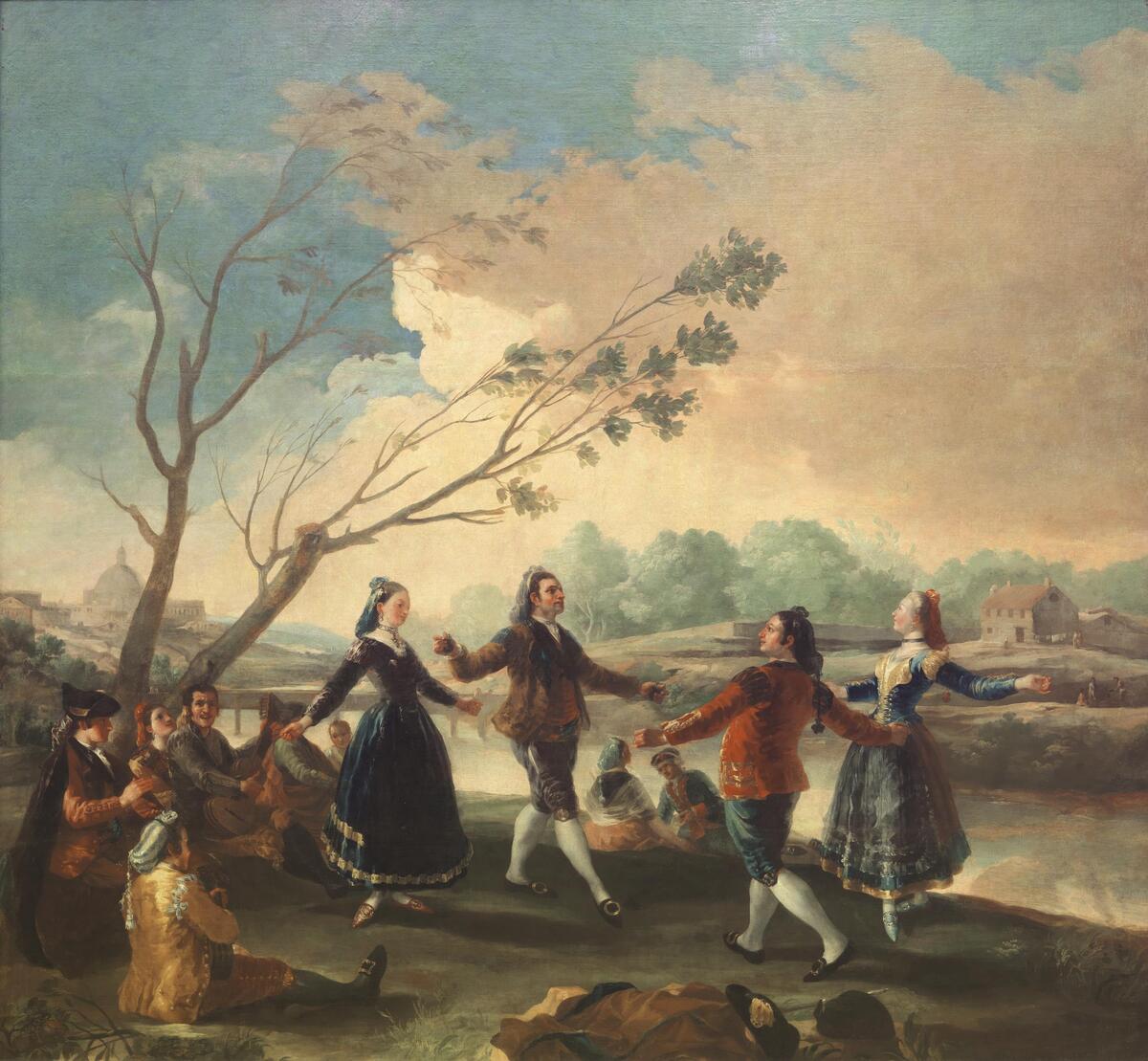
This is Francisco Goya's Dance of the Majos at the Banks of Manzanares, painted in 1776. It shows majos, stylishly dressed figures of Madrid's popular classes, dancing in a linked chain outdoors beside the Manzanares river. The scene captures a moment of festival sociability, not a grand historical event. Four dancers form the chain, while a guitarist and seated onlookers give them music and an audience.
Start with the chain itself. At the left, a woman in a dark blue dress with light trim turns her head toward her partner and extends one arm to keep the dance linked. On the right, an orange-jacketed majo and a woman in a blue and gold dress hold hands and lean in opposing poses, anchoring that end of the chain. Between them, two more dancers continue the linked line.
The setting is an outdoor river landscape. A tree trunk rises behind the dancers, and distant domed buildings mark the skyline. In the lower left, a guitarist and seated onlookers supply the music and the audience. The river landscape and distant skyline provide a quiet counterpoint to the animated foreground.
The four dancers form a continuous chain. Their varied costumes and buoyant poses convey the rhythm and sociability of an outdoor festival. Goya gives each figure a distinct stance and dress, but the linked hands and the shared movement turn them into one group. The dance is the subject, and the painting makes its rhythm visible through the connected poses.
So this is not just a record of steps. It is a picture of how costume, music and company create a shared occasion. Goya sets the lively chain against a calm river landscape, letting the dance hold the foreground while the world beyond stays quiet. The painting asks us to see the festival as a social bond, not merely a spectacle.
The story and its sources
Historical claims are linked to the records below. Close looking and interpretation are identified in the passage notes.
- Passage 1Documented historyWikimedia Commons: Dance of the Majos at the Banks of Manzanares
- Passage 2Close lookingWikimedia Commons: Dance of the Majos at the Banks of Manzanares
- Passage 3Close lookingWikimedia Commons: Dance of the Majos at the Banks of Manzanares
- Passage 4InterpretationWikimedia Commons: Dance of the Majos at the Banks of Manzanares
- Passage 5InterpretationWikimedia Commons: Dance of the Majos at the Banks of Manzanares
Details to notice
About 2 minutes to readRiverbank and distant domed skyline
The river landscape, tree trunk, and distant domed buildings identify the outdoor setting beside the Manzanares and provide a quiet counterpoint to the foreground dancers.
Musicians and seated onlookers
A guitarist and surrounding seated figures occupy the lower left, providing the music and audience that animate the dance and framing the central celebration.
Right-hand dancing pair
The orange-jacketed majo and the woman in the blue and gold dress anchor the right side of the chain, their joined hands and opposing poses emphasizing the dance's momentum.
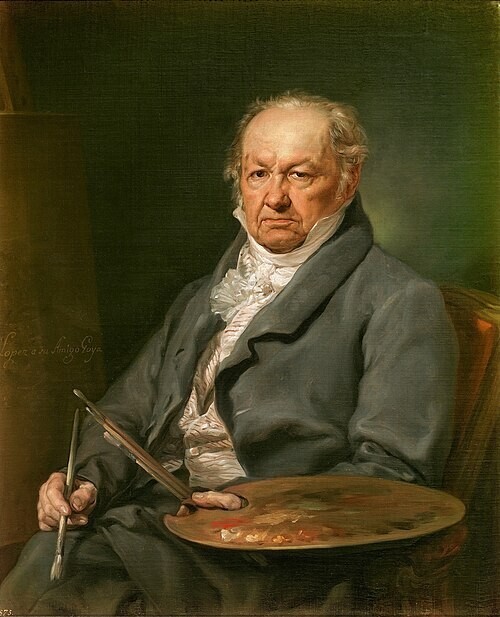
Artist portrait Image credit
Vicente López Portaña. Image source · Public domain
About the artist
Francisco de Goya
30 March 1746 to 16 April 1828
Goya was a Spanish painter and printmaker whose career extended from royal tapestry designs and court portraiture to images of war, repression and unsettling fantasy. Born in Fuendetodos, he trained in Zaragoza and Madrid and became First Painter to Charles IV in 1799. He spent his final years in Bordeaux.
- Born
- 30 March 1746
- Died
- 16 April 1828
- Nationality
- Spanish
- Birthplace
- Fuendetodos, Spain
- Died in
- Bordeaux, France
The research & record
Study the work.
Follow the evidence.
Find catalogue details, historical context, technical research and the literature behind this artwork.
The artwork record
Research catalogue
Catalogue information and detailed research, with references that link to the bibliography.
Updated .
Identity and catalogue
Link- Title
- Dance of the Majos at the Banks of Manzanares(Wikimedia Commons: Dance of the Majos at the Banks of Manzanares, n.d.)
- Artist or attribution
- Francisco Goya
- Medium and support
- Painting
- Current collection or location
- Museo del Prado(Wikimedia Commons: Dance of the Majos at the Banks of Manzanares, n.d.)
- Country or culture
- Spain
- Depicted subject
- A group of majos, stylishly dressed figures of Madrid's popular classes, dance in a linked chain outdoors beside the Manzanares river.
- Title variants
- El baile a orillas del Manzanares; Dance of the Majos at the Banks of Manzanares
- Accession number
- P000769
- Dimensions
- 272 × 295 cm
- Period
- Unknown
Read valuation records and their limitations
Title, attribution and date
The work is catalogued under the title Dance of the Majos at the Banks of Manzanares and attributed to Francisco Goya. The same record assigns it a date of 1776. These are the only identity particulars carried by the supplied evidence: the title, the attribution and the year stand together as the file record's account of the object, and no further catalogue apparatus, alternative title, medium statement, dimension, inscription or accession reference is established here. Any account of the painting's subject or handling therefore begins from a minimal documentary base rather than from a full curatorial entry.(Wikimedia Commons: Dance of the Majos at the Banks of Manzanares, n.d., file record)
Interpretation
The title and date should be read as distinct kinds of information even though the file presents them together. The attribution names an author; the date of 1776 is the point in time the record assigns to the painting itself, and it is the only date the evidence supplies. Nothing in the units distinguishes the making of the work from the compilation of the record, and no later catalogue date, revised dating or reattribution is documented. The safe reading is thus a single, undifferentiated entry: a Goya of 1776 under a Spanish title naming a dance beside the Manzanares.(Wikimedia Commons: Dance of the Majos at the Banks of Manzanares, n.d., file record)
The painting is titled Dance of the Majos at the Banks of Manzanares and is by Francisco Goya.(Wikimedia Commons: Dance of the Majos at the Banks of Manzanares, n.d.)
The painting is dated 1776.(Wikimedia Commons: Dance of the Majos at the Banks of Manzanares, n.d.)
Subject and iconography
LinkRead valuation records and their limitations
The linked chain as compositional center
Visual observation
The central action of the painting is a dance performed by majos in a linked chain of four figures, and that chain, rather than any single protagonist, organizes the composition. The four dancers form a continuous chain, so that the picture reads as a single connected movement rather than as a row of separate portraits. The description of the work records that their varied costumes and buoyant poses convey the rhythm and sociability of an outdoor festival. What the picture establishes visually, then, is a group whose shared activity is the subject: the linked hands and alternating stances make the dance itself legible as the organizing motif, and the distinct dress and posture given to each participant mark them as individuals within that collective action.(Wikimedia Commons: Dance of the Majos at the Banks of Manzanares, n.d., supplied visual focus description)
The chain is anchored at either end by differently characterized pairs. At the left, a woman wears a dark blue dress with light trim, her head turned toward her partner, one arm extended to keep the dance linked. At the right, an orange-jacketed majo and a woman in a blue and gold dress hold hands and lean in opposing poses, anchoring that end of the chain. Between these two described ends the record notes that two more dancers continue the linked line. The left figure's turned head and extended arm are described as the means by which the link is maintained, while the right-hand pair is characterized by the contrast of their lean. These descriptions are observations of pose and dress rather than identifications of named sitters, and the record does not assign identities to any of the four.(Wikimedia Commons: Dance of the Majos at the Banks of Manzanares, n.d., supplied visual focus description)
Music, audience and setting
The dance is supplied with both music and an audience within the picture. A guitarist and seated onlookers occupy the lower left of the painting, and the record describes them as supplying the music and audience for the dance. This placement matters for how the foreground is read: the musicians and spectators sit below and beside the standing chain, so that the lower left corner holds the occasion's sound and its witnesses while the linked figures carry the movement across the rest of the foreground. The record does not describe the number of onlookers, their dress, or the guitarist's instrument beyond the single word guitarist, and those details should not be supplied from outside the evidence.(Wikimedia Commons: Dance of the Majos at the Banks of Manzanares, n.d., supplied visual focus description)
The setting is an outdoor river landscape. A river landscape with a tree trunk and distant domed buildings identifies the outdoor setting beside the Manzanares, according to the same visual description. The record further observes that the river landscape and distant skyline provide a quiet counterpoint to the foreground dancers. Two things should be kept distinct here. The presence of a river landscape with a tree trunk and distant domed buildings is a matter of what is visible in the painting as described. The identification of that setting as beside the Manzanares is an identification attached to the work rather than something the visible features alone establish; the domed buildings on the skyline are not individually named in the record, and no specific architecture should be asserted for them beyond the description given.(Wikimedia Commons: Dance of the Majos at the Banks of Manzanares, n.d., supplied visual focus description)
Interpretation
Read together, the described elements produce a contrast between an animated foreground and a quieter distance. The linked chain, the leaning pairs, the guitarist and the seated onlookers occupy the near space, while the river, tree trunk and distant skyline recede behind them. The record states that the varied costumes and buoyant poses convey the rhythm and sociability of an outdoor festival, and that the landscape and skyline act as a quiet counterpoint to the dancers. This is the sense in which the picture can be described as a picture of a shared occasion rather than a record of steps: the evidence supports the observation of a connected group whose movement is made visible through connected poses, and of an outdoor festival setting, without establishing any specific choreography, tune, or named festival.(Wikimedia Commons: Dance of the Majos at the Banks of Manzanares, n.d., supplied visual focus description)
Visual observation
The object itself is identified in the source record as Dance of the Majos at the Banks of Manzanares by Francisco Goya, dated 1776 and held in the collection of the Museo del Prado under accession number P000769. The same record supplies the painting's medium but records no dimensions, support details or inscriptions, and it is described as a Wikimedia Commons file record used for discovery rather than as a curatorial or scholarly source. Those limits should govern how the visual descriptions above are weighted: they are observations drawn from a single partially consulted file record, not from technical examination or catalogue raisonné documentation, and questions of size, condition, surface, preparatory studies or later changes in appearance cannot be answered from the supplied evidence.(Wikimedia Commons: Dance of the Majos at the Banks of Manzanares, n.d., supplied visual focus description)
The scene shows majos dancing in a linked chain of four figures, the painting's central action.(Wikimedia Commons: Dance of the Majos at the Banks of Manzanares, n.d.)
At the left of the chain a woman wears a dark blue dress with light trim, her head turned toward her partner and one arm extended to keep the dance linked.(Wikimedia Commons: Dance of the Majos at the Banks of Manzanares, n.d.)
On the right, an orange-jacketed majo and a woman in a blue and gold dress hold hands and lean in opposing poses, anchoring that end of the chain.(Wikimedia Commons: Dance of the Majos at the Banks of Manzanares, n.d.)
A guitarist and seated onlookers occupy the lower left of the painting, supplying the music and audience for the dance.(Wikimedia Commons: Dance of the Majos at the Banks of Manzanares, n.d.)
A river landscape with a tree trunk and distant domed buildings identifies the outdoor setting beside the Manzanares.(Wikimedia Commons: Dance of the Majos at the Banks of Manzanares, n.d.)
Interpretations and debates
LinkRead valuation records and their limitations
The Evidence Base for Reading the Picture
Interpretation
The account of Dance of the Majos at the Banks of Manzanares rests on the visual description recorded with the Wikimedia Commons file, which identifies the 1776 painting by Francisco Goya in the collection of the Museo del Prado under accession number P000769. That description is the basis for every reading here; it records the subject and arrangement but no dimensions, support, inscriptions or technical examination, so interpretation can address what the picture shows and how its parts relate, but not how it was made, what pigments were used, or how it may have been treated. The Commons record is a discovery source rather than a curatorial or scholarly publication, and the readings below are attached to it rather than to a documented argument by a named author. Any larger claim about the picture's place in Goya's career or in the history of Spanish popular-costume imagery would need evidence this record does not supply.(Wikimedia Commons: Dance of the Majos at the Banks of Manzanares, n.d., supplied visual focus description)
Reading the Linked Chain
The most developed reading treats the dancing group as the painting's organizing idea. The description states that the four dancers form a continuous chain, and that their varied costumes and buoyant poses convey the rhythm and sociability of an outdoor festival. The chain is not just a line of bodies: the observation that each end of it is held by a differently characterized pair, a woman in dark blue with light trim at the left and an orange-jacketed majo opposite a woman in a blue and gold dress at the right, supports the idea that variety within the linked group is what produces the impression of shared movement. Costume distinction and physical connection work in opposite directions, individuating the dancers while the joined hands and extended arms pull them into a single action. The reading that the dance is the subject, made legible through connected poses, follows from this combination rather than from any statement about what Goya intended.(Wikimedia Commons: Dance of the Majos at the Banks of Manzanares, n.d., supplied visual focus description)
The Landscape as Counterpoint
The description also proposes a contrast between foreground and background, stating that the river landscape and distant skyline provide a quiet counterpoint to the foreground dancers. The features that make this reading possible are specific: a tree trunk and distant domed buildings identify an outdoor setting beside the Manzanares. The claim of counterpoint is an interpretive one, since stillness in a landscape is a quality inferred from the described elements rather than a property the record measures. What the evidence does establish is the arrangement: the landscape sits behind and beside the dance rather than competing with it, so that the setting frames the sociability of the foreground instead of narrating an event of its own. The domed buildings remain unidentified in the record, and no claim about which structures they represent should be built on this description.(Wikimedia Commons: Dance of the Majos at the Banks of Manzanares, n.d., supplied visual focus description)
Music, Audience and the Shape of the Occasion
A third element complicates any reading of the scene as a spontaneous gathering: a guitarist and seated onlookers occupy the lower left, supplying the music and audience for the dance. Their position matters for interpretation, because it makes the dance a performance with participants arranged around it, and it ties the linked chain to a source of rhythm outside the dancers themselves. The description's emphasis on sociability is therefore grounded in more than the dancers' poses: music, audience and dancers together constitute the occasion. This supports treating the picture as a depiction of a shared social practice, the outdoor festival, rather than as a portrait of individual figures or a record of choreographic steps. The record does not name the musician or the onlookers, and nothing in it identifies the dance performed beyond the label of majos dancing.(Wikimedia Commons: Dance of the Majos at the Banks of Manzanares, n.d., supplied visual focus description)
Limits of the Synthesis
Taken together, these readings describe a picture whose interest lies in how costume, music and company produce a shared occasion. That synthesis is the writer's, built from the described chain, the varied dress, the musician and onlookers, and the calm landscape behind them, and it should be held as a qualified interpretation rather than as a statement of the painter's private purpose. The evidence supports saying that the composition links distinct figures into one group and sets that group against a quieter setting; it does not support claims about Goya's intentions, about the painting's reception, or about its place in a sequence of his works. Within a larger history of material culture, the picture's documented value for this archive is as a described image of Madrid's popular classes at leisure, with majos identified as stylishly dressed figures of the popular classes in the accompanying narrative rather than in the Commons record itself, and with the limits of that record kept in view.(Wikimedia Commons: Dance of the Majos at the Banks of Manzanares, n.d., supplied visual focus description)
The four dancers form a continuous chain, and their varied costumes and buoyant poses convey the rhythm and sociability of an outdoor festival.(Wikimedia Commons: Dance of the Majos at the Banks of Manzanares, n.d.)
The river landscape and distant skyline provide a quiet counterpoint to the foreground dancers.(Wikimedia Commons: Dance of the Majos at the Banks of Manzanares, n.d.)
Collection and display
LinkRead valuation records and their limitations
Collection and display
The painting known as Dance of the Majos at the Banks of Manzanares is attributed to Francisco Goya and dated 1776, and it belongs to the collection of the Museo del Prado, where it is accessioned as P000769. This accession number is the anchor for any further collection research: it identifies the specific canvas within the Prado's holdings and allows the work to be distinguished from other Goya compositions depicting majos, riverside festivities or similar popular subjects. The file record consulted supplies the title, artist, date, medium as a painting, and the Prado collection and accession number, but it records no dimensions, no description of the support, no inscriptions and no provenance history. Those omissions matter for how the record should be used: the accession number establishes institutional custody and identity, but it does not by itself document when or how the work entered the Prado, whether it was part of a royal commission or later acquisition, or how its physical support and condition have been described by conservators.(Wikimedia Commons: Dance of the Majos at the Banks of Manzanares, n.d., file record)
Interpretation
Because the available record is a Wikimedia Commons file page annotated for discovery rather than a curatorial or scholarly source, the collection information it supplies should be treated as a starting point rather than a final authority on the object's institutional history. The Commons annotation explicitly limits its own reliability and records no dimensions, support or inscriptions, so questions about the painting's format, its material construction and any text or signature it may carry remain outside what these evidence units establish. The Prado accession number and the 1776 date are nonetheless the concrete facts the record does support, and they are sufficient to situate the work within a specific year of Goya's early career and within a named public collection. Any account of the painting's display history, its earlier owners or its conservation would require documentation beyond this file record, and the present account does not supply such details.(Wikimedia Commons: Dance of the Majos at the Banks of Manzanares, n.d., file record)
The work is a painting in the collection of the Museo del Prado, accessioned as P000769.(Wikimedia Commons: Dance of the Majos at the Banks of Manzanares, n.d.)
Documented values and qualified estimates
LinkRead valuation records and their limitations
The limits of the record
Interpretation
The only supplied source for Dance of the Majos at the Banks of Manzanares is a Wikimedia Commons file record consulted for discovery, and the limits of that record shape every value statement that can honestly be made here. It supplies the title, the attribution to Francisco Goya, the 1776 date, the painting's place in the collection of the Museo del Prado, and the accession number P000769. It does not record dimensions, support, inscriptions, condition, or provenance, and the annotation of the record warns that it is not a curatorial or scholarly source. Any figure attached to this painting therefore rests on a narrow factual base: a confirmed identification in a major museum collection, and nothing quantitative.(Wikimedia Commons: Dance of the Majos at the Banks of Manzanares, n.d.)
The working valuation
The working valuation supplied for this object is a model-generated calculation dated 2026-11-16, estimated at US$25M to US$100M. Its own methodology explains the internal logic and the reason for the range's width. It is anchored on the identification as a 1776 painting by Goya, an artist of major international significance, and on the long-standing presence of the work in the Museo del Prado collection under accession P000769. Because the identification confidence is stated as medium and because no dimensions, support, condition, inscription, provenance, exhibition history, or transaction records were supplied, the calculation deliberately applies a wide and conservative spread. It is designed to flag the object for manual review rather than to bind coverage, and the record states plainly that this is not an official insurance value, appraisal, auction result, or sale price. It does not rely on comparable sales or private insurance records, and it recommends refinement by qualified appraisers once technical and provenance details are confirmed, with consultation of a qualified fine-art appraiser and specialist insurer before any coverage decision.(Wikimedia Commons: Dance of the Majos at the Banks of Manzanares, n.d.)
What the figure registers
What the figure actually registers is institutional standing rather than market behaviour. The same source observes that major museum-held Goya paintings are generally not sold on the open market, and that no comparable sales or official valuations are available in the supplied context. The range is thus best read as a proxy for significance: the artist's international reputation and the painting's long residence in the Prado do the anchoring work, while the specific numbers remain a review trigger. Within a larger history of art and material culture, this gap between a museum object's cultural weight and the absence of any market record is itself instructive; it shows how canonical paintings accumulate value through collection and scholarship rather than through transactions, and why a working estimate for such a work must remain provisional in the absence of technical and provenance research.(Wikimedia Commons: Dance of the Majos at the Banks of Manzanares, n.d.)
Working estimate
Calculated working insurance estimate, not a sale price: Estimated value: US$25M to US$100M Recorded date: Working calculation, generated 2026-11-16. Methodology: This broad range is a model-generated working estimate for manual review only. It is anchored on the confirmed identification as a 1776 painting by Francisco Goya, an artist of major international significance, and on its long-standing presence in the Museo del Prado collection under accession P000769. No dimensions, support, condition, inscription, provenance, exhibition history, or transaction records were supplied, and the identification confidence is stated as medium. Because major museum-held Goya paintings are generally not sold on the open market and because no comparable sales or official valuations are available in the supplied context, the calculation applies a wide, deliberately conservative spread suitable for flagging review rather than for binding coverage. The range should be refined substantially by qualified appraisers once technical and provenance details are confirmed. Qualification: This is a model-generated working range for manual review and is not an official insurance value, appraisal, auction result, or sale price. It does not rely on comparable sales or private insurance records. Identification confidence is medium and key details such as dimensions, support, condition, and provenance were not supplied. Consult a qualified fine-art appraiser and specialist insurer before any coverage decision.(Wikimedia Commons: Dance of the Majos at the Banks of Manzanares, n.d.)
Further reading
Books for a closer look
Paid links. As an Amazon Associate I earn from qualifying purchases.

Open Library Goya
Kodansha International
Catalogue record for a Goya volume whose subjects include catalogues raisonnés, Museo del Prado, exhibitions and Spanish painting, aligning with a Prado-owned Goya painting of 1776.
ISBN 0870110837

Open Library Francisco Goya
Counterpoint
A biographical and critical study of Goya, relevant through the artist, though it is not specific to this painting.
ISBN 1582433070
Bibliography
Sources and further reading
References are arranged by author or organisation, with links to the original publications. Where no publication date is recorded, n.d. means no date.
Source notes updated .
No recorded sources match these filters. Reset the filters to see the full bibliography.
- 04
Book
Francisco Goya. Counterpoint.
A biographical and critical study of Goya, relevant through the artist, though it is not specific to this painting.
- ISBN
- 1582433070
Citation text
- 02
Book
Goya. Kodansha International.
Catalogue record for a Goya volume whose subjects include catalogues raisonnés, Museo del Prado, exhibitions and Spanish painting, aligning with a Prado-owned Goya painting of 1776.
- ISBN
- 0870110837
Citation text
- 03
Book
Francisco Goya - the Paintings. Independently Published.
Titled Francisco Goya - the Paintings, a record focused on Goya's painted work, the medium of this majos dance scene.
- ISBN
- 9781521566466
Citation text
- 05
Museum · About this artwork
Dance of the Majos at the Banks of Manzanares | Fundación Goya en Aragón.
Citation text
- 01
Secondary · About this artwork
Wikimedia Commons: Dance of the Majos at the Banks of Manzanares (n.d.). Wikimedia Commons.
Wikimedia Commons file record used for discovery only: supplies title, artist, 1776 date, medium, Prado collection and accession number P000769. No dimensions, support or inscriptions recorded. Not a curatorial or scholarly source.
Citation text
Art to live with
Bring this painting
home.
A piece of the archive, made yours. Explore Dance of the Majos at the Banks of Manzanares in a size and finish that fits your space.
Your text and annotations appear on these editions. Adding to cart saves that design for printing.
Combine this painting with your favourites01 / Find your edition
Made for you
Suggested from your location. Change it if you're sending elsewhere or using a VPN. Prices and delivery are shown in GBP.
1 product
Choose an edition to make it yours
iPhone 12 Mini ? Glossy ? back view
iPhone 12 Mini · Glossy

iPhone 12 Mini ? Glossy ? back view

iPhone 12 Mini ? Glossy ? back view

iPhone 12 Mini ? Glossy ? back view
Tough phone case
GBP 16.56
Delivery GBP 4.28 / Total GBP 20.84
A two-layer phone case with a printed polycarbonate shell and a shock-absorbing inner liner.
Two layers with a shock-absorbing TPU liner
Case & print details
- Device
- Apple · iPhone 12 Mini
- Material
- Polycarbonate shell with a TPU inner liner
- Artwork
- Outer back and wrapped edges from one template
- Finish
- Glossy
- Version
- Standard version
- Printing
- Dye sublimation
- Print file
- 1,122 × 1,831 px · 95 × 155 mm · PNG · 300 dpi recommended
Rear outline and camera openings follow this variant's Printify template. Case depth and small hardware remain illustrative.
Supplier product detailsFit and fill keep the painting’s proportions. Stretch changes them.
Move and zoom the painting on your tough phone case.
Made to order with your design
Made to order
US delivery only
The 30 cm ruler is scaled alongside your selected print. Keep the painting’s proportions with a black background, or stretch it to fill. Frame width, material texture and screen colours are illustrative.
Keep exploring