Identity and catalogue
Link- Artist or attribution
- Caravaggio
- Movement or period
- Baroque
- Country or culture
- Italy
- Title variants
- Crucifixion of Saint Peter
- Support
- canvas
Catalogue identity and date
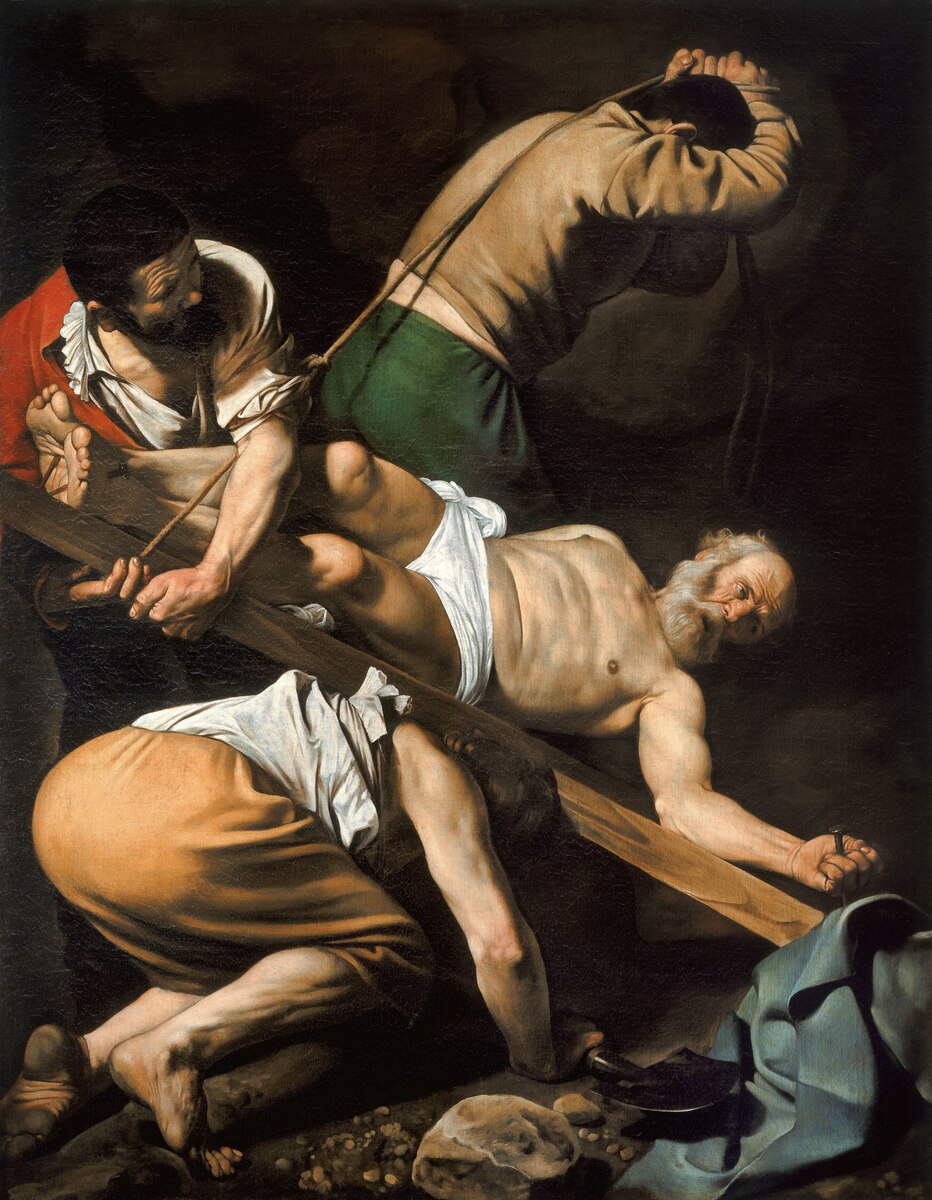
The object is catalogued as 'Crucifixion of Saint Peter', attributed to Caravaggio, and dated 1600. The medium is oil on canvas, and the recorded dimensions are 230 cm in height (90.5 in) and 175 cm in width (68.8 in). The painting's subject, as the record describes it, is the martyrdom and death of Saint Peter. The date 1600 belongs to the object record for the painting itself and should be kept distinct from later catalogue or database dates, which are the dates at which the work was described, photographed or entered into a collection listing rather than dates of execution. The record also places the painting in the collection of Santa Maria del Popolo in Rome, Italy, which is the physical and documentary setting from which the catalogue information derives.(Wikimedia Commons: The Crucifixion of Saint Peter, n.d., Summary, Artist, Title; Summary, Date; Summary, Dimensions; Summary, Description, Depicted people)
Subject and iconography
LinkThe recorded composition
Visual observation
The canvas presents a white-bearded old man, identified as Saint Peter, undergoing crucifixion. Around the cross, executioners carry out the physical work of the event: one of them hauls on a rope, and among the tools visible in the scene is a shovel. These are the two visual facts the object record establishes directly, and they locate the picture's emphasis on the mechanics of the execution rather than on the martyr alone. The identification of the bearded figure as Peter is presented by the record as an identification, not as an inference drawn from the image alone, and the same applies to reading the surrounding men as executioners.(Wikimedia Commons: The Crucifixion of Saint Peter, n.d., Summary, Depicted people; Summary)
The object and its setting
The object is an oil painting on canvas, 230 cm high and 175 cm wide, titled Crucifixion of Saint Peter and attributed to Caravaggio, with a date of 1600. It belongs to the collection of Santa Maria del Popolo in Rome, Italy.(Wikimedia Commons: The Crucifixion of Saint Peter, n.d., Summary, Part of)
The work's dedicated setting is the Cerasi Chapel. The documented record states that it is part of the paintings by Caravaggio in the Cerasi Chapel. That statement establishes the institutional and architectural home of the canvas, and it is the only supplied context for the circumstances under which the painting was made or installed. The evidence as given does not name the patron, specify a contract date, or describe the terms of the commission, so the precise creation circumstances remain outside what these units establish. The chapel placement is nonetheless consequential: it locates the canvas in a curated group of Caravaggio paintings rather than as an isolated picture, and it is the framework within which the work is documented and understood.(Wikimedia Commons: The Crucifixion of Saint Peter, n.d., Summary, Part of)
Subject and actors
Visual observation
The subject matter is the martyrdom and death of Saint Peter, and the picture is described as showing a white-bearded old man, identified as Saint Peter, being crucified. Peter is thus presented in old age, and the action is his crucifixion. The figure identification comes with the object record rather than from an independent documentary source in the supplied units, so the identification of the white-bearded man as Peter should be treated as the record's attribution and not as an inference drawn here.(Wikimedia Commons: The Crucifixion of Saint Peter, n.d., Summary, Depicted people; Summary, Part of)
Interpretation
Taken together, the observation units and the context unit allow a limited but firm synthesis. The documented facts are the artist, title, date, medium, dimensions, Roman collection and chapel affiliation, plus the recorded subject of Peter's martyrdom and death and the recorded presence of executioners, a hauled rope and a shovel. The identification of the old man as Peter rests on the record's own designation. There is no evidence in these units about earlier or later documentation of the commission, no named patron, no contract, no provenance sequence and no pigment or treatment information. The painting matters within a larger history of art and material culture because the supplied evidence places it inside a specific chapel programme at Santa Maria del Popolo, where it is grouped with other Caravaggio paintings, and because its recorded content is the physical labour of crucifying an old man rather than only the outcome of the martyrdom. That combination of a fixed documented location and a described concentration on executioners handling the body and its tools is the basis on which the work can be discussed without going beyond the evidence.(Wikimedia Commons: The Crucifixion of Saint Peter, n.d., Summary, Part of; Summary, Depicted people; Summary)
The painting is part of the paintings by Caravaggio in the Cerasi Chapel.(Wikimedia Commons: The Crucifixion of Saint Peter, n.d.)
Materials and technique
LinkDocumented medium and support
The documented material basis of the Crucifixion of Saint Peter is oil on canvas. This is the medium recorded in the object summary, and it is the only support and medium statement supplied for the work. The same summary gives the painter as Caravaggio, dates the painting to 1600, and gives its dimensions as 230 cm in height and 175 cm in width. These measurements describe a large canvas, and they belong to the object record rather than to any technical examination of the surface. Nothing in the supplied evidence reports a panel, a transferred support, a lining, a preparatory drawing, an underdrawing, a ground, a priming, a varnish, a restoration, or a sampling campaign, so any account of preparation layers or pigments would lie outside what the evidence establishes.(Wikimedia Commons: The Crucifixion of Saint Peter, n.d., Summary, Medium)
Distinguishing documentation from visual inference
Interpretation
The distinction between what is documented about the making of this canvas and what is inferred from looking at it matters for how the object enters a larger history of materials. The evidence supports a medium (oil on canvas), an attribution (Caravaggio), a date (1600), dimensions, a collection (Santa Maria del Popolo, Rome), and a place within the paintings by Caravaggio in the Cerasi Chapel. The evidence does not support claims about specific pigments, canvas weave, stretcher, preparation, or workshop procedure. Where the record describes executioners hauling a rope and a shovel among the tools, it is reporting what the painting shows, not how it was made. Future technical study could test questions the present evidence leaves open, but this account should not fill those gaps by inference.(Wikimedia Commons: The Crucifixion of Saint Peter, n.d., Summary, Medium; Summary, Depicted people; Summary)
The painting's recorded location and its grouping with Caravaggio's other works in the Cerasi Chapel give the material facts a setting. The object record places the canvas in the collection of Santa Maria del Popolo in Rome and identifies it as part of the paintings by Caravaggio in the Cerasi Chapel. This is a documented collection and chapel context, not a technical finding about the canvas. It connects the medium and dimensions on record to a specific Roman ensemble, so that the oil-on-canvas support and the large scale are understood as belonging to a chapel commission rather than to a free-standing panel picture. The evidence does not supply the terms of that commission, the date of installation, or any condition history within the chapel.(Wikimedia Commons: The Crucifixion of Saint Peter, n.d., Summary, Medium)
Collection and display
LinkThe object record
The Crucifixion of Saint Peter is documented as a painting by Caravaggio, dated 1600 and executed in oil on canvas, with dimensions given as 230 cm in height and 175 cm in width. The object record identifies it by this title, artist, date and medium, and places it in the collection of Santa Maria del Popolo in Rome, Italy. That same record locates the picture among the paintings by Caravaggio in the Cerasi Chapel and describes its subject as the martyrdom and death of Saint Peter. The collection statement and the chapel association therefore come from one and the same documentation, so the work's physical home in the church and its position within a specific chapel programme are reported together rather than drawn from separate sources.(Wikimedia Commons: The Crucifixion of Saint Peter, n.d., Summary, Collection)
Within the recorded description, Saint Peter is identified as the white-bearded old man being crucified, and the composition includes executioners, one of whom is hauling a rope, together with tools such as a shovel. These details are what the record establishes about who appears in the painting and what equipment is shown; they describe depicted figures and objects rather than the artist's intentions or the reactions of viewers. The shovel stands out because it is a plain working implement appearing in a scene of death, and the rope in the executioner's hands points to the physical effort of raising the cross. The evidence does not specify how the figures are arranged around the cross, so any account of that arrangement must be treated as observation of the image rather than as a fact established by the record.(Wikimedia Commons: The Crucifixion of Saint Peter, n.d., Summary, Collection)
Chapel and collection context
Interpretation
Because the collection record ties the painting to Santa Maria del Popolo and to the Cerasi Chapel, the setting is part of how the work is documented and understood: the chapel context frames Peter's death within a larger programme rather than presenting the canvas as an isolated image. The evidence supplied here does not itemise the other works in that chapel, nor does it describe the chapel's decorative scheme, so the claim being supported is the association itself and the fact that the picture belongs to the group of Caravaggio paintings there. The single documented statement about collection carries the identification, the date, the medium, the dimensions, the subject and the chapel placement at once, which means the painting's institutional location and its thematic placement rest on the same unit of evidence and cannot be corroborated independently from the material supplied.(Wikimedia Commons: The Crucifixion of Saint Peter, n.d., Summary, Collection)
Documented values and qualified estimates
LinkThe documented object
Interpretation
The object record for this painting identifies it as the Crucifixion of Saint Peter, an oil on canvas by Caravaggio (1571-1610), dated c. 1600 and measuring 230 cm in height by 175 cm in width (approximately 90.5 by 68.8 inches). The record places the work in Santa Maria del Popolo, Rome, within the paintings by Caravaggio in the Cerasi Chapel, and describes the subject as the martyrdom and death of Saint Peter. Peter appears as a white-bearded old man being crucified, and the scene includes executioners, one of them hauling a rope, together with working tools such as a shovel. These elements, the medium and support, the large scale, the date, the Roman chapel setting, and the identifiable figures and implements, are the documented particulars on which any statement of value for this object must rest; the record does not supply provenance intervals, condition history, restoration records, or exhibition history beyond the collection context it names.(Wikimedia Commons: The Crucifixion of Saint Peter, n.d.)
The recorded valuation and its method
The only valuation evidence supplied for this painting is a model-generated working estimate dated 2026-10-16, which places a range of US$150M to US$500M on the work for manual review. That calculation states its inputs openly: an oil on canvas by Caravaggio (1571-1610) dated c. 1600, large scale at 230 x 175 cm, from the Baroque period in Italy, depicting the martyrdom of Saint Peter, and identified as part of the paintings by Caravaggio in the Cerasi Chapel at Santa Maria del Popolo, Rome. It treats the painting as a major, securely attributed museum-quality Baroque masterpiece by a prominent Old Master, held within an institutional collection context and carrying high art-historical prominence. The figure is expressly a conservative, order-of-magnitude range for further review rather than a market-derived value: no official insurance schedule, appraisal, auction result, or private market data was supplied, and the calculation is not based on comparable sales. The range is described as intentionally broad precisely because those external benchmarks are absent, so the number reflects the confirmed descriptive attributes of the work rather than any recorded transaction, underwriting judgment, or specialist appraisal.(Wikimedia Commons: The Crucifixion of Saint Peter, n.d.)
The valuation unit itself is heavily qualified, and those qualifications carry as much evidentiary weight as the number. It states that it is a model-generated working range for manual review only, that it is not an official insurance value, appraisal, auction result, or sale price, and that it does not rely on comparable sales or private insurance records. It notes that while the work is confirmed in an institutional collection context, any actual insurance valuation would require specialist appraisal, provenance review, condition assessment, and underwriting judgment, and that the broad range should not be used for binding decisions without qualified professional review. Read against the object record, the two accounts are complementary rather than conflicting: the object record establishes attribution, date, medium, dimensions, subject and collection context, and the valuation calculation takes exactly those attributes as its stated inputs while disclaiming any independent market or appraisal basis. Nothing in the supplied evidence documents a sale, an official valuation, a condition report, or a provenance chain, so the estimated range remains a transparent working construct whose conservatism is a deliberate response to missing documentation, not a measured market position.(Wikimedia Commons: The Crucifixion of Saint Peter, n.d.)
Working estimate
Calculated working insurance estimate, not a sale price: Estimated value: US$150M to US$500M Recorded date: Working calculation, generated 2026-10-16. Methodology: This is a conservative working insurance range for manual review, calculated from the confirmed context: an oil on canvas by Caravaggio (1571-1610) dated c. 1600, large scale (230 x 175 cm), from the Baroque period in Italy, depicting the martyrdom of Saint Peter, and identified as part of the paintings by Caravaggio in the Cerasi Chapel at Santa Maria del Popolo, Rome. The calculation treats the work as a major, securely attributed museum-quality Baroque masterpiece by one of the most prominent Old Masters, with an institutional collection context and high art-historical prominence. The range is intentionally broad and conservative because no official insurance schedule, appraisal, auction result, or private market data was supplied. It is not based on comparable sales and is intended only as a preliminary order-of-magnitude figure for further review. Qualification: This is a model-generated working range for manual review only. It is not an official insurance value, appraisal, auction result, or sale price. It does not rely on comparable sales or private insurance records. The work is confirmed in an institutional collection context, and any actual insurance valuation would require specialist appraisal, provenance review, condition assessment, and underwriting judgment. The range is broad by design and should not be used for binding decisions without qualified professional review.(Wikimedia Commons: The Crucifixion of Saint Peter, n.d.)