Bearded Old Man
Artist: Wassily Kandinsky · circa 1904

Bearded Old Man: high-resolution image
The original file is hosted by Wikimedia Commons, available without payment or an account.
Open high-resolution image on Wikimedia CommonsThe complete story
The story About 3 minutes to read
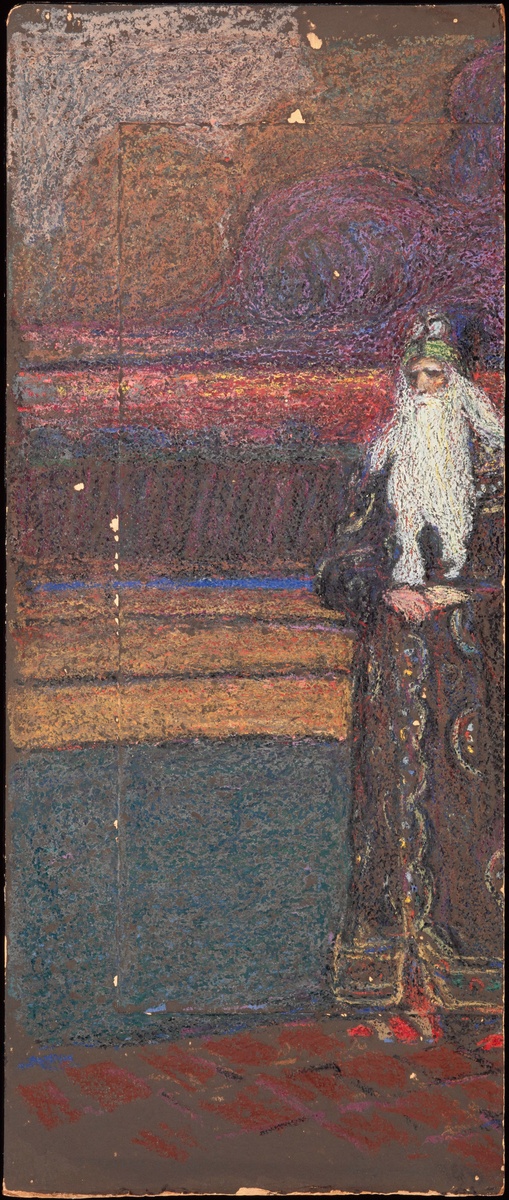
This is Wassily Kandinsky's Bearded Old Man, painted around 1904. In it, a small, white-bearded old man in a green cap and pale garment stands facing left. He is perched on top of a tall, dark, ornate support, so the figure is held up above the surrounding colour rather than walking through it. The painting itself is wax paint on board.
Look first at how much room the figure does not take up. The old man is small, and the tall brown support anchors the right side of the picture. Yellow scrollwork runs along that support, which gives it an ornamental, almost furniture-like character. The man rests on it, facing away toward the left of the scene.
Behind him, the background is built from horizontal bands of red, pink, violet, ochre and blue. They stack up like a compressed landscape or a shallow stage set. Above and behind the figure, a large, turbulent violet form hovers. It is the loosest shape in the picture, and it presses down over the bands beneath it.
What does that violet form mean? The record offers a reading rather than a documented answer: it can be seen as a symbolic cloud, a thought, or a dream image. That is an inference, not a meaning the sources establish. Still, it helps explain the picture's strange arrangement, with a small figure lifted above a stage-like landscape and something unsettled floating over him.
The banded background and the hovering form do different work. The bands give the scene a floor and a horizon, however compressed, so the old man has somewhere to stand. By contrast, the violet shape refuses that geometry. Read together, they make the figure look exposed: anchored below, but with something restless overhead.
So the painting holds two kinds of order at once. The ornate support and layered bands steady the old man, while the violet form loosens the space above him. Kandinsky gives us a small, elderly figure held aloft in a world that is partly measured and partly unsettled, and that contrast is what the picture is really about.
The story and its sources
Historical claims are linked to the records below. Close looking and interpretation are identified in the passage notes.
- Passage 1Documented historyWikimedia Commons: Bearded Old Man
- Passage 2Close lookingWikimedia Commons: Bearded Old Man
- Passage 3Close lookingWikimedia Commons: Bearded Old Man
- Passage 4InterpretationWikimedia Commons: Bearded Old Man
- Passage 5InterpretationWikimedia Commons: Bearded Old Man
- Passage 6Close lookingWikimedia Commons: Bearded Old Man
Details to notice
About 2 minutes to readLayered color bands
Horizontal strata of red, pink, violet, ochre, and blue form a compressed landscape or stage behind the figure and establish the work's abstract setting.
Swirling violet orb
A large turbulent violet form hovers above and behind the figure, reading as a symbolic cloud, thought, or dream image.
Ornate dark pedestal
The tall brown structure with yellow scrollwork supports the old man like a throne or altar and anchors the right side of the composition.
Artist portrait Image credit
未知上傳者. Image source · Public domain
About the artist
Wassily Kandinsky
1866 to 1944
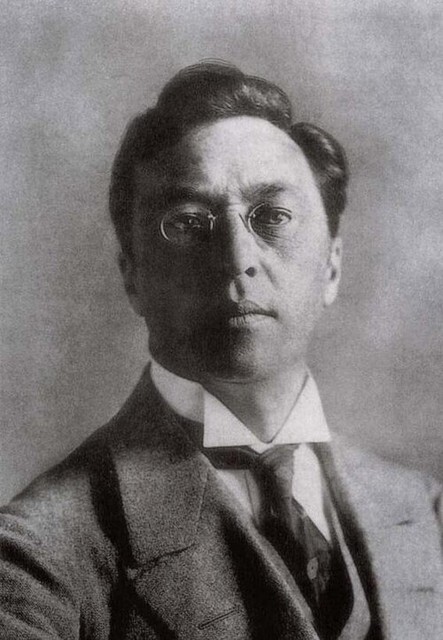
Wassily Kandinsky was an avant-garde painter of Russian origin (1866–1944). Their work is associated with Expressionism; Symbolism; Bauhaus. Their recorded places of work include Paris; Munich; Weimar; Rapallo; The Hague; Russia; Stockholm; Switzerland; Tunis.
- Born
- 1866
- Died
- 1944
- Nationality
- Russian Empire; Russian Soviet Federative Socialist Republic; Soviet Union; France; Germany
- Birthplace
- Moscow
- Died in
- Neuilly-sur-Seine
Biography sources
The research & record
Study the work.
Follow the evidence.
Find catalogue details, historical context, technical research and the literature behind this artwork.
The artwork record
Research catalogue
Catalogue information and detailed research, with references that link to the bibliography.
Updated .
Identity and catalogue
Link- Title
- Bearded Old Man(Wikimedia Commons: Bearded Old Man, n.d.)
- Artist or attribution
- Wassily Kandinsky
- Object date
- circa 1904
- Medium and support
- wax paint on board(Wikimedia Commons: Bearded Old Man, n.d.)
- Dimensions
- 54.7 cm × 23 cm
- Current collection or location
- Musée National d'Art Moderne, Centre Georges Pompidou, Paris(Wikimedia Commons: Bearded Old Man, n.d.)
- Movement or period
- Early twentieth-century modernism
- Country or culture
- Russian-born artist working in Europe
- Depicted subject
- A small, white-bearded old man stands atop a dark, ornate support, facing left. His figure is set against a background of layered colour bands and a swirling violet form.
- Title variants
- Old Man with Beard; Vieillard barbu
- Accession number
- AM 81-65-83 (V)
- Support
- board
Read valuation records and their limitations
Title, attribution and date
The work catalogued here is titled Bearded Old Man, and the record also gives the variant title Old Man with Beard. It is attributed to Wassily Kandinsky and is dated to around 1904. The word "around" belongs to the attribution record itself, so the object is assigned to a period in Kandinsky's early career rather than to a documented day or year of completion; the catalogue gives no firmer date on the evidence supplied.(Wikimedia Commons: Bearded Old Man, n.d., Description)
Medium, support and format
The painting is recorded as wax paint on board, which separates it from the oil-on-canvas convention that a reader might otherwise assume for a Kandinsky of this period. The support is a board, and the medium the record names is wax paint. The same record supplies the dimensions as 54.7 cm by 23 cm, an unusually tall and narrow format. That proportion matters for how the picture reads: it is a vertical field, so the composition's stacked horizontal elements and its upright support have to be understood within a markedly columnar frame rather than a broad one.(Wikimedia Commons: Bearded Old Man, n.d., Description)
Collection and accession
The collection record places the painting in the Musée National d'Art Moderne, Centre Georges Pompidou, Paris, under accession number AM 81-65-83 (V). The accession string is part of the object's catalogue identity and should travel with any citation of it. The record is a discovery-level source describing the work and its collection details; it is the kind of institutional description that carries title, medium, measurements and accession information, and it is the basis for the identifications given throughout this section.(Wikimedia Commons: Bearded Old Man, n.d., Description)
There is no evidence unit here recording an inscription, signature, date written on the board, or an earlier provenance. The record's silence on these points is not evidence that none exists; it means the supplied material supports title, variant title, attribution, approximate date, medium, support, dimensions, location and accession number, and no more. Claims about a signature or an unbroken chain of ownership would go beyond the evidence and are not made here.(Wikimedia Commons: Bearded Old Man, n.d., Description)
The painting is titled Bearded Old Man, also known as Old Man with Beard, and was made by Wassily Kandinsky around 1904.(Wikimedia Commons: Bearded Old Man, n.d.)
Subject and iconography
LinkRead valuation records and their limitations
Composition and scale
Visual observation
The visible composition of Bearded Old Man is organised around a marked imbalance of scale and placement. A small, white-bearded old man, wearing a green cap and a pale garment, stands atop a dark support and faces left (f4). The support beneath him is tall, brown and ornate, carrying yellow scrollwork, and it anchors the right side of the picture while holding the figure aloft (f7). Because the figure occupies so little of the surface and is perched rather than grounded, the reading of the work depends heavily on how the ornamental support and the surrounding colour are understood in relation to one another. The object itself, wax paint on board measuring 54.7 cm by 23 cm, is a narrow vertical format, a proportion that would reinforce the impression of a figure lifted above rather than settled within a scene.(Wikimedia Commons: Bearded Old Man, n.d., Vision-derived focus candidate: bearded_figure; Vision-derived focus candidate: ornate_support; Description)
Interpretation
Behind and around the figure the background is built from horizontal strata of red, pink, violet, ochre and blue, forming what the record describes as a compressed landscape or stage (f6). Above and behind the old man hovers a large, turbulent violet form, the loosest shape in the picture (f5). Taken together, these two elements establish different kinds of spatial order: the bands supply a shallow, layered ground and horizon against which the figure is seen, while the violet form resists that banding and presses over it. The evidence supports this as a description of visual arrangement; it does not establish what the violet shape depicts.(Wikimedia Commons: Bearded Old Man, n.d., Vision-derived focus candidate: banded_horizon; Vision-derived focus candidate: violet_orb)
Interpretive limits
The record offers an explicit reading of the violet form: it can be seen as a symbolic cloud, a thought, or a dream image. That reading is identified in the source itself as an inference rather than a documented meaning. The distinction matters for the research account, because the hovering form is visually the most unstable element of the composition, and the temptation to treat its instability as evidence of a specific symbolic programme should be resisted. What the evidence establishes is the form's turbulence and its position above and behind the figure; what it does not establish is any documented intention behind it.(Wikimedia Commons: Bearded Old Man, n.d., Vision-derived focus candidate: violet_orb; Vision-derived focus candidate: banded_horizon)
The narrow board and the wax medium belong to the object's material description rather than to its iconography, but they condition how the visible composition is encountered: a tall, slim support for a small figure held aloft, painted in a medium that the record identifies simply as wax paint on board. The visible details and the material description should be kept in the same account, since the vertical proportion of the 54.7 by 23 cm board and the placement of the ornate support at the right edge work together to produce the picture's characteristic exposure of the figure.(Wikimedia Commons: Bearded Old Man, n.d., Description; Vision-derived focus candidate: ornate_support; Vision-derived focus candidate: bearded_figure)
Visual observation
The figure is a small, white-bearded old man in a green cap and pale garment, standing atop a dark support and facing left.(Wikimedia Commons: Bearded Old Man, n.d.)
A large, turbulent violet form hovers above and behind the figure.(Wikimedia Commons: Bearded Old Man, n.d.)
Horizontal strata of red, pink, violet, ochre and blue form a compressed landscape or stage behind the figure.(Wikimedia Commons: Bearded Old Man, n.d.)
The tall, brown, ornate support with yellow scrollwork anchors the right side of the composition and holds the figure aloft.(Wikimedia Commons: Bearded Old Man, n.d.)
Materials and technique
LinkRead valuation records and their limitations
Documented materials and dimensions
The documented material description of Bearded Old Man is precise but compact: the work is wax paint on board, measuring 54.7 cm by 23 cm. These two facts establish the support as a rigid board rather than canvas, and the medium as a wax-based paint rather than oil. The unusually narrow proportions, a width less than half the height, set a tall, vertical field that any composition had to work within. The record consulted does not specify the species or preparation of the board, the composition of the wax medium, whether the paint was applied warm or cold, or what tools were used, so those aspects of the making must remain undocumented here rather than inferred.(Wikimedia Commons: Bearded Old Man, n.d., Description)
Observed colour and handling
Interpretation
A materials account of this object therefore rests on a firm but narrow documented base, wax paint on a 54.7 by 23 cm board, extended by visual description of colour zones and composition. The distinction matters for how the work can be placed in a history of technique: the record establishes what the object is made of and what can be seen, but not the workshop practice, preparation layers, or pigment choices behind the appearance. Interpretively, the narrow vertical format and the division of the surface into banded, ornamental and turbulent passages suggest a deliberately staged arrangement rather than a uniform field, and that reading is grounded in the observed configuration rather than in any technical finding the source reports.(Wikimedia Commons: Bearded Old Man, n.d., Description; Vision-derived focus candidate: bearded_figure)
The work is wax paint on board, measuring 54.7 cm by 23 cm.(Wikimedia Commons: Bearded Old Man, n.d.)
Interpretations and debates
LinkRead valuation records and their limitations
Evidence and the Status of Interpretation
Interpretation
Interpretation of this object has to begin with what the record actually supplies. The source gives the work a title, Bearded Old Man, with the variant Old Man with Beard, assigns it to Wassily Kandinsky around 1904, and describes it as wax paint on board measuring 54.7 cm by 23 cm, held at the Musée National d'Art Moderne, Centre Georges Pompidou, Paris, under accession number AM 81-65-83 (V). Those are the documentary anchors: an attribution, an approximate date, a medium and support, dimensions and a collection identity. The interpretive proposals that follow in the record do not carry the same status as these object facts, and the account should keep that distinction visible, because the only explicit reading the source offers is itself flagged as inference rather than documented meaning.(Wikimedia Commons: Bearded Old Man, n.d., Vision-derived focus candidate: violet_orb)
The Violet Form: Reading and Its Limits
The reading that the source does record concerns the large, turbulent violet form that hovers above and behind the figure. The record proposes that this form can be understood as a symbolic cloud, a thought, or a dream image, and immediately qualifies the proposal by stating that it is an inference rather than a documented meaning. What is observable is the form's position and character: it is a large, turbulent violet mass, sitting above and behind the old man, and it is the loosest shape in the composition relative to the more structured elements around it. What is inferred is any content it might carry, whether meteorological, psychological or oneiric. Because the source lists all three possibilities together without choosing among them, the honest formulation is that the record offers a range of readings rather than a single meaning, and that none of them is established by the evidence.(Wikimedia Commons: Bearded Old Man, n.d., Vision-derived focus candidate: violet_orb)
The figure itself constrains how far symbolic readings can be pushed. The old man is small, white-bearded, dressed in a green cap and pale garment, standing atop a dark support and facing left. He occupies a modest portion of the picture, and the source does not identify him by name, role or narrative. Any interpretation that treats him as a particular person or as the bearer of a specific message would exceed what the record supplies. The observable features, his age, beard, cap, pale clothing and leftward orientation, can support a description of him as an elderly figure held aloft, but the source gives no basis for assigning him an identity or a stated intention. The recorded inference about the violet form should therefore be kept separate from any claim about what the figure himself means or was meant to feel.(Wikimedia Commons: Bearded Old Man, n.d., Vision-derived focus candidate: bearded_figure; Vision-derived focus candidate: violet_orb)
The source's own reading of the violet form can be related to the composition without being promoted to fact. The form hovers above and behind the old man, over the banded landscape, and it is characterized as turbulent and loose. One can reasonably note that the record's symbolic readings, cloud, thought or dream image, would each place the form in a different relation to the figure and to the stage beneath it: a cloud belongs to a landscape, a thought or dream belongs to a mind, and the source does not decide between these frames. That observation clarifies why the proposal is offered as a reading rather than a finding. It also marks the limit of further synthesis: because the record supplies no testimony from the artist, no contemporary commentary and no documented programme for the picture, any expansion of the violet form's meaning beyond the three listed possibilities would be invention rather than interpretation grounded in evidence.(Wikimedia Commons: Bearded Old Man, n.d., Vision-derived focus candidate: violet_orb; Vision-derived focus candidate: banded_horizon)
Evidence and the Status of Interpretation
Taken together, the units describe an object about which a good deal is documented at the level of attribution and physical description and very little at the level of meaning. The title, attribution to Kandinsky, approximate date of around 1904, medium of wax paint on board, dimensions and Pompidou accession number are stated as facts. The figure's appearance, the hovering violet form, the banded strata and the ornate support are described as observed features. Only the symbolic reading of the violet form is explicitly interpretive, and the source itself marks it as inference. This asymmetry is the central interpretive condition of the object: its significance within a larger history of art or material culture cannot be argued from the record through claims about the maker's private intent, but only through the documented formal arrangement of figure, support, banded ground and hovering form, together with the qualified reading the record ventures.(Wikimedia Commons: Bearded Old Man, n.d., Vision-derived focus candidate: violet_orb; Vision-derived focus candidate: bearded_figure; Vision-derived focus candidate: banded_horizon; Vision-derived focus candidate: ornate_support)
The violet form can be read as a symbolic cloud, thought, or dream image, though this is an inference rather than a documented meaning.(Wikimedia Commons: Bearded Old Man, n.d.)
Collection and display
LinkRead valuation records and their limitations
Object and repository record
Bearded Old Man, also called Old Man with Beard, is attributed in the consulted record to Wassily Kandinsky and dated there to around 1904. The same record describes its medium as wax paint on board and gives its dimensions as 54.7 cm by 23 cm, a markedly vertical format that corresponds to the tall, narrow stacking of the composition. The work is held in the Musée National d'Art Moderne, Centre Georges Pompidou, Paris, under accession number AM 81-65-83 (V). These are the documentary anchors for the object: attribution, approximate date, material, support, size and current repository. Because the record treats the date as approximate, the painting should be placed in Kandinsky's early period only within that qualification rather than tied to a precise year.(Wikimedia Commons: Bearded Old Man, n.d., Description)
The collection record is a discovery-level source, an open-access Wikimedia Commons entry consulted as a description of the object, and its statements about title, attribution, medium, measurements and accession number carry the evidential weight of that kind of documentation rather than of a catalogue raisonné or museum technical file. This matters for how the object's place in a larger history should be phrased: the fact of its presence in the Musée National d'Art Moderne collection is documented by the accession number and institution, while the attribution and the circa 1904 date rest on the same descriptive record. The entry also states that the painting is known by two titles, Bearded Old Man and Old Man with Beard, a naming variation worth preserving because title variants affect how the work is traced across collections and literature.(Wikimedia Commons: Bearded Old Man, n.d., Description)
Description and collection context
The visible arrangement, as described in the record, places a small, white-bearded old man in a green cap and pale garment facing left, standing atop a dark support. That support is described as tall, brown and ornate, with yellow scrollwork running along it, and it anchors the right side of the composition while holding the figure aloft. Behind the figure, horizontal strata of red, pink, violet, ochre and blue build a compressed landscape or stage-like space, and above and behind him a large, turbulent violet form hovers. Read against the institutional facts, the vertical panel format and the elevation of the figure on an ornamental support are what make the object legible as a single pictorial construction; the repository record establishes where it now resides, while the description establishes what a viewer encounters there.(Wikimedia Commons: Bearded Old Man, n.d., Description)
Interpretation
The record offers an interpretation of the violet form as a possible symbolic cloud, thought or dream image, and it explicitly marks this as an inference rather than a documented meaning. The account should keep that distinction: the hovering shape is observed and described, but its significance is proposed. Within a history of early twentieth-century art, the value of the object lies less in any settled iconographic key than in the coexistence the record describes, of a measured, banded ground and support beneath the figure and a loose, unsettled form above him, preserved now in a major public collection where that contrast can be studied directly.(Wikimedia Commons: Bearded Old Man, n.d., Description)
The painting is held in the Musée National d'Art Moderne, Centre Georges Pompidou, Paris, with accession number AM 81-65-83 (V).(Wikimedia Commons: Bearded Old Man, n.d.)
Documented values and qualified estimates
LinkRead valuation records and their limitations
The working insurance estimate
Interpretation
Any discussion of the recorded value of Wassily Kandinsky's Bearded Old Man must begin with the parameters that the only supplied value record itself fixes: a working insurance range of US$2M to US$6M, generated as a working calculation on 2026-10-30. The methodology describes the range as broad and conservative, derived from confirmed context rather than from market transactions. That context is an early Kandinsky of circa 1904, executed in wax paint on board at a small scale of 54.7 by 23 cm, held in the Musée National d'Art Moderne, Centre Georges Pompidou, with the given accession number. The range is said to reflect the artist's canonical status and the rarity of his early period, while applying downward pressure for the modest size, the minor medium (wax paint on board rather than a major oil), the museum-held status, and a medium-confidence, title-based identification made without image inspection. The record states explicitly that no comparable sales and no private insurance records were used, and that the band was set deliberately wide to accommodate attribution and condition uncertainty.(Wikimedia Commons: Bearded Old Man, n.d.)
The qualifications attached to that figure are as consequential as the figure itself. The document is described as a model-generated working range for manual review only, expressly not an official insurance value, appraisal, auction result, or sale price, and it is stated not to reflect private insurance records, comparable sales, or institutional coverage data. Because the underlying identification is medium confidence and title-based, with no image inspection, the record instructs that a qualified appraiser confirm the object before any insurance, loan, or financial use. Read closely, the estimate is therefore a reasoning artifact about a title and a set of object attributes rather than an independent measure of the painting's market standing. It documents the terms on which a provisional valuation was framed and the uncertainties that framing was designed to absorb, and it should be cited for exactly that limited claim.(Wikimedia Commons: Bearded Old Man, n.d.)
Working estimate
Calculated working insurance estimate, not a sale price: Working range: US$2M to US$6M Recorded date: Working calculation, generated 2026-10-30. Methodology: Broad, conservative working range derived from confirmed context: an early Kandinsky (circa 1904) in wax paint on board, small scale (54.7 by 23 cm), held in the Musée National d'Art Moderne, Centre Georges Pompidou, with the given accession number. The range reflects the artist's canonical status and early-period rarity, while applying downward pressure for the modest size, minor medium (wax paint on board rather than major oil), museum-held status, and the medium-confidence, title-based identification without image inspection. No comparable sales or private insurance records were used; the range is a defensible order-of-magnitude band set deliberately wide to accommodate attribution and condition uncertainty. Qualification: This is a model-generated working range for manual review only, not an official insurance value, appraisal, auction result, or sale price. It does not reflect private insurance records, comparable sales, or institutional coverage data. The underlying identification is medium confidence and title-based with no image inspection. Confirm with a qualified appraiser before any insurance, loan, or financial use.(Wikimedia Commons: Bearded Old Man, n.d.)
Further reading
Books for a closer look
Paid links. As an Amazon Associate I earn from qualifying purchases.

Open Library Kandinsky: Russian and Bauhaus years, 1915-1933.
Solomon R. Guggenheim Museum
A Kandinsky catalogue whose recorded subjects include Centre Georges Pompidou, the Musee national d'art moderne, and catalogues raisonnes, which directly relates to the documented holding of Bearded Old Man at the Musee National d'Art Moderne, Centre Georges Pompidou. The most object-adjacent candidate, though its contents are unverified.
ISBN 0892070447

Open Library Kandinsky, complete writings on art
G.K. Hall
Recorded as Kandinsky's complete writings on art by the artist himself, offering primary-source material by the painter of Bearded Old Man. It may illuminate his ideas on colour and composition relevant to the layered bands and violet form, but no specific text is claimed here.
ISBN 0805799508

Open Library Concerning the spiritual in art
Dover Publications
Kandinsky's own treatise on the spiritual in art, listed under his authorship. Its recorded subjects of aesthetics and art themes and motives connect to the symbolic reading of colour and the hovering violet form in Bearded Old Man, without asserting any passage from the book.
ISBN 0486234118
Bibliography
Sources and further reading
References are arranged by author or organisation, with links to the original publications. Where no publication date is recorded, n.d. means no date.
Source notes updated .
No recorded sources match these filters. Reset the filters to see the full bibliography.
- 04
Book
Concerning the spiritual in art. Dover Publications.
Kandinsky's own treatise on the spiritual in art, listed under his authorship. Its recorded subjects of aesthetics and art themes and motives connect to the symbolic reading of colour and the hovering violet form in Bearded Old Man, without asserting any passage from the book.
- ISBN
- 0486234118
Citation text
- 03
Book
Kandinsky, complete writings on art. G.K. Hall.
Recorded as Kandinsky's complete writings on art by the artist himself, offering primary-source material by the painter of Bearded Old Man. It may illuminate his ideas on colour and composition relevant to the layered bands and violet form, but no specific text is claimed here.
- ISBN
- 0805799508
Citation text
- 02
Book
Kandinsky: Russian and Bauhaus years, 1915-1933. Solomon R. Guggenheim Museum.
A Kandinsky catalogue whose recorded subjects include Centre Georges Pompidou, the Musee national d'art moderne, and catalogues raisonnes, which directly relates to the documented holding of Bearded Old Man at the Musee National d'Art Moderne, Centre Georges Pompidou. The most object-adjacent candidate, though its contents are unverified.
- ISBN
- 0892070447
Citation text
- 01
Secondary · About this artwork
Wikimedia Commons: Bearded Old Man (n.d.). Wikimedia Commons: Bearded Old Man. Wikimedia Commons.
Discovery record with object details and collection information.
- Language
- en
Citation text
Art to live with
Bring this painting
home.
A piece of the archive, made yours. Explore Bearded Old Man in a size and finish that fits your space.
Your text and annotations appear on these editions. Adding to cart saves that design for printing.
Combine this painting with your favourites01 / Find your edition
Made for you
Suggested from your location. Change it if you're sending elsewhere or using a VPN. Prices and delivery are shown in GBP.
1 product
Choose an edition to make it yours
iPhone 12 Mini ? Glossy ? back view
iPhone 12 Mini · Glossy

iPhone 12 Mini ? Glossy ? back view

iPhone 12 Mini ? Glossy ? back view

iPhone 12 Mini ? Glossy ? back view
Tough phone case
GBP 16.34
Delivery GBP 4.22 / Total GBP 20.56
A two-layer phone case with a printed polycarbonate shell and a shock-absorbing inner liner.
Two layers with a shock-absorbing TPU liner
Case & print details
- Device
- Apple · iPhone 12 Mini
- Material
- Polycarbonate shell with a TPU inner liner
- Artwork
- Outer back and wrapped edges from one template
- Finish
- Glossy
- Version
- Standard version
- Printing
- Dye sublimation
- Print file
- 1,122 × 1,831 px · 95 × 155 mm · PNG · 300 dpi recommended
Rear outline and camera openings follow this variant's Printify template. Case depth and small hardware remain illustrative.
Supplier product detailsFit and fill keep the painting’s proportions. Stretch changes them.
Move and zoom the painting on your tough phone case.
Made to order with your design
Made to order
US delivery only
The 30 cm ruler is scaled alongside your selected print. Keep the painting’s proportions with a black background, or stretch it to fill. Frame width, material texture and screen colours are illustrative.
Keep exploring