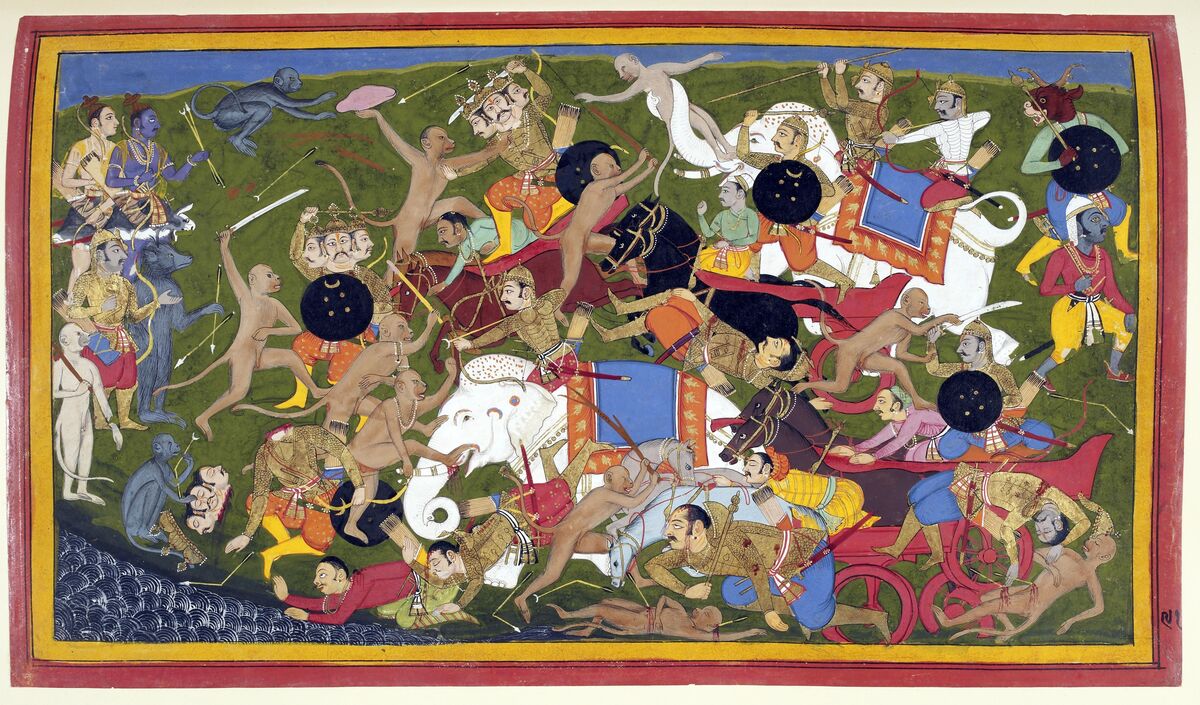
Battle at Lanka, from the Mewar Ramayana
Artist: Sahib Din (Sahibdin) · 1652, within the manuscript programme of 1649–1653
Battle at Lanka, from the Mewar Ramayana: high-resolution image, free to copy
The original file is hosted by Wikimedia Commons, available without payment or an account.5,100 × 2,995 pixels.
Open high-resolution image on Wikimedia CommonsSahibdin. British Library
Free to copy. Reuse terms: Public domain. Image source and credits.
The complete story
The story About 3 minutes to read
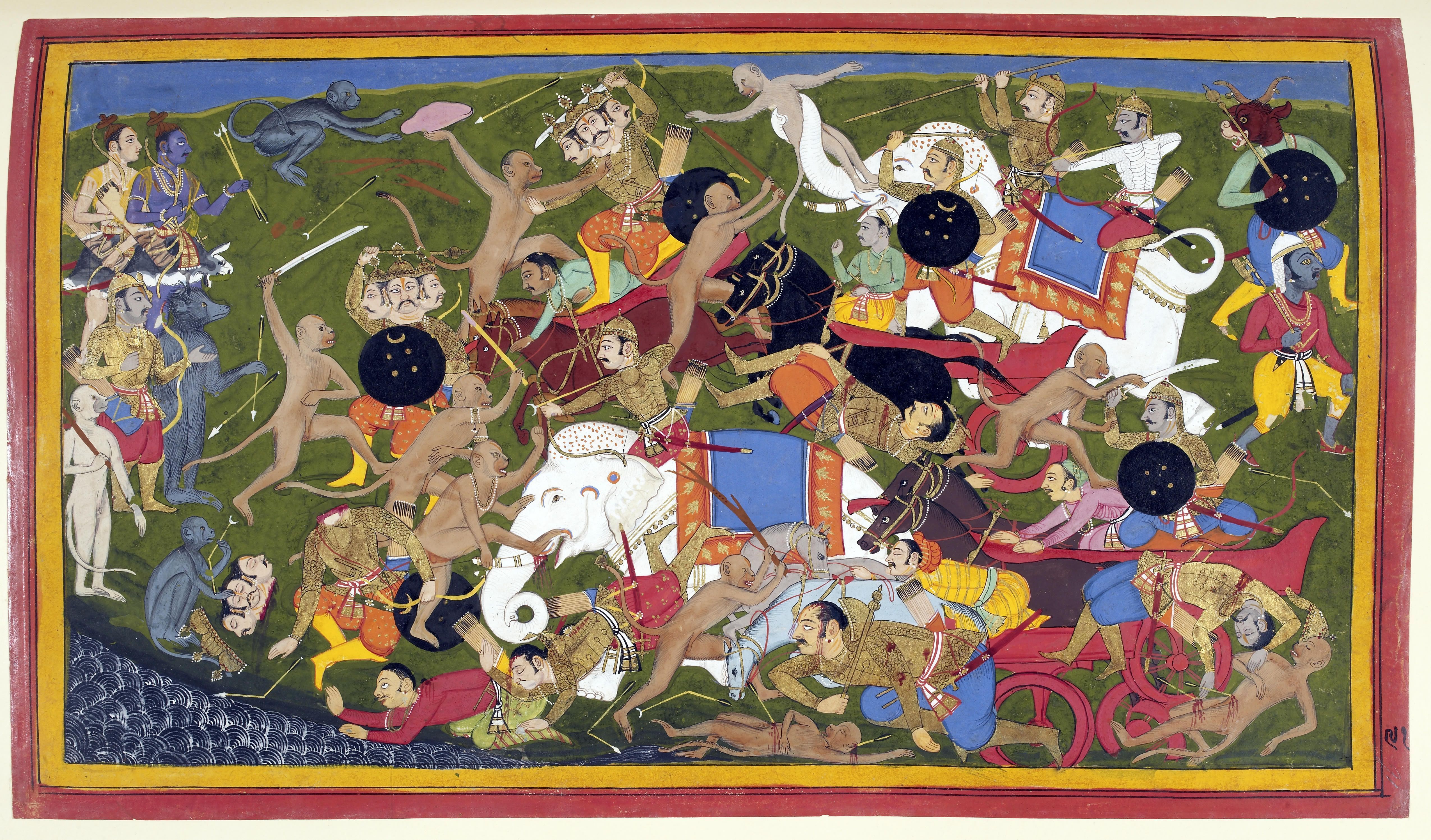
Begin with a body in mid-leap. A monkey reaches across the upper part of the painting, while below it horses, elephants, shields and weapons press against one another. There is hardly an empty patch of ground. Your eye has to move to make sense of the fighting, and each movement uncovers another collision.
This belongs to the Ramayana, the epic in which Rama seeks to recover Sita from Ravana. We are entering that sacred and literary story through one of its battles. Rama's animal allies fight the opposing army. Knowing the story gives direction to the crowded action, while recognising its tradition keeps us from treating the page as a record of an eyewitness battlefield.
Let your eye follow a spear or an arrow across the green ground. Its line carries you into another figure. Then a red garment or a black shield stops you, and a raised arm sends you onwards again. The figures overlap, but their colours and outlines remain clear enough for us to follow separate actions within the struggle.
This picture comes from a larger manuscript made for Rana Jagat Singh of Mewar. The manuscript was later divided between collections, and a digital project brought its surviving parts together again. Imagine turning the pages rather than meeting this image on its own. The battle belongs within a journey through the epic, with words and other pictures before and after it.
Now step back from any single fighter. The whole surface seems to surge. Repeated faces, limbs and weapons make the action feel larger than one encounter, while the crisp detail lets us enter it a little at a time. The page can hold many moments of looking together. We do not have to choose one hero and forget the rest.
Find that leaping body again. Around it, the painted army is still in motion, though no figure can move beyond its outline. A familiar story has become something our eyes must navigate. As you leave the page, hold onto that experience: the way a painter can turn listening to an epic into the physical work of looking.
The story and its sources
Guide sources checked 5 October 2026.
Historical claims are linked to the records below. Close looking and interpretation are identified in the passage notes.
- Passage 1Close looking
- Passage 2Reported traditionRobert P. Goldman and Sally J. Sutherland Goldman, The Ramayana of Valmiki: The Complete English Translation, index entries for Trisiras
- Passage 3Close looking
- Passage 4Documented historyJ. P. Losty, The Mewar Ramayana at the British Library: How the complete digital version came to be
- Passage 5Interpretation
- Passage 6Interpretation
Portrait unrecorded
About the artist
Sahibdin
Active about 1628 to 1655
Sahibdin was a painter at the court of Mewar in Udaipur, working during the reign of Maharana Jagat Singh I. Inscriptions on his paintings document a career from a Ragamala series of 1628 to his last known work in 1655. His vivid palette and narrative compositions shaped illustrations of Hindu devotional texts and epics. His birth and death dates are not securely recorded.
- Active
- About 1628 to 1655
- Nationality
- Indian
The research & record
Study the work.
Follow the evidence.
Find catalogue details, historical context, technical research and the literature behind this artwork.
The artwork record
Research catalogue
Catalogue information and detailed research, with references that link to the bibliography.
Identity and catalogue
Link- Title
- Battle at Lanka, from the Mewar Ramayana
- Artist / attribution
- Sahib Din (Sahibdin)
- Date
- 1652, within the manuscript programme of 1649–1653
- Medium and support
- Ink and colour on paper
- Dimensions
- Exact dimensions of this folio have not been verified
- Culture / place
- Udaipur, Mewar, Rajasthan
- Period
- Seventeenth-century Mewar painting
- Current location
- British Library, London; Add MS 15297(1), folio 91r
Read valuation records and their limitations
Subject and iconography
LinkRead valuation records and their limitations
Visual observation
Begin with the upper-left pair, where Rama's blue figure creates a quiet visual anchor. The rest of the field is crowded with diagonal weapons, raised arms and overlapping bodies. White elephants and dark shields punctuate the green ground; fallen fighters and broken chariot forms bring the eye toward the lower edge. These observations describe the visible image rather than establish the historical appearance of any army.(Exact image record: Battle at Lanka, Ramayana, Udaipur, 1649–53, n.d.)
The three-headed figure appears at different moments, including a violent conclusion near the lower left. Repetition is the clue to the painting's handling of time: the reader follows a character through successive actions in a shared landscape. The whole page remains a single composition, even as the viewer reconstructs a sequence within it.(Exact image record: Battle at Lanka, Ramayana, Udaipur, 1649–53, n.d.)
Historical context
LinkRead valuation records and their limitations
Part of the Mewar Ramayana commissioned for Maharana Jagat Singh and completed under his successor Raj Singh. The scene belongs to the Yuddha Kanda, the epic's war book. Its movement through royal, colonial and library collections is part of its later history.
Interpretations and debates
LinkRead valuation records and their limitations
Reported tradition
Rama's divine identity and the Sisodiya claim to descend from him belong to religious and dynastic traditions. They should be named respectfully as such. No independently documented curse, hidden-message story or supernatural incident attached to this exact folio emerged from the consulted sources. Its most compelling storytelling device is already visible: time unfolds through repeated figures.(Chhatrapati Shivaji Maharaj Vastu Sangrahalaya, n.d.)
The exact leaf's dimensions and pigment composition still need a folio-level technical record. Measurements of other Mewar pages cannot safely fill that gap. The image file is a reproduction of one surface, so it also cannot establish the condition of the verso, prove an individual brush hand throughout the page, or reveal every stage of workshop production.(British Library, n.d.)
The page and the manuscript
LinkRead valuation records and their limitations
The website's image is a manuscript illustration, identified in its image record as folio 91r of Add MS 15297(1). Its broad filename date, 1649–1653, describes the larger undertaking. British Library descriptions date the Yuddha Kanda volume itself to 1652. The narrower date helps distinguish this particular war book from the whole seven-book project.(Exact image record: Battle at Lanka, Ramayana, Udaipur, 1649–53, n.d.)(British Library official account, n.d.)
A manuscript leaf belongs to a reading sequence. The British Library's catalogue describes the larger copy as a Sanskrit text written in Devanagari on paper; an exact-image caption records ink and colour on paper. The painting belongs alongside text, adjacent episodes and the physical folio. Reading those connections can reveal narrative choices that disappear when the page circulates as an isolated battle picture.(British Library, n.d.)(Exact photograph caption: Battle Between the Armies of Rama and the King of Lanka, n.d.)
The epic episode
LinkRead valuation records and their limitations
The wider story concerns Rama's effort to recover Sita after her abduction by Ravana, ruler of Lanka. The battle brings his animal allies against the rakshasa forces. In the epic's war book, Hanuman kills the three-headed Trisiras, one of Ravana's sons. A scholarly translation distinguishes this warrior from another Trisiras who fights Rama in the forest book: sharing a name does not make them the same narrative figure.(J. P. Losty, The Ramayana: Love and Valour in India's Great Epic, bibliographic record and synopsis, n.d.)(Robert P. Goldman and Sally J. Sutherland Goldman, The Ramayana of Valmiki: The Complete English Translation, index entries for Trisiras, n.d.)
The combat is one stage of a longer epic, rather than a complete account of Rama's victory in a single scene. The subsequent killing of Ravana and the return from exile belong to other episodes. Describing the subject as an epic illustration preserves its religious and literary significance without presenting the painted action as evidence that a datable historical battle occurred.(J. P. Losty, The Ramayana: Love and Valour in India's Great Epic, bibliographic record and synopsis, n.d.)
Why a Mewar ruler commissioned it
LinkRead valuation records and their limitations
CSMVS curator Vandana Prapanna describes the manuscript as Jagat Singh's most ambitious court-studio project, begun in 1649 and finished during Raj Singh's reign in 1653. Its surviving portions include hundreds of text and illustrated leaves held in Britain and India. Its scale reflects sustained patronage, coordinated labour and considerable resources.(Chhatrapati Shivaji Maharaj Vastu Sangrahalaya, n.d.)
Scholar John Brockington places the commission within the rebuilding of Mewar's royal library after the Mughal sack of Chittaur in 1568. He interprets it as part of a Sisodiya campaign to strengthen dynastic standing after recognising Mughal sovereignty in 1615. In that reading, illustrating Rama also reinforced the dynasty's asserted ancestral connection to him. This is an interpretation of royal self-presentation, not proof of the ancestry itself.(John Brockington, Verbal and Visual Texts of the Rama Narrative, especially pp. 6–7, n.d.)
A shared workshop and several traditions
LinkRead valuation records and their limitations
Although this image is credited to Sahib Din, the full manuscript was a collective production. Brockington identifies Sahib Din's principal contributions to the Ayodhya and Yuddha books, Manohar's work in other sections, and another group influenced by Deccani painting. The Sanskrit text was copied by the Jain scribe Mahatma Hirananda. The project crossed artistic and religious boundaries within court employment.(John Brockington, Verbal and Visual Texts of the Rama Narrative, especially pp. 6–7, n.d.)
Brockington's wider study also cautions against treating every Ramayana image as an illustration of one uniform text. Oral performance, manuscript recensions and regional adaptations shaped how episodes were narrated and pictured. For this folio, the identified episode should be tied to the Mewar manuscript; an attractive anecdote from a different Ramayana tradition should carry its own attribution.(John Brockington, Verbal and Visual Texts of the Rama Narrative, especially pp. 6–7, n.d.)
From Udaipur to a dispersed digital manuscript
LinkRead valuation records and their limitations
Curator J. P. Losty traces the British Library volumes from Maharana Bhim Singh's gift to James Tod in 1820, through Tod's presentation to the Duke of Sussex in 1823, to purchase at the duke's library sale in 1844. They entered the British Museum before becoming part of the British Library. Several other portions remained in Indian collections.(LSE South Asia; republication of the British Library curator's account, n.d.)
The nineteenth-century bindings became a conservation problem: turning large guarded leaves flexed the painted surfaces and risked pigment loss. Losty describes their eventual dismantling and individual mounting, followed by a digital reunion launched in Mumbai in March 2014. CSMVS coordinated work on the Indian holdings. Digital reunion reconnects the dispersed text and pictures while the physical leaves remain in separate collections.(LSE South Asia; republication of the British Library curator's account, n.d.)(Chhatrapati Shivaji Maharaj Vastu Sangrahalaya, n.d.)
Details to carry with you
- The exact image is identified as British Library Add MS 15297(1), folio 91r.
- The Yuddha Kanda is dated 1652; the full manuscript programme ran from 1649 to 1653.
- The repeated three-headed fighter is identified as Trisiras.
- The picture combines successive actions within a single field.
- The manuscript was produced by several artists and workshops, rather than one painter alone.
Bibliography
Sources and further reading
References are arranged by author or organisation, with links to the original publications. Where no publication date is recorded, n.d. means no date.
Source notes updated .
No recorded sources match these filters. Reset the filters to see the full bibliography.
- 07
Archival record
Citation text
- 06
Citation text
Citation text
- 01
Image-record
Exact image record: Battle at Lanka, Ramayana, Udaipur, 1649–53 (n.d.). Wikimedia Commons; image credited to the British Library.
Citation text
- 09
Secondary
Exact photograph caption: Battle Between the Armies of Rama and the King of Lanka (n.d.). Getty Images.
Citation text
- 08
Academic
J. P. Losty, The Ramayana: Love and Valour in India's Great Epic, bibliographic record and synopsis (n.d.). Niyogi Books, 2008; Google Books record.
Citation text
- 03
Academic
John Brockington, Verbal and Visual Texts of the Rama Narrative, especially pp. 6–7 (n.d.). Cracow Indological Studies, 2022.
Citation text
- 04
Citation text
- 05
Academic
Robert P. Goldman and Sally J. Sutherland Goldman, The Ramayana of Valmiki: The Complete English Translation, index entries for Trisiras (n.d.). Princeton University Press; Yale Library copy.
Citation text
Art to live with
Bring this painting
home.
A piece of the archive, made yours. Explore Battle at Lanka, from the Mewar Ramayana in a size and finish that fits your space.
Your text and annotations appear on these editions. Adding to cart saves that design for printing.
Combine this painting with your favourites01 / Find your edition
Made for you
Suggested from your location. Change it if you're sending elsewhere or using a VPN. Prices and delivery are shown in GBP.
4 products
Choose an edition to make it yours
17.8 × 12.7 cm / 7 × 5 in · Standard
17.8 × 12.7 cm / 7 × 5 in · Standard

7 × 5 in / 17.8 × 12.7 cm · Standard

7 × 5 in / 17.8 × 12.7 cm · Standard

7 × 5 in / 17.8 × 12.7 cm · Standard

7 × 5 in / 17.8 × 12.7 cm · Standard

7 × 5 in / 17.8 × 12.7 cm · Standard
Metal art sign
GBP 19.84
Delivery GBP 17.90 / Total GBP 37.74
A printed aluminium sign with rounded corners and mounting holes.
Fit and fill keep the painting’s proportions. Stretch changes them.
Move and zoom the painting on your metal art sign.
Made to order with your design
Printed aluminium · mounting holes included
US delivery only
40.6 × 30.4 cm / 16 × 12 in · Black
40.6 × 30.4 cm / 16 × 12 in · Black

16 × 12 in / 40.6 × 30.4 cm · Black

16 × 12 in / 40.6 × 30.4 cm · Black

16 × 12 in / 40.6 × 30.4 cm · Black

16 × 12 in / 40.6 × 30.4 cm · Black
Framed art print
GBP 53.84
- 1 framed print
- GBP 53.84
- Delivery to United States
- GBP 14.31
- Total
- GBP 68.15
A ready-to-hang wooden frame with a clear Perspex cover and a semi-gloss printed insert.
Delivery is quoted for all selected copies together.
Fit and fill keep the painting’s proportions. Stretch changes them.
Move and zoom the painting on your framed art print.
Made to order with your design
Wooden frame & protective clear front included
US delivery only
25.4 × 25.4 cm / 10 × 10 in · Standard
25.4 × 25.4 cm / 10 × 10 in · Standard

10 × 10 in / 25.4 × 25.4 cm · Standard

10 × 10 in / 25.4 × 25.4 cm · Standard

10 × 10 in / 25.4 × 25.4 cm · Standard

10 × 10 in / 25.4 × 25.4 cm · Standard

10 × 10 in / 25.4 × 25.4 cm · Standard
Matte art print
GBP 11.42
Delivery GBP 7.29 / Total GBP 18.71
An unframed matte poster with archival inks, ready for a frame of your choice.
Fit and fill keep the painting’s proportions. Stretch changes them.
Move and zoom the painting on your matte art print.
Made to order with your design
Unframed · frame it your way
US delivery only
43.2 × 27.9 cm / 17 × 11 in · Standard
43.2 × 27.9 cm / 17 × 11 in · Standard

17 × 11 in / 43.2 × 27.9 cm · Standard

17 × 11 in / 43.2 × 27.9 cm · Standard

17 × 11 in / 43.2 × 27.9 cm · Standard
Fine art poster
GBP 24.09
Delivery GBP 7.69 / Total GBP 31.78
A gallery paper print with a smooth art-paper surface. Choose a size that suits the painting.
Fit and fill keep the painting’s proportions. Stretch changes them.
Move and zoom the painting on your fine art poster.
Made to order with your design
Unframed · frame it your way
The 30 cm ruler is scaled alongside your selected print. Keep the painting’s proportions with a black background, or stretch it to fill. Frame width, material texture and screen colours are illustrative.
Keep exploring