Date1652, within the manuscript programme of 1649–1653CultureUdaipur, Mewar, RajasthanPeriodSeventeenth-century Mewar painting
100%
Loading full-resolution artwork…
Drag to explorePinch or double-tap to explore
Scroll to zoom · drag to pan · double-click to focusPinch to zoom · drag to explore · double-tap to focusFIELD VIEW / 04
Tools & download
Pixel colour Select a pixel with the eyedropper
No pixel selected
Choose the eyedropper, then click or tap the image. Scroll to zoom for finer selection.
Add text
Hand to pan · Select to move text and drawings · Add as many texts as you like · Scroll to zoom
The research & record
Look closer. Read deeper.
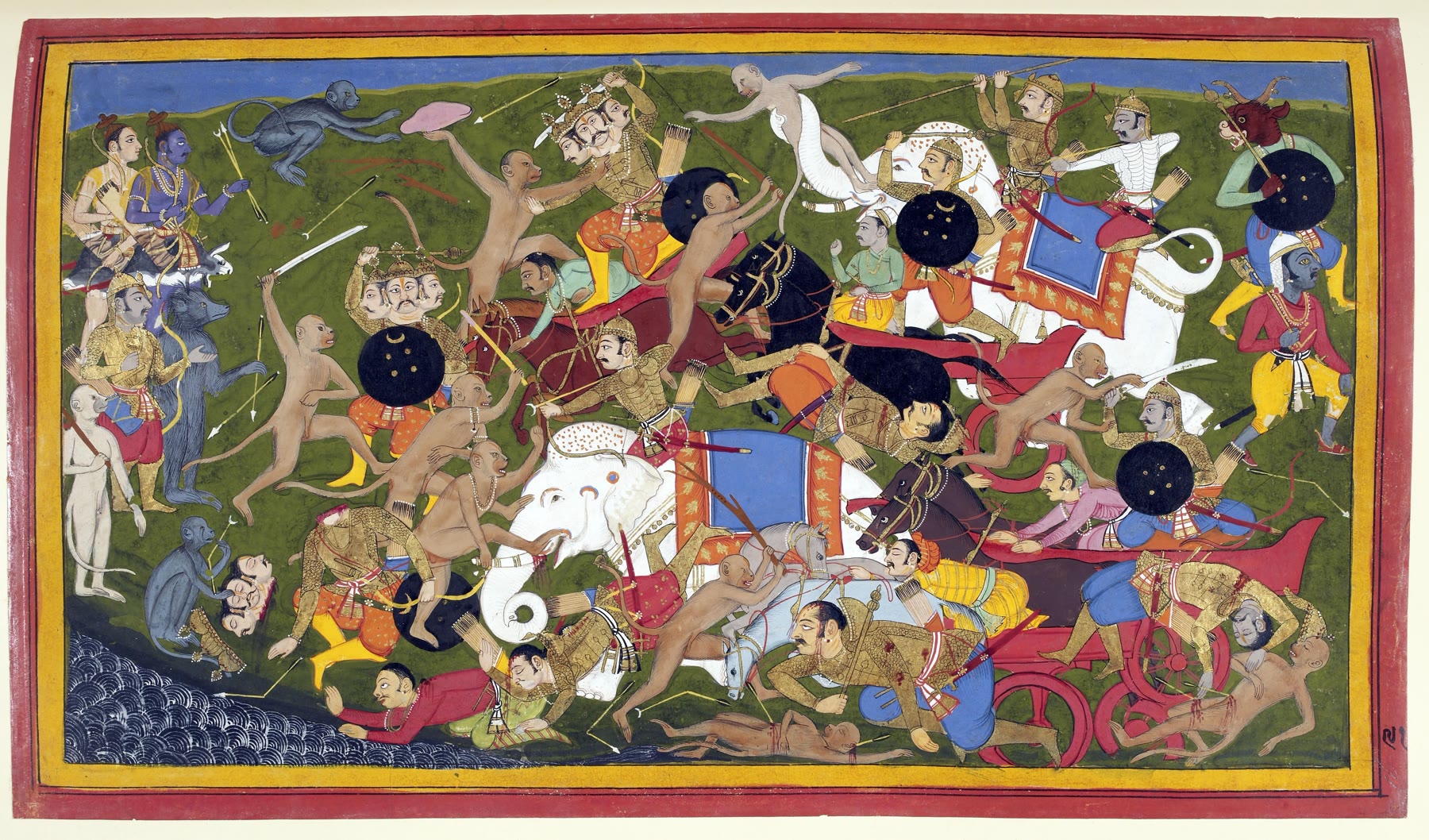
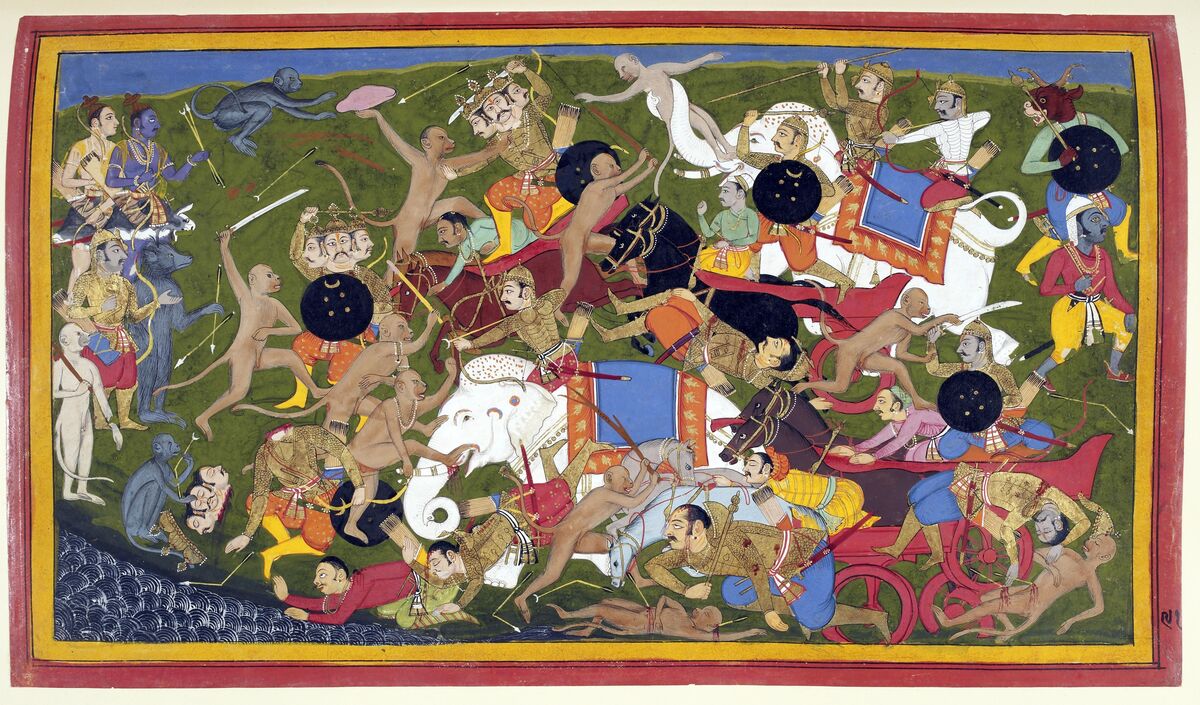
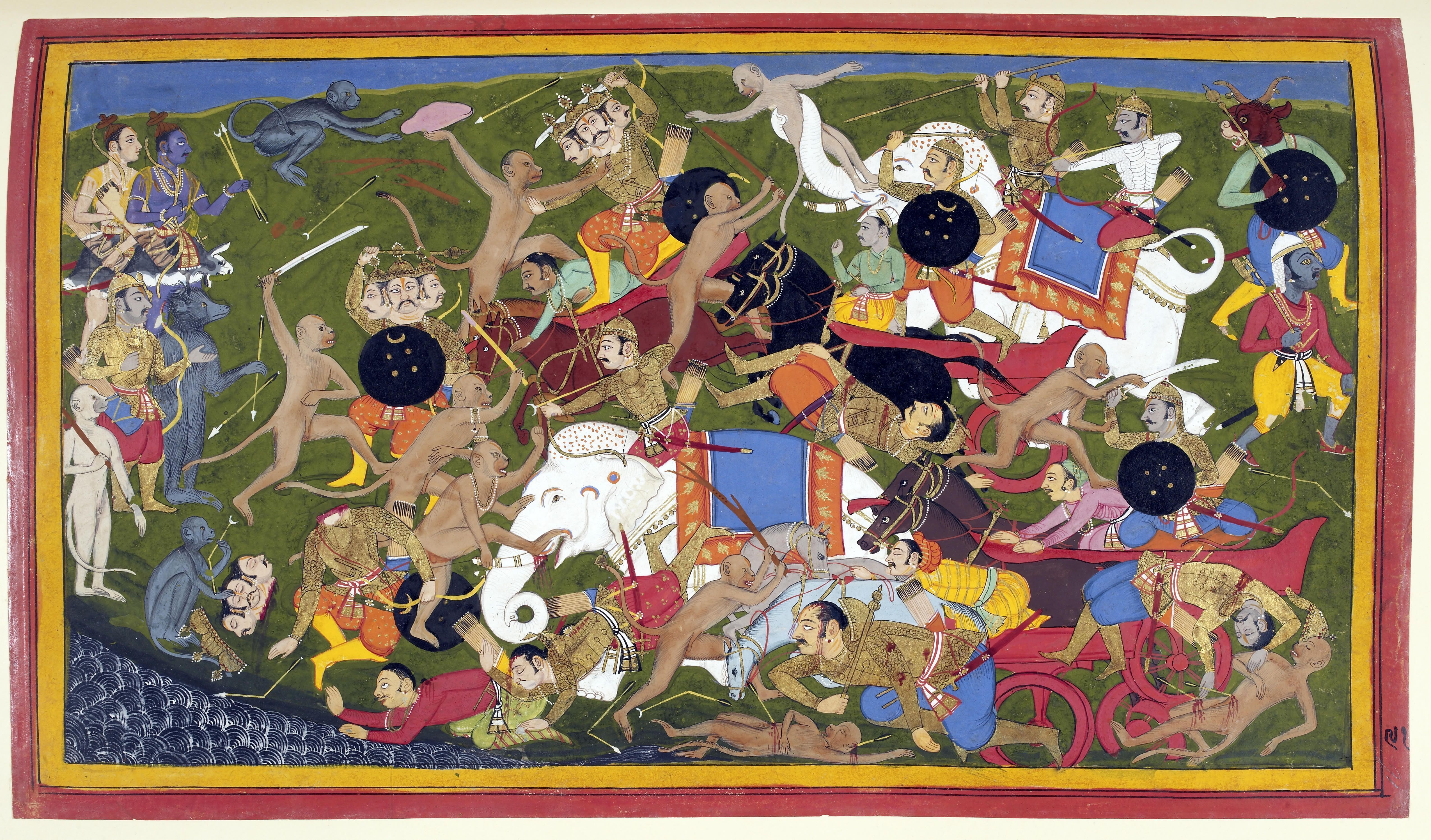
A battlefield becomes a sequence of stories within one painted page. Monkeys leap across elephants, chariots collide, and a three-headed warrior appears more than once, while blue-skinned Rama watches from the upper left. This is a folio from the lavish Mewar Ramayana, a court manuscript whose pictures connect an epic struggle with the ambitions and ancestry of its royal patrons.
The page and the manuscript
The website's image is a manuscript illustration, identified in its image record as folio 91r of Add MS 15297(1). Its broad filename date, 1649–1653, describes the larger undertaking. British Library descriptions date the Yuddha Kanda volume itself to 1652. The narrower date helps distinguish this particular war book from the whole seven-book project.[1][6]
A manuscript leaf belongs to a reading sequence. The British Library's catalogue describes the larger copy as a Sanskrit text written in Devanagari on paper; an exact-image caption records ink and colour on paper. The painting belongs alongside text, adjacent episodes and the physical folio. Reading those connections can reveal narrative choices that disappear when the page circulates as an isolated battle picture.[7][9]
How to read the fighting
Begin with the upper-left pair, where Rama's blue figure creates a quiet visual anchor. The rest of the field is crowded with diagonal weapons, raised arms and overlapping bodies. White elephants and dark shields punctuate the green ground; fallen fighters and broken chariot forms bring the eye toward the lower edge. These observations describe the visible image rather than establish the historical appearance of any army.[1]
The three-headed figure appears at different moments, including a violent conclusion near the lower left. Repetition is the clue to the painting's handling of time: the reader follows a character through successive actions in a shared landscape. The whole page remains a single composition, even as the viewer reconstructs a sequence within it.[1]
The epic episode
The wider story concerns Rama's effort to recover Sita after her abduction by Ravana, ruler of Lanka. The battle brings his animal allies against the rakshasa forces. In the epic's war book, Hanuman kills the three-headed Trisiras, one of Ravana's sons. A scholarly translation distinguishes this warrior from another Trisiras who fights Rama in the forest book: sharing a name does not make them the same narrative figure.[8][5]
The combat is one stage of a longer epic, rather than a complete account of Rama's victory in a single scene. The subsequent killing of Ravana and the return from exile belong to other episodes. Describing the subject as an epic illustration preserves its religious and literary significance without presenting the painted action as evidence that a datable historical battle occurred.[8]
Why a Mewar ruler commissioned it
CSMVS curator Vandana Prapanna describes the manuscript as Jagat Singh's most ambitious court-studio project, begun in 1649 and finished during Raj Singh's reign in 1653. Its surviving portions include hundreds of text and illustrated leaves held in Britain and India. Its scale reflects sustained patronage, coordinated labour and considerable resources.[2]
Scholar John Brockington places the commission within the rebuilding of Mewar's royal library after the Mughal sack of Chittaur in 1568. He interprets it as part of a Sisodiya campaign to strengthen dynastic standing after recognising Mughal sovereignty in 1615. In that reading, illustrating Rama also reinforced the dynasty's asserted ancestral connection to him. This is an interpretation of royal self-presentation, not proof of the ancestry itself.[3]
A shared workshop and several traditions
Although this image is credited to Sahib Din, the full manuscript was a collective production. Brockington identifies Sahib Din's principal contributions to the Ayodhya and Yuddha books, Manohar's work in other sections, and another group influenced by Deccani painting. The Sanskrit text was copied by the Jain scribe Mahatma Hirananda. The project crossed artistic and religious boundaries within court employment.[3]
Brockington's wider study also cautions against treating every Ramayana image as an illustration of one uniform text. Oral performance, manuscript recensions and regional adaptations shaped how episodes were narrated and pictured. For this folio, the identified episode should be tied to the Mewar manuscript; an attractive anecdote from a different Ramayana tradition should carry its own attribution.[3]
From Udaipur to a dispersed digital manuscript
Curator J. P. Losty traces the British Library volumes from Maharana Bhim Singh's gift to James Tod in 1820, through Tod's presentation to the Duke of Sussex in 1823, to purchase at the duke's library sale in 1844. They entered the British Museum before becoming part of the British Library. Several other portions remained in Indian collections.[4]
The nineteenth-century bindings became a conservation problem: turning large guarded leaves flexed the painted surfaces and risked pigment loss. Losty describes their eventual dismantling and individual mounting, followed by a digital reunion launched in Mumbai in March 2014. CSMVS coordinated work on the Indian holdings. Digital reunion reconnects the dispersed text and pictures while the physical leaves remain in separate collections.[4][2]
Stories and their evidence
Tradition, interpretation and remaining questions
Rama's divine identity and the Sisodiya claim to descend from him belong to religious and dynastic traditions. They should be named respectfully as such. No independently documented curse, hidden-message story or supernatural incident attached to this exact folio emerged from the consulted sources. Its most compelling storytelling device is already visible: time unfolds through repeated figures.[2]
The exact leaf's dimensions and pigment composition still need a folio-level technical record. Measurements of other Mewar pages cannot safely fill that gap. The image file is a reproduction of one surface, so it also cannot establish the condition of the verso, prove an individual brush hand throughout the page, or reveal every stage of workshop production.[7]
Artist
Sahib Din (Sahibdin)
Date
1652, within the manuscript programme of 1649–1653
Medium
Ink and colour on paper
Dimensions
Exact dimensions of this folio have not been verified
Culture / place
Udaipur, Mewar, Rajasthan
Current context
British Library, London; Add MS 15297(1), folio 91r
Details to carry with you
The exact image is identified as British Library Add MS 15297(1), folio 91r.
The Yuddha Kanda is dated 1652; the full manuscript programme ran from 1649 to 1653.
The repeated three-headed fighter is identified as Trisiras.
The picture combines successive actions within a single field.
The manuscript was produced by several artists and workshops, rather than one painter alone.
Fit and fill keep the painting’s proportions. Stretch changes them.
Move and zoom the painting on your flip phone case.
Preparing the artwork for your edition…
Made to order
From the archive
36.6 cm / 14.4 in30.7 cm / 12.1 in
36.6 × 30.7 cm / 14.4 × 12.1 in · Standard
Drag to rotate
36.6 × 30.7 cm / 14.4 × 12.1 in · Standard
14.4 in / 36.6 cm12.1 in / 30.7 cm
14.4 × 12.1 in / 36.6 × 30.7 cm · Standard
14.4 in / 36.6 cm12.1 in / 30.7 cm
14.4 × 12.1 in / 36.6 × 30.7 cm · Standard
14.4 in / 36.6 cm12.1 in / 30.7 cm
14.4 × 12.1 in / 36.6 × 30.7 cm · Standard
14.4 in / 36.6 cm12.1 in / 30.7 cm
14.4 × 12.1 in / 36.6 × 30.7 cm · Standard
Front · your design1 / 4
Desk mat
GBP 15.37
Delivery GBP 5.51 / Total GBP 20.88
A smooth polyester desk mat with a natural rubber non-slip base and anti-fray edges, available in three sizes.
Fit and fill keep the painting’s proportions. Stretch changes them.
Move and zoom the painting on your desk mat.
Preparing the artwork for your edition…
Made to order
The 30 cm ruler is scaled alongside your selected print. Keep the painting’s proportions with a black background, or stretch it to fill. Frame width, material texture and screen colours are illustrative.
We count article page loads to improve the archive, without a visitor tracking cookie. Essential storage supports your basket, delivery choice and site security. Stripe uses payment security storage when payment opens. Your notice and counting choices are remembered for one year.