Bacchus and Ariadne
Artist: Titian · 1520-3
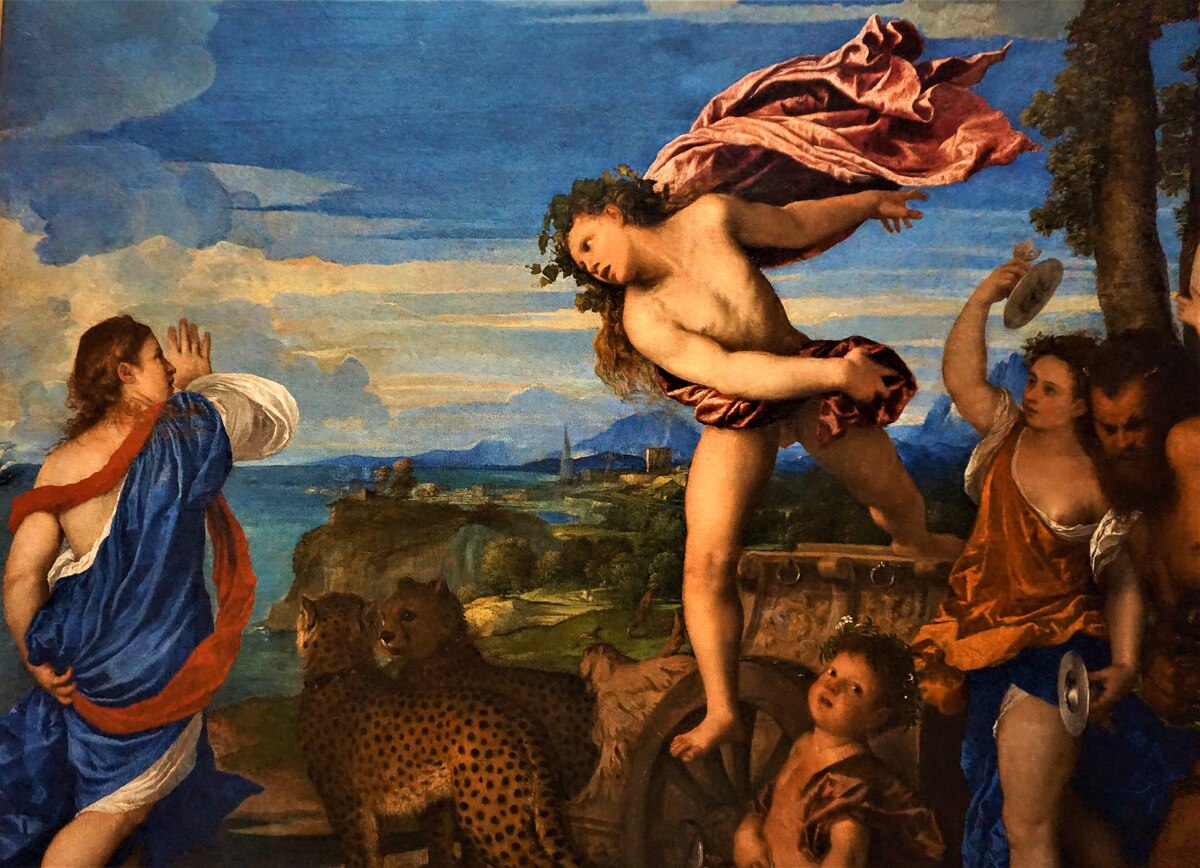
Bacchus and Ariadne: high-resolution image
The highest-resolution file we hold, available without payment or an account.3,840 × 2,778 pixels.
Download highest-resolution imageThe complete story
The story About 5 minutes to read
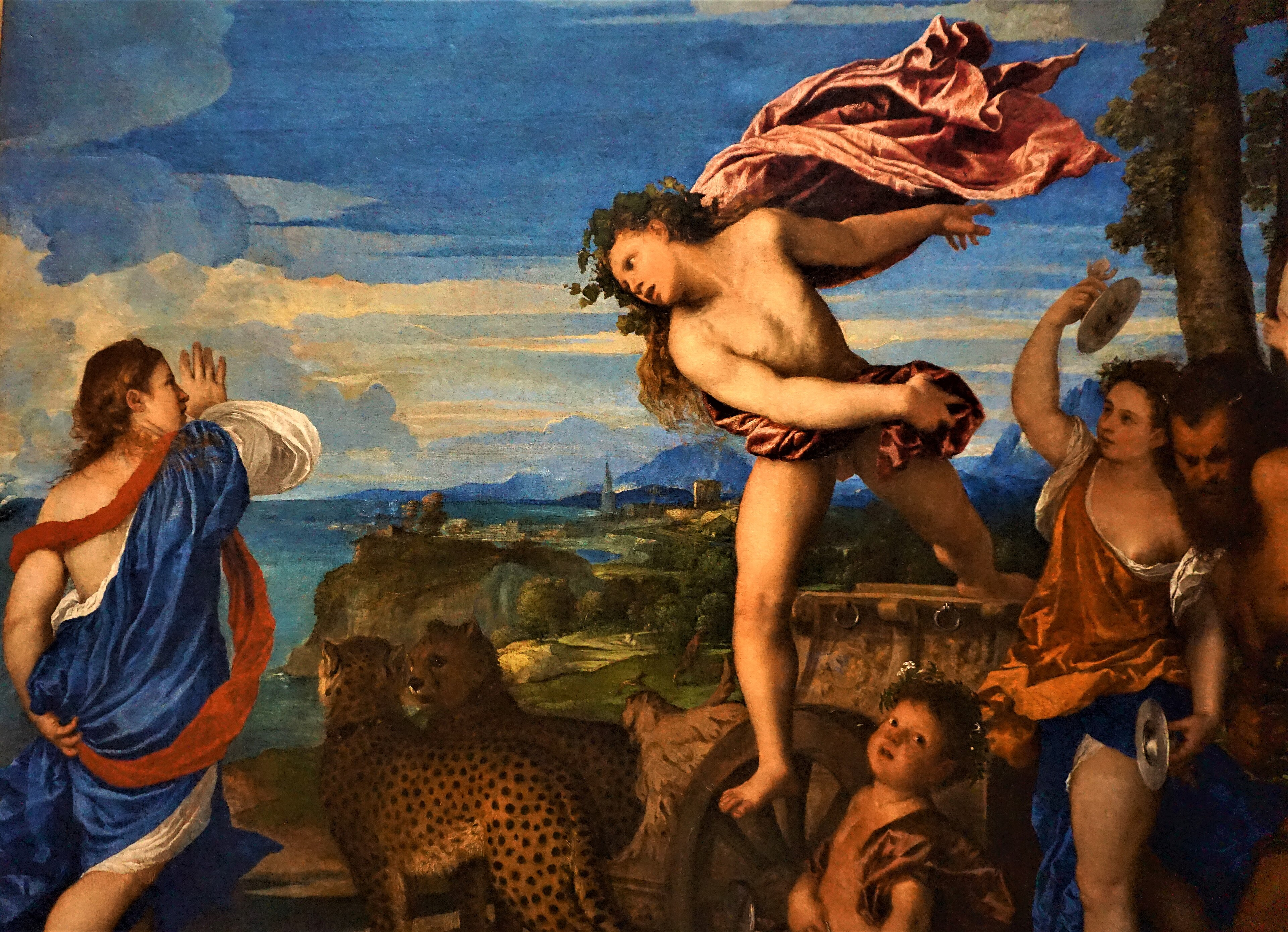
This is the moment Bacchus, the god of wine, first sees Ariadne. According to the story Titian paints, the Cretan princess has been abandoned on the island of Naxos by Theseus. Far out on the water, Theseus's ship is sailing away. Bacchus arrives with his noisy followers and falls in love with her at first sight, leaping from his chariot towards her.
Look at the two of them in the middle of all that noise. Ariadne stands on the edge of a cliff on the left, wrapped in blue and red drapery, her body twisting away from him. Her raised, open hand acknowledges Bacchus. He is young and naked, a crown of vine leaves in his wild curls, one bare foot still in the air as he leaps. His pink cape flutters out behind him, and his wooden chariot is pulled by two spotted cheetahs.
The story comes from the classical authors Ovid and Catullus. Titian was not painting a private fantasy, but a scene his patron would have recognised from ancient poetry. Alfonso the First d'Este, Duke of Ferrara, commissioned it for a room in his palace, the Alabaster Room. Every picture made for that room was a bacchanal: a scene of drinking, music, dancing and lovers.
The commission has a poignant history behind it. The Duke had originally asked Raphael for a painting on a similar subject, but Raphael died in 1520. Titian was the substitute. He began the picture in Venice, probably in 1520, and finished it at Ferrara early in 1523.
Now follow the crowd bursting out of the forest on the right. At least ten figures, some naked and some partly clothed, cavort towards the cliff. One of them is tangled in writhing snakes. Titian based that figure on the ancient Roman sculpture of Laocoön, which had been dug up in Rome in 1506. It is a way of showing off his study of the antique, and it gives the procession a strange, unsettling edge.
The colour is what most people remember. Titian set each pigment down in large, well-spaced areas and used them all at full strength. That gives the painting its jewel-like brilliance. Above Ariadne, the stars of Corona Borealis show her later fate, when Bacchus throws her crown into the sky.
The blue of that sky is the most intense colour in the picture. It is ultramarine, ground from lapis lazuli gemstones, and it was about a hundred times more expensive than any other pigment. The distant landscape uses azurite instead, a slightly greener blue. Titian reserved the costliest colour for the sky above Ariadne's head.
In the top right corner, a tree is painted in rusty ochre. The flowers below it suggest late spring or early summer, and the brown tree was always intended that way. The Gallery's own reading is cautious. Titian may have added it to set a warm contrast in the corner and to continue a diagonal sweep of earthy colour down to the cheetahs and on to Ariadne.
So much of the painting carries your eye towards her: the diagonal of the procession, the warm browns, the leap of the god himself. Ariadne stands between abandonment and rescue, turning back towards a stranger who will make her immortal in the stars. That meeting is the heart of the picture.
The story and its sources
Historical claims are linked to the records below. Close looking and interpretation are identified in the passage notes.
- Passage 1Documented historyBacchus and Ariadne
- Passage 2Close lookingBacchus and Ariadne
- Passage 3Documented historyBacchus and Ariadne
- Passage 4Documented historyBacchus and Ariadne
- Passage 5Close lookingBacchus and Ariadne
- Passage 6Close lookingBacchus and Ariadne
- Passage 7Documented historyBacchus and Ariadne
- Passage 8InterpretationBacchus and Ariadne
- Passage 9InterpretationBacchus and Ariadne
Details to notice
About 4 minutes to readCoastal City Landscape
The deep background band of blue sea, distant mountains, and a walled town with a slender tower, the serene world contrasted against the divine turmoil in the foreground.
Ivy-Crowned Child
A small ivy-wreathed figure at the base of the chariot gazing upward, placing the viewer at ground level beneath the leaping god.
Revelers with Cymbals
The noisy retinue at the right: a figure in orange and blue raising clashing cymbals and an ivy-crowned companion, the bacchic music that heightens the scene's clamor.

Artist portrait Image credit
Titian. Image source · Public domain
About the artist
Titian
Died 1576
Titian was an Italian painter (c.1490–1576). Their work is associated with Venetian school; High Renaissance. Their recorded places of work include Venice; Padua; Milan; Rome; Florence; Augsburg.
- Died
- 1576
- Nationality
- Republic of Venice
- Birthplace
- Pieve di Cadore
- Died in
- Venice
Biography sources
The research & record
Study the work.
Follow the evidence.
Find catalogue details, historical context, technical research and the literature behind this artwork.
The artwork record
Research catalogue
Catalogue information and detailed research, with references that link to the bibliography.
Updated .
Identity and catalogue
Link- Title
- Bacchus and Ariadne
- Artist or attribution
- Titian
- Object date
- 1520-3(The National Gallery, London, n.d.)
- Medium and support
- Oil on canvas
- Dimensions
- 176.5 x 191 cm
- Current collection or location
- National Gallery, London(The National Gallery, London, n.d.)
- Movement or period
- Italian Renaissance, Venetian school
- Country or culture
- Italy
- Depicted subject
- The Cretan princess Ariadne, abandoned on the island of Naxos by Theseus, is surprised by the god Bacchus as he leaps from his chariot, accompanied by his reveling followers. He falls in love with her at first sight, and later throws her crown into the sky to become the constellation Corona Borealis.
- Title variants
- Bacco e Arianna; Bacchus et Ariane; Baco y Ariadna; Bacchus und Ariadne
- Attribution qualification
- Securely attributed to Titian.
- Accession number
- NG35
- Support
- Canvas
- Inscriptions
- Signed bottom left: TICIANVS F.
Read valuation records and their limitations
The catalogue record
The National Gallery, London, catalogues the painting as Titian, Bacchus and Ariadne, dated 1520-3, oil on canvas, measuring 176.5 by 191 cm, and accessioned under inventory number NG35. This title, attribution, medium, support, dimensions and identifier form the object's core catalogue identity as the Gallery records it. The date range 1520-3 belongs to the making of the picture, not to any later act of cataloguing, sale or display; the intervals that follow in the object's history, from its Ferrarese commission to its nineteenth-century purchase, are separate events that the Gallery's account keeps distinct from the 1520-3 execution date. The same catalogue entry records that the painting is not on display at the National Gallery, so the present account of its appearance rests on the Gallery's descriptions and documentation rather than on an assertion about its current hanging.(The National Gallery, London, n.d., Key facts)
The story depicted
The subject is drawn from a story told by the classical authors Ovid and Catullus, and the Gallery's overview summarises its narrative shape: Bacchus, god of wine, falls in love at first sight with Ariadne and leaps from his chariot towards her, and later he throws her crown into the air, immortalising her as the constellation Corona Borealis, which appears as the stars above her head. The picture therefore compresses two successive moments of a classical narrative, the encounter and its celestial sequel, into a single field. The crown and the stars are not decorative additions but the visual statement of Ariadne's eventual translation into the heavens, and the Gallery's account of the iconography places this outcome in the upper part of the composition, above the figure herself.(The National Gallery, London, n.d., Overview)
Interpretation
The narrative presupposes an earlier episode that the painting shows only in its aftermath. Ariadne, a Cretan princess, has been abandoned on the Greek island of Naxos by Theseus, and his ship sails away in the distance, so the arriving god and his followers enter a scene already defined by desertion. This context explains the structure of the encounter the Gallery describes: Bacchus finds Ariadne at the moment of her loss, and the leap and the later constellation both follow from that situation. Taken together with the Ovidian and Catullan source and the two narrative beats, the abandoned princess, the arriving god and the crown lifted to the sky form one continuous story compressed into a single canvas rather than three unrelated motifs.(The National Gallery, London, n.d., Overview)
Commission and setting
The painting was commissioned for the Camerino d'Alabastro, the Alabaster Room, in the Ducal Palace at Ferrara, by Alfonso I d'Este, Duke of Ferrara. All the pictures made for the Camerino, completed between 1514 and 1525, are bacchanals: scenes of hedonism, drinking, music making and lovemaking. This programme gives the subject its setting and its function, since the encounter of Bacchus and Ariadne belonged to a coordinated decorative scheme rather than standing alone, and the Gallery's dating of the room's completion to 1514-1525 frames the painting's own 1520-3 execution within a longer campaign of decoration.(The National Gallery, London, n.d., Overview; Key facts)
The commission had a specific and documented origin. The Duke had commissioned a painting on a similar subject from Raphael, who died in 1520, and Titian's picture was a substitute for that projected work. Titian began Bacchus and Ariadne in Venice in 1520 or 1522 and finished it at Ferrara early in 1523, so the Gallery records an uncertainty about the start of work as well as a division of labour between two cities. The alternative start dates and the split between Venetian beginning and Ferrarese completion are qualifications the Gallery itself preserves, and they should be kept alongside the broader 1520-3 catalogue date rather than resolved into a single precise year.(The National Gallery, London, n.d., In-depth; Key facts)
Titian, Bacchus and Ariadne, 1520-3, oil on canvas, 176.5 x 191 cm, National Gallery, London, inventory number NG35.(The National Gallery, London, n.d.)
Titian's Bacchus and Ariadne illustrates a story told by the classical authors Ovid and Catullus.(The National Gallery, London, n.d.)
Bacchus, god of wine, falls in love at first sight with Ariadne and leaps from his chariot towards her.(The National Gallery, London, n.d.)
Later, Bacchus throws Ariadne's crown into the air, immortalising her as the constellation Corona Borealis, represented by the stars above her head.(The National Gallery, London, n.d.)
Subject and iconography
LinkRead valuation records and their limitations
The recorded composition
Visual observation
The composition of Bacchus and Ariadne is organised around two opposed zones of action. At the left, Ariadne stands on the edge of a cliff in blue and red drapery, her body twisting away from the approaching god while her raised open hand acknowledges him. In the centre, Bacchus is a youthful, naked figure riding a wooden chariot pulled by two spotted cheetahs; he wears a crown of vine leaves tangled in his wild brown curls, leaps from the chariot with one bare foot still in the air, and his pink cape flutters out behind him. From the right, a group of at least ten diverse, partially clothed or naked figures burst out of a forest and cavort towards the cliff on the left, above the sea. Read together, these three descriptions establish the picture's dynamic: the still, turned figure of Ariadne at one edge, the suspended leap of Bacchus at the centre, and the noisy procession entering from the opposite side and driving the eye across the canvas towards her.(The National Gallery, London, n.d., Audio description transcript)
Antique sources and subsequent influence
The iconography draws on classical poetry and on classical sculpture. The story illustrated is told by the classical authors Ovid and Catullus, and Titian drew inspiration from ancient sculpture, depicting authentically classical costumes; within the procession, the figure tangled in writhing snakes is based on the ancient Roman sculpture of Laocoön, excavated in Rome in 1506. The source establishes this as a specific derivation from a named antique model, not a general resemblance to classical art. At the same time, the painting records a later episode in the myth: Bacchus throws Ariadne's crown into the air, immortalising her as the constellation Corona Borealis, represented by the stars above her head. The visible stars are thus a narrative sign of her eventual fate as well as a feature of the sky.(The National Gallery, London, n.d., In-depth; Audio description transcript)
Bacchus is described as a youthful, naked man in the centre of the painting, riding a wooden chariot pulled by two spotted cheetahs, with a crown of vine leaves tangled in his wild brown curls, leaping from the chariot with one bare foot in the air and his pink cape fluttering out behind.(The National Gallery, London, n.d.)
Ariadne stands on the edge of a cliff at the left of the painting, in blue and red drapery, her body twisting away while her raised open hand acknowledges Bacchus.(The National Gallery, London, n.d.)
A group of at least ten diverse, partially clothed or naked figures burst out of a forest on the right, cavorting towards the cliff on the left, overlooking the sea.(The National Gallery, London, n.d.)
Historical context
LinkRead valuation records and their limitations
The subject and its literary source
The National Gallery's account identifies the subject of the painting as the Cretan princess Ariadne, abandoned on the Greek island of Naxos by Theseus, whose ship is shown sailing away in the distance. Within that narrative the arrival of Bacchus and his followers is the turning point, and the Gallery frames the canvas around this meeting rather than around the voyage that precedes it. The subject is not an invention of the painter: the Gallery states that Titian illustrated a story told by the classical authors Ovid and Catullus, so the scene belonged to a body of ancient poetry a patron could be expected to recognise. This matters for how the commission is understood, because the narrative content was shared literary property, while the choices of composition, colour and moment were the painter's response to a specific room and a specific patron.(The National Gallery, London, n.d., Overview)
The Camerino d'Alabastro and the patron
The painting belongs to the Camerino d'Alabastro, the Alabaster Room, in the Ducal Palace at Ferrara, and was commissioned by Alfonso I d'Este, Duke of Ferrara. The Gallery describes the complete decorative programme of that room, finished between 1514 and 1525, as consisting entirely of bacchanals: scenes of hedonism, drinking, music making and lovemaking. Bacchus and Ariadne therefore had to work as one panel within a coordinated sequence of sensuous mythological pictures rather than as an isolated devotional or dynastic image. The Gallery's account of the programme supplies the social world of the commission: a ducal apartment whose decoration was organised around pleasure, wine and festivity, the kind of subject matter that gave a Renaissance ruler a classical, mythic idiom for his own magnificence.(The National Gallery, London, n.d., Overview)
Commission, substitution and dating
The documented circumstances of execution establish both a chronology and a substitution. Titian began Bacchus and Ariadne in Venice in 1520 or 1522 and finished it at Ferrara early in 1523, so the work spans a period of travel and the crossing of two centres of production. More decisively, the Gallery records that the painting replaced a picture on a similar subject which the Duke had commissioned from Raphael, who died in 1520. Titian was thus the beneficiary of a broken commission rather than its original designer. That fact sets limits on what can be inferred about the Duke's intentions: the choice of subject and the ambition for the room preceded Titian's involvement, while the execution of this particular canvas belongs to Titian and to the years 1520 to 1523. The two dates given for the start in Venice, 1520 or 1522, are recorded by the Gallery as alternatives and should be carried forward as such.(The National Gallery, London, n.d., In-depth)
The Cretan princess Ariadne has been abandoned on the Greek island of Naxos by Theseus, whose ship sails away in the distance.(The National Gallery, London, n.d.)
All the pictures for the Camerino, completed 1514-1525, are bacchanals: scenes of hedonism, drinking, music making and lovemaking.(The National Gallery, London, n.d.)
Titian began Bacchus and Ariadne in Venice in 1520 or 1522 and finished it at Ferrara early in 1523.(The National Gallery, London, n.d.)
The painting was a substitute for a painting on a similar subject which the Duke had commissioned from Raphael, who had died in 1520.(The National Gallery, London, n.d.)
Materials and technique
LinkRead valuation records and their limitations
Pigments and colouristic method
The National Gallery's account describes Bacchus and Ariadne as oil on canvas, measuring 176.5 by 191 cm (inventory number NG35), painted by Titian between 1520 and 1523. The support and medium belong to the catalogue information for the work; the colouristic observations below come from the Gallery's overview and in-depth essays and from its audio description transcript, and they concern pigments and handling rather than any recorded technical analysis of layers, grounds or condition.(The National Gallery, London, n.d., Overview; In-depth)
According to the National Gallery, Titian combined all of the most vibrant pigments available in Venice at the time in this single canvas. Rather than blending them into a unified tonal range, he used each pigment separately in large areas of colour, keeping them well spaced within the picture and applying them all at full strength. The Gallery presents this as the source of the painting's rich, jewel-like quality. The description is an account of the palette and its distribution as characterised by the museum, not a report of pigment sampling or stratigraphic analysis.(The National Gallery, London, n.d., Overview; In-depth)
The blues carry the clearest evidence of deliberate material hierarchy. The sky is the most intense colour in the picture and is painted in ultramarine, the purest pigment, made from crushed lapis lazuli gemstones and described by the Gallery as 100 times more expensive than any other. The slightly greenish blue of the distant landscape is instead azurite. Setting the costliest blue in the sky above Ariadne and a cheaper blue in the distance shows how expense and placement worked together in Titian's design, at least as the Gallery's account frames it.(The National Gallery, London, n.d., Audio description transcript; In-depth)
In the top right corner the tree is painted in ochre colours and, the Gallery states, was always intended to be rusty brown. This is a point about intention in colour rather than about alteration over time: the brown is not described as a later change or discoloration. The Gallery notes that the iris, columbine and vine shoots in the picture suggest late spring or early summer, so the rusty tree sits against a seasonally fresh flora without being read as a contradiction of it.(The National Gallery, London, n.d., In-depth)
Visual observation
The Gallery proposes that Titian may have introduced the brown tree to provide a patch of warm contrasting colour at the top corner and to continue a strong diagonal sweep through the earthy colours of the bodies down to the brown cheetahs, drawing the viewer's eye to Ariadne. The cautious wording, attributing the motive as a possibility rather than a documented intention, should be preserved: the compositional function is offered as the museum's reading of the picture's design, not as evidence from the artist's own statements. The warm ochres of the tree thus connect the palette to the picture's narrative focus on the meeting between Bacchus and Ariadne.(The National Gallery, London, n.d., In-depth; Audio description transcript)
Handling as well as pigment is part of the Gallery's account. In the folds of the pale yellow drapery beneath the urn on which Titian signed his name, the modelling is achieved with brushstrokes rather than painted shadows. That description identifies a visible technique of building form through the application of paint, and it locates the passage in relation to the signature, although the evidence supplied does not describe the signature itself or the drapery's position in the composition beyond that reference. The observation belongs to the museum's reading of the painted surface; no separate technical examination of the brushwork is cited here.(The National Gallery, London, n.d., In-depth)
Taken together, the pigment and handling observations help explain why the picture matters in the history of art beyond its subject. The Gallery states that Bacchus and Ariadne had an important influence on European art, helping the loves of the gods become a popular subject for gallery pictures, notably in the poesie Titian painted for King Philip II of Spain over 20 years later. Because that influence is attributed to the painting as a whole, the palette described here, the spaced areas of full-strength colour and the brush-built drapery folds, belongs to the object whose later reputation the Gallery is tracing, even though the evidence does not itemise which later works responded to which material features.(The National Gallery, London, n.d., In-depth)
Titian combined all of the most vibrant pigments available in Venice at the time in this single canvas.(The National Gallery, London, n.d.)
Titian used each pigment separately in large areas of colour, keeping them well spaced within the picture and using them all at full strength to give the painting its rich, jewel-like quality.(The National Gallery, London, n.d.)
The ultramarine blue in the sky is the most intense colour and the purest pigment, made from crushed lapis lazuli gemstones, 100 times more expensive than any other.(The National Gallery, London, n.d.)
The sky blue is differentiated from the slightly greenish blue of the distant landscape, painted with the pigment azurite.(The National Gallery, London, n.d.)
The orange-brown tree in the top right corner is painted in ochre colours and was always intended to be rusty brown, even though the iris, columbine and vine shoots suggest late spring or early summer.(The National Gallery, London, n.d.)
The folds of the pale yellow drapery beneath the urn on which he signed his name are modelled with brushstrokes rather than painted shadows.(The National Gallery, London, n.d.)
Provenance and ownership
LinkRead valuation records and their limitations
Commission and early history at Ferrara
Bacchus and Ariadne was commissioned by Alfonso I d'Este, Duke of Ferrara, for the Camerino d'Alabastro, the Alabaster Room in the Ducal Palace at Ferrara. The National Gallery's account frames the work within that room's programme: all the pictures made for the Camerino, completed between 1514 and 1525, are bacchanals, scenes of hedonism, drinking, music making and lovemaking. The picture's subject, the abandoned Cretan princess Ariadne on Naxos with Theseus's ship departing in the distance, thus entered a decorative ensemble built around ancient poetry and conviviality rather than an isolated gallery canvas.(The National Gallery, London, n.d., Overview)
Documented transfers, 1584 to 1826
The earliest documented notice of the picture's location is Lomazzo's mention in 1584, when it was still at Ferrara. In 1598 it was appropriated and sent to Rome by Cardinal Pietro Aldobrandini when Ferrara passed to the Papacy. The National Gallery's provenance then records the painting in Aldobrandini inventories and at the Villa Aldobrandini in Rome. These entries establish an unbroken sequence of documented locations from the late sixteenth century onward: Ferrara, then Rome, under a named new possessor whose acquisition is explicitly described as an appropriation tied to a political transfer of territory.(The National Gallery, London, n.d., Provenance)
Interpretation
The provenance supplied here does not bridge the whole distance between the Roman Aldobrandini holdings and the nineteenth-century London market. What is documented is that the National Gallery acquired the painting by purchase in 1826, and that its previous owner was Thomas Hamlet. The evidence does not record how or when the picture left the Aldobrandini collections, nor does it specify the date, terms or intermediary of Hamlet's ownership. The gap between the Villa Aldobrandini record and Thomas Hamlet should be treated as an unrecorded interval, not as proof of any particular chain of ownership; only the 1826 purchase and the immediately preceding owner are stated.(The National Gallery, London, n.d., Details; Provenance)
Why the documented record matters
The provenance is unusually instructive for a Renaissance masterpiece because it traces a change of status as well as a change of address. The canvas was made for a specific dynastic interior at Ferrara, was removed in 1598 as part of the papal absorption of Ferrara and carried to Rome by a cardinal, and then entered a public British collection by purchase in 1826. Read alongside the National Gallery's statement that the work had an important influence on European art, helping the loves of the gods become a popular subject for gallery pictures, including Titian's later poesie for King Philip II of Spain, the documented movements show a painting that moved from courtly chamber to princely Roman collection to the modern museum, a trajectory that parallels its subject's migration from poetic narrative to the gallery picture.(The National Gallery, London, n.d., Provenance; Details; In-depth; Overview)
Object record and later display
The museum and supplementary institutional records also supply identification and display history that belong with the provenance account. The painting is not on display at the National Gallery, London, at the time of the consulted source, and it was shown in the exhibition 'Titian' at the Sainsbury Wing from 19 February to 18 May 2003. The reported details also give the work an inventory number, NG35, and record an inscription location. These identifiers and exhibition dates, rather than the object's visual description, are the later institutional facts that complete the documented history of the work's public life after its 1826 acquisition.(commons.wikimedia.org, n.d., Exhibition history)(The National Gallery, London, n.d., Details)
The painting was commissioned for the Camerino d'Alabastro (Alabaster Room) in the Ducal Palace, Ferrara, by Alfonso I d'Este, Duke of Ferrara.(The National Gallery, London, n.d.)
Provenance: Mentioned by Lomazzo in 1584 as at Ferrara; appropriated in 1598 and sent to Rome by Cardinal Pietro Aldobrandini when Ferrara passed to the Papacy; recorded in Aldobrandini inventories and at Villa Aldobrandini, Rome.(The National Gallery, London, n.d.)
Acquired by the National Gallery in 1826 by purchase. Previous owner: Thomas Hamlet.(The National Gallery, London, n.d.)
Provenance timeline
- 1514-1525
The Camerino pictures, including this work, are completed within this span.(The National Gallery, London, n.d., Overview)
- 1520 or 1522
Titian begins the painting in Venice.(The National Gallery, London, n.d., In-depth)
- early 1523
Titian finishes the painting at Ferrara.(The National Gallery, London, n.d., In-depth)
- 1584
Lomazzo mentions the painting as being at Ferrara.(The National Gallery, London, n.d., Provenance)
- 1598
The painting is appropriated and sent to Rome by Cardinal Pietro Aldobrandini when Ferrara passes to the Papacy; it is later recorded in Aldobrandini inventories and at Villa Aldobrandini, Rome.(The National Gallery, London, n.d., Provenance)
- 1826
The National Gallery acquires the painting by purchase; the previous owner is Thomas Hamlet.(The National Gallery, London, n.d., Details)
- 19 February 2003 - 18 May 2003
The painting is exhibited in the exhibition Titian at the Sainsbury Wing.(commons.wikimedia.org, n.d., Exhibition history)
Exhibition history
LinkRead valuation records and their limitations
The 2003 Titian Exhibition
The exhibition record for Titian's Bacchus and Ariadne that the supplied evidence establishes is brief and specific: the painting was exhibited in the exhibition titled 'Titian' at the Sainsbury Wing, from 19 February 2003 to 18 May 2003. This is the only loan or exhibition episode documented in the evidence assembled here, and it is recorded as exhibition history rather than as a statement about where the picture hangs now. The same body of evidence separately states that the painting is not on display at the National Gallery, London, so the 2003 showing at the Sainsbury Wing must be kept distinct both from the picture's present location and from its earlier history in Ferrara, Rome and private ownership before its purchase in 1826. The exhibition is thus a modern episode in a much longer biography of the object, not a description of its permanent installation.(commons.wikimedia.org, n.d., Exhibition history)(The National Gallery, London, n.d., Details)
Interpretation
Placing that exhibition in the object's longer history clarifies what kind of event it was. The canvas was commissioned for the Camerino d'Alabastro in the Ducal Palace, Ferrara, by Alfonso I d'Este, Duke of Ferrara, as part of a cycle of bacchanals completed between 1514 and 1525, and Titian worked on it between Venice and Ferrara, finishing it there early in 1523. It was mentioned by Lomazzo in 1584 as still at Ferrara, was appropriated in 1598 and sent to Rome by Cardinal Pietro Aldobrandini when Ferrara passed to the Papacy, and was recorded in Aldobrandini inventories and at the Villa Aldobrandini in Rome before being acquired by the National Gallery in 1826 by purchase from Thomas Hamlet. Seen against that sequence, the 2003 'Titian' exhibition belongs to the painting's modern museum life, when a work made for a Renaissance court room and later displaced through papal appropriation could be shown to a public audience under the name of its maker.(The National Gallery, London, n.d., Overview; Provenance; Details)(commons.wikimedia.org, n.d., Exhibition history)
The evidence supplied for this section does not provide a catalogue entry, catalogue number, page or plate for the 2003 exhibition, and none should be inferred. What it does record is the exhibition title, the venue and the exact dates, and those details are best preserved without elaboration. The section therefore distinguishes three separate things that are often conflated in writing about such a painting: an exhibition in which the work is documented to have appeared, the current display status of the work at its owning institution, and scholarly or curatorial literature that discusses the object whether or not it was on view at the time. The evidence here documents the first, reports the second, and does not supply the third in catalogue form.(commons.wikimedia.org, n.d., Exhibition history)
Interpretation
The later reception of Bacchus and Ariadne gives the 2003 exhibition a wider frame. The National Gallery's account states that the painting had an important influence on European art, helping the loves of the gods become a popular subject for gallery pictures, notably in the poesie Titian painted for King Philip II of Spain over 20 years later. A twentieth-century exhibition devoted to Titian could therefore present the canvas not only as a masterpiece of the Ferrarese camerino but as a point of departure for a later tradition of mythological painting. That reception history is documented in its own right and should not be read back into the circumstances of the 2003 showing, which the evidence describes only by title, venue and dates.(The National Gallery, London, n.d., In-depth)(commons.wikimedia.org, n.d., Exhibition history)
Exhibited in the exhibition 'Titian' at the Sainsbury Wing, 19 February 2003 - 18 May 2003.(commons.wikimedia.org, n.d.)
Reception and literature
LinkRead valuation records and their limitations
Immediate and early afterlife: imitation and record
The evidence for the painting's reception begins almost at the moment of its completion. The National Gallery's account states that Bacchus and Ariadne had an important influence on European art, helping the loves of the gods become a popular subject for gallery pictures. The comparison the source draws is precise in date and patron: the loves of the gods became notably current in the poesie Titian painted for King Philip II of Spain over 20 years later. Since Titian finished this canvas at Ferrara early in 1523, the poesie fall roughly two decades or more after it, which makes the Ferrara picture an early and consequential example of a genre of mythological gallery painting whose prestige the later Habsburg commissions consolidated. The claim is one of influence and subject popularity rather than a documentary chain of copies, so it should be read as the museum's account of the painting's place in a wider European development, not as evidence for any specific transaction between Ferrara and Spain.(The National Gallery, London, n.d., In-depth)
Bacchus and Ariadne had an important influence on European art, helping the loves of the gods become a popular subject for gallery pictures, notably in the poesie Titian painted for King Philip II of Spain over 20 years later.(The National Gallery, London, n.d.)
Interpretations and debates
LinkRead valuation records and their limitations
Two Kinds of Reading
Interpretation
The National Gallery's account of Bacchus and Ariadne presents two distinct lines of interpretation, and they carry different kinds of authority. One concerns Titian's relationship to ancient sculpture: the Gallery states that Titian drew inspiration from classical sculpture and depicted authentically classical costumes, basing the figure tangled in writhing snakes on the ancient Roman sculpture of Laocoön, excavated in Rome in 1506. This is an attribution of artistic method, a claim about how Titian worked and what visual models he consulted. It sits alongside, but should not be conflated with, the second line of reading, which concerns the compositional function of a single motif within the canvas: the suggestion that Titian may have introduced the brown tree to provide a patch of warm contrasting colour at the top corner and to continue the strong diagonal sweep through the earthy colours of the bodies down to the brown cheetahs, drawing our eyes to Ariadne. The hedging in the second statement, marked by "may have", is not incidental. The Gallery does not claim to know Titian's intention; it offers a plausible account of how the picture works on a viewer, grounded in the visible arrangement of colour and form.(The National Gallery, London, n.d., In-depth)
The distinction matters because the two claims rest on different supports. The Laocoön connection is external: it depends on a known sculpture with a documented excavation date, which supplies a terminus for the model's availability. The brown tree reading is internal: it depends on what can be seen in the picture, the placement of a warm brown mass at the upper right, the earthy tones of the bodies across the middle, and the brown of the cheetahs that pull the chariot. That the composition draws the eye toward Ariadne is a description of visual effect that a viewer can test by looking; it does not require access to the painter's private reasoning. The Gallery's phrasing keeps that boundary intact, and a research account should preserve it rather than converting a compositional observation into a statement about what Titian decided.(The National Gallery, London, n.d., In-depth)
The visible structure of the painting gives these readings their footing. Ariadne stands on the edge of a cliff at the left of the painting, in blue and red drapery, her body twisting away while her raised open hand acknowledges Bacchus. He is described as a youthful, naked man in the centre of the painting, riding a wooden chariot pulled by two spotted cheetahs, with a crown of vine leaves tangled in his wild brown curls, leaping from the chariot with one bare foot in the air and his pink cape fluttering out behind. Across the right, a group of at least ten diverse, partially clothed or naked figures burst out of a forest and cavort towards the cliff on the left, overlooking the sea. The diagonal sweep the Gallery identifies in its colour reading follows the movement these figures describe: from the forest on the right, through the procession and the god's leap, toward the figure on the cliff. The colour claim and the figural arrangement therefore reinforce one another, which is part of why the Gallery's cautious "may have" is a reasonable inference rather than an arbitrary one.(The National Gallery, London, n.d., Audio description transcript; In-depth)
Antique Models and Narrative
The subject these figures enact is drawn from ancient poetry. The Cretan princess Ariadne has been abandoned on the Greek island of Naxos by Theseus, whose ship sails away in the distance. Bacchus, arriving with his followers, falls in love with her at first sight and leaps from his chariot toward her. The Laocoön quotation sits within this narrative scene rather than apart from it: the figure tangled in snakes belongs to the god's noisy retinue, and the sculptural reference is embedded in the procession that moves across the canvas toward Ariadne. Because the model is a specific, datable antique object, the citation is also a form of display, evidence of the painter's study of classical sculpture carried into a scene whose costumes the Gallery describes as authentically classical. The narrative context and the antiquarian ambition are not competing explanations of the figure; they operate together.(The National Gallery, London, n.d., Overview; In-depth)
The poem and the room together explain why this painting looks the way it does. All the pictures for the Camerino, completed 1514-1525, are bacchanals: scenes of hedonism, drinking, music making and lovemaking. Within that program, Bacchus and Ariadne occupies a particular place in the commission's history. The painting was a substitute for a painting on a similar subject which the Duke had commissioned from Raphael, who had died in 1520. Titian began Bacchus and Ariadne in Venice in 1520 or 1522 and finished it at Ferrara early in 1523. The difference between 1520 and 1522 in the sources is left unresolved in the evidence, and it should remain so: the start date is given as one or the other, while the completion at Ferrara early in 1523 is stated without qualification. This matters for interpretation because the antique citations in the picture were made in the immediate aftermath of Raphael's death and in dialogue with a commission originally conceived for another artist.(The National Gallery, London, n.d., Overview; In-depth)
Later Influence
Taken together, the evidence shows a painting that is legible on several levels at once. Its story comes from Ovid and Catullus; its mood belongs to the bacchanal program of the Camerino; its classical quotations are datable to specific antique objects; and its colour scheme was devised to direct attention toward the figure at the cliff edge. The Gallery's readings are best kept at the level they are offered: a documented tradition about Titian's use of antique sculpture, a cautious compositional suggestion about the brown tree, and a broad claim about the painting's later influence. None of these requires an account of the maker's private intent, and the evidence supplied does not provide one. The object matters within a larger history because it joins classical learning, a patron's program, and a distinctive use of colour in a single canvas whose influence the Gallery traces forward into Titian's later work for Philip II.(The National Gallery, London, n.d., In-depth; Overview)
Titian drew inspiration from classical sculpture and depicted authentically classical costumes, basing the figure tangled in writhing snakes on the ancient Roman sculpture of Laocoön, excavated in Rome in 1506.(The National Gallery, London, n.d.)
Titian may have introduced the brown tree to provide a patch of warm contrasting colour at the top corner and to continue the strong diagonal sweep through the earthy colours of the bodies down to the brown cheetahs, drawing our eyes to Ariadne.(The National Gallery, London, n.d.)
Collection and display
LinkRead valuation records and their limitations
Collection and display
The National Gallery's own object record states plainly that Bacchus and Ariadne is not on display at the National Gallery, London. This is a present-tense statement about location and access rather than about the painting's ownership or condition, and the same source gives no reason for the absence. It matters for any account of the object because it separates the painting's documented institutional home in London from its current visibility to a gallery visitor: the work is a National Gallery painting that a visitor to the building would not presently encounter on the walls. Everything the rest of this record establishes about the canvas, its commission, its making and its provenance therefore describes an object whose display status and whose collection status must be held apart.(The National Gallery, London, n.d., Location)
The Gallery's provenance account traces the painting through several distinct phases of ownership before it reached London. It is said to be mentioned by Lomazzo in 1584 as being at Ferrara, which places the picture in its city of origin within the sixteenth century. In 1598 it was appropriated and sent to Rome by Cardinal Pietro Aldobrandini when Ferrara passed to the Papacy, and it is subsequently recorded in Aldobrandini inventories and at the Villa Aldobrandini in Rome. The National Gallery acquired it in 1826 by purchase, and its previous owner is named as Thomas Hamlet. These are discrete, documented milestones rather than a continuous chain, and the source does not fill the intervals between them. The earlier part of this history is inseparable from the painting's origin, since it was commissioned by Alfonso I d'Este, Duke of Ferrara, for the Camerino d'Alabastro (Alabaster Room) in the Ducal Palace at Ferrara, as one of a group of bacchanal pictures completed between 1514 and 1525. The 1598 transfer to Rome is thus a removal of the work from the palace context for which its subject and format were devised, and the 1826 purchase is the point at which that Ferrarese and Roman history becomes the prehistory of a London collection object.(The National Gallery, London, n.d., Location)
The object and its commission
The Gallery's curatorial overview supplies the physical and art-historical identity of the work: Titian, Bacchus and Ariadne, dated 1520-3, oil on canvas, 176.5 by 191 cm, National Gallery, London, inventory number NG35. The subject is described as illustrating a story told by the classical authors Ovid and Catullus. The narrative elements the Gallery identifies are Theseus's departure, with the Cretan princess Ariadne abandoned on the Greek island of Naxos and his ship sailing away in the distance; Bacchus, god of wine, falling in love with her at first sight and leaping from his chariot towards her; and, later, Bacchus throwing Ariadne's crown into the air, immortalising her as the constellation Corona Borealis, represented by the stars above her head. The commission is attributed to Alfonso I d'Este, Duke of Ferrara, for the Camerino d'Alabastro in the Ducal Palace at Ferrara, and all the pictures made for that room are characterised as bacchanals: scenes of hedonism, drinking, music making and lovemaking. On the making of the picture, the Gallery states that Titian began it in Venice in 1520 or 1522 and finished it at Ferrara early in 1523, and that it served as a substitute for a painting on a similar subject that the Duke had commissioned from Raphael, who had died in 1520. The two-year range given for the start is a qualification the record preserves rather than resolves. The Gallery also credits the painting with an important influence on European art, helping the loves of the gods become a popular subject for gallery pictures, notably in the poesie Titian painted for King Philip II of Spain over twenty years later. That claim concerns the work's later reputation and reception, not the intentions behind its making, and it is distinct from the documented circumstances of the commission.(The National Gallery, London, n.d., Location)
Surface, materials and pictorial construction
The Gallery's account of the picture's surface connects what a viewer sees to what the evidence establishes about materials and method. Bacchus is described as a youthful, naked man in the centre, riding a wooden chariot pulled by two spotted cheetahs, with a crown of vine leaves tangled in his wild brown curls, leaping from the chariot with one bare foot in the air and his pink cape fluttering out behind. Ariadne stands on the edge of a cliff at the left, in blue and red drapery, her body twisting away while her raised open hand acknowledges Bacchus. A group of at least ten diverse, partially clothed or naked figures burst out of a forest on the right, cavorting towards the cliff on the left, overlooking the sea. The Gallery states that Titian drew inspiration from classical sculpture and depicted authentically classical costumes, basing the figure tangled in writhing snakes on the ancient Roman sculpture of Laocoön, excavated in Rome in 1506. On technique, the record says Titian combined all of the most vibrant pigments available in Venice at the time in this single canvas, using each pigment separately in large areas of colour, keeping them well spaced within the picture and using them all at full strength to give the painting its rich, jewel-like quality. The ultramarine blue in the sky is described as the most intense colour and the purest pigment, made from crushed lapis lazuli gemstones and 100 times more expensive than any other; the sky blue is differentiated from the slightly greenish blue of the distant landscape, painted with the pigment azurite. The orange-brown tree in the top right corner is painted in ochre colours and is said to have been always intended to be rusty brown, even though the iris, columbine and vine shoots suggest late spring or early summer. Here the Gallery offers a cautious, attributed reading: Titian may have introduced the brown tree to provide a patch of warm contrasting colour at the top corner and to continue the strong diagonal sweep through the earthy colours of the bodies down to the brown cheetahs, drawing the eye to Ariadne. The word "may" is the Gallery's, and the seasonal mismatch between the intended brown tree and the flowering plants is preserved as an observation about the picture rather than explained away. The record also notes that the folds of the pale yellow drapery beneath the urn on which Titian signed his name are modelled with brushstrokes rather than painted shadows, a detail of handling that belongs with the account of large, well-spaced areas of pure colour rather than with any narrative reading of the scene.(The National Gallery, London, n.d., Location)
The object and its commission
Interpretation
Read together, these records show why the painting holds a place in a larger history of art and material culture that is larger than its narrative charm. The commission situates it within a coherent programme of bacchanals for a single room in a ducal palace, completed across 1514 to 1525, and the substitution of Titian for the deceased Raphael makes the picture a document of how a patron's programme was reconstituted when a planned artist became unavailable; the Gallery's dating of a start in Venice in 1520 or 1522 and completion at Ferrara early in 1523 places the execution across two centres. The technique described, with the costliest available pigment reserved for the sky and cheaper azurite used for the distant landscape, makes the painting evidence for the economics of Venetian materials as well as for colouristic design, while the Laocoön-derived figure shows the direct use of recently excavated antique sculpture as a working model. The Gallery's claim that the picture helped make the loves of the gods a popular subject for gallery pictures, notably in Titian's later poesie for Philip II, links the Ferrarese room to a subsequent European taste for mythological painting. The provenance, from the 1584 mention at Ferrara through the 1598 appropriation and transfer to Rome to the 1826 purchase from Thomas Hamlet, traces the same canvas from a palace interior to a modern public collection. The National Gallery's statement that the work is not on display qualifies how that collection history is presently experienced, without altering any of the documented facts about the object's making, materials or ownership.(The National Gallery, London, n.d., Location)
The painting is not on display at the National Gallery, London.(The National Gallery, London, n.d.)
Documented values and qualified estimates
LinkRead valuation records and their limitations
Recorded values
Interpretation
The only recorded valuation attached to Bacchus and Ariadne in the supplied evidence is a model-generated working insurance estimate, dated 16 October 2026, giving a broad range of US$500 million to US$2 billion. Its stated methodology combines the painting's secure attribution to Titian, its date and oil-on-canvas medium, its large scale, its status as an iconic National Gallery masterpiece, its collection history from the Ferrara court through the Aldobrandini family, and its acquisition in 1826, applying a conservative multiplier approach judged appropriate to unique, securely attributed Renaissance masterpieces held by museums. The document itself insists that the range is deliberately wide to support manual review, is not an official insurance value, appraisal, auction result or sale price, may not reflect current market or institutional conditions, and must be verified by a qualified professional before any insurance, acquisition or financial decision.(The National Gallery, London, n.d.)(commons.wikimedia.org, n.d.)
The estimate's references to Renaissance value and to the painting's cultural standing correspond to documented material facts rather than to any market data. Titian combined all of the most vibrant pigments available in Venice at the time in this single canvas, setting each pigment separately in large areas of colour, well spaced and at full strength, to give the jewel-like quality the Gallery describes. The ultramarine blue of the sky, made from crushed lapis lazuli gemstones, is the most intense colour and the purest pigment, 100 times more expensive than any other, while the sky blue is differentiated from the slightly greenish blue of the distant landscape painted with azurite. The ochre orange-brown tree in the top right corner was always intended to be rusty brown even though the iris, columbine and vine shoots suggest late spring or early summer; the Gallery suggests cautiously that Titian may have introduced it to provide a patch of warm contrasting colour in the top corner and to continue the strong diagonal sweep through the earthy colours of the bodies down to the brown cheetahs, drawing the eye to Ariadne. The folds of the pale yellow drapery beneath the urn on which he signed his name are modelled with brushstrokes rather than painted shadows. These are the features of ambition and expense that give the modern working estimate its stated rationale, and they are also the features that make the painting a document of Venetian material practice.(The National Gallery, London, n.d.)(commons.wikimedia.org, n.d.)
The painting's later standing, which the valuation cites as an input, is partly documented by exhibition history: the work was exhibited in the exhibition 'Titian' at the Sainsbury Wing between 19 February 2003 and 18 May 2003, as recorded in the supplementary institutional record. That record also supplies the object type, depicted people, exhibition history, accession number and inscription location. The National Gallery's account adds that Bacchus and Ariadne had an important influence on European art, helping the loves of the gods become a popular subject for gallery pictures, notably in the poesie Titian painted for King Philip II of Spain over 20 years later. The working range should therefore be read as a modern administrative artefact built on a documented artistic and institutional history, not as evidence of what the painting was worth in the sixteenth century or in 1826, for which the supplied sources record no figures.(The National Gallery, London, n.d.)(commons.wikimedia.org, n.d.)
Working estimate
Calculated working insurance estimate, not a sale price: Estimated value: US$500M to US$2B Recorded date: Working calculation, generated 2026-10-16. Methodology: This working insurance range is calculated from the confirmed artwork context and the supplied National Gallery and Wikimedia records. It reflects the painting's secure attribution to Titian, its date and oil-on-canvas medium, its large scale, its status as an iconic National Gallery masterpiece, its prominent collection history from the Ferrara court through the Aldobrandini family, and its acquisition in 1826. Because no public sale or official insurance valuation is available and the work is not on display, the range uses a broad conservative multiplier approach for unique, museum-held, securely attributed Renaissance masterpieces. The range is intentionally wide to support manual review and should not be treated as a precise or official figure. Qualification: This is a model-generated working range for manual review only. It is not an official insurance value, appraisal, auction result, or sale price. The range is approximate, may not reflect current market or institutional conditions, and must be verified by a qualified professional before any insurance, acquisition, or financial decision.(The National Gallery, London, n.d.)(commons.wikimedia.org, n.d.)
Further reading
Books for a closer look
Paid links. As an Amazon Associate I earn from qualifying purchases.

Open Library Bacchus And Ariadne According To Ancient Art And Mythology - Pamphlet
Kessinger Publishing, LLC · Pmplt edition
Richard Payne Knight's pamphlet is titled Bacchus and Ariadne According To Ancient Art And Mythology, addressing the classical iconography and mythological tradition of the very subject Titian depicts, which the documented facts connect to Ovid and Catullus and to ancient Roman sculpture such as the Laocoon. Relevant as documented treatment of the subject's antique sources and reception.
ISBN 9781430403272
Bibliography
Sources and further reading
References are arranged by author or organisation, with links to the original publications. Where no publication date is recorded, n.d. means no date.
Source notes updated .
No recorded sources match these filters. Reset the filters to see the full bibliography.
- 02
Official · About this artwork
Wikimedia Commons file page used as a supplementary institutional record; supplies object type, depicted people, exhibition history, accession number and inscription location.
Citation text
- 03
Book
Bacchus And Ariadne According To Ancient Art And Mythology - Pamphlet. Pmplt edition. Kessinger Publishing, LLC.
Richard Payne Knight's pamphlet is titled Bacchus and Ariadne According To Ancient Art And Mythology, addressing the classical iconography and mythological tradition of the very subject Titian depicts, which the documented facts connect to Ovid and Catullus and to ancient Roman sculpture such as the Laocoon. Relevant as documented treatment of the subject's antique sources and reception.
- ISBN
- 9781430403272
Citation text
- 01
Museum · About this artwork
Official National Gallery page for Bacchus and Ariadne, providing curatorial overview, in-depth essay, full catalogue details, provenance and audio description transcript.
Citation text
Art to live with
Bring this painting
home.
A piece of the archive, made yours. Explore Bacchus and Ariadne in a size and finish that fits your space.
Your text and annotations appear on these editions. Adding to cart saves that design for printing.
Combine this painting with your favourites01 / Find your edition
Made for you
Suggested from your location. Change it if you're sending elsewhere or using a VPN. Prices and delivery are shown in GBP.
4 products
Choose an edition to make it yours
17.8 × 12.7 cm / 7 × 5 in · Standard
17.8 × 12.7 cm / 7 × 5 in · Standard

7 × 5 in / 17.8 × 12.7 cm · Standard

7 × 5 in / 17.8 × 12.7 cm · Standard

7 × 5 in / 17.8 × 12.7 cm · Standard

7 × 5 in / 17.8 × 12.7 cm · Standard

7 × 5 in / 17.8 × 12.7 cm · Standard
Metal art sign
GBP 19.63
Delivery GBP 17.71 / Total GBP 37.34
A printed aluminium sign with rounded corners and mounting holes.
Fit and fill keep the painting’s proportions. Stretch changes them.
Move and zoom the painting on your metal art sign.
Made to order with your design
Printed aluminium · mounting holes included
US delivery only
40.6 × 30.4 cm / 16 × 12 in · Black
40.6 × 30.4 cm / 16 × 12 in · Black

16 × 12 in / 40.6 × 30.4 cm · Black

16 × 12 in / 40.6 × 30.4 cm · Black

16 × 12 in / 40.6 × 30.4 cm · Black

16 × 12 in / 40.6 × 30.4 cm · Black
Framed art print
GBP 53.30
- 1 framed print
- GBP 53.30
- Delivery to United States
- GBP 14.16
- Total
- GBP 67.46
A ready-to-hang wooden frame with a clear Perspex cover and a semi-gloss printed insert.
Delivery is quoted for all selected copies together.
Fit and fill keep the painting’s proportions. Stretch changes them.
Move and zoom the painting on your framed art print.
Made to order with your design
Wooden frame & protective clear front included
US delivery only
25.4 × 25.4 cm / 10 × 10 in · Standard
25.4 × 25.4 cm / 10 × 10 in · Standard

10 × 10 in / 25.4 × 25.4 cm · Standard

10 × 10 in / 25.4 × 25.4 cm · Standard

10 × 10 in / 25.4 × 25.4 cm · Standard

10 × 10 in / 25.4 × 25.4 cm · Standard

10 × 10 in / 25.4 × 25.4 cm · Standard
Matte art print
GBP 11.31
Delivery GBP 7.22 / Total GBP 18.53
An unframed matte poster with archival inks, ready for a frame of your choice.
Fit and fill keep the painting’s proportions. Stretch changes them.
Move and zoom the painting on your matte art print.
Made to order with your design
Unframed · frame it your way
US delivery only
40.6 × 30.5 cm / 16 × 12 in · Standard
40.6 × 30.5 cm / 16 × 12 in · Standard

16 × 12 in / 40.6 × 30.5 cm · Standard

16 × 12 in / 40.6 × 30.5 cm · Standard

16 × 12 in / 40.6 × 30.5 cm · Standard
Fine art poster
GBP 17.36
Delivery GBP 7.61 / Total GBP 24.97
A gallery paper print with a smooth art-paper surface. Choose a size that suits the painting.
Fit and fill keep the painting’s proportions. Stretch changes them.
Move and zoom the painting on your fine art poster.
Made to order with your design
Unframed · frame it your way
The 30 cm ruler is scaled alongside your selected print. Keep the painting’s proportions with a black background, or stretch it to fill. Frame width, material texture and screen colours are illustrative.
Keep exploring