Autumn in Bavaria
Artist: Wassily Kandinsky · 1908

Autumn in Bavaria: high-resolution image
The original file is hosted by Wikimedia Commons, available without payment or an account.
Open high-resolution image on Wikimedia CommonsThe complete story
The story About 4 minutes to read
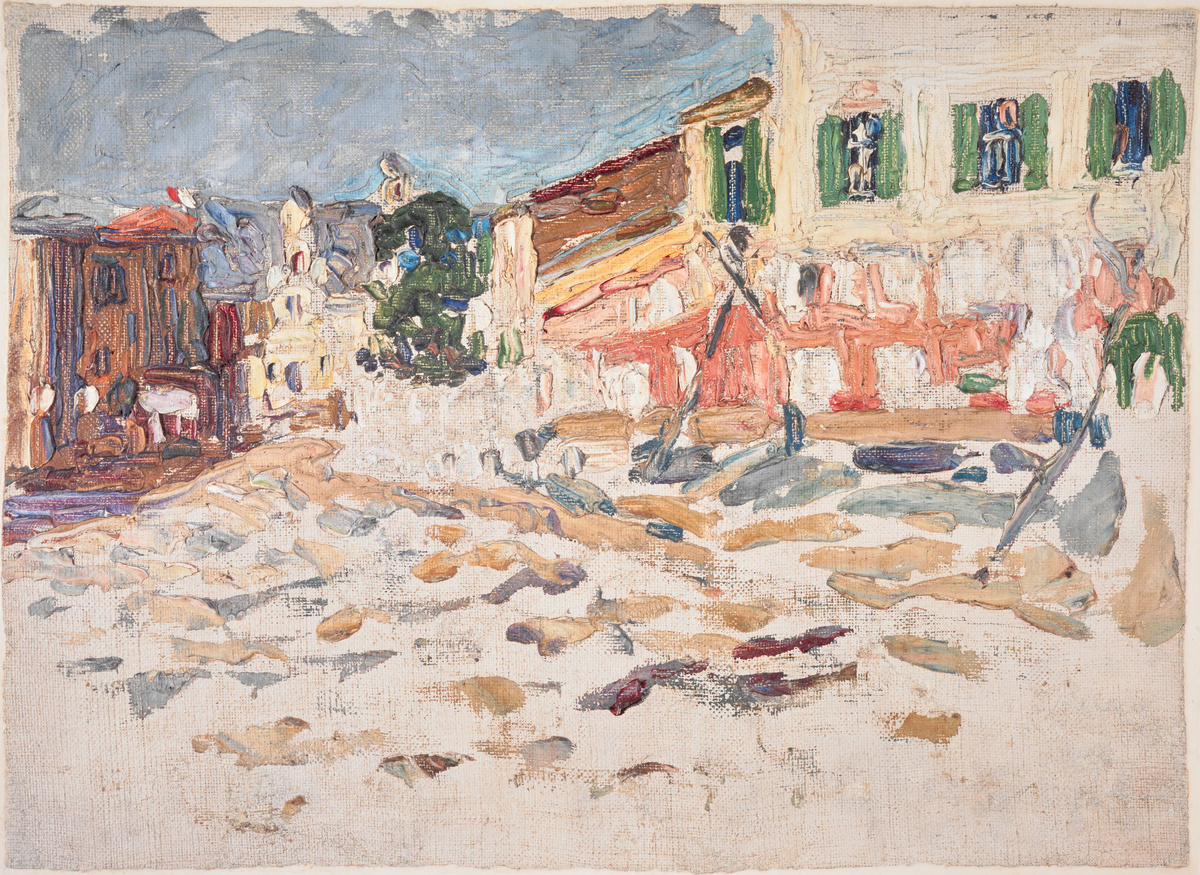
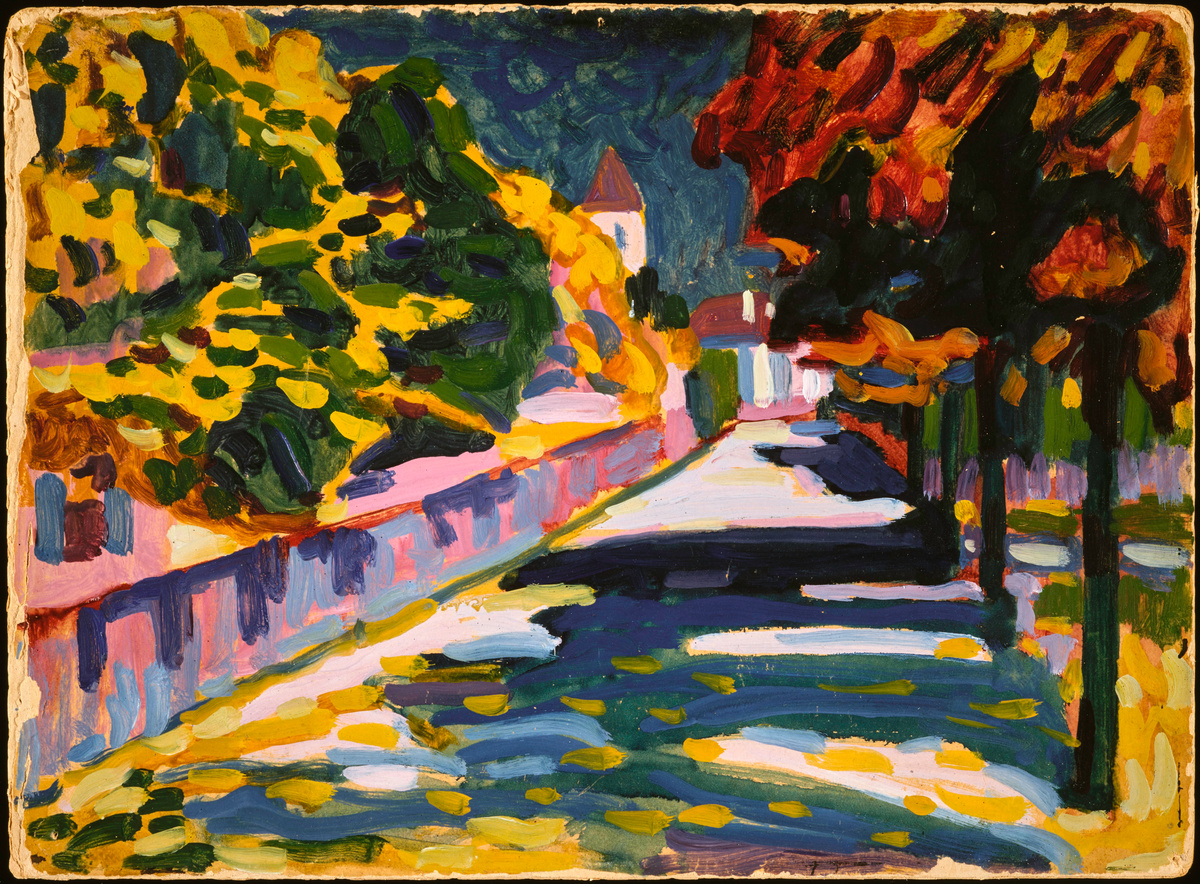
Wassily Kandinsky painted Autumn in Bavaria in 1908. The title and landscape genre tell us the subject: a Bavarian village in autumn. In this small oil painting, the scene is built around a shadowed lane that leads the eye into the village.
The lane runs diagonally into the picture, made from wide strokes of navy, pale grey, white and yellow-green. These broad marks form the painting's main spatial axis, taking you from the foreground into the middle distance. Near the centre, a pale church tower with a pointed brown roof rises simply against the background. It gives the village a clear landmark.
Above and to the left, a mass of yellow and yellow-green leaves, with dark green shadows, fills the upper corner. This is the dominant autumn note, and it frames the lane. On the right, dark green and rust-brown foliage forms a heavy screen. That dark mass contrasts with the yellow canopy and compresses the view down the lane.
Along the left side, a rose-pink wall with blue-violet shadows and a dark rectangular opening runs beside the route. It gives a human scale to the lane and a trace of the village itself. Together, these elements show how the painting works: the lane directs the eye, the church tower anchors the village, and the contrasting canopies of yellow and dark green shape the autumn atmosphere.
The painting belongs to Kandinsky's early twentieth-century landscape work, before he moved into abstraction. Here, he is still describing a real place in recognizable terms. The record of this work is primarily a Wikimedia Commons file page, not the museum's own catalogue. That makes the basic facts reliable for title, date and medium, but it leaves the broader interpretation of this exact scene open.
The scene appears quiet and ordinary, without figures or a stated story. What we can say confidently is how the composition works: the lane, the tower and the two contrasting canopies create a clear path and a strong sense of place. The painting does not come with a supplied account of the artist's intentions or of any symbolic meaning beyond autumn and village life.
Autumn in Bavaria is a landscape about a mood and a place. The shadowed lane draws you in, the church tower gives the village its centre, and the yellow and dark green leaves set the season. What stays with you is the way those broad, confident strokes turn a simple village view into a structured scene you can follow with your eye.
The story and its sources
Historical claims are linked to the records below. Close looking and interpretation are identified in the passage notes.
- Passage 1Documented historyWikimedia Commons: Autumn in Bavaria
- Passage 2Close lookingWikimedia Commons: Autumn in Bavaria
- Passage 3Close lookingWikimedia Commons: Autumn in Bavaria
- Passage 4Close lookingWikimedia Commons: Autumn in Bavaria
- Passage 5InterpretationWikimedia Commons: Autumn in Bavaria
- Passage 6InterpretationWikimedia Commons: Autumn in Bavaria
- Passage 7InterpretationWikimedia Commons: Autumn in Bavaria
Details to notice
About 3 minutes to readPink wall and dark opening
A rose-pink wall with blue-violet shadows and a dark rectangular opening runs along the left side, giving scale and a human trace to the route.
Dark roadside canopy
Dark green and rust-brown foliage on the right forms a heavy screen that contrasts with the yellow canopy and compresses the view down the lane.
Bavarian church tower
A pale, simply painted church tower with a pointed brown roof rises near the center distance, identifying the village and anchoring the lane's vanishing point.
Artist portrait Image credit
未知上傳者. Image source · Public domain
About the artist
Wassily Kandinsky
1866 to 1944
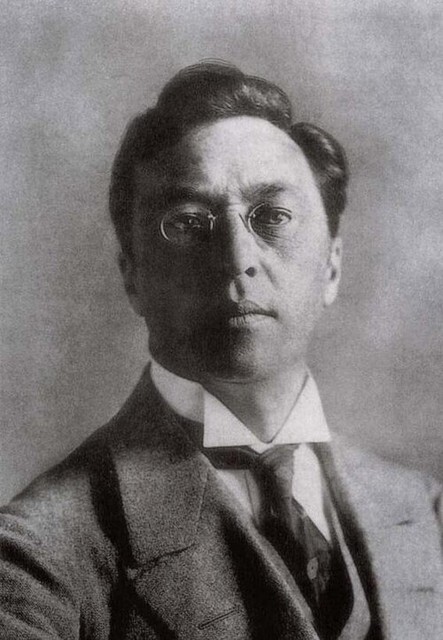
Wassily Kandinsky was an avant-garde painter of Russian origin (1866–1944). Their work is associated with Expressionism; Symbolism; Bauhaus. Their recorded places of work include Paris; Munich; Weimar; Rapallo; The Hague; Russia; Stockholm; Switzerland; Tunis.
- Born
- 1866
- Died
- 1944
- Nationality
- Russian Empire; Russian Soviet Federative Socialist Republic; Soviet Union; France; Germany
- Birthplace
- Moscow
- Died in
- Neuilly-sur-Seine
Biography sources
The research & record
Study the work.
Follow the evidence.
Find catalogue details, historical context, technical research and the literature behind this artwork.
The artwork record
Research catalogue
Catalogue information and detailed research, with references that link to the bibliography.
Updated .
Identity and catalogue
Link- Title
- Autumn in Bavaria
- Artist or attribution
- Wassily Kandinsky
- Object date
- 1908
- Medium and support
- oil and paper on board(Wikimedia Commons: Autumn in Bavaria, n.d.)
- Dimensions
- height: 33 cm (12.9 in); width: 44.7 cm (17.5 in)
- Current collection or location
- Musée National d'Art Moderne, Centre national d'art et de culture Georges-Pompidou, Paris (also associated with the Musée d'art moderne et contemporain de Strasbourg in the same source record)
- Movement or period
- Early twentieth-century landscape painting; Kandinsky's pre-abstraction Bavarian period
- Country or culture
- German (Bavaria, painter working in Germany); French national collection
- Depicted subject
- A landscape painting titled Autumn in Bavaria, depicting a Bavarian village scene in autumn, including a village lane, autumn canopy, church tower, roadside foliage and pink wall.(Wikimedia Commons: Autumn in Bavaria, n.d.)
- Title variants
- Herbst in Bayern; Automne en Bavière(Wikimedia Commons: Autumn in Bavaria, n.d.)
- Accession number
- AM 81-65-32(Wikimedia Commons: Autumn in Bavaria, n.d.)
- Support
- paper on board
Read valuation records and their limitations
Titles and genre
The supplied record gives the work a primary title, Autumn in Bavaria, and preserves two variant forms of that title in other languages: Herbst in Bayern and Automne en Bavière. The German variant matches the Bavarian subject named in the primary title, while the French variant aligns the work with the Francophone institutional setting in which the supplied record places it. The work is catalogued as a landscape painting, and the title together with that genre designation is what establishes the subject as a Bavarian village in autumn; the specifics of buildings and lane belong to the visual description of the scene rather than to separate documentary statements about the place depicted.(Wikimedia Commons: Autumn in Bavaria, n.d.)
Attribution and date
The object is dated to 1908 and attributed to Wassily Kandinsky. Both the date and the attribution come from the same Wikimedia Commons file page that supplies the title, medium, dimensions and collection data, and that source is a discovery record rather than the museum's own catalogue entry for the work. The section's own framing asks for the object date to be kept distinct from any later catalogue dates attached to the record; the evidence supplied here documents the 1908 painting date and does not establish a separate catalogue or publication date, so no such second date can be asserted from these units. The attribution to Kandinsky and the 1908 date should therefore be reported as the supplied record gives them, without being upgraded to a citation of the holding institution's own documentation.(Wikimedia Commons: Autumn in Bavaria, n.d.)
Interpretation
Read together, the identity units describe a small early twentieth-century landscape: Kandinsky painted it in 1908, it carries the title Autumn in Bavaria with German and French variants, and its recorded genre is landscape painting. The title, the date and the genre are consistent with one another, since a Bavarian autumn village view is exactly the kind of subject a 1908 landscape designation implies, but the units themselves establish only those catalogue facts. They do not supply a provenance narrative, an exhibition history or the artist's own statements, and the account should not be filled out with such material.(Wikimedia Commons: Autumn in Bavaria, n.d.)
Wassily Kandinsky painted Autumn in Bavaria in 1908.(Wikimedia Commons: Autumn in Bavaria, n.d.)
The work is titled Autumn in Bavaria, with variants Herbst in Bayern and Automne en Bavière.(Wikimedia Commons: Autumn in Bavaria, n.d.)
The genre is recorded as landscape painting.(Wikimedia Commons: Autumn in Bavaria, n.d.)
Subject and iconography
LinkRead valuation records and their limitations
Composition and colour structure
Interpretation
The painted scene is organised around two complementary framing masses and a central route. A shadowed village lane formed by wide diagonal strokes of navy, pale grey, white and yellow-green runs through the picture and functions as its main spatial and colour axis, carrying the eye from foreground toward the middle distance. Above and to the left, a mass of yellow and yellow-green leaves deepened by dark green shadows fills the upper corner, establishing the dominant autumn note and framing the lane. On the right, dark green and rust-brown foliage forms a heavy screen that contrasts with the yellow canopy and compresses the view down the lane. The effect is compositional rather than merely descriptive: the warm and cool canopies pinch the open lane between them, so that the autumn colour and the depth of the route are produced by the same arrangement of strokes.(Wikimedia Commons: Autumn in Bavaria, n.d., Vision-derived semantic focus candidate, Shadowed village lane; Vision-derived semantic focus candidate, Yellow autumn canopy; Vision-derived semantic focus candidate, Dark roadside canopy)
Within that structure, the centre of the scene contains a pale, simply painted church tower with a pointed brown roof near the middle distance. Its plainness and its central placement make it the clearest landmark in an otherwise heavily brushed view, and it is the element that fixes the village in place. Along the left side, a rose-pink wall with blue-violet shadows and a dark rectangular opening runs beside the route, giving scale and a human trace to the lane. Read together, the tower anchors the settlement while the pink wall supplies the measure of the human-made environment, so that the village is legible both as a distant silhouette and as a wall passed at close range.(Wikimedia Commons: Autumn in Bavaria, n.d., Vision-derived semantic focus candidate, Bavarian church tower; Vision-derived semantic focus candidate, Pink wall and dark opening)
Visual observation
These descriptions are observations derived from the supplied semantic focus candidates for the file record, not identifications confirmed against the museum's catalogue. They establish what can be seen and how the parts relate, but they do not by themselves name the specific Bavarian village, identify the church, or document the artist's intentions. That distinction matters when the visible evidence is used to characterise the work: the lane, tower, canopies and wall are securely observable as painted components of a Bavarian autumn village, while the broader interpretation of the exact site remains open on the supplied record.(Wikimedia Commons: Autumn in Bavaria, n.d., Vision-derived semantic focus candidate, Bavarian church tower; Vision-derived semantic focus candidate, Shadowed village lane; Vision-derived semantic focus candidate, Yellow autumn canopy; Vision-derived semantic focus candidate, Dark roadside canopy; Vision-derived semantic focus candidate, Pink wall and dark opening)
The centre of the scene contains a pale, simply painted church tower with a pointed brown roof near the middle distance.(Wikimedia Commons: Autumn in Bavaria, n.d.)
A shadowed village lane is formed by wide diagonal strokes of navy, pale grey, white and yellow-green, acting as the painting's main spatial and colour axis.(Wikimedia Commons: Autumn in Bavaria, n.d.)
A mass of yellow and yellow-green leaves with dark green shadows fills the upper left, creating the dominant autumn note and framing the lane.(Wikimedia Commons: Autumn in Bavaria, n.d.)
Dark green and rust-brown foliage on the right forms a heavy screen that contrasts with the yellow canopy and compresses the view down the lane.(Wikimedia Commons: Autumn in Bavaria, n.d.)
A rose-pink wall with blue-violet shadows and a dark rectangular opening runs along the left side, giving scale and a human trace to the route.(Wikimedia Commons: Autumn in Bavaria, n.d.)
Materials and technique
LinkRead valuation records and their limitations
The supplied record describes Autumn in Bavaria as an oil on paper on board measuring 33 cm by 44.7 cm. The support is therefore a composite one: a paper sheet mounted on or adhered to a rigid board, carrying an oil medium. This is the only material, support and dimension information the evidence establishes, and it comes from a Wikimedia Commons file page rather than from the museum's own catalogue record; the same annotation notes that the page is a discovery record for title, artist, date, medium, dimensions, collection and accession number. The stated measurements also give the work its scale relative to the brushwork described in the visual evidence: a landscape of roughly a third of a metre in height and under half a metre in width, in which single broad strokes can register as substantial elements of the composition.(Wikimedia Commons: Autumn in Bavaria, n.d.)
Colour and handling as seen in the painted surface
Interpretation
Within a history of early twentieth-century painting, the combination of materials recorded here is significant in its own right. Oil paint on a paper-and-board support is a portable, economical format, distinct from a stretched canvas of larger dimensions, and the evidence establishes only that format and size without explaining the artist's reasons for choosing it. The description of wide diagonal strokes forming the lane, of a simply painted tower, and of large masses of foliage in contrasting colours indicates a method of building the scene from broad, visible marks rather than from finely blended detail. That reading is an inference from the described appearance of the finished work; the evidence does not document the sequence of painting, the brushes employed, or whether the board was prepared in any particular way, and those questions remain open in this record.(Wikimedia Commons: Autumn in Bavaria, n.d., Vision-derived semantic focus candidate, Shadowed village lane; Vision-derived semantic focus candidate, Bavarian church tower; Vision-derived semantic focus candidate, Yellow autumn canopy; Vision-derived semantic focus candidate, Dark roadside canopy)
The medium is oil and paper on board, with dimensions 33 cm by 44.7 cm.(Wikimedia Commons: Autumn in Bavaria, n.d.)
Interpretations and debates
LinkRead valuation records and their limitations
Reading the Scene Against the Record
Interpretation
The key interpretive question this record can address is how the painting's legible subject relates to its made surface. The Wikimedia Commons record supplies the title Autumn in Bavaria, with the variants Herbst in Bayern and Automne en Bavière, an attribution to Wassily Kandinsky, a date of 1908, and the genre landscape painting. It gives the medium as oil and paper on board at 33 by 44.7 cm, a small format for a village view. Those supplied facts let the depicted subject be identified as a Bavarian village in autumn: the title and the landscape genre together establish the subject, while the specific buildings and the lane are visual components of that scene rather than independent evidence for a particular town. The interpretive claim this supports is narrower than a reading of the artist's private intentions. The record does not contain a statement by Kandinsky about what he meant, and no supplied account assigns symbolic content beyond autumn and village life. Any reading of mood or meaning therefore belongs to the viewer's synthesis of the described composition, not to documented artistic purpose.(Wikimedia Commons: Autumn in Bavaria, n.d.)
The Limits of the Record
The record itself sets limits on further interpretation. Its own framing notes that it depicts a Bavarian village in autumn, with title and genre establishing the subject and the buildings and lane functioning as visual components of that scene, which places the work within a landscape convention rather than, for example, a narrative or devotional image. The descriptive passages about the tower, lane and foliage are documented through supplied semantic focus candidates attached to the Wikimedia Commons file page. The annotation characterises that page as a discovery record rather than the museum's own catalogue record, carrying title, artist, date, medium, dimensions, collection and accession data. This distinction matters because it shapes what an interpretation of this exact object can safely claim. The compositional reading above rests on descriptions derived from the image as recorded, while claims about the work's place in a larger art-historical narrative would need sources the record does not contain. Interpretation here can explain the relationship between the visible structure and the autumn village subject, and it can state plainly that the record leaves broader readings of this scene open.(Wikimedia Commons: Autumn in Bavaria, n.d.)
The work depicts a Bavarian village in autumn; the title and landscape genre establish the subject, while the specific buildings and lane are visual components of that scene.(Wikimedia Commons: Autumn in Bavaria, n.d.)
Collection and display
LinkRead valuation records and their limitations
Institutional records and the limits of the source
A concise record identifies the work as Autumn in Bavaria, painted by Wassily Kandinsky in 1908, with alternative titles Herbst in Bayern and Automne en Bavière. The same record gives the medium as oil and paper on board and the dimensions as 33 cm by 44.7 cm, and classifies the picture as landscape painting. These particulars come from a Wikimedia Commons file page rather than from a museum catalogue entry, so the identification of title, date, medium, dimensions and genre should be treated as the supplied record's documented particulars rather than as an independently checked curatorial statement. That distinction matters for the study of the object, because the physical facts about material and size are the kind of information normally confirmed by direct examination or by an institution's own registration, and here they rest on a secondary discovery record.(Wikimedia Commons: Autumn in Bavaria, n.d.)
Collection information in the supplied record is twofold. The work is recorded in the collection of the Musée National d'Art Moderne, Centre national d'art et de culture Georges-Pompidou, Paris, under accession number AM 81-65-32. The record also associates the work with the Musée d'art moderne et contemporain de Strasbourg (MAMCS). The account does not state how these two institutional associations relate to one another: it does not explain whether one is a holding institution and the other a place of deposit, display or transfer, nor does it give dates for either association. The accession number is the most specific locational fact supplied, and it belongs to the Paris museum. The Strasbourg reference is recorded without an equivalent accession number or stated basis.(Wikimedia Commons: Autumn in Bavaria, n.d.)
Interpretation
Read together, the two institutional facts describe a documented affiliation with a major national modern art collection in Paris and a further recorded link to a municipal modern and contemporary art museum in Strasbourg. Neither association is presented in the supplied evidence as exclusive of the other, and no provenance sequence connecting the two is provided. For a catalogue-style account of the object, this leaves the work's current physical location unresolved on the supplied evidence, even though its registration in the Paris collection under AM 81-65-32 is clearly documented. The gap is a gap in the record, not a contradiction in it: a work can be catalogued in one institution's collections while being associated, for reasons the source does not state, with another.(Wikimedia Commons: Autumn in Bavaria, n.d.)
The status of the source shapes how the object's place in a larger history can responsibly be described. The record is a Wikimedia Commons file page, not the museum's own catalogue record, and the supplied annotation notes that some descriptive passages are documented only by the supplied semantic focus candidates. Within the terms of this archive, the basic identification of artist, title, date, medium and genre is reliable as recorded, while the broader interpretation of this exact scene remains open. A research account of the painting therefore has to be built from what the record establishes about its registration and appearance, and must not extrapolate from those facts to exhibition history, acquisition circumstances, conservation treatment, inscriptions or the artist's stated intentions, none of which the evidence supplies.(Wikimedia Commons: Autumn in Bavaria, n.d.)
The work is recorded in the collection of the Musée National d'Art Moderne, Centre national d'art et de culture Georges-Pompidou, Paris, with accession number AM 81-65-32.(Wikimedia Commons: Autumn in Bavaria, n.d.)
The supplied record also associates the work with the Musée d'art moderne et contemporain de Strasbourg (MAMCS).(Wikimedia Commons: Autumn in Bavaria, n.d.)
Documented values and qualified estimates
LinkRead valuation records and their limitations
Valuation evidence and its limits
Interpretation
The only valuation evidence supplied for Autumn in Bavaria is a calculated working insurance estimate, generated 2026-10-30, that sets a range of US$1.5M to US$4M. The record describes this explicitly as a broad, conservative working range for manual review only. It is not an official insurance value, not an appraisal, not an auction estimate or result, and not a sale price. The qualifications are as consequential as the figures: no comparable sales, prior auction results, documented acquisition price, private insurance records or institutional valuations were accessed, and the methodology states that none were invented. The range is therefore a qualitative construct built from the object's confirmed context rather than from transacted values.(Wikimedia Commons: Autumn in Bavaria, n.d.)
That qualitative construct draws on the object's documented profile: an authenticated-attribution 1908 Kandinsky oil of modest cabinet scale, 33 by 44.7 cm, from his pre-abstraction Bavarian landscape period, held in the French national collection at the Musee National d'Art Moderne, Centre Pompidou, accession AM 81-65-32, with an association to MAMCS Strasbourg. The methodology treats institutional collection status and the accession number as confirming provenance and reducing uncertainty, not as evidence of current market exposure. The factors moving the range upward are high artist prominence, the early-period date, the oil medium and strong institutional provenance; the factors moving it downward or holding it conservative are small scale and the works on board support, which the record notes is often factored conservatively relative to canvas. The low bound is a floor appropriate to a small early Kandinsky landscape, and the high bound a working buffer for a major-name pre-abstraction work with institutional provenance.(Wikimedia Commons: Autumn in Bavaria, n.d.)
The record states that the range is intentionally wide to accommodate valuation uncertainty and should be refined by a qualified appraiser with access to full comparables and institutional records. It also rates identification confidence as medium, based solely on the supplied Wikimedia Commons record, and notes that institutional catalogues and condition reports were not independently verified. Read together, these statements describe a number within a disclosed method, not a value the object itself carries in any published record: the actual insured value would require review by a qualified fine-art appraiser and the collecting institution.(Wikimedia Commons: Autumn in Bavaria, n.d.)
The valuation record's own inputs rest on a descriptive source that is a Wikimedia Commons file page rather than the museum's own catalogue record. That page carries the title Autumn in Bavaria, with the variants Herbst in Bayern and Automne en Bavière; the artist Wassily Kandinsky; the date 1908; the medium oil and paper on board; the dimensions 33 by 44.7 cm; the genre of landscape painting; the collection of the Musée National d'Art Moderne, Centre national d'art et de culture Georges-Pompidou, Paris, with accession number AM 81-65-32; and an association with the Musée d'art moderne et contemporain de Strasbourg (MAMCS). The record's annotation notes that some descriptive passages are documented only by the supplied semantic focus candidates. This is why the valuation record can cite collection and accession as provenance support while still rating identification confidence only medium, and why the two documents should be read as a chain of dependency rather than as independent confirmations of the same facts.(Wikimedia Commons: Autumn in Bavaria, n.d.)
Working estimate
Calculated working insurance estimate, not a sale price: Working insurance range: US$1.5M to US$4M Recorded date: Working calculation, generated 2026-10-30. Methodology: Broad conservative working range for manual review only, built from the supplied confirmed context: an authenticated-attribution 1908 Kandinsky oil of modest cabinet scale (33 x 44.7 cm) from his pre-abstraction Bavarian landscape period, held in the French national collection (Musee National d'Art Moderne, Centre Pompidou, accession AM 81-65-32) with an association to MAMCS Strasbourg. Institutional collection status and accession number are treated as confirming provenance and reducing uncertainty, not as evidence of current market exposure. Because no comparable sales, prior auction results, documented acquisition price, or official insurance figures were supplied, the range is set broadly using qualitative factors only: high artist prominence, early-period date, oil medium, works on board support (often factored conservatively relative to canvas), small scale, and museum-held status. The low bound reflects a conservative floor appropriate to a small early Kandinsky landscape; the high bound reflects a working buffer for a major-name pre-abstraction work with strong institutional provenance. The range is intentionally wide to accommodate valuation uncertainty and should be refined by a qualified appraiser with access to full comparables and institutional records. Qualification: Model-generated working insurance range for manual review only. This is not an official insurance value, not an appraisal, not an auction estimate or result, and not a sale price. No comparable sales, private insurance records, or institutional valuations were accessed or invented. Identification confidence is medium and based solely on the supplied Wikimedia Commons record; institutional catalogues and condition reports were not independently verified. Actual insured value requires review by a qualified fine-art appraiser and the collecting institution.(Wikimedia Commons: Autumn in Bavaria, n.d.)
Further reading
Books for a closer look
Paid links. As an Amazon Associate I earn from qualifying purchases.

Open Library Kandinsky: Russian and Bauhaus years, 1915-1933.
Solomon R. Guggenheim Museum
A Kandinsky catalogue whose recorded subjects include the Centre Georges Pompidou and the Musée national d'art moderne, the Paris collection that holds Autumn in Bavaria, as well as catalogues raisonnés and criticism. This makes it the most object-adjacent candidate for a work in that institution, though its exact contents are not verified here.
ISBN 0892070447

Open Library Kandinsky, complete writings on art
G.K. Hall
A collection of Kandinsky's complete writings, recorded under modern art. It is relevant through the artist himself rather than the specific painting, and may contain his statements on landscape and colour, but no claim is made about its treatment of Autumn in Bavaria.
ISBN 0805799508
Bibliography
Sources and further reading
References are arranged by author or organisation, with links to the original publications. Where no publication date is recorded, n.d. means no date.
Source notes updated .
No recorded sources match these filters. Reset the filters to see the full bibliography.
- 03
Book
Künstler sehen Bayern - Bayern lässt staunen. Museum Georg Schäfer.
Recorded as a Museum Georg Schäfer exhibition on German landscape painting, the Munich school and Bavaria in art. That subject matter connects directly to a Bavarian village landscape by Kandinsky, who worked in Munich and Murnau, and offers art-historical context for the depicted church tower, lane and autumn foliage.
- ISBN
- 9783943017045
Citation text
- 04
Book
Kandinsky, complete writings on art. G.K. Hall.
A collection of Kandinsky's complete writings, recorded under modern art. It is relevant through the artist himself rather than the specific painting, and may contain his statements on landscape and colour, but no claim is made about its treatment of Autumn in Bavaria.
- ISBN
- 0805799508
Citation text
- 02
Book
Kandinsky: Russian and Bauhaus years, 1915-1933. Solomon R. Guggenheim Museum.
A Kandinsky catalogue whose recorded subjects include the Centre Georges Pompidou and the Musée national d'art moderne, the Paris collection that holds Autumn in Bavaria, as well as catalogues raisonnés and criticism. This makes it the most object-adjacent candidate for a work in that institution, though its exact contents are not verified here.
- ISBN
- 0892070447
Citation text
- 01
Secondary · About this artwork
Wikimedia Commons: Autumn in Bavaria (n.d.). Wikimedia Commons: Autumn in Bavaria. Wikimedia Commons.
Discovery record providing title, artist, date, medium, dimensions, collection and accession number. It is a Wikimedia Commons file page, not the museum's own catalogue record; some descriptive passages are documented only by the supplied semantic focus candidates.
- Language
- en
Citation text
Art to live with
Bring this painting
home.
A piece of the archive, made yours. Explore Autumn in Bavaria in a size and finish that fits your space.
Your text and annotations appear on these editions. Adding to cart saves that design for printing.
Combine this painting with your favourites01 / Find your edition
Made for you
Suggested from your location. Change it if you're sending elsewhere or using a VPN. Prices and delivery are shown in GBP.
1 product
Choose an edition to make it yours
iPhone 12 Mini ? Glossy ? back view
iPhone 12 Mini · Glossy

iPhone 12 Mini ? Glossy ? back view

iPhone 12 Mini ? Glossy ? back view

iPhone 12 Mini ? Glossy ? back view
Tough phone case
GBP 16.34
Delivery GBP 4.22 / Total GBP 20.56
A two-layer phone case with a printed polycarbonate shell and a shock-absorbing inner liner.
Two layers with a shock-absorbing TPU liner
Case & print details
- Device
- Apple · iPhone 12 Mini
- Material
- Polycarbonate shell with a TPU inner liner
- Artwork
- Outer back and wrapped edges from one template
- Finish
- Glossy
- Version
- Standard version
- Printing
- Dye sublimation
- Print file
- 1,122 × 1,831 px · 95 × 155 mm · PNG · 300 dpi recommended
Rear outline and camera openings follow this variant's Printify template. Case depth and small hardware remain illustrative.
Supplier product detailsFit and fill keep the painting’s proportions. Stretch changes them.
Move and zoom the painting on your tough phone case.
Made to order with your design
Made to order
US delivery only
The 30 cm ruler is scaled alongside your selected print. Keep the painting’s proportions with a black background, or stretch it to fill. Frame width, material texture and screen colours are illustrative.
Keep exploring