Anguish
Artist: August Friedrich Albrecht Schenck · 1878
Anguish: high-resolution image
The original file is hosted by Wikimedia Commons, available without payment or an account.
Open high-resolution image on Wikimedia CommonsThe complete story
The story About 4 minutes to read
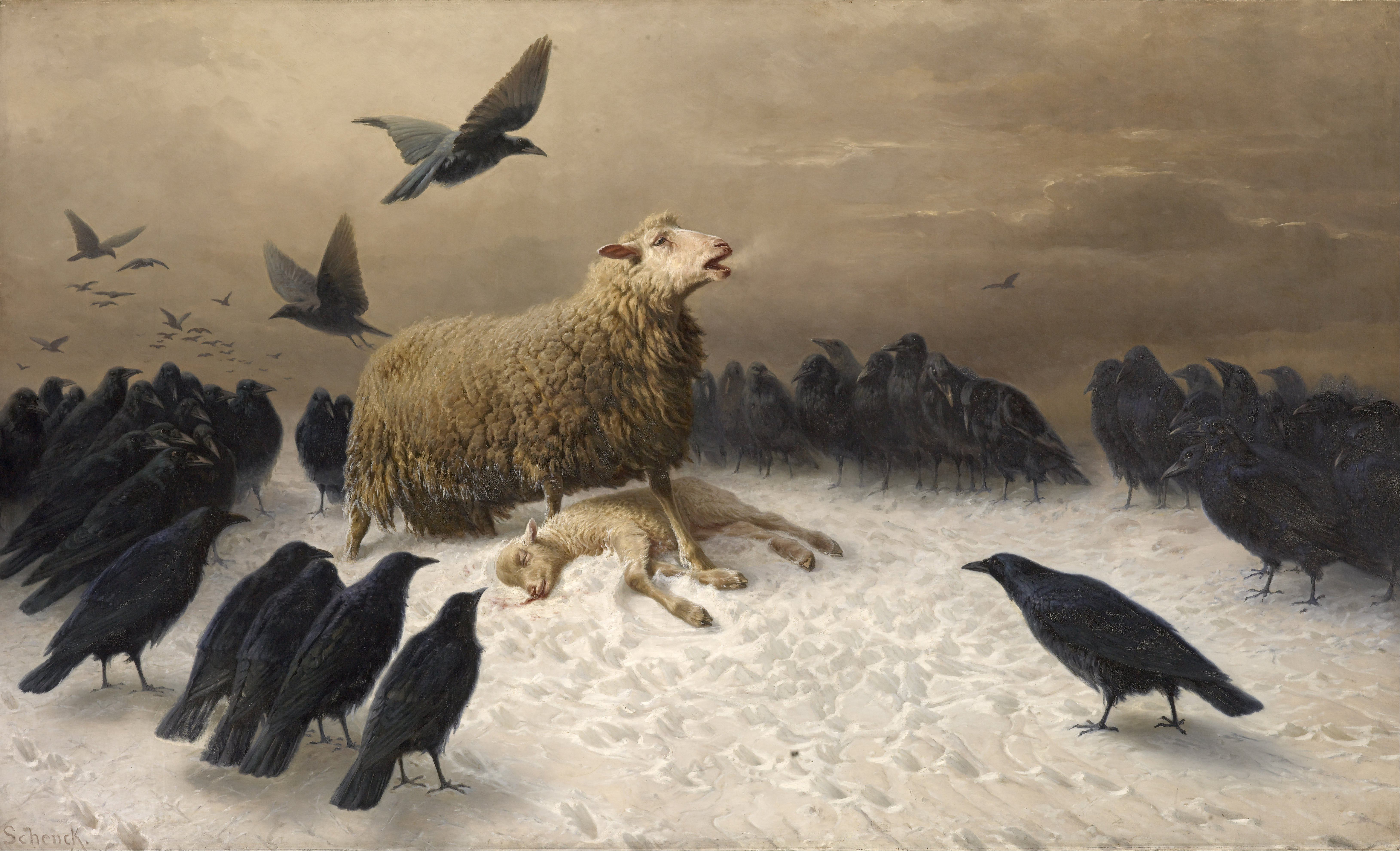
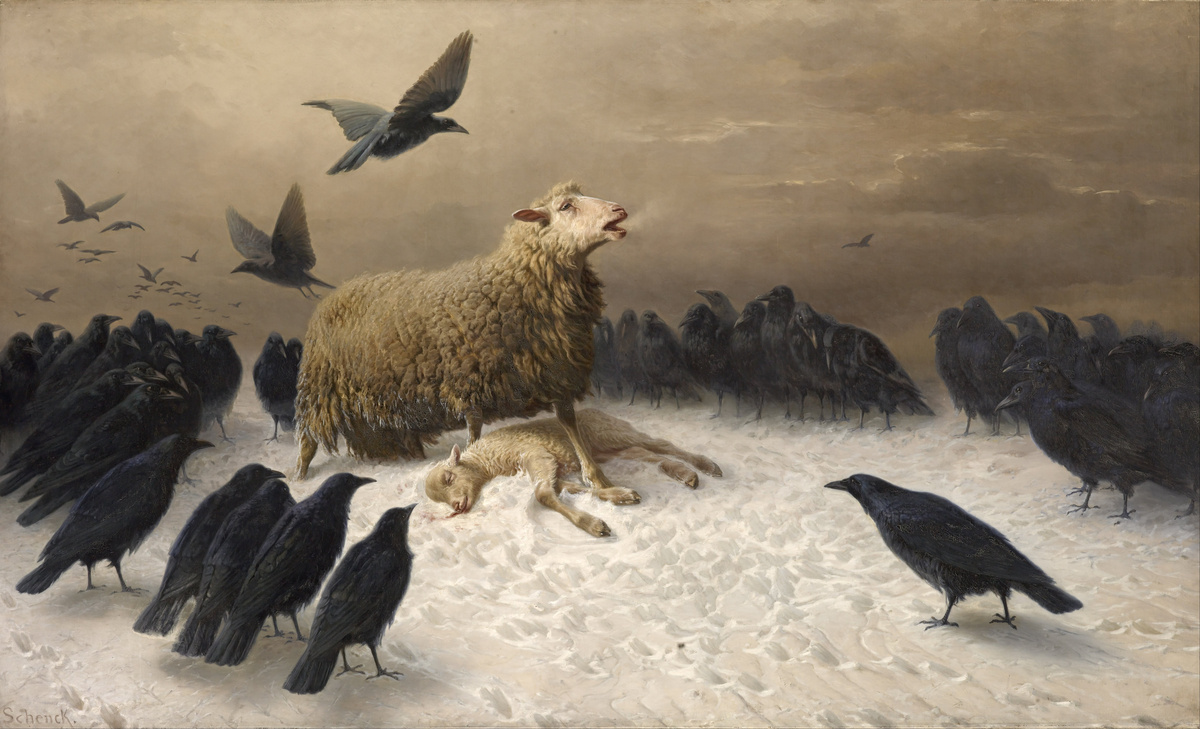
In August Schenck's painting Anguish, a ewe stands over her dead lamb in a snowfield. A dense flock of crows masses nearby, waiting. The picture is built on the plainest terms. One animal has lost her young, and other animals are watching. The NGV reads this scene as a metaphor for a broader human condition, expressed through animal painting.
The lamb lies still against the snow. The ewe stands above it, her body turned toward the threat rather than away from it. Schenck has given her clearly recognisable human characteristics, such as determination and sorrow. That is the NGV's reading, and it explains why the ewe holds our attention the way a bereaved figure in a history painting might.
The crows are not scattered across the sky. The NGV describes them as a sinister flock that appears organised and patiently awaits a moment of weakness. Their massing matters. A single bird would be incidental, but a gathered flock turns the snowfield into a place of pressure and vigilance. The ewe's grief is not private. It is exposed.
Schenck spent most of his career in France, specialising in landscapes and animal subjects, and exhibited regularly at the Paris Salons for over thirty years. Anguish was first shown at the Paris Salon of 1878. Understanding that setting helps. This is not a private sketch but a finished animal painting made for public exhibition in the capital of French art.
That is why the anthropomorphism matters. By giving the ewe recognisable determination and sorrow, Schenck asks the visitor to identify with her predicament and emotions. The crows supply the other half of the metaphor. A world that can produce such loss also contains patient cruelty, and the painting holds both in one cold landscape.
The painting still keeps its original frame, probably the one in which it was shown at the 1878 Salon. It is made of cast plaster, wood and gold leaf, and its gilding was intended to give the impression of solid metal. The frame is not part of the story the picture tells. It is evidence of how the work was presented to its first public, as an object meant to be seen within the polished conventions of the Salon.
So Anguish is less a report on sheep than a study of helplessness and grief. The ewe stands over what she has lost, and the crows wait in the snow behind her. Schenck uses the animal world to say something about ours. The painting works because its subject is simple and its feeling is not. A mother, a death, and a watching threat: that is the whole picture, and it is enough.
The story and its sources
Historical claims are linked to the records below. Close looking and interpretation are identified in the passage notes.
- Passage 1Documented historyInstitutional record for Anguish
- Passage 2Close lookingInstitutional record for Anguish
- Passage 3InterpretationInstitutional record for Anguish
- Passage 4Documented historyInstitutional record for Anguish
- Passage 5InterpretationInstitutional record for Anguish
- Passage 6Documented historyInstitutional record for Anguish
- Passage 7InterpretationInstitutional record for Anguish
Details to notice
About 3 minutes to readSchenck signature
The artist's inscription at the lower left reads Schenck, providing a direct visual clue to authorship.
Descending raven
A single raven descends with wings spread above the ewe, creating a dramatic aerial threat within the encircling flock.
Crow flock at right
A dense cluster of black crows masses along the right side of the snowfield, their dark forms facing the bereaved ewe and amplifying the sense of threat.
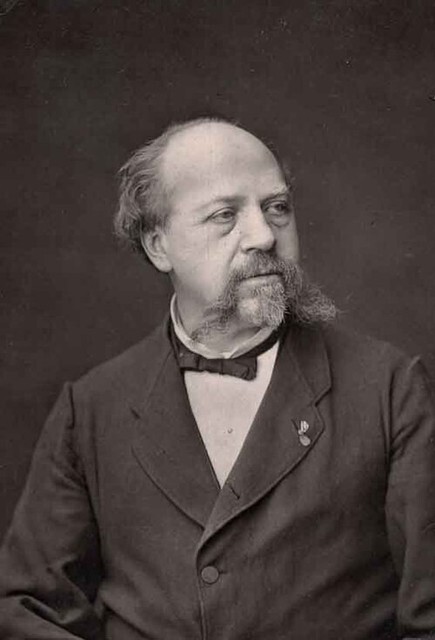
Artist portrait Image credit
Unknown author Unknown author. Image source · Public domain
About the artist
August Friedrich Albert Schenck
1828 to 1901
August Friedrich Albert Schenck was a German-French painter (1828–1901). Their work is associated with École d'Écouen. Their recorded places of work include Paris.
- Born
- 1828
- Died
- 1901
- Nationality
- Duchy of Holstein; France
- Birthplace
- Glückstadt
- Died in
- Écouen
Biography sources
The research & record
Study the work.
Follow the evidence.
Find catalogue details, historical context, technical research and the literature behind this artwork.
The artwork record
Research catalogue
Catalogue information and detailed research, with references that link to the bibliography.
Updated .
Identity and catalogue
Link- Title
- Anguish
- Artist or attribution
- August Friedrich Albrecht Schenck
- Object date
- 1878
- Medium and support
- oil on canvas
- Dimensions
- 151.0 × 251.2 cm
- Current collection or location
- National Gallery of Victoria, Melbourne, Australia(www.ngv.vic.gov.au, n.d.a)
- Movement or period
- 19th-century animal painting; Paris Salon
- Country or culture
- France (executed in Paris); German-born artist
- Depicted subject
- A bereaved ewe stands over her dead lamb in a snowfield while a flock of crows waits nearby, a scene the NGV reads as a metaphor for the human condition.
- Title variants
- Angoisse
- Accession number
- p.307.6-1
- Support
- canvas
- Inscriptions
- inscribed in brown paint l.l.: Schenck
Read valuation records and their limitations
Title, attribution and date
August Friedrich Albrecht Schenck painted Anguish, also recorded under the French title Angoisse, in 1878, in oil on canvas. That year is the object date established by the institutional record; it is distinct from the later dates attached to the painting's public life, notably its inclusion in the Paris Salon of 1878 as number 2026 and its move to London and Melbourne in 1879 and 1880. Anchoring the work in 1878 fixes it within the exhibiting career described for the artist: Schenck spent most of his career in France, specialising in landscapes and animal subjects, and was a regular exhibitor at the Paris Salons for over thirty years. Anguish therefore belongs to a sustained body of animal painting made for the Salon rather than to an isolated or amateur effort, and the oil-on-canvas support places it among the finished exhibition pictures of that practice.(www.ngv.vic.gov.au, n.d.a)
Subject and curatorial interpretation
The subject that the catalogue record and the curatorial reading describe is a ewe standing over a dead lamb in a snowfield, while a dense flock of crows masses nearby. The NGV's interpretation goes further than this description: Schenck has given the ewe clearly recognisable human characteristics, such as determination and sorrow, so that the viewer identifies with its predicament and emotions, and the sinister murder of crows appear organised and patiently await a moment of weakness. On that account Schenck is metaphorically examining a broader human condition in the context of an animal painting. Because these are attributed readings, they should be presented as the institution's interpretation of the picture's address to its audience rather than as documented statements by the artist, whose intentions are not recorded in the supplied evidence.(www.ngv.vic.gov.au, n.d.a)
The painting retains its original frame, described as probably the frame in which it was shown at the 1878 Paris Salon. The frame is made of cast plaster, wood and gold leaf; all its decorative work is cast, and its gilding was intended to create the impression of solid metal. This is material evidence for how the work was presented to its first public, since the frame's simulated metal finish belongs to the polished conventions of Salon display rather than to the painted image itself. The attribution of the frame to the 1878 Salon is stated as a probability in the record, and should be retained with that qualification.(www.ngv.vic.gov.au, n.d.a)
Assessment of the record
Interpretation
Read together, the record establishes a painting whose identity is unusually well documented at its points of transaction and interpretation but thinner at the level of authorship and provenance detail. The object date of 1878, the Salon number 2026, the London and Melbourne purchase of 1879, the 1880 arrival and the £1,200 price form a dated sequence, while the curatorial reading of anthropomorphism and the frame analysis supply the interpretive and material dimensions. The title variants Anguish and Angoisse reflect the painting's French manufacture and its English-language catalogue life. Within a larger history of animal painting, the case shows a Salon animal subject entering a colonial public collection through a dealer network and expert advice, carrying with it its exhibition frame as part of the object's identity.(www.ngv.vic.gov.au, n.d.a)
August Friedrich Albrecht Schenck painted Anguish (Angoisse) in 1878 in oil on canvas.(www.ngv.vic.gov.au, n.d.a)
Subject and iconography
LinkRead valuation records and their limitations
The composition on the canvas
Visual observation
The visible subject of August Friedrich Albrecht Schenck's Anguish (Angoisse), painted in 1878 in oil on canvas and held by the National Gallery of Victoria, Melbourne, is compressed into a few elements: a ewe stands over a dead lamb in a snowfield, while a dense flock of crows masses nearby. Both the institutional record and the Wikimedia Commons image description support this reading of the scene, and it is worth separating what the description establishes from what it implies. The ewe, the lamb, the snow and the gathered birds are the observable furniture of the picture. Bereavement, menace and vigilance are identifications placed on those forms, and the NGV record makes that interpretive move explicit rather than leaving it to the viewer.(www.ngv.vic.gov.au, n.d.a)(Wikimedia Commons: Anguish, n.d.)
The NGV's account gives the animals an emotional grammar. It states that Schenck has given the ewe clearly recognisable human characteristics, such as determination and sorrow, so that the viewer identifies with its predicament and emotions. The crows are characterised in the same register: they are described as a sinister murder of crows who appear organised and patiently await a moment of weakness. These are curatorial interpretations of the painted forms, not documented statements of the artist's intention, and the record's further claim follows from them: that Schenck is here metaphorically examining a broader human condition in the context of an animal painting.(www.ngv.vic.gov.au, n.d.a)(Wikimedia Commons: Anguish, n.d.)
Interpretation
Read together, the two groups of figures establish a structure of exposure. The lamb lies in the snow, the ewe stands over it, and the flock gathers at a distance that the description does not measure but that the term nearby establishes as close. The record's language of patience and of a coming moment of weakness is what turns a static scene into one under pressure: the threat is not shown in the act of killing but in the act of waiting. Because the NGV attributes this organisation to the crows as an appearance rather than narrating an event, the painting is best described as a held moment of vigilance rather than a depicted attack. The visible evidence alone does not report motion, and the sources do not describe one.(www.ngv.vic.gov.au, n.d.a)(Wikimedia Commons: Anguish, n.d.)
Visual observation
The scene's setting matters to how the animals read. The snowfield is a bare, cold ground against which the dark mass of the flock and the pale body of the lamb are set, and the description supplies no further landscape incident, no shelter, no human presence and no architectural element. The composition is therefore built on the plainest possible contrast between the mother, the dead young and the watchers. This is a composition of reduction, and the sources support no claim about clothing, furnishings or interior setting because the picture as described contains none: the only described objects are the animals and the snow.(www.ngv.vic.gov.au, n.d.a)(Wikimedia Commons: Anguish, n.d.)
A ewe stands over a dead lamb in a snowfield, while a dense flock of crows masses nearby.(www.ngv.vic.gov.au, n.d.a)(Wikimedia Commons: Anguish, n.d.)
Historical context
LinkRead valuation records and their limitations
The painter and the Salon
The documented biography of August Schenck establishes the professional world in which Anguish was made and first seen. The National Gallery of Victoria's collection record states that Schenck spent most of his career in France, specialised in painting landscapes and animal subjects, and was a regular exhibitor at the Paris Salon for over thirty years. That combination matters for reading the picture: it places the artist within the French exhibition system rather than at its margins, and it identifies animal painting as his established speciality, not an occasional experiment. The same record states that Anguish (Angoisse) was painted in 1878 in oil on canvas and was first shown at the Paris Salon of 1878, no. 2026. The date, the medium and the Salon entry give the work a firm documentary footing: this is a finished oil made for public exhibition in Paris, and its subject of animals in a snowfield belongs to the genre in which Schenck had built his career. Any account of the picture's meaning has to begin from that professional and exhibition context rather than treating the animal subject as incidental.(www.ngv.vic.gov.au, n.d.a)
The frame as presentation evidence
The painting retains its original frame, probably the frame in which it was shown at the 1878 Paris Salon, according to the NGV record. The frame is made of cast plaster, wood and gold leaf, and all its decorative work is cast, with gilding intended to create the impression of solid metal. This is presentation evidence as much as object evidence. It indicates how the picture was dressed for its first public showing and supports the record's cautious identification of the frame with the Salon display, an identification the record itself qualifies with 'probably' rather than asserting outright. The frame therefore connects the painted scene to the conventions of Salon display, but it should be described in the record's own qualified terms.(www.ngv.vic.gov.au, n.d.a)
What the evidence establishes and what it leaves open
Interpretation
Reading these units together, the strongest documented account of Anguish is an animal painting by a Salon regular, exhibited publicly in Paris in 1878, framed for that display, and acquired for Melbourne in 1879 with delivery in 1880. The metaphor of a broader human condition is the NGV's interpretive reading of the depicted ewe and crows, and it is plausible in light of Schenck's speciality in animal subjects, but the evidence does not document the artist's stated intention. The value of the object within a larger history of art and material culture lies in this combination: a genre painting of animals presented with the finish and framing of Salon exhibition, then transferred through the London trade into a colonial public collection, where it has continued to be interpreted and promoted by its custodians. Distinguishing the documented record from the attributed reading keeps both available for further research.(www.ngv.vic.gov.au, n.d.a)(www.ngv.vic.gov.au, n.d.b)
August Schenck spent most of his career in France, specialising in painting landscapes and animal subjects, and was a regular exhibitor at the Paris Salons for over thirty years.(www.ngv.vic.gov.au, n.d.a)
Materials and technique
LinkRead valuation records and their limitations
Support, medium and frame
Visual observation
The primary materials record for August Friedrich Albrecht Schenck's Anguish (Angoisse) is the painting itself: the NGV records it as oil on canvas, painted in 1878, and holds the work in Melbourne. The surviving frame is described as original to the picture and probably the one in which it appeared at the Paris Salon that year. It is made of cast plaster, wood and gold leaf, all of its decorative work cast, and the gilding was intended to give the impression of solid metal. That account distinguishes the materials of the painted image, a canvas support with oil medium, from the materials of its presentation, a composite of plaster, wood and metal leaf. The two sets of materials belong to different aspects of the object: the oil painting carries the depicted scene, while the frame is a constructed ensemble in which casting and gilding simulate a more precious substance than the plaster beneath.(www.ngv.vic.gov.au, n.d.a)(Wikimedia Commons: Anguish, n.d.)
The frame's significance is tied to its exhibition history rather than to its decoration alone. The NGV records that Anguish was first shown at the Paris Salon of 1878, no. 2026, and that the frame retained by the painting is probably the frame in which it was shown there. Because the frame is described as having been made with all decorative work cast and gilded to imitate solid metal, the object presented to the Salon public was a unified ensemble: an oil painting on canvas within a plaster and wood surround finished in gold leaf. The materials of the frame thus document the polished presentation conventions of the 1878 Salon as much as the painting's own making, and the survival of the frame preserves evidence of how the work was first displayed.(www.ngv.vic.gov.au, n.d.a)
The frame also carries the painting's later history as a collected object. The NGV records that Anguish was with the Artist's Association, London, by 21 November 1879, was purchased by Agnew's, and was purchased for the NGV on the advice of Alfred Taddy Thompson on 21 November 1879, arriving in Melbourne in 1880, bought for £1,200 in 1880. The original frame travelled with the work through that sequence from London to Melbourne and remains with it. Because the frame is dated by its association with the 1878 Salon rather than by an independent inscription or analysis, its identification as the Salon frame remains a qualified claim in the record, expressed as probability rather than certainty.(www.ngv.vic.gov.au, n.d.a)
Interpretation
Considered together, the documented materials and the visible subject explain why the object matters within a larger history of animal painting and of Salon presentation. Schenck, who spent most of his career in France specialising in landscapes and animal subjects and exhibited regularly at the Paris Salons for over thirty years, made Anguish as an oil on canvas for public exhibition, and the NGV reads the ewe's recognisable determination and sorrow as a metaphorical examination of a broader human condition within an animal painting. The frame's cast plaster, wood and gold leaf belong to that same public purpose, since the gilding was meant to convey the impression of solid metal. The physical evidence therefore supports an account of a finished exhibition painting in an imitative metallic surround, made by a regular Salon animal painter, rather than a private or provisional work.(www.ngv.vic.gov.au, n.d.a)(Wikimedia Commons: Anguish, n.d.)
The painting retains its original frame, probably the frame in which it was shown at the 1878 Paris Salon, made of cast plaster, wood and gold leaf, all decorative work cast, with gilding intended to create the impression of solid metal.(www.ngv.vic.gov.au, n.d.a)
Provenance and ownership
LinkRead valuation records and their limitations
Documented owners and transfers
The documented ownership history of August Friedrich Albrecht Schenck's Anguish (Angoisse) begins with a public exhibition rather than a private collection. The painting was first shown at the Paris Salon of 1878, catalogue no. 2026, the setting for which Schenck produced the finished animal painting now in Melbourne. This Salon appearance precedes and frames the later record of possession, and it identifies the work's first documented presentation to a public audience in Paris.(www.ngv.vic.gov.au, n.d.a, no. 2026)
By 21 November 1879 the picture was with the Artist's Association in London, from which it was purchased by Agnew's. On the same date, 21 November 1879, it was purchased for the National Gallery of Victoria on the advice of Alfred Taddy Thompson, and it arrived in Melbourne in 1880. The institutional record also gives a purchase price of £1,200 in 1880. These dates and figures establish a rapid passage from a London dealer's hands to an Australian public collection, with Thompson acting as the adviser whose judgement directed the acquisition. The record does not state where the painting was held between its 1878 Salon showing and its presence at the Artist's Association, and that interval should be treated as unrecorded rather than as a proven change of ownership.(www.ngv.vic.gov.au, n.d.a)
Interpretation
The acquisition should be read alongside Schenck's career: he spent most of his working life in France, specialised in landscapes and animal subjects, and exhibited regularly at the Paris Salons for over thirty years. A Salon-exhibited animal painting by a long-standing Salon exhibitor was therefore the kind of work that a colonial gallery, advised by a London agent or adviser, might seek out. The provenance record itself does not document Thompson's reasoning or Agnew's role beyond the purchase, so the acquisition's significance lies in what the dates establish: a painting shown publicly in Paris in 1878 was in a Melbourne collection within about two years.(www.ngv.vic.gov.au, n.d.a)
The frame as material evidence
The object that arrived in Melbourne retains its original frame, probably the frame in which it was shown at the 1878 Paris Salon. It is made of cast plaster, wood and gold leaf, with all decorative work cast, and its gilding was intended to create the impression of solid metal. Because the frame's continuous survival is recorded alongside the purchase and arrival, it is a physical link between the Salon presentation and the later institutional display. The attribution of the frame to the 1878 Salon is stated as probable, not certain, in the institutional record.(www.ngv.vic.gov.au, n.d.a)
Anguish was first shown at the Paris Salon of 1878 as no. 2026; that exhibition is the earliest documented public appearance in the record supplied. The NGV's senior curator of international art, Dr Ted Gott, later discussed the painting as one of his favourite works in the collection in an NGV Art Highlights video. This reception evidence concerns the painting's standing in Melbourne, not its ownership, and it should not be read back into the 1879 transactions: the record supports a change of hands and a purchase decision, and separately supports the work's later curatorial regard.(www.ngv.vic.gov.au, n.d.a, no. 2026)(www.ngv.vic.gov.au, n.d.b)
Anguish was with the Artist's Association, London, by 21 November 1879, purchased by Agnew's, and then purchased for the NGV on the advice of Alfred Taddy Thompson on 21 November 1879, arriving in Melbourne in 1880.(www.ngv.vic.gov.au, n.d.a)
Provenance timeline
- 1878
Anguish was first exhibited publicly at the Paris Salon, no. 2026.(www.ngv.vic.gov.au, n.d.a, no. 2026)
- 21 November 1879
The painting was with the Artist's Association, London, was purchased by Agnew's, and was then purchased for the NGV on the advice of Alfred Taddy Thompson.(www.ngv.vic.gov.au, n.d.a)
- 1880
Anguish arrived in Melbourne.(www.ngv.vic.gov.au, n.d.a)
Exhibition history
LinkRead valuation records and their limitations
The 1878 Paris Salon
The exhibition history of August Friedrich Albrecht Schenck's Anguish (Angoisse) begins with a documented public showing rather than with its later institutional life. The National Gallery of Victoria's collection record states that the painting was first shown at the Paris Salon of 1878, where it carried the number 2026. This is a specific, locatable entry in a specific annual exhibition: not a vague association with the Parisian art world but a numbered work in the Salon of that year. The same record establishes that Schenck spent most of his career in France, specialising in landscapes and animal subjects, and was a regular exhibitor at the Paris Salons for over thirty years. The 1878 appearance of Anguish therefore belongs to a long, repeated pattern of Salon participation by this artist, and it frames the painting as a finished public exhibit made for the principal exhibition venue of French art rather than as a private study. The physical evidence supports that framing: the painting retains its original frame, probably the frame in which it was shown at the 1878 Paris Salon, made of cast plaster, wood and gold leaf, with all decorative work cast and the gilding intended to create the impression of solid metal. The frame is thus the surviving trace of how the work was presented to its first public.(www.ngv.vic.gov.au, n.d.a, no. 2026)
The Salon showing of 1878 and the painting's removal to London and Melbourne are closely connected in the documentary record, and the connection matters for how the exhibition history should be understood. According to the institutional record, Anguish was with the Artist's Association, London, by 21 November 1879, was purchased by Agnew's, and was then purchased for the NGV on the advice of Alfred Taddy Thompson on 21 November 1879, arriving in Melbourne in 1880. The painting was purchased for £1,200 in 1880. The same record gives the work's medium and date, oil on canvas of 1878, and confirms its present holding by the National Gallery of Victoria, Melbourne. The sequence is therefore short and tightly dated: a Salon debut in 1878, a London transaction and an acquisition decision on a single day in November 1879, and arrival in Melbourne in 1880. Because the frame is probably the Salon frame, the object that reached Melbourne likely still carried the physical presentation of its Paris showing, so the Australian acquisition can be read as the arrival not only of a picture but of a Salon exhibit complete with its exhibition furniture.(www.ngv.vic.gov.au, n.d.a, no. 2026)
Display, Collection and Curatorial Attention
Exhibition history and current institutional regard are distinct kinds of evidence, and the supplied units keep them separate. The NGV's senior curator of international art, Dr Ted Gott, discussed Anguish as one of his favourite works in the collection in an NGV Art Highlights video. That is a record of curatorial attention and interpretation within the collecting institution, not a record of a loan, a temporary display or a later exhibition with a title, venue or catalogue number. The evidence supplies exactly one dated exhibition entry, the 1878 Paris Salon, no. 2026, together with the documented 1879 acquisition and 1880 arrival. No further exhibition titles, venues, dates, catalogue numbers, pages or plates are given in these units, and the account should not infer them. What the units do establish is that the painting has been a public exhibit since 1878 and a collection work in Melbourne since 1880, and that its standing within the NGV has been articulated by a senior curator in the institution's own public programming.(www.ngv.vic.gov.au, n.d.a, no. 2026)(www.ngv.vic.gov.au, n.d.b)
The exhibition record and the painting's content are not separate stories, and the evidence lets them be read together. The NGV describes a ewe standing over a dead lamb in a snowfield while a dense flock of crows masses nearby, and reads the ewe as given clearly recognisable human characteristics, such as determination and sorrow, so that the viewer identifies with its predicament and emotions; the crows are described as sinister, organised and patiently awaiting a moment of weakness, and the picture as metaphorically examining a broader human condition in the context of an animal painting. Those are attributed institutional readings, not documented facts about the animals depicted. What the exhibition evidence adds is the setting in which such a reading was first offered to a public: a numbered Salon entry of 1878, by an artist who exhibited at the Paris Salons for over thirty years, in a frame whose cast plaster, wood and gold leaf were designed to resemble solid metal. The anthropomorphic address and the polished presentation belong to the same Salon-facing object.(www.ngv.vic.gov.au, n.d.a, no. 2026)
Interpretation
Read together, these units place Anguish within a larger history of animal painting as public exhibition material. Schenck's specialisation in landscapes and animal subjects and his more than thirty years of regular Salon exhibiting establish a career context in which an animal picture could be a serious Salon entry, and the 1878 showing at no. 2026 is the concrete instance of that. The acquisition for £1,200 in 1880, on the advice of Alfred Taddy Thompson and via Agnew's, shows the work moving quickly from the London art trade into a colonial public collection, arriving in Melbourne in the same year as its purchase. The survival of the probable Salon frame makes the object unusually legible as an exhibited thing: its gilded cast ornament preserves the intended impression of solid metal with which it first faced a Salon audience. The evidence does not document later exhibition titles, venues or catalogue references, nor the circumstances of any modern display, and the account should leave those open. What can be said with confidence is that the painting's public life began in Paris in 1878, passed through London in 1879, and continued in Melbourne from 1880, while its standing in the NGV has since been voiced by a senior curator who names it among his favourites in the collection.(www.ngv.vic.gov.au, n.d.a, no. 2026)(www.ngv.vic.gov.au, n.d.b)
Anguish was first shown at the Paris Salon of 1878, no. 2026.(www.ngv.vic.gov.au, n.d.a)
Reception and literature
LinkRead valuation records and their limitations
Curatorial Advocacy and Public Programming
The documented modern reception of Anguish centres on the National Gallery of Victoria, where the painting has long been treated as a collection highlight. Dr Ted Gott, the NGV's senior curator of international art, discussed Anguish as one of his favourite works in the collection in an NGV Art Highlights video. This is a curator's personal and institutional endorsement rather than a visitor statistic or a record of attendance, and it shows the painting functioning within the gallery's own programming as a work singled out for explanation and advocacy. The video's framing places Anguish alongside another work in the title of the feature, but the documented claim concerns only Gott's regard for the painting, not the content of his commentary, which the supplied evidence does not record.(www.ngv.vic.gov.au, n.d.b)
The NGV's senior curator of international art, Dr Ted Gott, discussed Anguish as one of his favourite works in the collection in an NGV Art Highlights video.(www.ngv.vic.gov.au, n.d.b)
Interpretations and debates
LinkRead valuation records and their limitations
The NGV's Animal Metaphor
Interpretation
The NGV's reading of Anguish centers on the ewe. The collection record states that Schenck has given her clearly recognisable human characteristics, such as determination and sorrow, so that the viewer identifies with her predicament and emotions. This is an attributed curatorial interpretation rather than a statement about Schenck's private intention, and it depends on what the canvas shows: an animal whose stance and expression are legible as feelings a human viewer already knows. The reading is grounded in the composition itself, where a ewe stands over a dead lamb in a snowfield, a scene the record and the Wikimedia Commons file description both describe. The mother's loss is stated in the plainest visual terms, and the curatorial account builds outward from that recognition rather than importing a narrative the picture does not supply.(www.ngv.vic.gov.au, n.d.a)(Wikimedia Commons: Anguish, n.d.)
The second half of the NGV's reading concerns the crows. The collection record describes them as sinister, appearing organised, and patiently awaiting a moment of weakness. As with the ewe, this is an interpretive characterization offered by the institution, not a documented fact about the birds' behavior; what the image establishes is a dense flock massing near the dead lamb, as the observation of the scene records. The curatorial account treats their massing as meaningful: not incidental scavengers but a gathered presence that turns the snowfield into a place of pressure. Within that reading, the ewe's grief is not private but exposed, and the picture holds loss and threat in a single cold landscape.(www.ngv.vic.gov.au, n.d.a)(Wikimedia Commons: Anguish, n.d.)
Taken together, these two characterizations support the record's broader claim that Schenck is metaphorically examining a broader human condition in the context of an animal painting. That claim is the NGV's, and it functions as a synthesis of the ewe's humanized response and the crows' organized menace. The evidence supplied does not document Schenck's own stated intent, so the metaphor should be attributed to the institution rather than to the painter. What can be said with the evidence at hand is that an animal painting of this kind was legible to a major public collection as a vehicle for human feeling, and that this is the frame through which the NGV presents the work to its audiences.(www.ngv.vic.gov.au, n.d.a)
The metaphor reading gains context from Schenck's career. The NGV record notes that he spent most of his career in France, specializing in landscapes and animal subjects, and that he was a regular exhibitor at the Paris Salons for over thirty years. Anguish was first shown at the Paris Salon of 1878, no. 2026, and the painting is oil on canvas, made in 1878. The animal subject was therefore not a departure for Schenck but his established territory, and the work's public debut was a Salon rather than a private setting. This matters for interpretation because it locates the picture within a professional practice of exhibited animal painting, and it means the NGV's metaphor reading is being applied to a finished, publicly shown work rather than to a sketch or a personal exercise.(www.ngv.vic.gov.au, n.d.a)
Reception and Display
The painting's later history shows how the institutional reading was formed and transmitted. Anguish was with the Artist's Association, London, by 21 November 1879, was purchased by Agnew's, and was then purchased for the NGV on the advice of Alfred Taddy Thompson on 21 November 1879, arriving in Melbourne in 1880; the NGV record gives the purchase price as £1,200 in 1880. It retains its original frame, probably the frame in which it was shown at the 1878 Paris Salon, made of cast plaster, wood and gold leaf, with all decorative work cast and gilding intended to create the impression of solid metal. These are documented facts of presentation and acquisition, not interpretation, and they establish that the work entered Melbourne as a framed Salon exhibit with a known exhibition history. The curator's reading summarized above is one episode in that longer institutional life, and it should be distinguished from the acquisition and display record that surrounds it.(www.ngv.vic.gov.au, n.d.a)
Public reception of the work within the collection is documented in at least one form: Dr Ted Gott, the NGV's senior curator of international art, discussed Anguish as one of his favourite works in the collection in an NGV Art Highlights video. That is evidence of the painting's standing with a senior curator, not of nineteenth-century audience response, and the supplied evidence does not document how the 1878 Salon public received it or how Melbourne viewers responded on its arrival. The difference matters for interpretation: the NGV's metaphor reading is a curatorial account made from within the collecting institution, and the video record shows that account being publicly advocated, but it does not establish a continuous or unanimous reception history. Any larger claim about the painting's cultural importance should be qualified accordingly.(www.ngv.vic.gov.au, n.d.a)(www.ngv.vic.gov.au, n.d.b)
Within the evidence supplied, the most defensible synthesis is a layered one. The observable scene is a ewe standing over a dead lamb in a snowfield with a dense flock of crows massing nearby, and this much is shared by the collection record and the image source. The NGV then attributes human characteristics to the ewe, characterizes the crows as organized and patient, and reads the whole as a metaphor for a broader human condition. Schenck's career as a Salon exhibitor in France supplies the professional setting for an animal painting of this ambition, and the acquisition record and surviving frame show how the work was presented and received into an Australian collection. The limits of further synthesis are clear: the evidence does not include Schenck's own words, contemporary criticism, or a documented chain of interpretation before the NGV's, so the metaphor should be reported as an attributed scholarly and institutional reading rather than as established fact about the maker's intent.(www.ngv.vic.gov.au, n.d.a)(Wikimedia Commons: Anguish, n.d.)
In Anguish, Schenck has given the ewe clearly recognisable human characteristics, such as determination and sorrow, so that the viewer identifies with its predicament and emotions.(www.ngv.vic.gov.au, n.d.a)
The sinister murder of crows appear organised and patiently await a moment of weakness.(www.ngv.vic.gov.au, n.d.a)
Schenck is here metaphorically examining a broader human condition in the context of an animal painting.(www.ngv.vic.gov.au, n.d.a)
Collection and display
LinkRead valuation records and their limitations
Documenting the Object
The institutional record for August Friedrich Albrecht Schenck's Anguish (Angoisse) is maintained by the National Gallery of Victoria, Melbourne, which holds the work. The same record establishes that Schenck painted it in 1878 in oil on canvas and covers the painting's medium, dimensions, provenance, exhibition history, frame details and curatorial interpretation. The picture's subject, as the NGV describes it, is a ewe standing over a dead lamb in a snowfield while a dense flock of crows masses nearby.(www.ngv.vic.gov.au, n.d.a)
The institutional record shows that Anguish was made for a public setting rather than a private one. Schenck first showed the painting at the Paris Salon of 1878, no. 2026. Its maker had spent most of his career in France, specialising in landscapes and animal subjects, and he exhibited regularly at the Paris Salons for over thirty years. The painting is therefore a finished animal subject submitted to the principal public exhibition venue of French art, not a sketch or a study.(www.ngv.vic.gov.au, n.d.a)
The record traces the painting's movement after the Salon. By 21 November 1879 it was with the Artist's Association, London, where it was purchased by Agnew's; on the same date, 21 November 1879, it was purchased for the NGV on the advice of Alfred Taddy Thompson, and it arrived in Melbourne in 1880. The record gives the purchase price as £1,200 in 1880. These documented intervals place the picture in a London dealing and advisory network before its transfer to an Australian public collection.(www.ngv.vic.gov.au, n.d.a)
Frame and Presentation
The frame is documented as part of the object. The painting retains its original frame, probably the one in which it was shown at the 1878 Paris Salon. It is made of cast plaster, wood and gold leaf; all the decorative work is cast, and the gilding was intended to create the impression of solid metal. The record's use of "probably" for the Salon connection is a qualification worth keeping: the frame's survival is documented, while its identity with the 1878 exhibition frame is an attribution rather than a certainty. The frame is evidence of how the work was presented to its first public, as a finished object meant to be seen within the polished conventions of the Salon.(www.ngv.vic.gov.au, n.d.a)
Interpretation
The NGV's reading of the picture is interpretive and is attributed to the institution. The record states that Schenck has given the ewe clearly recognisable human characteristics, such as determination and sorrow, so that the viewer identifies with its predicament and emotions. It describes the crows as a sinister flock that appears organised and patiently awaits a moment of weakness. The record concludes that Schenck is here metaphorically examining a broader human condition in the context of an animal painting. This reading links the visible elements, a standing ewe, a dead lamb in snow and a gathered flock, to a claim about feeling and meaning, and it should be understood as the collection's interpretation rather than as a statement in the painting's own terms.(www.ngv.vic.gov.au, n.d.a)
Anguish is held by the National Gallery of Victoria, Melbourne.(www.ngv.vic.gov.au, n.d.a)
Documented values and qualified estimates
LinkRead valuation records and their limitations
The recorded purchase price
The documented financial history of August Friedrich Albrecht Schenck's Anguish begins with a purchase price of £1,200 in 1880, as recorded by the National Gallery of Victoria. This figure must be read carefully: it is a historical acquisition price, not a current market valuation, and the institutional record presents it under that explicit qualification. The sum therefore belongs to the object's nineteenth-century transit into a public collection, not to any later assessment of its worth.(www.ngv.vic.gov.au, n.d.a)
That acquisition price is inseparable from the provenance the institutional record sets out. Anguish was first shown at the Paris Salon of 1878, no. 2026. By 21 November 1879 it was with the Artist's Association, London, where it was purchased by Agnew's; also on 21 November 1879 it was purchased for the National Gallery of Victoria on the advice of Alfred Taddy Thompson, and it arrived in Melbourne in 1880. The £1,200 payment recorded against 1880 thus sits at the end of a documented sequence that runs from the Salon submission through a London dealer to an Australian public collection, with Thompson's advisory role named in the record.(www.ngv.vic.gov.au, n.d.a)
Interpretation
The painting retains its original frame, probably the frame in which it was shown at the 1878 Paris Salon, made of cast plaster, wood and gold leaf, with all decorative work cast and the gilding intended to create the impression of solid metal. Read alongside the price, the frame and the Salon number show that the £1,200 was paid for a finished exhibition object presented within the polished conventions of the Salon, not for a private sketch. The valuation and the physical presentation are two records of the same moment of public exposure, one financial and one material.(www.ngv.vic.gov.au, n.d.a)
Historical acquisition value: Purchased for £1,200 in 1880 Recorded date: 1880. Methodology: Historical acquisition price as recorded by the National Gallery of Victoria. Qualification: This is a historical acquisition price, not a current market valuation.(www.ngv.vic.gov.au, n.d.a)
Bibliography
Sources and further reading
References are arranged by author or organisation, with links to the original publications. Where no publication date is recorded, n.d. means no date.
Source notes updated .
No recorded sources match these filters. Reset the filters to see the full bibliography.
- 01
Secondary · About this artwork
Wikimedia Commons: Anguish (n.d.). File:August Friedrich Albrecht Schenck - Anguish - Google Art Project.jpg. Wikimedia Commons.
Wikimedia Commons file page used for discovery and image sourcing; not an institutional authority.
- Language
- en
Citation text
- 02
Official · About this artwork
Institutional record for Anguish. Anguish, August Friedrich Albrecht SCHENCK.
Official NGV collection record for the painting, including medium, dimensions, provenance, exhibition history, frame details and curatorial interpretation.
- Language
- en
Citation text
- 03
Official · About this artwork
Institutional record for Anguish. Art Highlights: The First Cloud & Anguish.
NGV video in which Senior Curator of International Art Dr Ted Gott discusses Anguish as one of his favourite works in the collection.
- Language
- en
Citation text
Art to live with
Bring this painting
home.
A piece of the archive, made yours. Explore Anguish in a size and finish that fits your space.
Your text and annotations appear on these editions. Adding to cart saves that design for printing.
Combine this painting with your favourites01 / Find your edition
Made for you
Suggested from your location. Change it if you're sending elsewhere or using a VPN. Prices and delivery are shown in GBP.
19 products
Choose an edition to make it yours
6 × 8 in · Printed cover · 118 lined pages
6 × 8 in · Printed cover · 118 lined pages
6 × 8 in · Printed cover · 118 lined pages
Notebook
GBP 11.91
Delivery GBP 5.30 / Total GBP 17.21
A 6 × 8 inch spiral notebook with 118 ruled pages (59 sheets), a printed front cover, dark grey back cover and metal spiral binding.
Fit and fill keep the painting’s proportions. Stretch changes them.
Move and zoom the painting on your notebook.
Made to order with your design
Made to order
US delivery only
76.2 × 50.8 cm / 30 × 20 in · Standard
76.2 × 50.8 cm / 30 × 20 in · Standard

30 × 20 in / 76.2 × 50.8 cm · Standard

30 × 20 in / 76.2 × 50.8 cm · Standard

30 × 20 in / 76.2 × 50.8 cm · Standard

30 × 20 in / 76.2 × 50.8 cm · Standard

30 × 20 in / 76.2 × 50.8 cm · Standard
Metal art sign
GBP 63.73
Delivery GBP 20.70 / Total GBP 84.43
A printed aluminium sign with rounded corners and mounting holes.
Fit and fill keep the painting’s proportions. Stretch changes them.
Move and zoom the painting on your metal art sign.
Made to order with your design
Printed aluminium · mounting holes included
US delivery only
iPhone 12 Mini ? Glossy ? back view
iPhone 12 Mini · Glossy

iPhone 12 Mini ? Glossy ? back view

iPhone 12 Mini ? Glossy ? back view

iPhone 12 Mini ? Glossy ? back view
Tough phone case
GBP 16.40
Delivery GBP 4.25 / Total GBP 20.65
A two-layer phone case with a printed polycarbonate shell and a shock-absorbing inner liner.
Two layers with a shock-absorbing TPU liner
Case & print details
- Device
- Apple · iPhone 12 Mini
- Material
- Polycarbonate shell with a TPU inner liner
- Artwork
- Outer back and wrapped edges from one template
- Finish
- Glossy
- Version
- Standard version
- Printing
- Dye sublimation
- Print file
- 1,122 × 1,831 px · 95 × 155 mm · PNG · 300 dpi recommended
Rear outline and camera openings follow this variant's Printify template. Case depth and small hardware remain illustrative.
Supplier product detailsFit and fill keep the painting’s proportions. Stretch changes them.
Move and zoom the painting on your tough phone case.
Made to order with your design
Made to order
US delivery only
40.6 × 30.4 cm / 16 × 12 in · Black
40.6 × 30.4 cm / 16 × 12 in · Black

16 × 12 in / 40.6 × 30.4 cm · Black

16 × 12 in / 40.6 × 30.4 cm · Black

16 × 12 in / 40.6 × 30.4 cm · Black

16 × 12 in / 40.6 × 30.4 cm · Black
Framed art print
GBP 53.30
- 1 framed print
- GBP 53.30
- Delivery to United States
- GBP 14.16
- Total
- GBP 67.46
A ready-to-hang wooden frame with a clear Perspex cover and a semi-gloss printed insert.
Delivery is quoted for all selected copies together.
Fit and fill keep the painting’s proportions. Stretch changes them.
Move and zoom the painting on your framed art print.
Made to order with your design
Wooden frame & protective clear front included
US delivery only
38.1 × 40.6 cm / 15 × 16 in · Natural
38.1 × 40.6 cm / 15 × 16 in · Natural

15 × 16 in / 38.1 × 40.6 cm · Natural

15 × 16 in / 38.1 × 40.6 cm · Natural

15 × 16 in / 38.1 × 40.6 cm · Natural

15 × 16 in / 38.1 × 40.6 cm · Natural

15 × 16 in / 38.1 × 40.6 cm · Natural
Canvas tote bag
GBP 14.25
Delivery GBP 4.33 / Total GBP 18.58
A sturdy cotton canvas tote with reinforced handles and artwork on the front panel.
Fit and fill keep the painting’s proportions. Stretch changes them.
Move and zoom the painting on your canvas tote bag.
Made to order with your design
Front print · reinforced cotton handles
US delivery only
22.9 × 20.3 cm / 9 × 8 in · Standard
22.9 × 20.3 cm / 9 × 8 in · Standard

9 × 8 in / 22.9 × 20.3 cm · Standard

9 × 8 in / 22.9 × 20.3 cm · Standard

9 × 8 in / 22.9 × 20.3 cm · Standard

9 × 8 in / 22.9 × 20.3 cm · Standard
Mouse mat
GBP 7.29
Delivery GBP 4.82 / Total GBP 12.11
A rectangular fabric mouse mat with a rubber backing and rounded corners.
Fit and fill keep the painting’s proportions. Stretch changes them.
Move and zoom the painting on your mouse mat.
Made to order with your design
Made to order
US delivery only
See more13 more products
43.2 × 45.7 cm / 17 × 18 in · Artwork
43.2 × 45.7 cm / 17 × 18 in · Artwork

17 × 18 in / 43.2 × 45.7 cm · Artwork

17 × 18 in / 43.2 × 45.7 cm · Artwork

17 × 18 in / 43.2 × 45.7 cm · Artwork
Woven tote bag
GBP 46.87
Delivery GBP 5.88 / Total GBP 52.75
A woven tote with cotton webbing handles and the painting translated into a woven design.
Fit and fill keep the painting’s proportions. Stretch changes them.
Move and zoom the painting on your woven tote bag.
Made to order with your design
Made to order
US delivery only
25.4 × 25.4 cm / 10 × 10 in · Standard
25.4 × 25.4 cm / 10 × 10 in · Standard

10 × 10 in / 25.4 × 25.4 cm · Standard

10 × 10 in / 25.4 × 25.4 cm · Standard

10 × 10 in / 25.4 × 25.4 cm · Standard

10 × 10 in / 25.4 × 25.4 cm · Standard

10 × 10 in / 25.4 × 25.4 cm · Standard
Matte art print
GBP 11.31
Delivery GBP 7.22 / Total GBP 18.53
An unframed matte poster with archival inks, ready for a frame of your choice.
Fit and fill keep the painting’s proportions. Stretch changes them.
Move and zoom the painting on your matte art print.
Made to order with your design
Unframed · frame it your way
US delivery only
iPhone 12 Mini ? Standard ? back view
iPhone 12 Mini · Standard

iPhone 12 Mini ? Standard ? back view

iPhone 12 Mini ? Standard ? back view

iPhone 12 Mini ? Standard ? back view
Flexible phone case
GBP 15.62
Delivery GBP 4.25 / Total GBP 19.87
A flexible TPU phone case with a frosted finish, a printed back and precise port openings.
Flexible TPU with a frosted, matte finish
Case & print details
- Device
- Apple · iPhone 12 Mini
- Material
- Semi-transparent thermoplastic polyurethane (TPU)
- Artwork
- Back print; rim stays unprinted
- Finish
- Standard
- Version
- Standard version
- Printing
- Dye sublimation
- Print file
- 791 × 1,586 px · 67 × 134.3 mm · PNG · 300 dpi recommended
Rear outline and camera openings follow this variant's Printify template. Case depth and small hardware remain illustrative.
Supplier product detailsFit and fill keep the painting’s proportions. Stretch changes them.
Move and zoom the painting on your flexible phone case.
Made to order with your design
Made to order
S · Standard
S · Standard

S · Standard

S · Standard

S · Standard

S · Standard

S · Standard
Crew socks
GBP 10.66
Delivery GBP 4.43 / Total GBP 15.09
Crew-length polyester and spandex socks with a ribbed cuff, cushioned sole and sublimated artwork.
Fit and fill keep the painting’s proportions. Stretch changes them.
Move and zoom the painting on your crew socks.
Made to order with your design
One pair · design repeated on both socks
US delivery only
12" · Standard
12" · Standard

12" · Standard

12" · Standard

12" · Standard
Laptop sleeve
GBP 26.12
Delivery GBP 4.92 / Total GBP 31.04
A polyester laptop sleeve with a fleece lining, top zip, printed front and black reverse.
Fit and fill keep the painting’s proportions. Stretch changes them.
Move and zoom the painting on your laptop sleeve.
Made to order with your design
Made to order
US delivery only
11oz · single image
11oz · White
11oz · single image
Mug
GBP 7.36
Delivery GBP 6.17 / Total GBP 13.53
A glossy white ceramic mug with a C-shaped handle, available in 11oz and 15oz sizes.
single layout · choose single, double or a repeating pattern in Customise.
Repeat, fit, fill and position your artwork around the mug.
Made to order with your design
Made to order
iPhone 12 Mini ? Standard ? back view
iPhone 12 Mini · Standard

iPhone 12 Mini ? Standard ? back view

iPhone 12 Mini ? Standard ? back view

iPhone 12 Mini ? Standard ? back view

iPhone 12 Mini ? Standard ? back view

iPhone 12 Mini ? Standard ? back view
Biodegradable phone case
GBP 20.96
Delivery GBP 4.25 / Total GBP 25.21
A matte phone case made from plant polymers and bamboo fibre, with the artwork printed on the back.
Flexible plant-polymer shell with a matte finish
Case & print details
- Device
- Apple · iPhone 12 Mini
- Material
- PLA and PBAT polymers with bamboo fibre
- Artwork
- Back print; rim stays unprinted
- Finish
- Standard
- Version
- Standard version
- Printing
- Dye sublimation
- Print file
- 777 × 1,553 px · 65.8 × 131.5 mm · PNG · 300 dpi recommended
Rear outline and camera openings follow this variant's Printify template. Case depth and small hardware remain illustrative.
Supplier product detailsFit and fill keep the painting’s proportions. Stretch changes them.
Move and zoom the painting on your biodegradable phone case.
Made to order with your design
Made to order
43.2 × 27.9 cm / 17 × 11 in · Standard
43.2 × 27.9 cm / 17 × 11 in · Standard

17 × 11 in / 43.2 × 27.9 cm · Standard

17 × 11 in / 43.2 × 27.9 cm · Standard

17 × 11 in / 43.2 × 27.9 cm · Standard
Fine art poster
GBP 23.85
Delivery GBP 7.61 / Total GBP 31.46
A gallery paper print with a smooth art-paper surface. Choose a size that suits the painting.
Fit and fill keep the painting’s proportions. Stretch changes them.
Move and zoom the painting on your fine art poster.
Made to order with your design
Unframed · frame it your way
iPhone 12 Mini ? Standard ? back view
iPhone 12 Mini · Standard

iPhone 12 Mini ? Standard ? back view

iPhone 12 Mini ? Standard ? back view

iPhone 12 Mini ? Standard ? back view
Clear phone case
GBP 15.11
Delivery GBP 4.25 / Total GBP 19.36
A clear phone case with artwork on the back. Leave areas transparent to show the phone underneath.
Clear shell with shock-absorbing TPU sides
Case & print details
- Device
- Apple · iPhone 12 Mini
- Material
- Polycarbonate back and clear TPU sides
- Artwork
- Back print; clear sides stay unprinted
- Finish
- Standard
- Version
- Standard version
- Printing
- Dye sublimation
- Print file
- 732 × 1,527 px · 62 × 129.3 mm · PNG · 300 dpi recommended
Rear outline and camera openings follow this variant's Printify template. Case depth and small hardware remain illustrative.
Supplier product detailsFit and fill keep the painting’s proportions. Stretch changes them.
Move and zoom the painting on your clear phone case.
Made to order with your design
Made to order
15oz · single image
15oz · Standard

15oz · single image

15oz · single image

15oz · single image

15oz · single image

15oz · single image
Travel mug
GBP 32.00
Delivery GBP 5.68 / Total GBP 37.68
A stainless-steel travel mug with a black lid, a tapered base and a printed white exterior.
single layout · choose single, double or a repeating pattern in Customise.
Repeat, fit, fill and position your artwork around the mug.
Made to order with your design
Made to order
US delivery only
2.5 × 3.4 cm / 1 × 1.4 in · Glossy
2.5 × 3.4 cm / 1 × 1.4 in · Glossy

1 × 1.4 in / 2.5 × 3.4 cm · Glossy

1 × 1.4 in / 2.5 × 3.4 cm · Glossy

1 × 1.4 in / 2.5 × 3.4 cm · Glossy

1 × 1.4 in / 2.5 × 3.4 cm · Glossy
Photo keyring
GBP 10.19
Delivery GBP 5.39 / Total GBP 15.58
A rectangular zinc-alloy photo keyring with a glossy insert and a swivel split ring.
Fit and fill keep the painting’s proportions. Stretch changes them.
Move and zoom the painting on your photo keyring.
Made to order with your design
Photo insert · zinc frame & swivel ring
US delivery only
iPhone 15 Pro ? Glossy ? back view
iPhone 15 Pro · Glossy

iPhone 15 Pro ? Glossy ? back view

iPhone 15 Pro ? Glossy ? back view

iPhone 15 Pro ? Glossy ? back view

iPhone 15 Pro ? Glossy ? back view

iPhone 15 Pro ? Glossy ? back view
Slim phone case
GBP 16.37
Delivery GBP 5.79 / Total GBP 22.16
A slim printed phone shell with open ports and a lightweight profile.
Slim, lightweight polycarbonate shell
Case & print details
- Device
- Apple · iPhone 15 Pro
- Material
- Polycarbonate
- Artwork
- Outer back and wrapped edges from one template
- Finish
- Glossy
- Version
- Standard version
- Printing
- Dye sublimation
- Print file
- 1,278 × 1,971 px · 108.2 × 166.9 mm · PNG · 300 dpi recommended
Rear outline and camera openings follow this variant's Printify template. Case depth and small hardware remain illustrative.
Supplier product detailsFit and fill keep the painting’s proportions. Stretch changes them.
Move and zoom the painting on your slim phone case.
Made to order with your design
Made to order
US delivery only
36.6 × 30.7 cm / 14.4 × 12.1 in · Standard
36.6 × 30.7 cm / 14.4 × 12.1 in · Standard

14.4 × 12.1 in / 36.6 × 30.7 cm · Standard

14.4 × 12.1 in / 36.6 × 30.7 cm · Standard

14.4 × 12.1 in / 36.6 × 30.7 cm · Standard
Desk mat
GBP 15.29
Delivery GBP 7.13 / Total GBP 22.42
A smooth polyester desk mat with a natural rubber non-slip base and anti-fray edges, available in three sizes.
Fit and fill keep the painting’s proportions. Stretch changes them.
Move and zoom the painting on your desk mat.
Made to order with your design
Made to order
The 30 cm ruler is scaled alongside your selected print. Keep the painting’s proportions with a black background, or stretch it to fill. Frame width, material texture and screen colours are illustrative.
Keep exploring