Yellow-Red-Blue
Artist: Wassily Kandinsky · 1925

Yellow-Red-Blue: high-resolution image
The original file is hosted by Wikimedia Commons, available without payment or an account.
Open high-resolution image on Wikimedia CommonsThe complete story
The story About 3 minutes to read
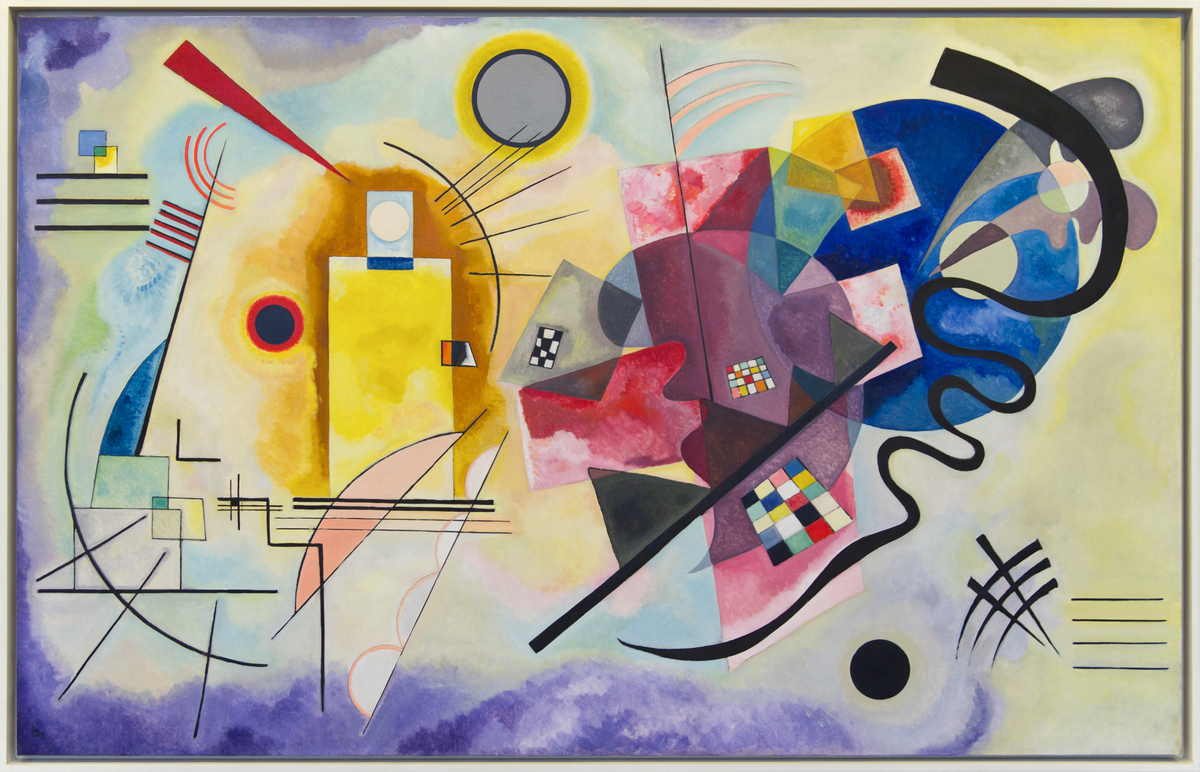
This is Wassily Kandinsky's Yellow-Red-Blue, an abstract painting from 1925. It was made in Weimar, in Germany, and the record describes its genre simply as abstract art. The painting doesn't tell a story with figures or events. The subject your record establishes is a circle, a form Kandinsky arranges among other shapes across the canvas.
Stand back and take in the surface as a whole. The record notes circles among the forms, and the title points to three colours working against one another. Look for where the yellow, the red and the blue each hold their ground. Where do they sit close and press together, and where does the pale canvas run between them, letting each colour keep its own edge?
The painting is oil on canvas, made in 1925 while Kandinsky was in Weimar. That is the whole of the historical context the supplied record supports. We know when and where it was made, and we know what it is called. What we don't have here is a statement from the artist or a museum essay explaining what these particular forms were meant to do.
So how should we read it? One honest answer is that the record supports the identification, an abstract painting with circles, and no further narrative or symbolic reading. The composition can still be looked at closely, shape against shape and colour against colour. But I won't tell you that a given circle means something specific, because nothing in my sources establishes that reading.
That leaves the work itself in front of you. Abstract painting asks you to read it through balance, weight and contrast rather than through a story. Notice how the circles and flat colour areas settle, or refuse to settle, into an arrangement. What you take from that arrangement is your own act of looking, and the painting gives it room.
The story and its sources
Historical claims are linked to the records below. Close looking and interpretation are identified in the passage notes.
- Passage 1Documented historyInstitutional record for Yellow-Red-Blue
- Passage 2Close lookingInstitutional record for Yellow-Red-Blue
- Passage 3Documented historyInstitutional record for Yellow-Red-Blue
- Passage 4InterpretationInstitutional record for Yellow-Red-Blue
- Passage 5Close lookingInstitutional record for Yellow-Red-Blue
Details to notice
About 2 minutes to readRed ring with dark center
Small red ring with a dark center sits within a yellow halo, a compact focal accent balancing the larger blue and yellow masses.
Black diagonal beam
A thick black diagonal beam cuts down through the central colored planes, establishing a firm axis amid the floating shapes.
Central colored planes
Overlapping crimson, pink, violet, green, and gray planes form a faceted central cluster, with checkerboard squares providing measured accents.
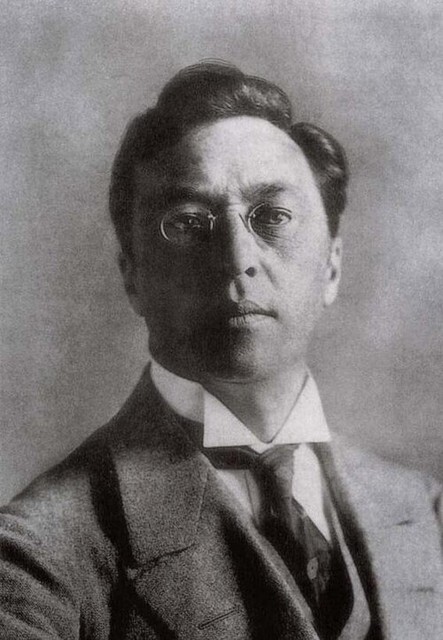
Artist portrait Image credit
未知上傳者. Image source · Public domain
About the artist
Wassily Kandinsky
1866 to 1944
Wassily Kandinsky was an avant-garde painter of Russian origin (1866–1944). Their work is associated with Expressionism; Symbolism; Bauhaus. Their recorded places of work include Paris; Munich; Weimar; Rapallo; The Hague; Russia; Stockholm; Switzerland; Tunis.
- Born
- 1866
- Died
- 1944
- Nationality
- Russian Empire; Russian Soviet Federative Socialist Republic; Soviet Union; France; Germany
- Birthplace
- Moscow
- Died in
- Neuilly-sur-Seine
Biography sources
The research & record
Study the work.
Follow the evidence.
Find catalogue details, historical context, technical research and the literature behind this artwork.
The artwork record
Research catalogue
Catalogue information and detailed research, with references that link to the bibliography.
Updated .
Identity and catalogue
Link- Title
- Yellow-Red-Blue(www.wikidata.org, n.d.)
- Artist or attribution
- Wassily Kandinsky(www.wikidata.org, n.d.)
- Object date
- 1925(www.wikidata.org, n.d.)
- Medium and support
- Oil paint on canvas(www.wikidata.org, n.d.)
- Dimensions
- 128 × 201.5 cm(www.wikidata.org, n.d.)
- Current collection or location
- Centre Georges Pompidou, Musée National d'Art Moderne, Paris(www.wikidata.org, n.d.)
- Movement or period
- Abstract art(www.wikidata.org, n.d.)
- Country or culture
- Germany (painted in Weimar)
- Depicted subject
- A non-narrative abstract painting in which coloured geometric and fluid forms, notably circles, rectangles and a serpentine band, are arranged across the canvas; the supplied sources record it as abstract art depicting circles but give no supported account of a depicted narrative episode.(www.wikidata.org, n.d.)
- Title variants
- Yellow-Red-Blue; Gelb-Rot-Blau; Jaune-rouge-bleu; Couleurs
- Accession number
- AM 1976-856
- Support
- Canvas
Read valuation records and their limitations
Names, maker and date
The painting is catalogued as Yellow-Red-Blue, an English title under which the record also preserves the forms Gelb-Rot-Blau, Jaune-rouge-bleu and Couleurs. The variation is itself informative for the object's identity: the German and French forms align the work with the German-speaking and French-speaking institutional and linguistic spheres through which it has been recorded, while Couleurs is a title of a different kind, naming colour as such rather than the three colours singled out in the longer titles. The work's creator is recorded as Wassily Kandinsky. Its inception, the date of creation, is given as 1925, which is the object date to which the work's making should be referred.(www.wikidata.org, n.d., Statements, title; Statements, creator; Statements, inception)
Interpretation
The catalogue date of 1925 should be kept distinct from the dates of the records that transmit it. The supplied institutional record is a modern aggregated database entry rather than a contemporary document, and the annotation to that source states that the Wikidata item does not cite a revealed page for its sourcing but aggregates identity fields for this painting. The 1925 date is therefore the object date as the catalogue reports it, while the catalogue itself is a later layer of documentation whose individual fields are not shown to rest on a cited primary source. The attribution to Kandinsky and the identification of the title and place of making carry the same qualification: they are catalogue assertions, supported by the record, not statements independently verified within this evidence.(www.wikidata.org, n.d., Statements, creator; Statements, inception; Statements, title)
The place of creation is recorded as Weimar. Read together with the 1925 date, this places the painting's making at the German institution with which Kandinsky was associated in that period, and it gives the German title Gelb-Rot-Blau a concrete setting. The record supplies the location as a catalogue field only; it does not supply a studio address, a commission, a first owner or a documented occasion for the work's execution, and none should be inferred from the place name alone.(www.wikidata.org, n.d., Statements, location of creation; Statements, inception; Statements, title)
Materials, dimensions and classification
The work is recorded as oil paint on canvas, with the canvas given as the painting's support. Its dimensions are recorded as 201.5 centimetres in width and 128 centimetres in height, so the canvas is markedly wider than it is tall, a horizontal rectangle of roughly three to two. Those measurements belong to the object's physical description in the catalogue and are the basis for any account of how the composition occupies its field; the record does not state whether the dimensions are unframed, stretched or otherwise measured. The genre is recorded simply as abstract art.(www.wikidata.org, n.d., Statements, width and height; Statements, genre)
Interpretation
The classification of the work as abstract art, and the related record that the painting depicts a circle, describe the picture's content at a general level rather than interpreting it. Within the catalogue's own terms, the object is a painting in oil on canvas whose subject matter is non-figurative and in which a circle is identified as a depicted element. The titles, meanwhile, foreground colour as a principal point of reference. Taken together, the catalogue establishes an abstract colour composition organised around forms including a circle, made in oil on canvas in 1925 at Weimar; it does not establish the number of circles, their placement, the specific pigments used or any symbolic programme, and the account should not supply those details from outside the evidence.(www.wikidata.org, n.d., Statements, genre; Statements, title; Statements, inception; Statements, location of creation)
Collection, inventory and status
The painting belongs to the collection of the Musée National d'Art Moderne, with inventory number AM 1976-856, and is recorded as located at the Centre Georges Pompidou. The inventory number, with its 1976 element, belongs to the museum's registration of the work and not to the painting's own date; the object remains a work of 1925, while the number records a later stage in its institutional documentation. The record also links to a French-language Centre Pompidou resource page for the work, which is consistent with the French title Jaune-rouge-bleu and with the work's place in a French national collection. The evidence gives no acquisition date, mode of acquisition or intermediate ownership, so the route by which the painting reached the museum is not established here.(www.wikidata.org, n.d., Statements, copyright status; Statements, title)
The painting is titled Yellow-Red-Blue, also recorded as Gelb-Rot-Blau, Jaune-rouge-bleu and Couleurs.(www.wikidata.org, n.d.)
The painting's creator is Wassily Kandinsky.(www.wikidata.org, n.d.)
The painting's date of creation, recorded as inception, is 1925.(www.wikidata.org, n.d.)
The painting measures 201.5 centimetres wide and 128 centimetres high.(www.wikidata.org, n.d.)
The work is recorded as belonging to the genre of abstract art.(www.wikidata.org, n.d.)
Subject and iconography
LinkRead valuation records and their limitations
The Recorded Composition
Visual observation
The institutional record for Yellow-Red-Blau, also recorded under the titles Gelb-Rot-Blau, Jaune-rouge-bleu and Couleurs, assigns the work to Wassily Kandinsky and dates its inception to 1925, with Weimar recorded as the place of creation. The record classifies the work within the genre of abstract art and states that it depicts a circle. These are the terms the record itself uses: a genre label, a title in four languages, and a specified depicted motif. They establish what the record identifies, not what a viewer will see at any given moment on the canvas, and the record's aggregation of identity fields is not accompanied by a cited revealed page for its statements. Analysis of the visible composition therefore has to proceed from the recorded identification outward, distinguishing carefully between what the record asserts and what close looking can confirm.(www.wikidata.org, n.d., Statements, depicts; Statements, location of creation)
The single depicted subject the record names is a circle, set among other shapes distributed across the surface. That bare identification matters for how the painting can responsibly be described: it is not a narrative image, and no figures, events or illustrated text are recorded in its subject field. Everything further about the arrangement of forms, their scale, their overlaps or their spacing would be observation supplied by a viewer rather than information the record establishes. The distinction is worth holding onto, because abstract painting of this period invites projection, and the institutional record deliberately stops at the identification of a motif. Within that limit, the circle is the anchor the evidence offers, and the remaining composition can be discussed only as the field in which that motif sits.(www.wikidata.org, n.d., Statements, depicts)
Interpretation
Read together, the units describe a large horizontal oil on canvas of 1925, made in Weimar, attributed to Kandinsky, identified as abstract and as depicting a circle, held at the Musée National d'Art Moderne and recorded at the Centre Georges Pompidou. That is a coherent object profile assembled from institutional metadata, and its value lies in precision about what is documented: title variants, date, place, medium, support, dimensions, genre, motif, collection and rights. What the profile does not contain is equally important. There is no description of colour distribution, no account of how yellow, red and blue occupy the surface, no documentation of technical imaging, and no evidence of revisions to the painting's appearance. The visible details and the documentary framework meet only at the motif of the circle and the medium of oil on canvas; beyond that point, observation and record must be kept separate in any responsible account of the work.(www.wikidata.org, n.d., Statements, depicts; Statements, location of creation; Statements, made from material)
Visual observation
The painting is recorded as depicting a circle.(www.wikidata.org, n.d.)
Historical context
LinkRead valuation records and their limitations
The documented record
The institutional record for this painting identifies it as Yellow-Red-Blue, also recorded under the titles Gelb-Rot-Blau, Jaune-rouge-bleu and Couleurs, and attributes it to Wassily Kandinsky, with a date of creation recorded as 1925. The same record gives the place of creation as Weimar, in Germany, and classifies the work as abstract art. These are identification fields, not a narrative of commissioning: the record assembles the artist's name, the date, the city and the genre, and it does so without a cited source page behind those statements. The account of the object therefore begins from a secure attribution and a documented time and place of making, while leaving the circumstances that prompted the making, and any patron or destination the work may have had, outside what the supplied evidence establishes.(www.wikidata.org, n.d., Statements, location of creation)
Physically, the record describes a painting in oil on canvas, with the canvas as its support, measuring 201.5 centimetres wide by 128 centimetres high. It belongs to the collection of the Musée National d'Art Moderne under inventory number AM 1976-856 and is recorded as located at the Centre Georges Pompidou; the record also links to a French-language Centre Pompidou resource page for the work. The 1976 element in the inventory number and the museum's location are collection facts, not evidence about when or for whom the painting was made, and the Weimar creation date of 1925 stands apart from them. On the record as supplied, the only creation circumstance available is the city and year, and even the identity of the patron or first owner is not among the fields the record supplies.(www.wikidata.org, n.d., Statements, location of creation; Statements, copyright status)
The record's copyright statement adds a further documented layer: the painting is recorded as public domain under a rule of seventy years or more after the author's death. This is a rights determination rather than a historical fact about the making of the work, and it depends on the author's death having occurred and on the applicable term, neither of which the supplied unit dates or names. It is useful here because it shows the kind of statement the record does make with authority, legal and institutional status, alongside the kind it does not supply, such as the identity of a commissioning patron or the function the painting served in Weimar in 1925.(www.wikidata.org, n.d., Statements, copyright status)
Subject and the limits of interpretation
Interpretation
Taken together, the units establish a secure identification and a documented creation in Weimar in 1925, in oil on canvas at a substantial scale, now held in a major public collection and in the public domain under a term measured from the author's death. They do not establish the commission, the household or institution for which the painting was made, the status it held at the time of creation, or the patrons involved. The difference between these two bodies of information matters for the larger history of abstract art and material culture: the work can be placed confidently at a moment and a place in Kandinsky's career and in a museum's holdings, but the social world of its making, which the section's questions ask about, remains outside the supplied evidence. The record supports the object's identity and its formal description; it does not support an account of why this canvas, at this size, with this subject, was made in Weimar in 1925.(www.wikidata.org, n.d., Statements, location of creation; Statements, copyright status; Statements, depicts)
The painting's place of creation is recorded as Weimar.(www.wikidata.org, n.d.)
The painting's copyright status is recorded as public domain under a rule of seventy years or more after the author's death.(www.wikidata.org, n.d.)
Materials and technique
LinkRead valuation records and their limitations
The recorded support and medium
The institutional record identifies Yellow-Red-Blau, also recorded as Jaune-rouge-bleu and Couleurs, as an oil painting on canvas, with the canvas recorded as the support. That single material statement establishes the support and the broad medium, but it does not by itself describe the ground preparation, the weave or texture of the canvas, the priming, or the layering of the paint. The record is an aggregation of identity fields for the work, identified as Q18705525, and its own annotation notes that it does not cite a revealed page for sourcing. The material description should therefore be read as recorded metadata rather than as the report of a technical examination: nothing in the supplied evidence reports a conservator's analysis, a cross-section, pigment identification, or a condition survey. Any account of how the paint was applied, what specific pigments were used, or what lies beneath the visible surface would go beyond what this record supports.(www.wikidata.org, n.d., Statements, made from material)
The record also fixes the circumstances of making that frame the material description. The creator is given as Wassily Kandinsky, the date of creation, recorded as inception, as 1925, and the place of creation as Weimar. The painted surface measures 201.5 centimetres wide and 128 centimetres high. That is a large vertical canvas, and the recorded dimensions are part of the material evidence: they establish the scale at which the oil paint was worked and the format the support was cut to, though the record says nothing about how the canvas was stretched or prepared. The work belongs to the collection of the Musée National d'Art Moderne, with inventory number AM 1976-856, and is recorded as located at the Centre Georges Pompidou. The record links to a French-language Centre Pompidou resource page for the work, and its copyright status is recorded as public domain under a rule of seventy years or more after the author's death. These are collection and rights facts rather than technical ones, but they anchor the object in a specific institutional holding whose conservation documentation is not reproduced here.(www.wikidata.org, n.d., Statements, made from material)
What the record documents and what it leaves open
Visual observation
What the object depicts is recorded separately from what it is made of. The record describes the painting's genre as abstract art and states that it depicts a circle. That depiction statement is a description of visible content, not a finding of material analysis. It tells us that a circle is among the forms on the oil-on-canvas surface, but it does not specify the circle's colour, its size, its position or the technique by which it was laid in. In the same way, the title's reference to yellow, red and blue names colours but does not document the pigments that produce them. The distinction matters for a materials account: the presence of a depicted circle and the naming of three colours in the title are visual and nominal evidence, while the oil-on-canvas identification is the record's material evidence. The supplied units do not bridge the two with any technical description of how the coloured forms were built up.(www.wikidata.org, n.d., Statements, depicts; Statements, made from material)
Interpretation
Read together, the units support a modest but firm material profile: a large vertical oil painting on canvas, made in Weimar in 1925 by Kandinsky, now held in the Musée National d'Art Moderne under inventory number AM 1976-856, depicting a circle within an abstract composition. That profile is enough to place the work within a history of twentieth-century abstract painting made in oil on canvas, and to explain why the medium and scale matter to how the object functions: a canvas of these dimensions presents coloured forms at a size that addresses a viewer's whole field of vision rather than a hand-held surface. The limits of the evidence should be kept equally firm. The record does not report pigments, ground, priming, brushwork, layering, tools, or any examination of the paint surface, and it does not report an artist's statement or a museum essay on the making of this canvas. Interpretations of the work's colour and form as programmatic or symbolic are not established by these units, and a materials account of the painting should stop at the documented support, medium, dimensions, date, place and collection until technical documentation is supplied.(www.wikidata.org, n.d., Statements, made from material; Statements, depicts)
The work is oil paint on canvas, with the canvas recorded as the painting's support.(www.wikidata.org, n.d.)
Interpretations and debates
LinkRead valuation records and their limitations
Reported traditions and disputed accounts
Reported tradition
The keyed evidence for this section is a Wikimedia Commons file page. It gives the painting's title as Yellow-Red-Blue and credits it to Kandinsky, and it records the image as public domain. Those three elements, a title, an attribution and a rights status, are the whole of what this particular unit establishes. The page is a file description rather than a catalogue entry or a scholarly publication, so its title and attribution function as reported identification: they tell us how the image is labelled and circulated in a public repository, not what an artist's statement or a museum record says about it. The source annotation also notes that its date refers to the upload rather than to the painting, which matters because a reader encountering the file page could otherwise mistake a repository date for a date of execution.(Wikimedia Commons: Yellow-Red-Blue, n.d., File description)
The credit line and the title are doing different kinds of work and should not be collapsed. The title Yellow-Red-Blue names three colours, and a title of that kind can reasonably be read as a pointer toward colour as a subject, but the Commons page itself makes no claim about what the colours do in the composition, whether they are distributed in the way the title lists them, or how the artist intended them to relate. The attribution to Kandinsky is similarly a statement of authorship as recorded by the repository. Neither element comes with a date, a place of making or a provenance attached in this unit, and none of those should be inferred from it. The evidence supports the existence of a publicly circulated identification; it does not support a fuller account of the work's creation.(Wikimedia Commons: Yellow-Red-Blue, n.d., File description)
Interpretation
Because the file page is the only object-specific unit supplied for this section, the honest scope of the section is narrow: a title, a named artist and a public-domain designation on a public media repository. That is a real form of documentation, and it is worth being precise about what it does. Public-domain status on such a page concerns the reproduction or the image file made available there, and it is a rights claim about circulation rather than a statement about the physical painting or its history. Similarly, the presence of the work on Commons shows that an image of it has been catalogued and shared under that identification, which is evidence about reception and labelling. It is not, by itself, evidence about materials, dimensions, condition or exhibition history, and this account should not manufacture those to fill the gap.(Wikimedia Commons: Yellow-Red-Blue, n.d., File description)
Reported tradition
A Wikimedia Commons file identifies the painting and its title as Yellow-Red-Blue, crediting Kandinsky, and records the image as public domain.(Wikimedia Commons: Yellow-Red-Blue, n.d.)
Collection and display
LinkRead valuation records and their limitations
Institutional identity and location
Yellow-Red-Blue is recorded as belonging to the collection of the Musée National d'Art Moderne under inventory number AM 1976-856, and the record gives its location as the Centre Georges Pompidou. Those two pieces of information describe a single institutional home rather than competing claims: the Musée National d'Art Moderne is the collecting body named in the inventory, and the Centre Georges Pompidou is the building in which the collection is located. The inventory number is the anchor for the work's identity as a museum object, distinct from its title or its date of creation, and it is the sort of number that allows the painting to be traced through records of acquisition, storage and display. Nothing in the supplied evidence sets out the acquisition history, the date of entry into the collection, or the circumstances of the 1976 sequence implied by the number's prefix, so the museum record establishes custody and identification rather than provenance narrative.(www.wikidata.org, n.d., Statements, collection and inventory number)
The Wikidata record links to a French-language resource page for the painting maintained by the Centre Pompidou, and that link is the bridge between the aggregated identity fields and the institution's own description of the work. The French page is also consistent with the work's French title, Jaune-rouge-bleu, one of the titles the record associates with the painting alongside Yellow-Red-Blue, Gelb-Rot-Blau and Couleurs. The existence of a French-language institutional page indicates the painting is described within a French national collection framework, but the supplied evidence does not reproduce the contents of that page, so what the institution itself says about the work's making, display or interpretation cannot be inferred here beyond the identity data the Wikidata item aggregates.(www.wikidata.org, n.d., Statements, described at URL)
Interpretation
Read together, the two units describe a work whose documented life is institutional rather than narrative. The record fixes an owner, an inventory number, a location and a route to an institutional description, while the transcript's account of the painting as abstract, made in Weimar in 1925 and depicting a circle sits in the same metadata. For the history of collecting and display, the significance is that a major early twentieth-century abstract painting is documented as part of a national modern art collection in Paris, with a stable identifier that lets the object be followed across future records. The supplied evidence does not document any specific exhibition, loan, installation or conservation treatment, and no such claims should be attached to the inventory number or the resource link.(www.wikidata.org, n.d., Statements, collection and inventory number; Statements, described at URL)
The painting belongs to the collection of the Musée National d'Art Moderne, with inventory number AM 1976-856, and is recorded as located at the Centre Georges Pompidou.(www.wikidata.org, n.d.)
The Wikidata record links to a French-language Centre Pompidou resource page for the work.(www.wikidata.org, n.d.)
Documented values and qualified estimates
LinkRead valuation records and their limitations
A working valuation and its limits
Interpretation
The only valuation in the supplied evidence is a model-generated working range, not a market fact. It records a working insurance range of US$40M to US$90M, with the recorded date given as a working calculation generated 2026-10-30. The methodology states that the bracket was derived only from confirmed context: a prime-period 1925 abstract oil on canvas by Kandinsky, a foundational modernist, at the large scale of 128 by 201.5 cm, held by the Musée National d'Art Moderne within the Centre Georges Pompidou and recorded under inventory AM 1976-856. The reasoning offered is that museum-held works are not normally insured at open-market replacement value, since major Kandinsky canvases of this period, scale and prominence are effectively irreplaceable and seldom trade publicly. The range is therefore described as a deliberately widened bracket for manual review reflecting scarcity, institutional importance and the absence of verifiable public comparables.(Wikimedia Commons: Yellow-Red-Blue, n.d.)(www.wikidata.org, n.d.)
The qualifications on that valuation are as consequential as the figure. It is expressly a model-generated working range for manual review only, not an official insurance value, appraisal, auction estimate or result, or sale price. No comparable sales and no private insurance records were used or consulted. No valuation date is implied, since the local system sets the price date, and the figure should be adjusted by a qualified fine-art appraiser using the institution's own schedules, condition reports and title documentation, with all figures confirmed by a qualified fine-art insurance specialist and the holding institution before any use. Read alongside the identity record, this means the range is an inference built on the confirmed 1925 date, Weimar origin, medium and dimensions, extended by an argument about institutional holdings and market scarcity. It carries no independent evidence of what the painting would bring, and the absence of comparables is itself part of the recorded method rather than an omission to be filled in from outside knowledge.(Wikimedia Commons: Yellow-Red-Blue, n.d.)(www.wikidata.org, n.d.)
The gap between what the records establish and what a valuation would require is the central issue for this object's place in a history of material culture. The evidence documents identification, date, place, medium, dimensions, genre, an inventory number and a holding institution; it does not document condition, title history, or any transaction. A painting of this scale and period held in a national modernist collection is, on the valuation's own reasoning, precisely the kind of object for which open-market comparables are least likely to exist, so the widened bracket is better understood as an honest marker of that scarcity than as a price. The value of the record here lies in the confirmed context it preserves: a 1925 Weimar oil on canvas, 128 by 201.5 cm, recorded as abstract art depicting a circle, conserved under AM 1976-856 at the Musée National d'Art Moderne. Any further figure, and any account of the work's significance or monetary worth, would need documentation the supplied units do not contain.(Wikimedia Commons: Yellow-Red-Blue, n.d.)(www.wikidata.org, n.d.)
Working estimate
Calculated working insurance estimate, not a sale price: Working insurance range: US$40M to US$90M Recorded date: Working calculation, generated 2026-10-30. Methodology: Broad conservative working range derived only from the confirmed context: a prime-period 1925 abstract oil on canvas by Wassily Kandinsky, a foundational modernist, at a large scale of 128 by 201.5 cm, held by the Musee National d'Art Moderne within the Centre Georges Pompidou and recorded under inventory AM 1976-856. Museum-held works are not normally insured at open-market replacement value, since major Kandinsky canvases of this period, scale, and prominence are effectively irreplaceable and seldom trade publicly. The range is therefore a deliberately widened bracket for manual review reflecting scarcity, institutional importance, and the absence of verifiable public comparables, and should be adjusted by a qualified fine-art appraiser using the institution's own schedules, condition reports, and title documentation. Qualification: Model-generated working range for manual review only. This is not an official insurance value, appraisal, auction estimate or result, or sale price, and no comparable sales or private insurance records were used or consulted. No valuation date is implied; the local system sets the price date. Confirm all figures with a qualified fine-art insurance specialist and the holding institution before any use.(Wikimedia Commons: Yellow-Red-Blue, n.d.)(www.wikidata.org, n.d.)
Further reading
Books for a closer look
Paid links. As an Amazon Associate I earn from qualifying purchases.

Open Library Kandinsky: Russian and Bauhaus years, 1915-1933.
Solomon R. Guggenheim Museum
A Kandinsky catalogue with subjects including Abstract Art, Centre Georges Pompidou and the Musée national d'art moderne, matching the documented collection and institution of Yellow-Red-Blue. It is the most object-adjacent candidate here, though the record does not confirm that this specific 1925 painting is discussed.
ISBN 0892070447

Open Library Concerning the spiritual in art
Dover Publications
Kandinsky's treatise on aesthetics and modern art, relevant as the artist's documented theoretical framework for non-narrative abstract painting such as Yellow-Red-Blue.
ISBN 0486234118
Bibliography
Sources and further reading
References are arranged by author or organisation, with links to the original publications. Where no publication date is recorded, n.d. means no date.
Source notes updated .
No recorded sources match these filters. Reset the filters to see the full bibliography.
- 04
Book
Concerning the spiritual in art. Dover Publications.
Kandinsky's treatise on aesthetics and modern art, relevant as the artist's documented theoretical framework for non-narrative abstract painting such as Yellow-Red-Blue.
- ISBN
- 0486234118
Citation text
- 03
Book
Kandinsky: Russian and Bauhaus years, 1915-1933. Solomon R. Guggenheim Museum.
A Kandinsky catalogue with subjects including Abstract Art, Centre Georges Pompidou and the Musée national d'art moderne, matching the documented collection and institution of Yellow-Red-Blue. It is the most object-adjacent candidate here, though the record does not confirm that this specific 1925 painting is discussed.
- ISBN
- 0892070447
Citation text
- 01
Secondary · About this artwork
Wikimedia Commons: Yellow-Red-Blue (n.d.). Wikimedia Commons.
Commons file page used for discovery only; its date refers to the upload, not the painting.
- Language
- English
Citation text
- 02
Official · About this artwork
Wikidata item Q18705525 does not cite a revealed page for sourcing; it aggregates identity fields for this painting.
- Language
- English
Citation text
Art to live with
Bring this painting
home.
A piece of the archive, made yours. Explore Yellow-Red-Blue in a size and finish that fits your space.
Your text and annotations appear on these editions. Adding to cart saves that design for printing.
Combine this painting with your favourites01 / Find your edition
Made for you
Suggested from your location. Change it if you're sending elsewhere or using a VPN. Prices and delivery are shown in GBP.
1 product
Choose an edition to make it yours
iPhone 12 Mini ? Glossy ? back view
iPhone 12 Mini · Glossy

iPhone 12 Mini ? Glossy ? back view

iPhone 12 Mini ? Glossy ? back view

iPhone 12 Mini ? Glossy ? back view
Tough phone case
GBP 16.34
Delivery GBP 4.22 / Total GBP 20.56
A two-layer phone case with a printed polycarbonate shell and a shock-absorbing inner liner.
Two layers with a shock-absorbing TPU liner
Case & print details
- Device
- Apple · iPhone 12 Mini
- Material
- Polycarbonate shell with a TPU inner liner
- Artwork
- Outer back and wrapped edges from one template
- Finish
- Glossy
- Version
- Standard version
- Printing
- Dye sublimation
- Print file
- 1,122 × 1,831 px · 95 × 155 mm · PNG · 300 dpi recommended
Rear outline and camera openings follow this variant's Printify template. Case depth and small hardware remain illustrative.
Supplier product detailsFit and fill keep the painting’s proportions. Stretch changes them.
Move and zoom the painting on your tough phone case.
Made to order with your design
Made to order
US delivery only
The 30 cm ruler is scaled alongside your selected print. Keep the painting’s proportions with a black background, or stretch it to fill. Frame width, material texture and screen colours are illustrative.
Keep exploring