ArchiveWoman with a Parasol – Madame Monet and Her Son

Artwork record / 39 of 331

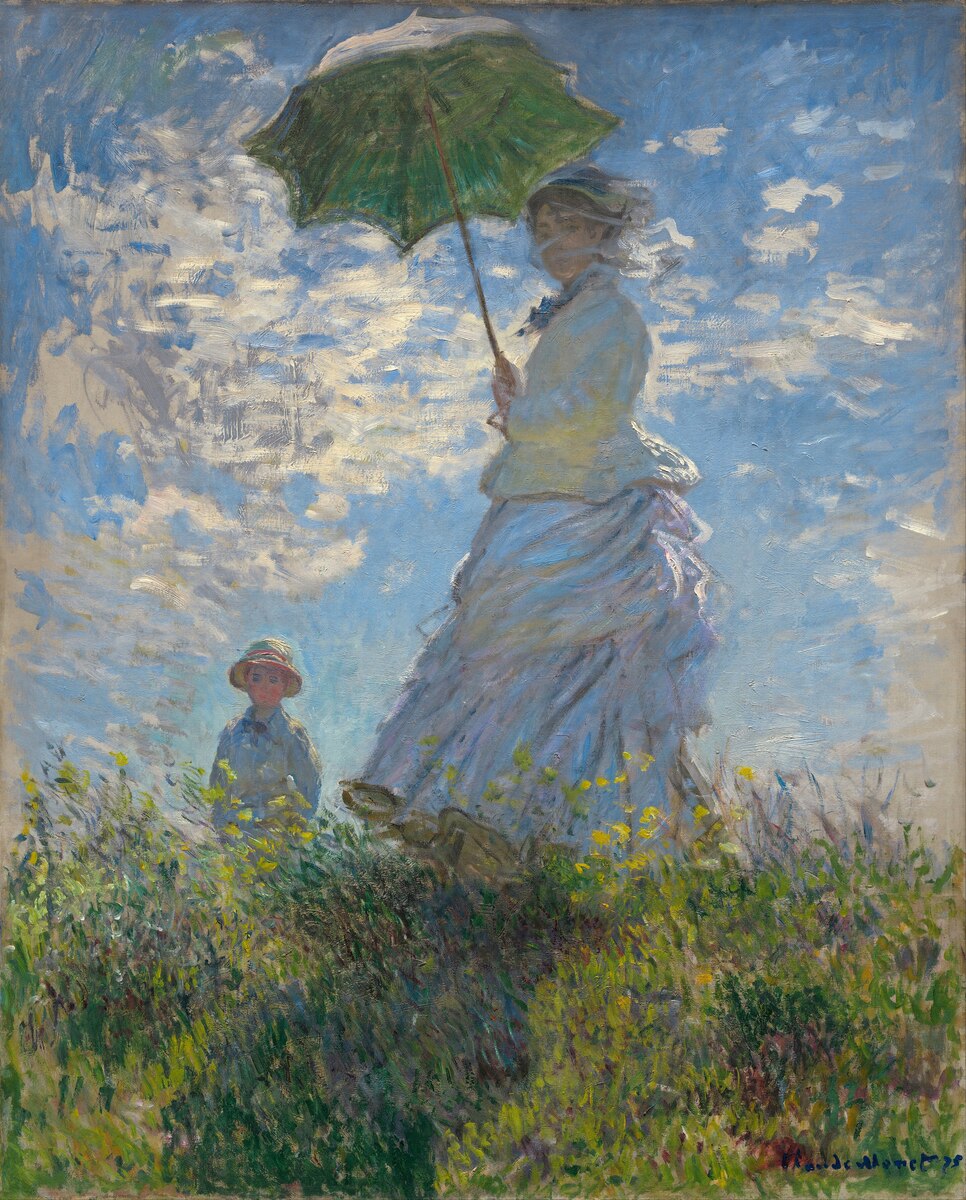
Woman with a Parasol – Madame Monet and Her Son by Claude Monet (1875)

Artist: Claude Monet

A docent-led reading of Claude Monet's 1875 painting of his wife Camille and son Jean on a grassy hill, tracing how wind, light and a low viewpoint turn a family moment into an Impressionist image of a passing instant.

Read the story ↓ About the artist ↓ Research and record ↓ Literature and sources ↓ Listen to the article ↓
Article text for AI
Shop this artwork ↓ 1 visit
Date1875CultureFrance PeriodImpressionismCurrent locationNational Gallery of Art, Washington, D.C., United States
Listen to the article 2:44
100%
Woman with a Parasol – Madame Monet and Her Son by Claude Monet (1875)
Loading full-resolution artwork…
Scroll to zoom · drag to pan · double-click to focus Pinch to zoom · drag to explore · double-tap to focus FIELD VIEW / 39
Tools & download
Pixel colour Select a pixel with the eyedropper
No pixel selected

Choose the eyedropper, then click or tap the image. Scroll to zoom for finer selection.

Add text

Hand to pan · Select to move text and drawings · Add as many texts as you like · Scroll to zoom

Woman with a Parasol – Madame Monet and Her Son: high-resolution image

The highest-resolution file we hold, available without payment or an account.3,840 × 4,770 pixels.

Download highest-resolution image

Details to notice

About 2 minutes to read
01

Monet signature

The dark inscription in the lower right corner reading Claude Monet with the date 75, painted into the grass; a documentary detail confirming authorship and the year of execution.

02

Flowering meadow

The slope of rough summer grass with scattered yellow blossoms painted in quick touches of green, yellow, and violet, forming the near foreground that catches the low light and frames both figures from below.

03

Windblown crinoline dress

The pale blue-white skirt billowing forward and back in looping brushstrokes, streaked with blue shadows, showing the wind pressing through the fabric; the fullest expression of Monet's fleeting-light brushwork on the figure.

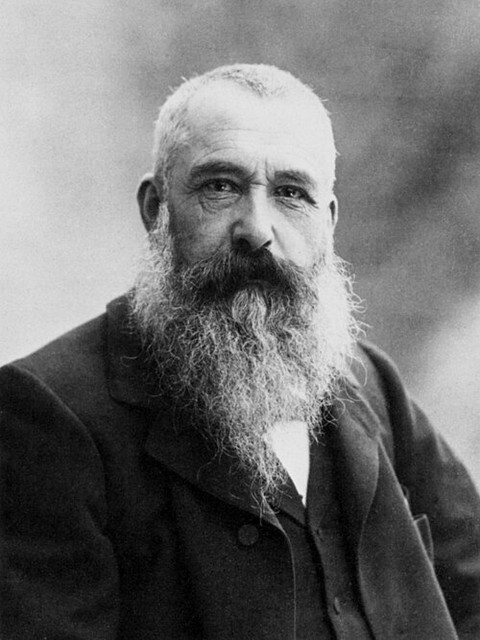
Artist portrait of Claude Monet
Artist portrait Image credit

Nadar. Image source · Public domain

About the artist

Claude Monet

1840 to 1926

Claude Monet was a French painter (1840–1926). Their work is associated with Impressionism. Their recorded places of work include Paris; Argenteuil; Vétheuil; Poissy; Giverny; Honfleur; Trouville, Seine-Maritime; Amsterdam; Oegstgeest; Sassenheim; The Hague; Zaandam; London.

Born
1840
Died
1926
Nationality
France
Birthplace
Paris
Died in
Giverny

The research & record

Study the work.
Follow the evidence.

Find catalogue details, historical context, technical research and the literature behind this artwork.

Article text for AI
Open research text

The artwork record

Research catalogue

Catalogue information and detailed research, with references that link to the bibliography.

Updated .

Identity and catalogue

Link
Title
Woman with a Parasol – Madame Monet and Her Son(Wikimedia Commons: Woman with a Parasol, n.d.)
Artist or attribution
Claude Monet
Object date
1875
Medium and support
Oil on canvas
Dimensions
100 × 82 cm (39.3 × 32.2 in)(Wikimedia Commons: Woman with a Parasol, n.d.)
Current collection or location
National Gallery of Art, Washington, D.C., United States(Wikimedia Commons: Woman with a Parasol, n.d.)
Movement or period
Impressionism(Wikimedia Commons: Woman with a Parasol, n.d.)
Country or culture
France
Depicted subject
The painting depicts Claude Monet's wife Camille Doncieux and their son Jean Monet outdoors on a grassy hill in 1875. Camille stands in a windblown dress, turned in near-profile and holding a green parasol; Jean is shown frontally, sunk to the waist in tall grass. The work belongs to the Impressionist era and captures a fleeting moment of light and air.(Wikimedia Commons: Woman with a Parasol, n.d.)
Title variants
Woman with a Parasol; La Promenade; La Femme à l'ombrelle, Madame Monet et son fils; Frau mit Sonnenschirm – Camille Monet und Sohn Jean auf dem Hügel; Gezinti; 散歩、日傘をさす女性
Accession number
1983.1.29
Support
Canvas
Catalogue identification

Wikimedia Commons records the painting under the title Woman with a Parasol – Madame Monet and Her Son, attributed to Claude Monet and dated 1875. Its medium is oil on canvas, and it is held at the National Gallery of Art, Washington, D.C., under accession number 1983.1.29. The same file record supplies a second catalogue element important for the object's identity: the work is recorded in the Monet catalogue raisonné as number 381. These identifiers do different kinds of work. The title and attribution locate the picture within Monet's authorship; the 1875 date places its making; the accession number fixes its present institutional custody; and the catalogue raisonné number ties the canvas to the standard scholarly inventory of Monet's oeuvre.(Wikimedia Commons: Woman with a Parasol, n.d., File information and collapsible summary)

Depicted in the painting are Camille Doncieux and Jean Monet. The Wikimedia Commons record identifies them as the figures in the composition, which means the work is not an anonymous genre scene but a picture whose subjects are named and whose relationship to the painter is part of the historical record. The identification is stated as documented information in the file record, and it aligns the image with Monet's family circle rather than with an invented or unspecified cast of characters.(Wikimedia Commons: Woman with a Parasol, n.d., Depicted people field)

The file record also documents the status of the digitized image supplied with it. That reproduction is described as a faithful photographic reproduction of a two-dimensional public domain work of art, sourced from Google Arts & Culture. This is a statement about the image file, not about the painting's own materials or condition, and it helps separate the identity of the physical canvas from the identity of its widely circulated digital surrogate. The distinction is consequential for research use: the reproduction is presented as a faithful record of a public domain two-dimensional work, while the object itself remains an oil painting on canvas in a public collection.(Wikimedia Commons: Woman with a Parasol, n.d., Licensing section)

The painting is Woman with a Parasol – Madame Monet and Her Son by Claude Monet, dated 1875, oil on canvas, held at the National Gallery of Art, Washington, D.C., accession number 1983.1.29.(Wikimedia Commons: Woman with a Parasol, n.d.)

The painting depicts Camille Doncieux and Jean Monet.(Wikimedia Commons: Woman with a Parasol, n.d.)

The image reproduction is a faithful photographic reproduction of a two-dimensional public domain work of art, sourced from Google Arts & Culture.(Wikimedia Commons: Woman with a Parasol, n.d.)

Historical context

Link
Subject and Commissioning Circumstances

The supplied record classifies the painting as genre art belonging to the Impressionism era, and the transcript identifies its subjects as Camille Doncieux and her son Jean, the wife and child of Claude Monet, standing on a grassy hill in 1875. A genre designation does not mean anonymity: the picture shows the artist's own household, yet it is framed as a scene of ordinary modern life rather than as a formal family portrait. That combination of private subjects and public pictorial category is the tension the object itself stages.(Wikimedia Commons: Woman with a Parasol, n.d., Object type and genre fields)

The transcript describes the composition as it has been read: a low viewpoint that sets Camille against the sky while the grass closes around Jean at the waist; a green parasol tilted against the wind; a dress pulled sideways; simple faces and soft edges; and sky and hill brushed with loose, visible strokes. Those are observations of the surviving canvas and its reproduction rather than archival facts about the sitting. They establish what the picture looks like now, and they are the basis on which any account of its subject and status must rest.(Wikimedia Commons: Woman with a Parasol, n.d., Object type and genre fields)

Exhibition, Dating and Later Accounts

Interpretation

The painting was shown at the second Impressionist exhibition, held from 30 March to 30 April 1876. The transcript describes that showing as occurring less than a year after the work was made, which is consistent with the 1875 date the record gives. Exhibition within a year places the canvas in a group context rather than a private one, and it makes the genre classification a public curatorial fact at that date, not merely a later label. The transcript's further characterization of the picture as turning a private moment into a public image of looking is an interpretation of that visibility, and it should be weighed as such.(Wikimedia Commons: Woman with a Parasol, n.d., Object type and genre fields; References field)

Because the record's own fields carry object type and genre, the catalogue raisonné number, and the exhibition history, the accounts available here operate at different evidential levels: the catalogue number identifies the painting, the exhibition entry dates a public appearance, and the transcript supplies a reading of viewpoint, movement and brushwork. None of these establish a documented commission, patron, price or acquisition date, and the record does not supply a provenance chain between the 1875 execution and the exhibition. Those gaps should be preserved rather than filled, even though secure identification of the work as Woman with a Parasol - Madame Monet and Her Son, number 381, with its National Gallery of Art accession and its 1876 exhibition, is on its own enough to anchor the object in a chronology.(Wikimedia Commons: Woman with a Parasol, n.d., References field; Object type and genre fields)

The painting is classified as genre art and belongs to the Impressionism era.(Wikimedia Commons: Woman with a Parasol, n.d.)

Materials and technique

Link
Documented support and dimensions

The object is an oil painting on canvas measuring 100 cm in height by 82 cm in width, the material and dimensional record that anchors every subsequent technical and art-historical discussion of the work. That measurement is established by the file documentation of the Wikimedia Commons record, which also records the title Woman with a Parasol, the attribution to Claude Monet, the date 1875, and the present location at the National Gallery of Art, Washington, D.C., under accession number 1983.1.29. The same record notes that the image reproduction is a faithful photographic reproduction of a two-dimensional public domain work of art, sourced from Google Arts and Culture, which means that most published visual accounts of the painting, including the ones summarized in the spoken transcript, depend on a photographic intermediary rather than on direct examination of the canvas. That distinction matters for any materials claim: a reproduction can transmit composition, color relationships and large-scale surface effects, but it cannot by itself establish canvas weave, ground preparation, layer structure or pigment identity.(Wikimedia Commons: Woman with a Parasol, n.d., File information)

The painting measures 100 cm in height and 82 cm in width, oil on canvas.(Wikimedia Commons: Woman with a Parasol, n.d.)

Provenance and ownership

Link
Provenance timeline
  1. 30 March to 30 April 1876

    The painting was shown at the second Impressionist exhibition.(Wikimedia Commons: Woman with a Parasol, n.d., Exhibition history field)

Exhibition history

Link
Exhibition History

The exhibition record for Woman with a Parasol – Madame Monet and Her Son places the painting in the second Impressionist exhibition, held in Paris from 30 March to 30 April 1876. That showing followed the canvas's execution in 1875 by only a matter of months, so the work entered public view while its subject, technique and Impressionist affiliation were still new. The evidence establishes the venue's identity as the second Impressionist exhibition and the opening and closing dates, but it does not supply the catalogue number, the gallery, the number of works shown or the critical response the picture received there.(Wikimedia Commons: Woman with a Parasol, n.d., Exhibition history field)

The painting's exhibition history and its place in the painter's catalogue raisonné have to be kept distinct as categories of record. The exhibition entry documents that the canvas was shown in 1876; the catalogue raisonné entry, where the work is recorded as number 381, documents its position within the enumerated corpus of Monet's paintings rather than a display. Neither record, as supplied, describes the picture's current hanging or a present-day installation, and the object is documented as held by the National Gallery of Art, Washington, D.C., under accession number 1983.1.29. The distinction matters because a nineteenth-century exhibition, a twentieth-century catalogue number and a modern museum accession each answer a different question about the same object, and the evidence supports only the first of these as an exhibition fact.(Wikimedia Commons: Woman with a Parasol, n.d., Exhibition history field; References field)

The painting was exhibited at the second Impressionist exhibition, held from 30 March to 30 April 1876.(Wikimedia Commons: Woman with a Parasol, n.d.)

Reception and literature

Link

A second, institutional stage of reception is the work's entry into the permanent collection of the National Gallery of Art, Washington, D.C., where it is held under accession number 1983.1.29. That accession number documents the object's formal registration in a public museum collection, a different kind of reception from the 1876 exhibition: it fixes the painting as a held and catalogued object rather than a work on temporary view. The collection and accession record also anchors the physical description supplied for the work, which gives its height as 100 cm and its width as 82 cm, executed in oil on canvas. These dimensions and the medium belong to the same documented object record, not to later interpretation.(Wikimedia Commons: Woman with a Parasol, n.d., References field)

Scholarly reception of the work is also registered through the Monet catalogue raisonné, where the canvas is recorded as number 381. The catalogue raisonné reference performs a different function from the museum accession: it situates the painting within the numbered corpus of Monet's accepted works, which is the standard apparatus by which attribution and completeness are debated. The supplied evidence documents the catalogue number but does not supply a publication date, compiler or edition for that entry, so the precise scholarly moment at which the number was assigned cannot be stated from this record.(Wikimedia Commons: Woman with a Parasol, n.d., References field)

Interpretation

Taken together, the exhibition entry, the collection and accession record, the catalogue raisonné number and the genre and era classification describe successive documented stages through which the object has been received: first as an exhibited Impressionist canvas in 1876, then as a catalogue raisonné entry within Monet's corpus, then as a classed genre painting and finally as a registered museum holding in Washington. What the evidence does not supply is a continuous narrative of critical admiration, imitation by other artists, changing display over time or literary reading. Those stages are not documented in the supplied units, and the account should not substitute a general history of the painting's fame for the specific records that exist.(Wikimedia Commons: Woman with a Parasol, n.d., Exhibition history field; References field; Object type and genre fields)

The work is recorded in the Monet catalogue raisonné as number 381.(Wikimedia Commons: Woman with a Parasol, n.d.)

Collection and display

Link
The object in the collection record

The work known as Woman with a Parasol, subtitled Madame Monet and Her Son, is held by the National Gallery of Art in Washington, D.C., where it carries the accession number 1983.1.29. That accession number, together with the collecting institution named in the same record, is the most concrete provenance fact available for the object in this account: it establishes both the present custodian and the registry entry under which the painting is administered. The record also gives the medium as oil on canvas and the dimensions as 100 cm in height by 82 cm in width, so the physical support and its scale can be stated alongside the holding institution rather than separately from it. Within the institution's collection, then, the object is documented as a painting rather than as a drawing, print or other work on paper, and its size places it among the larger canvases of the period in which it was made.(Wikimedia Commons: Woman with a Parasol, n.d., Collection field)

The same source record supplies the identification that anchors the accession entry to an artist and a subject: the painting is attributed to Claude Monet, dated 1875, and its title identifies the sitters as Madame Monet and her son. The catalogue information further states that the figures depicted are Camille Doncieux and Jean Monet, which connects the title's generic "Madame Monet and Her Son" to named individuals, the artist's wife and child. The record classifies the picture as genre art within the Impressionism era, a classification that describes it as a scene of ordinary life rather than a historical, religious or mythological subject. Because these details come from the same collection documentation as the accession number, the attribution, date, medium, dimensions, subject identification and genre classification stand together as one documented account of the object rather than as separately sourced claims.(Wikimedia Commons: Woman with a Parasol, n.d., Collection field)

Exhibition history and the catalogue raisonné

The record also fixes the work within two reference systems that operate beyond the walls of any single museum. It reports that the painting was exhibited at the second Impressionist exhibition, held from 30 March to 30 April 1876, which places a public showing of the canvas in Paris less than a year after the 1875 date given for its execution. Independently of that exhibition history, the painting is recorded in the Monet catalogue raisonné as number 381, a numbered entry in the systematic catalogue of the artist's paintings. The exhibition date and the catalogue number describe the object in different terms: one documents a historical moment of display, the other documents its place in the scholarly inventory of Monet's oeuvre. Kept together, they show how a single canvas can be located both in the history of exhibitions and in the reference literature that catalogues an artist's production.(Wikimedia Commons: Woman with a Parasol, n.d., Collection field)

The documentation and its image

The source from which this documentation is drawn is a Wikimedia Commons file record, and its reproduction of the painting is described there as a faithful photographic reproduction of a two-dimensional public domain work of art, with the image sourced from Google Arts & Culture. That statement concerns the status and origin of the digital image itself, not the physical painting, and it is a claim made within the file record rather than a conservation or authentication finding about the canvas. It matters for research use because it identifies the image as a reproduction of a public domain two-dimensional work and names the platform through which the image was supplied, so the reader can distinguish the evidence about the depicted object from the evidence about how that object has been circulated as an image. The accession number, attribution, date, dimensions, exhibition history and catalogue raisonné number cited here come from this same file record, which is the documentation consulted for the present account.(Wikimedia Commons: Woman with a Parasol, n.d., Collection field)

What the record establishes and what it leaves open

Interpretation

Taken as a whole, the documented record supports a precise but bounded set of statements about the object: it is a painting by Claude Monet dated 1875, executed in oil on canvas at 100 by 82 cm, depicting Camille Doncieux and Jean Monet, classified as genre art in the Impressionism era, exhibited at the second Impressionist exhibition from 30 March to 30 April 1876, recorded as number 381 in the Monet catalogue raisonné, and now held by the National Gallery of Art, Washington, D.C., under accession number 1983.1.29. What the record does not supply is equally important for an accumulating research account: it gives no acquisition history, no record of intervening owners, no conservation treatment, no pigment analysis and no condition report. The account therefore cannot describe how the painting moved from Monet's hands to the National Gallery of Art, nor what physical changes the canvas has undergone, without going beyond the evidence. Within those limits, the object is unusually well pinned down at both ends of its documented life, by a date and exhibition near the moment of creation and by an institutional accession number at the present day, and the gap between those two anchors remains to be filled by other sources.(Wikimedia Commons: Woman with a Parasol, n.d., Collection field)

The National Gallery of Art, Washington, D.C., holds the work; its accession number is 1983.1.29.(Wikimedia Commons: Woman with a Parasol, n.d.)

Documented values and qualified estimates

Link
The Calculated Insurance Range

Interpretation

The working valuation record for this canvas is explicit that it is a calculation rather than a valuation event. Generated on 16 October 2026, it states a range of US$50 million to US$150 million and labels itself a conservative working estimate prepared for manual insurance review only, not an appraisal, auction result, sale price, or official value. It also records the limits of its own inputs: the estimate rests solely on the supplied artwork context, with no comparable sales, no private insurance records, and no inspection of the physical work. On that basis the range should be read as a document about how one working calculation handled this object, not as evidence of what the object is worth.(Wikimedia Commons: Woman with a Parasol, n.d.)

The methodology attributed to the calculation explains the two ends of the range separately. The figure was derived, the record says, from confirmed artwork facts: a Claude Monet of 1875, oil on canvas, 100 by 82 centimetres, an Impressionist painting long held in the permanent collection of the National Gallery of Art, Washington, D.C., accession number 1983.1.29. The logic applies broad market-level thinking for major museum-quality Monet paintings, then adjusts conservatively downward because the work is almost certainly not available for private sale and because the supplied excerpts contain no recent auction result and no documented acquisition price. The low end is described as reflecting uncertainty about hypothetical private-market conditions for an unlisted, publicly held masterwork; the high end is said to reflect exceptional artistic and historical importance. The same record distinguishes the two ends in a second way: importance pushes the top, unavailability and absent transaction data constrain the bottom.(Wikimedia Commons: Woman with a Parasol, n.d.)

The record also sets out what would be needed before the range could be treated as anything more consequential. It states that an actual insurance or market value would require a qualified appraiser, a condition report, a provenance review, and current market analysis, and that nothing in it should be taken to imply an official insurance schedule, appraisal, auction result, or sale price. Two features of the object as documented bear directly on the low end, though the valuation record does not state a causal link between them and the figure: the object's accession number 1983.1.29 places it in a permanent public collection, and the same source record that supplies the accession number and collection also supplies its exhibition and catalogue history. The importance side of the calculation also rests on documented facts rather than an unattributed judgement about quality: the source record identifies the artist as among the most prominent Impressionists, in the valuation's words, and identifies the painting as a widely reproduced, iconic work of an important period.(Wikimedia Commons: Woman with a Parasol, n.d.)

What the Source Record Fixes

The two records also differ in the kind of authority they carry, and the difference matters when they are placed side by side. The catalogue, accession, exhibition, and sitter information comes from a Wikimedia Commons file record, described as a faithful photographic reproduction of a two-dimensional public domain work of art sourced from Google Arts and Culture, and that record also carries the statements about the artist's prominence and the work's wide reproduction. The value range, by contrast, comes from the working calculation itself and disclaims appraisal status, comparable sales, private insurance records, and physical inspection. Used together, the source record supplies the object's identifying facts while the valuation record supplies only a review-stage figure whose own text limits it; the valuation's reasoning explicitly draws on the object's collection history and institutional setting, so the two records are connected by method rather than by independent corroboration of value.(Wikimedia Commons: Woman with a Parasol, n.d.)

Working estimate

Calculated working insurance estimate, not a sale price: Estimated value: US$50M to US$150M Recorded date: Working calculation, generated 2026-10-16. Methodology: The range is a conservative working estimate for manual insurance review only, not an appraisal or official value. It is derived from the confirmed artwork facts: Claude Monet, 1875, oil on canvas, 100 x 82 cm, an Impressionist painting long held in the permanent collection of the National Gallery of Art, Washington, D.C., accession number 1983.1.29. Monet is among the most prominent Impressionist artists, and this is a widely reproduced, iconic work from an important period. The calculation applies broad market-level thinking for major museum-quality Monet paintings, with a conservative downward adjustment because the work is almost certainly not available for private sale, has no recent auction result or documented acquisition price in the supplied excerpts, and no comparable-sale data or private insurance records were used. The low end reflects uncertainty about hypothetical private-market conditions for an unlisted, publicly held masterwork; the high end reflects its exceptional artistic and historical importance. No official insurance schedule, appraisal, auction result, or sale price is implied. Qualification: This is a model-generated working insurance range for manual review only. It is not an official insurance value, appraisal, auction result, or sale price. It is not based on comparable sales, private insurance records, or an inspection of the physical work. Actual insurance or market value would require a qualified appraiser, condition report, provenance review, and current market analysis. The range is a broad, conservative calculation using only the supplied artwork context and source excerpt.(Wikimedia Commons: Woman with a Parasol, n.d.)

Further reading

Books for a closer look

Paid links. As an Amazon Associate I earn from qualifying purchases.

  • Cover of Monet - Woman with a Parasol
    Open Library

    Federico Castelli Gattinara, 2004

    Monet - Woman with a Parasol

    Barron''s Educational Series

    Recorded title names the painting directly and the sole recorded subject is 'Criticism and interpretation', indicating a focused interpretive study of this specific work rather than a broad survey. This is the closest object-specific scholarly candidate in the set.

    ISBN 9780764158094

    Find book on Amazon.co.uk View reference
  • Cover of Claude Monet: Life and Art
    Open Library

    Paul Hayes Tucker, 1998

    Claude Monet: Life and Art

    Yale University Press

    Recorded subjects include Monet criticism and interpretation and French artists, marking it as scholarly art-historical writing on Monet, the painter of the named work. Useful as contextual art-historical comparison, while not being an object-specific monograph.

    ISBN 9780300072860

    Find book on Amazon.co.uk View reference

Bibliography

Sources and further reading

References are arranged by author or organisation, with links to the original publications. Where no publication date is recorded, n.d. means no date.

Source notes updated .

  1. 03

    Book

    Claude Monet. Cassell; Orion Publishing Group, Limited.

    Catalogued as a catalogue raisonne of Monet by Wildenstein, the standard documentary reference for identifying and dating his paintings, which would document this work within Monet's oeuvre. Relevant as an authoritative scholarly catalogue, though not a single-object study.

    ISBN
    0304322210
    Link to reference
    Citation text
  2. 02

    Book

    Monet - Woman with a Parasol. Barron''s Educational Series.

    Recorded title names the painting directly and the sole recorded subject is 'Criticism and interpretation', indicating a focused interpretive study of this specific work rather than a broad survey. This is the closest object-specific scholarly candidate in the set.

    ISBN
    9780764158094
    Link to reference
    Citation text
  3. 04

    Book

    Claude Monet: Life and Art. Yale University Press.

    Recorded subjects include Monet criticism and interpretation and French artists, marking it as scholarly art-historical writing on Monet, the painter of the named work. Useful as contextual art-historical comparison, while not being an object-specific monograph.

    ISBN
    9780300072860
    Link to reference
    Citation text
  4. 01

    Secondary · About this artwork

    Wikimedia Commons: Woman with a Parasol (n.d.). Wikimedia Commons: Woman with a Parasol. Wikimedia Commons.

    Wikimedia Commons file record providing the object's title, artist, date, medium, dimensions, collection, accession number, exhibition history and catalogue raisonné reference.

    Language
    en
    Link to reference
    Citation text

Article text and sources · Reading and attribution

An unhandled error has occurred. Reload 🗙