Identity and catalogue
Link- Title
- Woman Holding a Balance
- Artist or attribution
- Johannes Vermeer
- Object date
- c. 1664
- Medium and support
- oil on canvas
- Dimensions
- painted surface: 39.7 x 35.5 cm (15 5/8 x 14 in.); stretcher size: 42.5 x 38 cm (16 3/4 x 14 15/16 in.); framed: 62.9 x 58.4 x 7.6 cm (24 3/4 x 23 x 3 in.)
- Movement or period
- Dutch Golden Age
- Country or culture
- Dutch
- Depicted subject
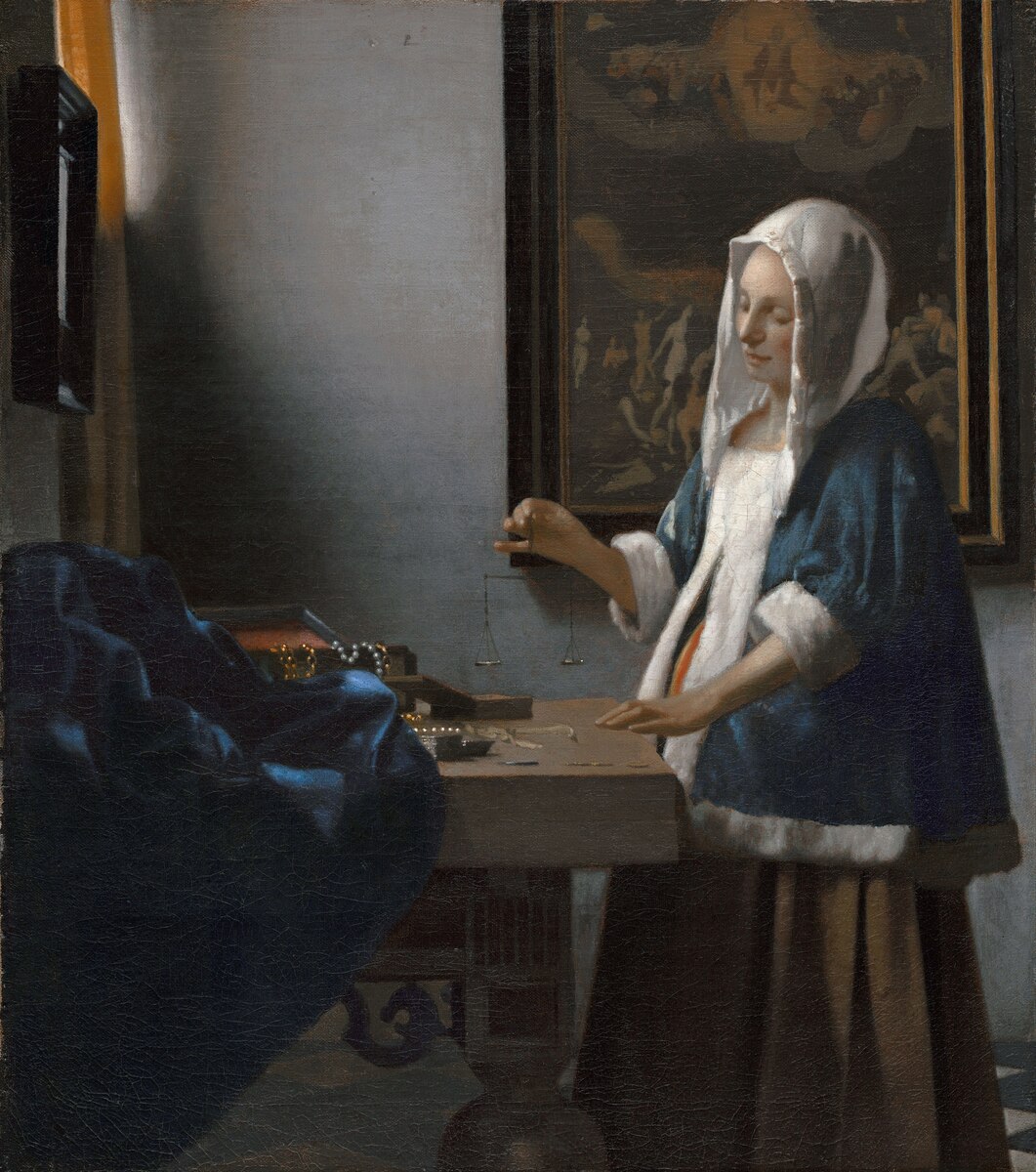
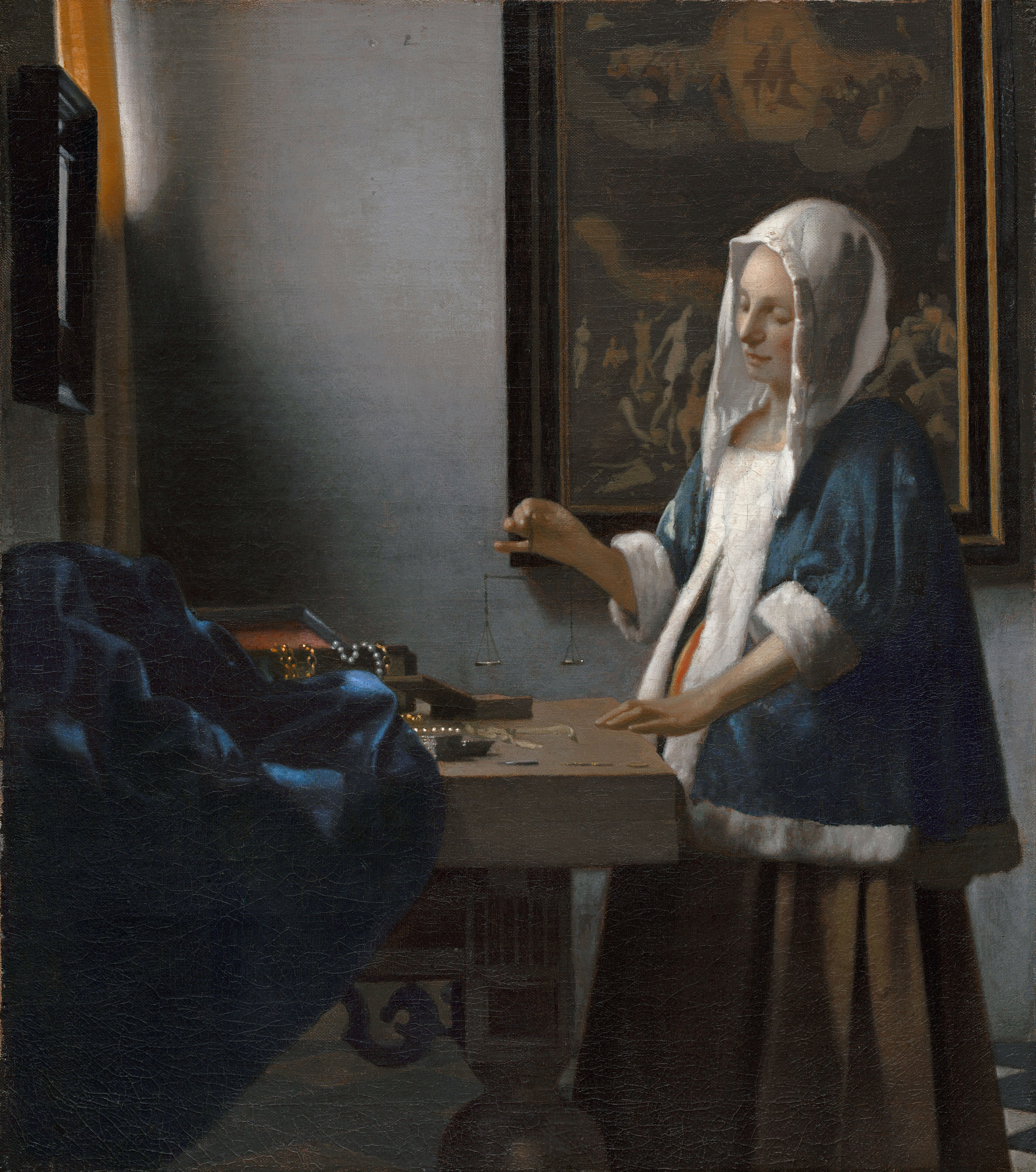
- A woman dressed in a blue jacket with fur trim stands serenely at a table in the corner of a room, holding a small balance at equilibrium; a large painting of the Last Judgment hangs on the wall behind her.
- Title variants
- Woman Weighing Gold; A Woman Weighing Gold; Woman Weighing Gold
- Accession number
- 1942.9.97
- Support
- canvas
Catalogue identity
The object is catalogued as Woman Holding a Balance, an oil on canvas dated around 1664 and attributed to Johannes Vermeer. The National Gallery of Art, Washington, D.C., holds it in the Widener Collection under accession number 1942.9.97. Vermeer is documented as a Dutch painter and art dealer, born in Delft in October 1632 and buried there on 15 December 1675, with a working period given as 1653 to 1675. The circa 1664 date belongs to the object's own making and is distinct from the later catalogue, sale and museum dates that record its ownership, publication and display; the painting's titles and attributions likewise changed over time, so the present catalogue heading is the product of a documentary history rather than a single fixed label.(National Gallery of Art, n.d.a, Artwork overview; Associated Names)(Wikimedia Commons contributors, n.d., Summary)
Description and interpretation
The material and visual evidence supports a reading of deliberate balance. The woman, dressed in a blue jacket with fur trim, stands at a table in a corner of a room, the scales in her right hand held at equilibrium, which the National Gallery of Art reads as suggestive of her inner state of mind. Behind her hangs a large painting of the Last Judgment in a black frame, and on the table are a shimmering blue cloth, open boxes, two strands of pearls and a gold chain. The gallery describes the picture as a superb example of Vermeer's exquisite sense of stability and rhythm, a judgement about composition that the described arrangement of figure, table and back wall makes legible.(National Gallery of Art, n.d.a, Artwork overview)(Wikimedia Commons contributors, n.d., Summary)
Subject and iconography
LinkThe Room and Its Occupant
Visual observation
The National Gallery of Art describes the picture as showing a woman dressed in a blue jacket with fur trim, standing serenely at a table in a corner of a room. Her position at the table in the corner, rather than at the centre of an open space, is part of what the gallery characterises as the work's exquisite sense of stability and rhythm. The same source identifies her garment as a blue jacket trimmed with fur, and gives her bearing as serene, two features that together establish the quiet, self-contained tone of the scene before any iconographic question is raised about what she is doing.(National Gallery of Art, n.d.a, Artwork overview; More About this Artwork)
Behind the woman, on the back wall of the room, hangs a large painting of the Last Judgment in a black frame. This is a depicted painting within the painting, not a free-standing object, and the gallery's overview records both its subject and its black framing. Its placement on the back wall closes the depth of the room and sets a scene of final accounting directly behind the woman's private activity at the table.(National Gallery of Art, n.d.a, Artwork overview)
On and about the table the gallery records a group of objects: a shimmering blue cloth, open boxes, two strands of pearls, and a gold chain. The description notes the blue cloth as shimmering, which is a statement about the appearance of the painted surface rather than about the textile itself. Together with the blue jacket, the blue cloth gives the scene a second expanse of the same colour family, and the pearls, gold chain, open boxes and cloth form the material setting against which the woman's action is staged. That these valuables appear at all is relevant to the history of the picture's title, since the earlier title A Woman Weighing Gold or Woman Weighing Gold, recorded by both the National Gallery of Art and the Wikimedia Commons institutional record, reflects a former understanding of the subject as the weighing of precious metal, an understanding evidently built from the objects on the table.(National Gallery of Art, n.d.a, Artwork overview; Bibliography)(Wikimedia Commons contributors, n.d., File page)
From Seen Object to Studied Surface
Interpretation
The visible scene and the technical study of the picture are connected by the National Gallery of Art's own research output. The gallery has published an interactive article, Reconsidering Vermeer's Perfectionism, about what can be learned by examining the pigments in Vermeer's paintings. The article is framed around pigments and around the notion of perfectionism, which places the analysis of materials in relation to a received characterisation of Vermeer's working method. The evidence establishes the existence and subject of that published study, and it links the study to Vermeer's paintings as a group; it does not, in the material supplied here, report which pigments were found in this canvas or what changes in appearance they document. The connection to the present object is therefore a connection of institutional research programme rather than a reported finding about this surface.(National Gallery of Art, n.d.a, More About this Artwork; Artwork overview)
Changing Titles and Changing Readings
Visual observation
The interpretive history of the picture is legible in its titles. Earlier publications called it A Woman Weighing Gold or Woman Weighing Gold, a naming that reflects a former reading of the subject as an act of weighing gold. The gallery's current presentation of the work under a title centred on a woman holding a balance corresponds to a reading in which the balance itself, and the equilibrium it holds, carries the meaning, rather than the monetary value of the material on the table. The competing titles are not simply synonyms; they are positions on what the depicted action is. The title history is documented in the National Gallery of Art's bibliography note and in the Commons file page, which records the same earlier titles.(National Gallery of Art, n.d.a, Bibliography; Artwork overview)(Wikimedia Commons contributors, n.d., File page)
What the Evidence Establishes
Interpretation
Read together, the visible elements and the documented record describe a picture that is at once a domestic scene and a subject of contested naming. The woman in the blue jacket with fur trim, the table with the blue cloth, open boxes, pearls and gold chain, and the black-framed Last Judgment on the back wall are the observed constituents of the composition. The picture is oil on canvas, dated around 1664, by a Delft painter and art dealer whose working period is given as 1653 to 1675, and it entered the National Gallery of Art in 1942 through the Widener bequest after a documented descent that includes the 1683 Dissius inventory, Amsterdam sales, a Munich sale of 1826 that named it differently and attributed it to Gabriel Metsu, a Paris sale of 1830, the Casimir Pierre Périer family, a Christie & Manson sale of 1848, purchase by P. & D. Colnaghi & Co. in 1910, a Knoedler share in October 1910, and sale to Peter A. B. Widener on 11 January 1911. Its earlier titles as a woman weighing gold belong to a former reading of the subject, and a high-resolution public-domain reproduction from the Google Art Project extends its availability beyond the two exhibitions documented here at the Louvre and the Rijksmuseum. The gallery's pigment-focused article on Vermeer's perfectionism stands as an indication of the kind of technical inquiry the institution has pursued on his paintings, without, in the evidence supplied, reporting results specific to this canvas.(National Gallery of Art, n.d.a, Artwork overview; More About this Artwork)(Wikimedia Commons contributors, n.d., Exhibition history)
Materials and technique
LinkExamining the Pigments
Technical examination
The technical literature that the National Gallery of Art attaches to Woman Holding a Balance is not an independent conservation report but a public-facing didactic article. The museum has published an interactive article, Reconsidering Vermeer's Perfectionism, devoted to what can be learned by examining the pigments in Vermeer's paintings, and the gallery's object page for this canvas points readers to it under the heading More About this Artwork. The article's framing is deliberately revisionary: perfectionism is put forward as a subject to be reconsidered, which signals that the examination of pigments is being used to complicate, rather than simply celebrate, the familiar image of Vermeer as a painter of flawless surfaces. Nothing in the supplied record identifies a particular instrument, a sampling campaign, a laboratory, a date of examination, or a named conservator, so the article's existence and its stated subject are the evidence here, not the specific results it may contain.(National Gallery of Art, n.d.a, More About this Artwork)
The limits of this evidence should be stated plainly. A pigment study of Vermeer's paintings as a group, published as an interactive article, is not the same thing as a technical examination of Woman Holding a Balance in particular, and the record supplied here does not establish that the article reports findings for this canvas, that any sample was taken from it, or that any pigment identification in it applies to this work. It also does not establish whether the examination relied on non-invasive imaging, on microscopic sampling, or on reanalysis of earlier data, and it supplies no dates for the examinations described. Any statement about this painting's materials beyond its medium of oil on canvas, dated around 1664, would therefore go past the evidence. The responsible reading is that the gallery itself treats pigment examination as a route to understanding Vermeer's practice, and that this painting, as a Vermeer in the gallery's collection, sits within the field that article addresses.(National Gallery of Art, n.d.a, More About this Artwork)
What the Surface Shows and What Materials Could Confirm
Interpretation
Read together, the two strands of evidence also clarify why a technical account of this object belongs in its research history at all. The same institution that supplies the visual description and the article on pigments also supplies the object's documentary record: oil on canvas, dated around 1664, Widener Collection, accession number 1942.9.97, given to the National Gallery of Art in 1942 after passing by inheritance from the Estate of Peter A. B. Widener by gift through power of appointment of Joseph E. Widener, Elkins Park, Pennsylvania. That record is the frame within which any future examination would be conducted and reported, and it is the reason the pigment article is attached to this object page rather than treated as a free-standing essay. Where the evidence stops, the account stops: the record establishes that the gallery promotes pigment examination as a way of understanding Vermeer, and that this painting is a Vermeer on canvas of about 1664 in its collection, but it does not yet establish which pigments, which methods, or which findings belong to this canvas specifically. That distinction between an institution's program of technical study and a documented technical result for one object is the qualification on which the present account rests.(National Gallery of Art, n.d.a, More About this Artwork)
Technical examination
The National Gallery of Art has published an interactive article, Reconsidering Vermeer's Perfectionism, about what can be learned by examining the pigments in Vermeer's paintings.(National Gallery of Art, n.d.a)
Provenance and ownership
LinkDocumented Provenance
The documented provenance of Woman Holding a Balance opens with the 1683 inventory of goods accruing to Jacob Dissius after the death of his wife Magdalena van Ruyven, an inventory that lists twenty paintings by Vermeer. That entry anchors the picture within an early documented group of Vermeer holdings, and the chain of recorded transfers continues through Amsterdam sales in 1777 and 1801, a Munich sale on 5 December 1826 (no. 101, then catalogued as by Gabriel Metsu), a Paris sale in 1830, and ownership within the Casimir Pierre Périer family. A Christie & Manson sale on 5 May 1848, no. 7, follows, then purchase by P. & D. Colnaghi & Co. of London in 1910, a one-quarter share purchased by M. Knoedler & Co. in October 1910, and sale on 11 January 1911 to Peter A. B. Widener. The painting then passed by inheritance from the Estate of Peter A. B. Widener by gift through power of appointment of Joseph E. Widener, Elkins Park, Pennsylvania, and was given to the National Gallery of Art in 1942, where it is held in the Widener Collection under accession number 1942.9.97. Read as a sequence, these entries establish successive changes of hands at identifiable sales and through an estate disposition, rather than a continuous record of unbroken ownership.(National Gallery of Art, n.d.b, Provenance)(Wikimedia Commons contributors, n.d., Provenance)(National Gallery of Art, n.d.a, Provenance)
Two entries in the record require qualification rather than acceptance at face value. The Munich sale of 5 December 1826 listed the painting under a different name, as by Gabriel Metsu, so the same object appears in that sale under an attribution other than Vermeer's; the sale reference therefore documents a transaction in the picture while also testifying to a period in which its authorship was recorded differently. Separately, a 1801 sale reference sometimes tied to this painting was in error: the painting in that sale was one of the same subject by Pieter de Hooch, now in Berlin. This correction shows that a same-subject composition by another artist has been conflated with the present work in the literature, and the distinction matters for provenance because an erroneous sale link would otherwise insert an undocumented owner into the chain. The remaining intervals between the recorded events, including the decades between the Paris sale of 1830 and the Christie & Manson sale of 1848, are unrecorded in the supplied evidence and should not be described as proven changes of ownership.(National Gallery of Art, n.d.a, Provenance)(Wikimedia Commons contributors, n.d., Provenance; Provenance note 3)
Changing Titles and Attributions
The painting's changing titles track its changing understanding. Earlier publications titled it A Woman Weighing Gold or Woman Weighing Gold, reflecting a former understanding of the subject as weighing gold, a reading grounded in the objects on the table rather than in the balance itself. The National Gallery of Art, which holds the work, now centres its reading on the balance and the equilibrium it holds, describing the painting as a superb example of Johannes Vermeer's exquisite sense of stability and rhythm. The Munich sale of 1826, where the picture was catalogued as by Gabriel Metsu, belongs to the same history of shifting labels: both the title and the attribution have changed over time, and the current attribution to Vermeer rests on the object as it is now catalogued and held. Vermeer himself was a Dutch painter and art dealer, born in Delft in October 1632 and buried there on 15 December 1675, with a working period from 1653 to 1675, so the painting's date of around 1664 places it within his documented activity. That the object is oil on canvas further fixes its material character alongside its dates and attributions.(National Gallery of Art, n.d.a, Bibliography; Provenance)(Wikimedia Commons contributors, n.d., File page; Provenance)
The documented provenance includes the 1683 inventory of goods accruing to Jacob Dissius after the death of his wife Magdalena van Ruyven, which lists twenty paintings by Vermeer; Amsterdam sales in 1777 and 1801; a Munich sale on 5 December 1826, no. 101, then catalogued as by Gabriel Metsu; a Paris sale in 1830; the Casimir Pierre Périer family; a Christie & Manson sale on 5 May 1848, no. 7; purchase by P. & D. Colnaghi & Co., London in 1910; a one-quarter share purchased by M. Knoedler & Co. in October 1910; and sale on 11 January 1911 to Peter A. B. Widener.(National Gallery of Art, n.d.b)(Wikimedia Commons contributors, n.d.)
A 1801 sale reference sometimes tied to this painting was in error; the painting in that sale was one of the same subject by Pieter de Hooch, now in Berlin.(Wikimedia Commons contributors, n.d.)
Provenance timeline
- 1683
An inventory of goods accruing to Jacob Dissius after the death of his wife Magdalena van Ruyven lists twenty paintings by Vermeer, the earliest documented provenance stage recorded for the painting.(National Gallery of Art, n.d.b, Provenance)(Wikimedia Commons contributors, n.d., Provenance)
- 1777
An Amsterdam sale is recorded among the documented provenance of the painting.(National Gallery of Art, n.d.b, Provenance)(Wikimedia Commons contributors, n.d., Provenance)
- 1801
An Amsterdam sale is listed in the documented provenance, but a sale reference sometimes tied to this painting from that year was in error; the painting in that sale was one of the same subject by Pieter de Hooch, now in Berlin.(National Gallery of Art, n.d.b, Provenance)(Wikimedia Commons contributors, n.d., Provenance; Provenance note 3)
- 5 December 1826
At a Munich sale, catalogued under a different name as by Gabriel Metsu, the painting appeared as no. 101.(National Gallery of Art, n.d.b, Provenance)(Wikimedia Commons contributors, n.d., Provenance)(National Gallery of Art, n.d.a, Provenance)
- 1830
A Paris sale is recorded in the documented provenance of the painting.(National Gallery of Art, n.d.b, Provenance)(Wikimedia Commons contributors, n.d., Provenance)
- after 1830
The painting is recorded in the documented provenance as having been in the Casimir Pierre Perier family.(National Gallery of Art, n.d.b, Provenance)(Wikimedia Commons contributors, n.d., Provenance)
- 5 May 1848
The painting appeared at a Christie and Manson sale as no. 7.(National Gallery of Art, n.d.b, Provenance)(Wikimedia Commons contributors, n.d., Provenance)
- 1910
P. and D. Colnaghi and Co., London, purchased the painting.(National Gallery of Art, n.d.b, Provenance)(Wikimedia Commons contributors, n.d., Provenance)
- October 1910
M. Knoedler and Co. purchased a one-quarter share in the painting.(National Gallery of Art, n.d.b, Provenance)(Wikimedia Commons contributors, n.d., Provenance)
- 11 January 1911
The painting was sold to Peter A. B. Widener.(National Gallery of Art, n.d.b, Provenance)(Wikimedia Commons contributors, n.d., Provenance)
- 1942
The painting passed by inheritance from the Estate of Peter A. B. Widener, by gift through power of appointment of Joseph E. Widener, Elkins Park, Pennsylvania, and was given to the National Gallery of Art.(National Gallery of Art, n.d.a, Provenance)(Wikimedia Commons contributors, n.d., Provenance)
Reception and literature
LinkChanging Titles and Changing Readings
Before the painting acquired its present title, it circulated under names that shaped how viewers approached it. Earlier publications called it A Woman Weighing Gold or Woman Weighing Gold, a title that reflected a former understanding of the subject as an act of weighing precious metal. The change of title is itself a record of reception: the objects on the table, the gold chain and the pearls, once anchored the reading of the scene, while the later title directs attention to the balance itself. The National Gallery of Art's object page and the institutional record both preserve this earlier naming, so the shift is documented rather than inferred.(National Gallery of Art, n.d.a, Bibliography)(Wikimedia Commons contributors, n.d., File page)
Public display forms a second documented stage. The painting was shown in the exhibition Vermeer and the Masters of Genre Painting: Inspiration and Rivalry at the Louvre Museum, where it was placed among works by Vermeer and his contemporaries in genre painting, a context that frames it within traditions of inspiration and rivalry rather than as an isolated masterpiece. It was later shown in the Vermeer exhibition at the Rijksmuseum from 10 February 2023 to 4 June 2023, a monographic presentation that gathered the artist's paintings for a modern public. These two exhibitions represent different curatorial arguments: one situates the picture in a network of genre painters, the other in the concentrated body of Vermeer's own work.(Wikimedia Commons contributors, n.d., Exhibition history)
The National Gallery of Art has also addressed reception directly through its own published articles. One article, Vermeer's Fiercest Fans, presents three individuals united by their profound appreciation for the paintings of Johannes Vermeer, making admiration itself the subject of interpretation rather than only the object of it. The gallery has likewise published an interactive article, Reconsidering Vermeer's Perfectionism, about what can be learned by examining the pigments in Vermeer's paintings. Together these items show an institution tracking both the affective response the paintings provoke and the technical examination that qualifies claims about the artist's working methods. The technical strand is important to reception because it tests the very perfectionism that admirers attribute to Vermeer.(National Gallery of Art, n.d.a, More About this Artwork)
Reproduction and Scholarly Study
Interpretation
Reproduction is a further stage in the painting's public life. A high-resolution public-domain photographic reproduction is hosted on Wikimedia Commons, sourced from the Google Art Project, where it carries the object's title, artist, date, medium, dimensions and collection. This means the picture can circulate as a digital file independent of the gallery wall, and its metadata travels with the image. The very existence of such a file, described on a Commons file page rather than in a sale catalogue or a printed catalogue raisonne, marks a shift in how reception is recorded and how viewers encounter the work.(National Gallery of Art, n.d.a, Bibliography)(Wikimedia Commons contributors, n.d., File page)
A National Gallery of Art article, Vermeer's Fiercest Fans, presents three individuals united by their profound appreciation for the paintings of Johannes Vermeer.(National Gallery of Art, n.d.a)
Interpretations and debates
LinkThe Gallery's Reading of Balance
Interpretation
The National Gallery of Art presents Woman Holding a Balance as a superb example of Johannes Vermeer's exquisite sense of stability and rhythm, a formulation that treats the painting's formal composure as the quality most worth naming. In the same overview the gallery singles out one detail for interpretation: the scales in the woman's right hand are at equilibrium, which the gallery reads as suggestive of her inner state of mind. The claim is explicitly an analogy between a painted instrument and an interior condition, and it is an attributed reading, not a report of something the artist wrote or of a contract for the picture. Its force depends on an observable fact, that the pans are level rather than tipped, and the museum moves from that fact to a proposal about psychological steadiness. Because no document in the evidence records Vermeer's intention, the reading belongs to the gallery's interpretation and can be assessed as an argument about how the picture works rather than as a statement of what its maker privately meant.(National Gallery of Art, n.d.a, Artwork overview)
Scholarly Interpretations
The scholarly literature attaches named arguments to the picture, and these should be kept distinct from one another. Edward A. Snow discussed the painting in A Study of Vermeer, published in Berkeley in 1979. Nanette Salomon wrote an essay titled 'Vermeer and the Balance of Destiny' in Essays in Northern European Art Presented to Egbert Haverkamp-Begemann on His Sixtieth Birthday, 1983, at pages 216 to 221. Ivan Gaskell wrote 'Vermeer, Judgment and Truth' in The Burlington Magazine, volume 126, September 1984, at pages 557 to 561. The London journal venue of Gaskell's article and the festschrift context of Salomon's essay indicate two different scholarly settings, one a periodical and one a commemorative volume, and the titles alone signal divergent emphases: destiny and balance in one case, judgment and truth in the other. Because only the bibliographic record is available here, the substantive arguments of these studies cannot be reconstructed, and the titles should not be pressed into a summary of what each author concluded.(National Gallery of Art, n.d.a, Bibliography, 1979; Bibliography, 1983; Bibliography, 1984)
The history of the title shows how interpretation has changed. Earlier publications called the picture A Woman Weighing Gold or Woman Weighing Gold, a naming that reflects a former understanding of the subject as an act of weighing gold. The current title, Woman Holding a Balance, shifts attention from the presumed substance on the pans to the instrument and its even condition, which is precisely the element on which the National Gallery of Art's reading of inner equilibrium rests. The change is therefore not merely lexical. It marks a move from a reading centred on wealth and metal to one centred on composure and judgment, and the reformulation of the title and the reformulation of the subject belong together. It is also a reminder that titles are given by later describers rather than by the artist, so the older name documents an earlier interpretive consensus rather than any statement by Vermeer.(National Gallery of Art, n.d.a, Bibliography; Artwork overview)(Wikimedia Commons contributors, n.d., File page)
Limits of Interpretation
To say what the painting means, one must be clear about what kind of statement is being made. The National Gallery of Art's connection between level scales and a settled mind is an attributed reading, and the same is true of the emphases carried by the titles of Salomon's and Gaskell's studies, whose arguments are not available here. None of this evidence reports a statement by Vermeer about his aims, and the picture's documented appearances as a weighing of gold show how readily the same painted evidence has supported different subjects. The most defensible synthesis is therefore layered: an observable arrangement of a figure, a balance at equilibrium, a table of valuables, and a Last Judgment on the wall; a set of named scholarly responses to that arrangement; and a museum interpretation that reads the balance as an image of inner composure. The painting matters within the history of Dutch genre painting because it converts an ordinary domestic action into a problem of judgment, and because the history of its titles and attributions demonstrates how much of that meaning is negotiated by later viewers rather than fixed at the moment of making.(National Gallery of Art, n.d.a, Artwork overview; Bibliography, 1983; Bibliography, 1984; Bibliography)(Wikimedia Commons contributors, n.d., File page)
Nanette Salomon wrote 'Vermeer and the Balance of Destiny' in Essays in Northern European Art Presented to Egbert Haverkamp-Begemann on His Sixtieth Birthday, 1983, pages 216-221.(National Gallery of Art, n.d.a)
Collection and display
LinkThe Object and Its Custody
Woman Holding a Balance belongs to the collection of the National Gallery of Art in Washington, D.C., where it is catalogued as accession number 1942.9.97 in the Widener Collection. The museum identifies the work as oil on canvas, dated around 1664, made by Johannes Vermeer, the Dutch painter and art dealer born in Delft in October 1632, buried there on 15 December 1675, and active between 1653 and 1675. The same basic identification, with the medium and approximate date, is carried by the institutional record accompanying the high-resolution reproduction of the painting hosted on Wikimedia Commons, so the two accounts agree on the object's core attribution and material description even though they serve different purposes, one as a collection catalogue entry and the other as the repository page for a photographic surrogate.(National Gallery of Art, n.d.a, Artwork overview)(Wikimedia Commons contributors, n.d., Summary)
The transfer of the painting into public ownership is documented through the Widener family. It passed by inheritance from the Estate of Peter A. B. Widener by gift through power of appointment of Joseph E. Widener, Elkins Park, Pennsylvania, and was given to the National Gallery of Art in 1942, the same year reflected in the accession number. The documented provenance reaches further back through a sequence of changing owners and markets: the 1683 inventory of goods accruing to Jacob Dissius after the death of his wife Magdalena van Ruyven, which lists twenty paintings by Vermeer; Amsterdam sales in 1777 and 1801; a Munich sale on 5 December 1826, no. 101, then catalogued as by Gabriel Metsu; a Paris sale in 1830; the Casimir Pierre Périer family; a Christie & Manson sale on 5 May 1848, no. 7; purchase by P. & D. Colnaghi & Co., London in 1910; a one-quarter share purchased by M. Knoedler & Co. in October 1910; and sale on 11 January 1911 to Peter A. B. Widener. This chain shows the painting moving through Dutch, French and English collections and the London trade before settling in an American private collection and then a public museum, and it also preserves an attribution failure at the 1826 Munich sale, where the work appeared under the name of Gabriel Metsu rather than Vermeer.(National Gallery of Art, n.d.a, Artwork overview)(Wikimedia Commons contributors, n.d., Summary)
That 1801 reference requires qualification rather than being folded silently into the provenance. According to the institutional record, the 1801 sale reference sometimes tied to this painting was in error; the painting in that sale was one of the same subject by Pieter de Hooch, now in Berlin. The same record notes that the 5 December 1826 Munich sale listed the painting under a different name, as by Gabriel Metsu. Taken together, these points show that chains of ownership reconstructed from sale catalogues can attach the wrong object or the wrong author to a work, and that the surviving documentation sometimes corrects itself only after the fact. The provenance should therefore be read as a documented sequence with at least one identified false link, not as an unbroken and self-consistent trail.(Wikimedia Commons contributors, n.d., Summary)(National Gallery of Art, n.d.a, Artwork overview)
Exhibition and Public Circulation
The painting's modern display history includes two major loan exhibitions: it was shown in Vermeer and the Masters of Genre Painting: Inspiration and Rivalry at the Louvre Museum, and in the Vermeer exhibition at the Rijksmuseum, 10 February 2023 to 4 June 2023. These appearances place the canvas within curatorial arguments about Vermeer's relationship to other genre painters and within a large monographic presentation of his work, contexts in which the physical picture is seen alongside related objects rather than only through reproductions or collection records.(Wikimedia Commons contributors, n.d., Summary)
Public access to the image runs on a separate track from the museum's custody of the canvas. A high-resolution public-domain photographic reproduction of the painting is hosted on Wikimedia Commons, sourced from the Google Art Project. This means the object circulates in two institutional registers at once: an original oil on canvas held by the National Gallery of Art, and a photographic surrogate whose file page carries its own title, artist, date, medium, dimensions and collection information. The reproduction does not add provenance or attribution facts of its own; it restates the object's identification while making detailed visual study possible outside the museum.(Wikimedia Commons contributors, n.d., Summary)(National Gallery of Art, n.d.a, Artwork overview)
Titles and Interpretive Framing
The painting's titles record a shift in understanding rather than a change in the object. Earlier publications titled it A Woman Weighing Gold or Woman Weighing Gold, reflecting a former understanding of the subject as weighing gold, while the current title, Woman Holding a Balance, follows a reading centred on the balance itself. The National Gallery of Art describes a woman dressed in a blue jacket with fur trim standing serenely at a table in a corner of a room, with the scales in her right hand at equilibrium, which the museum reads as suggestive of her inner state of mind. The same evidence links that equilibrium to the large painting of the Last Judgment, framed in black, hanging on the back wall, and to the objects in the scene: a shimmering blue cloth, open boxes, two strands of pearls, and a gold chain. The older gold-weighing title pointed to those valuables; the current understanding treats them as the setting that gives the balanced scales their meaning.(National Gallery of Art, n.d.a, Artwork overview)
Scholarly interpretation of the picture is documented in several publications. Nanette Salomon wrote 'Vermeer and the Balance of Destiny' in Essays in Northern European Art Presented to Egbert Haverkamp-Begemann on His Sixtieth Birthday, 1983, pages 216-221. Ivan Gaskell wrote 'Vermeer, Judgment and Truth' in The Burlington Magazine, volume 126, September 1984, pages 557-561. Edward A. Snow discussed the painting in A Study of Vermeer, Berkeley, 1979. These titles indicate that the weighing woman, the Last Judgment and questions of judgement and truth have been debated in print since the late 1970s, and they sit alongside the museum's own account rather than replacing it. The museum also publishes further material on the artist: an interactive article, Reconsidering Vermeer's Perfectionism, about what can be learned by examining the pigments in Vermeer's paintings, and an article, Vermeer's Fiercest Fans, presenting three individuals united by their profound appreciation for the paintings of Johannes Vermeer. Together these items show the object embedded in technical study of pigments and in accounts of reception, not only in iconographic argument.(National Gallery of Art, n.d.a, Artwork overview)
Comparing the Accounts
Interpretation
The two supplied accounts overlap but are not identical in scope, and their differences are useful. The National Gallery of Art object page supplies the accession number, the curatorial description, the Widener credit line and the scholarly bibliography, while the Commons file page supplies the fuller provenance sequence including the Dissius inventory, the identified 1801 error concerning the Pieter de Hooch painting now in Berlin, and the two exhibition appearances. Both agree that the work is oil on canvas, dated around 1664, by Vermeer, that it reached the National Gallery of Art in 1942 through the Widener estate, and that earlier publications used a gold-weighing title. Reading them together produces a more complete record than either alone, but it also shows that the provenance detail and exhibition history rest on the institutional record of the reproduction page, whereas the descriptive and bibliographic material rests on the museum's own object page.(National Gallery of Art, n.d.a, Artwork overview)(Wikimedia Commons contributors, n.d., Summary)
Woman Holding a Balance is in the collection of the National Gallery of Art, Washington, D.C., Widener Collection, accession number 1942.9.97.(National Gallery of Art, n.d.a)
Documented values and qualified estimates
LinkRecorded values
Interpretation
Calculated working insurance estimate: US$75M to US$250M. Recorded date: working calculation, generated 2026-10-16. The methodology is a broad working range derived only from confirmed context in the supplied sources: an autograph Johannes Vermeer, Dutch Golden Age, c. 1664, oil on canvas, small scale, in the Widener Collection at the National Gallery of Art. The range reflects the extreme scarcity and canonical status of Vermeer paintings at institutional level and the acquisition history in the National Gallery of Art provenance, and is set conservatively wide for manual review rather than as a market quote. The qualification must be carried with the figure: it is a model generated working range for manual review only, not an official insurance value, appraisal, auction result, or sale price, it is not based on comparable sales, private insurance records, or any public valuation of this painting, and it should be reviewed by a qualified fine art insurance specialist before any use.(National Gallery of Art, n.d.a)(National Gallery of Art, n.d.b)(Wikimedia Commons contributors, n.d.)
Read together, the records show three levels of value that should not be collapsed into one another. The object's documented value as evidence lies in its date, medium, collection and provenance, including the Dissius inventory, the 1826 Metsu attribution, and the Widener gift and 1942 accession. Its cultural value lies in its canonical place among Vermeer's small output and in the exhibitions that have carried it to the Louvre and the Rijksmuseum. The insurance figure is neither of these: it is a model generated working range for manual review only, tied to no comparable sales, private insurance records, or public valuation of this painting, and qualified as requiring review by a qualified fine art insurance specialist. Treating the range as a market fact would misstate what the evidence supports, while treating it as irrelevant would lose the only supplied quantification of the painting's scarcity and institutional standing.(National Gallery of Art, n.d.a)(National Gallery of Art, n.d.b)(Wikimedia Commons contributors, n.d.)
Working estimate
Calculated working insurance estimate, not a sale price: Estimated value: US$75M to US$250M Recorded date: Working calculation, generated 2026-10-16. Methodology: Broad working range derived only from confirmed context in the supplied sources: an autograph Johannes Vermeer, Dutch Golden Age, c. 1664, oil on canvas, small scale, in the Widener Collection at the National Gallery of Art. The range reflects the extreme scarcity and canonical status of Vermeer paintings at institutional level and the acquisition history in the NGA provenance, and is set conservatively wide for manual review rather than as a market quote. Qualification: This is a model generated working range for manual review only. It is not an official insurance value, appraisal, auction result, or sale price. It is not based on comparable sales, private insurance records, or any public valuation of this painting, and it should be reviewed by a qualified fine art insurance specialist before any use.(National Gallery of Art, n.d.a)(National Gallery of Art, n.d.b)(Wikimedia Commons contributors, n.d.)