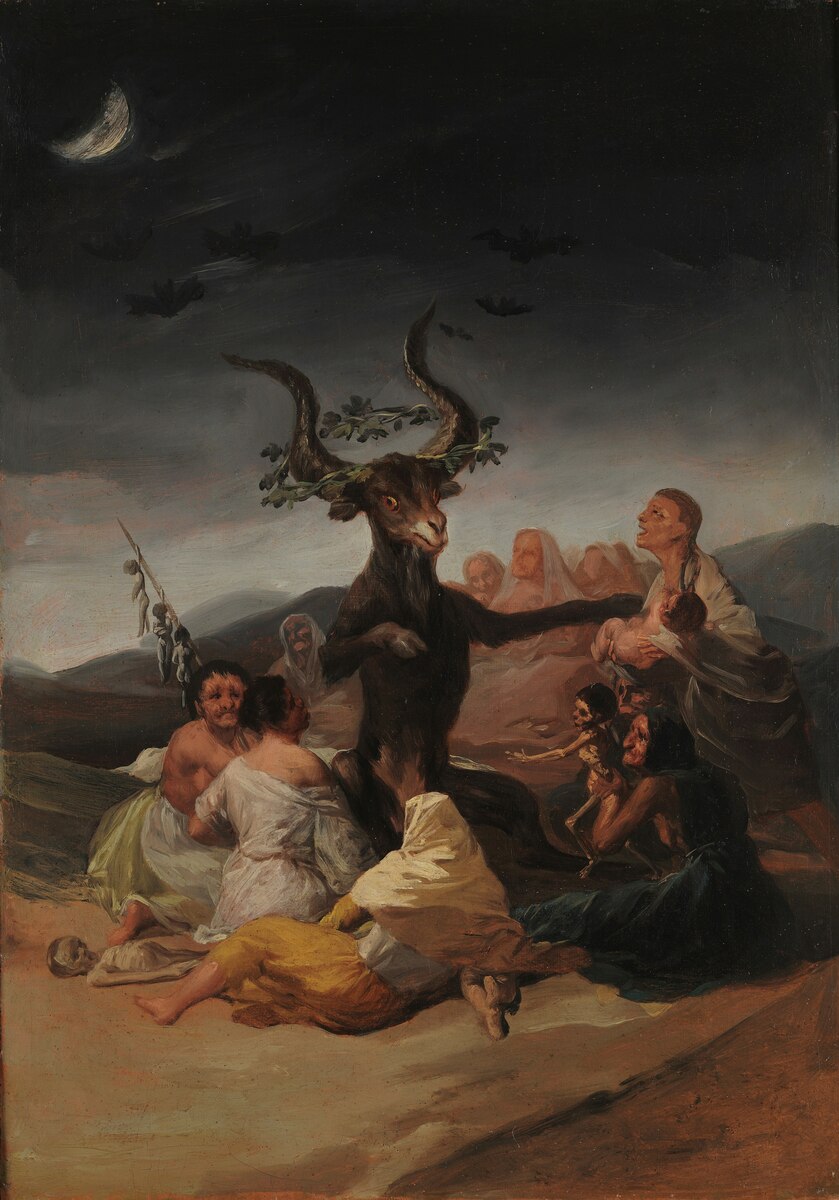
A small nocturnal scene of a witches' sabbath, painted by Francisco Goya between 1797 and 1798. A goat-headed devil with branching horns and a green oak wreath extends an arm toward a child offered by a woman in a pale mantle. Skeletal witches clutch small naked children, a crescent moon and bats cross the cloudy sky, and in the distance a figure is carried aloft on a pole. The evidence for this exact canvas comes from a Wikimedia Commons file page, so the account stays close to what is documented and visible.
In the distant left landscape a small figure is carried aloft on a long pole by a silhouetted witch, echoing the child offerings in the foreground and showing the nocturnal flight of the coven.
02
Crescent moon and bats
The thin crescent moon in the upper left and the dark bats crossing the cloudy night sky establish the unholy hour and the supernatural atmosphere of the Sabbath.
03
Seated witches and grounded body
Foreground left group of seated and reclining witches in white, ochre, and yellow drapery, one bare shouldered and meeting the viewer's gaze, beside a shrouded body and skull on the ground; it anchors the scene's human participants and their grim props.
Your gallery guide
Witches' Sabbath by Francisco Goya (between 1797 and 1798)
A small nocturnal scene of a witches' sabbath, painted by Francisco Goya between 1797 and 1798. A goat-headed devil with branching horns and a green oak wreath extends an arm toward a child offered by a woman in a pale mantle. Skeletal witches clutch small naked children, a crescent moon and bats cross the cloudy sky, and in the distance a figure is carried aloft on a pole. The evidence for this exact canvas comes from a Wikimedia Commons file page, so the account stays close to what is documented and visible.
Editorial review by Artifact Archive automated publishing
This is Francisco Goya's Witches' Sabbath, painted between 1797 and 1798. At the centre stands a goat-headed devil with tall branching horns and a green oak wreath across its head.
The devil extends one arm toward a small child, who is being offered by a woman in a pale mantle on the right. Around them, witches and skeletal figures clutch naked children in the dark.
The goat-headed devil commands the centre of the canvas. Its tall branching horns and the green oak wreath make it the tallest and most solid form in the picture.
To the right, a woman in a pale mantle lifts her face while holding out a small child toward the devil's outstretched hand. Her light clothing makes her stand out against the surrounding darkness.
In the lower right, emaciated, almost skeletal figures clutch small naked children. One of them reaches outward with a thin arm, tightening the knot of bodies around the offering.
Above the group, a thin crescent moon and dark bats cross a cloudy night sky. Their small scale keeps the night wide and cold above the crowded figures.
In the distant left landscape, a small figure is carried aloft on a long pole by a silhouetted witch. That tiny flight extends the sabbath beyond the foreground into the open air.
Goya painted this small oil on canvas in the late 1790s. The date places it among his earlier treatments of witchcraft and superstition, before the darker visions of his later years.
The painting turns a folk belief into a compact, staged scene. The devil's outstretched arm and the woman's offering create a clear transaction at the centre.
The skeletal witches and the carried child in the distance widen that transaction into a whole nocturnal world. The crescent moon and bats confirm the hour and the uncanny setting.
What the sources document is the subject and its elements. They do not record Goya's private intention, so we can describe the effect without claiming to know his purpose.
Witches' Sabbath represents a nocturnal gathering around a goat-headed devil, with a child offered at the centre and witches clutching children nearby. The crescent moon, bats and distant flight complete the scene.
The painting is now in the Lázaro Galdiano Museum in Madrid. What remains with us is the stark contrast between the small, pale offering and the dark, crowded sabbath around it.
The story and its sources
Editorial review by Artifact Archive automated publishing.
Historical claims are linked to the records below. Close looking and interpretation are identified in the passage notes.
Goya was a Spanish painter and printmaker whose career extended from royal tapestry designs and court portraiture to images of war, repression and unsettling fantasy. Born in Fuendetodos, he trained in Zaragoza and Madrid and became First Painter to Charles IV in 1799. He spent his final years in Bordeaux.
A nocturnal witches' sabbath: a goat-headed devil with tall branching horns, a green oak wreath across its head, and one arm extended toward a child offered by a woman in a pale mantle at the right, surrounded by skeletal witches clutching small naked children and seated figures in the foreground, beneath a crescent moon and bats.
Title variants
Witches Sabbath; El aquelarre; Le Sabbat des sorcières; Akelarrea; Ведьминский шабаш; Hexensabbat; El Aquelarre; 魔女の夜宴; Häxsabbaten; Sabat czarownic; Шабаш (картина); L'aquelarre; Il grande caprone; שבת המכשפות (גויה, 1798); السبت السحره
The painting is catalogued under the title Witches' Sabbath and is attributed to Francisco Goya. Both the title and the attribution come from the file information recorded by Wikimedia Commons, which also provides the date, medium and dimensions of the work. The attribution is presented as such rather than as an uncontested signature: the catalogue entry names Goya as the artist, and the scholarly account of the object therefore treats the painting as his while preserving the wording of the attribution rather than converting it into an unqualified statement of authorship.(Wikimedia Commons: Witches' Sabbath, n.d., File information)
The painting is dated between 1797 and 1798. That dating belongs to the object itself, as the span assigned to its making, and it is distinct from any later date that might be attached to a catalogue record, photograph, file page or accession entry. The date places the work in the late 1790s, which is the period in which the object was painted, not the period in which the catalogue entry describing it was created. Keeping these two kinds of date apart matters because the surviving documentation for the painting is a modern file description, while the historical period it records is the end of the eighteenth century.(Wikimedia Commons: Witches' Sabbath, n.d., Summary)
The work is an oil on canvas measuring 43 cm by 30 cm. The medium and the small scale are both recorded in the same summary that supplies the date, and they establish the physical terms of the object: a portable panel-sized canvas painted in oils, not a monumental altarpiece or a fresco. The dimensions and the medium are part of the catalogue identity of the painting alongside the title and attribution, and they condition how the nocturnal scene is encountered, since the crowded figures and the wide night sky are compressed into a support of modest size.(Wikimedia Commons: Witches' Sabbath, n.d., Summary)
The picture catalogued as Witches' Sabbath is attributed to Francisco Goya, dated 1797 to 1798, and described as oil on canvas measuring 43 by 30 cm; it is held in the Lázaro Galdiano Museum, Madrid, under accession number Inv. 2006. These are the identifying facts that anchor any reading of the image, and they establish the object as a small easel painting executed in the medium Goya used across his mature career, now preserved in a Spanish public collection.(Wikimedia Commons: Witches' Sabbath, n.d., Visual focus)
The central transaction
The commanding form is a central goat-headed devil with tall branching horns and a green oak wreath across its head, extending one arm toward a child. The wreath is a specific botanical attribute, not a generic headdress, and the horns give the figure a height and mass that dominate the composition. To the right, a woman in a pale mantle lifts her face while holding out a small child toward the devil's outstretched hand, her light clothing standing out against the surrounding darkness. The pairing of the devil's arm and the woman's offering creates a transaction at the centre of the canvas: a child is being handed over, and the pale mantle marks the human participant against the shadowed ground.(Wikimedia Commons: Witches' Sabbath, n.d., Visual focus)
The nocturnal setting and its extension
The lower right group consists of emaciated, almost skeletal figures clutching small naked children, one reaching outward with a thin arm. Their thinness parallels the children's nakedness, so the lower right reads as a knot of bodies tightening around the offering rather than a separate scene. Above them, a thin crescent moon and dark bats cross a cloudy night sky, and in the distant left landscape a small figure is carried aloft on a long pole by a silhouetted witch. The moon and bats fix the hour and the uncanny setting, while the tiny pole-borne flight extends the nocturnal gathering beyond the foreground into open air, so that the composition works at three scales: the central transaction, the clutching group, and the distant flight.(Wikimedia Commons: Witches' Sabbath, n.d., Visual focus)
What the documented record establishes is the subject and its constituent elements: a goat-headed devil, the offering of a child by a woman in a pale mantle, skeletal figures with naked children, a crescent moon, bats, and a distant witch carrying a figure on a pole. The sources do not record Goya's private intention, so the devil's outstretched arm and the woman's offering can be described as a clear transaction without claiming to know the artist's purpose. The painting turns a folk belief into a compact staged scene, and the child carried through the air widens that transaction into a whole nocturnal world rather than a single moment of exchange.(Wikimedia Commons: Witches' Sabbath, n.d., Visual focus)
A central goat-headed devil with tall branching horns and a green oak wreath across its head extends one arm toward a child; it is the commanding image of the painting.(Wikimedia Commons: Witches' Sabbath, n.d.)
The lower right group shows emaciated, almost skeletal figures clutching small naked children, one reaching outward with a thin arm.(Wikimedia Commons: Witches' Sabbath, n.d.)
The painting known as Witches' Sabbath is attributed to Francisco Goya and held by the Lázaro Galdiano Museum in Madrid, where it carries the accession number Inv. 2006. Museum and repository records make the work identifiable as a specific, catalogued object within a public collection, which is the necessary starting point for any further account of its date, medium, dimensions or subject. The object's presence in Madrid under that inventory number links the descriptive information about the scene to an individual canvas rather than to the broader theme of witchcraft in Goya's work.(Wikimedia Commons: Witches' Sabbath, n.d., Summary)
Materials and date
The painting is dated between 1797 and 1798 and is executed in oil on canvas, measuring 43 cm by 30 cm. These are the material and chronological facts on which an account of the picture must rest: a small oil on canvas of the late 1790s. The scale, close to that of a cabinet picture, is intrinsic to the object as documented, and the date places it within the artist's production of that specific two-year span. The Wikimedia Commons file page is the source for the title, artist, date, medium, dimensions, collection and accession number, so these particulars belong together as a single archival description of the work.(Wikimedia Commons: Witches' Sabbath, n.d., Summary)
Composition and figures
The documented subject of the picture centres on a goat-headed devil with tall branching horns and a green oak wreath across its head, which extends one arm toward a child. This figure is the commanding image of the painting, and its solid, horned form is what the scene is organised around. The wreath is specified in the description as green oak, and the gesture of the extended arm establishes the direction of the action toward the child. The composition therefore depends on a single dominant figure whose posture gives the scene its narrative focus.(Wikimedia Commons: Witches' Sabbath, n.d., Summary)
At the right side of the composition, a woman in a pale mantle lifts her face while holding out a small child toward the devil's outstretched hand. The description of a pale mantle places her in contrast with the surrounding dark forms, so that the offering of the child is legible through the meeting of her gesture and the devil's. The lower right group shows emaciated, almost skeletal figures clutching small naked children, one of them reaching outward with a thin arm. These two accounts of the figures belong to the same documented description of the canvas: the woman's presentation of the child and the skeletal group belong to one scene of children handled within a nocturnal gathering.(Wikimedia Commons: Witches' Sabbath, n.d., Summary)
Night sky and distant flight
Above the figures, the upper left of the canvas contains a thin crescent moon and dark bats crossing a cloudy night sky. In the distant left landscape, a small figure is carried aloft on a long pole by a silhouetted witch. The moon and bats establish the hour and atmosphere of the scene, while the distant flight extends the gathering beyond the crowded foreground into the open air. Both elements are documented features of the picture, and both contribute to its setting rather than to the central transaction between the devil and the woman.(Wikimedia Commons: Witches' Sabbath, n.d., Summary)
What the records establish
Interpretation
What the available sources document is the subject of the painting and the elements that compose it: the goat-headed devil, the woman offering a child, the skeletal figures with children, the crescent moon, the bats and the distant flight. The same records supply the attribution to Goya, the date of 1797 to 1798, the oil on canvas medium, the 43 by 30 cm dimensions, and the museum collection and accession number. They do not record Goya's private intention, and no documented account of the artist's purpose is included in this evidence. The subject and its elements can therefore be described with confidence, while any statement about what the artist meant the picture to accomplish would exceed what the records establish.(Wikimedia Commons: Witches' Sabbath, n.d., Summary)
The working insurance estimate for Francisco Goya's Witches' Sabbath is recorded as a range of US$50 million to US$150 million, generated on 2026-10-16 as a calculated working figure rather than a documented valuation. The stated basis is a confirmed painting by Goya (1746-1828), dated between 1797 and 1798, oil on canvas, 43 by 30 cm, held at the Lazaro Galdiano Museum, Madrid, under inventory number 2006. The range is described as a conservative working estimate for manual review only, constructed from broad tiered multiples for museum-grade old master paintings rather than from any recorded transaction. Its rationale combines Goya's canonical status as a major Spanish old master, the historical importance of the 1797-1798 witchcraft series, secure museum attribution, and the very large qualitative gulf between old master works held in museums and those on the open market. No comparable sales, private insurance records, or official valuations were used in the calculation.(Wikimedia Commons: Witches' Sabbath, n.d.)
The estimate carries qualifications that limit how it should be read. It is explicitly a model-generated working range intended for manual review, not an official insurance value, appraisal, auction result, or sale price. It is characterized as a broad conservative placeholder based on limited public context, and it does not reflect condition, provenance, exhibition history, market appetite, or institutional insurance arrangements. The recorded advice is to verify with a qualified appraiser and the owning institution before any coverage decision. Because the calculation used no comparable sales or official valuations, the figure should be treated as an attributed working construct of its authors rather than as evidence about the painting's market or institutional worth.(Wikimedia Commons: Witches' Sabbath, n.d.)
Working estimate
Calculated working insurance estimate, not a sale price: Estimated insurance range: US$50M to US$150M Recorded date: Working calculation, generated 2026-10-16. Methodology: Conservative working range for manual review only. Basis: confirmed painting by Francisco Goya (1746-1828), dated between 1797 and 1798, oil on canvas, 43 x 30 cm, held at the Lazaro Galdiano Museum, Madrid (Inv. 2006). The range reflects Goya's canonical status as a major Spanish old master, the historical importance of the 1797-1798 witchcraft series, secure museum attribution, and the very large qualitative gulf between old master museum-held works and the open market. Calculations use broad tiered multiples for museum-grade old master paintings rather than any recorded transaction. No comparable sales, private insurance records, or official valuations were used. Qualification: Model-generated working range for manual review only. This is not an official insurance value, appraisal, auction result, or sale price. It is a broad conservative placeholder based on limited public context and does not reflect condition, provenance, exhibition history, market appetite, or institutional insurance arrangements. Verify with a qualified appraiser and the owning institution before any coverage decision.(Wikimedia Commons: Witches' Sabbath, n.d.)
Further reading
Books for a closer look
Paid links. As an Amazon Associate I earn from qualifying purchases.
Carlo Ginzburg's Ecstasies is recorded with subjects Sabbat and witchcraft history, so it is directly relevant to the iconography and cultural concept of the witches' sabbath that Goya depicts. It offers a scholarly interpretive comparison rather than a broad artist survey.
This Goya catalogue record lists subjects including catalogues raisonnes, criticism and interpretation, Museo del Prado and Goya studies. It is the most object-adjacent Goya catalogue among the candidates for researching the painting's place in his oeuvre.
Carlo Ginzburg's Ecstasies is recorded with subjects Sabbat and witchcraft history, so it is directly relevant to the iconography and cultural concept of the witches' sabbath that Goya depicts. It offers a scholarly interpretive comparison rather than a broad artist survey.
Francisco Goya (1969).Goya. Kodansha International.
This Goya catalogue record lists subjects including catalogues raisonnes, criticism and interpretation, Museo del Prado and Goya studies. It is the most object-adjacent Goya catalogue among the candidates for researching the painting's place in his oeuvre.
Origins of the Witches' Sabbath by Michael D. Bailey is catalogued under Sabbat, witchcraft, sources and history. It is a scholarly study of the sabbath motif itself, useful for contextualizing the subject of Goya's painting.
Advertising supports the archive. These preferences control aggregate page counting, reading activity and ad-delivery diagnostics. They use no visitor tracking cookie.