The story About 4 minutes to read
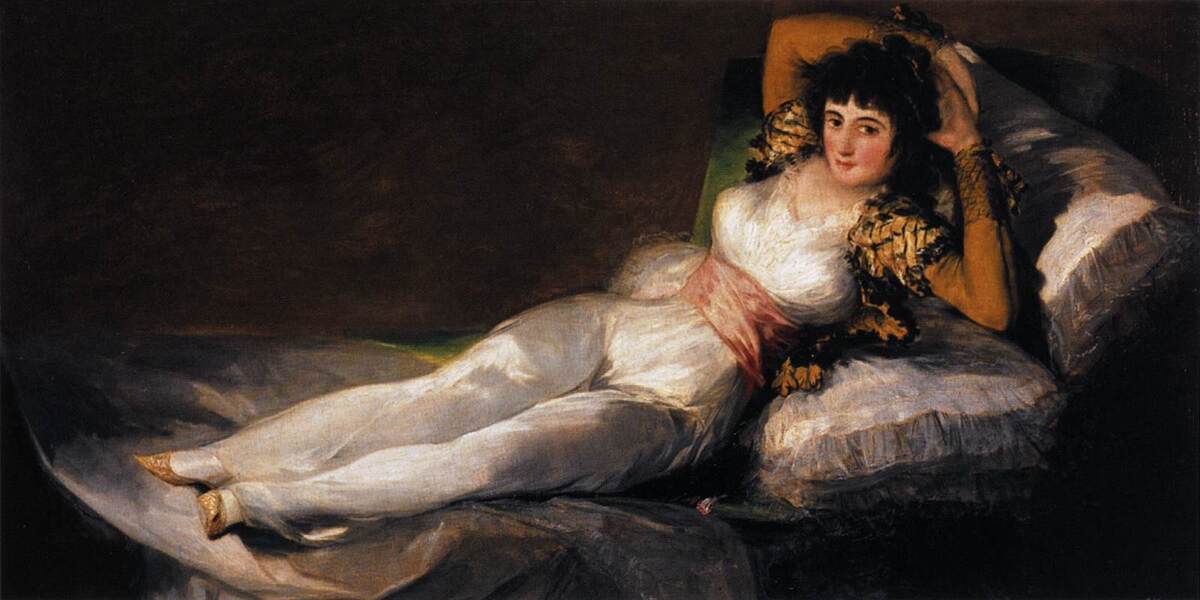
Goya painted a single woman lying on a bed. She wears a white gown and a short black jacket trimmed in gold, and she looks out at us steadily.
The painting is known as The Clothed Maja, made between 1800 and 1803, and it hangs today in the Museo del Prado.
The title tells us she is a maja, a Madrid woman of the lower classes whose dress and confident manner were famous in the city.
The body stretches almost the full width of the canvas, which is nearly two metres across and only about one metre high.
Goya placed her on a low bed with pillows behind her, so the figure reads as a long horizontal band, calm and unbroken.
Her arms rest behind her head and along her side, and her hands are relaxed. Nothing in the pose suggests work or hurry.
The dress matters as much as the body. A white gown clings closely enough to describe the shape beneath it, while the short black bolero sits open over her shoulders.
Gold embroidery catches the light along the jacket and at her waist. The pale green sash and the soft cushions set the figure apart from the dark background.
The head is small against the wide body, which makes the face a quiet centre rather than a dramatic one.
The word maja describes a particular Madrid type: a working-class woman whose short jackets, full skirts and forthright manner gave her a distinctive public identity.
Goya was not painting a mythological goddess or a society lady in court dress. He gave that popular Madrid type the scale and seriousness usually reserved for grander subjects.
The result is a portrait that is also a statement about a specifically Spanish kind of confidence, dressed in clothes ordinary people would recognise.
The exact sitter is not settled. The supplied record names two candidates: María Teresa de Silva, the thirteenth Duchess of Alba, and Josefa de Tudó, the first Countess of Castillo Fiel.
A duchess and a countess are both grander than a maja. If either identification were correct, the painting would be playing an aristocratic identity through popular dress.
That reading stays open. What the evidence supports is the type, not a fixed name for the woman in the bed.
Look again at the white gown and the gold-trimmed jacket. They are not costume in a theatrical sense; they are the clothes of a maja, worn by a figure Goya painted at nearly life size.
That combination is the painting's argument. Goya took a popular Madrid woman, gave her a calm and unapologetic pose, and asked viewers to take her as seriously as any grander portrait.
Who she was remains debated. What she represents, a distinctly Spanish and unsubmissive femininity, is clear from what we see.