Identity and catalogue
Link- Artist or attribution
- Francisco Goya
- Object date
- 1798
- Medium and support
- oil painting on canvas
- Movement or period
- Romanticism
- Country or culture
- Spanish
- Depicted subject
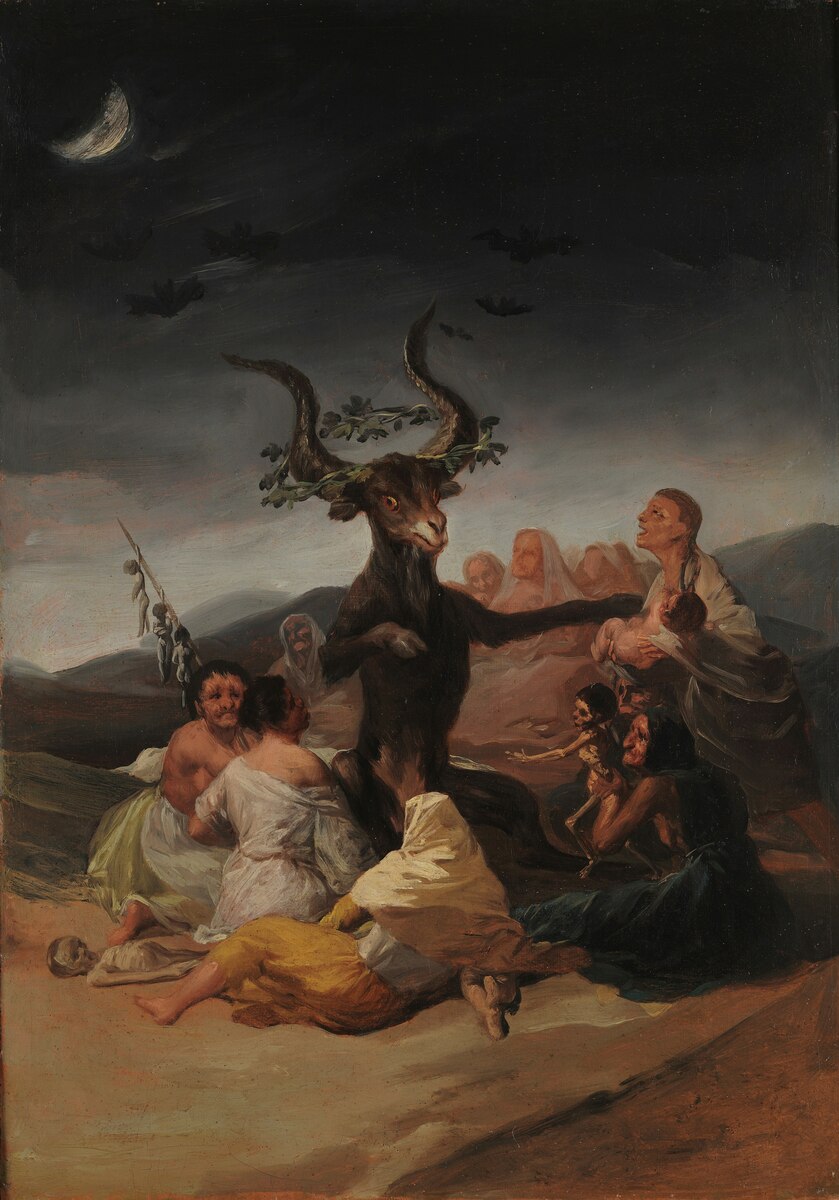
- A moonlit Witches' Sabbath in a barren landscape, with Satan as a horned goat crowned by a wreath of grape leaves, surrounded by young and aged witches; an old crone holds a starving infant while a younger witch holds a healthier child, suggesting an initiation ceremony or sacrifice; dead infants appear on the ground and hanging from a stake.
- Title variants
- Witches' Sabbath; El Aquelarre
- Support
- canvas
- Dimensions
- Unknown
Title, attribution and date
The 1798 painting catalogued as Witches' Sabbath, in Spanish El Aquelarre, is an oil on canvas by the Spanish artist Francisco Goya, and it stands as the earliest securely dated entry in the evidence for this enquiry. Its material identification is straightforward in the supplied record: a canvas support worked in oil, dated by its author's career to the final years of the eighteenth century. That the Spanish title El Aquelarre is carried alongside the English Witches' Sabbath matters for catalogue practice, because the title names a subject rather than a narrative incident, and the same subject title recurs elsewhere in Goya's work in a physically unrelated object. Within the larger history of European art, a painted witches' gathering made at this date sits at the convergence of the subgenre of the demonic genre scene and the specific conditions of late eighteenth-century Spanish intellectual life, in which Enlightenment reformism and entrenched popular devotion existed in uneasy proximity.(Wikipedia fallback: Witches' Sabbath (Goya, 1798), n.d.)
The primary evidence unit for this section is a discovery-level reference work entry rather than an official museum object record, and no supplier record, conservation report, pigment analysis or inscription transcription was supplied. That provenance of evidence shapes the account throughout: the physical measurements, exact support preparation, any signature or inscription, and the accession inventory of the holding institution are not established here and should not be supplied from outside knowledge. What the evidence does establish is narrower but firm, that the object is correctly identified by artist, date, medium and support, and that it belongs to a group of six related witchcraft paintings by the same hand entering the same collection in the same year. Because attribution rests on this single discovery-level account, the attribution is reported as the evidence's finding rather than independently confirmed by technical examination.(Wikipedia fallback: Witches' Sabbath (Goya, 1798), n.d.)
The evidence distinguishes this canvas from a later work of the same title. Goya returned to the imagery of witches' gatherings in a number of compositions, most notably in a Black Painting titled Witches' Sabbath or The Great He-Goat, dated 1821 to 1823. The near identity of title between the 1798 oil on canvas and the later mural-derived work makes careful catalogue separation essential. The 1798 object is a canvas purchased by aristocratic patrons in the Spain of the 1790s; the 1821 to 1823 object belongs to the very different Black Paintings, made a quarter century later in radically changed personal and political circumstances. Conflating the two would misstate both the date and the original conditions of the painting under discussion, and the recurrence of the coven subject across Goya's career is better treated as a persistent thematic commitment than as evidence about the earlier canvas itself.(Wikipedia fallback: Witches' Sabbath (Goya, 1798), n.d.)
Interpretation and reception
The evidence records twentieth-century critical readings of the painting rather than the artist's own stated intentions. In that scholarship the work has been seen as a protest against those who upheld and enforced the values of the Spanish Inquisition, an institution that had been active in witch hunting during the seventeenth-century Basque witch trials. Critics in the twentieth century further surmised that the painting was made in 1798 as a bitter struggle raged between liberals and those in favour of a church and a royalist-led state, a confrontation that culminated in the so-called Ominous Decade of 1823 to 1833. These are attributed interpretations, and the date of the painting precedes the Ominous Decade by decades, so the political framing rests on the broader trajectory of the period rather than on any contemporary document of Goya's intent. Both this painting and the later Great He-Goat have been read as attacks on superstitious beliefs rife in Spain during a period when tales of midnight gatherings of witches and the appearance of the devil were commonplace among the rural populace, readings that also reflect Goya's disdain for the popular tendency towards superstition and the church-led return to medieval fears.(Wikipedia fallback: Witches' Sabbath (Goya, 1798), n.d.)
Interpretation
One critical formulation is particularly revealing of the object's social position. The evidence states that Goya depicted such scenes in a painting commissioned by landed aristocrats and that, in one critic's words, he mocked what he saw as medieval fears exploited by the established order for political and capital gain. The attribution of that sentence to a single critic is significant: this is not the evidence's own finding but an attributed reading, and the underlying commission remains, as established above, unresolved between commission and post-completion purchase. If the work was bought after completion rather than commissioned, the irony of an aristocratic patron hanging a satire of superstition on their own wall becomes a retrospective construction rather than a contemporary transaction. That unresolved patronal question is therefore inseparable from the interpretive claim, and the account should present the ironisation thesis as an argued position that depends on premises the evidence does not settle.(Wikipedia fallback: Witches' Sabbath (Goya, 1798), n.d.)
Read together, the units show an object whose documentary base is clear at the level of artist, date, medium, support and two well-attested ownership transfers, and thin at the level of material description, exact dimensions, inscriptions and the provenance interval between the two transfers. The certainty of the 1798 date and the Osuna purchase is what allows the painting to function as a fixed point against which Goya's later return to the witches' gathering can be measured, and it is precisely that fixed point that the recurring title threatens to obscure. The painting's importance within a larger history of art and material culture lies in this combination: an Enlightenment-era oil on canvas of a demonic subject, made for aristocratic patrons at the moment of Spanish political contest, retained and later donated to the public by a twentieth-century financier, and read ever since through interpretive frames that the evidence attributes to critics rather than to the maker.(Wikipedia fallback: Witches' Sabbath (Goya, 1798), n.d.)
Subject and iconography
LinkComposition and the figure of Satan
Visual observation
Witches' Sabbath is described in the supplied account as showing Satan, surrounded by a coven of young and aged witches in a moonlit barren landscape. Within that composition, the figure of Satan is identified as a goat that possesses large horns and is crowned by a wreath of grape leaves. The setting and the combination of a horned animal leader with a mixed assembly of old and young women are the basic coordinates of the image as the source presents it, and they establish the visual field within which the remaining details are placed. The characterization of the goat as Satan, and the group as a coven, belongs to the source's identification rather than to a bare inventory of forms.(Wikipedia fallback: Witches' Sabbath (Goya, 1798), n.d.)
Infants and the coven across the canvas
On the right side of the composition, an old crone can be seen holding an extremely starved looking, but apparently still living, infant in her hands, while a younger witch to her right does the same with a healthier looking child. The supplied account draws an implication from this pairing: that the two children will follow the same fate. Elsewhere in the image, the dead body of an infant can be seen discarded to the left, and in the center foreground the legs of another infant can be seen held down with force to the ground by a presumably younger witch. Taken together, these details distribute infants across the canvas in several states, and the qualification attached by the source to the starved child, apparently still living, marks how carefully the account distinguishes what is shown from what is inferred about the children's condition.(Wikipedia fallback: Witches' Sabbath (Goya, 1798), n.d.)
The depth of the scene is populated as well as its foreground. More witches, young and old, can be seen in the background, and to the left three dead infants hang from the neck on a stake. In the middle high-ground a number of bats can be seen flying overhead, their flocking motion echoing the curve of the crescent moon. The repetition of old and young figures at more than one depth, and the placement of the hanging infants on the left against the bat flock and crescent at the upper middle distance, describe a composition organized so that the same motifs recur and visually rhyme rather than appear once in isolation.(Wikipedia fallback: Witches' Sabbath (Goya, 1798), n.d.)
A recurring subject in Goya's work
Interpretation
The source relates this canvas to Goya's wider use of coven imagery, noting that he used the imagery of covens of witches in a number of works, most notably in one of his Black Paintings, Witches' Sabbath or The Great He-Goat, dated 1821 to 1823. That later work is a distinct object with its own date range, and the connection established here is a relationship between subjects and motifs across Goya's career, not an identity between the two pictures. The supplied evidence does not establish a direct compositional derivation from the earlier painting to the later one, so the link should be understood as the recurrence of a subject Goya returned to rather than as a documented copying relationship.(Wikipedia fallback: Witches' Sabbath (Goya, 1798), n.d.)
On the right, an old crone can be seen holding an extremely starved looking, but apparently still living, infant in her hands, while a younger witch to her right does the same with a healthier looking child, implying they will follow the same fate.(Wikipedia fallback: Witches' Sabbath (Goya, 1798), n.d.)
Place within Goya's Coven Imagery
The picture belongs to a larger body of work in which Goya used the imagery of covens of witches, most notably in one of the Black Paintings, Witches' Sabbath or The Great He-Goat, dated 1821 to 1823. The relationship between the two works is one of recurrence across a career rather than repetition within a single commission: the later Black Painting reworks the coven subject more than two decades after the 1798 painting entered the Osuna collection. Setting the earlier canvas beside the later one clarifies what is distinctive about the 1798 picture. The 1798 work is documented in aristocratic ownership through purchase, whereas the later work named in the evidence belongs to the Black Paintings group and carries the alternative title The Great He-Goat. The comparison also guards against treating the Osuna canvas as an isolated curiosity; the coven was a subject Goya returned to, and the evidence attaches the highest prominence within that recurrence to the later painting.(Wikipedia fallback: Witches' Sabbath (Goya, 1798), n.d.)
Goya used the imagery of covens of witches in a number of works, most notably in one of his Black Paintings, Witches' Sabbath or The Great He-Goat (1821–1823).(Wikipedia fallback: Witches' Sabbath (Goya, 1798), n.d.)
Provenance and ownership
LinkThe Osuna Acquisition of 1798
The 1798 Witches' Sabbath (Spanish: El Aquelarre), an oil painting on canvas by the Spanish artist Francisco Goya, is today held in the Museo Lázaro Galdiano in Madrid. Its documented ownership history begins in the year of its making, when it was purchased together with five other paintings related to witchcraft by the Duke and Duchess of Osuna. That single documented transaction of 1798 is the earliest recorded moment in the picture's life as property, and it is the point from which the provenance account must proceed; nothing in the supplied evidence records the circumstances of the painting's creation before that purchase or any owner prior to the Osuna acquisition.(Wikipedia fallback: Witches' Sabbath (Goya, 1798), n.d.)
The acquisition of the witchcraft paintings is attributed to the duchess rather than to her husband, so the buyer of record within the household is given as the Duchess of Osuna. A stated uncertainty attaches to the transaction itself: it is not known whether the six witchcraft paintings were commissioned from Goya or bought by the Osunas after they had been completed. The evidence therefore establishes a purchase in 1798 and an attribution of that purchase to the duchess, but it leaves the commissioning question open. This distinction matters for how the group is understood, because a commission would place the duchess in the position of specifying subject matter in advance, whereas a purchase after completion would place her among the first owners of an existing set rather than its instigator. No documentation supplied here resolves which of these two possibilities obtained, and the account must preserve that gap rather than fill it.(Wikipedia fallback: Witches' Sabbath (Goya, 1798), n.d.)
From the Twentieth Century to Public Ownership
Between the 1798 Osuna purchase and the twentieth-century acquisition described in the evidence, the record supplied here is silent. This is an unrecorded interval, not a proven change of ownership: no intermediate owner, sale, inheritance, export or transfer is documented, and the absence of such entries should not be read as evidence that none occurred. The next documented event is that in the twentieth century the painting was purchased by the financier José Lázaro Galdiano and donated to the Spanish state upon his death. That donation is the transfer by which the work entered public ownership and, ultimately, the Museo Lázaro Galdiano in Madrid, where it is held today. The provenance therefore rests on two documented moments of acquisition, the 1798 Osuna purchase and the twentieth-century Lázaro Galdiano purchase and bequest, separated by an interval for which the present evidence provides no chain of custody.(Wikipedia fallback: Witches' Sabbath (Goya, 1798), n.d.)
Interpretation
The Osuna group belongs within Goya's broader use of coven imagery, which appears in a number of his works and most notably in the Black Painting Witches' Sabbath or The Great He-Goat of 1821 to 1823. The 1798 canvas and the later Black Painting share a subject, but they occupy different places in the artist's career and in the history of collecting, and the evidence treats the 1798 picture as one of a set of witchcraft paintings obtained by the Osunas rather than as an isolated commission. For a history of material culture, the Osuna transaction is significant precisely because it records landed aristocrats acquiring a group of witchcraft pictures in the same year they were made, while the later Lázaro Galdiano purchase and bequest converted the work from private property into a state-held museum object. The provenance record thus connects aristocratic patronage at the end of the eighteenth century to the twentieth-century formation of public collections in Spain, even though the intervening sequence of owners remains undocumented in the evidence assembled here.(Wikipedia fallback: Witches' Sabbath (Goya, 1798), n.d.)
Provenance timeline
- 1798
The painting was purchased along with five other paintings related to witchcraft by the Duke and Duchess of Osuna. The acquisition is attributed to the duchess, and it is not established whether the works were commissioned or bought after completion.(Wikipedia fallback: Witches' Sabbath (Goya, 1798), n.d.)
Interpretations and debates
LinkInterpretive Frameworks
Interpretation
One attributed reading treats the goat as functioning like a priest at an initiation ceremony for the children. That reading is framed against a stated popular superstition of the period, namely that the Devil often fed on children and human fetuses. The qualification matters: the evidence presents the priestly role as how the Devil seems to be acting and the feeding belief as contemporary popular superstition, not as a documented ritual practice that the painting records. The reading therefore explains the composition's arrangement of children around the goat without converting either the ceremony or the superstition into a historical event.(Wikipedia fallback: Witches' Sabbath (Goya, 1798), n.d.)
A second attributed reading concerns inversion as a convention of witchcraft imagery. In this account many of the symbols used are inverted, specifically the goat extending his left rather than right hoof toward the child and the quarter moon facing out of the canvas at the top left corner. These reversals are described as typical of the imagery of witchcraft rather than as an innovation of this canvas, which places the picture within an existing visual vocabulary of deliberate reversal. The inversion reading and the initiation reading are complementary but distinct claims: one concerns how the scene is coded, the other concerns what action is depicted.(Wikipedia fallback: Witches' Sabbath (Goya, 1798), n.d.)
Political and Religious Readings
Political and religious readings form a third family of attributions. Goya's paintings have been seen as a protest against those who upheld and enforced the values of the Spanish Inquisition, which had been active in witch hunting during the seventeenth-century Basque witch trials. Twentieth-century critics surmised that Witches' Sabbath was painted in 1798 as a bitter struggle raged between liberals and those in favour of a church and a royalist-led state, a struggle said to have culminated in the so-called Ominous Decade of 1823 to 1833. Both paintings in this line of argument can be seen as an attack on the superstitious beliefs rife in Spain during a period when tales of midnight gatherings of witches and the appearance of the devil were commonplace among the rural populace, and they are said to reflect Goya's disdain for the popular tendency towards superstition and the church-led return to medieval fears. These are attributed critical positions, introduced as surmise and as ways the works have been seen, and the chronological gap between the painting's 1798 date and the 1823 to 1833 culmination is part of what any reader must weigh.(Wikipedia fallback: Witches' Sabbath (Goya, 1798), n.d.)
The patronage context complicates the anti-superstition reading in a way the evidence states explicitly. The depictions were made in a painting commissioned by landed aristocrats, and in one critic's words Goya mocked what he saw as medieval fears exploited by the established order for political and capital gain. The interpretation is doubly attributed: the mocking and the profit motive belong to that critic's formulation, while the aristocratic commission belongs to the work's documented situation. The tension between a clientele drawn from the established order and a reading of the imagery as an attack on that order is left unresolved in the evidence; the account records the commission and the attributed critique side by side rather than harmonising them.(Wikipedia fallback: Witches' Sabbath (Goya, 1798), n.d.)
Interpretive Frameworks
Taken together, the evidence supports a layered account rather than a single authorised meaning. What can be seen establishes the actors and their arrangement: the crowned goat, the children in several conditions of life and death, the assembled witches, the stake, the bats and the crescent moon. What the attributed interpretations establish is a set of explanatory frames, an initiation presided over by the Devil, the inversion of sacred order, protest against Inquisition values, and an attack on superstition shared by rural believers and exploited by the established order. The limits of synthesis are set by the nature of the sources: the readings are presented as how the works have been seen, as what one critic argued or surmised, and as the seeming role of the goat, while the maker's private intent is not documented. The painting matters within a larger history of art and material culture precisely because a devotional-looking image of a witches' gathering, painted for aristocratic patrons in a period of intense religious and political conflict and repeated by the artist in a Black Painting decades later, shows how witchcraft imagery could carry opposed meanings at once.(Wikipedia fallback: Witches' Sabbath (Goya, 1798), n.d.)
Critics in the 20th century surmise that the Witches Sabbath was painted in 1798 as a bitter struggle raged between liberals and those in favour of a church and a royalist-led state, which culminated in the so-called Ominous Decade (1823–1833).(Wikipedia fallback: Witches' Sabbath (Goya, 1798), n.d.)
Collection and display
LinkThe Evidence Base
The primary evidence available for this section consists of a single discovery-level record: an English-language Wikipedia article consulted as a fallback because no official museum object record was supplied for the painting. That record identifies the work as Witches' Sabbath, known in Spanish as El Aquelarre, a 1798 oil painting on canvas by the Spanish artist Francisco Goya. The account of its present location, its 1798 purchase, and its later passage into public ownership therefore rests on this fallback entry rather than on an institutional catalogue. The article's own annotation marks it as a discovery aid, and its consultation status is recorded as partial, so the details that follow should be read as reported by that source rather than as independently verified catalogue data.(Wikipedia fallback: Witches' Sabbath (Goya, 1798), n.d.)
Provenance and Present Location
According to the same record, the painting is today held in the Museo Lázaro Galdiano, Madrid. That present-day location is the endpoint of a provenance that the record traces in two broad stages. In 1798 the work was purchased along with five other paintings related to witchcraft by the Duke and Duchess of Osuna, a transaction the source describes as an acquisition of a group of witchcraft pictures rather than a single isolated commission. In the twentieth century the painting was purchased by the financier José Lázaro Galdiano and donated to the Spanish state upon his death. The record thus establishes a movement from an aristocratic Spanish collection of the late eighteenth century, through the hands of a twentieth-century financier and collector, into a named public museum whose identity derives from that same collector. The intervals between these stages, and the means by which the work passed from the Osuna collection to Lázaro Galdiano, are not specified in the supplied evidence.(Wikipedia fallback: Witches' Sabbath (Goya, 1798), n.d.)
Within the Osuna acquisition, the record attributes the purchase of the witchcraft paintings to the duchess rather than to her husband, while stating that it is not known whether the works were commissioned or bought after completion. This qualification matters for how the group is understood. An acquisition attributed to the duchess leaves open whether the paintings were made to her specification or selected from existing work, and the source does not resolve the question. The evidence also groups the 1798 Witches' Sabbath with five other witchcraft-related paintings bought in the same year, so the work belongs from the outset to a set rather than standing alone, even though the evidence supplied here does not name the other five or describe how the set was displayed.(Wikipedia fallback: Witches' Sabbath (Goya, 1798), n.d.)
Description of the Scene
The record describes the composition in some detail. Witches' Sabbath shows Satan surrounded by a coven of young and aged witches in a moonlit barren landscape. The goat, identified as Satan, possesses large horns and is crowned by a wreath of grape leaves. On the right an old crone holds an extremely starved-looking but apparently still living infant, while a younger witch to her right holds a healthier-looking child, which the record reads as implying that both will follow the same fate. A dead infant lies discarded to the left, and in the center foreground the legs of another are held down with force to the ground by a presumably younger witch. More witches, young and old, appear in the background, and three dead infants hang from the neck on a stake to the left. These observations of figure, condition and placement are the descriptive content on which the interpretive claims in the record depend.(Wikipedia fallback: Witches' Sabbath (Goya, 1798), n.d.)
The record treats the scene as a ritual: the Devil seems to act as a sort of priest at an initiation ceremony for the children, while popular superstition at the time held that the Devil often fed on children and human fetuses. Two further descriptive elements link the figures to the setting and to the imagery of witchcraft. In the middle high-ground a number of bats fly overhead, their flocking motion echoing the curve of the crescent moon. The record also notes that many of the symbols used are inverted, typical of the imagery of witchcraft: the goat extends his left rather than right hoof toward the child, and the quarter moon faces out of the canvas at the top left corner. The attribution of an initiation ceremony is the record's reading of the action, not a documented fact about Goya's intention, and the claim about contemporary superstition is reported belief rather than evidence about the painting's making.(Wikipedia fallback: Witches' Sabbath (Goya, 1798), n.d.)
Goya's Wider Coven Imagery
The record places the 1798 canvas within Goya's wider use of coven imagery, most notably in one of his Black Paintings, Witches' Sabbath or The Great He-Goat, dated 1821 to 1823. The two works share a subject and a motif, and the later date establishes that the theme recurred in Goya's work decades after the Osuna purchase. Beyond that connection, the evidence does not describe the later painting's support, condition, or setting, and it does not claim that the earlier canvas was a study for or a direct precedent to the Black Painting. The relationship the record establishes is one of shared subject matter and repeated imagery across two separate works, not of derivation or continuity of ownership.(Wikipedia fallback: Witches' Sabbath (Goya, 1798), n.d.)
Critical Interpretation
Twentieth-century critics, as reported in the record, read the painting as an attack on the superstitious beliefs rife in Spain during a period when tales of midnight gatherings of witches and the appearance of the devil were commonplace among the rural populace. The record also states that Goya's paintings have been seen as a protest against those who upheld and enforced the values of the Spanish Inquisition, which had been active in witch hunting during the seventeenth-century Basque witch trials. It further reports that critics in the twentieth century surmised the Witches' Sabbath was painted in 1798 as a bitter struggle raged between liberals and those in favour of a church and a royalist-led state, culminating in the so-called Ominous Decade of 1823 to 1833. The record frames such readings as reflecting Goya's disdain for the popular tendency towards superstition and the church-led return to medieval fears. Each of these claims is attributed to critics rather than presented as documented fact, and the political reading is explicitly characterized as a surmise.(Wikipedia fallback: Witches' Sabbath (Goya, 1798), n.d.)
Interpretation
A further critical position reported in the record holds that Goya's depictions of such scenes, in a painting commissioned by landed aristocrats, somehow in one critic's words mocked what he saw as medieval fears exploited by the established order for political and capital gain. The attribution to a single critic and the phrase in his words mark this as one scholar's formulation rather than a consensus, and the evidence does not identify that critic. The claim is also internally qualified: the same record elsewhere states that it is not known whether the Osuna works were commissioned or bought after completion, so the description of the picture as commissioned by landed aristocrats sits uneasily with that acknowledged uncertainty. Both threads belong in the account because the evidence preserves them side by side, and the tension between the commission language and the stated uncertainty about commission should be recorded rather than smoothed over.(Wikipedia fallback: Witches' Sabbath (Goya, 1798), n.d.)
Read together, the supplied evidence ties the object's material identity, its aristocratic acquisition in 1798, its passage through the collection of José Lázaro Galdiano, and its present home at the Museo Lázaro Galdiano into a single line of custody, while leaving the intervals of that line and the exact terms of the 1798 acquisition open. The interpretive literature the record reports, from Inquisition-era protest to rural superstition to political and capital gain, does not rest on documentation of Goya's intent but on the visible inversions and ritualized violence of the scene, which the critics treat as evidence of critical purpose. For a history of material culture, the object matters in two connected ways: as one of a group of witchcraft paintings acquired by the Osuna household in a single year, which makes it evidence for aristocratic collecting of such subjects in late eighteenth-century Spain, and as a work whose subsequent ownership by a named collector led to its permanent public display in Madrid. Its later pairing with the 1821 to 1823 Black Painting of the same or a similar subject shows the theme's persistence across Goya's career, though the evidence establishes only shared imagery, not a direct connection between the two canvases. Where the accounts differ, they differ chiefly over whether the 1798 canvas was commissioned or bought finished and over what its satire was directed against; the evidence does not settle either question, and the section should preserve that uncertainty.(Wikipedia fallback: Witches' Sabbath (Goya, 1798), n.d.)
Documented values and qualified estimates
LinkThe object and its scene
Interpretation
Witches' Sabbath, known in Spanish as El Aquelarre, is an autograph 1798 oil painting on canvas by Francisco Goya, today held in the Museo Lázaro Galdiano, Madrid. The picture shows Satan, surrounded by a coven of young and aged witches in a moonlit barren landscape; the goat possesses large horns and is crowned by a wreath of grape leaves. Within the scene, an old crone on the right can be seen holding an extremely starved looking, but apparently still living, infant in her hands, while a younger witch to her right does the same with a healthier looking child, implying they will follow the same fate. The Devil seems to be acting as a sort of priest at an initiation ceremony for the children, although popular superstition at the time believed the Devil often fed on children and human fetuses. The dead body of an infant can be seen discarded to the left, whereas the legs of another can be seen held down with force to the ground by a presumably younger witch in the center foreground, and more witches, young and old, can be seen in the background, as well as three dead infants hanging from the neck on a stake to the left. In the middle high-ground, a number of bats can be seen flying overhead, their flocking motion echoing the curve of the crescent moon.(Wikipedia fallback: Witches' Sabbath (Goya, 1798), n.d.)
The painting's imagery operates through deliberate inversion, a convention typical of the imagery of witchcraft: the goat extends his left rather than right hoof toward the child, while the quarter moon faces out of the canvas at the top left corner. Goya used the imagery of covens of witches in a number of works, most notably in one of his Black Paintings, Witches' Sabbath or The Great He-Goat (1821–1823).(Wikipedia fallback: Witches' Sabbath (Goya, 1798), n.d.)
The documented ownership of the 1798 canvas begins with the Duke and Duchess of Osuna, who acquired it in 1798 along with five other paintings related to witchcraft. The acquisition of the witchcraft paintings is attributed to the duchess rather than her husband, but it is not known whether they were commissioned or bought after completion. In the twentieth century the painting was purchased by the financier José Lázaro Galdiano and donated to the Spanish state upon his death, which is how it entered the Museo Lázaro Galdiano, Madrid.(Wikipedia fallback: Witches' Sabbath (Goya, 1798), n.d.)
Critical readings and political context
Twentieth-century interpretation of the picture has centered on its critical stance toward superstition and institutional power. His paintings have been seen as a protest against those who upheld and enforced the values of the Spanish Inquisition, which had been active in witch hunting during the seventeenth-century Basque witch trials; critics in the 20th century surmise that the Witches Sabbath was painted in 1798 as a bitter struggle raged between liberals and those in favour of a church and a royalist-led state, which culminated in the so-called Ominous Decade (1823–1833). Both the 1798 painting and the later Black Painting can be seen as an attack on the superstitious beliefs rife in Spain during a period when tales of midnight gatherings of witches and the appearance of the devil were commonplace among the rural populace, and they reflect Goya's disdain for the popular tendency towards superstition and the church-led return to medieval fears. In one critic's words, Goya's depictions of such scenes in a painting commissioned by landed aristocrats mocked what he saw as medieval fears exploited by the established order for political and capital gain.(Wikipedia fallback: Witches' Sabbath (Goya, 1798), n.d.)
A separate working insurance calculation for the canvas was generated on 2026-10-16, producing an estimated range of US$80M to US$150M. The stated methodology derived this as a broad, conservative working insurance range for manual review from the confirmed context supplied: that the work is an autograph 1798 oil on canvas by Francisco Goya, an artist of the highest historical importance, held in the Museo Lázaro Galdiano, Madrid, and documented as acquired in 1798 along with five other witchcraft paintings by the Duke and Duchess of Osuna and later purchased by José Lázaro Galdiano and donated to the Spanish state. Those provenance facts were taken to support high cultural significance and institutional status, but no dimensions, condition report, accession number, or official museum valuation was supplied, and no comparable auction records or private insurance schedule were available in the source material. The range is therefore described as an order-of-magnitude insurance planning estimate based on the artist's canonical market tier and the painting's museum-quality, historically documented origin, set wide enough to accommodate missing physical and condition details, and expressly not the result of an appraisal or a review of actual comparable sales. The calculation carries its own qualification: it is a model-generated working range for manual review only, not an official insurance value, appraisal, auction result, or sale price, and not based on a condition report, dimensions, comparable sales, or any private insurance record. Actual insurance values require inspection by a qualified fine-art appraiser and confirmation of provenance, title, and condition.(Wikipedia fallback: Witches' Sabbath (Goya, 1798), n.d.)
Working estimate
Calculated working insurance estimate, not a sale price: Estimated insurance range: US$80M to US$150M Recorded date: Working calculation, generated 2026-10-16. Methodology: A broad, conservative working insurance range for manual review was derived from the supplied confirmed context. The work is an autograph 1798 oil on canvas by Francisco Goya, an artist of the highest historical importance, held in the Museo Lázaro Galdiano, Madrid. The excerpt confirms it was acquired in 1798 along with five other witchcraft paintings by the Duke and Duchess of Osuna, and later purchased by José Lázaro Galdiano and donated to the Spanish state. These provenance facts support high cultural significance and institutional status, but no dimensions, condition report, accession number, or official museum valuation was supplied. No comparable auction records or private insurance schedule is available in the source material. The range is therefore an order-of-magnitude insurance planning estimate based on the artist's canonical market tier and the painting's museum-quality, historically documented origin, set wide enough to accommodate missing physical and condition details. It is not the result of an appraisal or review of actual comparable sales. Qualification: This is a model-generated working range for manual review only. It is not an official insurance value, appraisal, auction result, or sale price. It is not based on a condition report, dimensions, comparable sales, or any private insurance record. Actual insurance values require inspection by a qualified fine-art appraiser and confirmation of provenance, title, and condition.(Wikipedia fallback: Witches' Sabbath (Goya, 1798), n.d.)