10
Academic
Anna Matilda Whistler: biographical record (n.d.). University of Glasgow.
Artwork record / 01 of 06
Artist: James McNeill Whistler
Spend a moment with Anna, and discover the effort behind a portrait that seems so quiet.
Read the story ↓ About the artist ↓ Research and record ↓ Literature and sources ↓ Listen to the article ↓Your browser could not copy automatically. Select the research text below, then copy it.
Open the complete research text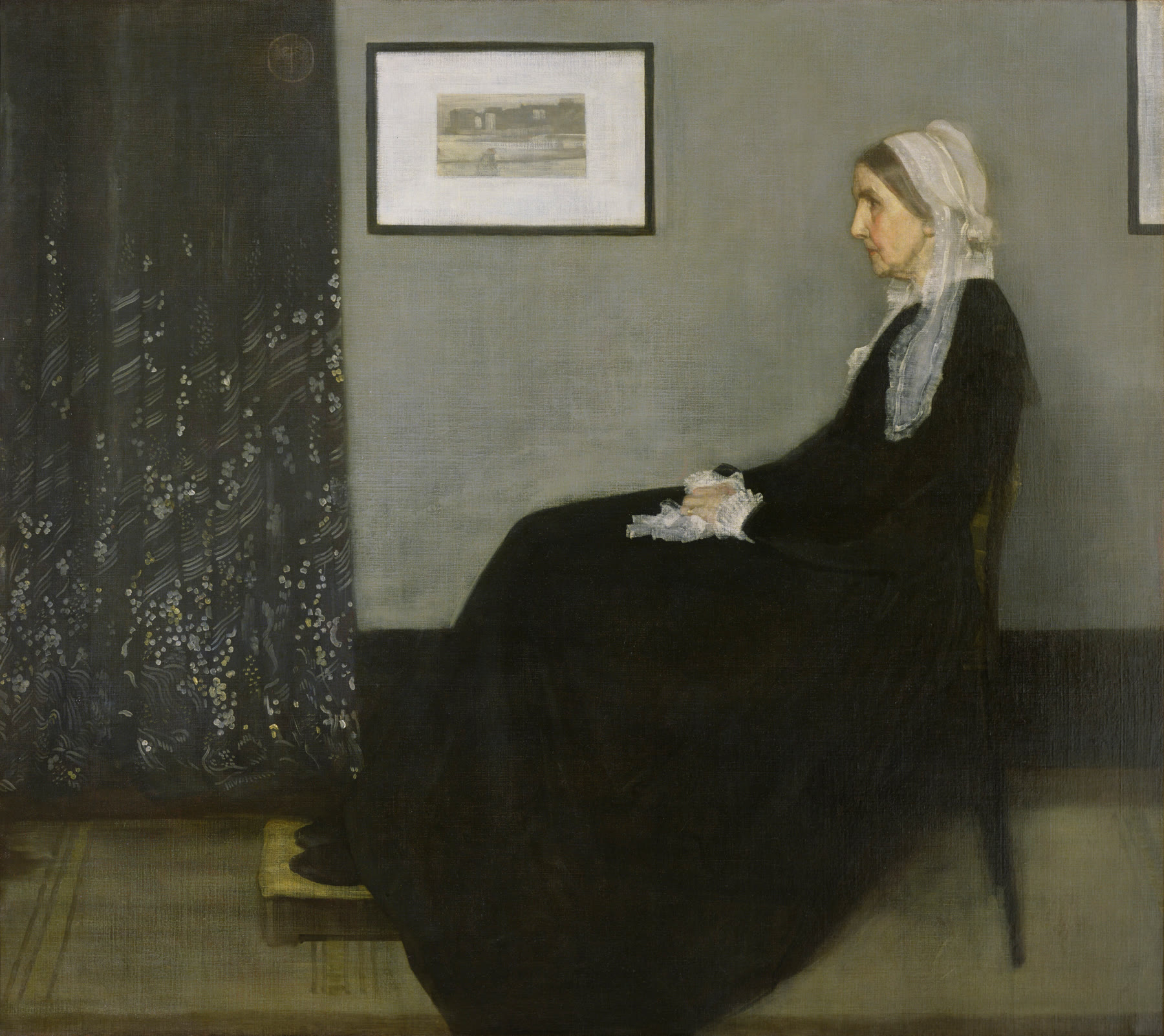
The highest-resolution file we hold, available without payment or an account.5,897 × 5,247 pixels.
Download highest-resolution imageJames McNeill Whistler. Musée d'Orsay
Free to copy. Reuse terms: Public domain. Image source and credits.
Your gallery guide
Spend a moment with Anna, and discover the effort behind a portrait that seems so quiet.
Story draft · Editorial review pending
Explore the researchThe story About 3 minutes to read
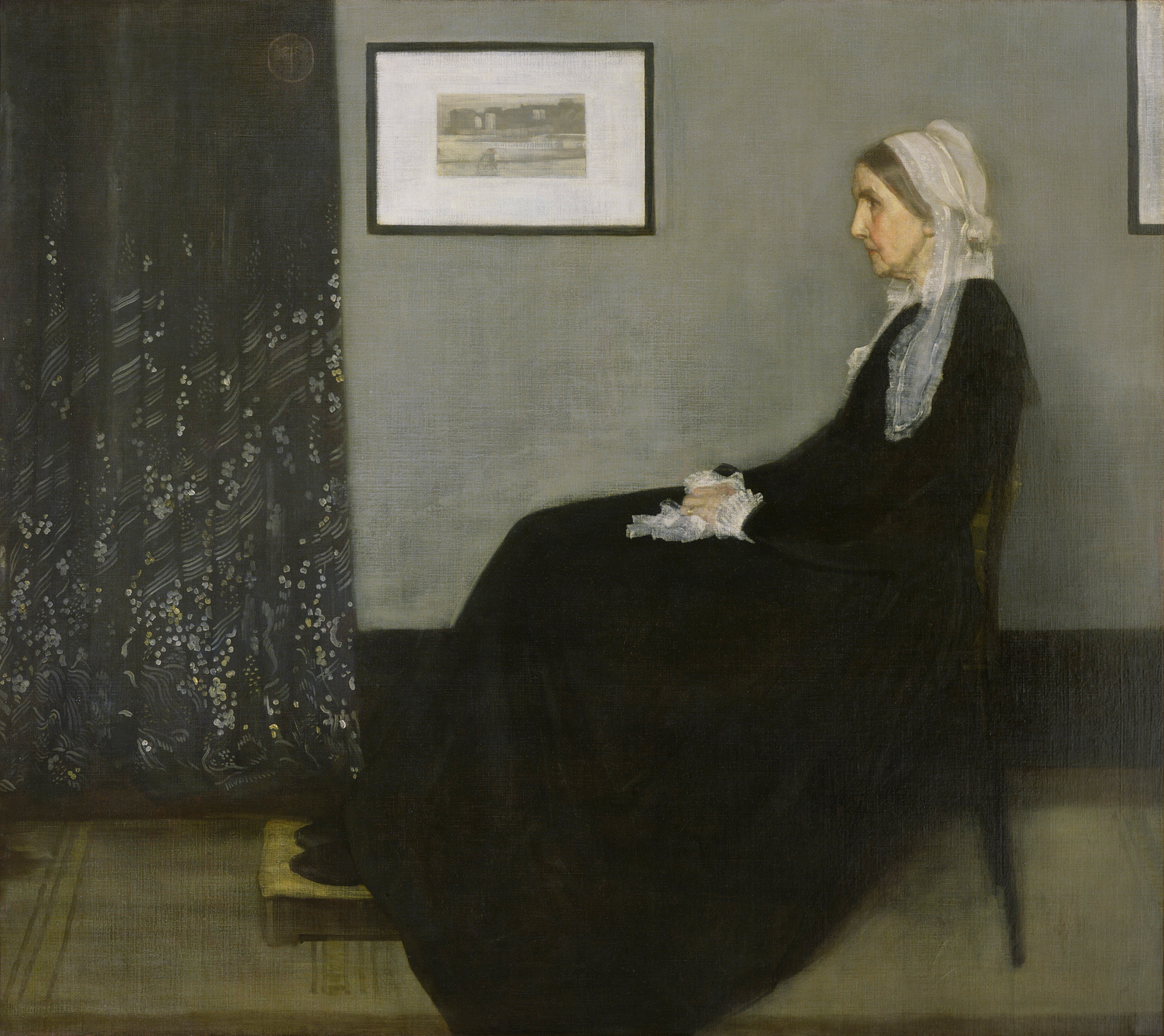
Start with her hands. They rest together in her lap, a small pale shape against the long black dress. Nothing here is hurried. Her feet have a support; her back is upright; her face turns away from us. Stay with that pose for a moment. Keeping still takes effort, even when a picture makes it look effortless.
The woman is Anna, the painter's mother, and she left her own account of the sittings. In a letter to her sister, she remembered that her son first asked her to stand. She tried, but found it too tiring. He changed his plan and painted her seated. That quiet chair carries a small history of a body reaching its limit, and a son responding.
Now let your eye move out into the room. The curtain makes a dark strip down the left. The framed print interrupts the grey wall. The dress spreads into a broad, steady shape, while the cap and cuffs give us little catches of light. The room offers very few distractions. Each time we wander away, those pale hands and the line of her face draw us back.
There is another name for this familiar mother: Arrangement in Grey and Black. Whistler used musical titles to direct attention towards the relationships between colours and shapes. Hold both titles in mind as you look. One brings us close to a particular woman. The other asks us to notice how carefully the space around her has been composed.
Anna's letter also remembers the strain of getting the painting right. She described her son's frustration at difficult passages, his persistence, and her pleasure when he finally felt he had succeeded. We cannot read every feeling from her painted face. But her own words let us glimpse a relationship at work behind this measured surface.
Look at the hands again. They have not moved, but perhaps the stillness feels different now. We have met someone who grew tired, sat down, watched her son struggle, and cared about what he was making. The painting gives her very little to do. Our attention can give her time.
Story draft · Editorial review pending.
Guide sources checked 5 October 2026.
Historical claims are linked to the records below. Close looking and interpretation are identified in the passage notes.
Miscellaneous Items in High Demand, PPOC, Library of Congress. Image source · Public domain
About the artist
1834 to 1903
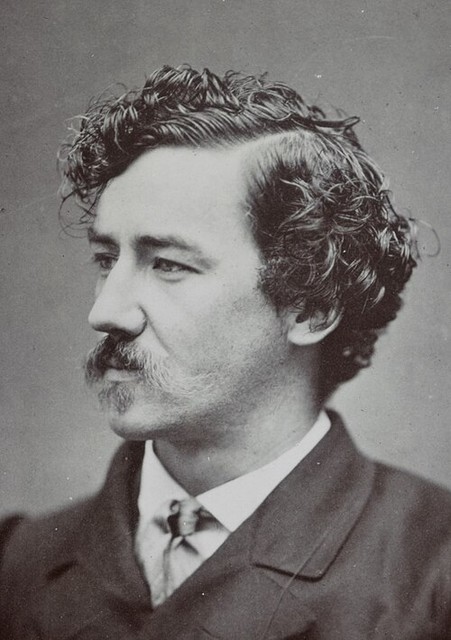
Whistler was an American painter and printmaker who built his career in Paris and London. His portraits, etchings and nocturnes brought close attention to tonal relationships. He studied in Paris before moving to London in 1859, and his work and public lectures helped shape debates about the relationship between art and nature.
The research & record
Find catalogue details, historical context, technical research and the literature behind this artwork.
Your browser could not copy automatically. Select the research text below, then copy it.
Open the complete research textThe artwork record
Catalogue information and detailed research, with references that link to the bibliography.
Visual observation
Look first at the long horizontal strip of dark paint behind the sitter, then at the vertical edge of the curtain and the rectangles of the framed print. Against those measured lines, the skirt forms a broad, descending curve. Anna’s small profile and hands carry warmer colour than the wall, while the white cloth gathers attention at her lap. These are observations from the image, not a proposed hidden code.(Whistler’s Mother: high-resolution image record, n.d.)
A useful reading is that the emptiness around Anna gives her presence weight. Small differences of edge, texture and tone sustain a scene without unfolding action. Her handkerchief, footstool and bonnet, together with the dark band on the wall and the framed print, keep those abstract relationships recognisably domestic. The interpretation begins with visible furnishings rather than an assumed account of her thoughts.(Whistler’s Mother: high-resolution image record, n.d.)
Painted in Chelsea in 1871, exhibited at the Royal Academy in 1872, and acquired by the French state in 1891.
Reported tradition
Documented anecdote: in her April 1872 letter to James H. Gamble, Anna reported that cases containing portraits had narrowly escaped a train fire on their return from Speke Hall. She described scorching to the frame but said the painting was uninjured. This is her account of a close escape; it should not acquire invented rescue dialogue. Later in the same letter she reported that her portrait was well hung at the Royal Academy.(University of Glasgow, Whistler correspondence project; original at Glasgow University Library, n.d.b)
Unverified material claim: Thomas Robert Way recalled a Three Girls design on the canvas reverse; Otto Bacher instead described a child’s portrait. Glasgow regards the first as possible with reservations and the second as less likely. Relining prevents the reverse from settling the question. Neither account establishes a lost painting definitely hidden behind Anna.(Whistler catalogue YMSM 101: technical description and conservation, n.d.)
The Musée d’Orsay records this 1871 London painting as Arrangement en gris et noir n°1, also titled The Artist’s Mother. The nickname identifies a person; the formal title identifies relationships of colour. That dual identity is central to the picture’s subsequent interpretation.(Musée d’Orsay, n.d.)
Whistler explained in his 1878 essay The Red Rag that an artwork should appeal through its own visual or musical relationships, without depending on patriotic, devotional or sentimental associations. He used his mother’s portrait as an example. Contemporary critics disputed the title, and some thought it distracted from his achievement as a portraitist. His statement is evidence of an artistic position, rather than proof that viewers must suppress every emotional response.(James McNeill Whistler; digital edition by Project Gutenberg, n.d.)
Anna Matilda McNeill Whistler was born in Wilmington, North Carolina, in 1804. She married George Washington Whistler in 1831; James, born in 1834, was her eldest son. She was sixty-six when she posed.(Anna Matilda Whistler: biographical record, n.d.)
The origin story has unusually good evidence. In a letter of 3–4 November 1871 to her sister Kate Palmer, Anna described another model’s inability to continue posing and her son’s decision to begin her portrait. She initially stood for him for several days, then found the effort too great. He changed to a seated pose. The famous stillness therefore grew partly out of a sitter’s physical comfort, rather than a pose maintained without alteration from the beginning.(University of Glasgow, Whistler correspondence project; original in Library of Congress, n.d.)
Anna also wrote that the portrait was being made for her son’s own satisfaction, rather than for payment. Her account includes his frustration over difficult passages, her private prayers while he worked, and her pleasure when a problem was resolved. This is a close participant’s testimony, filtered through a mother’s affection and Christian faith. It gives Anna an active voice in the picture’s creation, while resisting the assumption that her painted reserve tells us her entire personality.(University of Glasgow, Whistler correspondence project; original in Library of Congress, n.d.)
Technical examination reveals repeated adjustments: earlier positions placed the figure and footstool higher, shifted the arms and knees, and moved the curtain and framed picture further right. The chair once had a curved back. Those earlier choices would have enclosed Anna more tightly; the surviving version opens more space around her.(Whistler catalogue YMSM 101: technical description and conservation, n.d.)
Paint handling varies from heavier wall strokes to the thinly painted skirt and curtain pattern, and the more colourful face and hands. Early photographs record areas before later darkening. The reproduction’s appearance therefore includes material ageing alongside Whistler’s original decisions.(Whistler catalogue YMSM 101: technical description and conservation, n.d.)
Before entering a museum, the portrait appears in business correspondence. In September 1878 Algernon Graves asked Whistler to deliver it, another portrait and two nocturnes as arranged with Charles Augustus Howell. The correspondence editors identify the mother’s portrait and the other portrait as security for an advance of £100. A personal likeness could also function as a valuable movable asset: the surviving letter places it within an actual commercial transaction.(University of Glasgow, Whistler correspondence project; original at Glasgow University Library, n.d.a)
Admirers including Stéphane Mallarmé and Claude Monet supported the campaign for a French state acquisition.(Norton Simon Museum and Musée d’Orsay, n.d.)
The French state bought the portrait in 1891 for the Musée du Luxembourg. It moved to the Jeu de Paume in 1922, the Louvre in 1925 and the Musée d’Orsay in 1986. The purchase did not place it directly in the Louvre.(Musée d’Orsay, n.d.)
The 3-cent Mothers of America stamp, issued on 2 May 1934, adapted Whistler’s painting. Its circulation made the image serve an explicitly commemorative purpose: Anna became a representative mother, far beyond the specific London room and family relationship depicted on the canvas.(Smithsonian National Postal Museum, n.d.)
The adaptation was contested. A surviving Museum of Modern Art release reproduces Alfred H. Barr Jr.’s May 1934 letter protesting the alteration of Whistler’s design and proposing a replacement that preserved the composition. The same release records MoMA’s role in the painting’s American tour and reports audiences exceeding two million. That attendance figure is a contemporary museum claim, not an independently audited modern count. The dispute shows how a painting’s popularity can pull it away from its maker’s stated priorities.(Museum of Modern Art Archives, n.d.)
Details to carry with you
Bibliography
References are arranged by author or organisation, with links to the original publications. Where no publication date is recorded, n.d. means no date.
Source notes updated .
No recorded sources match these filters. Reset the filters to see the full bibliography.
Academic
Anna Matilda Whistler: biographical record (n.d.). University of Glasgow.
Museum
Academic
Whistler catalogue YMSM 101: technical description and conservation (n.d.). University of Glasgow.
Image-record
Whistler’s Mother: high-resolution image record (n.d.). Wikimedia Commons; reproduction credited to Musée d’Orsay.
Art to live with
A piece of the archive, made yours. Explore Whistler's Mother in a size and finish that fits your space.
Your text and annotations appear on these editions. Adding to cart saves that design for printing.
Combine this painting with your favourites01 / Find your edition
Choose your delivery country for available editions and delivery prices. Prices and delivery are shown in GBP.
1 product
Preparing your editions…
11oz · 2 image repeats
11oz · Standard

11oz · 2 image repeats

11oz · 2 image repeats

11oz · 2 image repeats

11oz · 2 image repeats

11oz · 2 image repeats
GBP 7.75
Delivery GBP 3.74 / Total GBP 11.49
An 11oz white ceramic mug with AAA+ ORCA coating and a C-shaped handle. Dishwasher and microwave safe, printed and dispatched in the UK.
repeat layout · choose single, double or a repeating pattern in Customise.
Repeat, fit, fill and position your artwork around the mug.
Preparing the artwork for your edition…
Made to order
The 30 cm ruler is scaled alongside your selected print. Keep the painting’s proportions with a black background, or stretch it to fill. Frame width, material texture and screen colours are illustrative.
Keep exploring