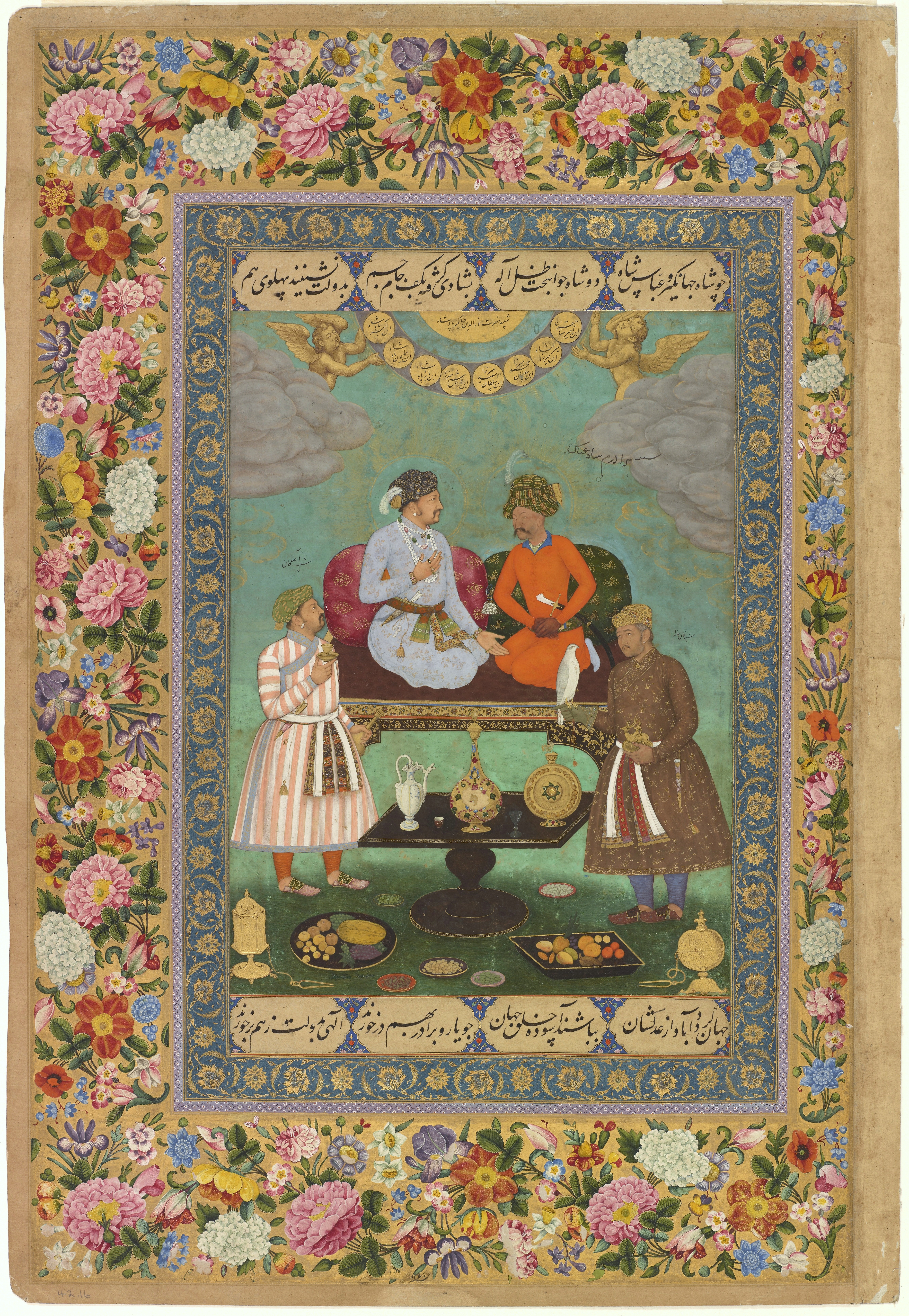
DateAbout 1620; borders dated 1746–1747CultureMughal India; later album decoration in IranPeriodMughal dynasty, reign of Jahangir
100%
Loading full-resolution artwork…
Drag to explorePinch or double-tap to explore
Scroll to zoom · drag to pan · double-click to focusPinch to zoom · drag to explore · double-tap to focusFIELD VIEW / 05
Tools & download
Pixel colour Select a pixel with the eyedropper
No pixel selected
Choose the eyedropper, then click or tap the image. Scroll to zoom for finer selection.
Add text
Hand to pan · Select to move text and drawings · Add as many texts as you like · Scroll to zoom
The research & record
Look closer. Read deeper.
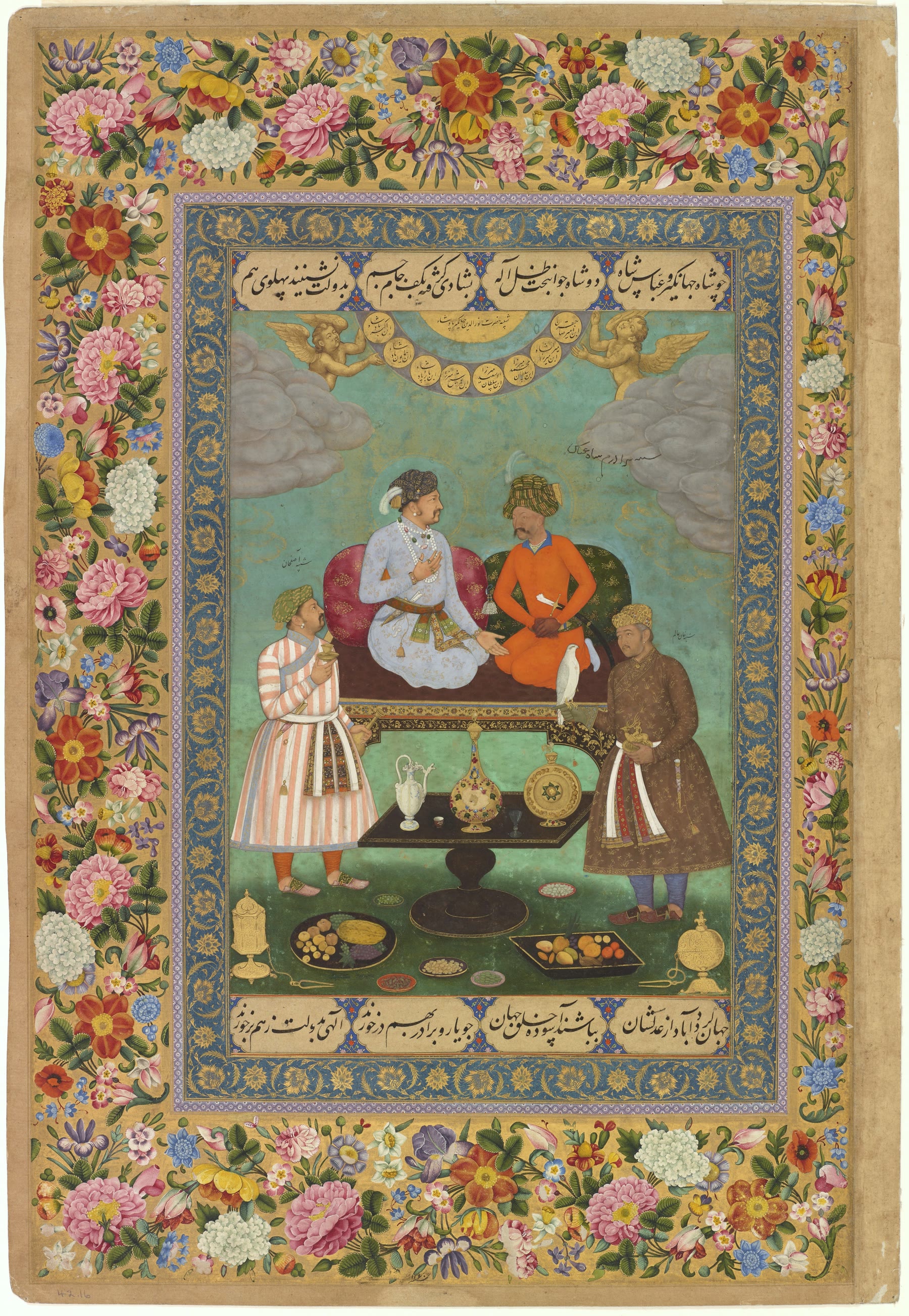
Two rival rulers sit together in a setting of jewels, vessels, flowers and winged figures. The meeting is imaginary: Jahangir and Shah Abbas never met. A tiny European mechanical sculpture adds another layer to the spectacle. The painting makes hospitality a claim to power, while its later Iranian borders and dispersed album history reveal a journey far beyond the Mughal court.
Identifying the right painting
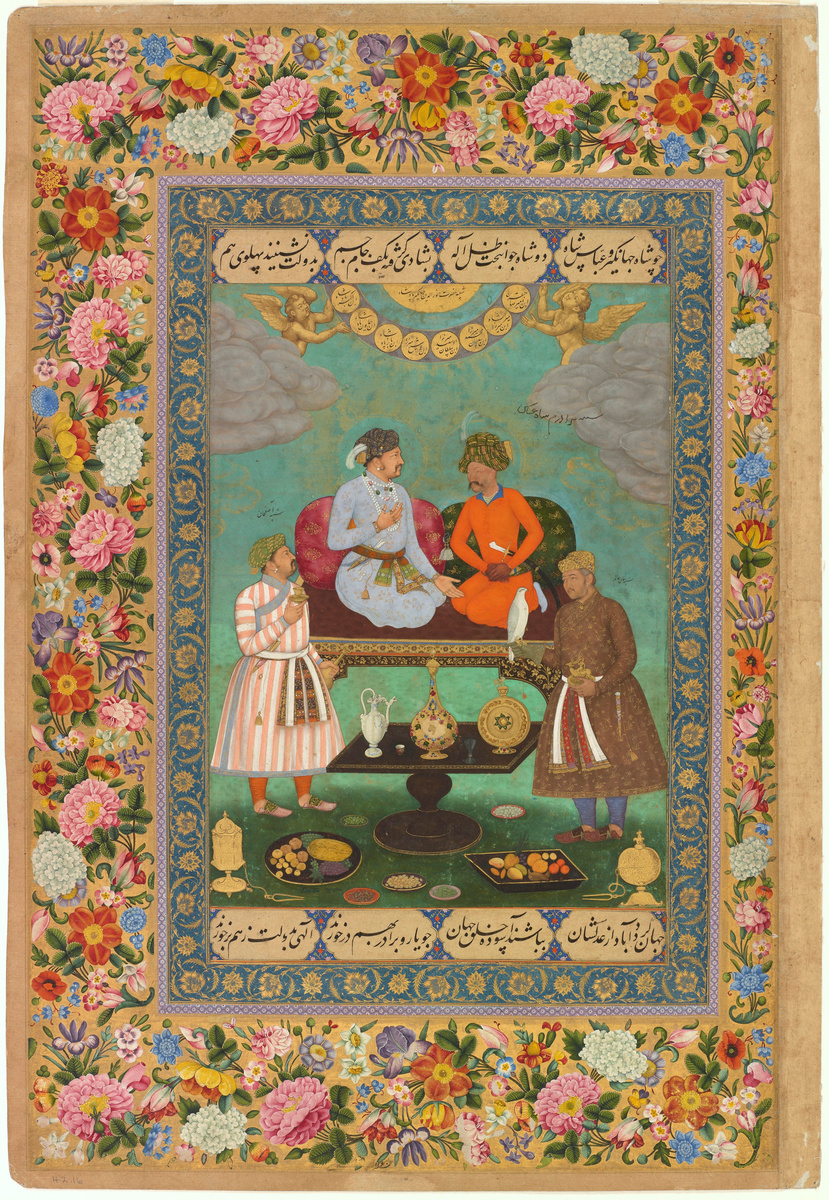
The Smithsonian identifies the seated reception as F1942.16a, attributed to Bishandas. Muhammad Sadiq's floral border, dated 1746–1747, surrounds the earlier painting.[1]
Artist attribution is not unanimous. Jessica Keating's 2015 study identifies Abu'l Hasan, and the Commons filename retains that name. The disagreement concerns this same entertainment image. Keeping both positions visible is more useful than turning an inherited filename into a definitive signature. Abu'l Hasan's celebrated standing embrace of the rulers is a separate Smithsonian object, F1945.9a.[2][3][7]
Hospitality as a claim to power
The museum reads the opulence as imperial self-assertion. Political events developed differently: Shah Abbas captured Qandahar from the Mughals in 1622. INFLIBNET's history chapter stresses the fortress's strategic and commercial importance. The convivial picture acquires a sharper edge beside that history: its imagined agreement could not settle competing territorial ambitions.[1][9]
Historian Murad Khan Mumtaz reads the setting as an Imaginal garden, a space in which royal aspirations could be pictured beyond ordinary earthly circumstances. His suggestion that such images sought to affect the earthly world through an imagined realm is a scholarly interpretation. It should be introduced with his name, rather than narrated as a known purpose stated by the painter.[5]
Reading the figures and the frame
Jahangir, dressed in pale fabric, opens one hand toward the ruler in orange. Two standing attendants bracket the central pair. A table and smaller dishes fill the foreground; the sky above contains clouds, a golden disk and two winged figures. The pale clothing and animated gesture give Jahangir visual emphasis, but that observation does not by itself prove what either ruler felt.[2]
The album's scholarly catalogue identifies a genealogical diagram above Jahangir that traces his descent from Timur. It joins courtly objects below and celestial forms above to make the encounter a statement of legitimate, wide-reaching rule. The elaborate surrounding flowers add another historical layer: the page's final appearance combines a Mughal painting with decoration made later in Iran.[6][8]
The small machine in the attendant's hand
The attendant at the right holds a miniature sculpture of Diana riding a stag. Keating identifies it as a German clockwork automaton, a costly object of the kind produced for European elites. Her study asks how its function and value changed as it travelled and was represented at the Mughal court. The detail makes the painting evidence of curiosity about objects from distant places, as well as an image of rulers.[3]
A surviving Diana and the Stag at the Metropolitan Museum shows how such devices worked: Augsburg makers combined metalwork with mechanisms that moved table ornaments during elite dining rituals. Some also served as drinking vessels. That museum object is a comparison, not the proven physical object held in this painting. The pictured sculpture's exact mechanism and subsequent whereabouts remain unestablished here.[4]
Diplomatic gifts and an unresolved identification
The St. Petersburg Album catalogue identifies Khan Alam, Jahangir's ambassador to Iran, as the attendant holding the sculpture. It also discusses an Italian table, Chinese porcelain and Venetian glass. Those different origins give the image's display of wealth a geographic reach; they are more specific than a general description of luxurious court furnishings.[6]
The catalogue relates the glass to Jahangir's memoir, which records a Venetian cup sent by Shah Abbas in 1615. It proposes that the painted vessel may be that gift. The connection is plausible within the documented exchange of gifts, but a memoir entry and a painted cup do not establish a unique object match. The identification must remain a proposal.[6]
An album made through displacement
The Institute of Oriental Manuscripts describes the album's origins in works taken to Iran after Nadir Shah's invasion of India in 1739. Indian paintings were combined with Persian works and calligraphy, then given decorated margins. The institute's surviving album and related leaves dispersed across other collections preserve parts of this larger undertaking; the name St. Petersburg Album extends beyond the pages now held in that city.[8]
For this leaf, the Smithsonian records gaps in ownership before purchase from Hagop Kevorkian in 1942. Those gaps interrupt a continuous chain of custody. The centre and border also require separate dates: the page preserves multiple acts of artistic production.[1]
Stories and their evidence
Dreams, allegory and the limits of lore
Mumtaz discusses royal dream imagery as part of Mughal representations of sacred kingship. The embrace painting has inscriptions explicitly associated with a dream; this seated scene can be discussed alongside it as an allegorical assembly. The two objects must remain distinct. A dream story or symbolic detail documented for the embrace should not migrate into an account of the entertainment scene without its own evidence.[5][7]
The productive uncertainty here lies in attribution and interpretation, rather than an unsupported tale of an actual meeting. The imaginary encounter, the tiny automaton, the disputed artist and the century-later floral border provide strong narrative material. Translating the Persian inscriptions in full, or identifying every vessel, would require further specialist checking beyond the records consulted for this article.[2]
Artist
Attributed to Bishandas; Abu'l Hasan proposed in published scholarship
Date
About 1620; borders dated 1746–1747
Medium
Opaque watercolour, gold and ink on paper
Dimensions
25 × 18.3 cm, as catalogued by the Smithsonian
Culture / place
Mughal India; later album decoration in Iran
Current context
Freer Gallery of Art, National Museum of Asian Art, Washington, DC; F1942.16a
Details to carry with you
The depicted meeting was imaginary.
The exact website image is the seated entertainment scene, F1942.16a.
The floral borders were added more than a century after the central painting.
The attendant at the right holds a Diana-and-stag automaton.
This is a different object from Jahangir's standing embrace of Shah Abbas, F1945.9a.
Fit and fill keep the painting’s proportions. Stretch changes them.
Move and zoom the painting on your flip phone case.
Preparing the artwork for your edition…
Made to order
From the archive
36.6 cm / 14.4 in30.7 cm / 12.1 in
36.6 × 30.7 cm / 14.4 × 12.1 in · Standard
Drag to rotate
36.6 × 30.7 cm / 14.4 × 12.1 in · Standard
14.4 in / 36.6 cm12.1 in / 30.7 cm
14.4 × 12.1 in / 36.6 × 30.7 cm · Standard
14.4 in / 36.6 cm12.1 in / 30.7 cm
14.4 × 12.1 in / 36.6 × 30.7 cm · Standard
14.4 in / 36.6 cm12.1 in / 30.7 cm
14.4 × 12.1 in / 36.6 × 30.7 cm · Standard
14.4 in / 36.6 cm12.1 in / 30.7 cm
14.4 × 12.1 in / 36.6 × 30.7 cm · Standard
Front · your design1 / 4
Desk mat
GBP 15.37
Delivery GBP 5.51 / Total GBP 20.88
A smooth polyester desk mat with a natural rubber non-slip base and anti-fray edges, available in three sizes.
Fit and fill keep the painting’s proportions. Stretch changes them.
Move and zoom the painting on your desk mat.
Preparing the artwork for your edition…
Made to order
The 30 cm ruler is scaled alongside your selected print. Keep the painting’s proportions with a black background, or stretch it to fill. Frame width, material texture and screen colours are illustrative.
We count article page loads to improve the archive, without a visitor tracking cookie. Essential storage supports your basket, delivery choice and site security. Stripe uses payment security storage when payment opens. Your notice and counting choices are remembered for one year.