ArchiveWashington Crossing the Delaware

Artwork record / 207 of 331

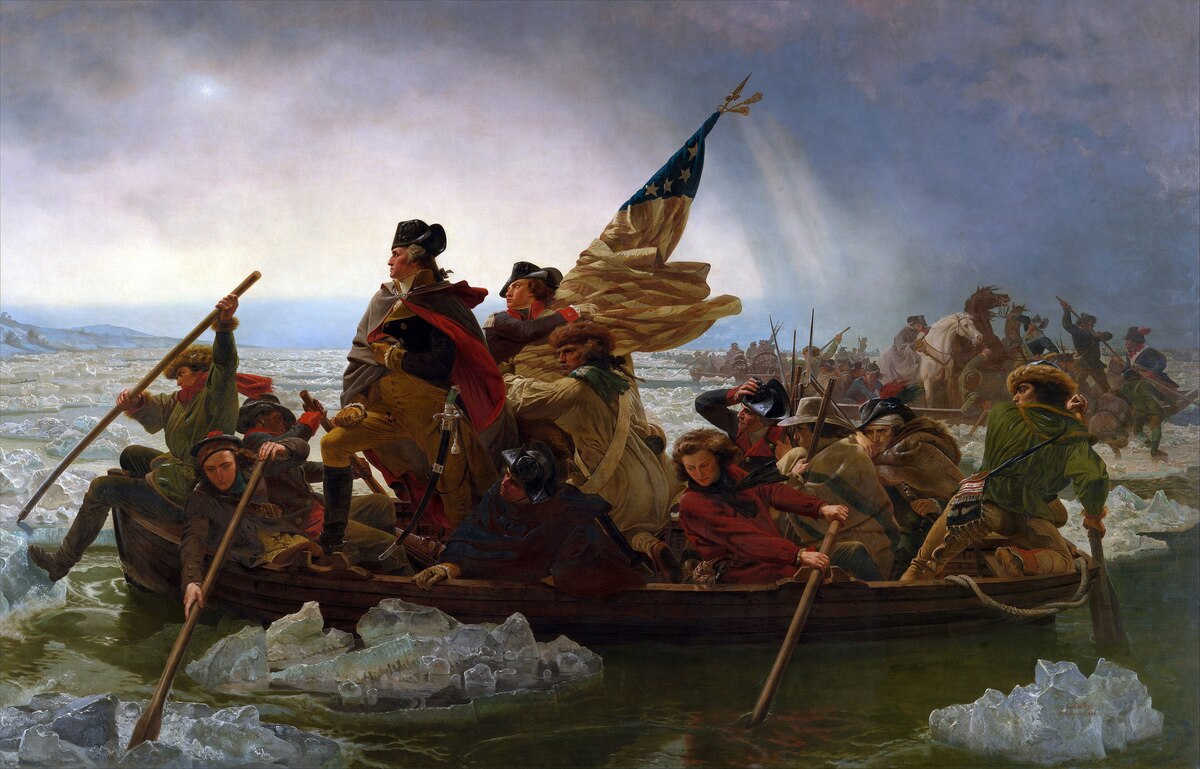
Washington Crossing the Delaware by Emanuel Leutze (1851)

Artist: Emanuel Leutze

Emanuel Leutze's Washington Crossing the Delaware turns a desperate winter raid into an emblem of American resolve. This docent tour follows the painting's subject, its staged composition and the historical distance between the event and the image.

Read the story ↓ About the artist ↓ Research and record ↓ Literature and sources ↓ Listen to the article ↓
Article text for AI
Shop this artwork ↓ 1 visit
Date1851CultureAmerican PeriodAmerican history painting, 19th centuryCurrent locationThe Metropolitan Museum of Art, New York City
Listen to the article
100%
Washington Crossing the Delaware by Emanuel Leutze (1851)
Loading full-resolution artwork…
Scroll to zoom · drag to pan · double-click to focus Pinch to zoom · drag to explore · double-tap to focus FIELD VIEW / 207
Tools & download
Pixel colour Select a pixel with the eyedropper
No pixel selected

Choose the eyedropper, then click or tap the image. Scroll to zoom for finer selection.

Add text

Hand to pan · Select to move text and drawings · Add as many texts as you like · Scroll to zoom

Washington Crossing the Delaware: high-resolution image

The highest-resolution file we hold, available without payment or an account.3,840 × 2,460 pixels.

Download highest-resolution image

Details to notice

About 3 minutes to read
01

Horse and Troops on the Frozen Shore

At the right, a rider on horseback leads further soldiers, spears and a wagon across the frozen ground beyond the boat, expanding the crossing from a single boat into an entire army on the move.

02

Ice Floes and Dipping Oar

Broken slabs of river ice crowd the boat while an oar blade digs into the dark water at the lower left; the sharp ice and laboring blade make the frozen, dangerous crossing legible at a glance.

03

Oarsman in Red Shirt

A dark-skinned rower in a red shirt and pale neckerchief leaning forward into his oar as it bites the water. His concentrated effort makes the physical labor of the crossing visible and he is one of the painting's most discussed figures.

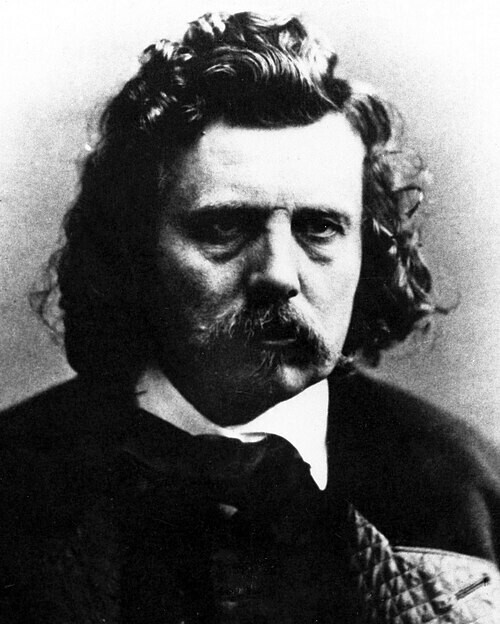
Artist portrait of Emanuel Leutze
Artist portrait Image credit

William Kurtz. Image source · Public domain

About the artist

Emanuel Leutze

1816 to 1868

Emanuel Leutze was an American artist (1816-1868). Their work is associated with Romanticism. Their recorded places of work include Munich; Philadelphia.

Born
1816
Died
1868
Nationality
Kingdom of Württemberg; United States
Birthplace
Schwäbisch Gmünd
Died in
Washington, D.C.

The research & record

Study the work.
Follow the evidence.

Find catalogue details, historical context, technical research and the literature behind this artwork.

Article text for AI
Open research text

The artwork record

Research catalogue

Catalogue information and detailed research, with references that link to the bibliography.

Updated .

Identity and catalogue

Link
Title
Washington Crossing the Delaware
Artist or attribution
Emanuel Leutze
Object date
1851
Medium and support
Oil on canvas
Dimensions
378.5 cm × 647.7 cm
Current collection or location
The Metropolitan Museum of Art, New York City(Wikimedia Commons: Washington Crossing the Delaware, n.d.)
Movement or period
American history painting, 19th century
Country or culture
American
Depicted subject
George Washington's surprise attack on Hessian forces at Trenton on the morning of December 26, 1776, depicted as a heroic crossing of the Delaware River.(Wikimedia Commons: Washington Crossing the Delaware, n.d.)
Title variants
Washington Crossing the Delaware
Accession number
97.34
Support
Canvas
Inscriptions
E. Leutze / Dusseldorf 1855(Wikimedia Commons: Washington Crossing the Delaware, n.d.)
Catalogue record and its date

Interpretation

Emanuel Leutze painted Washington Crossing the Delaware in 1851, the year the work entered public view in New York. The canvas is an oil on canvas measuring 378.5 by 647.7 centimetres, a scale that gives the rowboat and its occupants a near life-size presence. The painting carries the inscription 'E. Leutze / Dusseldorf 1855', a detail that sits in tension with the 1851 date attached to the work in the institutional record. Because the object date comes from the historical account of its making and exhibition, while the inscription preserves a later place and year, the two should be kept distinct rather than collapsed into a single date. The inscription documents Leutze's connection to Dusseldorf and a later point in the object's history, not the moment the picture was painted.(Wikimedia Commons: Washington Crossing the Delaware, n.d., File title and summary; Inscriptions)

The record's account of the crossing connects this object to the wider history of the American Revolution and to the later circulation of the image. The attack at Trenton is described as a surprise attack by American revolutionaries, and the picture's making more than seventy years after 1776 places it within a nineteenth-century effort to remember the war rather than within the war itself. Within that larger history the painting matters less as a report of the crossing than as a founding image produced long afterward, and the provenance sequence traced here shows how such an image passed from a European dealer's hands into American private collections and the auction market.(Wikimedia Commons: Washington Crossing the Delaware, n.d., File title and summary; Object history, English; Summary, Italian and Spanish)

Emanuel Leutze painted Washington Crossing the Delaware in 1851.(Wikimedia Commons: Washington Crossing the Delaware, n.d.)

The painting bears the inscription 'E. Leutze / Dusseldorf 1855'.(Wikimedia Commons: Washington Crossing the Delaware, n.d.)

Subject and iconography

Link
The recorded composition

Visual observation

The recorded composition is strikingly legible in the institution's own summary description: Washington stands in a boat while soldiers row through ice-filled water, and a large American flag is held aloft behind him. This single recorded arrangement organizes the whole visual field, because it places the standing commander, the raised flag and the laboring crew in one shared frame. The same recorded composition is what the object history treats as the depiction of Washington's attack on the Hessians at Trenton on the morning of December 26, 1776, so the image is described at once as a scene of figures and as a representation of a dated military event. The narrative it carries is further described as a surprise attack by American revolutionaries during the American War of Independence, which the source dates 1775 to 1783. In other words, the recorded elements are not incidental scenery: the boat, the water and the flag together make the picture readable as the crossing and the attack, and the institutional description and the object history describe the same configuration, one in terms of what is shown and the other in terms of what that showing depicts.(Wikimedia Commons: Washington Crossing the Delaware, n.d., Summary; Object history, English; Summary, Italian and Spanish)

The painting shows Washington standing in a boat, with a large American flag held aloft behind him, and soldiers rowing through ice-filled water.(Wikimedia Commons: Washington Crossing the Delaware, n.d.)

Historical context

Link
The Represented Event

Emanuel Leutze's Washington Crossing the Delaware depicts a specific event of the American War of Independence (1775-1783): Washington's attack on Hessian forces at Trenton on the morning of December 26, 1776. One account of the painting describes the subject as the attack on the Hessians at Trenton on that morning, while a second summary describes it as a surprise attack by American revolutionaries on Hessian forces during the war. The two formulations agree on the date, the place, the opposing force and the character of the action as a surprise; they differ only in emphasis, one naming the Hessians directly and the other framing the episode within the wider revolutionary conflict. Together they establish the historical episode the canvas represents and situate the picture within a war rather than in an isolated military anecdote.(Wikimedia Commons: Washington Crossing the Delaware, n.d., Object history, English; Summary, Italian and Spanish)

Circulation, Prints and Reception

Interpretation

Read together, the evidence supports a layered account of the object. The represented event is dated and located through the documentary summaries of the subject; the visual description supplies what the canvas actually shows; the creation history places the surviving version second in a sequence begun in 1849 and interrupted by fire in 1850; the provenance and print history trace how the image moved through dealers, collectors, an estate sale and a published engraving; and the reception evidence records its success in America and Germany alongside the studies and copies made after it. The differing formulations of the subject across the summaries, and the difference between an observed arrangement of figures and a documented military episode, are qualifications rather than contradictions: they mark where the evidence describes the painting and where it describes the history the painting claims to represent. This is why the work matters within a larger history of art and material culture. It is a mid-nineteenth-century history painting whose subject lies in 1776, whose creation belongs to the aftermath of 1849 and 1850, and whose meaning was extended through an 1853 engraving, a documented chain of ownership and a wide transatlantic afterlife in studies and copies.(Wikimedia Commons: Washington Crossing the Delaware, n.d., Object history, English; Summary; Summary, Italian and Spanish)

Leutze's painting depicts Washington's attack on the Hessians at Trenton on the morning of December 26, 1776.(Wikimedia Commons: Washington Crossing the Delaware, n.d.)

Leutze began the first version of this subject in 1849. It was damaged by fire in his studio in 1850, later restored, acquired by the Kunsthalle Bremen, and destroyed in a bombing raid in 1942.(Wikimedia Commons: Washington Crossing the Delaware, n.d.)

The painting depicts the attack on Hessian forces at Trenton, a surprise attack by American revolutionaries during the American War of Independence (1775-1783).(Wikimedia Commons: Washington Crossing the Delaware, n.d.)

Materials and technique

Link
Support, medium and dimensions

Visual observation

Emanuel Leutze's Washington Crossing the Delaware is recorded as an oil on canvas measuring 378.5 by 647.7 cm, an unusually large scale for a history painting of this subject and one that conditions how its surface and handling can be read. The institutional record also notes that the canvas bears the inscription "E. Leutze / Dusseldorf 1855", a signature and place-and-date line that coexists in the same record with the painting's conventional identification as a work of 1851. Within this archive the inscription is reported as present on the object rather than interpreted; no evidence unit supplied here explains the relationship between the inscribed date and the 1851 identification, and no unit describes the medium of the inscription, whether applied in paint or otherwise. What the record establishes with certainty is the support (canvas), the medium (oil) and the dimensions; the inscription is documented as text on the work and remains, on present evidence, an unexplained element of its material record.(Wikimedia Commons: Washington Crossing the Delaware, n.d., Summary, Italian; Summary)

Interpretation

The evidence assembled here for this painting is institutional and descriptive rather than the product of a published technical examination. It reports support and medium, dimensions and an inscription, along with subject matter: Washington standing in a boat, a large American flag held aloft behind him, soldiers rowing through ice-filled water. No supplied unit records a pigment analysis, cross-section, ground or priming layer, canvas weave, lining, stretcher, varnish history, infrared or X-radiographic imaging, or conservation treatment for this canvas. Any account of its making must therefore rest on what the record states and on what the visible image shows, and must not convert the absence of technical data into claims about materials or preparation. The distinction matters, because the questions a technical study would answer, such as whether the composition was reworked, whether the flag was painted over an earlier design, or how the canvas was prepared, are simply not answered by the evidence available here.(Wikimedia Commons: Washington Crossing the Delaware, n.d., Summary, Italian; Summary)

Inscription and dissemination in print

The inscription "E. Leutze / Dusseldorf 1855" is the one element of the material record that names a place of making. Read together with the documented sequence, in which the first version was begun in 1849 and the second in 1850, with the second exhibited in New York in October 1851, the inscription places Leutze in Dusseldorf at a date later than both the conventional 1851 identification and the New York exhibition. The evidence does not reconcile these points, and it does not state when the inscription was applied or by whom. It is therefore safest to record the inscription as documented text present on the canvas and to note the tension with the dates established elsewhere in the record, rather than to resolve it. Parallel material evidence of the work's dissemination is the engraving published by M. Knoedler in 1853, which shows the composition being carried into another medium within two years of the New York exhibition.(Wikimedia Commons: Washington Crossing the Delaware, n.d., Summary, Italian; Summary)

The painting is an oil on canvas measuring 378.5 cm by 647.7 cm.(Wikimedia Commons: Washington Crossing the Delaware, n.d.)

Provenance and ownership

Link
The Two Versions and Their Divergent Fates

The documented history of the subject begins before the canvas now in question. Leutze began a first version of this scene in 1849; that painting was damaged by fire in his studio in 1850, was later restored, was acquired by the Kunsthalle Bremen, and was finally destroyed in a bombing raid in 1942. The loss of the first version means that the surviving second canvas carries the documentary weight of the composition, and it also means that any comparison between Leutze's two treatments of the subject must rest on the record of the Bremen picture rather than on the object itself.(Wikimedia Commons: Washington Crossing the Delaware, n.d., Object history, English)

Leutze began the second version of the subject in 1850, and it was exhibited in New York in October 1851. According to the provenance record, Marshall O. Roberts bought it for $10,000. The purchase price is the earliest documented monetary valuation attached to the canvas, and the exhibition date establishes that the painting was shown publicly in New York before it entered private hands.(Wikimedia Commons: Washington Crossing the Delaware, n.d., Object history, English)

The painting's recorded provenance can be set out in sequence. It was with Goupil, Vibert and Company, in Paris and New York, during 1851 to 1852; then with Marshall O. Roberts of New York from 1852 until his death in 1880; then in his estate from 1880 to 1897; then in a sale conducted by Ortgies and Company at the Fifth Avenue Art Galleries, New York, on January 20, 1897, as lot no. 172; and then with John S. Kennedy of New York in 1897. The appearance of the firm Goupil, Vibert and Company in both Paris and New York indicates that the canvas moved through a transatlantic art trade before settling with its first documented American owner, and the gap between its 1851 exhibition and Roberts's documented holding from 1852 is an interval in the record rather than evidence of an undocumented change of hands. The estate years and the 1897 auction mark the transfer of the work out of the Roberts family and into the hands of John S. Kennedy, and the lot number locates the sale within a specific auction catalogue.(Wikimedia Commons: Washington Crossing the Delaware, n.d., Object history, English)

In 1850, Leutze began this second version, which was exhibited in New York in October 1851. Marshall O. Roberts bought it for $10,000.(Wikimedia Commons: Washington Crossing the Delaware, n.d.)

The painting's provenance includes: with Goupil, Vibert and Company, Paris and New York, 1851–52; Marshall O. Roberts, New York, 1852–died 1880; his estate, 1880–97; sale, Ortgies and Company, Fifth Avenue Art Galleries, New York, January 20, 1897, no. 172; John S. Kennedy, New York, 1897.(Wikimedia Commons: Washington Crossing the Delaware, n.d.)

Provenance timeline
  1. 1849

    Leutze began the first version of the subject; this first version was later damaged by fire in his studio, restored, acquired by the Kunsthalle Bremen, and destroyed in a bombing raid.(Wikimedia Commons: Washington Crossing the Delaware, n.d., Object history, English)

  2. 1850

    Leutze began this second version of the subject, which had been preceded by the first version damaged by fire in his studio that same year.(Wikimedia Commons: Washington Crossing the Delaware, n.d., Object history, English)

  3. October 1851

    This second version was exhibited in New York. Marshall O. Roberts bought it for 10,000 dollars.(Wikimedia Commons: Washington Crossing the Delaware, n.d., Object history, English)

  4. 1851 to 1852

    The painting was with Goupil, Vibert and Company, Paris and New York.(Wikimedia Commons: Washington Crossing the Delaware, n.d., Object history, English)

  5. 1852 to 1880

    Marshall O. Roberts owned the painting in New York until his death in 1880.(Wikimedia Commons: Washington Crossing the Delaware, n.d., Object history, English)

  6. 1880 to 1897

    The painting remained in Marshall O. Roberts's estate.(Wikimedia Commons: Washington Crossing the Delaware, n.d., Object history, English)

  7. January 20, 1897

    It was sold at Ortgies and Company, Fifth Avenue Art Galleries, New York, as no. 172.(Wikimedia Commons: Washington Crossing the Delaware, n.d., Object history, English)

  8. 1897

    John S. Kennedy, New York, acquired the painting.(Wikimedia Commons: Washington Crossing the Delaware, n.d., Object history, English)

Reception and literature

Link
Transatlantic Success

Leutze's depiction was a great success in America and in Germany, and this dual reception is documented rather than inferred. The two national contexts were connected by the artist's own working situation: the second version was painted in Dusseldorf, and the inscription 'E. Leutze / Dusseldorf 1855' on the canvas places its making in that German artistic center, while its subject is the American attack on Hessian forces at Trenton, a surprise attack by American revolutionaries during the American War of Independence of 1775 to 1783. The painting's broad appeal therefore crossed the same Atlantic that the depicted crossing had, and its fame was not confined to the nation whose founding moment it portrayed.(Wikimedia Commons: Washington Crossing the Delaware, n.d., Object history, English; Summary, Italian and Spanish)

Reproduction and Circulation

Reproduction was one mechanism through which the image traveled beyond the painted canvas. In 1853, M. Knoedler published an engraving of the painting, only two years after the New York exhibition and while the original was still in Marshall O. Roberts's collection. The existence of the engraving establishes that the composition was deliberately put into circulation for a print-buying public, which is a different kind of reception from the experience of standing before a canvas nearly four meters high and more than six meters wide. The engraving also gives the image a portable form and a wider audience than any single owner could provide.(Wikimedia Commons: Washington Crossing the Delaware, n.d., Object history, English)

The painting generated a substantial body of related objects: many studies for the painting exist, as do copies by other artists. These studies and copies document the composition's importance as a model, since other artists chose to repeat it and Leutze himself worked through the subject in preparatory form. The evidence does not specify which studies preceded which version or how many copies were made, so the scale and chronology of this afterlife remain open. What can be said is that the picture functioned as a source to be studied and reproduced, not only as a finished object to be viewed.(Wikimedia Commons: Washington Crossing the Delaware, n.d., Object history, English)

The Depicted Subject and Its Cultural Work

Interpretation

Taken together, the documented stages show that Washington Crossing the Delaware accumulated meanings over time rather than arriving with a single fixed significance. It was exhibited and sold in New York in 1851, engraved and published by M. Knoedler in 1853, circulated in Germany as well as America, studied and copied by other artists, and preserved in a second version after the first was destroyed in 1942. Its monumental scale and its place in an American collection since the nineteenth century help explain why it became a reference point for later images of the Revolution. The evidence supplied here does not establish the full range of later literary readings, public events, artistic appropriations or display changes, so those stages of reception remain to be documented from other sources; what the present record supports is a picture whose reputation was built through exhibition, purchase, print publication, imitation and transatlantic recognition.(Wikimedia Commons: Washington Crossing the Delaware, n.d., Object history, English)

In 1853, M. Knoedler published an engraving of the painting.(Wikimedia Commons: Washington Crossing the Delaware, n.d.)

Leutze's depiction was a great success in America and in Germany.(Wikimedia Commons: Washington Crossing the Delaware, n.d.)

Many studies for the painting exist, as do copies by other artists.(Wikimedia Commons: Washington Crossing the Delaware, n.d.)

Collection and display

Link
The object and its institutional record

Emanuel Leutze's Washington Crossing the Delaware is an oil on canvas measuring 378.5 by 647.7 centimeters, a scale that places it among the large history paintings of the mid-nineteenth century rather than among easel pictures. The canvas bears the inscription 'E. Leutze / Dusseldorf 1855', which fixes the painter's name and the German city of execution in the object's own surface, even though the painting is elsewhere recorded as having been exhibited in New York in October 1851. The painting is now in the collection of the Metropolitan Museum of Art, New York City, where it carries accession number 97.34. The accession number itself belongs to the 1897 sequence of the museum's registration, which aligns with the painting's documented arrival in a New York collection in that year rather than with its mid-century exhibition history.(Wikimedia Commons: Washington Crossing the Delaware, n.d., Accession number 97.34, institution QS:P195,Q160236)

Provenance

The provenance recorded for the painting runs through a sequence of named owners and dealers. It was with Goupil, Vibert and Company in Paris and New York in 1851 and 1852; it then passed to Marshall O. Roberts of New York, who held it from 1852 until his death in 1880. After Roberts's death the painting remained in his estate until 1897, when it was sold at auction by Ortgies and Company at the Fifth Avenue Art Galleries in New York on January 20, 1897, as lot number 172. John S. Kennedy of New York acquired it in 1897. That documented chain of custody establishes the painting's movement from its first commercial handlers, through a prominent American private collection, and into the hands of a later owner in the same year that the Metropolitan Museum's accession number 97.34 places it within the museum's registration sequence.(Wikimedia Commons: Washington Crossing the Delaware, n.d., Accession number 97.34, institution QS:P195,Q160236)

The first version and the print after the painting

Leutze's connection to the subject extends beyond the canvas now in New York. He began a first version of the composition in 1849; that canvas was damaged by fire in his studio in 1850, later restored, acquired by the Kunsthalle Bremen, and destroyed in a bombing raid in 1942. The New York painting is therefore the second version, begun in 1850, and it is the one that survived into the present. The existence of the Bremen canvas, its restoration, and its eventual destruction mean that the earlier conception of the subject is known today only through documentation and through the many studies and copies by other artists that the painting generated. Leutze's depiction was a great success in America and in Germany, and in 1853 M. Knoedler published an engraving of the painting, which extended its reach well beyond the owners of the canvas itself.(Wikimedia Commons: Washington Crossing the Delaware, n.d., Accession number 97.34, institution QS:P195,Q160236)

Subject and historical reference

The subject of the painting is Washington's attack on Hessian forces at Trenton, a surprise attack by American revolutionaries during the American War of Independence of 1775 to 1783, fought on the morning of December 26, 1776. The composition shows Washington standing in a boat, with a large American flag held aloft behind him, and soldiers rowing through ice-filled water. The painting is thus a constructed image of a specific military action, made more than seventy years after the event, and its historical value in the collection context lies in how it shaped later understanding of the Revolution rather than in any claim to have recorded the crossing directly.(Wikimedia Commons: Washington Crossing the Delaware, n.d., Accession number 97.34, institution QS:P195,Q160236)

Reception and circulation

Interpretation

The object's documented history as a museum piece, with a single accession number and a documented sale price, sits alongside the wider material record of its reproduction. The 1853 Knoedler engraving and the surviving studies and copies by other artists indicate that the painting's circulation was not limited to the canvas acquired by the Metropolitan Museum. The provenance entries, the auction lot number, and the accession number together provide the kind of fixed points by which the painting's changing status, from a dealer's stock to a private collection to a public institution, can be traced, while the inscription 'E. Leutze / Dusseldorf 1855' and the 1851 exhibition date preserve the tension between the painting's German execution and its American reception.(Wikimedia Commons: Washington Crossing the Delaware, n.d., Accession number 97.34, institution QS:P195,Q160236)

The painting is in the collection of the Metropolitan Museum of Art, New York City, with accession number 97.34.(Wikimedia Commons: Washington Crossing the Delaware, n.d.)

Documented values and qualified estimates

Link
Purchase and recorded price

The documented record of value attached to Emanuel Leutze's Washington Crossing the Delaware begins with a purchase rather than an estimate. Marshall O. Roberts bought the painting in 1851 for $10,000, a figure recorded in the object's history as an acquisition price. This is the only monetary amount the supplied evidence establishes, and it belongs to a specific transaction at a specific moment: the year the second version of the subject was exhibited in New York. The evidence explicitly cautions that this is a historical acquisition price and not a current valuation, so it cannot be used as an estimate of present market worth. Any later figures the painting may have commanded, at the 1897 sale or elsewhere, are not given in the supplied material. The 1851 sum therefore documents a nineteenth-century buyer's commitment to a contemporary history painting; it does not measure the work's standing today.(Wikimedia Commons: Washington Crossing the Delaware, n.d.)

The price is best understood against the object's fuller history, which the acquisition sits inside. Leutze began a first version of the subject in 1849; that canvas was damaged by fire in his studio in 1850, later restored, acquired by the Kunsthalle Bremen, and destroyed in a bombing raid in 1942. In 1850 Leutze began this second version, which was exhibited in New York in October 1851. The provenance recorded for the second version runs from Goupil, Vibert and Company in Paris and New York in 1851 to 1852; to Marshall O. Roberts in New York from 1852 until his death in 1880; to his estate from 1880 to 1897; to a sale by Ortgies and Company at the Fifth Avenue Art Galleries in New York on January 20, 1897, lot no. 172; and then to John S. Kennedy in New York in 1897. The painting is an oil on canvas measuring 378.5 cm by 647.7 cm, and it bears the inscription 'E. Leutze / Dusseldorf 1855'. In 1853 M. Knoedler published an engraving of the painting. Read together, these units show that the work's documented value history is inseparable from its movement through dealers, a private collection, an estate and an auction house, and from its reproduction in print.(Wikimedia Commons: Washington Crossing the Delaware, n.d.)

Subject, maker and reception

The painting's subject is Washington's surprise attack on Hessian forces at Trenton on the morning of December 26, 1776, during the American War of Independence (1775 to 1783). It shows Washington standing in a boat, with a large American flag held aloft behind him, and soldiers rowing through ice-filled water. The work is attributed to Emanuel Leutze and dated 1851, and it is in the collection of the Metropolitan Museum of Art, New York City, with accession number 97.34. These are the basic identifying facts the record establishes. The same record notes that the depiction was a great success in America and in Germany, and that many studies for the painting exist, as do copies by other artists. The existence of studies and copies matters for how the object is valued in a scholarly sense: the composition was not a single isolated canvas but a subject Leutze developed and others reproduced, which helps explain both its wide circulation and the difficulty of treating any one canvas as the only witness to the design.(Wikimedia Commons: Washington Crossing the Delaware, n.d.)

The documented acquisition price and the provenance chain should not be confused with the paintings' differing fates. The first version, begun in 1849, was damaged by fire in Leutze's studio in 1850, later restored, acquired by the Kunsthalle Bremen, and destroyed in a bombing raid in 1942. The second version, begun in 1850, is the one exhibited in New York in October 1851 and bought by Roberts; it is the canvas with the provenance that leads from Goupil, Vibert and Company to Roberts, his estate, the 1897 sale and John S. Kennedy. The $10,000 therefore attaches specifically to the second version. The inscription 'E. Leutze / Dusseldorf 1855' on that canvas, and the 1853 Knoedler engraving, further distinguish the object from the lost first version. The evidence allows the two versions to be told apart but does not say what price, if any, was attached to the first version, nor what the Bremen canvas looked like.(Wikimedia Commons: Washington Crossing the Delaware, n.d.)

Value in context

Interpretation

The larger point of recording these values is that Washington Crossing the Delaware is a work whose significance was constructed through exhibition, purchase, reproduction and collecting, not only through its painted surface. It was exhibited in New York in October 1851, bought the same year by Marshall O. Roberts for $10,000, engraved by M. Knoedler in 1853, and it achieved success in America and in Germany; studies and copies by other artists extended its reach further. The provenance later moved the canvas through the Roberts estate and the 1897 auction to John S. Kennedy, and it is now at the Metropolitan Museum of Art under accession number 97.34. Those documented moments describe a nineteenth-century history painting that was valued as a contemporary public statement and, through prints and copies, as a widely circulated image. The evidence supports this account of circulation and value, but it does not establish present market value, later sale prices, or the private intentions of the buyer, and those limits should remain attached to the $10,000 figure.(Wikimedia Commons: Washington Crossing the Delaware, n.d.)

Historical acquisition value: Purchased by Marshall O. Roberts in 1851 for $10,000. Recorded date: 1851. Methodology: Historical purchase price recorded in object history. Qualification: This is a historical acquisition price, not a current valuation. Do not use as an estimate of present market value.(Wikimedia Commons: Washington Crossing the Delaware, n.d.)

Further reading

Books for a closer look

Paid links. As an Amazon Associate I earn from qualifying purchases.

  • Cover of Emanuel Leutze, Washington crossing the Delaware
    Open Library

    Ernest Goldstein, 1983

    Emanuel Leutze, Washington crossing the Delaware

    Garrard Pub. Co. · 1st ed.

    Recorded title pairs Emanuel Leutze with Washington crossing the Delaware, and subjects include American painting, painting, portraits, art appreciation, and history. This indicates an object-focused treatment of the painting, though the juvenile literature subject suggests a general rather than specialist catalogue.

    ISBN 0811610020

    Find book on Amazon.co.uk View reference

Bibliography

Sources and further reading

References are arranged by author or organisation, with links to the original publications. Where no publication date is recorded, n.d. means no date.

Source notes updated .

  1. 02

    Book

    Washington crossing the Delaware: restoring an American masterpiece. Metropolitan Museum of Art; distributed by Yale University Press.

    Recorded title matches the painting, and subjects include conservation and restoration, picture frames and framing, Metropolitan Museum of Art, and an explicit subject heading for Washington crossing the Delaware as linked to Leutze. This is the most object-specific study among the candidates, addressing the painting itself and its material treatment.

    ISBN
    9780300176421
    Link to reference
    Citation text
  2. 03

    Book

    Emanuel Leutze, Washington crossing the Delaware. 1st ed. Garrard Pub. Co.

    Recorded title pairs Emanuel Leutze with Washington crossing the Delaware, and subjects include American painting, painting, portraits, art appreciation, and history. This indicates an object-focused treatment of the painting, though the juvenile literature subject suggests a general rather than specialist catalogue.

    ISBN
    0811610020
    Link to reference
    Citation text
  3. 01

    Secondary · About this artwork

    Wikimedia Commons: Washington Crossing the Delaware (n.d.). Institutional record for Washington Crossing the Delaware. Wikimedia Commons.

    Institutional record from the Metropolitan Museum of Art, accessed via Wikimedia Commons page, providing structured data and object history.

    Language
    English
    Link to reference
    Citation text

Article text and sources · Reading and attribution

An unhandled error has occurred. Reload 🗙